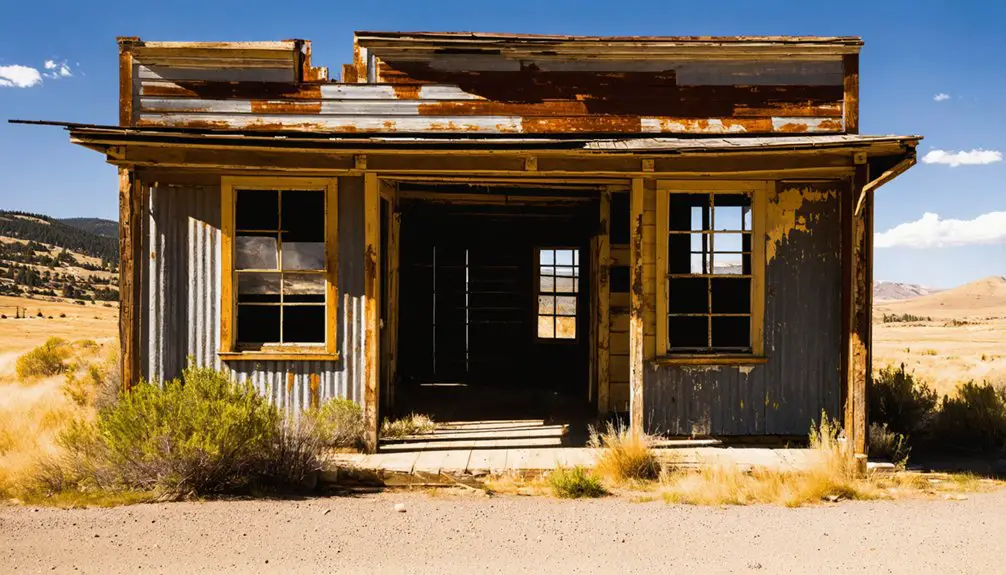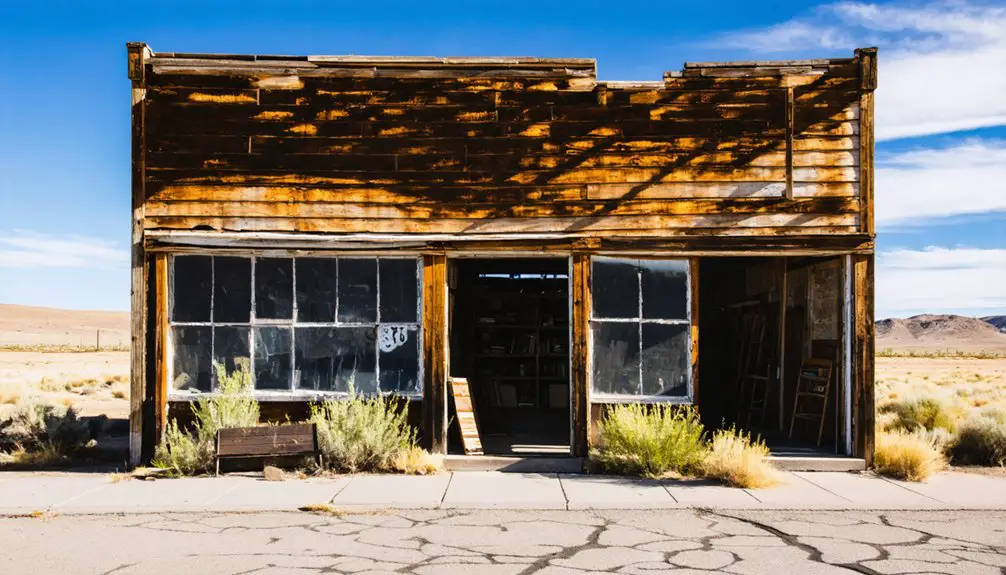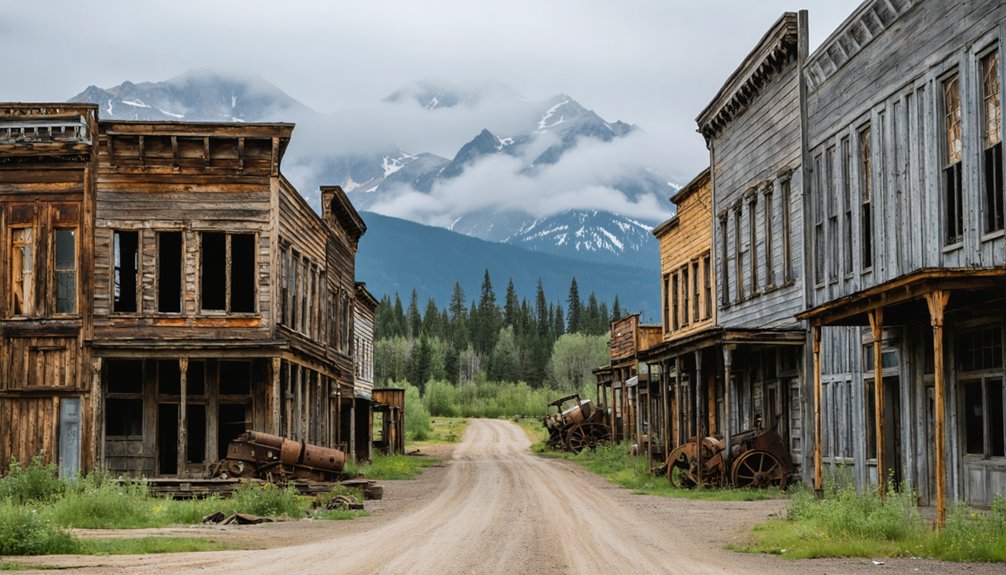
You’ll find Oregon’s most enthralling ghost towns scattered across high desert plateaus and mountain valleys, where crumbling wool warehouses and rusting gold dredges tell stories of boom-and-bust cycles. Shaniko’s preserved water tower stands sentinel over empty streets, while Sumpter’s massive mining equipment remains frozen mid-operation. Antelope survived both wildfire and cult takeover, and Golden’s saloon-free buildings showcase frontier temperance ideals. Each site requires careful planning—bring maps, extra fuel, and respect for these fragile historic landmarks that reward explorers with authentic glimpses into the region’s resilient past.
Key Takeaways
- Shaniko: Oregon’s wool capital with preserved 1900s architecture, including iconic water tower and recently reopened hotel; best visited April-September during festivals.
- Sumpter: Gold mining town featuring massive 2.5-million-pound dredge, historic railway, and underground tunnels from its 1900 heyday of 3,000 residents.
- Golden: Oregon’s only state-managed mining ghost town, unique as a temperance community with 1890s church and store amid hydraulic mining remnants.
- Antelope: Historic stage stop surviving 1898 fire and 1980s cult takeover; site of 1984 bioterror attack with preserved frontier storefronts.
- Buncom: 1851 Chinese mining settlement with restored 1910 post office and frontier buildings; accessible via forest road southwest of Medford.
Shaniko: The Wool Capital Frozen in Time
A weathered wool warehouse stands sentinel over windswept plains, its wooden bones still echoing with the bleating of long-gone sheep herds. You’ll find Shaniko 130 miles southeast of Portland, where boardwalks and false-front buildings transport you to Oregon’s 1900s wool boom.
Once shipping millions of pounds annually, this “Wool Capital of the World” thrived until railroads bypassed it in 1911. Families left and storefronts emptied as the desert reclaimed what had briefly seemed permanent.
Today, roughly 23 residents maintain this living relic. The 1900 Shaniko Hotel—with its 18-inch handmade brick walls—reopened in 2023 after preservation battles. A 10,000-gallon wooden water tower constructed in 1900 still stands as one of the town’s most distinctive landmarks.
Visit April through September when seasonal shops operate.
The ghost town architecture provides exceptional vintage travel photography opportunities, especially during August’s Shaniko Days festival.
You’re free to wander preserved sheep sheds and explore without tourist crowds suffocating your experience.
Sumpter: A Golden Legacy in the Elkhorn Mountains
While Shaniko’s wool wagons rolled across high desert plateaus, prospectors 250 miles southeast were carving fortunes from the Elkhorn Mountains’ granite veins.
While wooden wheels creaked westward with fleece, determined miners tunneled eastward through stone, seeking different riches in opposing horizons.
You’ll find Sumpter nestled where five South Carolinians first pitched camp in 1862, chasing California gold but striking pay dirt in these geological formations instead.
By 1900, this “Queen City” boasted 3,000 residents, seven hotels, and twelve miles of underground tunnels extracting $9 million in precious metal.
The 1917 fire that consumed twelve blocks couldn’t erase Sumpter’s spirit.
Today, you can explore the massive 2.5-million-pound dredge—a mechanical beast that once roared loud enough to hear forty miles away.
Three dredges operated along the Powder River until 1954, with the remains of Dredge #1 and Dredge #2 still marking the landscape where they churned through riverbed gravel.
Urban legends from the 2013 Ghost Mine series add mystique to your wanderings through remaining brick storefronts and surrounding mining camps.
The Sumpter Valley Railway reached town in 1896, transforming this remote mining camp into a thriving hub connected to the outside world.
Antelope: From Stage Stop to Modern Controversy
Where pronghorn antelope once grazed across valley grasslands, Howard Maupin established a dusty stage stop in 1872 that would witness one of America’s strangest municipal seizures a century later.
You’ll find Antelope’s architectural restoration efforts preserving structures that survived the 1898 fire and the 1980s Rajneesh takeover—when followers renamed the entire town and built a 7,000-person commune.
The cultural significance runs deeper than most ghost towns: this place experienced genuine bioterrorism in 1984, when cult leaders poisoned 750 people to manipulate local elections. The largest bioterror event in U.S. history targeted salad bars in The Dalles, making national headlines and drawing federal investigation.
Today’s thirty residents maintain their hard-won independence in weathered storefronts and original buildings. The town remained isolated for decades after a major highway rerouted in 1917, reducing traffic and business opportunities.
You’re exploring authentic small-town resilience here—a community that literally voted itself back into existence after outsiders tried erasing its identity.
Buncom: Southern Oregon’s Best-Preserved Mining Town
Gold glinted in Sterling Creek‘s waters long before 1851, when Chinese miners established what would become Buncom at the confluence with the Little Applegate River.
This early settlement evolved from mining camp to supply hub, serving the Little Applegate Valley’s ranchers and loggers until gold depletion forced abandonment by 1918.
You’ll find three restored structures along Sterling Creek Road—a 1910 post office, bunkhouse, and cookhouse showcasing remarkable historical architecture with original glass panes intact. The Buncom Historical Society’s preservation work lets you skip entrance fees while glimpsing authentic frontier life without barriers or entrance fees.
Drive twenty miles southwest of Medford to reach this accessible ghost town. The journey requires navigating a narrow, winding road through dense madrona forests and past scenic vineyards before arriving at the site. Though situated on private land, you’re welcome to park and explore these weathered buildings that refuse to surrender their stories to time’s relentless march. The settlement once included a General Store and Livery Stable that provided essential services to miners and the growing farming community.
Golden: The Saloon-Free Settlement on Coyote Creek
Unlike its raucous neighbors where whiskey flowed as freely as creek water, Golden emerged in the 1840s as a temperance settlement on Coyote Creek’s banks—a mining town without a single saloon.
You’ll discover four authentic structures from its 1890s peak, including the 1892 church and Bennett Store, now protected as Oregon’s only state-managed mining ghost town.
For urban exploration enthusiasts, Golden offers rare access to preserved 19th-century architecture where 150 residents once thrived. The founding families’ orchard contributes to ongoing plant preservation efforts alongside Golden Coyote Wetlands. Miners seeking entertainment had to travel to nearby Placer, known for its dancing and lively frontier scene that Golden’s Campbellite founders strictly prohibited.
You’ll notice Hollywood’s fingerprints here—Gunsmoke’s fictional cemetery markers still confuse visitors decades after filming wrapped.
Reach this National Register site to experience authentic mining heritage minus commercial crowds, where hydraulic operations once carved the landscape before silence reclaimed these hills. The peaceful woodlands setting makes Golden part of the Golden State Heritage Site, a protected historic district showcasing Oregon’s mining past.
Hardman: A Prairie Town Lost to Progress
High on a windswept plateau at 3,600 feet, Hardman sprawls across Morrow County’s southern edge where wheat fields ripple toward the Blue Mountains and modern wind turbines tower over sagebrush. You’ll discover pioneer legends in this settlement born from Raw Dog and Yellow Dog’s 1870s merger, where postmaster David N. Hardman shaped a once-thriving commercial hub.
Urban decay tells stories of prosperity lost—skating rinks, racetracks, and newspapers abandoned when rails bypassed the town for Heppner in the 1920s. Twenty residents now call home what was Oregon’s premier farming center.
Explore two dozen weathered structures, including a National Register lodge, scattered among agricultural lands. Unlabeled buildings invite investigation along rural roads where stagecoaches once stopped and commerce flourished before progress dealt its final blow.
Planning Your Oregon Ghost Town Road Trip
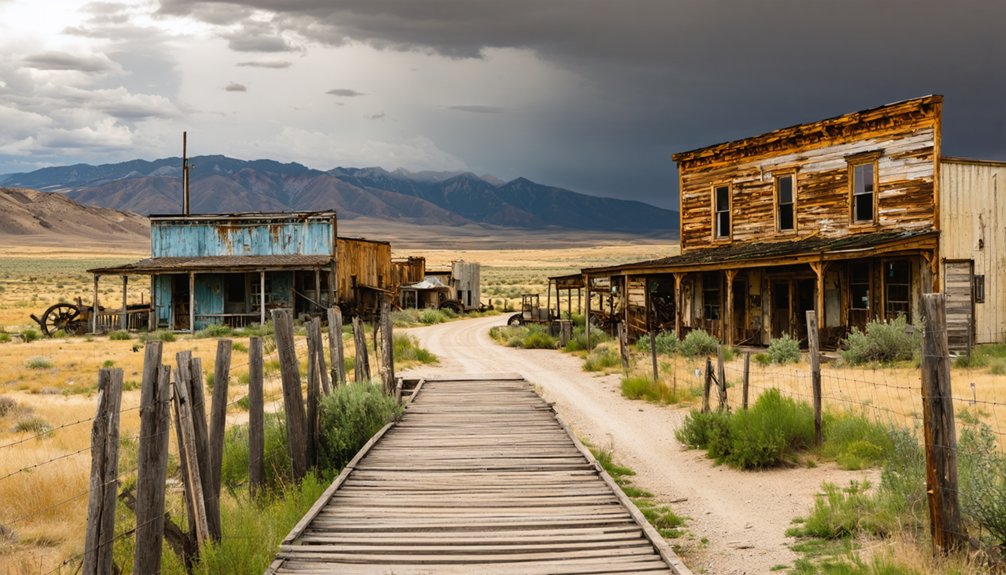
Where do you begin mapping an adventure through Oregon’s 256 documented ghost towns, scattered across high desert plateaus, mountain valleys, and forested creek beds? Start with regional loops: the Eastern Oregon circuit connects Shaniko, Lonerock, and Sumpter via Highway 207.
While doing so, Southern routes link Buncom to Golden’s four preserved structures across just 4.2 miles. Pack essentials like paper maps—cell service vanishes on backroads leading to Sterlingville Cemetery or Pine Grove. Carry extra fuel and snacks for remote stretches.
Consider travel insurance before traversing dirt roads through the Elkhorn Range or accessing wooded sites where nature’s reclaiming abandoned townsites. Check seasonal conditions, as some paths become impassable.
You’re chasing freedom through decayed storefronts and weathered headstones, where history whispers from every crumbling foundation.
Photography Tips for Capturing Historic Ruins
When sunlight slants through collapsed rooflines at Shaniko’s abandoned wool warehouse, you’ll need more than a smartphone to capture the interplay of decay and light that defines Oregon’s ghost towns. Pack a 24-70mm lens for versatile ruin shots and arrive during golden hour when soft light reveals weathered textures without harsh shadows.
Shoot RAW files at your camera’s lowest ISO, using bracketed exposures to preserve both shadow detail in dark doorways and sky information through broken windows. These layers of history demand patient composition—frame crumbling staircases through doorways, emphasize peeling paint patterns, and let natural light tell the story of urban decay.
Skip the flash; embrace long exposures with a tripod instead. Your images should feel abandoned, not artificially lit.
Preservation Efforts and Visiting Responsibly
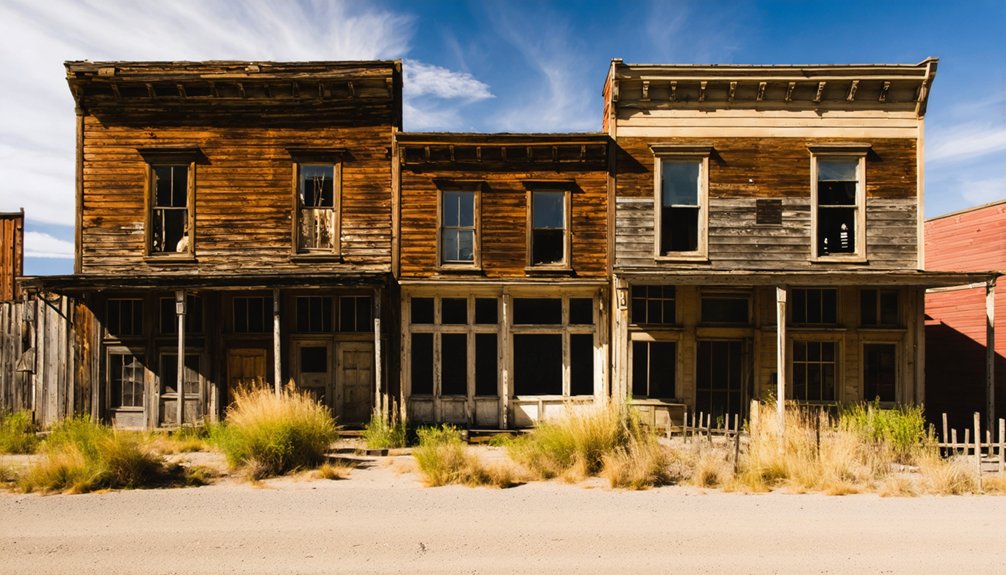
When you step onto these weathered grounds where timber workers once lived and gold seekers struck their claims, you’re walking through fragile time capsules that need your careful stewardship.
Organizations like the Maxville Heritage Interpretive Center are working to secure original town sites through million-dollar preservation campaigns.
Communities host annual festivals at places like Buncom to fund ongoing maintenance of decaying structures.
You can contribute by staying on designated trails, never removing artifacts, and donating to local heritage funds that protect these vanishing remnants of Oregon’s frontier past.
Respecting Historic Site Rules
Oregon’s ghost towns stand as fragile time capsules where weathered wood and rusted metal tell stories of boom-and-bust cycles. These historic sites face an ironic threat: the very curiosity that draws visitors to their crumbling doorways accelerates their destruction.
Ethical exploration means respecting boundaries—both legal and physical. You’ll find managed sites like Golden offering legitimate access through Oregon State Parks, while others remain on private land where trespassing isn’t just illegal; it’s disrespectful to owners and history alike.
Conservation strategies work when you follow simple principles: photograph everything, touch nothing, and leave artifacts exactly where you found them. Walk structures’ perimeters twice before entering, evaluating stability.
Wear protective gear that shields both you and fragile surfaces. Never share precise locations publicly—overcrowding transforms preservation into destruction.
Supporting Local Preservation Funds
- State matching grants like Oregon Heritage and CLG programs require local fundraising—your $5 donation helps release thousands in government funds for restoration work.
- Community-driven projects such as Maxville’s $2.5 million revival depend on visitor contributions that’ve already raised $240,000 privately.
- Heritage area designations around sites like Sumpter’s gold dredge generate admission revenue that directly funds building stabilization and archaeological work.
Every dollar you contribute becomes leverage for larger preservation grants, transforming your wanderlust into tangible historic conservation.
Frequently Asked Questions
Are Oregon Ghost Towns Safe to Visit With Children?
You’ll need careful hazard assessment before exploring—crumbling structures and unstable terrain create real dangers. Seek family-friendly activities at preserved sites with clear paths instead. Your children’s safety demands weighing adventure against collapsing buildings and remote locations lacking emergency services.
What Is the Best Season to Visit Oregon’s Ghost Towns?
You’ll find summer and fall offer ideal conditions—trails are passable, historical preservation sites shine brilliantly, and photography hotspots burst with golden light. You’re free to roam dusty streets, capture weathered buildings, and experience Oregon’s haunting past without winter’s restrictions.
Do Any Ghost Towns Require Entrance Fees or Permits?
You won’t need permits or entrance fees to explore Oregon’s abandoned structures. These historical preservation sites like Shaniko, Golden, and Canyon City offer free access, letting you roam weathered buildings and dusty streets without constraints or costs.
Are There Guided Tours Available for Oregon Ghost Towns?
Guided ghost town tours are scarce in Oregon’s remote areas. You’ll find Pendleton Underground Tours showcasing historic preservation through 90-minute experiences. Most abandoned sites require self-exploration, offering freedom to discover community involvement stories independently across desolate backroads.
Can You Camp Overnight Near These Ghost Town Locations?
You’ll find overnight camping near most Oregon ghost towns on surrounding public lands, though you should check local camping regulations first. Wildlife encounters are common in these remote areas, so you’re free to explore responsibly while staying nearby.
From abandoned remnants of the past to hauntingly beautiful landscapes, exploring ghost towns in Oregon offers a unique glimpse into history. Many towns feature interpretive signs that tell stories of their former inhabitants, while others may have old buildings still standing. As you wander through the winding paths, keep an eye out for unique flora and fauna that have made these areas their home.
The ghost towns of Oregon history reveal a fascinating narrative of resilience and decline, with each site telling its own story. As you navigate these remnants, you may even stumble upon local artisans and historians who are eager to share insights about their cherished heritage. This blend of history and artistry enhances the experience, making each visit not just a trip into the past, but a celebration of the community’s enduring spirit.
References
- https://www.nationaldaycalendar.com/lists/12-oregon-ghost-towns
- https://en.wikipedia.org/wiki/List_of_ghost_towns_in_Oregon
- https://www.visitoregon.com/oregon-ghost-towns/
- https://thatoregonlife.com/2016/04/road-trip-ghost-towns-eastern-oregon/
- http://www.photographoregon.com/ghost-towns.html
- https://www.travelmedford.org/southern-oregon-ghost-towns-
- https://www.pdxmonthly.com/travel-and-outdoors/2025/10/oregon-ghost-towns-history
- https://traveloregon.com/things-to-do/culture-history/ghost-towns/
- https://thejournaloflosttime.com/stories/shaniko-oregon-high-desert-empire
- https://www.legendsofamerica.com/or-shaniko/