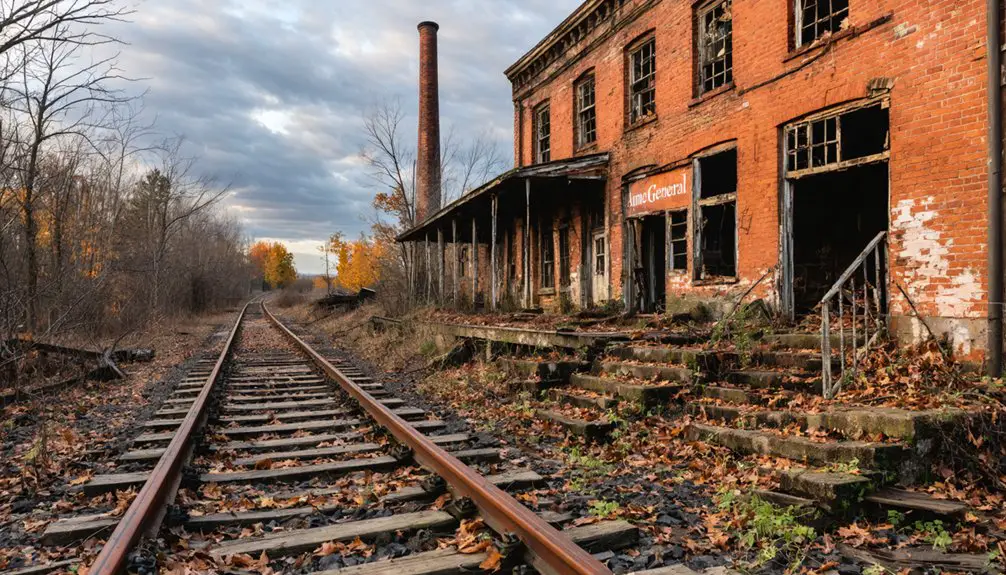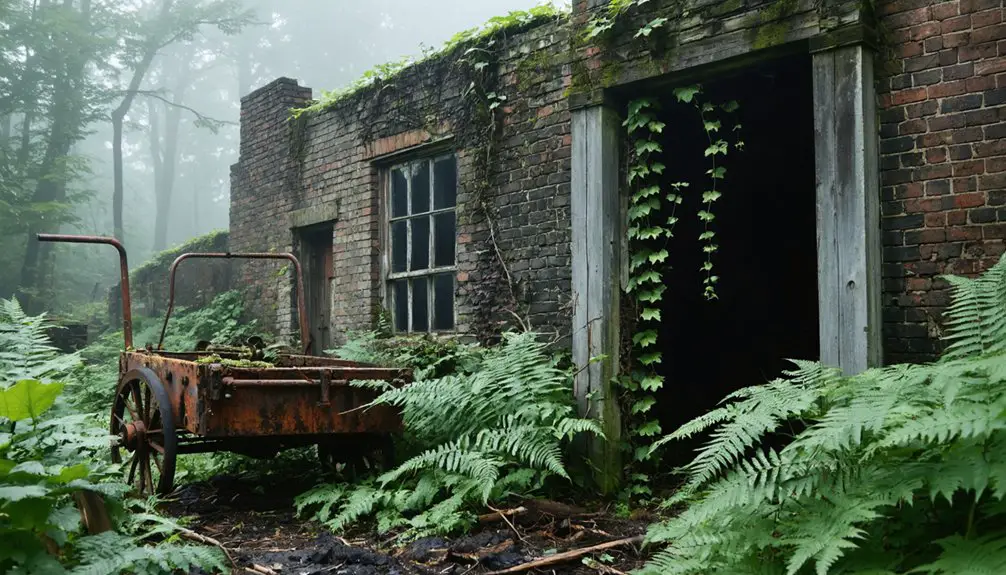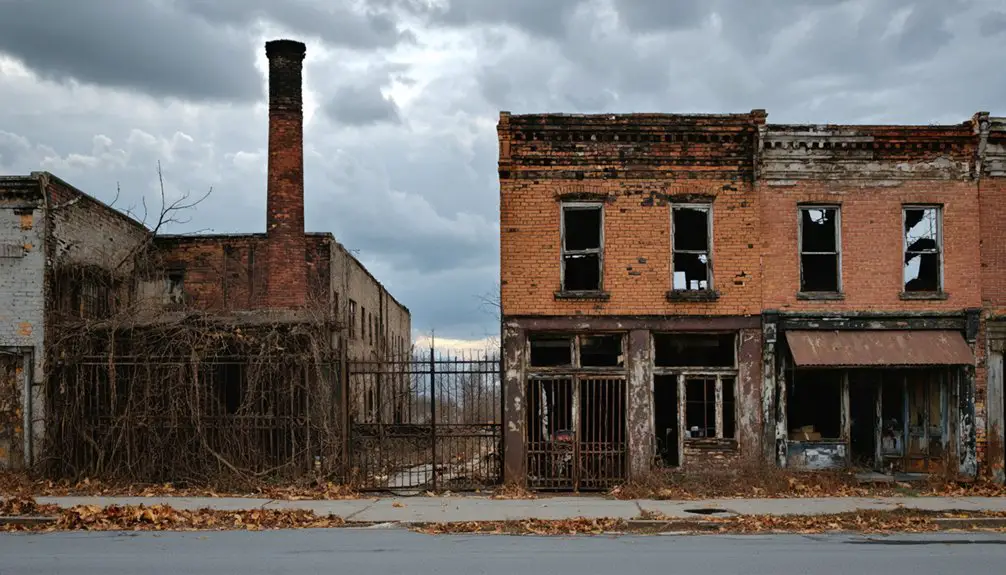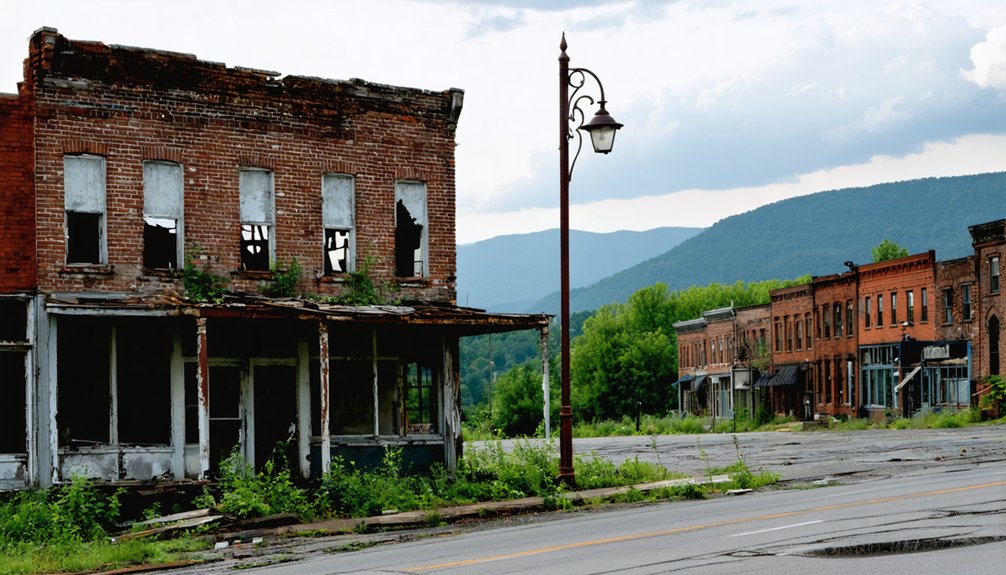
You can explore several fascinating ghost towns across Pennsylvania, each telling a unique story of America’s industrial past. Centralia stands out with its underground coal fire that’s burned since 1962, while Petroleum Center marks the birthplace of the oil industry. Rausch Gap offers hiking trails through abandoned mining ruins, and Yellow Dog Village provides guided tours of preserved worker houses. Frick’s Lock showcases historic canal infrastructure, and Eckley Miners’ Village operates as a living museum where you’ll discover the deeper histories behind these haunting locations.
Key Takeaways
- Centralia features smoking fissures and buckled pavement from an underground fire burning since 1962, with only seven residents remaining.
- Yellow Dog Village offers guided tours, overnight stays, and community activities at 28 preserved worker houses north of Pittsburgh.
- Rausch Gap provides backpacking, camping, and scenic trails with stone foundations and railway ruins in St. Anthony’s Wilderness.
- Eckley Miners’ Village showcases preserved 1850s coal mining cottages and plans to rebuild its iconic breaker by 2025.
- Frick’s Lock displays historic canal locks and remaining structures from Pennsylvania’s 1820s canal-building era along the Schuylkill River.
Centralia: Pennsylvania’s Most Famous Ghost Town With an Underground Fire
Beneath the cracked streets of Centralia, an inferno has burned for more than six decades, transforming a once-thriving mining community into Pennsylvania’s most haunting ghost town.
What started as routine trash burning in 1962 ignited an underground fire in abandoned coal mines that’s predicted to rage for another century.
You’ll find smoking fissures emerging from the earth, buckled pavement, and striking urban decay where 1,435 residents once lived.
The government relocated most inhabitants after carbon monoxide levels became life-threatening, leaving only seven determined residents who won the right to stay until death.
By 2013, remaining residents settled lawsuits and received permanent occupancy rights, though they cannot transfer or sell their properties.
Congress recognized the impracticality of extinguishing the fire and allocated over $42 million in 1983 to address the disaster and its consequences.
Today, you can explore empty streets, visit St. Mary’s Church for weekly services, and witness nature reclaiming what the underground fire destroyed—a *testimony* to humanity’s battles with uncontrollable forces.
Petroleum Center: Birthplace of America’s Commercial Oil Industry
While Centralia’s underground fire captured the public imagination, Pennsylvania’s Oil Creek Valley harbors ghost towns that literally fueled America’s rise to industrial dominance. When Edwin Drake struck oil at Titusville in 1859, he set off an unprecedented rush that transformed wilderness into roaring boomtowns history within months.
Petroleum Center exemplifies this explosive growth. Post-Civil War veterans flooded the valley with investment capital, and by 1865, crude output skyrocketed from 2,000 to over 7,000 barrels daily.
Within months, crude production surged over 250 percent as Civil War fortunes poured into Pennsylvania’s oil fields, creating instant wealth and chaos.
The Oil industry’s pioneers invented technologies still used today—drive pipes, pipelines, and even early hydraulic fracturing with nitroglycerin torpedoes. Samuel Van Syckel’s revolutionary 1865 pipeline connected oil wells to railroads, transporting 80 barrels per hour and transforming how the industry moved its product.
You’ll find little remaining of these once-thriving settlements. Overproduction crashed prices, and boom turned to bust before Standard Oil organized the chaos. Drake himself died poor in 1880, never profiting from the discovery that launched an empire, though the Seneca Oil Company had severed ties with him two decades earlier.
Yet Pennsylvania’s fields birthed the modern petroleum industry that powered your freedom to roam.
Rausch Gap: Abandoned Coal Mining Village Along the Appalachian Trail
You’ll discover Rausch Gap’s haunting remains nestled in northern Lebanon County, where a once-thriving coal mining village of 1,000 residents has been reclaimed by the St. Anthony’s Wilderness.
The settlement’s crumbling foundations and dug-out basements line the Stony Valley Rail-Trail, offering a tangible connection to Pennsylvania’s 19th-century industrial past.
The town’s decline accelerated after railroad headquarters moved elsewhere in 1872, leaving behind the industrial infrastructure that had sustained the community.
Among the visible remnants, you’ll find an old stone bridge crossing the trail alongside scattered railway ruins and a historic well.
Beyond the scattered ruins, you can pay respects at the isolated cemetery—the only maintained feature of this ghost town that flourished from 1828 to 1910.
Historic Mining Community Foundations
Deep in the wilderness of Stony Valley, stone foundations and crumbling basements mark where nearly 1,000 coal miners and their families once called home. You’ll discover these mining remnants scattered along the Stony Valley Rail-Trail, approximately 3.5 miles from Gold Mine Road.
The site reveals two dozen house foundations, abandoned wells, and dug-out cellars where workers lived during the anthracite boom of the mid-1800s. The community’s decline accelerated after 1872 when railroad headquarters relocated to Pine Grove, leading to complete abandonment by 1900 as coal quality diminished.
Concrete markers along the trail once held spare railroad track pieces, testament to the area’s railroad history when it served as headquarters for the Schuylkill and Susquehanna Railroad. Near the settlement, you’ll find remnants of an old stone arch bridge that once served as a critical crossing point over Rausch Creek.
Though rocky terrain has reclaimed much of the settlement, you can still trace the layout of this once-thriving community before reaching the bridge over Rausch Creek, where civilization retreated into forest.
Appalachian Trail Access Points
Along the Appalachian Trail’s route through St. Anthony’s Wilderness, you’ll discover Rausch Gap’s shelter offering overnight camping freedom. This backcountry access point provides essential amenities while you explore the abandoned mining village ruins.
Trail Features for Visitors:
- Cold Spring Water Source – Reliable hydration spot year-round
- Outhouse Facilities – Basic comfort for extended stays
- Stony Valley Rail-Trail Connection – Easy approach from Lebanon County
- Blue-Blazed Mining Loop – Direct access to coal debris sites
Trail safety requires awareness of old mining pits and unstable foundations scattered throughout the area.
You’ll navigate through State Game Lands 211‘s pine plantations, where local flora now reclaims industrial scars.
The railroad grades provide relatively level hiking, making loop trips feasible for adventurous explorers seeking Pennsylvania’s forgotten wilderness history.
St. Anthony’s Wilderness Cemetery
Hidden among the overgrown wilderness of this abandoned mining town, St. Anthony’s Wilderness Cemetery stands as the only “white cemetery” in Stony Valley.
You’ll find just three inscribed headstones and a dozen field stones marking what locals believe are over 100 burials from Rausch Gap’s coal mining era.
The cemetery’s located about a third of a mile down a small path before the bridge along the Stony Valley Rail Trail.
Despite minimal innovative preservation efforts, these weathered markers tell stories of miners and railroad workers who built a thousand-person community by 1860.
Local legends suggest a separate “black cemetery” existed nearby, and some believe victims from the nearby Yellow Springs tragedy rest here.
The trail follows the route of the Dauphin & Susquehanna Railroad, a 54-mile line built in 1854 to transport coal from Stony Valley before financial struggles led to its reorganization.
You’ll discover history that nature’s slowly reclaiming.
Yellow Dog Village: One of America’s Best-Preserved Ghost Towns
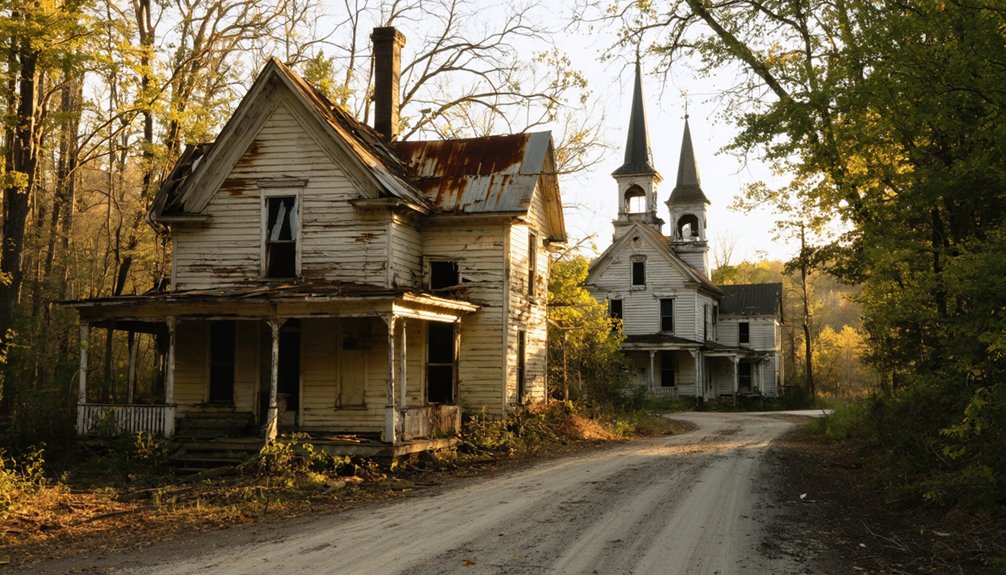
Nestled in the hills north of Pittsburgh, Yellow Dog Village stands as one of America’s most remarkably preserved ghost towns. Its weathered structures offer an unfiltered glimpse into early 20th-century coal company life.
Built in 1912 for limestone workers, this settlement earned its notorious name from “yellow dog contracts” that barred unionization.
After decades of decline and a 2012 E. coli outbreak forced evacuation, the village became a haunting time capsule. Within the abandoned homes, visitors can still find vintage furniture and memorabilia including old photographs, handwritten letters, and personal belongings left behind by former residents.
Today’s historic preservation efforts enable exploration through:
- Paid guided tours revealing authentic company town architecture
- Open house events throughout restored worker cottages
- Overnight stays in renovated 1920s-era homes
- Hands-on community revitalization experiences
You’ll discover 28 original worker houses plus the hilltop manager’s residence, stripped by vandals yet remarkably intact—a rare opportunity to walk through unvarnished American labor history.
Frick’s Lock: An 18th-Century Village Lost to Nuclear Development
You’ll find Frick’s Lock nestled along the Schuylkill Canal in Chester County, where pre-Revolutionary War buildings stand frozen in time since the 1980s.
This 18th-century village met an unusual fate when Philadelphia Electric Company purchased the land for the Limerick Nuclear Power Station.
This forced residents out within 48 hours and transformed a thriving community into a ghost town virtually overnight.
Today, the power plant’s cooling towers loom over ten vacant structures that remain as eerie reminders of the families who once called this place home.
Historical Significance and Origins
Along the banks of the Schuylkill River in Chester County, Frick’s Lock stands as a tribute to America’s canal-building era and the communities that rose and fell with it. You’ll discover a village whose cultural storytelling begins with Revolutionary War-era buildings on farmland that transformed into a bustling canal hub.
The Schuylkill Navigation System‘s construction in the 1820s created this settlement, featuring:
- Locks #54 and #55 – Part of 118 locks controlling river navigation
- Canal commerce – Coal shipments exploding from 10,000 to over 1,000,000 tons annually by the 1850s
- Worker housing – Residential properties supporting canal operations
- National recognition – Listed as historic district in 2003
Despite preservation challenges from decades of abandonment, this 18-acre ghost town offers you an authentic glimpse into Pennsylvania’s industrial heritage.
the history of french azilum ghost town reveals intriguing stories about its early settlers and their endeavors during the 19th century. As you explore the remnants of this once-thriving community, you’ll uncover the unique cultural influences that shaped its development. Each structure and artifact tells a part of the narrative, inviting visitors to connect with the past in a profound way.
Abandonment Due to Development
While Frick’s Lock weathered the decline of canal transportation in the late 1800s, it couldn’t survive the atomic age. In the 1960s, Philadelphia Electric Company seized this 18-acre village through eminent domain to construct the Limerick Nuclear Power Plant directly across the Schuylkill River.
Residents who’d persisted through economic hardship were forced from their homes—some left voluntarily, others under coercion. The village fell within the facility’s 2,500-foot Exclusion Area Boundary, sealing its fate.
What followed exemplifies industrial decline’s harshest consequences: urban decay consumed the remaining structures as vandals shattered windows, thieves stripped copper and antiques, and graffiti covered centuries-old stone walls.
Today, roughly ten gutted buildings stand as monuments to progress’s devastating cost on independent communities.
Visiting Today’s Restricted Site
Despite its National Register listing in 2003, Frick’s Lock remains inaccessible to casual visitors as private property within the nuclear facility’s exclusion zone. The forbidden access hasn’t deterred urban explorers from documenting these hidden ruins, though you’ll face unpredictable restrictions and potential legal consequences.
If you’re considering exploration, understand what awaits:
- 18th-century stone structures deteriorating amid overgrown fields
- Nuclear cooling towers looming as surreal backdrop across the Schuylkill River
- Original canal locks from the 1820s slowly succumbing to nature
- No official tours or facilities available for safe, legal visits
Paul S. Frick’s preservation efforts in the late 1990s documented this village before further decay.
While the site’s eerie atmosphere attracts history enthusiasts, respect property boundaries and explore Pennsylvania’s more accessible ghost towns instead.
Eckley Miners’ Village: A Hollywood-Saved Coal Town Open to Visitors
The quiet village of Eckley stands frozen in time, its dirt streets and weathered miners’ cottages preserved much as they appeared in the 1850s. When Hollywood came calling in 1970 to film “The Molly Maguires” starring Sean Connery, the authentic coal patch town became its own best set. That film influence sparked historic preservation efforts that continue today, with plans to rebuild the iconic breaker by 2025.
You’ll wander past slate pickers’ houses with thin board-and-batten walls, double-family homes showing miners’ modest aspirations, and the band practice house where workers found respite.
The Pennsylvania Historical and Museum Commission operates this living museum at 2 Eckley Main Street, where interpretive markers reveal working-class anthracite life. It’s coal mining history you can touch and experience firsthand.
Frequently Asked Questions
Are Pennsylvania Ghost Towns Safe to Visit Alone or at Night?
You’d think abandoned towns would be *safer* at night with fewer people, but safety concerns—sinkholes, unstable ground, toxic fumes, and questionable characters—make daytime the best visiting time. Don’t risk your freedom exploring alone after dark.
Do I Need Permits to Explore Abandoned Ghost Towns in Pennsylvania?
You’ll need permits from Pennsylvania’s Historical and Museum Commission for artifact hunting on public lands due to legal restrictions and preservation efforts. However, casual exploration typically doesn’t require permits—just respect boundaries and avoid removing historical items.
What Should I Bring When Visiting Remote Pennsylvania Ghost Towns?
Bring sturdy boots, layered clothing, GPS with offline maps, first aid supplies, and plenty of water. Pack a quality camera for photography tips capturing historical preservation details. Don’t forget bear spray, bug repellent, and your adventurous spirit for remote exploration.
Can I Take Artifacts or Souvenirs From Pennsylvania Ghost Towns?
“Take only pictures, leave only footprints” applies here. You can’t legally remove artifacts from Pennsylvania ghost towns on public land. Historical preservation laws prohibit artifact removal without permission, protecting our shared heritage while respecting property rights on private land.
Which Pennsylvania Ghost Towns Allow Camping or Overnight Stays Nearby?
You’ll find rural camping at Oil Creek State Park near Petroleum Centre’s hidden history, Yellow Dog Village’s on-site grounds, and Ghost Town Trail’s dispersed forest sites. Pine Grove Furnace also offers nearby camping among abandoned ruins worth exploring overnight.
References
- https://en.wikipedia.org/wiki/List_of_ghost_towns_in_Pennsylvania
- https://kids.kiddle.co/List_of_ghost_towns_in_Pennsylvania
- https://www.atlasobscura.com/things-to-do/pennsylvania/ghost-towns
- https://uncoveringpa.com/ghost-towns-in-pa
- https://www.youtube.com/watch?v=yxFuqGq-FJ8
- https://pabucketlist.com/pa-abandoned-places/
- http://freepages.rootsweb.com/~gtusa/history/usa/pa.htm
- https://www.youtube.com/watch?v=0jxNCcpVW2o
- https://www.legendsofamerica.com/centralia-pennsylvania/
- https://pabucketlist.com/the-rise-and-fall-of-centralia-pas-toxic-ghost-town/