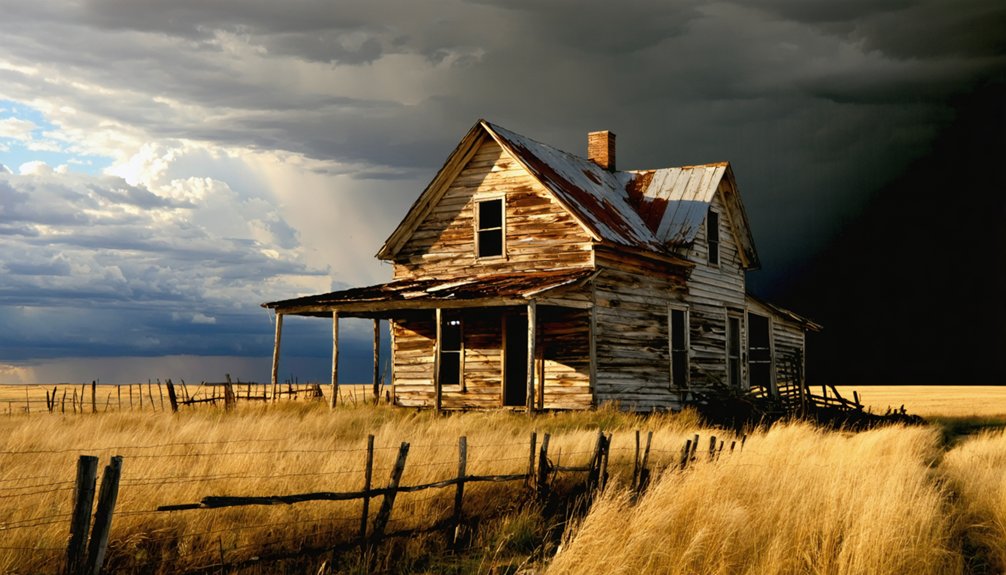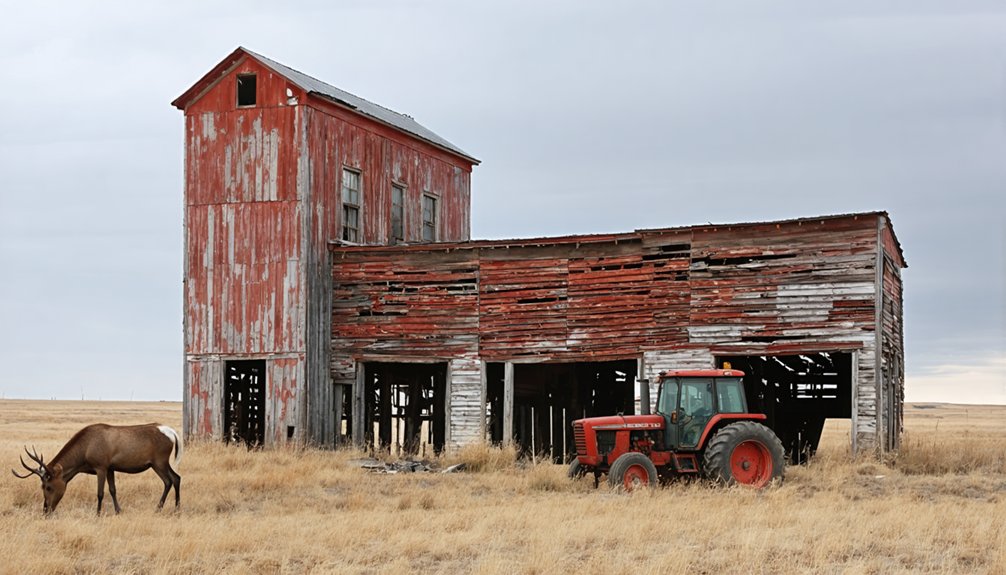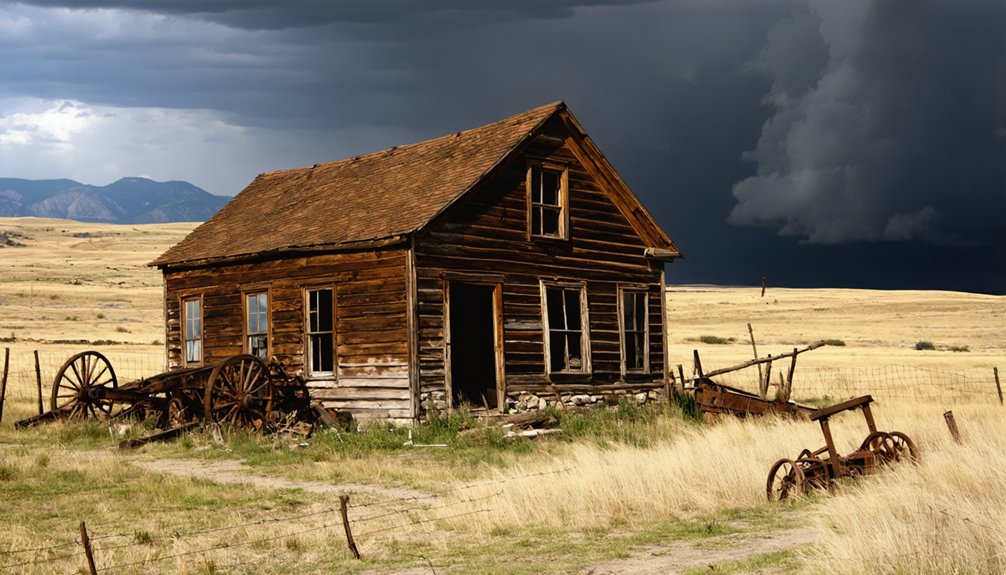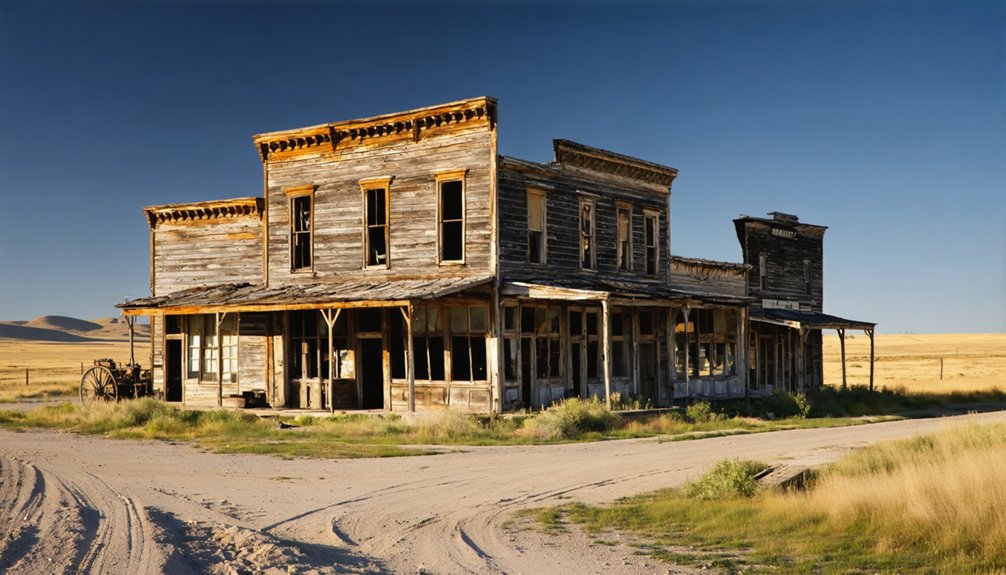
You’ll find South Dakota’s most atmospheric ghost towns scattered across windswept prairies and gold rush country. Ardmore sits just north of the Nebraska border with 15-25 abandoned houses and a rusted water tower, while Okaton off I-90 features a collapsed grain elevator and defunct gas pumps. Near the Black Hills, Scenic’s crumbling saloon and street-facing jail cells tell frontier stories, and remote Capa requires traversing rugged dirt roads to reach its weathered cemetery and collapsed Catholic church—each site revealing deeper layers of mining heritage and railroad dreams.
Key Takeaways
- Ardmore features 15-25 abandoned houses, a weathered fire station, and rusted water tower located 1 mile north of the Nebraska border.
- Okaton offers collapsed structures, old grain elevator, and defunct gas pumps; revitalized as tourist stop with population of 23.
- Scenic Ghost Town displays crumbling buildings including Longhorn Saloon and unique church-jail with 15-25 dilapidated structures near Black Hills.
- Black Hills contains over 600 ghost towns from 1874 gold rush with mine tailings, old cabins, and historic mining remnants.
- Capa requires rugged access but rewards visitors with 14 weathered buildings, abandoned houses with furniture, and historic gravesites.
Ardmore Ghost Town
Nestled just one mile north of the South Dakota-Nebraska border along Highway 71, Ardmore stands as a haunting reminder of frontier ambition gone dry. You’ll find 15-25 abandoned houses lining Main Street, alongside a weathered fire station where former residents gather biennially to share ghost stories.
Founded in 1889, this railroad town thrived until drought and acidic Hat Creek water forced its decline. President Coolidge even picnicked here in 1927.
Today, you can explore the boarded general store, rusted water tower, and that distinctive white experimental farm barn visible from mountain trails near Hot Springs.
The town originally served as a stopping point for steam trains to refill water from the local creek before the transition away from steam power made such stops unnecessary.
By 1980, the population had dwindled to 16 residents, marking the final chapter of a community that once depended entirely on railroad traffic. Respect the no-trespassing signs, but you’re free to wander the eerie streets where many report feeling watched. It’s authentic Western decay, surprisingly graffiti-free.
Okaton Ghost Town
Born from the Milwaukee Railroad’s westward push in 1906, Okaton sprang up almost overnight to house construction crews and optimistic homesteaders claiming land near present-day Murdo.
You’ll find urban decay everywhere—collapsed houses, tumbling shacks, and rusting farm equipment scattered across the windswept prairie.
The grain elevator still bears its “Bingo Grain Co.” paint job from an unreleased film.
Robert and Evelyn Westlake transformed the site into a 1980s tourist stop with a rock shop, petting zoo, and general store.
Though closed now, these structures remain standing alongside the defunct gas pumps.
The old Okaton School stands as one of the town’s most prominent remaining structures.
With only 23 residents in 2023, preservation challenges mount daily.
Respect private property boundaries when exploring.
The post office closed in 2013, but this slowly vanishing town still clings to existence off Interstate 90.
The town’s decline accelerated when railroad operations ceased in the 1980s, dealing a final blow to the local economy.
Scenic Ghost Town
You’ll find Scenic Ghost Town at 17 Main Street, perfectly positioned for a quick detour when you’re exploring the Badlands.
The town’s been abandoned for over a century, and its crumbling buildings—including the iconic Longhorn Saloon and a peculiar church-jail combo with cells facing the street—offer an authentic glimpse into South Dakota’s frontier past.
History buffs particularly appreciate getting close to these weathered structures and artifacts, making it worth the short drive from the Black Hills region.
The site is currently owned by a Philippines-based church, which maintains this scenic destination for visitors to explore. Despite previous attempts to transform it into a living museum, the ambitious preservation efforts ultimately collapsed, leaving the town in its current state of authentic decay.
Historical Black Hills Setting
The Black Hills’ pine-covered ridges and winding canyons conceal over 600 ghost towns, most born from the frenzied gold rush that followed the 1874 discovery.
You’ll find military sites like Camp Crook scattered throughout, established to expel illegal miners violating Sioux treaties.
Mining history runs deep here—from Bear Rock’s cave post office to Homestake Mine‘s 125-year operation.
These abandoned settlements offer unmatched exploration:
- Stage route ruts carved through center Hills in 1878, still visible and marked by weathered snow posts
- Eroded mine tailings creating dramatic badlands at Hornblend and Blue Lead
- Pactola’s lone cabin rising from 150 feet of lake water, surrounded by towering pines
- Massive grindstone remnants at Buena Vista, too heavy to remove, now nature’s sculptures
Each site tells stories of ambition, failure, and frontier resilience.
The landscape reveals industrial remnants where cyanide vats still stand in valleys, marking the chemical processes once used to extract precious metals from ore.
Walking through these locations provides a glimpse into past life and history, simulating a journey back to the Wild West era.
Abandoned Structures and Remains
Among South Dakota’s most accessible ghost towns, Scenic stands frozen in agricultural decline—a maze of weathered storefronts and collapsing homes scattered across windswept prairie. You’ll find 15 to 25 abandoned buildings here, though they’re on private property, so respect boundaries while exploring the urban decay from roadways.
As you venture further into the state, you can discover additional ghost towns in South Dakota that tell stories of the past, frozen in time like Scenic. Other notable sites include the remnants of Tuthill and Edgemont, where rusted railroad tracks and dilapidated houses evoke memories of bustling pioneer life. Each location offers a haunting glimpse into an era long gone, inviting the curious to explore the whispers of history.
Founded in 1889, this agricultural community survived the Great Depression without welfare, only to dwindle to 16 residents by 1980 before earning ghost town status in 2004.
Rusted cars punctuate the landscape like metallic tombstones. Preservation challenges are evident everywhere—roofs sag dangerously, walls lean at precarious angles. Like nearby Okaton and Cottonwood, both established in 1906, Scenic reflects the boom-and-bust cycle of railroad-dependent prairie settlements.
The town is currently owned by a church in the Philippines, adding an unusual international dimension to this abandoned American settlement. Former residents still gather periodically at the old fire station, keeping memories alive even as structures crumble. It’s raw, unrestricted history you won’t find sanitized behind museum glass.
Maitland Ghost Town
Originally known as Garden City when prospectors established it in 1877, Maitland emerged during the frenzied Black Hills Gold Rush as one of the Deadwood-Two Bit district’s earliest settlements.
The town’s mining history transformed when Alexander Maitland acquired the Penobscot Mine in 1902, installing a 40-ton stamp mill that processed $30-per-ton ore. You’ll discover remnants of this boom period scattered across the landscape:
- Crumbling shaft houses standing sentinel over gaping mine entrances
- Rusted ore bins clinging to hillsides above waste rock piles
- Foundation stones marking where 50 homes once sheltered families
- Weathered mining equipment frozen in time since the 1950s
The stamp mill’s 1950 fire ended any town restoration hopes. Today, you’re free to explore this authentic northern Black Hills site where nature reclaims what prospectors built.
Capa Ghost Town
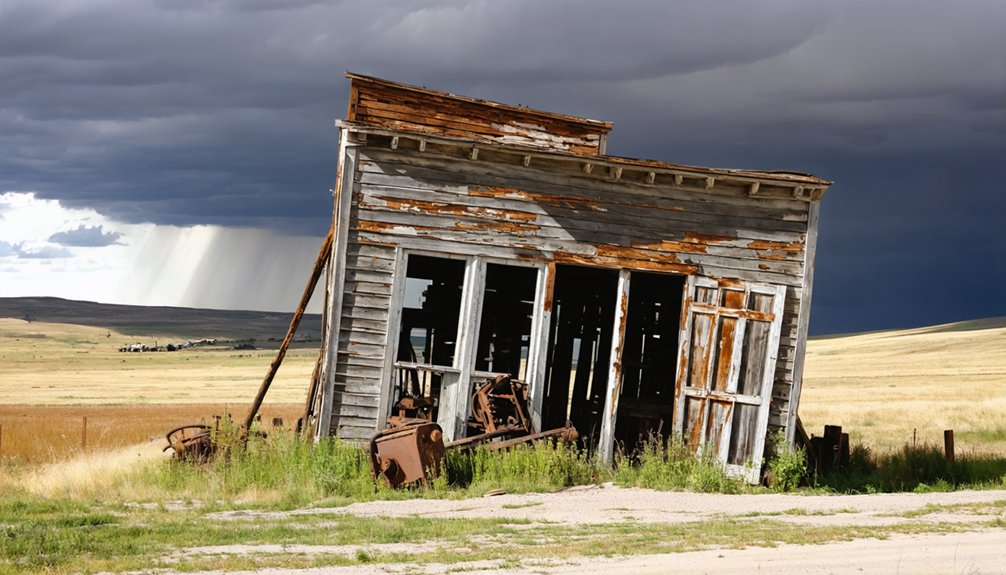
You’ll need a sturdy vehicle—think SUV or truck—to navigate the 9-mile dirt and gravel road from Midland that leads to Capa’s remote prairie setting in Jones County.
Once you arrive, fourteen weathered buildings dot the landscape, including abandoned houses with furniture still inside and three outhouses standing sentinel among roaming bison.
The collapsed Catholic church now sits as a rubble pile, while an old truck rusts near a cemetery where weathered stones mark graves like Edward Thorn’s from 1921.
Prairie Location and Access
Deep in the heart of South Dakota’s windswept prairie, Capa sits at coordinates 44°06′32″N 100°58′42″W in Jones County’s unincorporated territory. You’ll find this ghost town nine miles east of Midland, where prairie solitude reigns supreme.
Reaching Capa demands proper preparation. You’ll need a high-clearance vehicle—SUV, Jeep, or truck—for the rough gravel roads ahead:
- Navigate 12-15 miles of roller-coaster gravel through undulating hills
- Watch for bison roaming the wind-blown countryside
- Expect zero cell coverage in this middle-of-nowhere location
- Park near the gate, then walk a mile to the cemetery
Before exploring, respect private property boundaries and ask permission when necessary. Your vehicle must be reliable—breaking down here means serious trouble.
Remote access to Capa rewards those seeking genuine frontier isolation.
Remaining Structures and Features
After steering through those rugged prairie roads, you’ll encounter what remains of Capa’s physical legacy—fourteen weathered structures scattered across the windswept landscape. The abandoned Catholic church stands as the town’s centerpiece, though its arched windows now frame empty sky and stamped tin ceiling lies exposed to the elements.
Interior decays tell silent stories—tattered furnishings, old shoes, and personal belongings rot where residents left them.
You’ll find three outhouses still standing, including one two-holer design, their holes collapsing into earth. The hotel, barn, school, and various houses complete the scene, alongside an abandoned truck and barbed wire tangles.
Building preservation isn’t happening here; nature’s reclaiming everything. Gravestones tip sideways in forgotten plots, marking settlers like Edward Thorn from 1921.
Argonne Ghost Town
Once known as Saint Marys after Dr. Louis Gotthelf’s daughter, this settlement transformed into Argonne in 1920, honoring WWI heroes.
You’ll find the site 4.3 miles west and 0.4 miles north of Highway 25 North’s intersection with 229th Street, where population decline from 100 residents to complete abandonment tells a stark tale.
What remains to spark your imagination:
- Bank vault remnants standing as silent sentinels
- Empty prairie where $100,000 consolidated school once stood
- Abandoned railroad grade cutting through grassland
- Scattered foundation stones marking vanished businesses
The 1933 school fire accelerated this community’s fade. By the 1970s, the last resident departed.
Historic preservation efforts began in 2022 with plans for commemorative markers, ensuring adventurers like you can still connect with this forgotten chapter.
Frequently Asked Questions
Are South Dakota Ghost Towns Safe to Explore Without a Guide?
You’re playing Russian roulette exploring solo. While haunted legends draw adventurers, rotting structures, hidden wells, and crime risks demand caution. Check preservation efforts for site conditions, verify legal access, pack emergency supplies, and you’ll navigate these freedom-filled ruins more safely.
What’s the Best Time of Year to Visit Ghost Towns?
Visit during fall for ideal exploration conditions. You’ll discover historical preservation efforts amid stunning foliage, experience cultural significance without summer crowds, and enjoy comfortable temperatures that let you freely wander these atmospheric ruins at your own pace.
Can You Camp Overnight at South Dakota Ghost Towns?
You can’t just roll up with your covered wagon anymore. Camping regulations restrict overnight stays at ghost town sites themselves, but preservation efforts maintain nearby Black Hills National Forest dispersed camping spots where you’ll find freedom within 300 feet of roads.
Exploring the history and charm of ghost town attractions in South Dakota can make for an unforgettable adventure. From the remnants of mining operations to rustic buildings, each site tells a unique story of the area’s past. After a day of exploration, you can relax at one of the campgrounds tucked away in the Black Hills, offering a perfect blend of nature and history.
Throughout the year, various annual events in South Dakota showcase the state’s rich cultural heritage and community spirit. From the lively Sturgis Motorcycle Rally to local county fairs, there’s always something happening that draws both residents and visitors alike. Engaging in these festivities provides an excellent opportunity to connect with locals and experience the vibrant traditions of the region.
Do You Need Special Permits to Photograph Ghost Town Structures?
You’ll need photography permits for commercial work on state/federal lands, but not for personal shots. Private ghost towns require landowner permission—there’s no blanket access. Historic preservation concerns mean respecting boundaries while capturing your adventure.
Are There Any Ghost Town Tours Available in South Dakota?
You’ll find several ghost town tours across South Dakota, from Deadwood’s $26 walking experiences to free self-guided treks through Mystic and Okaton. These tourist attractions blend historical preservation with Old West legends, letting you explore at your own pace.
Among the intriguing options, the ghost towns of South Dakota offer a unique glimpse into the past, showcasing abandoned buildings and forgotten stories. Each site tells its own tale of the pioneers who once thrived there, giving visitors a sense of the hardships and triumphs that defined frontier life. As you wander through these desolate landscapes, the haunting beauty of the prairies serves as a reminder of America’s rich and complex history.
References
- https://en.wikipedia.org/wiki/List_of_ghost_towns_in_South_Dakota
- https://www.atlasobscura.com/things-to-do/south-dakota/ghost-towns
- https://www.youtube.com/watch?v=_0WNYsFLSLA
- https://kxrb.com/the-creepiest-ghost-towns-in-all-of-south-dakota/
- https://blackhillsatvdestinations.com/ghost-towns/
- https://www.blackhillshikingbikingandmore.com/old-mining-ghost-towns
- https://www.sdpb.org/rural-life-and-history/2023-08-21/some-black-hills-ghost-towns-and-their-origins
- https://www.tripadvisor.com/Attractions-g28962-Activities-c47-t14-South_Dakota.html
- https://www.travelsouthdakota.com/trip-ideas/abandoned-beauty-ghost-towns-structures-south-dakota
- https://www.atlasobscura.com/places/ardmore-ghost-town