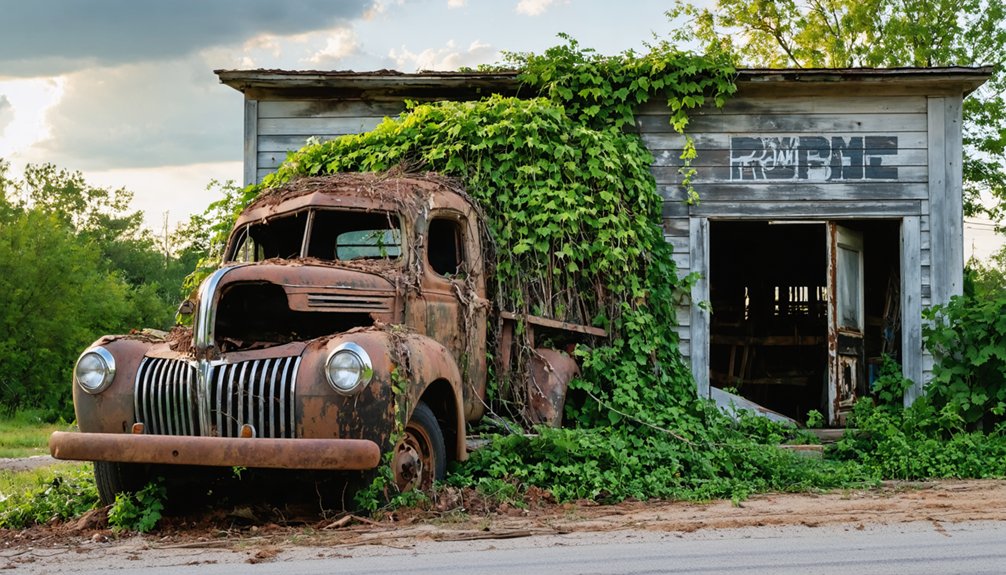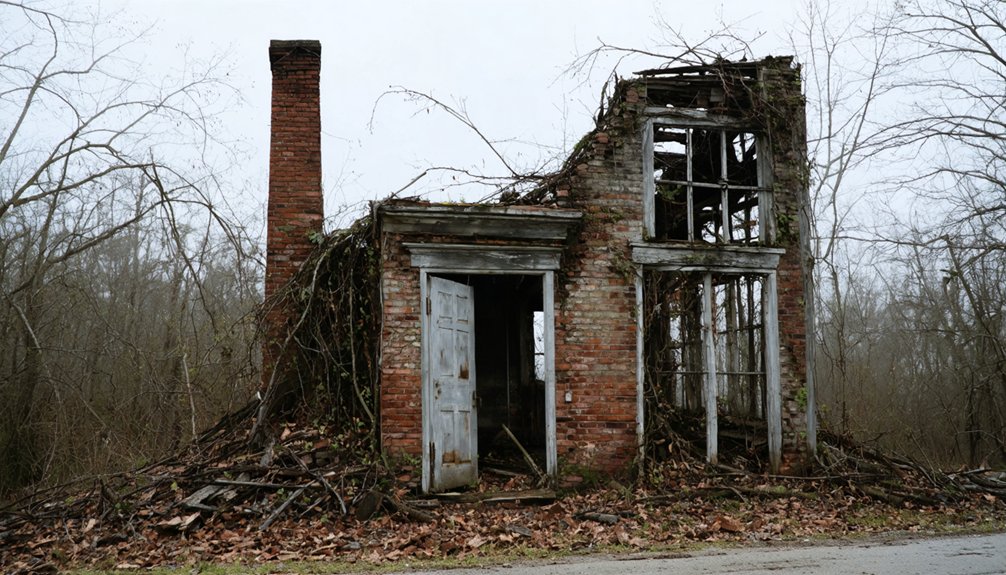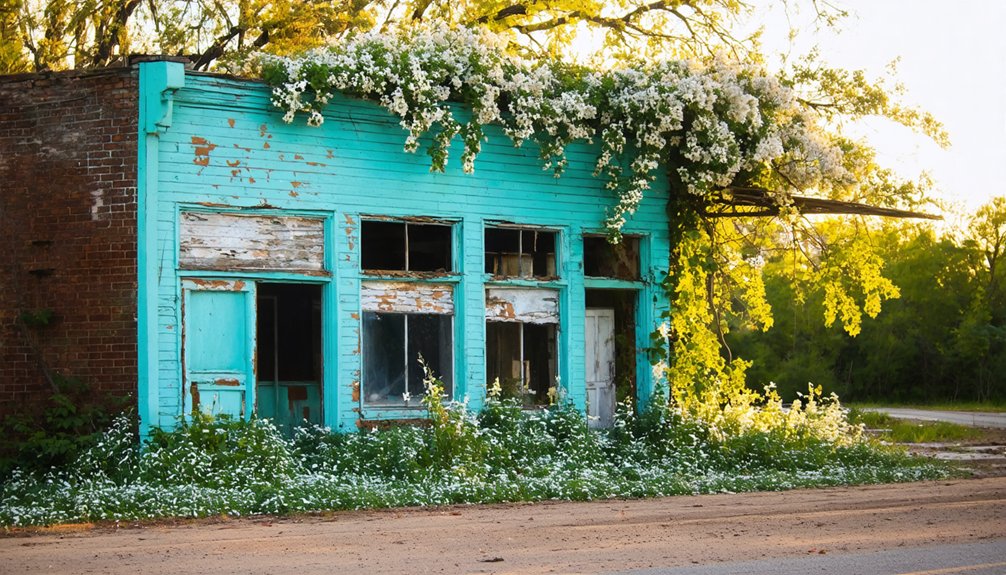
You’ll find Alabama’s ghost towns at their most enchanting during spring, when wildflowers blanket forgotten streets and mild weather makes exploration comfortable. Old Cahawba Archaeological Park offers unrestricted access to the state’s first capital, complete with moss-draped columns and ancient mounds. Bellefonte’s haunted cemetery and Spectre’s decaying film set provide eerie photography opportunities, while Blakeley’s Civil War earthworks burst with seasonal blooms. Each site reveals unique stories of French colonists, cholera outbreaks, and wartime drama that come alive through the ruins awaiting your discovery.
Key Takeaways
- Old Cahawba Archaeological Park offers unguarded exploration of moss-draped columns, grave markers, and 4,000-year-old Mississippian mounds amid spring wildflowers.
- Bellefonte features a haunted 1826 cemetery with ghostly folklore, scattered courthouse ruins, and atmospheric spring scenery for paranormal enthusiasts.
- Spectre’s decaying film set includes 20+ buildings with cinematic ambiance, creating perfect spring photography opportunities among nature-reclaimed structures.
- Blakeley preserves Civil War earthworks and trenches with spring wildflowers highlighting historic fortifications where African-American troops earned Medals of Honor.
- St. Stephens displays limestone foundations and crumbling walls along the Tombigbee River, with spring beaches and natural Indian Bathtubs nearby.
Arcola: A French Colonial Settlement Lost to Time
When Napoleon’s most devoted followers fled France after the emperor’s defeat at Waterloo, they didn’t expect to end up in the wilds of Alabama.
Yet in 1817, General Charles Lefebvre-Desnouettes led 200 Bonapartists up the Tombigbee River to establish the Vine and Olive Colony.
Two hundred exiled French soldiers journeyed deep into Alabama Territory, chasing imperial dreams along an untamed river.
They founded Arcola in the early 1820s, naming it for Napoleon’s 1796 victory at the Battle of Arcole.
You’ll find this ghost town near the Black Warrior River in Hale County, where French influence once transformed wilderness into ambitious vineyards.
The colonists secured land grants totaling hundreds of acres, but Alabama’s climate crushed their dreams of cultivating grapes and olives.
By 1825, most had abandoned their experiment in exile.
The settlement was part of a larger Congressional land grant to exiled Bonapartists that encompassed four townships and also included the villages of Demopolis and Aigleville.
The General himself never saw the colony’s demise—he died in 1822 when the ship Albion sank in a storm while he attempted to return to Europe.
Today, only the 1856 Alfred Hatch Place remains standing—a Greek Revival monument to what replaced French ambition with American plantation reality.
Bellefonte: From Thriving County Seat to Vanished Village
You’ll find Bellefonte’s story begins with remarkable promise—incorporated in December 1821. This Jackson County seat flourished with 400 residents, a bustling courthouse square, and the elegant Martin Inn by 1844.
Then catastrophe struck when cholera swept through the settlement, compounding losses from Civil War devastation and the town’s fateful decision to reject the railroad that would bypass them by three miles. The town’s name derives from French, meaning beautiful spring, referencing the natural water source that first attracted settlers to this location. By the 1920s, Bellefonte was completely abandoned, with the county seat having relocated to Scottsboro years earlier.
Today, you can explore what remains: a haunting cemetery with graves dating to 1826, a solitary chimney rising from the Martin Inn’s ruins, and scattered bricks half-buried in soil that once anchored a thriving community.
Early 1821 Prosperity
Within two years of Jackson County’s creation in 1819, Bellefonte transformed from untamed Cherokee cession land into Alabama’s newest county seat. You’ll find a remarkable settler narrative here—Dr. George Washington Higgins and Stephen Carter secured 60 acres in 1820, establishing what’d become the county’s first incorporated town by December 1821.
The partnership proved shrewd. They’d purchased James Riley’s land claim and began selling lots in 1830 with clear titles, attracting settlers who’d been hesitant about disputed public lands elsewhere. Early merchants like Alvah Finley, James L. Carter, and W.F. Hurt established thriving business activities that drew families from across the region.
Historical architecture rose quickly: a two-story brick courthouse arrived in 1828, followed by frame churches. The settlement’s name itself referenced multiple Bellefonte locations, a common place name pattern found throughout early American territories.
Cholera’s Devastating Impact
By the late 1850s, Bellefonte’s promising trajectory met a brutal adversary that no courthouse or commerce could withstand—cholera. The disease swept through this flood-prone settlement on Mud Creek with merciless efficiency, exploiting conditions that made it a perfect storm:
- Dense population crowded into homes without modern sanitation.
- Flood-prone location contaminating water sources repeatedly.
- High mobility along the Tennessee border importing fresh cases.
You’ll find evidence in the cemetery—229 grave plots tell stories of entire families erased.
The 1936 survey revealed only 57 inscribed markers remaining, silent witnesses to catastrophic loss. Population plummeted from nearly 200 to just 100 by 1883.
The cemetery sits on high ground, a location deliberately chosen by early settlers who believed elevated burial sites would aid souls in their ascent to heaven. The town had thrived as county seat from 1821-1823, establishing itself with a courthouse and public facilities before disease devastated the community.
Today’s haunted stories and folklore legends stem from this genuine tragedy, where cold spots and whispered voices echo generations of suffering.
Exploring Spring Ruins
Today, Bellefonte exists as Alabama’s most substantial ghost town—a place where you can still walk the courthouse square where lawyers once argued cases and merchants hawked their wares.
You’ll find scattered bricks marking where two-story buildings once stood, while a solitary chimney rises from the Martin Inn’s ruins.
The 1826 cemetery holds archaeological discoveries on its elevated ground—229 plots documented in 1936, though only 57 inscribed markers remain legible.
Urban legends swirl around this abandoned county seat.
Visitors report cold spots, failed electronics, and phantom footsteps echoing through empty spaces.
The town’s demise mirrors the nearby mothballed nuclear plant—both monuments to rejected progress on Cherokee land.
Originally named after a local spring, the settlement that meant “Beautiful Fountain” reached nearly 400 residents before war and the 1868 loss of its county seat status triggered its complete abandonment by 1880.
Visit during spring when wildflowers soften the haunting remains.
Old Cahawba: Alabama’s Abandoned First Capital
Long before Alabama even existed as a state, the land where Cahawba would rise had witnessed millennia of human history. Native archaeology reveals Mississippian villages with ceremonial mounds dating back 4,000 years, their earthworks later woven into the town’s blueprint.
As Alabama’s first capital from 1820 to 1826, Cahawba thrived as a cotton distribution powerhouse, boasting 3,000 residents by 1860. Yet its prosperity couldn’t withstand nature’s relentless flood impact—seasonal waters ultimately drove the government to Tuscaloosa. The Civil War brought harsh new realities when Cahawba became Castle Morgan prison, a Confederate facility that held over 3,000 Union soldiers by 1865 in overcrowded conditions.
What you’ll discover at Old Cahawba:
- Moss-draped columns standing sentinel over empty streets
- Weathered grave markers telling forgotten stories
- Archaeological treasures spanning ancient civilizations to antebellum grandeur
Today’s Old Cahawba Archeological Park offers you unguarded exploration through Alabama’s most hauntingly beautiful abandoned capital.
Spectre: Hollywood’s Intentional Ghost Town Creation
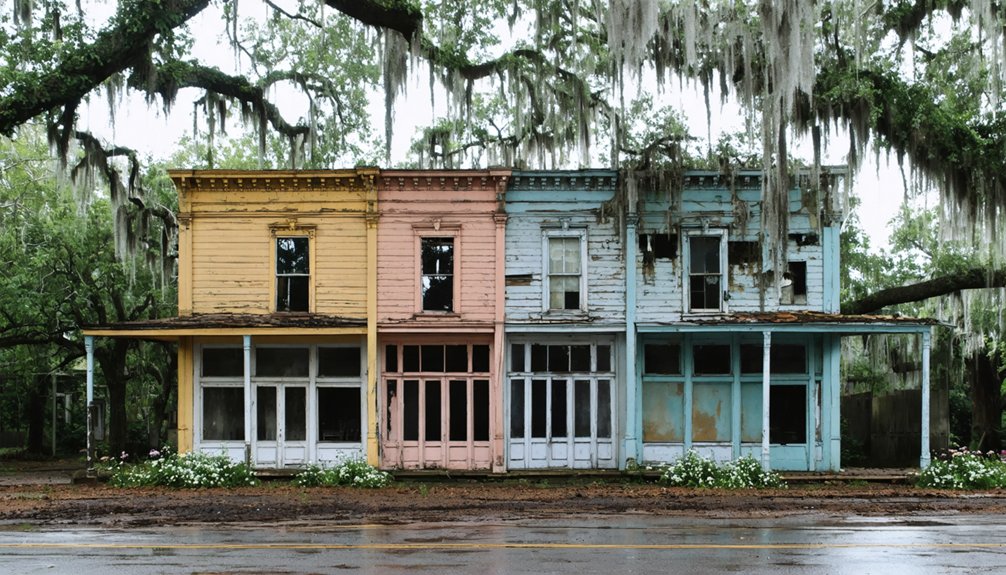
Unlike ghost towns born from economic collapse, Spectre emerged fully formed in 2003 as Tim Burton’s meticulously crafted film set for “Big Fish.”
Where weathered facades and rusting sculptures were designed to evoke Southern Gothic nostalgia. You’ll find this intentional ruin nestled on private property near Millerville, where its church steeple and riverside tavern continue decomposing gracefully under Alabama’s spring canopy—a Hollywood illusion now authentically reclaimed by nature.
Accessing these cinematic remnants requires permission from the property owner, but springtime visits reward you with blooming dogwoods framing structures that blur the line between manufactured decay and genuine abandonment.
Big Fish Film Set
Deep in the woods of Jackson Lake Island near Millbrook, Alabama, a peculiar town sits frozen in time—not by tragedy or economic collapse, but by Hollywood design. Tim Burton constructed Spectre in 2003 for his film *Big Fish*, creating exterior shells of houses, a chapel, and dirt roads specifically to tell Edward Bloom’s fantastical story.
What You’ll Discover:
- Dilapidated structures overtaken by nature and resident goats.
- Hanging shoes at the entrance—a tradition visitors continue.
- Two surviving Styrofoam trees from the Enchanted Forest scene.
This accessible ghost town attracts photographers seeking unique compositions and believers in urban legends who’ve reported unexplained phenomena. The Bright family’s private property remains reachable by boat, offering freedom seekers an off-trail adventure where fiction and folklore merge into haunting reality.
Photography tips: Golden hour enhances the mysterious atmosphere perfectly.
Intentional Decay and Preservation
Tim Burton’s production team didn’t stumble upon Spectre—they created it from scratch on Jackson Lake Island‘s forested terrain.
In 2003, they constructed over 20 buildings with authentic 19th-century materials, spending part of a $70 million budget to build this fictional Southern town.
What makes Spectre fascinating for urban exploration enthusiasts is its intentional abandonment.
Unlike typical preservation techniques that fight decay, landowners deliberately let nature reclaim the set.
Alabama’s humid climate accelerated the transformation—roofs collapsed, walls crumbled, and vegetation consumed storefronts within a decade.
This controlled deterioration created something unique: a Hollywood ghost town frozen in cinematic decay.
You’ll find the church steeple still standing while surrounding structures gradually return to earth, offering photographers and film history buffs an authentic ruin experience.
Accessing the Movie Ruins
Reaching Spectre requires more planning than your typical roadside attraction. This filming location sits on privately owned Jackson Lake Island, accessible only through Old Spectre Road. You’ll need to call ahead for the gate code—this isn’t open-access urban exploration territory.
Once you’ve arranged entry, here’s what you’ll encounter:
- $3 per person entry fee for day visits
- Optional camping at $10 per night among the ruins
- Limited building access due to chicken wire barriers
The island welcomes visitors for tourism, camping, and fishing, giving you freedom to wander among the deteriorating film sets. Don’t expect pristine Hollywood magic—weather, fire, and floods have transformed these facades into authentic ruins, creating an atmosphere that rivals any naturally abandoned town.
Blakeley: Nature’s Reclamation of a Historic Battleground
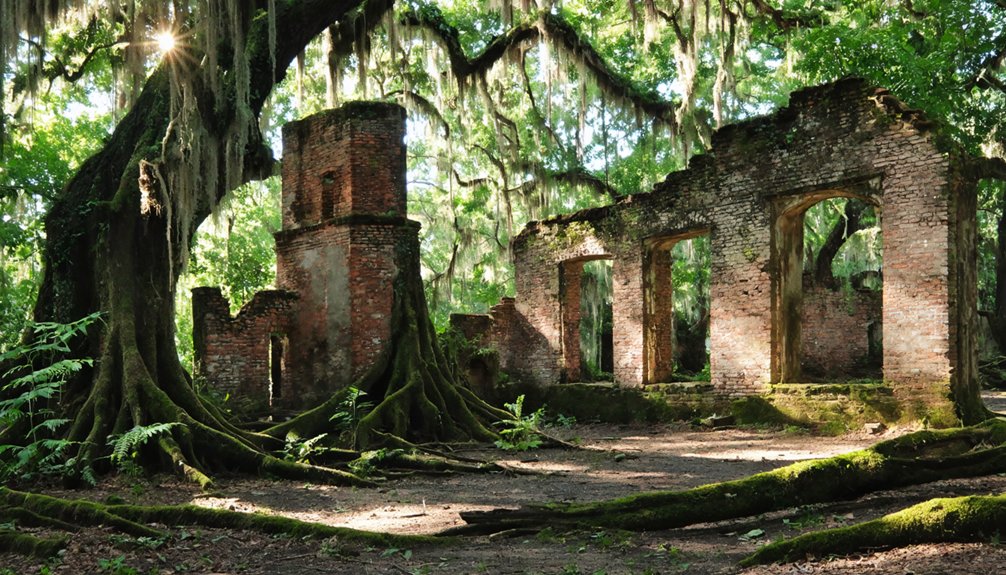
Where Spanish moss drapes ancient oaks and earthen fortifications rise beneath layers of spring wildflowers, Historic Blakeley State Park preserves the site of Alabama’s largest Civil War battle—and the ghost town that history forgot.
You’ll discover 2,100 acres where nature’s reclaimed what urban decay began. Blakeley, once Alabama’s largest city after its 1814 charter, now exists only as scattered ruins amid wilderness.
Walk miles of Confederate earthworks and Union trenches where 16,000 soldiers overwhelmed 3,500 defenders on April 9, 1865—the same day Lee surrendered at Appomattox.
Historic preservation meets wild delta landscape here, with rifle pits and breastworks threading through untouched forest. Spring offers ideal conditions for exploring fortifications where 5,000 African-American troops helped secure victory, earning four Medals of Honor at Redoubt #4.
St. Stephens: A Perfectly Preserved Archaeological Time Capsule
Along the Tombigbee River’s eastern bluff, limestone foundations and crumbling walls mark Alabama’s most archaeologically intact ghost town—a former territorial capital frozen in time since the 1830s.
St. Stephens served as Alabama’s territorial capital from 1817-1819 before yellow fever epidemics and economic shifts emptied it completely. What makes this site extraordinary? The ruins remained undisturbed for two centuries, creating exceptional preservation techniques that allow archaeologists to uncover layers of frontier life.
Your adventure includes:
- Self-guided walking tours through authentic street layouts and building foundations
- Archaeological discoveries displayed in the 1854 courthouse museum (reopening summer 2025)
- Natural attractions like Indian Bathtubs—ancient rock basins—and sugar-white beaches
Public archaeological digs occasionally welcome visitors, letting you witness history emerging from Alabama soil firsthand.
Planning Your Alabama Ghost Town Road Trip This Spring
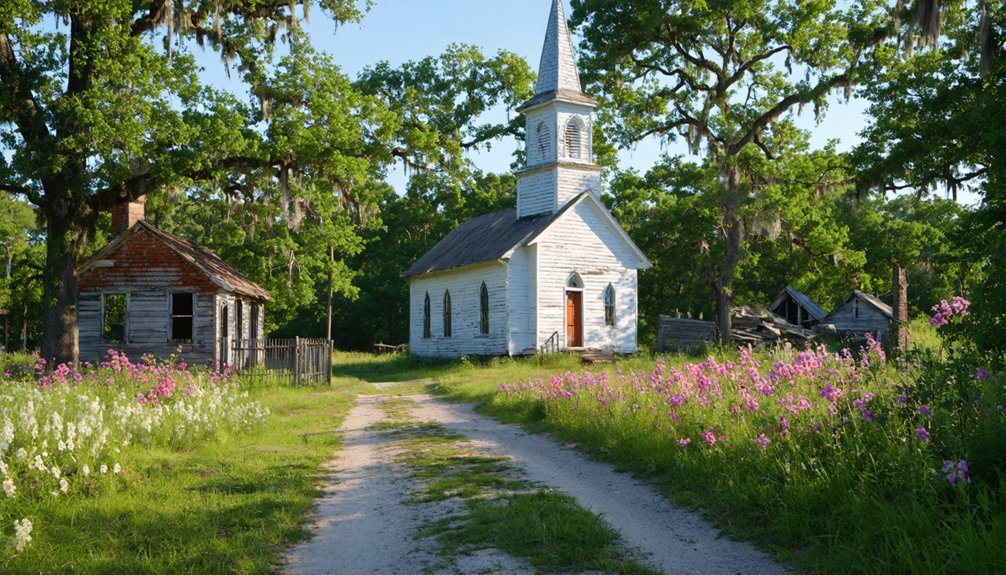
After exploring these individual sites, you’ll want to connect them into a memorable spring journey. The South Alabama loop offers 400 miles of discovery, starting and ending at Cahaba with an estimated 8-hour driving time. You’ll navigate between six ghost towns, tracking the original road from St. Stephens through Prairie Bluff to Cahaba.
Journey through 400 miles of Alabama’s past, connecting six ghost towns along historic routes from St. Stephens to Cahaba.
Spring’s mild 70-80°F temperatures create ideal conditions for exploring riverport history along the Alabama River, where Old Cahawba Archaeological Park stands open for investigation.
Contact historical societies before departing—they’ll provide essential access details for gated sites like Prairie Bluff and reveal hidden cemeteries obscured by spring vegetation.
The Digital Alabama ghost towns map pinpoints locations, while checking weather forecasts helps you avoid flooding at low-lying riverfront sites.
Pack allergy medication for high pollen levels.
Frequently Asked Questions
Are Alabama Ghost Towns Safe to Visit With Children During Spring?
You’ll find these sites reasonably safe, though spring floods and crumbling structures demand vigilance. Preservation efforts maintain pathways, yet haunted legends and dense foliage add adventure. Watch children near ruins, bring bug spray, and embrace the wild history surrounding you.
Do I Need Permission to Explore Private Ghost Town Properties?
You’ll absolutely need permission—no “sliding into DMs” here! Property access requires explicit owner consent under Alabama law. Legal considerations make trespassing prosecution possible. Always contact landowners before exploring private ghost towns to respect rights and avoid penalties.
What Photography Equipment Works Best for Capturing Abandoned Structures?
You’ll need a sturdy tripod for long exposures, a wide-angle lens (16-35mm), and a reliable torch for dark interiors. This photography gear helps document historical preservation while capturing the haunting beauty of decaying structures in low-light conditions.
Can I Camp Overnight Near Any Alabama Ghost Town Sites?
Yes, you’ll find overnight camping at Old Cahawba, Blakeley, St. Stephens, and Spectre. Check camping regulations beforehand, as facilities vary from primitive sites to RV hookups. Always respect private property access restrictions at abandoned locations.
Are Guided Tours Available for Alabama’s Ghost Town Locations?
Yes, you’ll find guided tour options at Alabama’s ghost towns, particularly Old Cahawba Archaeological Park. They offer walking tours, wagon rides, and nighttime shuttles exploring historical preservation sites where you can experience authentic stories of the abandoned state capital.
In addition to these experiences, exploring ghost towns in Alabama allows you to discover remnants of the past that tell tales of the people who once inhabited these areas. Each site is steeped in history and offers a unique glimpse into a bygone era, making it a fascinating destination for history enthusiasts. As you wander through these deserted streets, you’ll encounter beautifully restored buildings and haunting ruins that spark the imagination.
References
- https://thebamabuzz.com/5-alabama-ghost-towns-to-put-on-your-bucket-list/
- https://www.youtube.com/watch?v=1Qy5Sq51SbA
- https://deepsouthurbex.com/2020/01/02/6-south-alabama-ghost-towns/
- https://freepages.history.rootsweb.com/~gtusa/usa/al.htm
- https://www.ezhomesearch.com/blog/11-ghost-towns-in-alabama-that-bridge-the-distance-between-yesterday-and-today/
- https://www.abandonedalabama.com/maps/
- https://kids.kiddle.co/List_of_ghost_towns_in_Alabama
- https://encyclopediaofalabama.org/article/charles-lefebvre-desnouettes/
- https://www.hmdb.org/m.asp?m=38185
- https://kids.kiddle.co/Alfred_Hatch_Place_at_Arcola