Spring’s the perfect time to explore Arkansas’s ghost towns when wildflowers bloom around Rush’s abandoned zinc mines and receding Beaver Lake waters reveal Monte Ne’s submerged resort ruins. You’ll find comfortable temperatures for wandering through Graysonia’s concrete sawmill skeleton or photographing Eros’s WPA-era schoolhouses without battling summer’s oppressive heat. The season offers ideal conditions for discovering East Calico’s crumbling cotton gins and that massive Morning Star Mine zinc nugget story. What you’ll encounter at each site reveals fascinating layers of Arkansas’s forgotten industrial past.
Key Takeaways
- Rush Ghost Town offers an interpretive trail through preserved zinc mining structures from the 1880-1940 era near Buffalo National River.
- Monte Ne’s submerged resort ruins become visible during spring’s lower water levels, accessible by kayak tours on Beaver Lake.
- Eros and Bruno in Marion County feature WPA-era school buildings and historic structures reflecting 1930s rural farming communities.
- East Calico showcases a 1920s cement jail, collapsed cotton gins, and railroad remnants beneath distinctive bluffs along White River.
- Graysonia displays concrete sawmill ruins, kilns, and a firehouse from its 1907 timber industry peak along the Antoine River.
Rush Ghost Town: Arkansas’s Abandoned Zinc Mining Capital
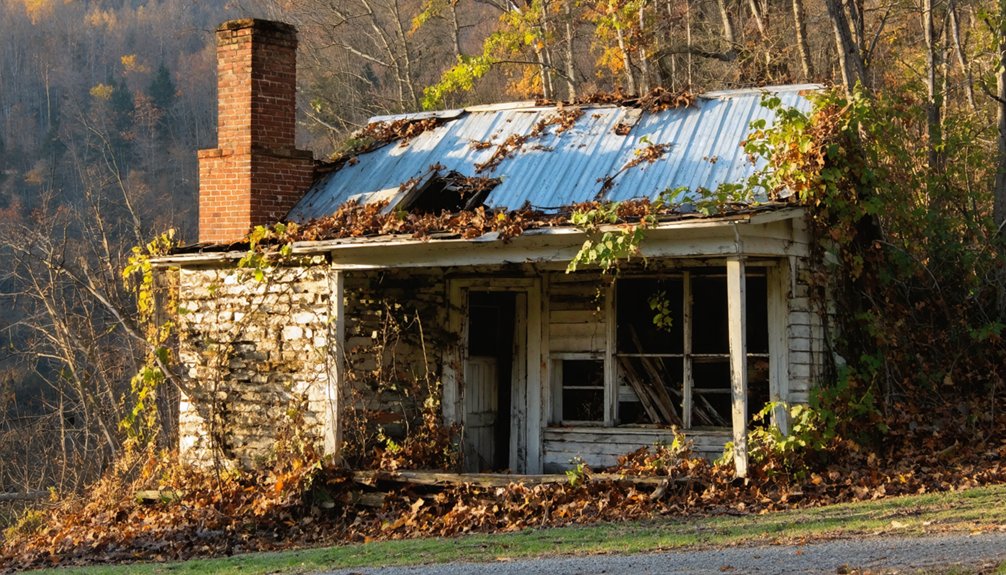
Nestled along Rush Creek in the Buffalo National River area, Rush stands as Arkansas’s most significant ghost town—a weathered proof to the zinc mining boom that transformed this remote hollow into a bustling industrial center.
You’ll discover crumbling structures from 1880-1940, when up to 5,000 miners extracted zinc for World War I ammunition and industrial needs. The Morning Star Mine‘s famous 13,000-pound zinc nugget won accolades at world fairs before economic collapse struck in 1918.
Today’s mining history reveals itself through abandoned buildings and rock piles disguised as natural hills. The post office closed in the mid-1950s, marking the final loss of Rush’s identity as an active community. Preservation efforts since 1972 maintain this authentic frontier experience—no commercialization, just raw exploration.
You’re free to wander where prospectors once sought silver but found zinc instead, creating Arkansas’s most authentic escape into industrial wilderness. The National Park Service has built an interpretive trail around the site, offering informative features that bring the mining camp’s story to life.
Monte Ne: The Submerged Resort Community of Beaver Lake
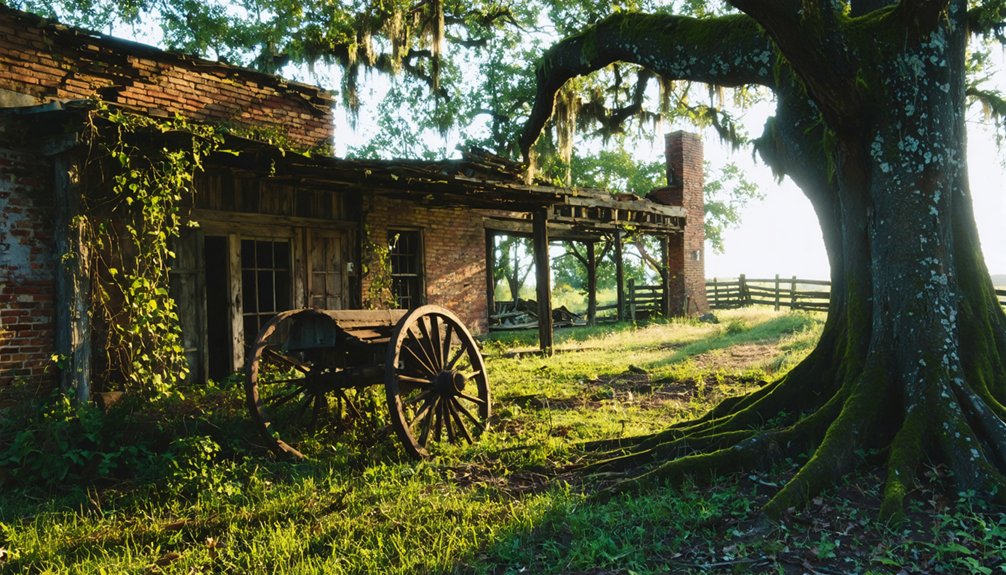
While Rush preserves its industrial past through crumbling mine shafts and zinc-stained earth, Arkansas’s strangest ghost town lies beneath 30 feet of water. You’ll find Monte Ne’s submerged architecture in Beaver Lake, where William Hope Harvey’s 1901 luxury resort disappeared when the dam flooded his dream.
During spring’s lower water levels, you can glimpse the amphitheater ruins—Harvey’s unfinished pyramid project meant as a time capsule for future generations. The amphitheater once seated 500-1,000 people and hosted everything from plays to Harvey’s 1932 presidential convention when he ran for the Liberty Party.
What to explore:
- Stone foundations and retaining walls visible at the boat launch during drought conditions
- Historical preservation efforts documented at Rogers Historical Museum, featuring salvaged artifacts
- Kayak tours around visible ruins when water drops sufficiently
The resort once boasted Arkansas’s first golf course and indoor pool before changing vacation patterns and financial troubles sent it underwater—literally. Harvey originally purchased 320 acres in 1900 to develop the self-contained community, envisioning a destination that would rival the nation’s finest resorts.
Eros and Bruno: Marion County’s Faded Farming Communities
Deep in Marion County’s rolling hills, two forgotten farming communities sit just eight miles apart along winding country roads. Their weathered buildings mark what’s left of settlements that once thrived on subsistence agriculture and tight-knit rural life.
You’ll find Eros along Highway 125, where the 1935 school building stands as a testament to WPA-era craftsmanship. This historical school architecture earned National Register status in 1992, though it’s been abandoned for decades.
The Civilian Conservation Corps once worked nearby during the Depression years. The CCC operated in soil conservation projects at Eros, transforming the landscape during the 1930s.
Bruno sits downstream where Hampton Creek cuts through sycamore groves. Five historic buildings dot this ghost town, including the old schoolhouse. The districts merged with Pyatt to create a new school in Eros following the 1973 consolidation.
Both communities consolidated their districts by 1973, sealing their fate as relics.
Spring’s perfect for exploring these time capsules before nature reclaims them completely.
East Calico: The Ghost Town Within a Town
Unlike Marion County’s quietly fading farm settlements, East Calico earned its ghost town status through wild living and violent reputation.
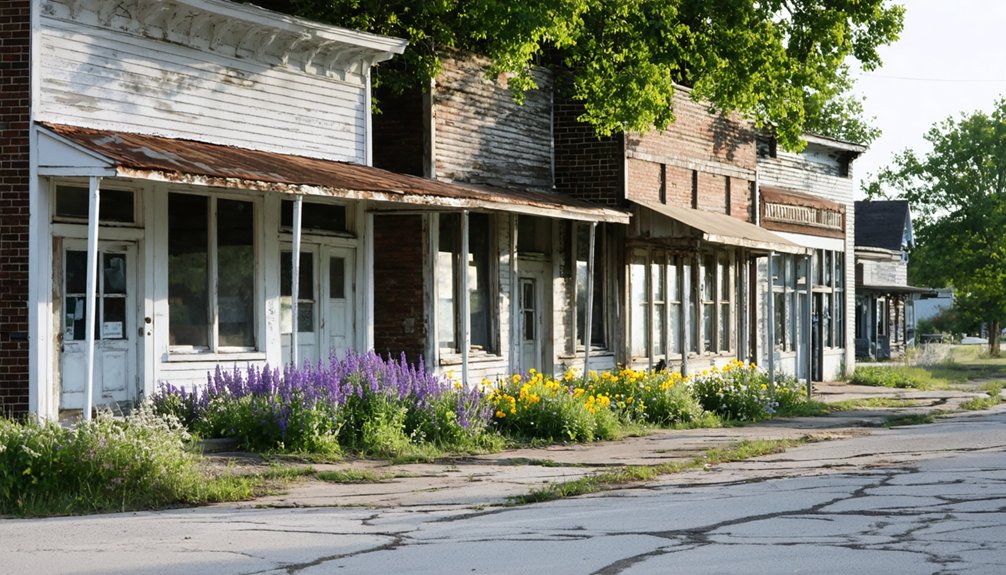
You’ll discover America’s only authentic ghost town existing within a functioning town’s limits.
This 1800s trading post along White River once thrived on bootleg “Peppersauce” moonshine, steamboat landings, and railroad commerce before fires and floods drove residents westward.
Explore these preserved remnants:
- Walk through the 1920s cement jail that held twenty brawlers on Saturday nights
- Photograph collapsed cotton gins, lumber yards, and overgrown taverns
- Trace abandoned railroad tracks beneath Calico’s distinctive bluffs
Historical preservation efforts since 2007 transformed these privately-owned ruins into accessible haunted attractions.
The railroad’s arrival in 1903 transformed the settlement into a prosperous hub for zinc, timber, and cotton trade.
Start your exploration at the Calico Rock Museum and Visitor Center where you can pick up detailed maps and historical brochures before venturing into the ghost town.
Spring’s mild weather lets you wander freely through twenty remaining structures where French trappers, bootleggers, and frontier vagabonds once raised hell.
Graysonia: A Timber Town Lost to Time
Tucked along the Antoine River‘s winding path between Arkadelphia and Alpine, Graysonia rose from nothing in 1907 when lumber barons William Grayson and Nelson McLeod dragged their entire operation from timber-depleted Daleville.
You’ll find remnants of what 1,000 souls once called home—a classic company town where the timber industry controlled everything from your electricity to your employment.
The sawmill’s concrete skeleton still stands, flanked by two kilns and a crumbling firehouse.
By 1932, the virgin forests were gone, and cinnabar mining couldn’t save it.
The mill had churned out 150,000 board feet of lumber daily, ranking among the largest operations in the South.
Today, you can wander through foundations where nearly 200 houses once crowded the riverbank.
Spring’s mild temperatures offer ideal conditions before the hot summer months descend on this remote site.
It’s Arkansas’s only incorporated ghost town in Clark County—a monument to corporate dominance and nature’s finite resources.
As interest in abandoned sites in Arkansas grows, many explorers and photographers venture into these forgotten places to capture their haunting beauty. Each location tells a unique story, echoing the past and showcasing the remnants of human endeavor against the relentless passage of time. Visitors often find themselves reflecting on what life was like in these once-thriving communities.
Frequently Asked Questions
What Safety Precautions Should Visitors Take When Exploring Arkansas Ghost Towns?
Wear sturdy boots and watch for unstable structures while respecting historical preservation. You’ll avoid trespassing laws by staying on public trails. Pack water, check weather forecasts, and never remove artifacts—they’re protected and monitored.
Are There Guided Tours Available for Any of These Abandoned Sites?
While Arkansas’s “resting” settlements lack formal guided experiences, you’ll find exceptional tours exploring the state’s haunted historical significance instead. Cities like Eureka Springs and Rogers offer preservation efforts through immersive walks, revealing Arkansas’s spirited past through authentic storytelling and adventure.
Can Visitors Legally Enter the Remaining Structures at These Ghost Towns?
Legal access depends on property ownership—you’re free to explore Rush’s preserved buildings on public trails, but you’ll need landowner permission for private ghost town sites to avoid trespassing charges while satisfying your adventurous spirit.
What Wildlife Might Be Encountered When Visiting These Locations in Spring?
You’ll encounter native wildlife like white-tailed deer, wild turkeys, and black bears foraging after winter. Spring migration brings warblers and hawks overhead. Watch for bobcats, foxes, and basking copperheads along trails through these abandoned sites.
Are Camping Facilities Available Near These Arkansas Ghost Town Sites?
You’ll find Rush Campground’s primitive sites blending historical preservation with modern comfort near ghost town ruins. Photography opportunities abound at dawn, while full-hookup RV sites and tent camping let you explore abandoned mining structures at your own pace.
References
- https://arkansasfrontier.com/ghost-towns-in-arkansas/303766/
- http://freepages.rootsweb.com/~gtusa/history/usa/ar.htm
- https://www.axios.com/local/nw-arkansas/2024/01/02/arkansas-ghost-towns-mapped
- https://www.youtube.com/playlist?list=PL4jqwLUrhjNQTUht0FCp8mnQYi_DNiUWU
- https://kkyr.com/arkansas-top-5-ghost-towns/
- https://www.youtube.com/watch?v=U4kJjjbcnMM
- https://www.uaex.uada.edu/environment-nature/musings-on-nature-blog/posts/ghost-towns.aspx
- https://encyclopediaofarkansas.net/entries/rush-ghost-town-marion-county-1270/
- https://www.barefoottraveler.com/rush.html
- https://onlyinark.com/places-and-travel/rush-arkansas-ghost-town/