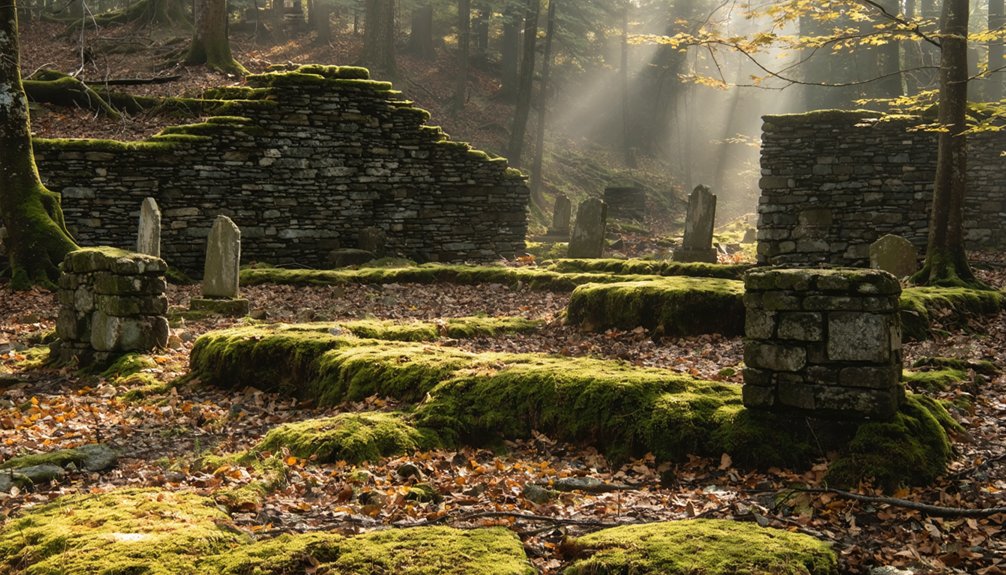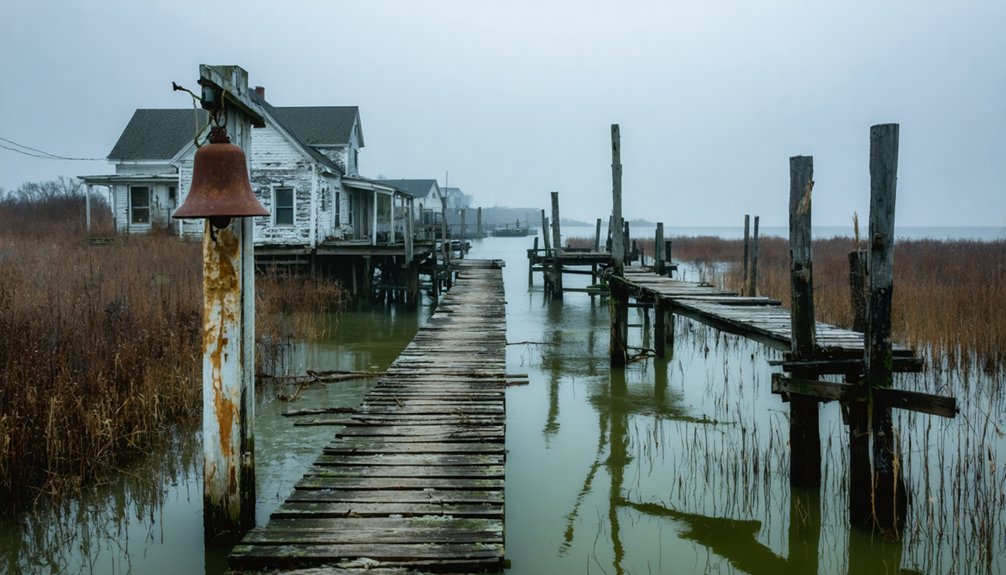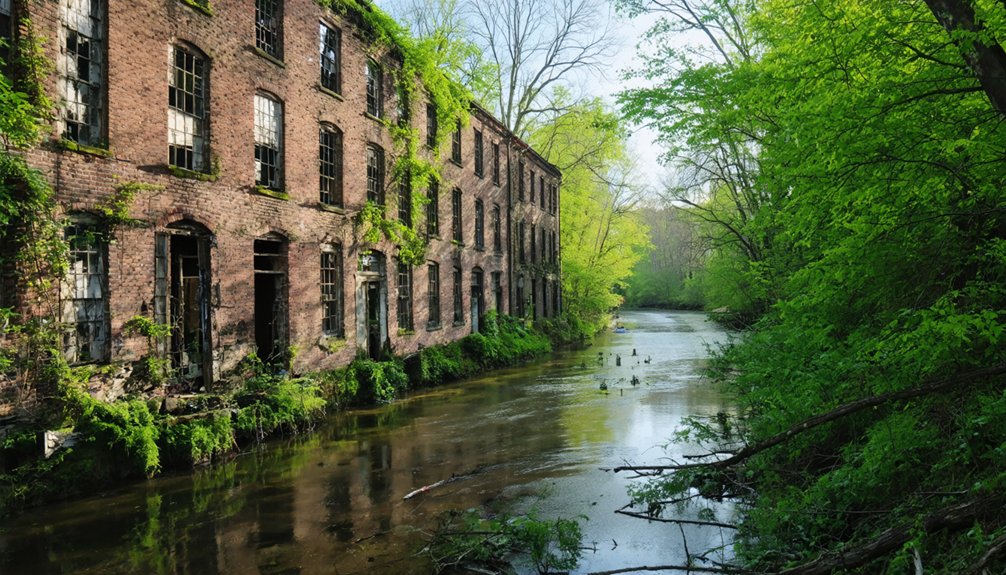
You’ll find Connecticut’s most haunting ghost towns come alive in spring, when melting snow reveals Bara-Hack’s stone foundations and crumbling mill remnants nestled in Pomfret’s woodlands. Gay City State Park offers twenty miles of trails winding past 19th-century cellar holes, while Johnsonville’s Victorian streets sit eerily preserved beside the rushing Moodus River. For coastal exploration, Pleasure Beach‘s overgrown amusement park ruins stretch across windswept dunes. Spring’s longer daylight hours and accessible trails make these abandoned settlements perfect for discovery, and there’s much more to uncover about planning your haunting adventure.
Key Takeaways
- Spring offers longer daylight, blooming flora, and ice-free trails, making it ideal for exploring Connecticut’s abandoned settlements.
- Gay City State Park features accessible 19th-century mill town ruins with twenty miles of trails through reclaimed industrial landscapes.
- Bara-Hack in Pomfret displays stone foundations, cemeteries, and water mill relics from a settlement abandoned by 1890.
- Johnsonville Village showcases eight relocated historic buildings along the Moodus River, creating a picturesque Victorian-era ghost town.
- Pleasure Beach offers overgrown amusement park ruins and coastal views, representing Connecticut’s largest abandoned leisure destination.
What Defines a Ghost Town in Connecticut
A ghost town whispers its history through weathered timber and crumbling stone, beckoning spring visitors to walk streets where communities once thrived.
In Connecticut, you’ll find these abandoned settlements where economic activity has ceased, leaving tangible remains for your exploration.
Urban decay meets historical preservation as dilapidated main streets and forgotten cemeteries mark places like Bara-Hack and Dudleytown. Some sites maintain skeleton populations, yet their original purpose vanished long ago.
You’re free to discover visible infrastructure—buildings, roads, and foundations—that tell stories of resource depletion, railroad bypasses, and natural disasters. The abandonment of towns often reflects economic shifts including industrial decline and migration patterns that reshaped Connecticut’s landscape.
Whether it’s a former mill town or coastal village, these accessible remnants invite you to experience Connecticut’s forgotten communities without restrictions, where history breathes through every abandoned doorway. No single official definition exists for classifying these sites, as designations depend on visibility of remains and current population status.
Why Spring Is the Perfect Season for Ghost Town Exploration
Spring transforms Connecticut’s ghost towns into their most explorable state, when winter’s ice retreats and summer’s oppressive vegetation hasn’t yet reclaimed the ruins. You’ll discover structures emerging from dormancy, their weathered frames silhouetted against blooming dogwoods and mountain laurels.
Between thaw and overgrowth lies the perfect window—when Connecticut’s forgotten settlements reveal themselves most clearly to those who seek them.
Seasonal warmth beckons you forward without summer’s humidity weighing you down or winter’s brutal cold cutting through abandoned buildings.
The lengthening daylight grants you extended exploration hours—you’re not racing against early darkness. Spring blooms paint forgotten homesteads in unexpected beauty, softening decades of decay with nature’s renewal.
Mud season’s end means accessible trails without the ankle-twisting hazards of frozen ground or summer’s obscuring undergrowth. You’ll navigate crumbling foundations with clear sightlines, breathing crisp air while discovering Connecticut’s abandoned past at its most inviting threshold. Consider joining organized expeditions with experienced guides who can provide historical context and ensure safe navigation of unstable mill ruins. Pack your hiking boots and safety gear to ensure you’re prepared for uneven terrain and structural exploration.
Bara-Hack: A Wilderness Settlement Frozen in Time
Deep in Windham County’s Ragged Hills, you’ll discover Bara-Hack—a settlement where two families carved out lives beginning in 1778, only to vanish completely by 1890. Stone foundations rise from the forest floor on either side of a quiet brook, marking where the Randall and Higinbotham homesteads once stood.
While their shared cemetery holds weathered markers spanning a century of births, deaths, and daily bread broken together. Spring transforms this forgotten place into an accessible time capsule, where moss-covered walls and crumbling millworks emerge from winter’s grip to tell stories of spinning wheels, water-powered industry, and the eventual silence that reclaimed it all. The Randall family’s affluent background is evident in the scale of their former homestead, as they brought considerable wealth from Rhode Island to this remote Connecticut wilderness. The settlement earned haunting nicknames including the Village of Lost Voices, reflecting the disembodied sounds that visitors have reported hearing drift through the trees since the early 1800s.
Stone Foundations and Graveyard
When you venture into the Ragged Hills section of Pomfret, Nightingale Brook cuts through what remains of Bara-Hack, dividing two weathered stone foundations that once anchored family homes. Stone relics emerge from the forest floor—barn foundations, nearly invisible mill remains, and walls threading between ancient trees. You’ll discover worked boulders and structural pillars marking where streets once connected this wilderness community.
The Randall-Botham Cemetery stands intact amid the overgrowth, preserving cemetery history through weathered markers. Phebe Higginbotham rests here, claimed at nineteen. Rhoda followed at thirty. Dorcas defied them all, reaching one hundred. A well remains perfectly preserved, while slave quarters foundations speak of harder truths. Welsh families established this settlement in 1780, naming it for the breaking of bread. These stone sentinels guard stories the living abandoned, waiting for those bold enough to seek them out.
Access requires a permit or guided tour, as the settlement sits on private property with restricted entry for visitors and paranormal enthusiasts alike.
Centuries of Settlement History
These weathered stones mark more than graves—they chronicle a settlement born from war and desperation. In 1778, Johnathan Randall and Obediah Higinbotham fled British-occupied Rhode Island, establishing their refuge along Nightingale Brook.
Higinbotham, possibly a deserter from Lancashire, brought knowledge of medieval trade practices that shaped their economy—his linen wheels produced flax spinning tools rivaling ancient artifacts in craftsmanship.
You’ll discover remnants of their ingenuity: stone foundations where water-powered mills once hummed, leach stones for soap-making, and precisely-laid chimneys. The settlement thrived until post-Civil War hardships emptied it by 1890.
Now forest reclaims their cleared fields, yet these ruins tell stories of colonial resilience. Originally settled by Welsh families around 1780, the area developed its distinct character through generations of determined homesteaders. The cemetery still exists, maintained as an enduring testament to those who once called this wilderness home. Walk among the foundations and imagine families who carved civilization from wilderness, only to watch it dissolve back into earth.
Remote Windham County Location
Tucked within Pomfret’s Ragged Hills, this settlement sits at coordinates 41°52′48″N 72°00′40″W—a location that demands commitment from anyone seeking it.
You’ll traverse overgrown paths through dense woodland, far from paved roads and civilization’s hum.
The isolation that once attracted the Randall and Higinbotham families in 1778 remains palpable today.
What awaits in these forgotten woods:
- Industrial ruins including stone foundations, barn remnants, and a nearly invisible mill along the brook
- Native history predating the 1713 Pomfret township incorporation
- Extensive stone walls marking boundaries long erased by forest
- Cemetery stones bearing witness to pioneers like Dorcas, who reached 100 years
Adjacent to a 4H camp, the site maintains its wilderness character despite modern encroachment.
Dudleytown: Connecticut’s Most Cursed Abandoned Village
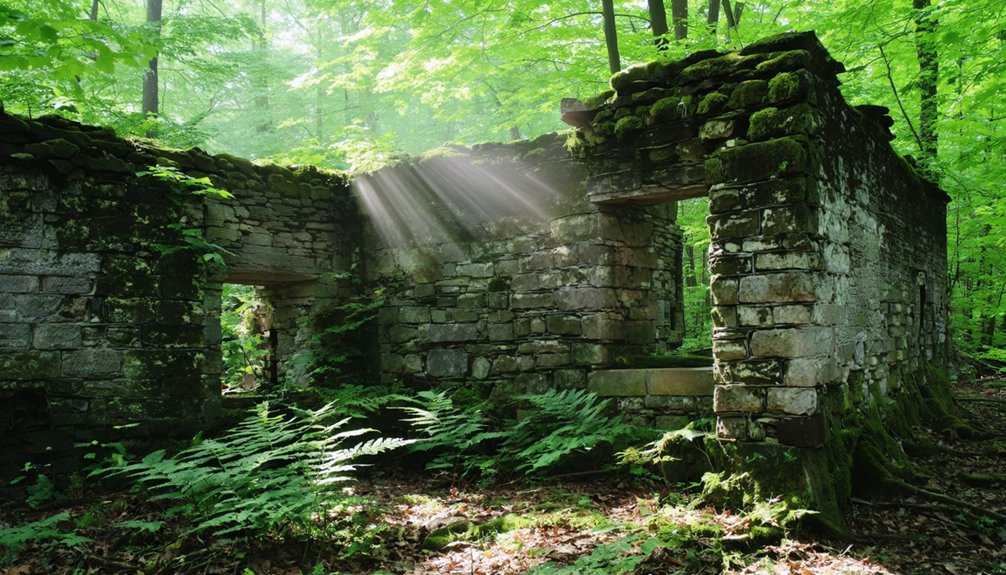
You’ll find Dudleytown nestled in a shadow-drenched valley where whispers of the Dudley family curse still echo through Dark Entry Forest.
Legend claims that Edmund Dudley’s beheaded ghost followed his descendants across the Atlantic, releasing madness and death upon this doomed settlement until its last resident fled in 1924.
Spring’s lengthening daylight offers your best chance to explore the cellar holes and crumbling stone walls before the forest’s notorious darkness descends—though the private land trust has closed access to ghost hunters who’ve plagued these cursed grounds since the 1980s.
The Dudley Family Curse
Deep in Cornwall’s shadowed valley, where sunlight struggles to penetrate the ring of encircling mountains, lies the forsaken village of Dudleytown—a place where legend and tragedy intertwine so thoroughly that separating fact from folklore becomes nearly impossible.
The Dudley family supposedly carried a curse from 16th-century England, where their noble ancestors lost their heads to treason charges. These curse legends blamed supernatural forces for the settlement’s misfortunes:
- Crops withering in the rocky soil despite farmers’ efforts
- Residents descending into unexplained madness and violence
- Mysterious deaths plaguing families generation after generation
- Children vanishing without trace into the surrounding forest
Yet historians discovered something intriguing: Cornwall’s Dudleys shared no genealogical connection to those doomed English noblemen. The curse exists only in whispered tales.
Spring Exploration and Legends
When spring breathes life into Connecticut’s forests, Dudleytown remains stubbornly trapped in perpetual gloom.
While wildflower blooms carpet surrounding trails, the three mountains encircling this cursed valley cast shadows that choke most vegetation.
You’ll find exceptional birdwatching opportunities along Dark Entry Forest‘s perimeter, where warblers and thrushes avoid the settlement’s moss-covered foundations.
Since the 1980s, you can’t legally explore the cellar holes where the Dudleys once farmed rocky soil.
The private trust controlling access has barred visitors, ending decades of freedom seekers investigating legends of madness and mysterious deaths.
Yet the whispers persist—William Tanner’s descent into insanity, vanished families, unexplained fires.
The forest reclaimed what settlers abandoned in 1924, leaving only stone walls as monuments to those who couldn’t escape this shadowed ground.
Gay City State Park: Where History Meets Nature
Nestled in the wooded hills between Hebron and Bolton, Gay City State Park conceals the haunting remnants of a 19th-century mill town beneath its canopy of oak and maple. You’ll discover a settlement founded in 1796 by Elijah Andrus’s religious sect, where stone foundations and grass-filled cellar holes whisper stories of families who vanished after successive mill fires between 1830 and 1885.
Ten miles of trails wind past these archaeological treasures. There, wildlife preservation has transformed Factory Hollow into thriving habitat. The environmental impact of nature’s reclamation is striking—deer browse where workers once labored, and the abandoned millpond reflects clouds instead of industry.
Explore freely:
- Stone walls threading through dense forest
- Cemetery gravestones marking the Gay and Sumner families
- 1,569 acres of unrestricted wandering
- Swimming holes replacing industrial watercourses
Johnsonville Village: A Victorian Time Capsule
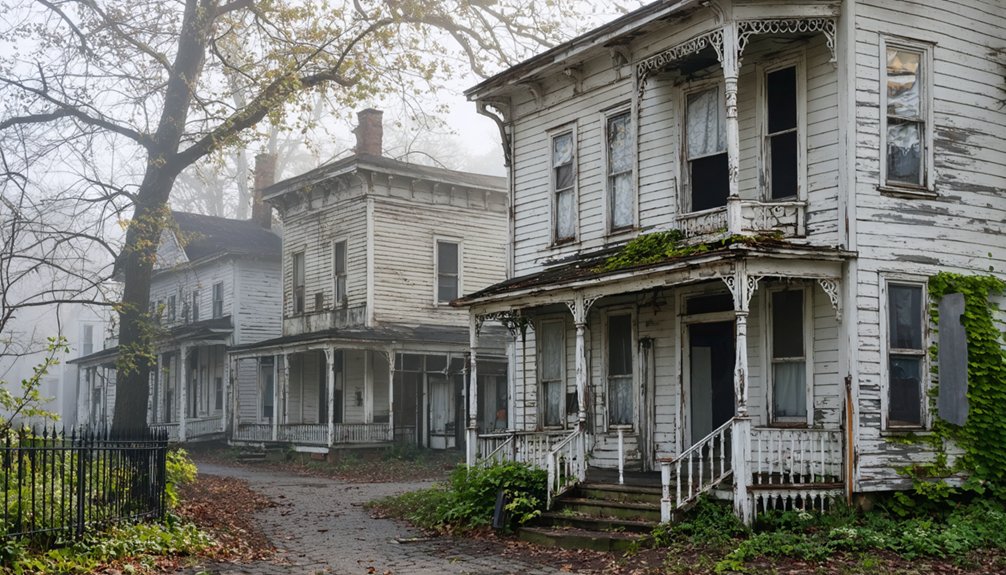
You’ll discover Johnsonville Village nestled beside the Moodus River, where eight relocated 19th-century buildings stand frozen in time amid overgrown vines and Victorian street lamps.
The crown jewel remains the Emory Johnson homestead, built in 1846 with its pillared porches and formal gardens.
While the massive Neptune Mill once hummed with twine production before lightning claimed it in 1972.
Spring transforms the 62-acre property into an atmospheric sanctuary, where you can trace the millpond’s edges and cross the covered bridge as rushing waterways breathe life into this eerie time capsule.
Victorian Architecture and Mills
Perched along the Salmon River, Johnsonville Village unfolds like a carefully curated Victorian photograph brought to life. The Neptune Mill dominates the landscape—a three-story industrial cathedral crowned with a steeple and bell, its 100×100-foot frame echoing mill history dating to 1832.
You’ll discover authentic Victorian architecture transported from across New England:
- Emory Johnson’s 1846 homestead with pillared porches and formal gardens
- Gilead Chapel (1876) seating 75 worshippers beneath its relocated rafters
- General store (1858) hauled from Massachusetts
- Carriage House and Livery Stable from Winsted’s golden era
Water-powered twine production once thrived here, supplying fishnet materials to both coasts. Raymond Schmitt’s 1965 restoration vision preserved this industrial sanctuary, though the village now stands silent—waiting for wanderers seeking freedom from cookie-cutter suburbia.
Spring Exploration Along Rivers
When spring runoff swells the Salmon and Moodus Rivers, Johnsonville’s 62 acres transform into a waterside sanctuary where Victorian industry meets reawakening nature. You’ll trace paths along both rivers where mill workers once hauled twine destined for fishing boats on distant coasts.
The 15-acre Johnson Millpond reflects the 1899 office building’s weathered facade—a historical preservation puzzle awaiting resolution since Iglesia ni Cristo’s 2017 acquisition.
Wildlife observation opportunities abound here. Herons stalk the shallows where factory wheels once churned, while spring migrants rest in trees surrounding abandoned worker tenements. You’re walking through layers of Connecticut’s industrial soul, where water power birthed communities that thrived, closed, and now exist in liminal space—neither restored nor demolished, just quietly breathing between eras.
Pleasure Beach: A Coastal Ghost Town Experience
Along the Connecticut coastline, Pleasure Beach stands as one of the state’s most haunting reminders of bygone leisure. You’ll discover urban decay where carousels once spun and roller coasters thundered. This abandoned amusement park, thriving from 1892 through the Depression era, drew hundreds of thousands before bankruptcy shuttered it in 1960.
Historical reconstruction seems impossible after devastating fires claimed the steeplechase ride, ballroom, and midway.
Today, you can explore remnants of freedom-seeking escapism:
- Crumbling foundations where the 5000-seat coliseum entertained masses
- Overgrown paths leading to the skeletal Polka Dot Playhouse
- Sandy beaches now protecting piping plovers
- Views of the burned Father’s Day bridge severing mainland access
Spring reveals nature reclaiming manufactured joy, creating Connecticut’s largest ghost town.
Connecticut’s Paranormal Reputation and Ghost Town Legends
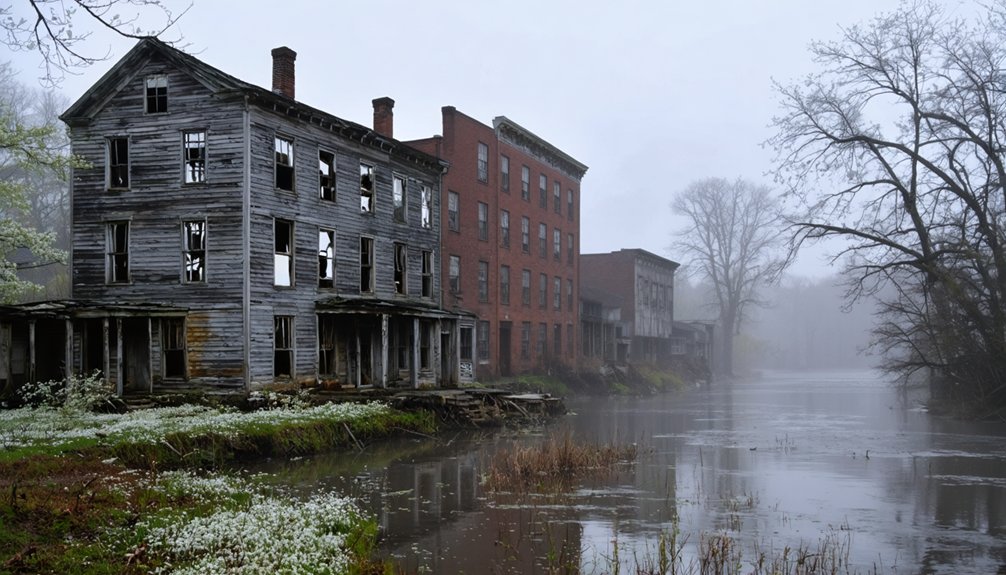
Connecticut’s paranormal reputation runs deeper than most states dare claim. You’ll discover this land hosted America’s first witch trials—three decades before Salem’s infamous hysteria.
When autumn darkness falls across New Haven and surrounding towns, paranormal events multiply beneath the shadow of Sleeping Giant mountain.
Your myth busting journey leads to places authorities won’t discuss freely. Dudleytown’s redacted police reports hint at secrets they’re desperate to bury.
Walk through Johnsonville’s vacant Victorian streets where mill workers’ spirits reportedly linger. Explore Gay City’s forest-consumed ruins and Bara-Hack’s isolated graveyard where stone foundations mark vanished lives.
These aren’t sanitized tourist attractions. They’re raw encounters with Connecticut’s untamed past, where you’ll find freedom from conventional explanations and face mysteries that refuse comfortable answers.
Planning Your Ghost Town Day Trip Route
Before dawn breaks over Hartford, you’ll need a strategy that maximizes your daylight hours across Connecticut’s ghost town landscape. The central-south circuit delivers ideal spring exploration—start at Gay City State Park where historical preservation meets accessible trails, then venture east thirty miles to Bara-Hack’s weathered foundations. From there, wind south to Johnsonville Village’s preserved buildings along Route 66.
Consider these essential route factors:
- Environmental impact: Stay on marked paths to protect fragile ruins and spring ecosystems
- Access restrictions: Dudleytown remains on private land—respect posted boundaries
- Daylight windows: April-May offers ten hours for photography and exploration
- Ferry schedules: Pleasure Beach requires advance planning for coastal access
Your complete loop spans eighty miles, allowing freedom to chase Connecticut’s forgotten settlements without crowding your timeline.
Safety Tips and What to Bring for Your Ghost Town Adventure
Your carefully mapped route means nothing if you’re unprepared for Connecticut’s decaying settlements. Pack sturdy hiking boots for traversing narrow trails where roads once thrived, and bring a headlamp to pierce the shadowy woods along Dark Entry Road.
Long sleeves protect against overgrowth strangling abandoned structures, while bug spray wards off woodland swarms. A first-aid kit proves essential when exploring isolated cellar holes and crumbling foundations.
Wildlife encounters increase near deteriorating buildings—stay alert for animals moving across rotted floors.
Photography tips: morning light penetrates dense canopies best, capturing moss-covered ruins in ethereal detail.
Always join guided tours rather than trespassing; groups provide security while knowledgeable guides prevent dangerous missteps.
Pack water generously—these forgotten places hold no modern conveniences, only history waiting to be witnessed responsibly.
Frequently Asked Questions
Are Pets Allowed at Connecticut’s Ghost Town State Parks?
Yes, you’ll find pet policies welcoming your furry companions at Connecticut’s ghost town state parks. Gay City offers animal accommodations on leashed trails, letting you explore abandoned ruins together through sun-dappled forests and misty meadows from dawn until sunset.
What Are the Operating Hours for Visiting These Ghost Towns?
Time bends differently where historical legends whisper through ruins. You’ll discover preservation efforts open these haunts from 8:00 a.m. until sunset daily, though guided tours follow scheduled pickups starting at 11:00 a.m. for deeper exploration.
Is Photography Permitted at All Connecticut Ghost Town Locations?
You’ll find photography permits aren’t typically required at Connecticut’s ghost towns, though historical preservation sites on state land may need authorization. Most abandoned locations welcome your camera freely, capturing decay’s haunting beauty without restriction.
One of the most intriguing aspects of ghost towns in Connecticut for summer is the opportunity to explore their rich history. Taking the time to wander through the remnants of old buildings can provide a glimpse into the past, making it a perfect backdrop for photography enthusiasts. Be sure to bring along your sense of adventure, as each site tells a unique story waiting to be uncovered.
Do Any Ghost Towns Charge Admission or Parking Fees?
You’ll be thrilled—most Connecticut ghost towns won’t drain your wallet! Historical preservation sites rarely charge fees, though visitor amenities like guided tours cost $25-$30. Cemeteries and outdoor locations remain free, letting you explore haunted grounds without financial barriers.
Can I Camp Overnight Near Any of These Abandoned Settlements?
You won’t find tent camping spots at these ghost towns due to private property restrictions and camping regulations. Gay City State Park offers your best chance—explore nearby designated campgrounds where you can legally pitch your tent under starlit skies.
References
- https://en.wikipedia.org/wiki/List_of_ghost_towns_in_Connecticut
- https://kids.kiddle.co/List_of_ghost_towns_in_Connecticut
- https://www.atlasobscura.com/things-to-do/connecticut/ghost-towns
- https://www.hauntedrooms.com/connecticut/haunted-places
- https://thespaces.com/entire-connecticut-ghost-town-1-9m/
- https://www.youtube.com/watch?v=V3k1shmJqeU
- https://ctvisit.com/articles/ghost-hunting-in-connecticut
- https://westernmininghistory.com/664/what-is-a-ghost-town-wmh-town-classifications-explained/
- https://www.williampitt.com/johnsonville-connecticuts-hauntingly-beautiful-ghost-town/
- https://economictimes.com/magazines/panache/the-haunted-village-why-this-abandoned-ghost-town-in-america-is-an-illegal-zone-to-visit/articleshow/115809235.cms