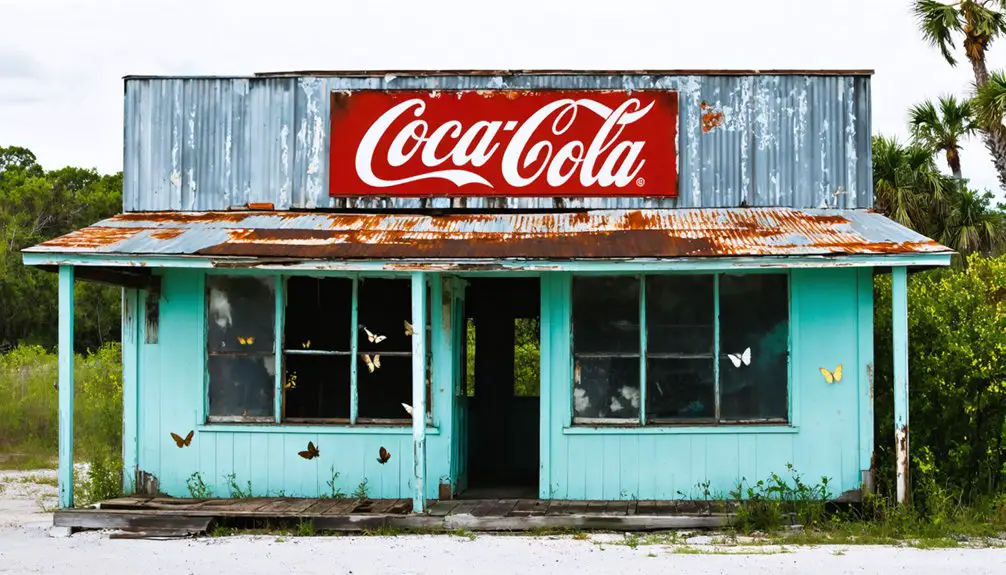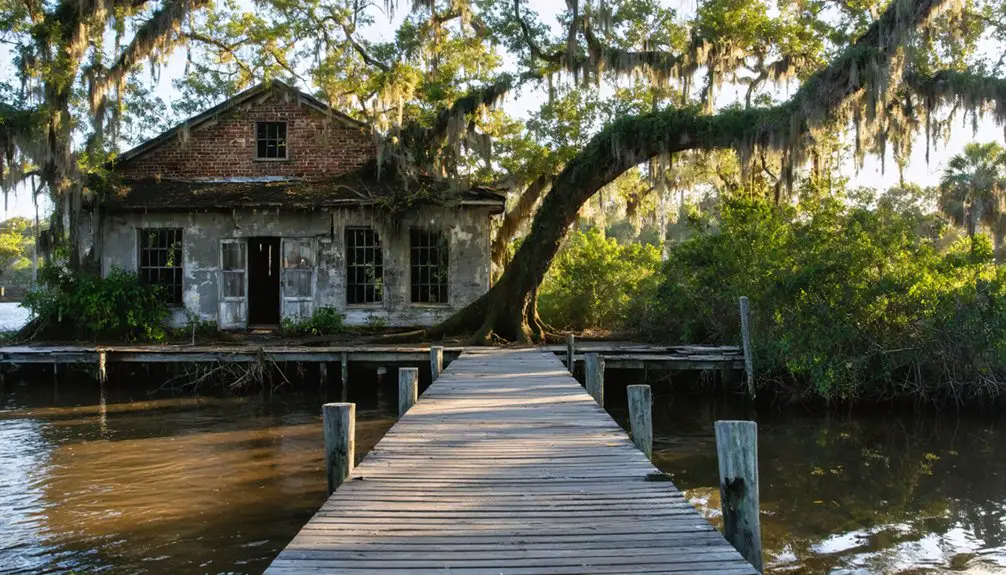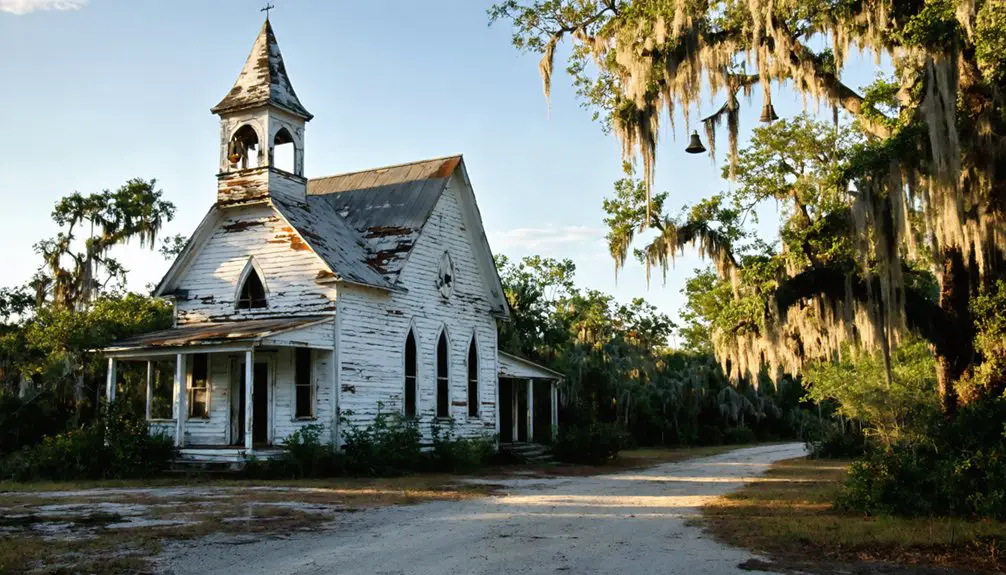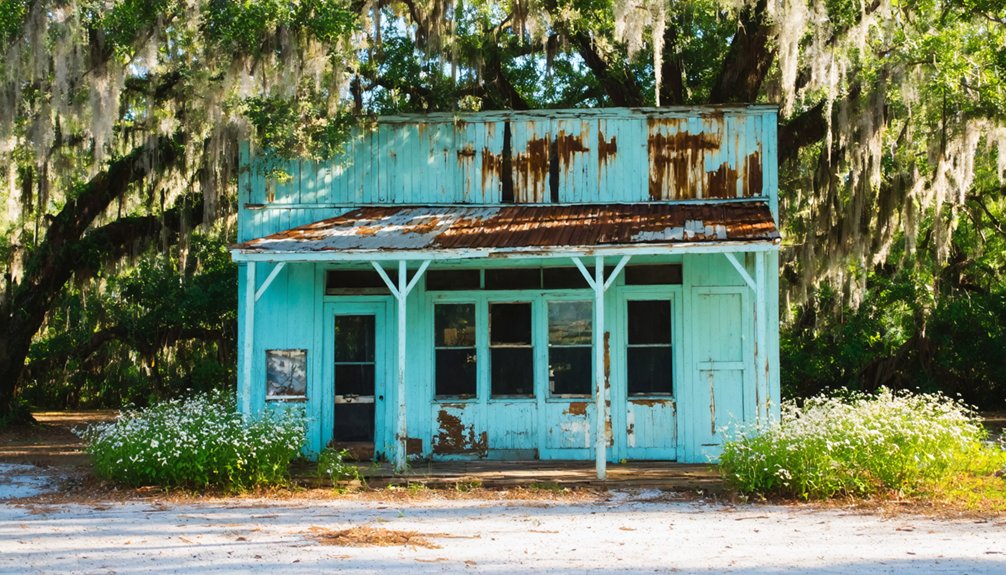
You’ll find Florida’s most atmospheric ghost towns come alive each spring when wildflowers blanket Ellaville’s sawmill ruins and morning mist drifts through Eldora’s citrus groves within Canaveral National Seashore. Fort Dade’s concrete batteries on Egmont Key offer crumbling military history accessible by boat, while Punta Rassa’s cattle-shipping past hides beneath modern causeways. Aladdin City’s Moorish street names whisper of Miami’s 1926 hurricane-destroyed fantasy, and Kerr City’s rusting Texaco station slumbers near Lake Kerr’s shores, each location revealing deeper stories beneath Florida’s spring canopy.
Key Takeaways
- Ellaville offers 5.5 miles of hiking through crumbling industrial ruins, including sawmill foundations, skeletal trestles, and brick cisterns from the 1800s.
- Eldora features the 1877 Eldora House museum, Mystery Well, and scenic trails to Mosquito Lagoon with springtime wildlife like manatees and otters.
- Fort Dade on Egmont Key has 6 miles of brick pathways connecting abandoned military bunkers, batteries, and an 1848 lighthouse for exploration.
- Kerr City near Lake Kerr displays rusting remnants from its 1884 citrus hub era, requiring owner permission to access this registered historic site.
- Spring exploration requires sturdy boots and insect repellent, with warmer waters, blooming flora, and active wildlife enhancing the ghost town experience.
Fort Dade: Military Ruins on Egmont Key
When you step off the boat onto Egmont Key’s shell-strewn beaches, you’ll find yourself transported to a military outpost frozen in time.
Fort Dade’s concrete batteries stand sentinel along the northwest shore, their heavy guns once commanding five-mile ranges as part of Tampa Bay’s coastal defenses.
You’ll wander six miles of brick pathways connecting gutted mess halls, ammunition bunkers, and spotting towers now claimed by jungle vegetation.
The military strategy that once protected this essential shipping channel lies exposed in crumbling walls and water-logged ruins.
Spring’s crystal-clear waters invite you to snorkel Battery Burchsted’s submerged remnants, where colorful marine life has colonized what hurricanes and time couldn’t completely erase.
The island’s historic lighthouse, first erected in 1848, continues to guide vessels through Tampa Bay, making it the oldest structure still serving its original purpose in these waters.
Deep beneath the fortifications, dark underground compartments once stored powder and shells for the coastal defense system.
This state park and wildlife refuge offers complete solitude—accessible only by boat, preserving its haunting beauty.
Eldora: Citrus Settlement Frozen in Time
Tucked within Canaveral National Seashore‘s maritime hammocks, Eldora’s weathered remnants whisper tales of a once-thriving waterfront community that citrus built and winter destroyed.
You’ll discover the 1877 Eldora House—the settlement’s lone survivor—where 200 residents once shipped honey, oranges, and Spanish moss via steamboat along Indian River‘s shores.
The brutal 1895 freeze obliterated their groves overnight, scattering families who’d spent decades cultivating this frontier paradise.
Ghost town preservation efforts transformed the restored boarding house into a museum where you’ll wander rooms frozen in the 1880s, examining citrus history through weathered photographs and fishing artifacts.
Originally known as Pumpkin Point, the settlement evolved into a bustling community complete with its own post office, school, and a unique medicinal syrup business harvesting palmetto berries.
Near the Eldora House stands the Mystery Well, an enigmatic structure that plunges far deeper than the regional water table required, with its true purpose still puzzling researchers and fueling speculation about hidden storage or secret passages.
Follow the mile-long Eldora Hammock Trail through gnarled oaks dripping Spanish moss toward Mosquito Lagoon, where manatees surface in morning mist—nature reclaiming what winter’s fury stole.
Ellaville: Industrial Ghost Town of North Florida
You’ll discover Ellaville’s transformation from Florida’s largest sawmill operation to wilderness ruins as you hike the 5.5-mile loop through what was once George Drew’s industrial empire.
Spring’s mild temperatures and lower river levels reveal crumbling bridge foundations, overgrown building sites, and the skeletal railroad trestles that once transported timber from a mill employing 500 workers.
The convergence of the Suwannee and Withlacoochee Rivers frames your exploration of this company town where prosperity drowned beneath floods and economic collapse, leaving only iron and stone to mark where a thousand residents once lived.
Founded in 1861 and named for Drew’s African-American servant Ella, the town peaked at about 1,000 residents by the early 1870s before ultimately declining into abandonment.
Drew became known as “Millionaire Drew” within 15 years of establishing the mill, amassing significant wealth from his lumber operations before serving as Florida’s first post-Civil War governor in 1876.
Company Town Origins
Long before Ellaville became a ghost town, George Franklin Drew stood on the western banks of the Suwannee River in 1861 and envisioned an industrial empire rising from Florida’s dense pine forests. He named his settlement after Ella, his loyal African-American servant, and built a mansion before the Civil War reshaped everything.
You’ll discover Ellaville’s industrial heritage emerged when Drew partnered with Louis Bucki to establish Florida’s largest steam-operated sawmill.
This company town exploded to 1,000 residents by the 1870s, sprawling across 1,200 acres with 90,000 more in timberlands. Workers filled two schools, two churches, and a bustling commissary while 500 employees kept the mill running.
Drew’s empire extended to railroad car production, turpentine operations, and even a private railroad connecting his domain to distant markets.
Industrial Collapse Remnants
The catastrophic mill fire of 1898 marked the beginning of Ellaville’s slow death, though the town’s founders rebuilt quickly and pressed on.
You’ll find where industrial machinery once processed yellow pine from 90,000 acres, now reclaimed by Madison County wilderness.
The exhausted timber supply forced the mill’s permanent closure around 1900, abandoning worker settlements that housed 500 employees.
Relentless flooding from the Suwannee and Withlacoochee Rivers accelerated the exodus through the early 1900s, washing away dreams of prosperity.
The Great Depression delivered the final blow—shops shuttered, families scattered, leaving only whispers of ambition.
When the post office closed in 1942, Ellaville officially ceased to exist.
Today you’ll discover eerie remnants hidden off-grid, where nature devours what determination built.
Deep brick cisterns and crumbling foundations emerge from the forest floor, silent witnesses to the town’s industrial past.
The abandoned Drew Mansion burned in the 1970s after years of vandalism, erasing the last monument to millionaire founder George Franklin Drew.
Spring Exploration Tips
When spring’s mild breath sweeps across Madison County, Ellaville’s riverside ruins emerge from winter dormancy as North Florida’s most atmospheric ghost town destination.
You’ll navigate remnants of the abandoned Florida Railway Mainline, where spring flowering trillium and violets carpet the Suwannee’s banks.
Pack sturdy boots for uneven terrain along old rail paths, and bring insect repellent for mosquito-heavy zones near the Withlacoochee confluence.
Time your exploration for daylight hours—no facilities exist at this remote site.
River wildlife thrives in warming March-April waters; watch for otters and alligators (maintain 30 feet distance).
Check USGS gauges beforehand, as spring floods can isolate access points.
The 1925 Hillman Bridge offers commanding views across stabilized river levels, perfect for spotting migratory birds returning to steamboat dock sites where commerce once thrived.
Punta Rassa: Vanished Gateway to Southwest Florida
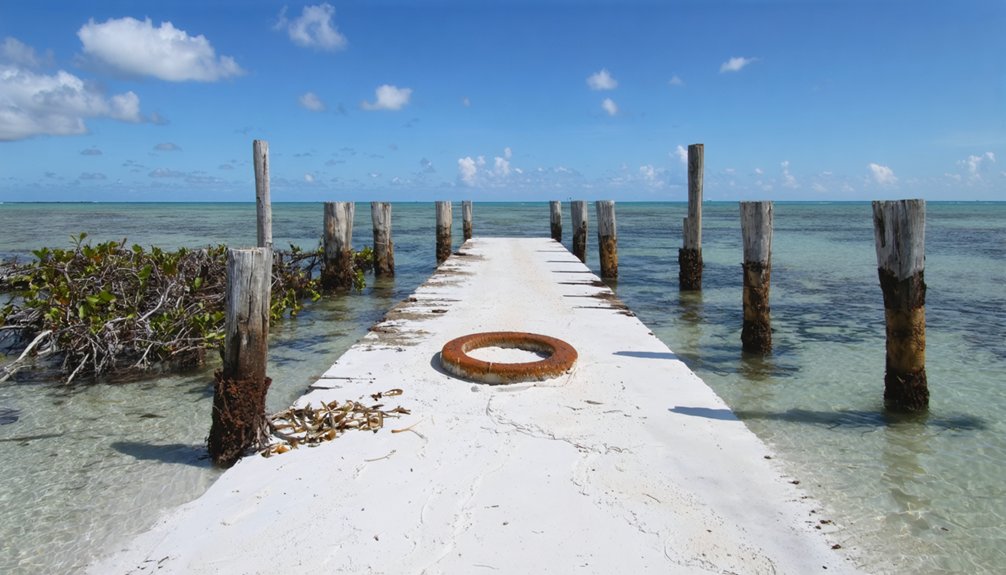
You’ll find Punta Rassa’s remnants where the Sanibel Causeway toll plaza now stands, though little remains of the bustling 19th-century port that once echoed with the crack of cowboys’ whips and the lowing of thousands of cattle bound for Cuban markets.
This vanished gateway served as Southwest Florida’s crucial connection to the world—home to the telegraph station that first brought news of the USS Maine’s sinking to American soil and the launching point for Jake Summerlin’s cattle empire.
Today’s bridge traffic rushes past where Fort Dulaney’s barracks once stood and the Schultz Hotel welcomed wealthy sportfishermen, leaving only historical markers to hint at the strategic military outpost and commercial hub that shaped Fort Myers’ coastal heritage.
Historic Trading Post Location
Long before Fort Myers emerged as Southwest Florida’s commercial hub, Punta Rassa thrived as the region’s most essential gateway—a windswept point where Spanish cattle ships, Confederate blockade runners, and international telegraph cables converged on Florida’s Gulf coast.
You’ll find shell mounds scattered across this vanished settlement, remnants of the Calusa Indians who first recognized this strategic location’s value. By the 1860s, Jacob Summerlin‘s cattle trade transformed Punta Rassa into Southwest Florida’s economic powerhouse, shipping over 1.5 million head to Cuba.
The crack of cowhands’ twelve-foot whips once echoed across these coastal plains as “crackers” drove herds toward waiting ships.
Today, you’ll discover only fragments of the International Ocean Telegraph Company building—faint traces of a town that once outranked Fort Myers in regional importance.
Sanibel Connection Today
Where Punta Rassa once bustled with cattle and telegraph operators, the Sanibel Causeway now launches from its exact coordinates—a three-mile engineering marvel that replaced George Shultz’s steamboat service in 1963.
You’ll drive over the exact spot where 30,000 head of cattle annually departed for Cuban markets, though nothing marks this vanished empire. Maritime archaeology enthusiasts can explore the underwater remnants of the Ponderosa and other 19th-century shipwrecks nearby.
The cattle industry that once defined this peninsula exists only in sediment cores and rusted iron beneath condominiums. Pull into the causeway parking area and scan the waters—somewhere beneath those waves lie the telegraph cables that connected Cuba to mainland America.
The fishing pier stands as the sole acknowledgment of Punta Rassa’s strategic waterfront legacy.
Fort Myers Coastal Heritage
Before the Sanibel Causeway carried tourists toward island paradise, Punta Rassa commanded Southwest Florida’s coastline as a strategic crossroads where cattle barons, telegraph operators, and military commanders converged on a wind-scraped peninsula.
You’ll discover where Ponce de León introduced America’s first cattle in 1521, where 30,000 head thundered through Fort Dulaney’s corrals by 1840, and where underwater telegraph cables carried news of the USS Maine’s destruction in 1898—reaching Punta Rassa before anywhere else in America.
Climate change now reshapes these coastal remnants, transforming former shipping docks into wildlife habitats where herons stalk through marsh grasses that once trampled beneath livestock hooves.
The International Ocean and Telegraph Company’s monument marks where civilization’s threads connected Cuba to Key West to continental ambition.
Aladdin City: Miami’s Forgotten Moorish Dream
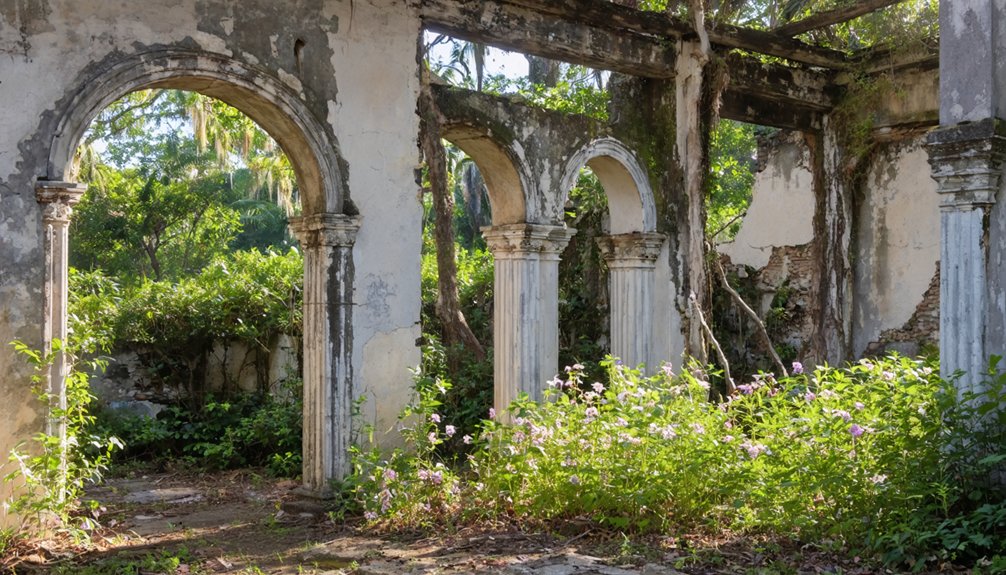
Tucked into Miami’s Redland region, Aladdin City rose like a mirage from the Florida soil in 1926, its exotic street names—Ali Baba Circle, Damascus Street, West Cairo Street—promising a Moorish fantasy that would rival Coral Gables’ Mediterranean elegance. The Sovereign brothers envisioned mail-order kit homes assembled in a single day, creating an architectural revival that challenged conventional development. September’s devastating hurricane shattered their dream before it flourished.
A 1926 Moorish paradise destroyed by hurricane before completion, leaving only exotic street names and architectural fragments in Miami’s Redland.
Today, you’ll discover community preservation efforts maintaining this ghost town’s memory:
- Explore the oval-shaped Ali Baba Circle where Persian-design bank cornerstones still mark forgotten ambitions
- Trace 200-foot-wide Sovereign Boulevard’s path through abandoned lots
- Photograph surviving Moorish Revival structures scattered across countryside remnants
- Compare Aladdin City’s ruins with thriving Opa-locka’s similar architecture
This spring, walk freely through Miami’s vanished fantasy.
Kerr City: Hidden Remnants of a Lost Community
While Miami’s Moorish fantasies crumbled along the coast, a quieter dream faded into Marion County’s pine forests.
You’ll find Kerr City’s fourteen original structures scattered across 205 acres near Lake Kerr—Florida’s first Texaco station, a weathered post office, and abandoned buildings that once housed a thriving citrus community of 100 souls.
George Smiley carved this stagecoach stop from plantation land in 1884, but the Great Freeze of 1894-1895 killed more than orange trees—it killed futures.
Within a decade, residents fled, leaving behind rusting bed frames and gas lamps frozen in time.
Today, Kerr City legends whisper through cracker cabins and cemetery headstones.
You’ll need the owner’s permission to explore this National Register site, but that’s what makes discovery worthwhile.
Frequently Asked Questions
What Permits or Permissions Are Needed to Visit Florida Ghost Towns?
You’ll need standard park passes for most sites, respecting historical preservation efforts. Private property concerns require owner permission before exploring certain ruins. Most public ghost towns welcome your spontaneous adventures without special permits—just follow posted guidelines.
Are Florida Ghost Towns Safe to Explore With Children in Spring?
You’ll find most Florida ghost towns reasonably safe with supervision, though haunted stories and local legends add thrilling atmosphere. Navigate crumbling fort walls, dodge spring mosquitoes, and watch children closely around overgrown trails where adventure meets calculated risk.
What Should I Bring When Visiting Remote Ghost Town Locations?
Like a time traveler’s survival kit, you’ll need water, sturdy boots, and bug spray for Florida’s wilderness ruins. Bring cameras for ghost town history photography tips, plus offline maps, first-aid supplies, and sunscreen to document your untethered adventure safely.
Can I Camp Overnight Near Any of These Ghost Town Sites?
You’ll find overnight camping at Flamingo’s modern campground near the ghost town ruins. Wake to sunrise photography tips over historic sites, then explore abandoned structures freely. Other locations lack designated camping, requiring day-trip planning instead.
Which Florida Ghost Towns Have Guided Tours or Visitor Centers?
You’ll find guided ghost tours in Apalachicola, Cocoa Village, Titusville, St. Cloud, and Key West. Each offers historical preservation through experiential walks, where local legends come alive with spine-tingling tales and authentic ghost-hunting adventures you’ll never forget.
References
- https://www.florida-backroads-travel.com/florida-ghost-towns.html
- https://www.ghosttowns.com/states/fl/fl.html
- https://www.youtube.com/watch?v=-vPPooDMJ5U
- https://www.atlasobscura.com/things-to-do/florida/ghost-towns
- https://www.timeout.com/florida/florida-ghost-towns
- https://patchproflorida.com/blog/the-fascinating-history-of-floridas-ghost-towns/
- https://floridatrailblazer.com/tag/ghost-towns/
- https://www.freakyfoottours.com/us/florida/
- https://www.legendsofamerica.com/fort-dade-egmont-key/
- https://abandonedfl.com/fort-dade/