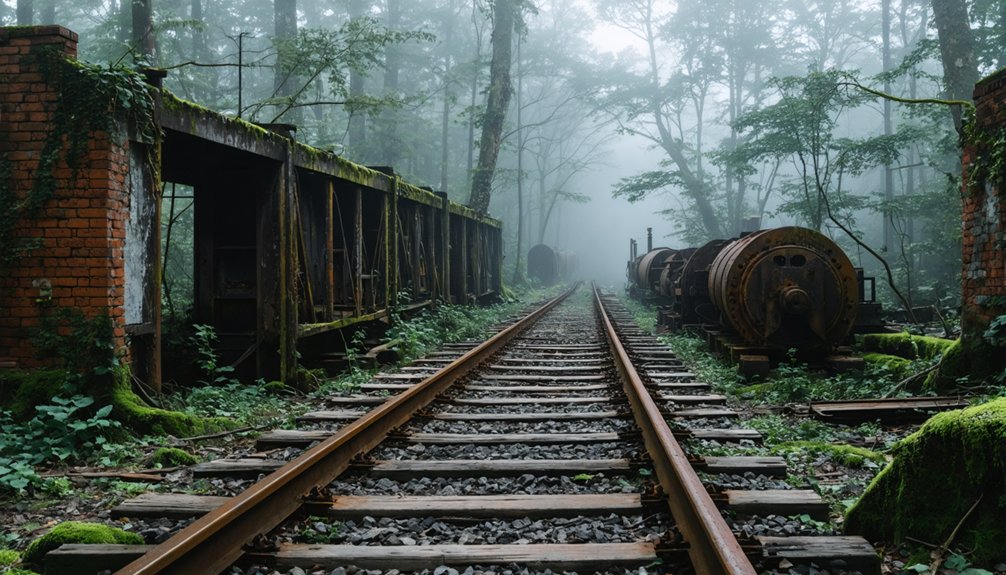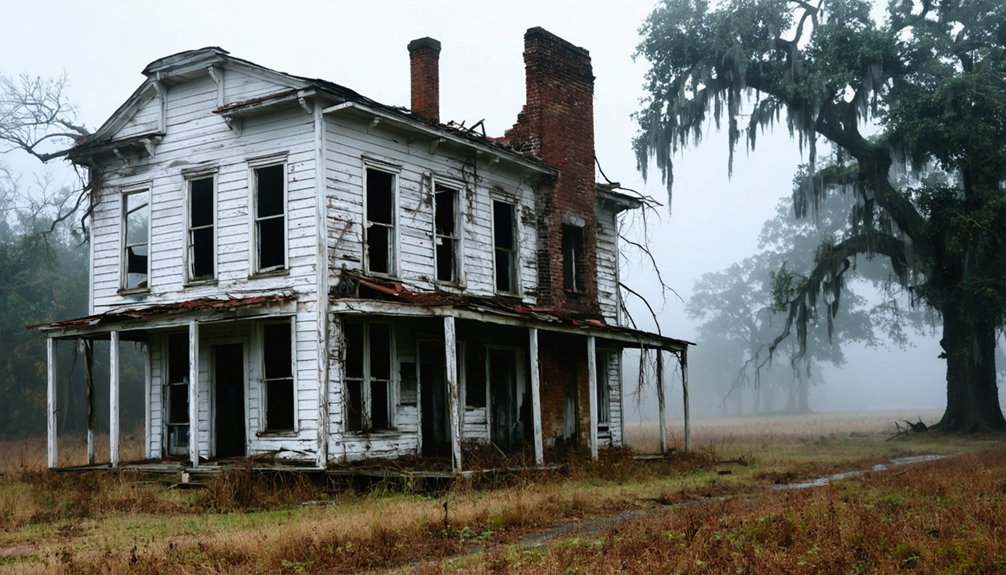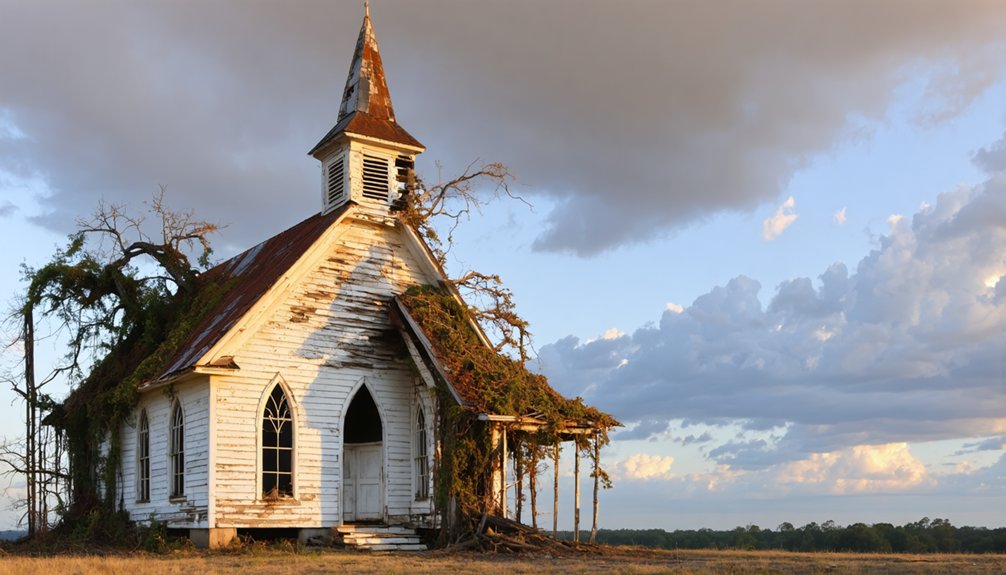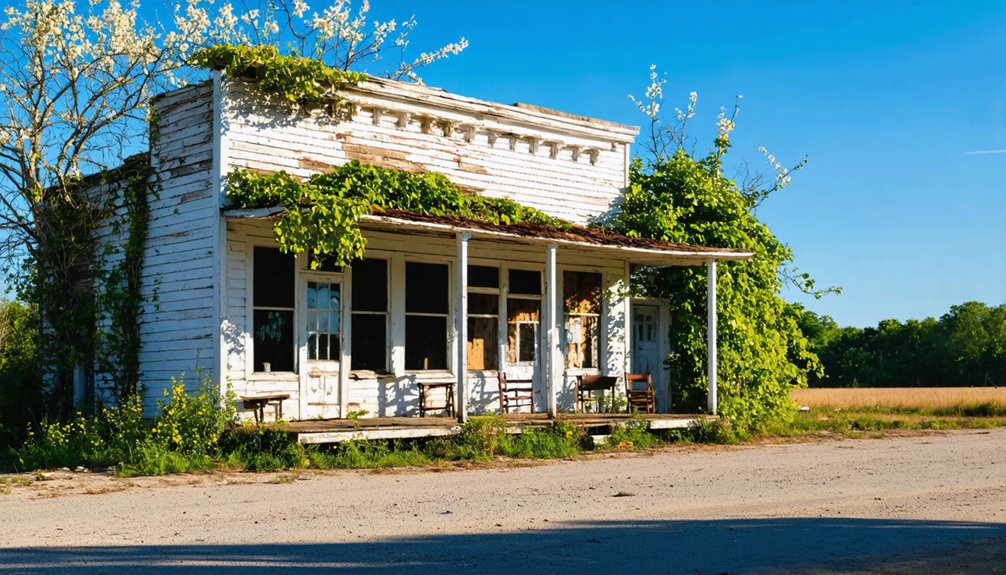
You’ll find Georgia’s ghost towns stunning in spring when wildflowers bloom through Auraria’s gold rush ruins and dogwoods frame Scull Shoals’ crumbling mill walls along the Oconee River. Don’t miss Wrightsboro’s hand-cut stone Rock House or Ebenezer’s 1769 Jerusalem Lutheran Church, where colonial history whispers through the warming air. Apalachee’s Gothic Revival church stands sentinel over dissolved dreams, while the gentle season makes hiking to these forgotten settlements infinitely more comfortable. Each location below reveals secrets best discovered when nature reclaims what time abandoned.
Key Takeaways
- Auraria offers gold rush history with accessible ruins, remnants of fifteen law offices, and connections to Colorado’s Denver founding story.
- Scull Shoals features Georgia’s first paper mill ruins along the Oconee River, including an arched brick bridge and warehouse walls.
- Wrightsboro preserves Quaker heritage through the hand-cut stone Rock House, historic cemetery, and fort from the 1768 settlement.
- Ebenezer showcases Jerusalem Lutheran Church from 1769, colonial Salzburger architecture, and Revolutionary War significance as Georgia’s brief capital.
- Apalachee displays an 1857 Gothic Revival Baptist Church and abandoned structures along Highway 441 near Madison’s rural countryside.
Auraria: Golden Remnants in the North Georgia Mountains
Spring’s perfect for exploring without summer’s oppressive heat.
Walk past foundations where fifteen law offices once operated, imagining the “Scuffle Town” chaos that earned Auraria its rough reputation.
Gold mining ceased long ago, but you’re free to wander unrestricted, discovering remnants of $20 million worth of extracted gold and the frontier spirit that built Colorado’s Denver. The town’s peak population exceeded 200 in 1840, bustling with miners, lawyers, and shopkeepers before the California Gold Rush drew everyone away.
The Athens Stage Line once connected this bustling hub to Augusta and other towns, bringing travelers and commerce to the gold fields.
Scull Shoals: Industrial Ruins Along the Oconee River
Along the Oconee River’s banks, where water once powered Georgia’s first paper mill, Scull Shoals stands as a haunting memorial to industrial ambition and nature’s persistence.
Where industrial dreams met their ruin, the Oconee River reclaims what human ambition built—a testament to nature’s quiet victory.
You’ll discover crumbling warehouse walls and an arched brick bridge spanning the old raceway—remnants of a town that employed 600 workers and processed 12,000 cotton bales annually.
The site’s industrial heritage reveals itself through stone foundations buried beneath decades of silt. That same erosion that doomed the mills makes your spring exploration compelling: nature’s reclaimed what commerce built.
Access the ruins via dirt road off Macedonia Road near Greensboro, then follow the gentle riverside trail.
The riverboat history here connected Georgia’s cotton economy to distant markets, though the 1887 flood ultimately swept those dreams downstream forever. Fort Clark, constructed in 1793 by Michael Cupp, originally protected these riverside settlers from Creek Indians across the water.
Among the village’s early leaders was Dr. Lindsay Durham, who operated a 600-bed hospital and developed patent medicines that advanced local healthcare practices.
Wrightsboro: A Quaker Settlement Frozen in Time
Where Georgia’s red clay meets conviction, Wrightsboro preserves the unlikely story of 40 Quaker families who carved the South’s most remote Friends settlement from Creek Indian lands in 1768.
You’ll find authentic Quaker architecture in the Rock House’s hand-cut stone walls—built thick enough to withstand both elements and uncertainty.
Walk the 1810 cemetery where Joseph Maddock rests, the miller who built this pacifist outpost before Patriots burned him alive for refusing violence.
Their principled stand against slavery drove nearly every Friend northward by 1809, leaving behind only ruins and conviction. The Governor Wright-commissioned fort once stood nearby to protect the pacifist settlers from regional conflicts.
Historic preservation efforts maintain what remains on Wrightsboro Road off US 78. The settlement originally received 12,000 acres from Royal Governor James Wright, later expanded to 44,000 acres as the community grew among the pines.
Visit dawn or dusk when spring light filters through ancient oaks, and you’ll understand why some beliefs matter more than staying put.
Ebenezer: Colonial Heritage Near Savannah
Twenty-five miles upriver from Savannah’s cobblestones, Ebenezer unfolds as Georgia’s most consequential ghost town—where 150 Austrian Protestants turned religious exile into colonial prosperity.
You’ll discover Jerusalem Lutheran Church still standing from 1769, its walls witnessing Revolutionary War occupation when British soldiers converted sanctuary into hospital.
Historical preservation has maintained this rare colonial structure, emblematic of Salzburgers who built Georgia’s first orphanage and Sunday school here.
Walk Red Bluff’s banks where water-driven grist mills once powered a 2,000-person settlement rivaling Savannah.
The community’s grid pattern layout centered around communal areas, with kitchen gardens radiating toward agricultural fields on the outskirts.
Spring brings azaleas blooming around empty foundations—remnants of biblical-named satellite communities.
Cultural tourism opportunities abound at the on-site museum interpreting Salzburger resilience.
You’re tracing footsteps of refugees who escaped Catholic persecution, only to forge freedom through silk production and Lutheran pietism in Georgia’s wilderness.
The town briefly served as Georgia’s capital in 1782 after American forces reclaimed it from British control.
Forgotten Rural Settlements: Apalachee and Godfrey
North of Madison along US Highway 441, Apalachee whispers stories of cotton-town ambitions that railroad tracks couldn’t sustain.
You’ll discover the 1857 Baptist Church’s Gothic Revival spires still reaching skyward, while abandoned schools like the massive 1911 schoolhouse—now converting to private residence—remind you how boll weevils and Depression decimated prosperity.
The town dissolved in 1995, yet you can wander Parsonage Road where residences cling to memory.
Venture deeper into Putnam or Hancock County to find Godfrey, where agricultural dreams vanished with fewer traces.
Unlike Apalachee’s historic churches and preserved landmarks, Godfrey offers pure exploration—no markers, just quiet fields reclaiming what humanity abandoned.
The post office closed in the 1950s, marking the beginning of the community’s gradual fade from prominence.
Spring breathes life into these forgotten settlements, perfect for those seeking unscripted discoveries beyond tourist maps.
In its heyday during 1920, the town supported three general stores alongside a cotton gin, oil refinery, and vibrant cultural clubs that brought the community together.
Frequently Asked Questions
Are Ghost Town Visits in Georgia Free or Do They Require Entrance Fees?
You’ll find most Georgia ghost towns are free to explore, though some require state historic site fees. Historical preservation efforts protect certain locations, while unauthorized access to private property risks trespassing charges. Always verify ownership before adventuring onto abandoned grounds.
Exploring abandoned places in Georgia provides a glimpse into the past, revealing stories etched in the crumbling walls and overgrown landscapes. Each site often carries with it a sense of mystery, inviting adventurers to uncover the secrets left behind. However, keep in mind that some areas may not be safe or accessible, so always prioritize your safety during your explorations.
What Safety Precautions Should Visitors Take When Exploring Abandoned Georgia Ghost Towns?
You’ll need sturdy footwear and constant hazard awareness—watch for unstable floors and rusty nails. Respect preservation efforts by not disturbing structures. Travel during daylight, tell someone your plans, and pack first aid supplies for unexpected cuts or scrapes.
Can Visitors Camp Overnight Near These Georgia Ghost Town Locations?
You’ll discover overnight camping at several ghost town sites, where historical preservation meets adventure. Camp Rutledge near Hard Labor Creek welcomes explorers, while High Falls offers year-round stays amid local legends. You’re free to experience Georgia’s haunted past firsthand.
Are Guided Tours Available for Any of Georgia’s Ghost Town Sites?
You’ll find guided ghost tours throughout Georgia that weave local legends into historical preservation efforts. Dahlonega offers researched walking tours, while Savannah’s award-winning experiences let you explore haunted sites with paranormal equipment and expert storytellers leading your adventure.
What Is the Best Time of Day to Photograph Georgia Ghost Towns?
You’ll capture the best shots during early morning photography around 6-7 AM or with sunset lighting between 5-7 PM. These golden hours bathe weathered buildings in warm, dramatic light that’ll make your ghost town images truly unforgettable.
References
- https://roughdraftatlanta.com/2021/05/23/travels-with-charlie-georgias-ghost-towns-slideshow/
- https://flagpole.com/news/news-features/2013/10/23/exploring-georgias-ghost-towns/
- https://www.ghosttowns.com/states/ga/ga.html
- https://www.ezhomesearch.com/blog/ghost-towns-in-georgia/
- https://vanishinggeorgia.com/tag/georgia-ghost-towns/
- https://www.freakyfoottours.com/us/georgia/
- https://www.youtube.com/watch?v=OfhPAHTOkJE
- https://exploregeorgia.org/things-to-do/article/where-to-find-famous-georgia-ghosts
- https://lisamrussell.substack.com/p/auraria-georgias-golden-ghost-town
- https://www.hhhistory.com/2025/10/auraria-georgias-gold-rush-ghost-town.html