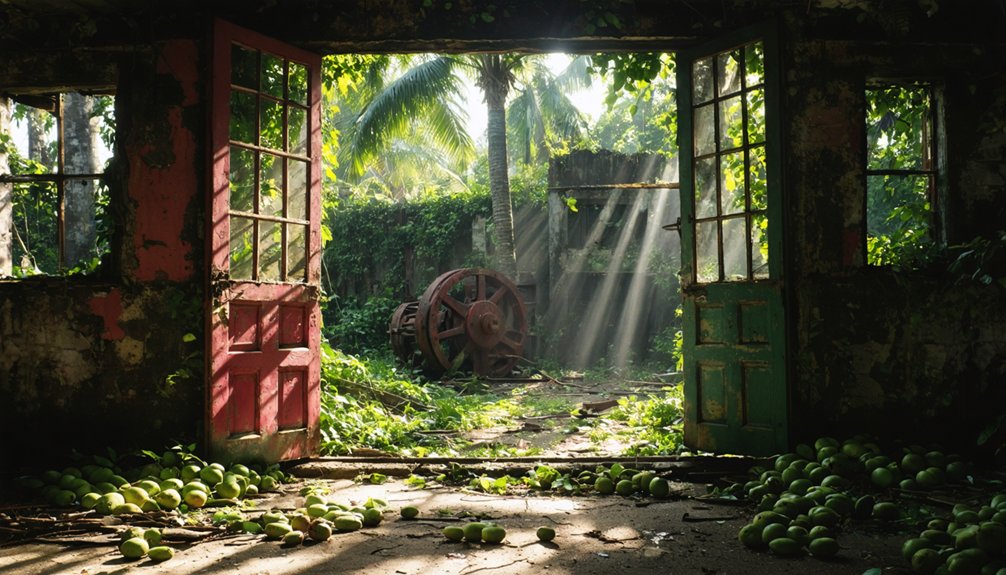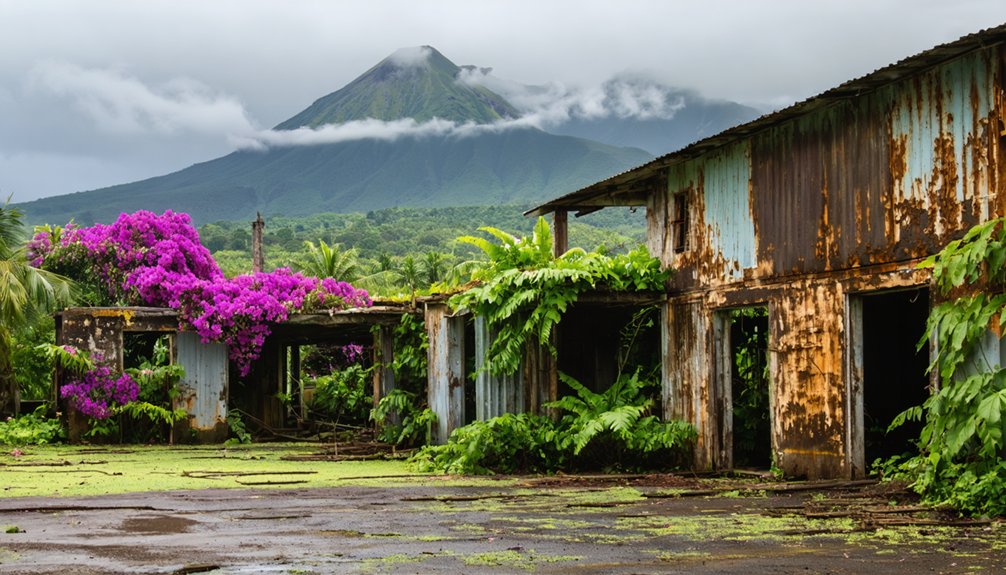
You’ll find Hawaii’s most haunting “ghost towns” beneath hardened lava flows and jungle vines. Walk across Kalapana’s jet-black crust where 180 homes vanished overnight in 1990, or descend switchback trails to Kalaupapa Peninsula, where Hansen’s disease patients lived in forced isolation until 1969. Spring’s mild weather makes hiking these sites ideal—you won’t face summer’s scorching heat or winter’s unpredictable rains. Each location holds stories of resilience, tragedy, and cultural memory that transform ordinary visits into profound encounters with Hawaii’s complex past.
Key Takeaways
- Kalapana on the Big Island, buried by lava in 1990, is accessible via a short hike over lava fields from Highway 130.
- Kalaupapa Peninsula on Molokai features two historic settlements, now a national park, though the trail remains closed since 2018.
- Ancient Kaupulehu sites on the Big Island reveal visible archaeological remains like stone foundations and royal salt works.
- Puʻuhonua O Hōnaunau on the Kona Coast preserves sacred refuge structures surrounded by a 1,500-foot lava wall.
- Morgan’s Corner on Oahu, site of a 1948 murder, lies behind gates at ‘Ilana Wai residential community.
Lava-Buried Villages of the Big Island: Kaimu and Kalapana
When Kilauea’s Pu`u `O`o vent awakened in 1983, nobody imagined it would erase an entire coastal community from Hawaii’s map.
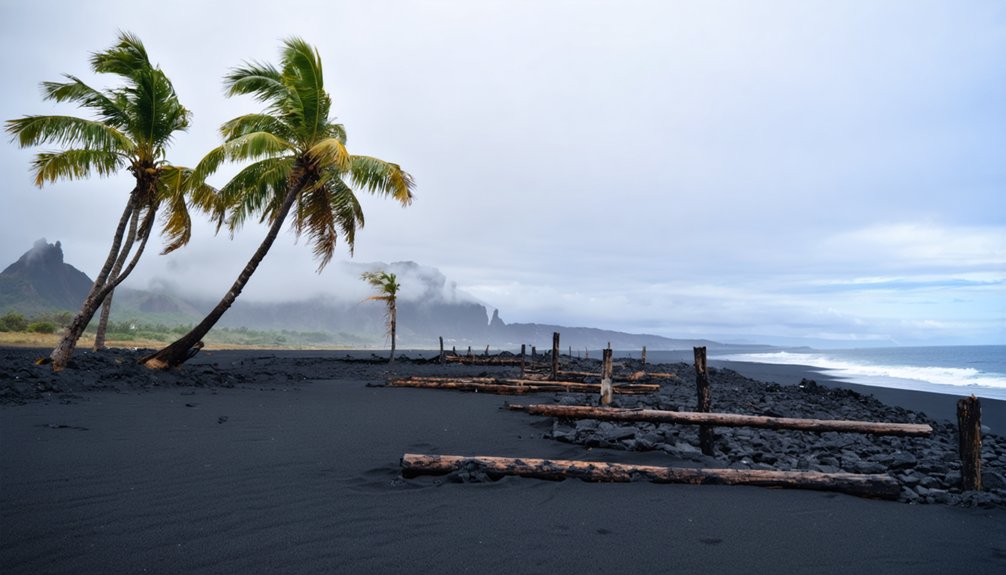
By 1990, Kalapana vanished beneath 50–80 feet of molten rock, swallowing over 180 homes, the legendary Kaimu Black Sand Beach, and the 13th-century Wahaula Heiau temple.
Kalapana disappeared under 50–80 feet of lava in 1990, consuming 180 homes, a black sand beach, and an ancient temple.
You’ll walk across stark volcanic landscapes where roads now dead-end at hardened lava. The island gained 1,000 feet of new coastline, transforming geography overnight.
Yet resilience blooms here—locals replanted coconut groves and papaya trees atop their buried village.
Today’s lava-formed beaches emerge as waves pulverize young rock into fresh black sand.
Rock circles and art installations honor what’s lost while celebrating renewal.
New homes being built on these recent lava fields create some of the youngest lands on Earth, attracting settlers drawn to affordable property despite the volcanic risk.
This haunting terrain embodies Hawaii’s eternal cycle: destruction breeding creation, past merging with future. Access the area via a short hike over lava fields from the end of Highway 130, where free parking awaits near Uncle Robert’s Awa Bar & Farmers Market.
Ancient Settlements Lost to Time: Kaupule and Waipi’o Valley
While volcanic fury reshaped Kalapana within living memory, older losses whisper from Hawaii’s deeper past—settlements that didn’t vanish in dramatic flows but faded gradually as populations shifted and traditions transformed.
You’ll find Kaupulehu’s ancient cultural sites along the Big Island’s west coast, where royal families once controlled salt works and sacred shark birthing caves.
The 1790 Fair American incident marked its historical turning point, yet the archaeological significance runs deeper—family kauhale clustered around springs, their stone foundations still visible among kiawe trees.
Waipi’o Valley tells a different story. Its taro patches supported scattered homesteads where ‘ohana ties, not village centers, shaped settlement patterns.
Each kauhale contained multiple specialized structures, from the hale noa for family sleeping to separate eating houses for men and women.
You’re walking through landscapes where ownership meant diligent labor, where neighbors interdependence created organic communities that conquest couldn’t entirely erase.
Molokai’s Leprosy Settlement: Kalawao and Kalaupapa
No Hawaiian “ghost town” carries more profound weight than Kalaupapa Peninsula, where isolation policy created a community bound by stigma and survival. You’ll find two settlements here: Kalawao, where twelve patients arrived in 1866, and Kalaupapa village, where the community relocated by 1900 seeking warmer weather and better supplies.
Father Damien’s 1873 arrival transformed desperate conditions—building homes, churches, and dignity where only caves existed before. Sulfone drugs introduced in 1946 effectively cured Hansen’s disease, leading to the eventual abolition of forced quarantine laws by 1969.
Today’s Kalaupapa National Historical Park represents both historical preservation and cultural resilience. Four former patients still call this peninsula home, their guaranteed lifelong residency honoring decades of forced separation. The challenging Kalaupapa Pali Trail descends 2,000 feet over 3.5 miles with 26 switchbacks, though it has remained closed to the public since 2018.
You can’t visit without permission—access remains restricted, protecting residents‘ privacy while preserving 900 years of Hawaiian history beneath the world’s tallest sea cliffs.
Haunted Oahu: Morgan’s Corner and Old Pali Road
Where Honolulu’s verdant Nu’uanu Valley climbs toward the Ko’olau Range, a sharp hairpin turn on Pali Drive has collected decades of tragedy, rumor, and genuine horror.
You’ll find Morgan’s Corner—named for Dr. James Morgan’s 1920s estate—where 68-year-old Therese Wilder was murdered by escaped convicts in 1948. She suffocated from a broken jaw and forced gag at 3939 Nu’uanu Pali Road. The case sparked debate over capital punishment in Hawai’i.
Urban legends now obscure documented facts. That viral story about teenagers hanged from trees? Unverified folklore.
Yet hundreds of road accidents at this blind curve have killed real victims, their spirits allegedly haunting the switchback where drivers race at dangerous speeds. Locals passing through report experiencing “chicken skin” when navigating the notorious bend at night.
Ghost tours misleadingly direct you elsewhere for liability reasons. The authentic location sits behind gates at ‘Ilana Wai residential community—inaccessible, privatized, its dark history paved over but never forgotten.
Sacred Refuge Sites: PuʻUhonua O Honaunau on the Kona Coast
Oahu’s modern ghost stories pale beside the ancient spiritual power radiating from Puʻuhonua O Hōnaunau, where condemned souls once fled for their lives across shark-infested waters.
You’ll feel the mana emanating from this 180-acre sanctuary the moment you approach its thousand-foot lava wall—built without mortar in 1550, still standing after five centuries.
The cultural significance here runs deeper than most historical sites. Twenty-three chiefs’ bones rest in Hale o Keawe temple, their spiritual energy once powerful enough to absolve any crime.
Kapu breakers who reached these grounds walked free, absolved through sacred rituals performed by kahuna priests.
Spring brings fewer crowds, letting you absorb the site’s transformative energy.
Watch green sea turtles glide through Hōnaunau Bay—the same waters desperate lawbreakers once swam seeking redemption. Near the bay, you’ll find Keone’ele Cove, which served as the royal canoe landing traditionally surrounded by grass huts where high chiefs arrived and departed. Carved Kiʻi wooden statues surround the temple grounds, representing Hawaiian gods and family guardians central to the site’s spiritual power.
Frequently Asked Questions
What Permits or Permissions Are Required to Visit These Ghost Towns?
Traveling Hawaii’s ghost towns feels like opening hidden treasures—you’ll need state permits for Kalaupapa, landowner permission for Hālawa Valley, and guided tour waivers elsewhere. Local regulations protect these sacred spaces, so permission requirements guarantee respectful access while honoring cultural boundaries.
Are Guided Tours Available for These Abandoned Hawaiian Sites?
Yes, you’ll find guided tours at most sites, emphasizing historical preservation and offering incredible photography opportunities. Kalaupapa requires mandatory mule tours, while Waipi’o Valley operators share cultural insights through 4×4 adventures down those dramatic cliffs.
What Safety Precautions Should Visitors Take When Exploring Ghost Towns?
Ghost towns are time capsules with hidden dangers. You’ll need sturdy safety gear—boots, water, first aid—and solid emergency planning. Stay on marked paths, tell someone your route, and respect kapu sites while chasing that untamed adventure.
How Accessible Are These Locations for Visitors With Mobility Limitations?
Hawaii’s ghost towns present significant accessibility challenges with rugged terrain, uneven paths, and lack of infrastructure. You’ll need mobility assistance and possibly off-road wheelchairs. Most require advance planning, specialized equipment, and physical support to navigate safely.
Hawaii’s hidden ghost town experiences offer a unique glimpse into the islands’ past, where remnants of history await intrepid explorers. Engaging with these eerie sites can uncover fascinating stories and hidden treasures, but be prepared for the journey ahead. With the right preparation and mindset, these adventures can lead to unforgettable discoveries off the beaten path.
What Is the Best Time of Day to Visit These Sites?
You’ll absolutely *die* for evening tours starting at 7:00-8:00 PM—they’re perfect for capturing spine-tingling photography while local legends come alive. You’ll experience Hawaii’s haunted history with complete freedom, exploring paranormal hotspots when spirits are most active.
References
- https://nvtami.com/2023/04/26/big-island-hawaii-ghost-towns/
- https://www.americanghostwalks.com/7-creepiest-urban-legends-and-ghost-stories-from-hawaii
- https://www.youtube.com/watch?v=3tGSM9Xl-4M
- https://www.geotab.com/ghost-towns/
- https://www.mysteries-of-hawaii.com/blog
- https://freepages.rootsweb.com/~gtusa/history/usa/hi.htm
- https://www.atlasobscura.com/things-to-do/hawaii/abandoned
- https://en.wikipedia.org/wiki/List_of_ghost_towns_in_Hawaii
- https://arnottslodge.com/kaimu-black-sand-beach/
- https://www.shakaguide.com/article/big-island/kalapana