You’ll find Kansas’s best ghost towns emerging from winter dormancy each spring, from Lecompton’s Constitution Hall overlooking the Kansas River to Prairie City’s 1855 cemetery near Baldwin City. Explore Atchison’s Victorian mansions, Trading Post’s Civil War relics along the Marais des Cygnes, and Ellinwood’s underground tunnel system built by German immigrants. Belle Plaine nestles between two rivers, while Shoal Creek’s reconstructed frontier village offers authentic log cabins and bison herds. Each location reveals different chapters of territorial conflicts, architectural heritage, and frontier resilience worth discovering beyond these glimpses.
Key Takeaways
- Prairie City near Baldwin City offers ruins of an 1857 Catholic Mission, historic cemetery, and views from Liberty Hill’s highest point.
- Trading Post features John Brown’s cabin fort, Civil War relics, and the 1825 trading post along the Marais des Cygnes River.
- Ellinwood preserves Kansas’s only underground tunnel system from the 1880s, connecting former saloons, hotels, and shops beneath the town.
- Shoal Creek Living History Museum displays 16 relocated log cabins and buildings with spring demonstrations of frontier occupations and pioneer life.
- Belle Plaine’s valley setting between two rivers showcases resilient frontier settlement history established in 1871 with peaceful wooded trails.
Lecompton: Former Territorial Capital Along the Kansas River
Perched on a bluff overlooking the Kansas River just an hour west of Kansas City, Lecompton stands as one of America’s most historically significant small towns—a place where the nation’s divide over slavery nearly tore it apart before the Civil War even began.
Where pre-Civil War America’s deepest conflicts erupted into violence, transforming a Kansas river town into the battleground that defined a nation’s future.
This former territorial capital earned its sobering nickname: “Birthplace of the Civil War, Where Slavery Began to Die.” You’ll discover Constitution Hall, where pro-slavery leaders drafted their controversial 1857 constitution, now preserved as a National Historic Landmark.
The Territorial Capital Museum showcases artifacts from the violent “Bleeding Kansas” era, when competing visions of liberty clashed bloodily in these streets. Housed in the former Lane University building, which was founded in 1865 by the United Brethren Church, the museum also served as the community’s high school before its preservation.
Originally named Bald Eagle due to nesting eagles along the river when founded in 1854, the settlement was later renamed to honor Judge Samuel D. Lecompte, the Kansas territorial chief justice.
With just 588 residents today, Lecompton’s ghost town preservation efforts and historic tourism offerings let you walk through authentic buildings where nine territorial governors shaped our nation’s destiny.
Atchison: Victorian Architecture in Northeastern Kansas
Rising from the bluffs of the Missouri River in northeastern Kansas, Atchison unfolds as a Victorian time capsule where red-brick mansions with wraparound porches and distinctive towers transport you to the architectural exuberance of the 1880s.
Over twenty National Register sites showcase this boomtown’s prosperity, with three standouts defining Victorian Preservation excellence. The B.P. Waggener House exemplifies formal complexity with its limestone basement and ornate carriage house.
The Muchnic Gallery’s fourteen rooms display Architectural Details in oak, walnut, and mahogany, now serving as exhibition space. Built in 1885 by lumber merchant George Howell, the Queen Anne house features a slate roof and distinctive eyebrow windows. The Evah C. Cray Historical Home Museum presents twenty-five rooms crowned by a castle-like tower, reopening April 8, 2026.
Walking tours reveal hipped roofs, eyebrow windows, and slate craftsmanship that made Atchison the Midwest’s Victorian showcase—architecture that celebrates individual expression and enduring beauty. Prominent lawyer and two-term mayor Balie P. Waggener commissioned architect R. H. Prudden to design his grand staircase mansion between 1884 and 1886, replacing an earlier wood-frame home.
Prairie City: Cemetery and Ruins in Douglas County
While Atchison’s Victorian grandeur celebrates architectural triumph, the scattered stones of Prairie City tell a darker story—one of ambition crushed by railroad politics and territorial violence.
Southwest of Baldwin City, you’ll discover remnants of Kansas’s first printing press town, where John Brown spent his final night before the Battle of Black Jack.
What remains for exploration:
- Historic cemetery (1855) – Pioneer graves of territorial settlers from Douglas and Franklin counties, including the Miller family markers
- Catholic Mission ruins – Stone walls from the 1857 church that served until 1893
- Abandoned Miller house – Two child graves rest on the property
- Liberty Hill viewpoint – Douglas County’s highest point overlooking the vanished townsite
The Native heritage of this landscape predates the settlers’ failed dreams, visible in the territorial cemetery’s weathered stones. The Prairie City Cemetery Association has maintained the 295 ft x 295 ft burial ground since 1879, preserving graves of Civil War veterans and Kansas Militia members who fought at the Battle of Westport. Legend suggests that Horace Greeley coined his famous phrase during a visit to this now-vanished settlement.
Trading Post: Historic Settlement on the Marais Des Cygnes River
Along the muddy banks of the Marais des Cygnes River, Trading Post has witnessed more bloodshed than perhaps any Kansas settlement of its size. River legends run deep here—from the 1858 massacre where pro-slavery Missourians executed five free-state men to John Brown’s protective cabin fort.
You’ll discover Civil War sites throughout this ghost town, where Union forces captured Confederate stragglers during Price’s 1864 retreat. The Trading Post Museum displays Osage artifacts and battle relics near the massacre memorial, where victims’ ashes rest beneath an 1888 monument.
Spring brings renewed life to Kansas’s oldest continuously occupied community, now silent except for cemetery stones marking those who died fighting for freedom along these contested waters. Originally established as Cyprian Chouteau’s trading post in 1825, the settlement served as the first permanent white community in Linn County. The massacre site features Hadsall’s stone house, which now serves as a Kansas Historical Society museum five and a half miles northeast of Trading Post.
Ellinwood: Underground Tunnels and German Heritage
Beneath the prairie streets of Ellinwood lies Kansas’s only surviving underground tunnel system—a limestone labyrinth where German settlers once escaped tornado warnings, blizzards, and the scorching summer sun. Built in the late 1800s, these passages connected saloons, hotels, and shops, creating a subterranean world of underground commerce that thrived until the 1940s.
Exploring the tunnels today:
- Tom Drake’s original 1887 harness shop preserves authentic artifacts.
- Jung’s barber shop and public bathhouse remain frozen in time.
- Sample rooms where railroad salesmen once displayed wares to merchants.
- Dick Building tours showcase German traditions through preserved limestone corridors.
The Underground City Foundation now maintains these historic passages, emphasizing their importance to Kansas and local history. The tunnels were especially vital during Prohibition as clandestine venues for alcohol service. Spring visits let you experience this weather-protected curiosity without summer heat. Book tours through the Historic Wolf Hotel to walk passages that sheltered cowboys, immigrants, and possibly Prohibition-era speakeasies.
Belle Plaine: Valley Town Between Two Rivers
Tucked into the crease where the Arkansas and Ninnescah Rivers converge, Belle Plaine has outlasted every other town that sprouted across Sumner County in 1871. You’ll discover a settlement that refused to fade—where orchards once flourished in the fertile river valley and settlers arrived on horseback seeking their slice of Paradise Valley.
Walk these streets where local history reveals Kansas’s raw beginnings: the county’s first murder, its first ferry crossing, and celebrations that marked Independence Day 1871.
While neighboring towns crumbled into memory, Belle Plaine incorporated in 1884 and endured. Today, you’ll find an authentic survivor nestled between those two rivers, its valley location perfect for spring exploration when the waterways frame this persistent prairie outpost against Kansas’s endless horizon.
Shoal Creek Living History Museum: Reconstructed 1800s Ghost Town Experience
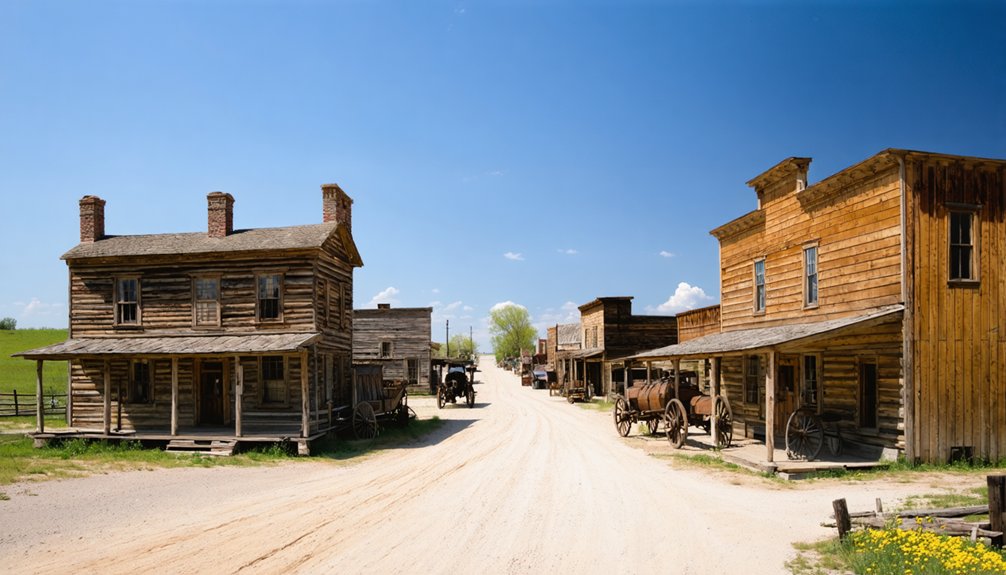
You’ll find an entire 1800s pioneer village waiting within Kansas City’s Hodge Park, where 16 authentic log cabins, homes, and workshops have been carefully relocated from across Missouri and restored to period-specific detail.
Unlike typical ghost towns that crumbled naturally, Shoal Creek Living History Museum was deliberately reconstructed building by building—starting in 1975—to preserve structures dating from 1807 to 1885.
On weekdays, the deserted dirt paths winding between the weathered cabins create an eerie ghost town atmosphere, while weekend events transform the settlement into a bustling 19th-century community populated by costumed reenactors.
Authentic Relocated Historic Buildings
While most ghost towns crumble into dust, Shoal Creek Living History Museum took a different approach—rescuing entire buildings from abandonment and giving them new life as a reconstructed 1800s village.
You’ll find sixteen authentic structures dating from 1807-1885, each relocated from surrounding counties where they’d otherwise have disappeared. This historical preservation effort transforms these forgotten buildings into living history.
Walk among structures that tell Missouri’s frontier story:
- Daniel Hughes cabin (1825) – rare double dog trot design connecting three cabins
- Missouri City’s city hall and jail (1867-1868) – last remnants of an early community
- Isaac C. Nif cabin (1855) – restored as an 1800s doctor’s office with medicinal garden
- Original log homes – expanded with raised roofs and additions for growing pioneer families
You’re free to explore these twenty-one structures set across eighty acres of rolling hills.
Period-Detailed Immersive Experience
Beyond simply preserving old buildings, Shoal Creek transforms them into an authentic 1800s frontier village where history breathes through every weathered log and hand-hewn beam.
You’ll encounter “Citizens of Shoal Creek”—reenactors with intricate backstories who bring the settlement’s past to life through costumed reenactments, skirmishes, and demonstrations of frontier occupations.
During special events, you’re free to explore historic building tours showcasing the schoolhouse, church, stores, and workshops that once served real Missouri communities. Self-guided tour brochures reveal each structure’s original purpose and inhabitants, while living history programs demonstrate daily frontier life.
These period-authentic encounters transport you beyond mere observation into genuine connection with pioneer existence. The peaceful wooded trails and resident bison herd complete your immersion in this reconstructed 19th-century world.
Frequently Asked Questions
What Spring Weather Conditions Should Visitors Expect When Touring Kansas Ghost Towns?
Wildflowers blanket abandoned streets as you’ll encounter unpredictable seasonal weather variations—mild 60°F mornings can shift to thunderstorms by afternoon. Spring flora and fauna awaken around crumbling buildings while winds sweep across open prairie, demanding flexible planning.
Are Any Kansas Ghost Towns Wheelchair Accessible or Suitable for Mobility Devices?
Most Kansas ghost towns lack accessible pathways, limiting mobility-friendly exploration. However, you’ll find wheelchair-accessible alternatives like Cawker City’s Twine Ball and Dalton Gang Hideout in Meade, offering barrier-free adventures through Kansas’s quirky historical attractions instead.
How Many Total Ghost Towns Exist Within a Day Trip Distance From Kansas City?
You’ll discover approximately 30 documented ghost towns within day-trip distance from Kansas City, spanning the Kansas-Missouri border. These abandoned settlements offer incredible photography opportunities and historical preservation sites waiting for your exploration across rolling prairie landscapes.
Visiting abandoned places in Kansas can evoke a sense of nostalgia and curiosity about the lives once lived there. Each site tells a unique story, drawing in those with a passion for history and adventure. As you wander through the remnants of these forgotten towns, you’ll encounter fascinating artifacts that offer a glimpse into the past.
Do Any Ghost Towns Charge Admission Fees or Require Advance Tour Reservations?
Most Kansas ghost towns don’t charge admission since they’re abandoned settlements on public land. However, you’ll find haunted legends tours in nearby Atchison requiring reservations and fees, offering exceptional photography opportunities of historic haunted sites.
What Safety Precautions Should Visitors Take When Exploring Abandoned Structures and Ruins?
You’ll need proper safety gear like N95 masks and gloves before entering any structure. Always test structural stability first—rotten floors and collapsing walls don’t care about your adventure spirit. Stay alert, travel with others, and respect boundaries.
References
- https://en.wikipedia.org/wiki/List_of_ghost_towns_in_Kansas
- https://legendsofkansas.com/kansas-ghost-town-list/
- https://www.travelks.com/blog/stories/post/13-most-haunted-places-in-kansas-you-must-visit-this-fall/
- https://www.kcur.org/arts-life/2022-04-09/ghost-towns-are-all-around-kansas-city-if-you-know-where-to-look
- https://www.legendsofamerica.com/ks-ghosttowns/
- https://www.youtube.com/watch?v=OyBXD18P_j4
- https://abandonedks.com
- https://en.wikipedia.org/wiki/Lecompton
- https://lecomptonkansas.com
- https://civilwaronthewesternborder.org/partners-staff/lecompton