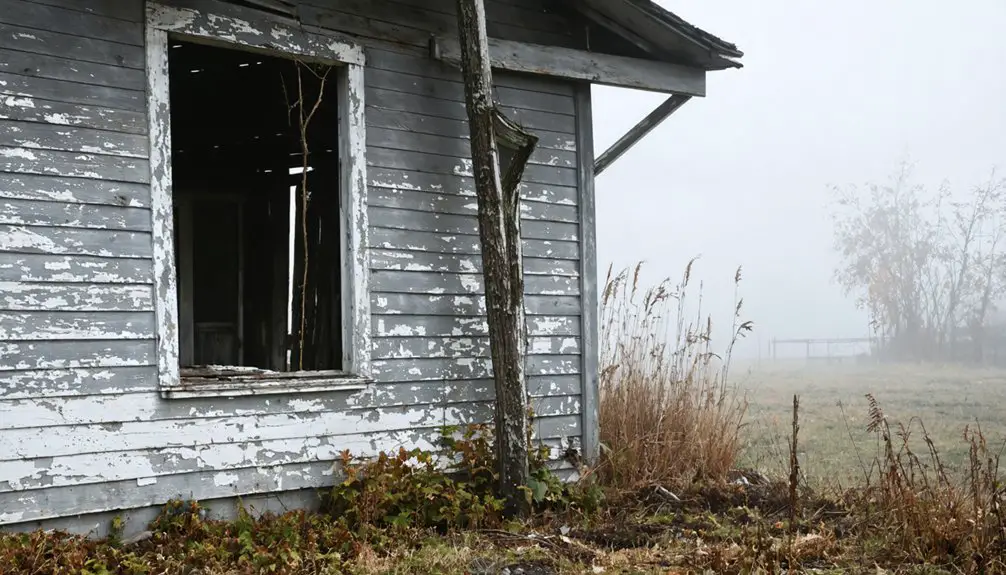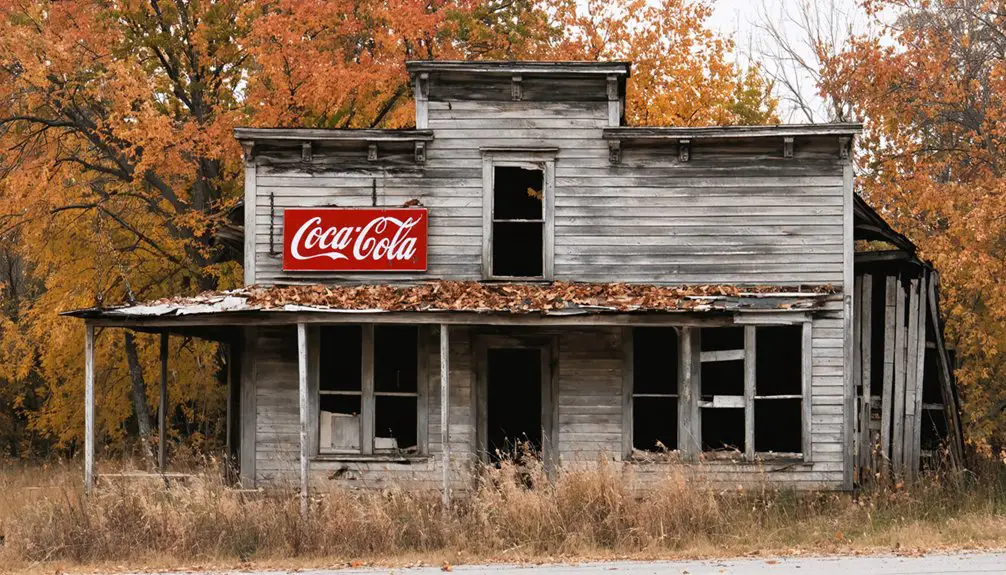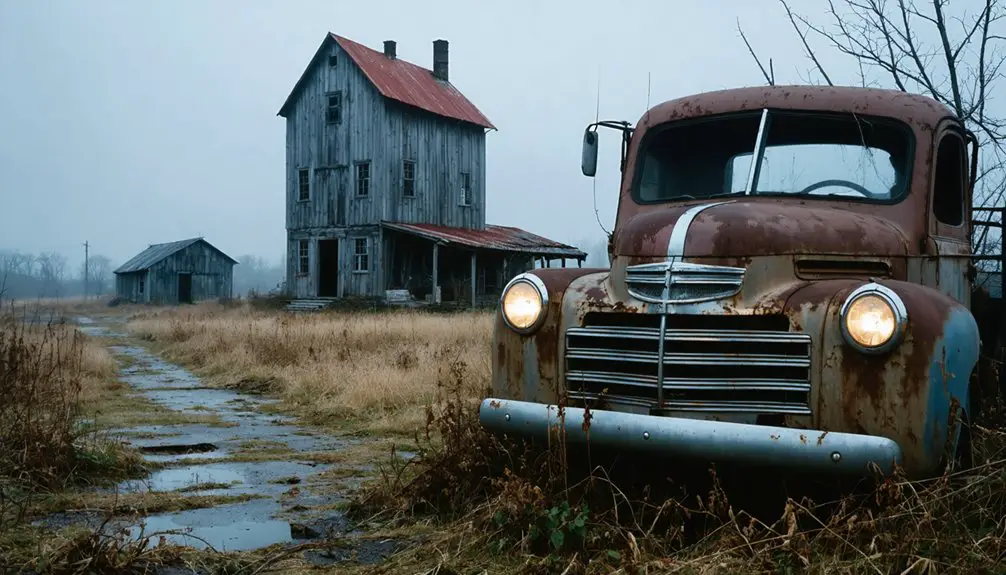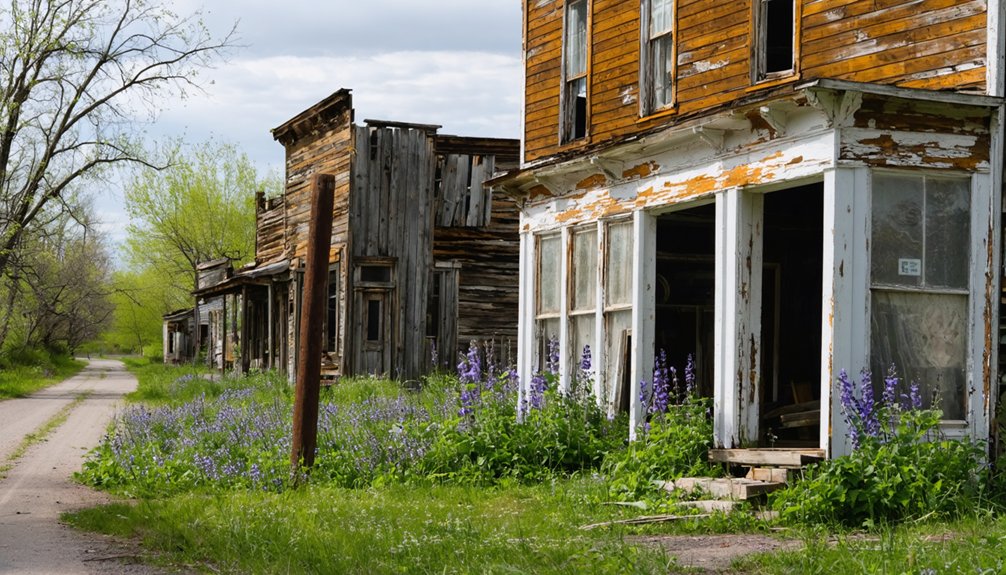
Spring’s your ideal window to explore Michigan’s ghost towns when sites reopen after winter but before summer crowds arrive. You’ll find Fayette’s 22 restored iron-smelting buildings, Glen Haven’s logging village within Sleeping Bear Dunes, and Central Mine’s copper ruins all accessible mid-May through June. The Keweenaw Peninsula’s isolated Gay offers dramatic industrial decay along Lake Superior, while North Manitou Island’s ferry-accessible sawmill preserves 1870s machinery. Prepare for substantial rainfall and seek local advice on trail conditions—there’s much more to discover about timing your visit and steering through these hauntingly beautiful remnants.
Key Takeaways
- Fayette Historic State Park features 22 restored buildings from an 1867-1891 iron smelting community; museum opens in May with 5 miles of trails.
- Central Mine displays 13 original structures including a church and houses; peaked at 929 residents in 1870 before closing in 1898.
- Glen Haven within Sleeping Bear Dunes preserves a 1920s logging village with blacksmith shop and general store showcasing Michigan’s timber heritage.
- North Manitou Island offers ferry-accessible ghost towns including an 1870s sawmill and 1906-1915 lumber town near the NPS dock.
- Mid-May through mid-June is ideal for visiting; sites reopen after winter, spring flora blooms, and trails become accessible with proper preparation.
Fayette Historic State Park: A Preserved Iron Smelting Community
When spring snowmelt opens Michigan’s back roads, you’ll find one of the Upper Peninsula’s most fascinating industrial relics tucked along the Garden Peninsula’s limestone shores. Fayette Historic State Park preserves a complete 19th-century iron smelting town where two blast furnaces once produced over 229,000 tons of pig iron between 1867 and 1891.
Two blast furnaces at Fayette Historic State Park produced over 229,000 tons of pig iron between 1867 and 1891.
You’ll explore 22 restored buildings that housed nearly 500 workers who transformed Lake Superior ore into ingots for America’s railroads and factories.
The preservation efforts since 1959 have stabilized everything from the opera house to workers’ homes, creating an authentic glimpse into Michigan’s industrial heritage. The town’s workforce consisted largely of immigrants from Europe and the British Isles who operated the furnaces and supported the thriving industrial community. The site overlooks Big Bay de Noc, nestled between Snail Shell Harbor and Sand Bay along Lake Michigan’s coast.
Five miles of trails wind through the site, and the museum opens in May—perfect timing to beat summer crowds while experiencing this remarkable ghost town.
Glen Haven: A Logging Village Frozen in Time
While Fayette showcases Michigan’s iron industry, Glen Haven reveals a different chapter of the state’s resource economy—one written in timber rather than ore. You’ll find this logging history preserved within Sleeping Bear Dunes National Lakeshore, where village preservation efforts have frozen Glen Haven in its 1920s prime.
Walk wooden sidewalks past the operational blacksmith shop and general store, imagining when narrow-gauge locomotives hauled timber through these dunes. Spring’s the perfect time to visit—before summer crowds arrive, you’ll experience the village’s quiet authenticity. Glen Haven is one of several locations across different regions that share this place name.
D.H. Day built an empire here, processing 35,000 board feet daily and shipping lumber across the Great Lakes. After clear-cutting the forests, Day planted cherry trees that transformed the region’s agricultural landscape.
The National Park Service maintains this ghost town so you can explore freely, connecting with Michigan’s logging heritage on your own terms.
North Manitou Island: Two Ghost Towns on One Remote Isle
For the truly adventurous ghost town hunter, North Manitou Island delivers double the reward—two abandoned settlements accessible only by ferry across Lake Michigan’s unpredictable waters.
You’ll find the main village near the NPS dock, where William Burton built his deep-water harbor in the 1830s.
A sawmill from 1927 still stands with machinery from the 1870s.
Trek through island ecology to Crescent on the north shore, named for its curved coastline.
This lumber town thrived from 1906 until 1915, complete with saloon, general store, and dual-purpose schoolhouse-church.
The Smith & Hull Company dismantled the mill after it shut down, moving the entire operation off the island and leaving nothing behind.
Today, only dock pilings and a graveyard remain.
Both North and South Manitou Islands once had docks that supplied cordwood and lumber for city markets until forest depletion ended the lumber town era around 1910.
Spring boat excursions from Leland’s Fishtown Dock offer your gateway—check dock status before planning your escape to these vanished communities.
Central Mine: Accessible Copper Country Ruins
You’ll find Central Mine’s copper-era ruins easily accessible off US-41 between Calumet and Copper Harbor, making it ideal for spring exploration when winter’s grip loosens but summer crowds haven’t arrived.
The site preserves 13 original structures including a Methodist church and restored houses filled with period antiques. Though buildings stay closed until summer—you can still wander the grounds and photograph mining remnants.
Nearby Copper Harbor and Eagle Harbor offer lodging options for overnight stays while you explore this ghost town that produced 52 million pounds of copper before closing in 1898. The community’s population peaked at 929 in 1870, when copper mining operations employed dangerous conditions with steam-powered equipment. The Keweenaw County Historical Society owns and manages the 38-acre site, operating a visitors center in one of the preserved historic houses.
Historic Mining Infrastructure Remains
Deep in the Keweenaw Peninsula, Central Mine stands as Copper Country’s most accessible ghost town, where you can walk among 13-20 original frame structures that once housed 1,200 residents during the 1880s boom.
Spring visits reward you with clear views of mining infrastructure that produced 52 million pounds of copper over 44 years.
You’ll discover flooded underground tunnels where 40 tons of pure copper first emerged, along with scattered poor-rock piles now attracting rock hounds with metal detectors.
The Keweenaw County Historical Society maintains 38 acres for free exploration, with trails leading to shaft sites and the well-preserved Methodist Church.
Historic preservation efforts let you experience authentic two-story company houses on stone foundations. The Engine House No. 2 Ruins feature partially intact stone walls with arched openings now overgrown with forest vegetation. A memorial marker commemorates the April 22, 1872 tragedy when a cable failure in Shaft No. 2 killed 10 miners out of 13 aboard the skip car.
Spring’s thaw reveals winter-hidden details across this rugged terrain.
Lodging Options Near Ruins
Since Central Mine sits roughly 30 miles southwest of Copper Harbor, you’ll find the densest concentration of lodging options in that historic harbor town and along the Keweenaw Waterway corridor.
Copper Harbor offers everything from lakefront cabins like the Garden Cabin on Lake Fanny Hooe to rustic year-round retreats at Keweenaw Mountain Lodge‘s 24 log cabins.
You’ll discover local accommodation ranging from the Bear Den Cabin steps from Lake Superior to the Dapple Gray Bed & Breakfast’s Victorian suites overlooking the water.
For scenic retreats closer to Central Mine, consider Keweenaw Waters Resort’s multi-bedroom cabins along the Keweenaw Waterway or stay in downtown Hancock at The Lodge Luxury Suites.
Spring’s mild temperatures make these northern outposts comfortable basecamp options for exploring abandoned mining infrastructure.
Gay: A Copper Boomtown Reclaimed by Nature
You’ll find Gay tucked along Lake Superior’s eastern Keweenaw Peninsula shore, where twin stamp mills once processed 22.7 million tons of copper ore before closing in 1932.
The 236-foot Mohawk Mill smokestack still pierces the sky above mountains of black stamp sands that stretch along the waterline.
Meanwhile, 117 company homes and a restored 1927 schoolhouse-turned-museum mark what was once a thriving industrial town.
Spring’s arrival makes the 12-mile drive southeast from Mohawk navigable, revealing how nature’s slowly reclaiming this remote copper country settlement where mining operations forever altered the Lake Superior shoreline.
Mining Era History
When Joseph E. Gay’s namesake village sprang up in 1898, you’re standing where copper fever transformed wilderness into industrial powerhouse. The Mohawk and Wolverine operations ran massive stamp mills from 1902 to 1932, crushing 500 tons daily of billion-year-old basalt to extract native copper.
Mining techniques revolutionized the Keweenaw:
- Ore traveled 16.9 miles via dedicated railroad to lakeside mills.
- Three stamp sets pulverized rock while ore processing separated copper by density.
- Black tailings dumped directly into Big Traverse Bay—22.7 million tons total.
This raw efficiency generated $15 million in dividends but left a toxic legacy. Spring visitors today walk beaches of sparkling stamp sands, dusty reminders of an era when profit trumped preservation and freedom meant boom-or-bust prosperity.
Abandoned Structures Remain
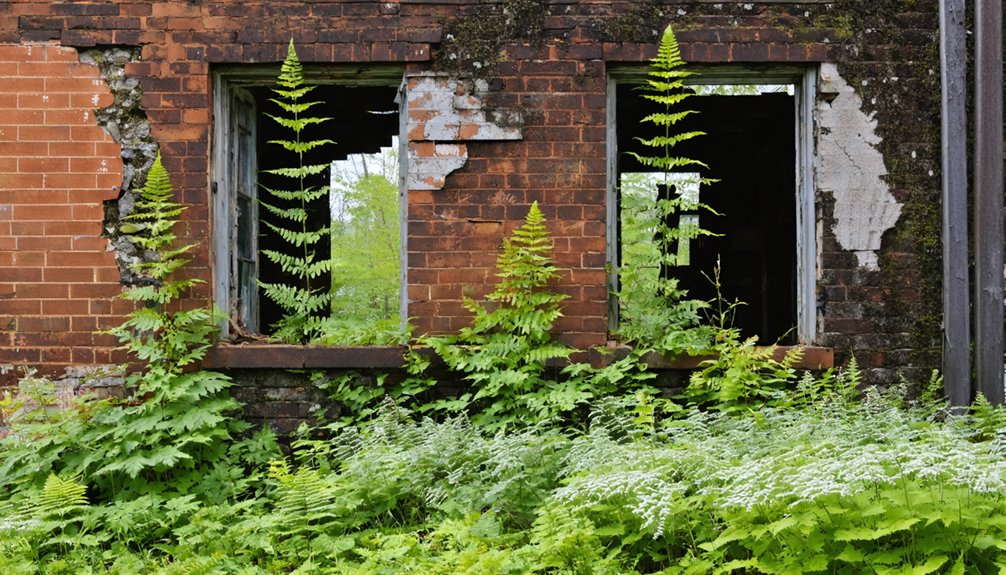
While most ghost towns fade quietly into forests, Gay wears its industrial scars openly across the landscape. You’ll find urban decay at every turn—the Gay Bar’s windows break more each year, and wood frames crumble beneath a 236-foot smoke stack’s shadow.
Yet historic preservation efforts persist: the 1927 school reopened as a museum in 2012, and the physician’s house serves as Sherman Township Office.
What makes spring visits compelling is the stark contrast between nature’s reclamation and industrial remnants. Company-built homes from 1901-1920 stand amid 22.7 million tons of stamp sands—fine gray material sparkling with arsenic.
You’ll spot aspens and invasive weeds struggling through the waste, while forested wetlands press in from the west, slowly consuming what copper built.
Remote Peninsula Wilderness
Twenty miles from the nearest town, Gay occupies one of Michigan’s most isolated shorelines—a stretch of Keweenaw Peninsula where Lake Superior’s Big Traverse Bay crashes against billion-year-old Precambrian rock.
You’ll find forested wetlands sprawling westward, where the Ojibwa once harvested wild rice and berries undisturbed.
Spring brings renewed focus on wildlife conservation and ecological restoration here. Federal, tribal, and state teams work to save Buffalo Reef’s spawning grounds from migrating stamp sands:
- 50 billion pounds of tailings containing arsenic, silver, and nickel threaten fish habitat
- Fine gray sands prevent vegetation regrowth across shoreline acres
- Ongoing superfund efforts protect Ojibwa fishing rights and wildlife populations
This remote peninsula wilderness remains yours to explore, though nature’s reclamation battles industrial legacy.
Planning Your Spring Ghost Town Adventure in Michigan
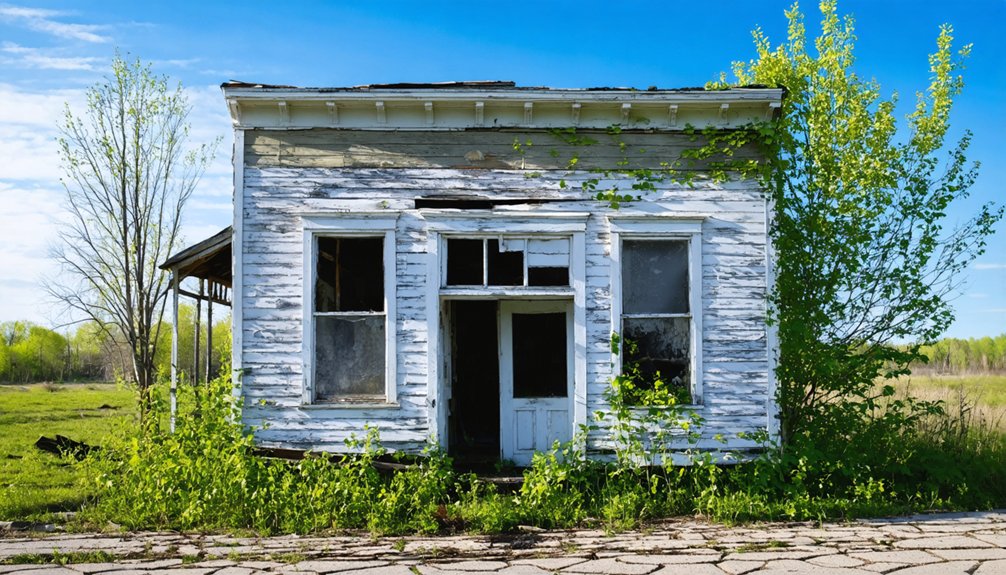
Since Michigan’s ghost towns scatter across vastly different regions—from the Keweenaw Peninsula’s copper country to the Thumb’s quiet crossroads—you’ll want to map your spring adventure around weather patterns and site accessibility. Target mid-May through mid-June when Upper Peninsula sites finally open after winter’s grip loosens.
Spring ghost town exploration demands strategic timing—target mid-May through mid-June when Upper Peninsula sites emerge from winter’s extended closure.
You’ll encounter spring flora like apple blossoms marking old townsites and crisp air perfect for wildlife observation.
Pack accordingly for Keweenaw County’s notorious precipitation—even spring sees substantial rainfall. Talk to locals about current trail conditions and hidden hazards; overgrown vegetation can conceal dangerous mineshafts with 25-foot drops.
Plan your route to hit multiple sites—Freda’s Champion Mill ruins connect easily with Redridge via Covered Drive.
Keep your schedule flexible since weather dictates access more than any calendar.
Frequently Asked Questions
Are Michigan Ghost Towns Safe to Explore With Children?
Michigan ghost towns aren’t safe for children due to structural instability, exposed hazards, and contamination risks. While some sites offer historical preservation as tourist attractions, you’ll find most lack supervision and maintenance, making spring exploration dangerous for families.
Do I Need Special Permits to Visit Ghost Towns in Michigan?
You won’t need access permits for most Michigan ghost towns—they’re yours to explore freely. Just respect private property boundaries and grab a Michigan Recreational Passport for state parks like Fayette. Spring’s perfect for wandering these forgotten places.
What Wildlife Might I Encounter at Michigan Ghost Towns in Spring?
You’ll spot native species like deer, foxes, and coyotes roaming freely through abandoned sites. Spring brings excellent bird sightings—migratory songbirds, raptors, and waterfowl return to these wild spaces where nature’s reclaimed what humans left behind.
Can I Camp Overnight Near Michigan Ghost Town Sites?
Looking to immerse yourself in ghost town history overnight? You can’t camp at historic preservation sites themselves, but Michigan’s state forests nearby offer dispersed camping where you’ll experience authentic solitude under spring stars.
In addition to enjoying the peacefulness of the great outdoors, consider exploring abandoned sites in Michigan that tell stories of the past. Each location holds a unique narrative, offering a glimpse into the lives once lived there. As you wander through these forgotten places, the rich history and haunting beauty of Michigan will captivate your imagination.
Are Guided Tours Available for Michigan Ghost Towns?
Yes, you’ll find guided tours at several Michigan ghost towns. Local tour guides lead explorations at Fayette Historic Townsite with historical preservation insights, while Quincy Mine and Laurium Manor offer seasonal guided experiences showcasing authentic copper boom history.
References
- https://www.ghosttowns.com/states/mi/mi.html
- https://wgrd.com/michigan-ghost-town-map/
- https://www.youtube.com/watch?v=7-vjuqiGWJU
- https://www.visitkeweenaw.com/things-to-do/museums-history/ghost-towns/
- https://www.nps.gov/slbe/learn/historyculture/ghosttowns.htm
- https://99wfmk.com/michigan-ghost-town-gallery/
- https://en.wikipedia.org/wiki/Fayette_Historic_State_Park
- https://www.uptravel.com/things-to-do/attractions/fayette-historic-state-park-townsite/
- https://visitescanaba.com/blog/the-history-of-an-iron-smelting-town
- https://www.miroadtrip.com/locations/fayette-historic-state-park