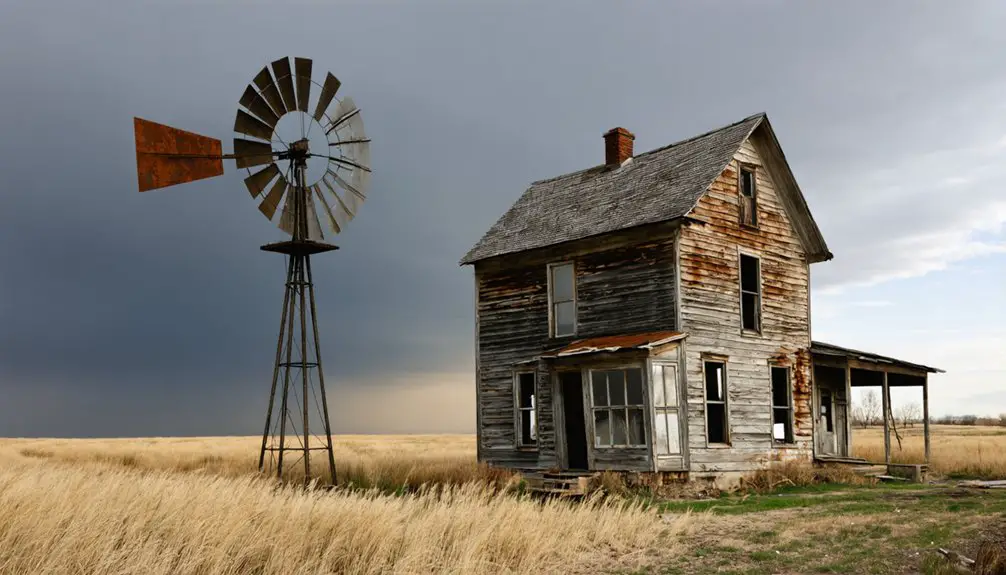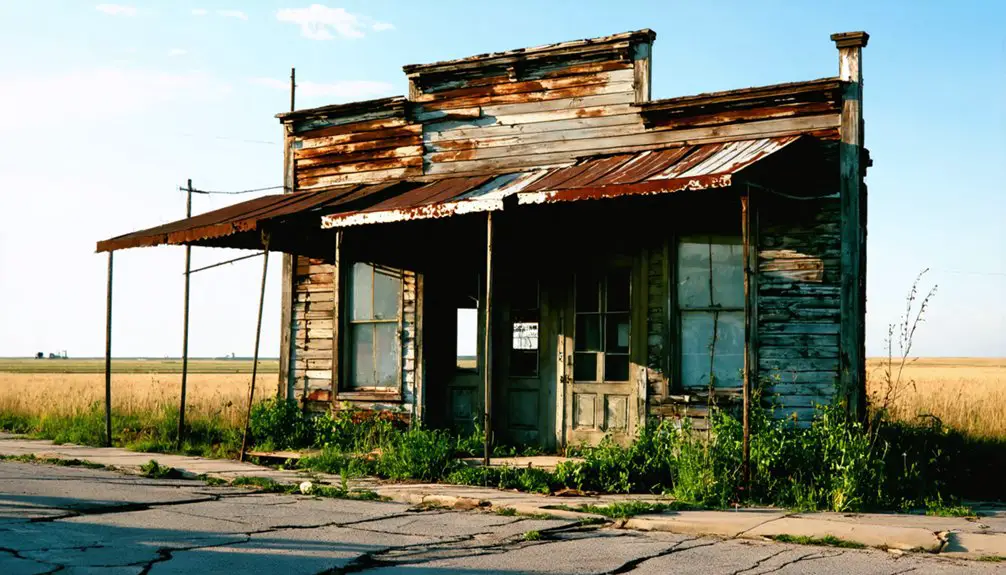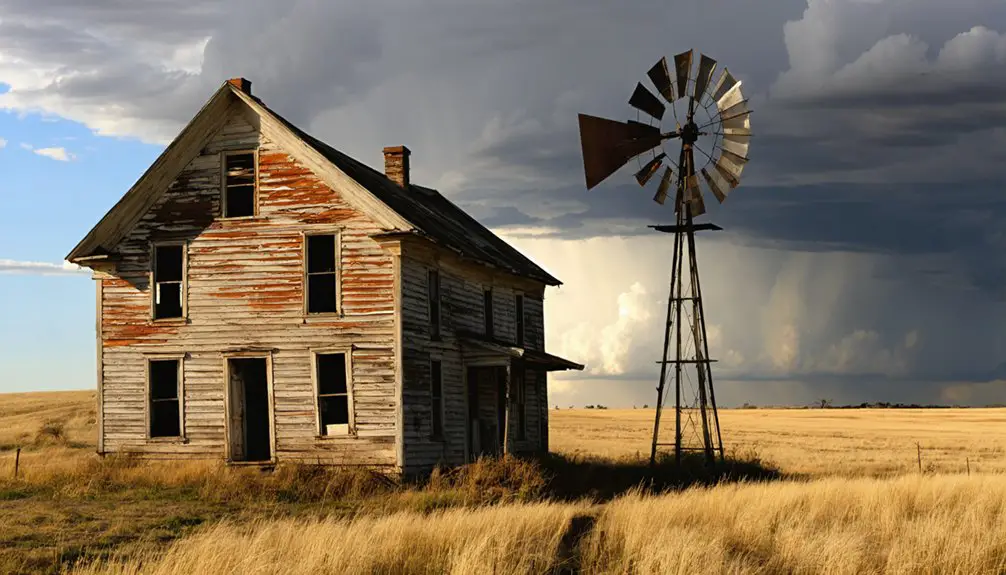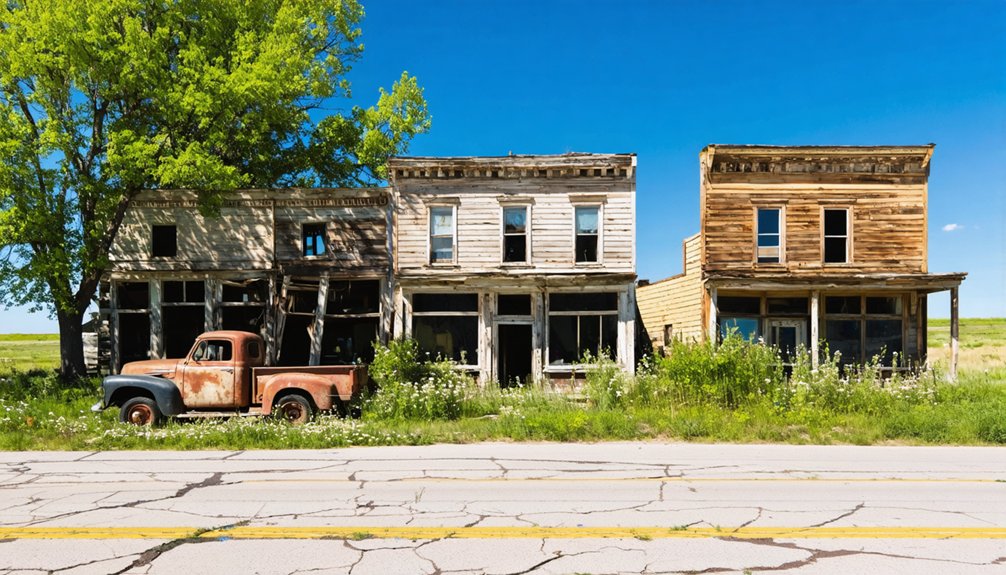
You’ll find Nebraska’s spring ghost towns awaken with wildflowers pushing through abandoned foundations and warming winds carrying whispers of prairie history. Amboy’s weathered mill stands just off Highway 136, while Rock Bluff’s Missouri River bluffs offer dramatic overlooks near Nebraska’s first college ruins. St. Deroin beckons from Indian Cave State Park‘s edge, and remote Brocksburg rewards adventurous travelers with high-clearance vehicles. Minersville’s coal-scarred landscape south of Nebraska City holds cemetery stones marking miners who never left. Each site reveals distinct chapters of frontier ambition and decline.
Key Takeaways
- Amboy near Red Cloud features accessible weathered structures including a mill and schoolhouse along Highway 136 on open prairie.
- Rock Bluff offers Nebraska’s oldest county schoolhouse and historic Missouri River bluffs with ties to early statehood efforts.
- St. Deroin at Indian Cave State Park includes a relocated schoolhouse, cemetery with ghost legends, and scenic river views.
- Brocksburg requires high-clearance vehicles to access remote structures along the rugged Outlaw Scenic Trail near South Dakota’s border.
- Minersville south of Nebraska City contains an accessible cemetery and visible coal mine depressions from 1860s-1890s mining operations.
Amboy: Authentic Prairie Settlement With Preserved Structures
Tucked four miles east of Red Cloud along Highway 136, Amboy sits quietly on the south central Nebraska prairie. Its weathered structures telling stories of a settlement that once thrived with 100 residents.
You’ll discover authentic prairie architecture when you explore the mill that operated until the 1940s, a schoolhouse frozen in time, and a weathered barn standing against endless skies.
Spring brings renewed life to these grasslands, making it perfect for wandering back roads to this isolated site.
The railroad’s closure sealed Amboy’s fate, but historical preservation efforts left an informational sign marking your arrival. This historic railroad hub once served as a vital junction for commerce and transportation across the prairie.
Originally called Webster Center, the town was renamed Amboy in 1879, likely after the Illinois community of the same name.
Take the late 1800s bridge across the creek, and you’re free to roam among remnants of Nebraska’s pioneer past.
Rock Bluff: Historic Educational Hub Along Scenic Bluffs
While Amboy showcases prairie agriculture, Rock Bluff reveals Nebraska’s intellectual ambitions along the Missouri River bluffs. You’ll discover where Naomi Institute once stood—Nebraska’s first higher education institution when it opened in 1870.
Rock Bluff stands as a testament to Nebraska’s pioneering spirit in higher education along the historic Missouri River.
This steamboat landing thrived with nearly 200 residents, two saloons, and a racetrack before railroads bypassed it entirely.
The educational history runs deep here. That brick one-room schoolhouse you’ll find three miles east of Murray? It’s the county’s oldest, now protected through serious preservation efforts by the Cass County Historical Society. The tornado-damaged second story’s gone, but what remains tells stories of frontier learning and determination.
Spring brings wildflowers to these abandoned streets where professors once taught and riverboats once docked. You’re standing where Nebraska’s statehood journey gained momentum in 1866. Founded in 1854 by Benedict Spires, a German immigrant, the settlement quickly became a vital outfitting point for freighters crossing the plains. The town once competed with Plattsmouth for county seat status, reflecting its political importance in early Cass County.
St. Deroin: Trading Post Ruins Near Indian Cave State Park
Where Missouri River trading routes once thrived, you’ll find St. Deroin’s historic ruins at Indian Cave State Park‘s northern edge. Joseph Deroin’s 1840 trading post once served nearly 200 residents before floods reclaimed the land.
What awaits your exploration:
- The relocated 1910 schoolhouse standing sentinel on river bluffs above the abandoned townsite
- A general store overlooking the former ferry landing where steamboats once docked
- Cemetery grounds where haunted legends of Joseph Deroin riding his buried horse echo through spring nights
You’ll discover tales of A.J. Ritter’s ghost searching for his dynamite-severed arm on moonless evenings.
Spring’s gentle weather lets you wander these remnants freely, tracing foundations where twenty businesses thrived before the Missouri River shifted course in 1915, erasing this frontier trading center forever. Lewis and Clark camped near this very location in July 1804, marking it as part of their historic exploration route.
Brocksburg: Remote Outlaw Trail Discovery
Deep in Nebraska’s ranching country along the South Dakota border, Brocksburg’s weathered remains emerge from behind windswept cottonwoods like a secret the prairie tried to keep.
You’ll earn this discovery—GPS dies out here, and the rugged roads demand a high-clearance vehicle and solid directions. Spring’s your best window via the Nebraska Outlaw Scenic Trail, where challenging terrains test both machine and resolve.
Henry Brockman laid out this town in the late 1800s, serving scattered homesteaders until the post office closed in 1957.
Now it’s genuinely abandoned: leaning structures, a century-old tornado shelter, and hidden histories waiting in the unforgiving landscape. Oddly, workout equipment sits among the ruins in a strange setup that defies explanation. Like Factoryville, where foundations remain amid prairie grass, Brocksburg tells the story of a settlement that couldn’t survive when its purpose faded.
Three residents once drowned in an ice gorge at the town bridge—a reminder that this country’s always demanded everything from those who tried to tame it.
Minersville: Industrial-Era Ghost Town Near Fort Kearny
Tucked into the Otoe County bluffs south of Nebraska City, Minersville’s silent ruins tell a harder story than most ghost towns dare to whisper. This coal mining history remnant thrived through the 1860s-1890s, with over 1,000 souls extracting lignite from 25-55 foot shafts using nothing but buckets and ropes.
What Makes Minersville Worth Your Spring Adventure:
- Cemetery remains accessible – Unlike most structures trapped on private land, you’ll find authentic headstones marking the miners who never left
- Tangible industrial heritage – Coal shaft depressions still scar the landscape where 30+ mines once operated
- Catastrophic history – The 1901 cave-in that killed all but fourteen tells freedom’s brutal price
The town vanished completely by 1945, leaving these abandoned settlements as monuments to ambition, tragedy, and nature’s final word. While mine owners constructed stone houses for themselves, the miners who powered Minersville’s economy lived in humble dugouts carved from the earth. Originally called Bennet’s Ferry after founder John Bennett, the settlement earned its mineral-inspired name only after coal deposits transformed it into a boomtown in the mid-1860s.
Frequently Asked Questions
What Safety Precautions Should Visitors Take When Exploring Nebraska Ghost Towns?
You’ll want to obtain permission before entering private properties, watch for structural hazards like rotting floors, and consider joining local guided tours. They’ll help you explore safely while respecting historical preservation and avoiding dangerous contaminated areas.
Are There Entrance Fees for Accessing These Ghost Town Sites?
Freedom whispers through abandoned doorways—most Nebraska ghost towns won’t charge you entrance fees. You’ll find historical preservation sites like Fort Kearny at $60-80 daily, but remote ruins remain free, where wildlife encounters replace admission booths.
As you wander through the remnants, you’ll stumble upon historic sites in Nebraska’s ghost towns that tell stories of the past. Many of these places, like the old church in Custer County, evoke a sense of nostalgia and curiosity, inviting exploration. The quiet harmony of nature surrounds these sites, creating a perfect backdrop for those keen on uncovering the rich history of the region.
Which Ghost Towns Allow Camping or Overnight Stays Nearby?
You’ll find camping near Indian Cave State Park’s ghost town, where historic landmarks meet local legends. Choose from Electric Plus, Basic, or Equestrian sites with modern amenities. Half require reservations; others welcome spontaneous adventurers first-come, first-served.
What Photography Equipment Works Best for Capturing Ghost Town Ruins?
You’ll need wide-angle lenses for expansive ruins and a sturdy tripod for low-light shots. These photography techniques aid historical preservation while you’re documenting decay. Pack fast apertures, external lighting, and protective gear for your independent explorations.
How Do Spring Weather Conditions Affect Road Accessibility to Remote Sites?
Spring’s “warm-up” ironically traps you—temperature fluctuations freeze gravel into ruts overnight, while spring rainfall transforms Sandhills back roads into muddy traps. You’ll need four-wheel-drive and extra fuel to reach Nebraska’s most liberated, forgotten places.
References
- https://www.ghosttowns.com/states/ne/ne.html
- https://history.nebraska.gov/wp-content/uploads/2017/12/doc_publications_NH1937GhostTowns.pdf
- https://www.youtube.com/watch?v=l3s2qhSxis8
- https://kids.kiddle.co/List_of_ghost_towns_in_Nebraska
- https://www.onlyinyourstate.com/trip-ideas/nebraska/ne-ghost-towns-road-trip
- https://negenweb.us/knox/stories/ghosttowns.htm
- https://en.wikipedia.org/wiki/List_of_ghost_towns_in_Nebraska
- https://visitnebraska.com/trip-idea/explore-7-authentic-ghost-towns-nebraska
- https://history.nebraska.gov/finding-nebraskas-ghost-towns/
- https://www.youtube.com/watch?v=tJWaL6_ovK8