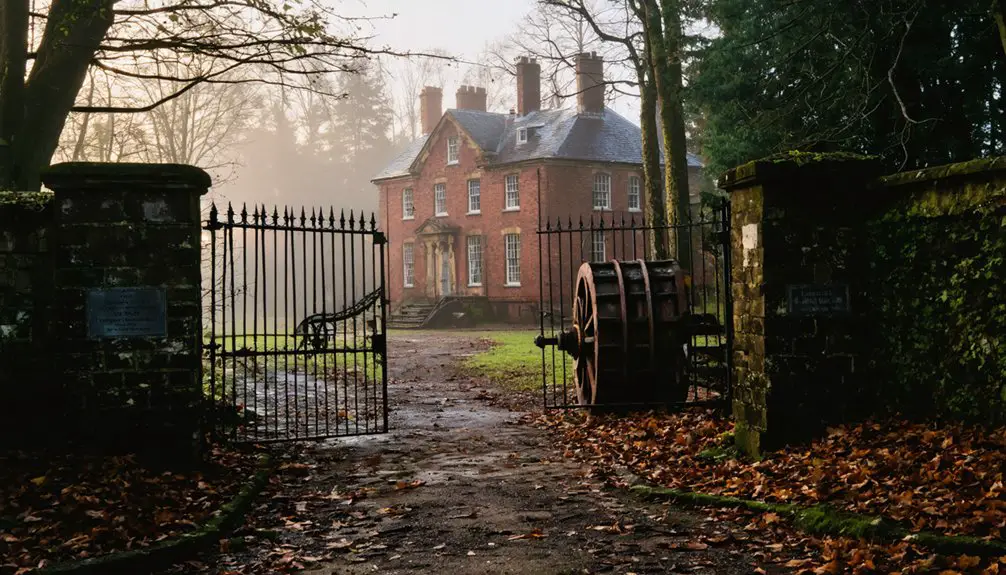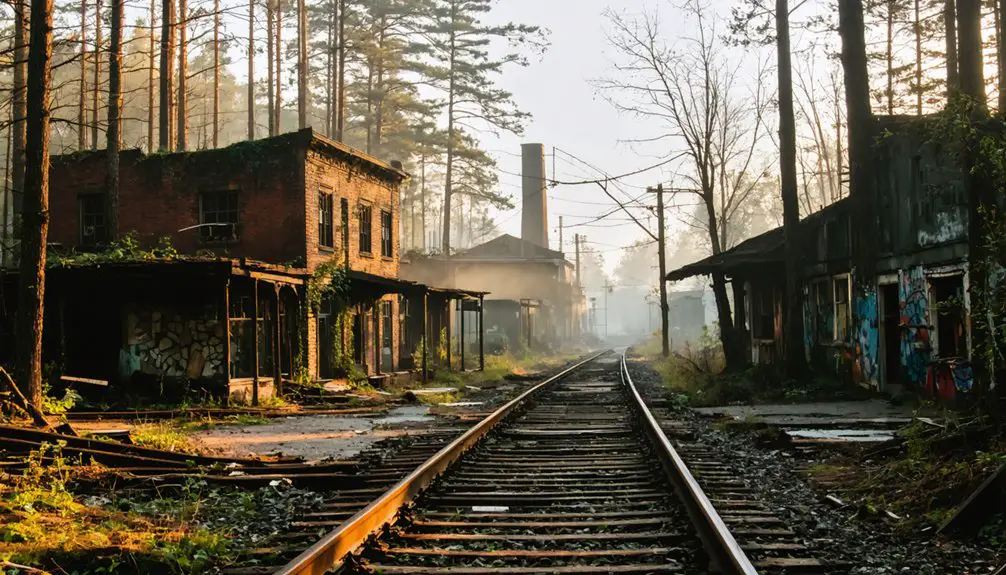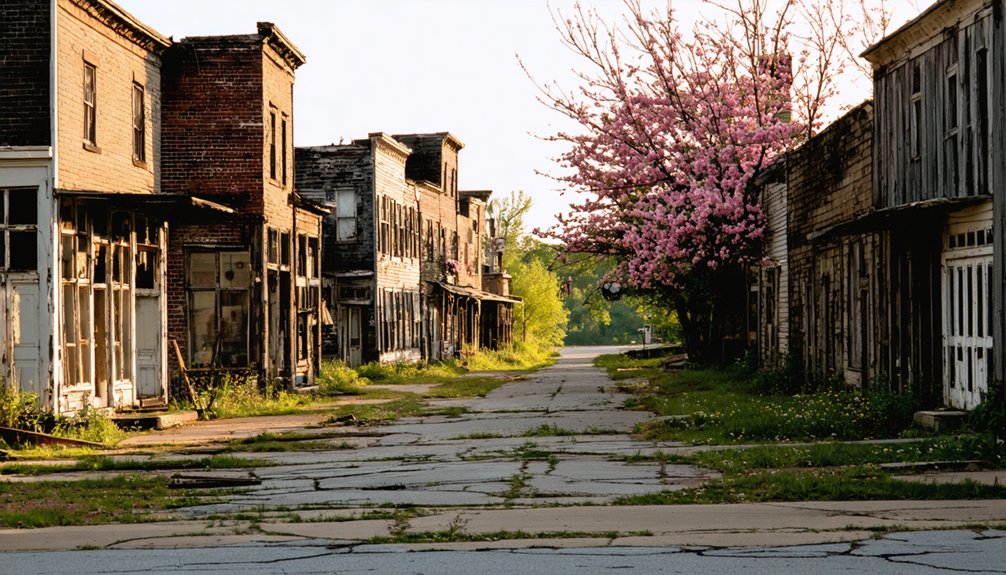
You’ll find New Jersey’s most atmospheric ghost towns perfect for spring exploration when 50–70°F temperatures and April wildflowers enhance abandoned settlements like Batsto Village’s 1766 iron works, Waterloo Village’s canal-era architecture, and Feltville’s eleven haunted houses within Watchung Reservation. These sites offer free dawn-to-dusk access through pine forests and along historic waterways, where crumbling ruins of paper mills at Harrisville and Allaire’s preserved bog iron furnace reveal the state’s industrial heritage without summer crowds or insects. Discover the unique stories behind each location.
Key Takeaways
- Batsto Village offers spring trails through pine forests with 250 years of iron-making history and an antique show.
- Feltville’s eleven historic houses within Watchung Reservation provide free dawn-to-dusk exploration and guided tours through wooded acres.
- Waterloo Village features three centuries of architecture along the Musconetcong River, recently restored with $3 million in funding.
- Walpack Center contains eight residents and preserved Revolutionary-era structures within Delaware Water Gap National Recreation Area.
- Spring temperatures of 50–70°F with wildflower displays make ideal conditions for exploring ruins with minimal insects.
Batsto Village: A Living Museum in the Pine Barrens
Preservation efforts transformed this bankrupt ghost town into a living museum after New Jersey acquired it in the 1950s.
You’re free to explore spring trails winding through fragrant pines along the Batsto River, where bog ore once fueled America’s independence.
The Annie M. Carter Interpretive Center offers insights into the unique ecosystems and biology of the Pine Barrens surrounding the village.
Charles Read built the original Batsto Iron Works in 1766, harnessing the area’s natural resources of bog ore, wood, and water to forge household items and Revolutionary War supplies.
Visit during the Spring Antique, Glass & Bottle Show to experience nearly 250 years of history without barriers or crowds constraining your wandering spirit.
Waterloo Village: Canal Town Frozen in Time
Where iron forges once blazed along the Muscenetcong River, Waterloo Village stands as a tribute to New Jersey’s industrial revolution and canal-era prosperity. You’ll discover historical architecture spanning three centuries, from the 1761 forge buildings to Victorian homes added after the Civil War.
The village served as a strategic midpoint on the 102-mile Morris Canal, where travelers stopped overnight during their five-day journeys between Jersey City and Phillipsburg.
Museum exhibits showcase the canal’s unique engineering, including one of 23 inclined planes that lifted boats on rails. You can explore the General Store, restored workshops, and homes that once housed blacksmiths and craftsmen. The village received a $3 million grant in 2019 for comprehensive restorations of key historic buildings including the tenement, foreman’s house, and boarding house.
After abandonment in 1903, the village remained frozen until restoration began in the 1970s, preserving this remarkable slice of transportation history. Today, the site operates as part of Allamuchy Mountain State Park, managed by the New Jersey State Park Service with support from Friends of Waterloo Village Inc.
Feltville: The Deserted Village of Watchung Reservation
Deep within the Watchung Reservation’s 2,000 wooded acres, eleven white clapboard houses stand in eerie formation along a quiet hillside—silent witnesses to three distinct chapters of American enterprise.
Since 1736, this settlement evolved from Peter Wilcox’s sawmill community to industrialist David Felt’s 1845 company town, then to Glenside Park resort before its 1916 abandonment. Today, haunted legends swirl around the Greek Revival buildings, with ghost stories attracting paranormal enthusiasts alongside history buffs.
What You’ll Discover:
- Eight preserved houses and original 1850s church accessible for exploration
- Free roaming access dawn to dusk through the historic district
- Weekend visitor center tours revealing King David’s paternalistic mill village
- Adirondack-style porches added during the resort era
Union County maintains this National Register site where three families still reside among the restored structures. A nearby trail leads to the Wilcox Badgley Cemetery, where a single original headstone from 1776 marks the grave of John Wilcox among the memorial stones honoring early settlers. Before Halloween, visitors can experience haunted family hayrides with guided tours through the historic grounds.
Walpack Center: Eight Residents in 24 Square Miles
Step into Walpack Center, where spring wildflowers carpet the grounds of a township larger than Manhattan yet home to just eight souls.
This historic district, preserved since 1965, shelters the Revolutionary War-era Van Campen Inn among its weathered 19th-century buildings—a stone sentinel to centuries past.
You’ll find authenticity frozen in time here, where the National Park Service protects these structures as monuments to a community that once thrived along the Delaware River’s edge. The town’s Post Office still displays old wanted posters on its walls, offering visitors a glimpse into law enforcement from another era. The Walpack Historical Society guides visitors through public tours of the settlement, revealing stories of the farming families who built this community in the 1800s.
Historic District Since 1965
Since 1965, Walpack Center has held the distinction of being a federally designated historic district within Delaware Water Gap National Recreation Area. It preserves a snapshot of 19th-century rural life frozen in time. The National Park Service oversees this remarkable example of historic preservation, while the Walpack Historical Society maintains these structures and opens them periodically for visitors seeking authentic glimpses into America’s past.
What you’ll discover in this preserved settlement:
- Original post office, church, and schoolhouse standing exactly as they did in the 1800s
- Expert preservation techniques maintaining authentic structural integrity
- Seasonal access to the Rosenkrans Museum and Methodist Church during warmer months
- Unmediated exploration of buildings reflecting demographic decline from 41 residents in 2000 to just 7 by 2020
The area takes its name from the town of Walpack Center, where structures date back to around 1850. The town’s transformation into a historic district is connected to the Tocks Island Dam project, a controversial flood control plan that ultimately led to the area becoming protected parkland.
Note: Walpack Center buildings lack wheelchair accessibility.
Revolutionary War-Era Van Campen Inn
At the terminus of Jonathan Hampton’s 1755-1756 Military Road, the Van Campen Inn emerges from the wilderness like a sentinel of America’s founding era. You’ll discover Colonial architecture built to endure—fieldstone walls 22 inches thick that once sheltered General Horatio Gates and 3,000 troops during a December 1776 snowstorm.
This yaugh house fed weary travelers and Revolutionary soldiers alike, including John Adams en route to the Continental Congress.
Walk the restored 1.6-mile Military Trail to where General Casimir Pulaski’s cavalry camped in 1778. The National Park Service maintains this Revolutionary history alongside the Walpack Historical Society, opening it for tours on select weekends.
Behind those thick walls, 150 settlers once sought refuge from frontier attacks—a tribute to the fierce independence that forged this nation.
Harrisville Ruins: Industrial Remnants of the 1800s
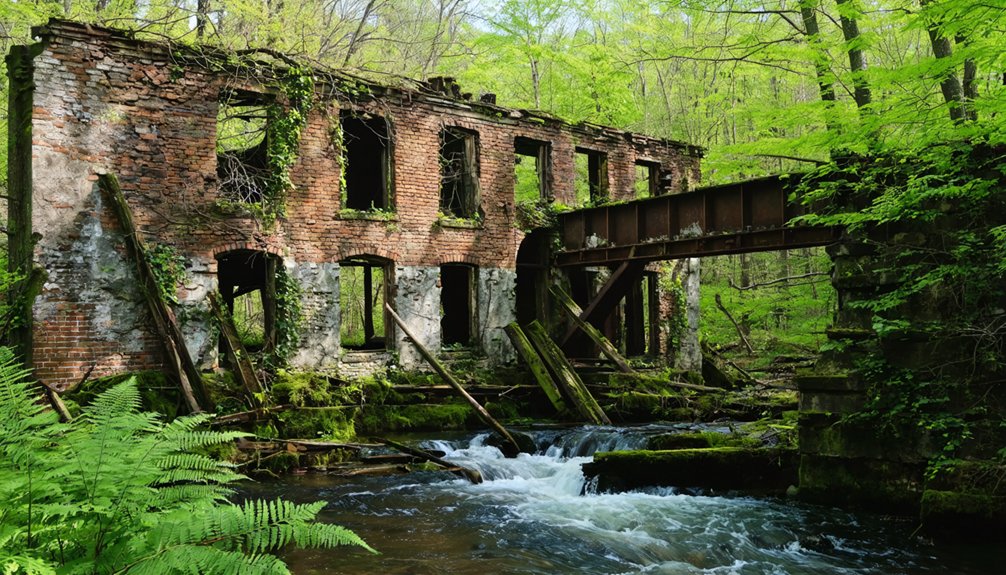
Deep in the heart of the Pine Barrens, where spring sunlight filters through dense forest canopy, the brick ruins of Harrisville stand as weathered monuments to New Jersey’s industrial past. This abandoned paper mill town, operating from 1815 until its collapse in 1891, offers you an unguarded glimpse into 19th-century life.
Joseph Wharton’s 1896 purchase couldn’t save it—a devastating 1914 fire obliterated what remained.
What You’ll Discover:
- Fenced paper mill ruins showcasing industrial archaeology at its most atmospheric
- Still-flowing artisan well and canal remnants carved by hand
- Foundation holes where worker families once lived
- Ruins preservation efforts protecting crumbling walls from complete decay
Located off Route 679 in Wharton State Forest, Harrisville lets you wander freely through Pinelands history without restrictions or crowds.
Allaire Village: Manufacturing Heritage Preserved
Where spring wildflowers now carpet the grounds of a once-thriving industrial empire, Allaire Village stands as New Jersey’s most authentically preserved iron-making community.
You’ll explore thirteen original structures spanning 1750-1835, where James P. Allaire built America’s largest bog iron furnace after 1822.
This self-sufficient village housed over 400 residents who transformed marsh ore into steamship components, representing the pinnacle of industrial innovation before Pennsylvania’s richer deposits ended operations by 1850.
Today’s living history museum offers you hands-on freedom to experience authentic blacksmithing, carpentry, and hearth cooking demonstrations.
Cultural preservation comes alive through 20,000 historical objects and costumed volunteers across forty acres.
Walk where workers once spent their own company currency, discovering how this Deserted Village exemplifies early Industrial America’s transformation from wilderness to manufacturing powerhouse.
Planning Your Spring Ghost Town Adventure
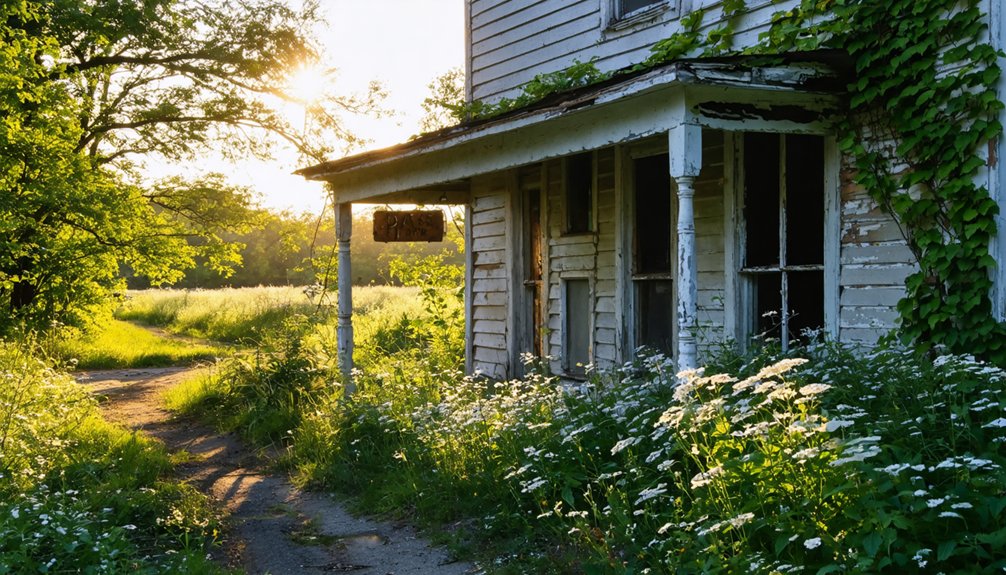
Spring’s mild embrace transforms New Jersey’s ghost towns from historical curiosities into accessible outdoor adventures you’ll want to experience firsthand.
As you wander through ghost towns in New Jersey, you’ll discover remnants of a vibrant past, with crumbling buildings and overgrown paths that tell stories of days gone by. Each step invites exploration, where nature slowly reclaims the land, showcasing a beautiful blend of history and wild surroundings. Take a moment to pause, breathe in the fresh air, and appreciate the unique artistry of decay mingling with the revival of wildlife.
March through May delivers 50-70°F temperatures and minimal rainfall, letting you explore abandoned settlements without summer’s oppressive heat or insect swarms. April’s wildflower displays create stunning backdrops for wildlife observing along cemetery paths and former factory sites.
Essential preparations for your ghost town expedition:
- Pack sturdy hiking boots for uneven terrain around remnants and bridle paths
- Bring water and insect repellent for spring bog explorations at sites like Whitesbog
- Check pollen forecasts if you’re sensitive to spring flora allergens
- Verify seasonal mansion tour schedules at Atsion and other historic properties
Most sites open dawn to dusk year-round, though guided experiences operate on limited schedules. Download trail maps beforehand—you’re exploring independently.
Frequently Asked Questions
Are Pets Allowed at New Jersey Ghost Town Sites?
You’ll find pet regulations at New Jersey ghost towns generally welcome leashed dogs during daytime exploration. Animal accommodations vary by site—Batsto and Feltville permit pets on grounds, though ghost tours typically restrict them except service animals.
What Photography Equipment Works Best for Capturing Abandoned Structures?
You’ll need mirrorless cameras with wide-angle lenses (16-35mm f/2.8) since over half your shots require tripods for long exposures. Master lighting techniques using off-camera flash near windows, while essential camera gear includes flashlights for traversing electricity-free structures safely.
Can Visitors Enter the Historic Buildings at These Locations?
You’ll find most buildings open for exploration, though access restrictions vary by site. Safety precautions mean some structures remain exterior-only viewing. Batsto’s mansion requires guided tours, while Feltville and Allaire let you wander freely through accessible buildings.
Are There Guided Tours Available at These Ghost Towns?
Like explorers charting unmapped territory, you’ll discover guided tour options at Waterloo Village, Batsto Village, and Walpack Center’s Van Campen Inn. These sites also welcome private tour opportunities for groups seeking educational experiences beyond the beaten path.
What Are the Operating Hours for Visiting These Sites?
You’ll find most sites open dawn to dusk daily, perfect for exploring ghost towns at your own pace. Weekend tours run 10am-3pm seasonally. Photography safety tips: arrive early for ideal lighting and fewer crowds.
References
- https://en.wikipedia.org/wiki/List_of_ghost_towns_in_New_Jersey
- https://www.jerseysbest.com/community/take-a-road-trip-through-n-j-s-spooky-ghost-towns-to-see-peculiar-pieces-of-history/
- https://jerseydigs.com/ghost-towns-in-nj/
- https://www.youtube.com/watch?v=ZIp3AYb0ulw
- https://www.atlasobscura.com/things-to-do/new-jersey/abandoned
- https://southjerseytrails.org/2017/03/16/six-pine-barrens-ghost-towns-to-explore/
- https://pinelandsalliance.org/learn-about-the-pinelands/pinelands-history-and-culture/ghost-towns-of-the-pine-barrens/
- https://www.youtube.com/watch?v=P0aFAgcr79E
- https://thedigestonline.com/new-jersey/batsto-village/
- https://batstovillage.org/history/