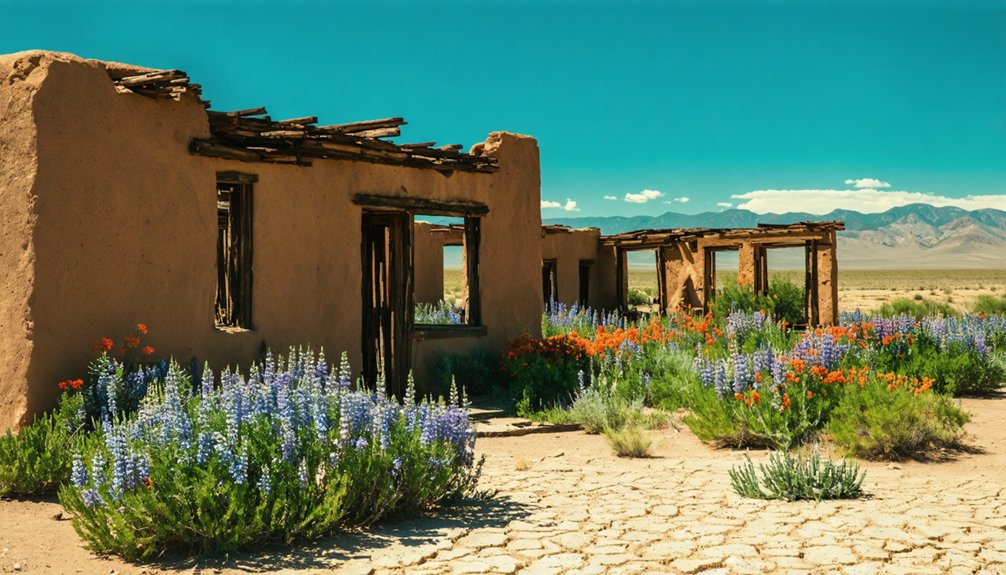
You’ll find New Mexico’s ghost towns at their finest each spring, when wildflowers transform abandoned streets into vibrant corridors. White Oaks showcases Victorian architecture alongside blooming lilac, while Mogollon’s mountain setting offers dramatic switchback drives through pine-scented air. Golden’s functioning 1830s church contrasts with Chloride’s weathered false fronts, and Loma Parda’s crumbling walls whisper tales of frontier violence. Shakespeare preserves Billy the Kid’s outlaw legacy through guided tours that reveal stories passed down through generations, alongside practical details about managing these remote destinations safely.
Key Takeaways
- White Oaks features Victorian architecture, spring wildflowers, and fifteen preserved structures including the No Scum Allowed Saloon from gold rush days.
- Golden offers the functioning San Francisco de Assis Church and access to North America’s oldest turquoise mines along the Turquoise Trail.
- Chloride preserves twenty-seven original structures with spring wildflower trails and Harry Pye’s historic 1879 cabin available for overnight stays.
- Mogollon requires navigating nine miles of mountain switchbacks but rewards visitors with nearly 100 authentic buildings and a mining museum.
- Guided tours operate daily at Shakespeare with $15 adult admission, providing access to eight preserved buildings frozen since the 1930s.
White Oaks: Gold Rush Remnants and Wildflower Trails
When spring breathes life into the high desert surrounding White Oaks, wildflowers carpet the old wagon roads where fortune seekers once kicked up dust clouds in their rush toward gold.
You’ll wander past Victorian homes with pitched roofs—architectural rebels that defied New Mexico’s adobe tradition—while yellow blossoms frame the Hoyle House’s widow’s walk.
Historical preservation has left fifteen structures standing, including the No Scum Allowed Saloon, where you can almost hear Billy the Kid’s spurs on weathered floorboards.
The town that swelled to 4,000 souls in 1882 now hosts fifteen residents who’ve chosen solitude over crowds.
Walk Cedarvale cemetery at sunrise when wildflower viewing transforms headstones into islands in a sea of purple lupine and Indian paintbrush.
Unlike typical New Mexico settlements, White Oaks emerged as a frontier cattle community before gold was discovered in Baxter Mountain, giving it a distinctly cowboy character that persists in its weathered structures today.
The historic White Oak Church stands among the preserved buildings, serving as a reminder of the spiritual life that sustained miners and families through boom and bust cycles.
Loma Parda: Fort Union’s Notorious Neighbor
Where else could a cowboy ride his horse straight through saloon doors, shoot the animal dead after demanding drinks, and consider it just another Saturday night? Seven miles from Fort Union, Loma Parda earned its “Sodom on the Mora” reputation through decades of whiskey-soaked violence and sin. You’ll find crumbling rock walls where soldiers gambled away their pay, where shootings and stabbings punctuated every evening.
The priest literally fled, abandoning his locked church. Today, abandoned structures stand as testaments to frontier debauchery—saloons, dance halls, bordellos slowly reclaimed by the desert. This farming village along the Mora River transformed into a notorious haven after Fort Union’s establishment in 1851. The town lasted until 1900, nine years after the fort itself was abandoned. Visit at dusk when haunted legends come alive: shadowy figures of prostitutes and murdered men drift through ruins.
Those neglected graveyards and mysterious caves in Baldwomen’s Canyon? They’ve got stories that’ll chill your wandering soul.
Golden: Turquoise Trail Treasure With Historic Church
Long before California’s forty-niners panned their first flakes, prospectors struck gold along Tuerto Creek in 1825, igniting the Mississippi’s western frontier into its first frenzied rush for riches.
Gold fever struck New Mexico’s mountains twenty-four years before California’s rush, birthing the frontier’s first desperate scramble for fortune.
You’ll find Golden slumbering along the Turquoise Trail, where mining ghosts whisper through collapsed saloon frames and rusted equipment.
The 1830 San Francisco de Assis Church still stands defiant against decay, its adobe walls hosting Saturday Mass at 4:00 PM.
Each October’s first Saturday, the faithful gather for the Fiesta de San Francisco de Asiss—Matachines dancers process through weathered streets while blessings drift over cemetery stones.
Church history pulses through this landscape where boomtown dreams evaporated after 1880, leaving authentic ruins unmarred by reconstruction.
You’re free to wander where disappointed miners once abandoned their fortunes.
Just north, Cerrillos preserves North America’s oldest continuously worked turquoise mines spanning over 1,200 years of mining heritage.
The Henderson Store, family owned since 1918, offers Native American arts and crafts Wednesday through Saturday from 10:00 AM to 3:30 PM.
Chloride: Well-Preserved Main Street With Modern Amenities
Silver’s siren song lured Harry Pye into these Black Range mountains in 1880, where he struck chloride ore so pure the boomtown took its name from the mineral itself.
You’ll find twenty-seven original structures still standing along Wall Street, their false fronts and adobe walls weathered but defiant. The Monte Cristo Saloon now showcases local artists’ work, while the Pioneer Store museum displays era-correct artifacts that tell authentic stories.
Spring transforms surrounding trails into wildflower hikes through mining territory. The 200-year-old Hanging Tree oak dominates Main Street’s center—despite its ominous name, it merely sobered up rowdy miners. Harry Pye’s original 1879 cabin still stands as the town’s first permanent structure, available for overnight stays that immerse you in authentic mining history.
You’ll grab lunch Thursday through Sunday at the restaurant, exploring historic architecture between bites. Unlike Golden’s solitude, Chloride’s twenty residents keep businesses running, blending preservation with practical amenities for wanderers seeking untamed history. The town sits five miles southwest of Winston, accessible via an all-weather hard surface road off State Road 52.
Mogollon: Remote Mountain Mining Town Adventure
Nine miles of serpentine mountain road separate you from Mogollon, where James Cooney’s 1870 gold discovery sparked a settlement so remote that Apache raids and repeated catastrophes couldn’t extinguish it.
Nine miles of mountain switchbacks lead to a gold rush town that refused to die despite Apache raids and disaster.
Spring snowmelt reveals urban decay frozen in time—nearly 100 buildings clinging to Silver Creek Canyon‘s steep walls. You’ll wind past miner shacks and abandoned homes where 6,000 fortune-seekers once gambled their lives on gold strikes worth $1.5 million annually.
Ghost town preservation here means authenticity over polish. Fifteen caretakers occupy structures rebuilt in brick after five fires ravaged wooden originals. The Mogollon Museum displays mining tools, period photographs, and a recreated mine shaft that brings the boom town era to life.
Hike Fanny Road to Mogollon Cemetery for panoramic views across the Mogollon Mountains, where Spanish Flu victims rest beneath obscured graves. The Little Fanny mine once ranked among the area’s top gold producers, its legacy etched into the mountainside above town.
Check if weekend businesses have opened—this isolation demands self-reliance, the ultimate frontier reward.
Shakespeare: Billy the Kid’s Stomping Grounds
You’ll walk the same dusty streets where outlaws once dodged the law, their boots scuffing against packed earth that still holds echoes of gunfire and whispered deals. The guided tours reveal Shakespeare’s grittier side—the saloon where Russian Bill met his hanging fate, the hotel rooms where frontier justice played out in shadowy corners.
Spring mornings here carry a particular stillness, broken only by your footsteps and the guide’s stories of desperados who knew these weathered buildings as sanctuary and trap alike.
Outlaw History and Legends
While Shakespeare’s dusty streets may look peaceful today, this ghost town once buzzed with the kind of outlaw energy that defined New Mexico’s wildest days—and nobody embodied that chaos quite like Billy the Kid.
You’ll walk where the young gunslinger rode with Jesse Evans’ gang, a brief but brutal chapter before Lincoln County erupted in violence.
Famous shootouts marked his trail—he ambushed Sheriff Brady in broad daylight, traded bullets at Blazer’s Mill, and lived by a code written in gunpowder.
The outlaw legends you’ve heard? Most are newspaper fiction. Billy killed six men, not twenty-one, but his two daring jail escapes and defiance of territorial authority made him immortal.
Shakespeare preserves that raw, ungoverned spirit—the kind that reminds you freedom’s always been worth fighting for.
Guided Tours and Access
Standing at Shakespeare’s weathered gate, you can’t just wander in—this ghost town opens only through guided tours that run daily at 10am, 12pm, and 3pm Mountain Time. Your $15 ticket ($7 for kids) buys access to eight preserved buildings where guides like Manny Hough blend historic preservation with local storytelling passed down through generations.
What You’ll Experience:
- Saloon, assay office, and Grant House interiors frozen since the 1930s
- Authentic frontier tales told with grit and humor by Hill family descendants
- Main street’s original mining-era structures maintained through private preservation
- Real West history minus the Hollywood legends
Book through shakespeareghostown.com, then drive to this remote site near Lordsburg. Spring weather makes exploring comfortable, though cell service disappears. The guided-only rule protects these fragile structures while ensuring you hear stories no website captures.
Planning Your Spring Ghost Town Journey
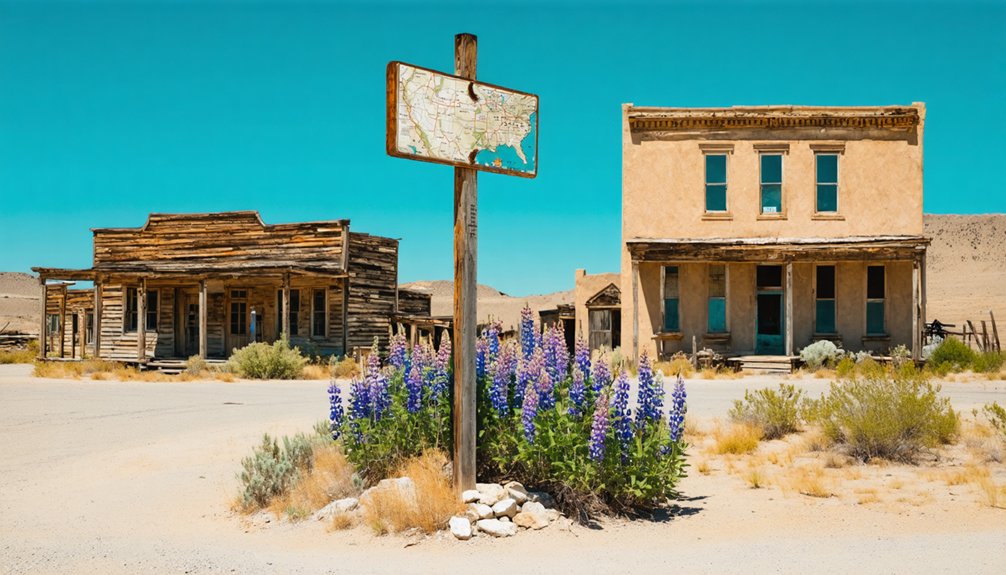
Your spring ghost town adventure demands more than wanderlust—pack water, snacks, a first-aid kit, and a reliable paper map, since cell service vanishes along winding mountain roads like those leading to Mogollon at 7,000 feet.
String together sites logically: explore the Turquoise Trail’s Cerrillos and Madrid in a single day, then venture southwest to pair Lake Valley with Shakespeare’s morning tours.
Time your arrivals carefully, particularly for Shakespeare’s 10am, 12pm, and 3pm guided tours, and allow extra hours for unexpected photo stops where hundred-mile desert views stretch beneath impossibly blue skies.
Essential Gear and Supplies
Before you set out to explore New Mexico’s abandoned settlements, you’ll need to pack thoughtfully—the difference between a memorable adventure and a dangerous situation often comes down to what’s in your backpack.
Critical Supplies for Ghost Town Exploration:
- Navigation and emergency tools – GPS device, detailed maps, headlamp for mine shafts, first-aid kit, and whistle
- Environmental protection – Sunscreen, wide-brim hat, insect repellent for ticks and scorpions, dust masks near collapsed structures
- Sustenance and hydration – Multiple water bottles, high-calorie snacks (your ghost town cuisine), rehydration salts for desert conditions
- Clothing and footwear – Sturdy hiking boots, layered clothing for 30-40°F temperature swings, long pants and sleeves against thorns
Pack your vintage photography gear, fill your gas tank before hitting unpaved roads to Mogollon, and carry that spare tire—freedom means self-reliance in these untamed places.
Route Planning and Timing
The dusty scent of creosote bush fills your nostrils as you spread your map across the hood of your truck, the paper corners flapping in that persistent New Mexico wind. Spring opens roads that winter sealed shut—Highway 152 between Kingston and Silver City sheds its snow, though you’ll want to check NMDOT’s 511 system before committing.
Those winding single-lane routes to Cabezon and beyond demand respect; vehicle requirements aren’t suggestions when you’re ten miles from civilization on deteriorating dirt.
Weather hazards shift with elevation—morning sun at Cuervo, afternoon clouds at Emory Pass.
Download offline maps; cell towers don’t follow ghost-hunters into the backcountry.
String together multiple sites: Truth or Consequences to Chloride takes an hour, letting you maximize daylight while the season favors exploration.
What to Bring for Your New Mexico Ghost Town Exploration
Pack smartly for true exploration freedom:
- Layered clothing with closed-toe hiking shoes – variable temperatures swing 30-40°F between sun-baked valleys and shadowed mine shafts.
- Navigation essentials including GPS and offline maps – cell service vanishes in places like Trementina, where only wind answers your calls.
- Water and high-energy snacks – desert dehydration strikes fast at 6,000+ feet elevation.
- Flashlight and first-aid kit – collapsed structures and dark tunnels demand prepared wanderers.
Your backpack becomes your lifeline where civilization surrenders to sagebrush and silence.
Frequently Asked Questions
Are Pets Allowed When Visiting New Mexico Ghost Towns?
You’ll be thrilled beyond belief—most New Mexico ghost towns welcome leashed pets during exploration! Pet policies generally favor freedom-loving adventurers, though pet restrictions apply to indoor spaces. You’ll find dusty trails and sun-baked ruins perfectly suited for four-legged companions.
As you wander through the historic ghost towns in New Mexico, you’ll encounter fascinating remnants of the past that tell stories of those who lived there. Each site offers unique architecture and stunning landscapes, making them perfect for photography enthusiasts and history buffs alike. Be sure to bring plenty of water and snacks for both you and your furry friend as you explore these intriguing locations.
Do Any Ghost Towns Offer Overnight Camping or Lodging Nearby?
You’ll find overnight options at several ghost towns! Lyons & Campbell Ranch offers lodging with historical tours, while Chloride’s vintage trailer provides camera friendly spots. Lake Valley has BLM camping where you can capture sunrise over weathered buildings.
Is Cell Phone Service Available at Remote Ghost Town Locations?
Cell phone coverage is nearly nonexistent at most remote ghost town locations, leaving you disconnected from the digital world. You’ll need alternative emergency communication methods, as even Verizon’s signal barely whispers across cemetery hills near Hillsboro.
Are Ghost Town Sites Wheelchair Accessible for Mobility-Impaired Visitors?
Accessibility features vary dramatically—Shakespeare’s six buildings have rudimentary ramps you’ll struggle maneuvering independently. Taos Pueblo’s packed-dirt wheelchair routes cover accessible grounds easily, though ancient buildings remain off-limits. White Oaks offers frontier exploration without confirmed accessible pathways.
Do I Need Permits to Explore Abandoned Mines Near Ghost Towns?
You’ll absolutely need permits before exploring abandoned mines—access restrictions protect you from deadly hazards like toxic gases and collapses. Sites like Kelly Mine require permission, while most shafts remain legally off-limits. Freedom doesn’t include risking your life underground.
References
- https://compaslife.com/blogs/journal/abandoned-enchantment-ghost-towns-of-new-mexico-1
- https://newmexicotravelguy.com/new-mexico-ghost-towns/
- https://geronimoranch.com/blog/ghost-towns-in-nm/
- https://www.newmexico.org/places-to-visit/ghost-towns/
- https://www.tripadvisor.com/Attractions-g28952-Activities-c47-t14-New_Mexico.html
- https://www.newmexicoghosttowns.net/dripping-springs-nm
- https://en.wikipedia.org/wiki/List_of_ghost_towns_in_New_Mexico
- https://www.newmexicomagazine.org/blog/post/abandoned-ghost-towns-new-mexico/
- https://www.youtube.com/watch?v=pGPjU65CHeE
- https://newmexiconomad.com/kingston/