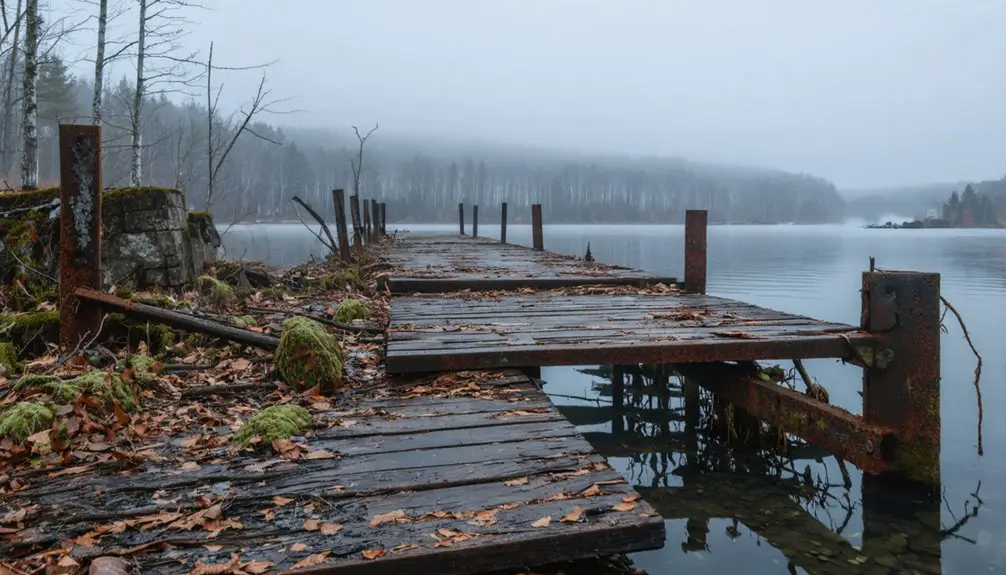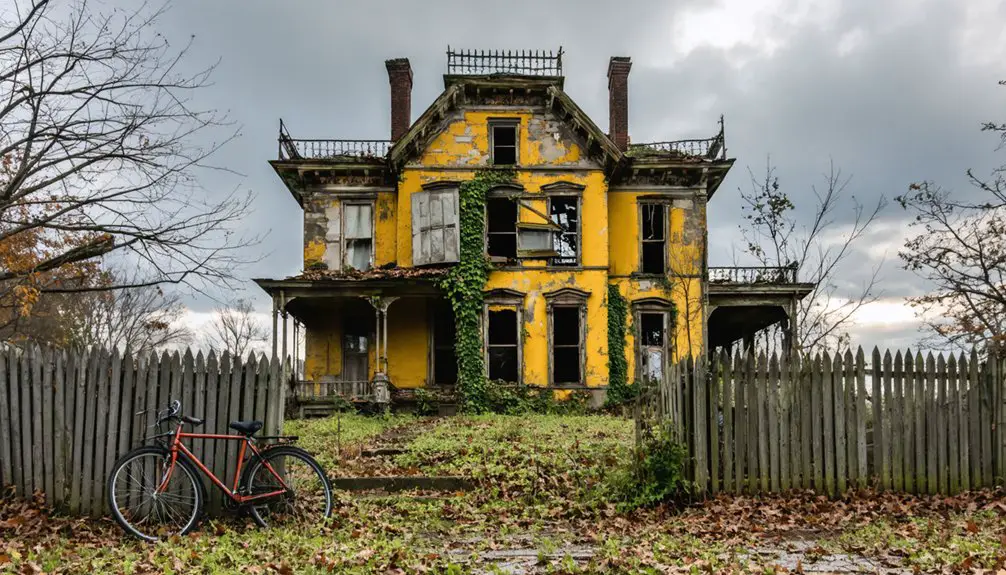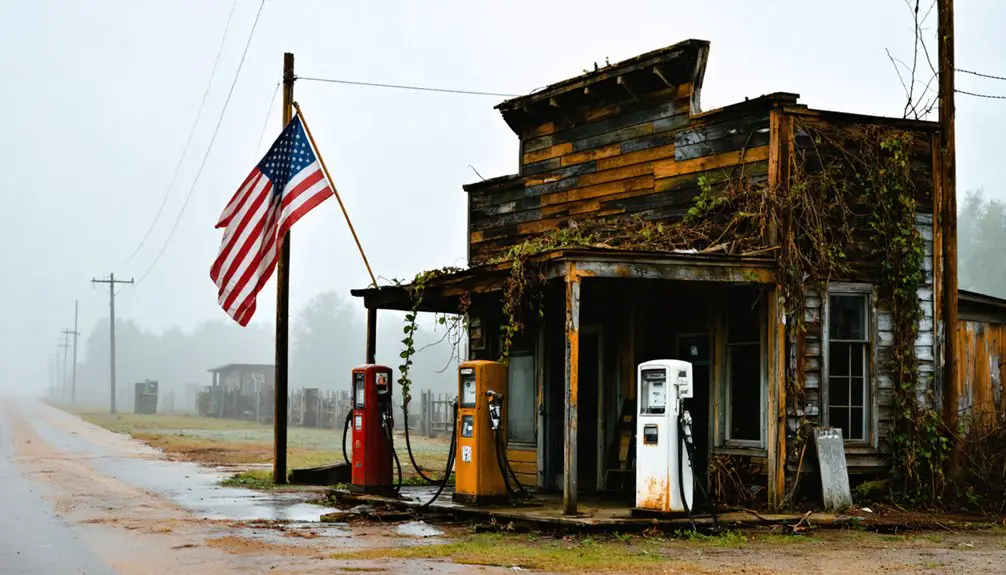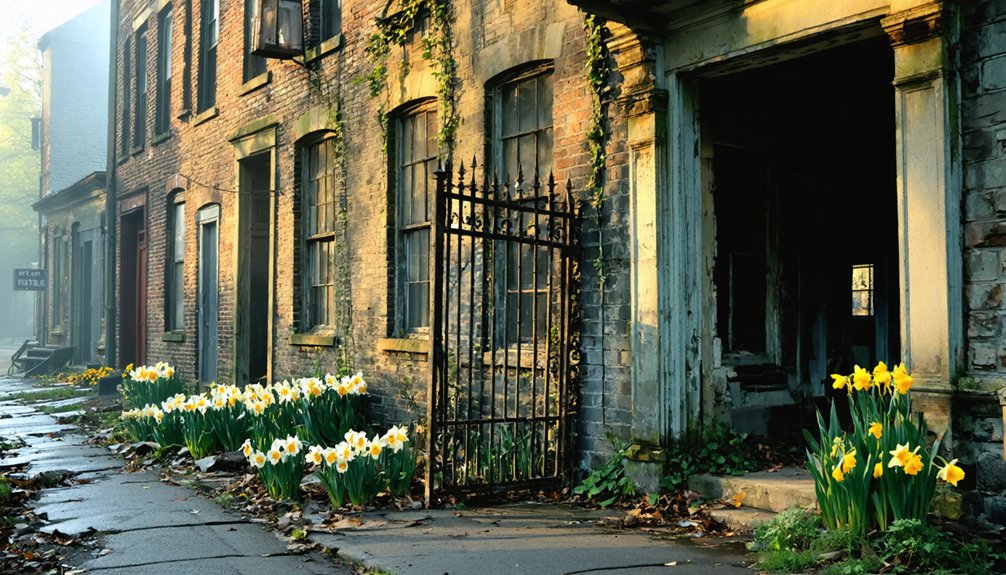
You’ll find New York’s most enthralling ghost towns come alive each spring, from Doodletown’s seventy stone foundations near Bear Mountain to Tahawus’s abandoned iron furnaces deep in the Adirondacks. Mid-April through early June offers the perfect window—wildflowers bloom through cracked pavement at Parksville, while morning mist shrouds North Brother Island’s bird-filled ruins. Bring waterproof boots for muddy trails, download offline maps, and respect property boundaries as you explore these haunting remnants of communities shaped by industry, disaster, and time’s relentless reclamation.
Key Takeaways
- Doodletown near Bear Mountain offers a 3-mile trail through seventy home foundations, accessible via Route 9W with naturally preserved ruins.
- Tahawus in the Adirondacks features historic mining remnants, including an 1854 blast furnace and MacNaughton Cottage, seven miles into wilderness.
- Pottersville along Route 9 showcases flood-impacted structures, an 1847 Methodist Church, and the eastern U.S.’s largest marble cave entrance.
- North Brother Island serves as a bird sanctuary with Riverside Hospital ruins, viewable only from water as it remains off-limits.
- Spring visits offer mild weather for exploring trails and ruins while witnessing nature’s reclamation through budding vegetation and nesting birds.
Doodletown: A Preserved Settlement Near Bear Mountain
Tucked into the wooded hills near Bear Mountain, Doodletown sits frozen in time—a settlement that thrived for two centuries before vanishing almost overnight.
You’ll discover seventy home foundations scattered along the 3-mile Doodletown Trail, where crumbling staircases and stone stoops emerge from the forest floor like memories refusing to fade.
The Palisades Interstate Park Commission gradually acquired these properties from the 1920s onward, evicting the last residents in 1965 through eminent domain.
What makes this site exceptional for urban exploration isn’t just the visible remnants—it’s the story of three hundred people whose community was erased for parkland expansion.
The settlement’s name derives from the Dutch term “dead valley,” reflecting the area’s early colonial influences.
The trail begins near the intersection of Route 9W and Doodletown Brook, providing access to this haunting historical landscape.
Historical preservation here means nature itself maintains the ruins, creating an eerie landscape where Dutch heritage meets America’s complicated relationship with progress and displacement.
Tahawus: The Twice-Abandoned Mining Town of the Adirondacks
Unlike most ghost towns that fade slowly into obscurity, Tahawus died twice—first in 1858 when iron mining collapsed, then again in 1989 when titanium operations finally ceased.
Tahawus stands apart—a ghost town that experienced two complete deaths across 131 years of mining history.
You’ll find this remote settlement where iron ore was discovered in 1826. It transformed from a 16-building mining village to an elite hunting retreat, then was rebuilt during WWII for wartime titanium production.
Today’s ruins present serious preservation challenges—most structures were demolished for safety, leaving scattered machinery and the 1854 blast furnace standing sentinel.
The restored MacNaughton Cottage represents successful historical preservation, marking where Theodore Roosevelt learned he’d become president in 1901. Roosevelt had climbed Mount Marcy and was located after searchers shot into the distance to alert his party of McKinley’s worsening condition.
You can’t enter unsafe buildings, but you’re free to explore the grounds, hike to Mount Marcy, and trace two centuries of boom-and-bust cycles etched into Adirondack wilderness. The site sits approximately seven miles through wilderness on a long, desolate asphalt road that ends abruptly in the former town center.
Pottersville: Site of Tragedy in Warren County
You’ll find Pottersville nestled in the Adirondacks along U.S. Route 9, where a catastrophic 1927 flood swept through this once-thriving hamlet, leaving scars still visible in the landscape nearly a century later.
The torrent destroyed homes, businesses, and bridges that had served the community since roads first opened in 1805, transforming this prosperous farming and tourism center into a shadow of its former self. The local fire department responded to numerous calamities throughout the community’s history, demonstrating remarkable resilience during recovery efforts after major disasters.
Today, you can walk the same historic routes where stagecoaches once stopped and where the Wells House hotel welcomed summer visitors, though many buildings from that era now stand empty or vanished entirely. The area’s largest marble cave entrance in the eastern United States remains a geological landmark drawing curious visitors to this haunting remnant of Warren County’s past.
The 1927 Flood Disaster
The icy waters of the Schroon River surged through Pottersville on an April morning in 1927, transforming this quiet Warren County hamlet into a scene of devastation that locals would recount for generations.
You’ll find remnants of this historical flooding etched into the landscape—foundations swept clean, roadbeds washed away, structures that simply vanished overnight. The torrent claimed homes, businesses, and lives, reshaping the community forever.
When you visit today, preservation efforts have marked key sites where the flood hit hardest. You can trace the waterline on remaining buildings and walk the reconfigured streets that had to be rebuilt from scratch.
Spring’s thaw serves as a poignant reminder of nature’s raw power, making your exploration both sobering and unforgettable. The disaster was triggered by heavy rainfall beginning in late fall 1926, coupled with snowmelt that overwhelmed rivers throughout the region. While Vermont bore the brunt with 84 deaths, communities across New York also faced catastrophic losses during this regional disaster.
Accessing the Abandoned Site
Despite its haunting designation as a “ghost town,” Pottersville remains very much alive and accessible along U.S. Route 9 in the Adirondack Park. You’ll find roads that’ve existed since 1805, still steering through the same routes early travelers used.
The Natural Stone Bridge and Caves welcomes visitors year-round, showcasing eastern America’s largest marble cave entrance.
While downtown’s 1918 fire left gaps in the historical landscape, you can explore the 1847 United Methodist Church—Warren County’s oldest still holding services.
The Wells House site and former Pottersville Central School stand as abandoned structures marking the hamlet’s evolution.
You won’t need special exploration gear here; it’s a living community of 424 residents where history mingles with modern life, accessible to anyone seeking authentic Adirondack heritage.
North Brother Island: Nature Reclaims a Former Hospital
You’ll find North Brother Island‘s crumbling Riverside Hospital complex frozen in time since its 1963 closure, where tuberculosis patients once gazed from pavilion windows and “Typhoid Mary” spent her final decades in forced isolation.
Today, Black-Crowned Night Herons have claimed the twelve abandoned buildings as their nesting ground. Their colonies thrive among vegetation that bursts through rotted floorboards and consumes brick walls. The hospital ruins now lie hidden beneath dense tree canopies, making the once-prominent medical facility nearly invisible from above.
Though the island remains officially off-limits as a federally protected bird sanctuary, you can still glimpse the octagonal lighthouse tower and hospital ruins from the water, their weathered frames standing as monuments to over a century of quarantine, tragedy, and New York’s public health battles. The island became NYC’s jurisdiction following a federal purchase in 2007, transferring ownership from Hampton Scows Inc. to the city.
Riverside Hospital’s Dark History
Long before nature’s vines crept through broken windows and reclaimed crumbling corridors, Riverside Hospital served as New York City’s fortress against contagion. Founded in the 1850s and relocated here in 1885, this isolation complex witnessed humanity’s darkest hours—spawning haunted legends and eerie encounters that persist today.
The hospital’s grim legacy includes:
- Typhoid Mary’s 30-year imprisonment as America’s first documented asymptomatic carrier
- The General Slocum disaster morgue processing 1,021 bodies from the 1904 steamship tragedy
- Tuberculosis Pavilion’s isolation wards where patients breathed their final breaths
- Polio epidemic overflow during the devastating 1916 outbreak
You’ll find twenty-five decaying structures standing as monuments to suffering. The island closed in 1963, abandoned to rot—a testament to medical advancement and human resilience against invisible killers.
Wildlife Takes Over Ruins
Since Riverside Hospital’s last patient departed in 1963, North Brother Island has transformed into one of the region’s most thriving wildlife sanctuaries—a 20-acre symbol of nature’s resilience where black-crowned night herons nest among crumbling tuberculosis wards and raccoons prowl through abandoned morgue corridors.
You’ll witness urban decay meeting natural reclamation as English ivy and kudzu strangle 25 roofless buildings. Sugar maples push through asphalt while barn swallows nest in collapsed dormitories.
The island hosted the region’s largest night heron colony through the early 2000s, sharing space with gulls, cormorants, and egrets across this Harbor Herons Region sanctuary.
Though you can’t visit—the Wildlife Conservation Society restricts access to protect nesting birds—you’ll glimpse this rewilded ghost town from LaGuardia departures, watching nature erase humanity’s footprint entirely.
Parksville: Sullivan County’s Hidden Abandoned Community
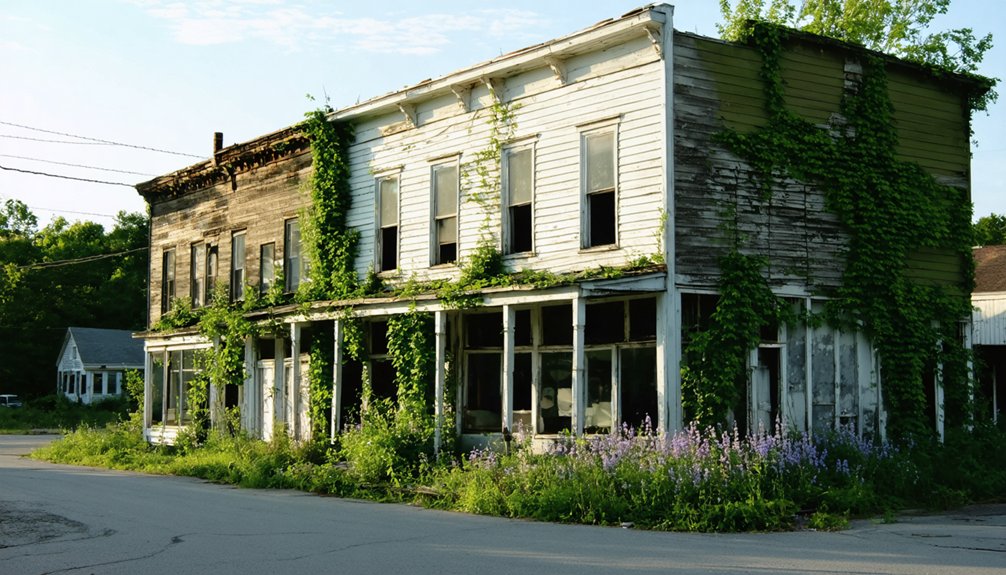
Tucked into a Catskills valley where the Little Beaver Kill River winds past shuttered storefronts, Parksville stands as Sullivan County’s most haunting reminder of the Borscht Belt’s golden age. You’ll find urban decay frozen in time—100+ hotels reduced to vacant shells after Interstate 86 rerouted freedom-seeking travelers away from Main Street.
What You’ll Discover:
- Weathered survivors like Rolling River Cafe Gallery and Cabernet Franks
- The 1898 United Methodist Church Cemetery where founder William Parks rests
- Papered windows and abandoned structures along old Route 17
- Historical preservation efforts breathing life into this 1,000-resident hamlet
Spring weather transforms your exploration of these accessible ruins. Drive the old highway, photograph the eerily quiet storefronts, and visit the Borscht Belt marker recognizing when 65 hotels once thrived here.
Love Canal: Niagara Falls’ Evacuated Neighborhood
Four miles south of thundering Niagara Falls, a seemingly ordinary subdivision hides America’s most infamous environmental disaster. You’ll find Love Canal where 800 homes once stood—now replaced by chain-link fences and warning signs marking contaminated ground.
Beneath suburban dreams lies America’s toxic nightmare—where 800 families once lived, only warning signs and contaminated earth remain.
This environmental controversy began when Hooker Chemical dumped 21,000 tons of toxic waste here between 1942-1953, then sold it for $1. They built schools and playgrounds directly atop buried carcinogens.
By 1978, chemicals oozed into basements, burning children’s skin and causing devastating illnesses. President Carter evacuated 900 families in 1980, leaving behind urban decay that sparked America’s environmental justice movement.
Today, you can drive past the renamed Black Creek Village, where nature slowly reclaims this toxic ghost town.
Planning Your Spring Ghost Town Adventure in New York
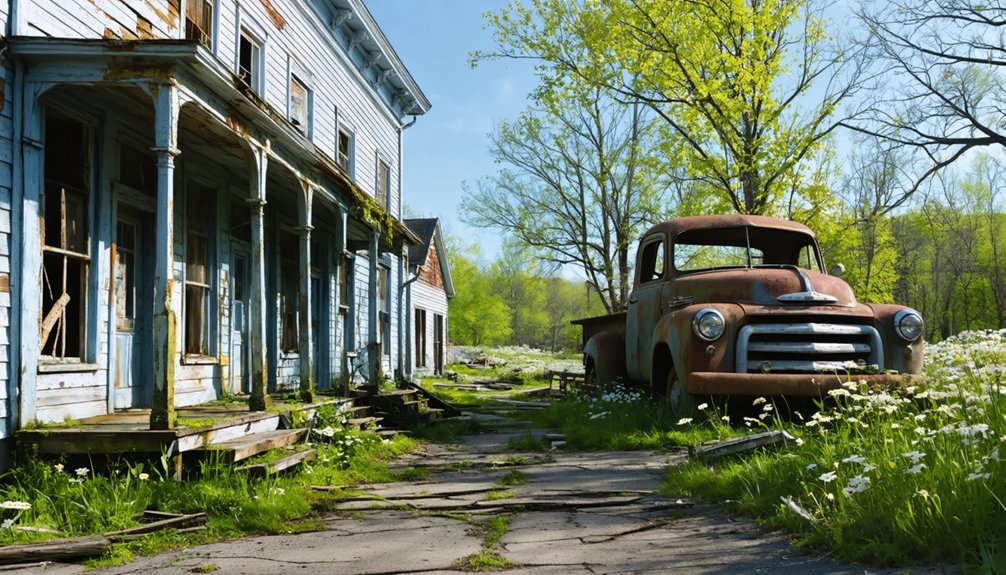
Before you chase New York’s forgotten landscapes, you’ll need to prepare for the state’s unpredictable spring weather—a lesson I learned the hard way during my first muddy trek to Tahawus.
Pack waterproof boots and rain gear for April-May downpours that transform trails into slick obstacle courses.
Essential gear for urban exploration while respecting historical preservation:
- Sturdy hiking boots for steering Doodletown’s overgrown foundations
- Bug spray and tick repellent for May adventures near Irishtown
- GPS device or offline maps for unmarked routes to Charlie Hollow
- Flashlight and long pants for exploring shadowy ruins safely
Check permit requirements beforehand—sites like Camp Santanoni need day-use registration, while Mohonk Preserve charges access fees.
Respect private property boundaries, especially around Pottersville.
Target mid-April through early June for ideal conditions and minimal crowds.
Safety Tips for Exploring Abandoned Sites
When my boot crashed through rotted floorboards at an abandoned Adirondack hotel, I learned that ghost town exploration demands respect for decay’s invisible dangers.
You’ll need proper safety gear before any urban exploration: N95 respirator for mold and asbestos, headlamp for dark spaces, and sturdy boots. Pack a first aid kit—those rusty nails don’t care about your adventure spirit.
Walk the structure’s exterior first, identifying exits and hazards. Inside, stay near walls where supports remain strongest. Test each stair by stepping near the edges, never the center. Watch for ceiling collapse signs overhead.
Structural integrity follows predictable patterns—walls support weight better than centers, and stair edges hold when middles have rotted through.
Keep your exit path clear—use a doorstop on doors. Download offline maps since cell service vanishes in these forgotten places. If the building looks questionable, walk away. There’s always another ghost town waiting.
Best Times to Visit New York Ghost Towns in Spring
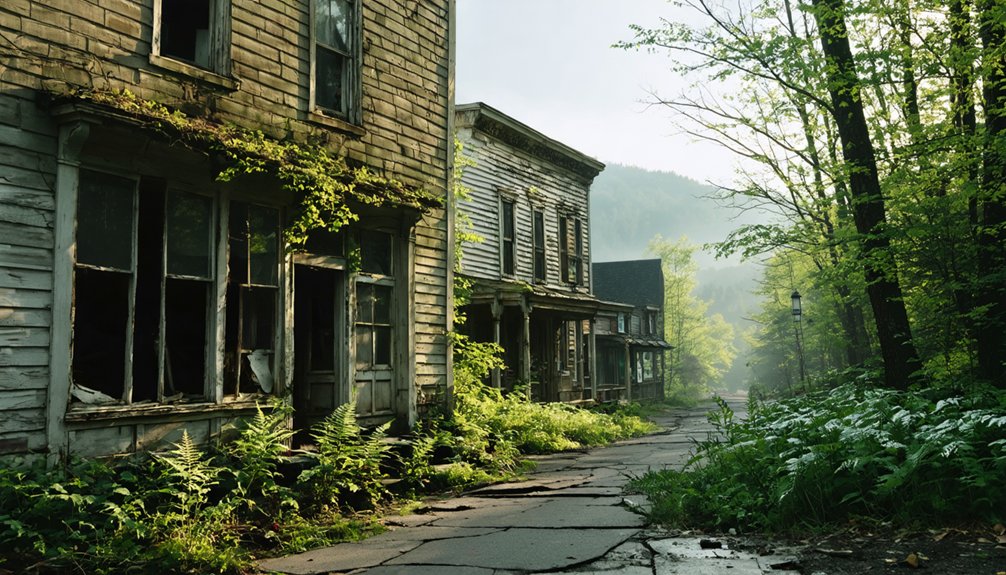
The crunch of thawing earth beneath my boots at Tahawus last April marked that perfect window—after mud season’s worst but before summer’s crowds reclaim these forgotten places. You’ll find ideal conditions mid-April through May, when spring foliage frames crumbling foundations without obscuring them.
Historical preservation efforts mean sites like Doodletown welcome visitors during extended daylight hours—14 by late May—giving you freedom to explore thoroughly.
Prime visiting windows:
- Late April weekdays – trails dry, structures visible, zero crowds at Pottersville
- Early May mornings – enhanced waterfall backdrops near abandoned Adirondack mines
- Mother’s Day weekend – Albany Tulip Festival pairs perfectly with ghost town circuits
- March afternoons – frost-cleared foundations emerge in Bear Mountain sections
Dawn arrivals maximize solitude; you’ll have Doodletown’s 30+ labeled structures entirely to yourself.
Frequently Asked Questions
Are Guided Tours Available for Any New York Ghost Towns?
Yes, you’ll find guided tours exploring New York’s abandoned sites, offering history preservation insights and incredible photography opportunities. Expert guides share personal stories while leading you through crumbling structures, capturing hauntingly beautiful moments of forgotten communities reclaimed by nature.
Can I Bring My Dog When Visiting Abandoned Sites?
You can bring your dog to most sites following dog friendly policies—keep them leashed on six-foot leads. Prioritize pet safety tips: pack booties for sharp ruins, avoid contaminated zones like Love Canal, and carry tick prevention in overgrown areas.
Do I Need Permits to Explore Ghost Towns in New York?
Like stepping through an unbarred door, you won’t need permits for most New York ghost towns on public land. However, check local legal restrictions and respect preservation efforts—some sites require guided tours or have access limitations protecting historical integrity.
Exploring abandoned places in New York can reveal fascinating glimpses of the past, from crumbling factories to forgotten amusement parks. Each site tells its own story, capturing moments in time that resonate with history and intrigue. As you wander through these remnants, be sure to appreciate the artistry of nature reclaiming its territory in the shadows of urban skyscrapers.
Which Ghost Town Is Closest to New York City?
Doodletown’s your closest escape, just 45 miles north in Rockland County. You’ll find urban decay meeting historical preservation—concrete stairs and stone foundations from 70 homes, abandoned in the 1960s when residents were evicted for park expansion.
Are There Camping Facilities Near These Abandoned Locations?
You’ll find designated campsites near all four locations—though not directly on-site due to preservation challenges and wildlife habitats. Bear Mountain, Adirondack Forest Preserve, and surrounding state parks offer tent and RV camping for your adventurous spring exploration.
References
- https://943litefm.com/abandoned-ghost-towns-new-york/
- https://www.onlyinyourstate.com/experiences/new-york/ghost-towns-ny
- https://www.ghosttowns.com/states/ny/ny.html
- https://hudsonvalleycountry.com/6-mysterious-hudson-valley-ghost-towns/
- https://www.youtube.com/watch?v=Nw2j2-YSknU
- https://www.geotab.com/ghost-towns/
- https://www.atlasobscura.com/things-to-do/new-york-state/abandoned
- https://visitadirondacks.com/fall/abandoned-places-ghost-towns
- https://www.atlasobscura.com/places/doodletown
- https://midatlanticdaytrips.com/2022/06/doodletown/