You’ll find North Carolina’s most haunting ghost towns accessible when spring warms the trails and waterways. Mortimer’s logging ruins hide among mountain dogwoods in Pisgah National Forest, while Portsmouth Village’s salt-crusted windows overlook blooming coastal marshes on the Outer Banks. Henry River Mill Village—The Hunger Games’ District 12—stands frozen in textile-town decay, and Brunswick Town’s tabby foundations crumble beneath ancient oaks along the Cape Fear River. Proctor’s submerged structures emerge from Fontana Lake’s receding waters, revealing what flood erased. Each location holds stories that unfold across weathered foundations and forgotten streets.
Key Takeaways
- Portsmouth Village on the Outer Banks is accessible by boat from Ocracoke, featuring historic buildings and deserted streets within Cape Lookout National Seashore.
- Henry River Mill Village, known as District 12 from The Hunger Games, offers film history but restricts access on Saturdays.
- Brunswick Town near Cape Fear River displays colonial tabby foundations, St. Philip’s Church ruins, and mile-long earthworks from 1726.
- Mortimer in Pisgah National Forest contains logging town remnants including concrete shells, mill foundations, and a CCC maintenance building from 1904.
- Proctor’s submerged structures remain visible above Fontana Lake’s waterline, accessible only by boat or backcountry trails through forested valleys.
Mortimer: A Forgotten Logging Town in Pisgah National Forest
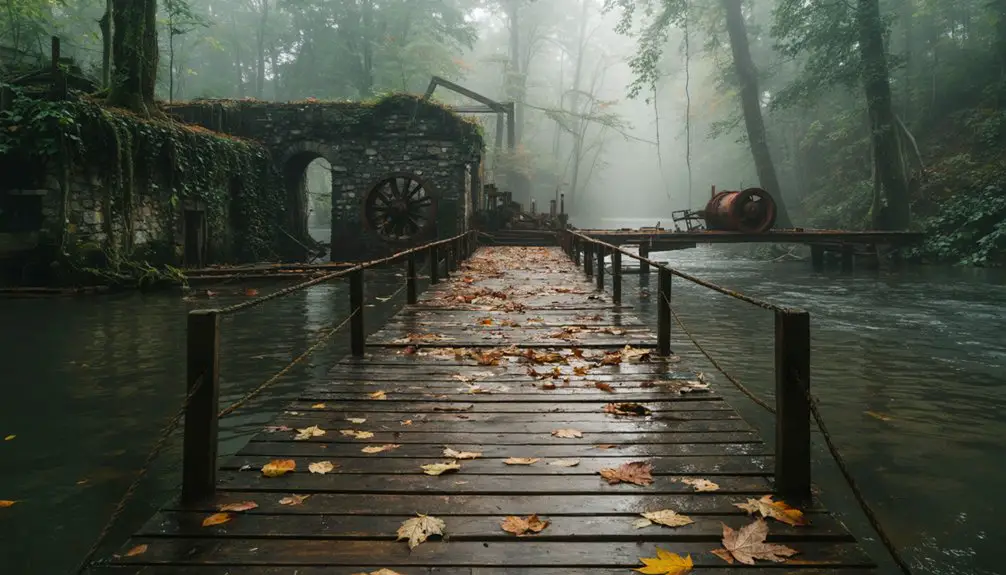
Deep in Pisgah National Forest, where Wilson Creek cuts through the Appalachian ridges, you’ll find scattered concrete shells and rusted boilers half-swallowed by rhododendron thickets—all that remains of Mortimer, once a thriving timber town of 800 souls.
The timber industry built this place in 1904, connecting it to civilization via narrow gauge railroad that followed the creek’s bends. You can still walk these old rail beds, now converted to trails winding past the white CCC maintenance building and mill foundations.
Spring brings wild azaleas blooming around community remnants—the boiler room at the campground entrance, concrete shells where workers once operated looms and saws. The 1916 flood that killed 80 people ended Mortimer’s story, leaving these haunting fragments for wanderers like you. The town’s Ritter Lumber Company shuttered operations permanently after the disaster, sealing Mortimer’s fate as a ghost town. Today, only 16 families remain along Wilson Creek, living among the ghosts of this once-bustling lumber town.
Portsmouth Village: A Preserved Island Settlement on the Outer Banks
While Mortimer vanished into mountain laurel and forest shadow, Portsmouth Village froze in time beneath the relentless Outer Banks sun.
You’ll boat across from Ocracoke to this maritime archaeology wonderland where 1753 whispers through weathered clapboards.
Once North Carolina’s shipping powerhouse—handling two-thirds of exports by 1842—Portsmouth thrived until storms carved new inlets in 1846, strangling its harbor with shoals.
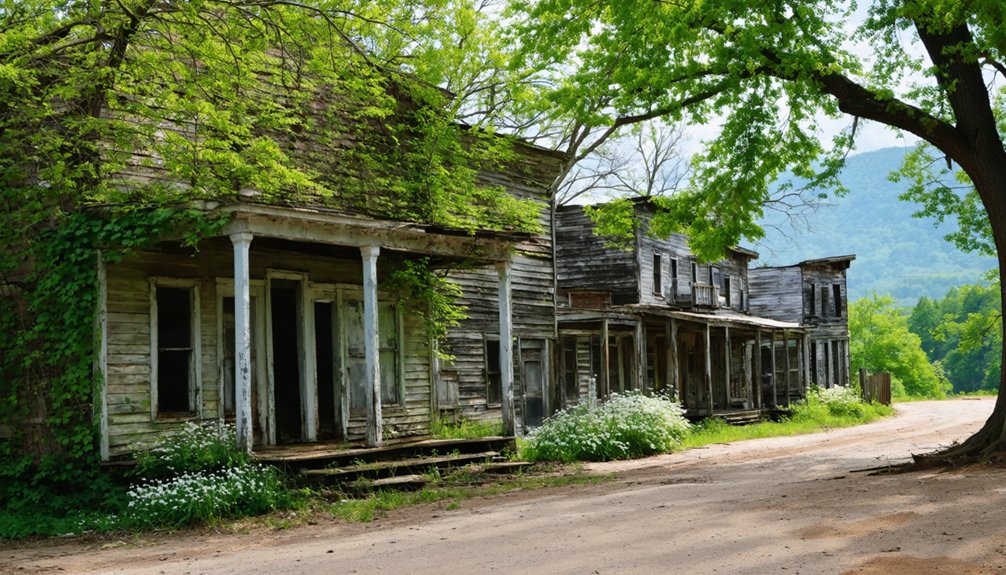
Today’s historic preservation efforts let you peer through salt-crusted windows at belongings left behind when the last residents departed in 1970.
The church still stands. The Post Office (established 1840) served as a social and informational hub until 1959. You’ll walk empty sand streets where 685 souls once lived, now protected within Cape Lookout National Seashore.
Men once worked as hunting guides for visitors at lodges, including the Pilentary Club that hosted dignitaries before a 1933 storm destroyed it.
Bring water and wander freely—this ghost town demands nothing but your curiosity and respect for isolation’s quiet beauty.
As you explore these historic ghost towns in North Carolina, you’ll discover remnants of the past, where time seems to stand still. Each building and pathway tells a story, inviting you to imagine the lives that once filled these now-desolate spaces. Nature is slowly reclaiming these areas, weaving a tapestry of beauty amidst the ruins.
Henry River Mill Village: The Hunger Games District 12 Location
Tucked between Charlotte and Ashville where hemlock shadows dapple the Henry River, 20 weathered cottages stand sentinel over Hollywood’s apocalyptic fantasy made flesh. You’ll recognize District 12’s coal-dusted streets from *The Hunger Games*, but the industrial history here runs deeper than cinema.
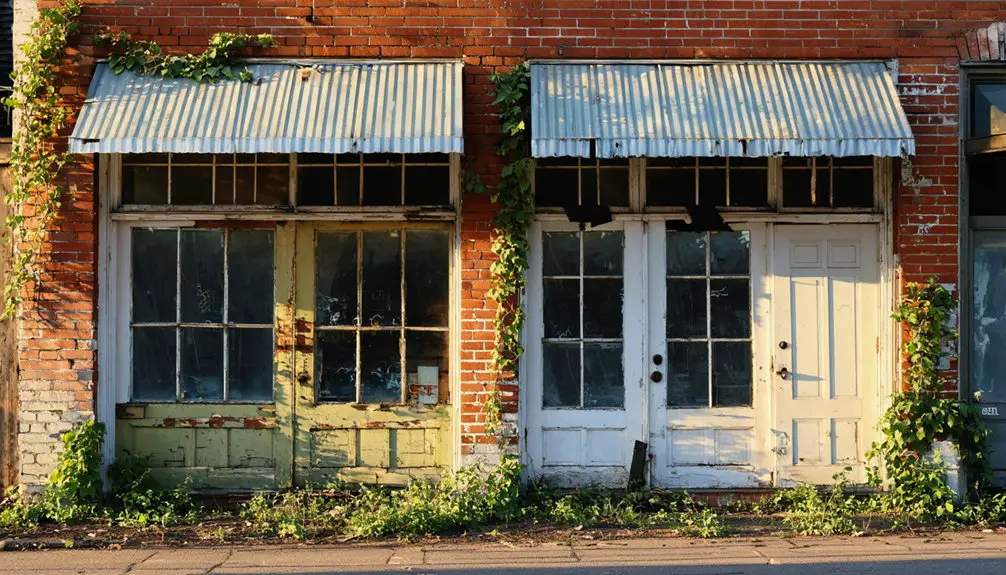
This 1905 textile village once thrummed with 12,000 spindles spinning lace yarn, its workers paid in “Doogaloo” coins that chained them to the company store. Lightning claimed the three-story mill in 1977; now only brick shells and that steel truss bridge remain. The two-story brick company store doubled as schoolhouse and church until 1917, anchoring village life beyond commerce. Built from sun-baked mud bricks on a river rock foundation, this remarkable structure survived over a century of floods and industrial decay.
Community preservation efforts restrict access to Saturdays, but you’ll feel the weight of displacement wandering these hollow doorways—450 souls who built empire on others’ terms, then vanished when overseas competition severed their threads.
Brunswick Town: Colonial Ruins Along the Cape Fear River
Where the Cape Fear River bends toward the Atlantic, tabby foundations rise through wiregrass like broken teeth—all that remains of North Carolina’s most ambitious colonial experiment.
You’ll walk among 336 half-acre lots where Roger Moore’s 1726 vision thrived until British troops torched it on revolution’s eve.
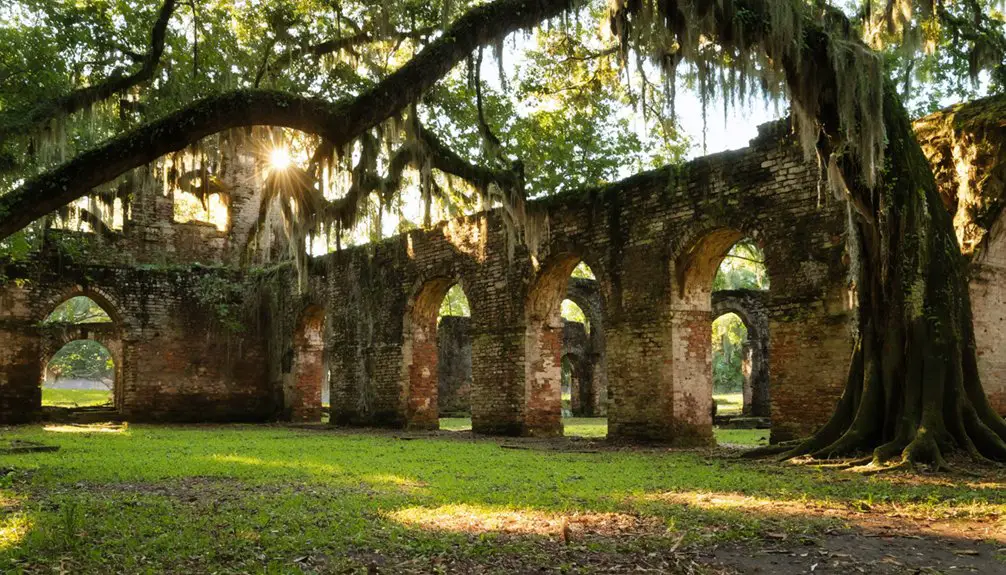
The colonial architecture of St. Philip’s Church stands skeletal against river oaks, its brick walls outlasting two wars.
Confederate earthworks saved what fire couldn’t finish—archaeological excavations in 1958 unearthed taverns, shops, and Governor Tryon’s mansion beneath Fort Anderson‘s trenches.
Earthworks extending over a mile were constructed entirely by hand, with dirt moved from the nearby river by enslaved laborers and Native Americans.
Spring magnolias bloom over courthouse squares where patriots once blocked British ships.
Before colonial ambition took root here, Cape Fear Indians sold these riverside lands after smallpox and migration drove them toward Charleston.
You’re free to wander these ruins where defiance costs everything, where ambition crumbles, where moss reclaims what empires couldn’t hold.
Proctor: Submerged History Beneath Fontana Lake
Beneath Fontana Lake’s glassy surface, telephone poles still stand where Moses Proctor’s descendants once walked streets lit by electric lamps—a town so modern it boasted a 300-seat theater before vanishing underwater in 1943.
You’ll find what remains above the waterline along Hazel Creek’s north shore, where the old Calhoun House watches over submerged structures that once housed 2,000 souls.
The historical flooding displaced 1,200 families who’d built everything from scratch—lumber mills, churches, homes carried board-by-board to new ground.
Spring brings wildflowers to the 26 cemeteries accessible only by boat or backcountry trails.
You’ll reach this forbidden valley through the “Road to Nowhere,” a broken promise that dead-ends into forest, where silence replaces what electric streetcars once interrupted.
Frequently Asked Questions
What Permits or Permissions Are Required to Visit These Ghost Towns?
Most sites don’t require permits for daytime exploration, but you’ll need to respect abandonment legality and trespassing rules. Portsmouth needs boat access, Proctor requires backcountry permits, while Henry River sells tickets—always check current regulations before wandering.
Are These Locations Suitable for Families With Young Children?
Most aren’t ideal for young children. Cape Lookout offers the safest family friendly activities with protected buildings and ferry access, though Portsmouth requires boats. Henry River’s crumbling structures and Ghost Town’s steep chairlift don’t provide kid safe exploration opportunities.
What Safety Precautions Should Visitors Take When Exploring Abandoned Sites?
Like treading through time’s fragile cathedral, you’ll need sturdy boots for crumbling paths, respect historical preservation by never touching artifacts, maintain distance during wildlife encounters, pack emergency supplies, and always test floorboards before stepping—freedom demands responsibility.
Can I Bring My Dog to These Ghost Town Locations?
You’ll find pet-friendly policies at Brunswick Town and Lost Cove, where leashed dogs can explore alongside you. However, Cape Lookout prohibits ferry-riding pups. Follow dog safety tips: keep leashes secured and watch for unstable terrain’s hidden dangers.
What Photography Equipment Works Best for Capturing Ghost Town Ruins?
Like treasure hunters preserving fading maps, you’ll need full-frame cameras for low-light historical preservation, 16-35mm wide-angles capturing emptiness, sturdy tripods for long exposures, and flashlights guiding darkness. Regular equipment maintenance ensures you’re ready when adventure calls.
References
- https://www.atlasobscura.com/things-to-do/north-carolina/ghost-towns
- https://www.uncorkedasheville.com/abandoned-places-in-north-carolina/
- https://www.youtube.com/watch?v=iWhjTfCyUpY
- https://kids.kiddle.co/List_of_ghost_towns_in_North_Carolina
- https://www.visitnc.com/list/ncs-mysterious-disappearances-and-abandoned-places
- http://www.onlyinyourstate.com/experiences/north-carolina/nc-ghost-towns
- https://www.treasurenet.com/threads/mortimer-nc.68030/
- https://www.islands.com/1988321/mortimer-north-carolina-abandoned-ghost-town-historic-pisgah-national-forest/
- http://www.wilsoncreekexperience.com/the-creek/
- https://www.youtube.com/watch?v=nxOGwCFhRRQ