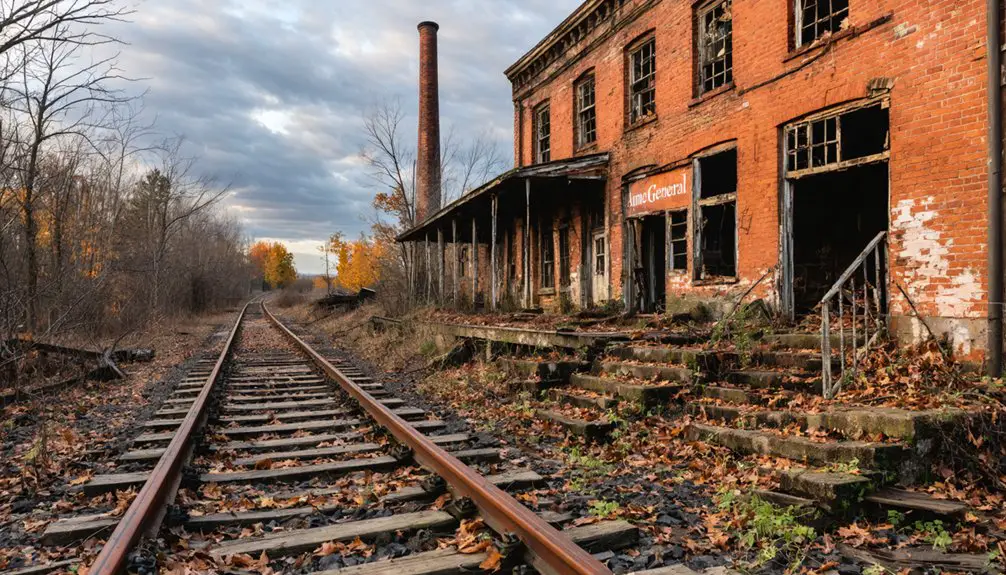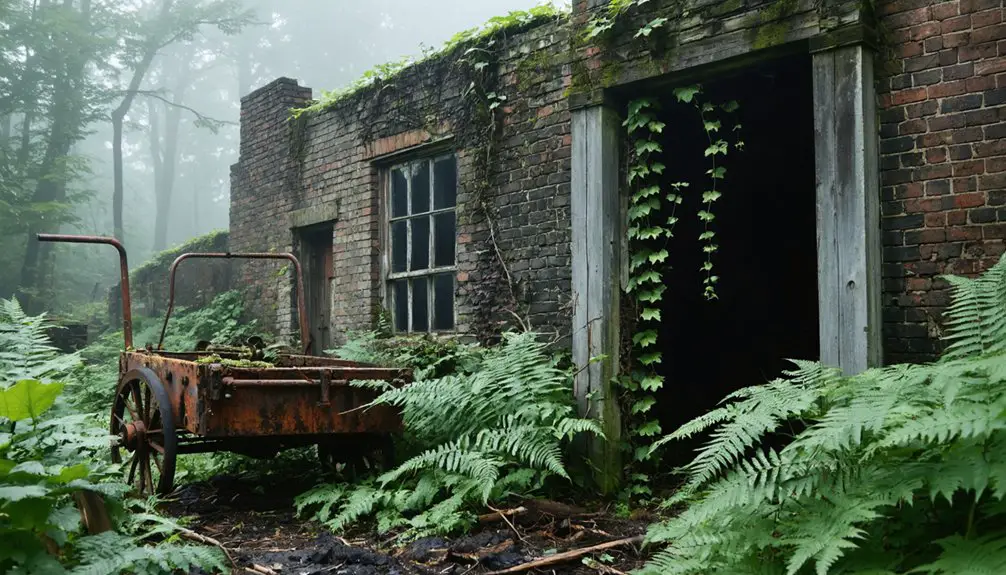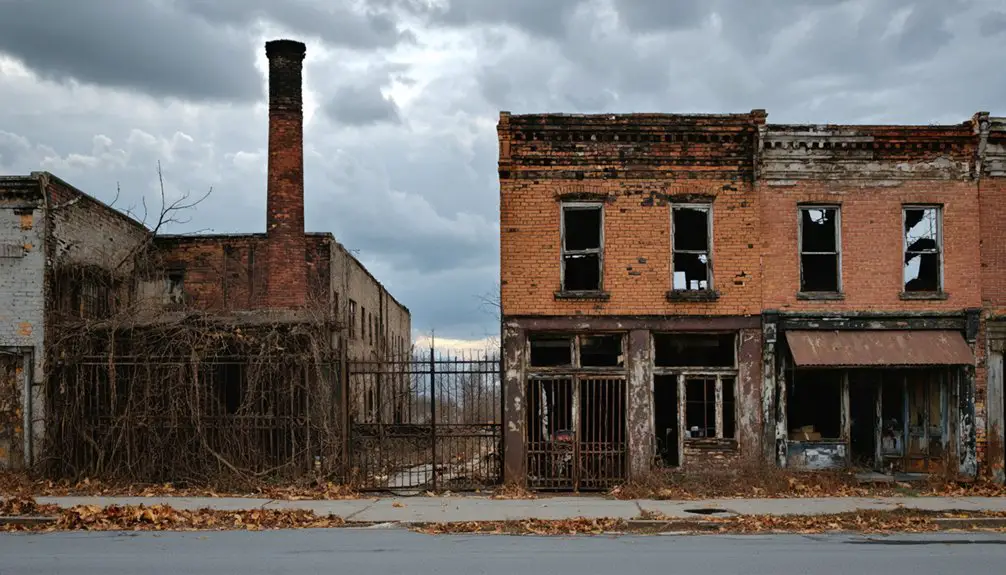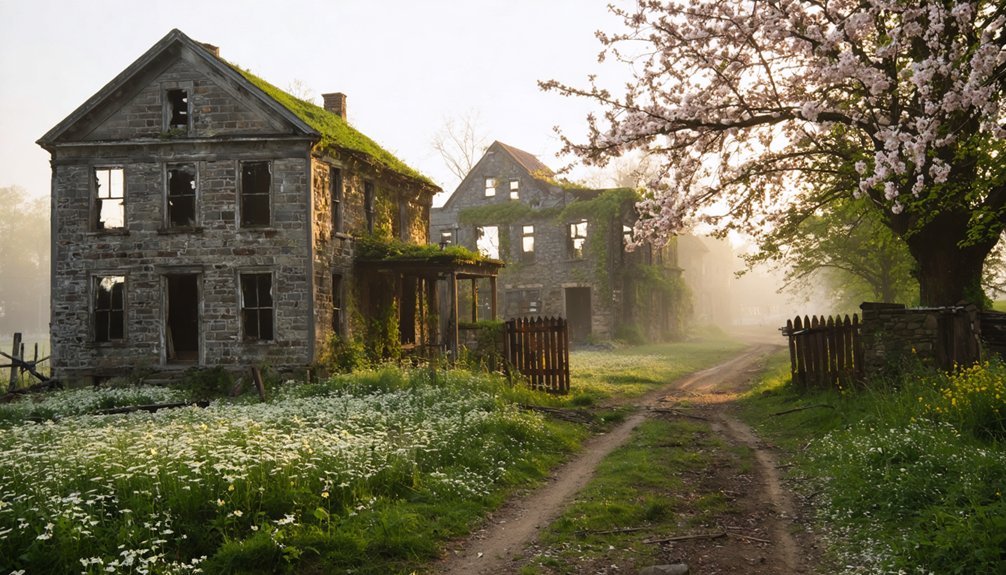
You’ll find Pennsylvania’s best ghost towns awaken in spring when temperatures hit 50-65°F and trails become navigable. Centralia’s steam-venting highways reveal an underground inferno burning since 1962, while Rausch Gap’s 1,000-person mining settlement hides along the Appalachian Trail, accessible via a 3.5-mile hike. Petroleum Center marks where Drake struck oil in 1859, and Yellow Dog Village offers guided tours through 19 intact 1910s duplexes. Spring wildflowers frame these crumbling foundations, and there’s considerably more to each site’s haunting story.
Key Takeaways
- Centralia features steam-venting highways and toxic gas signs from an underground mine fire burning since 1962.
- Rausch Gap requires a 3.5-mile hike along Stony Valley Rail-Trail to view overgrown foundations and mine entrances.
- Eckley Miners’ Village preserves 1850s red wooden houses, company store, and structures from the film “The Molly Maguires.”
- Drake Well Museum at Petroleum Center commemorates America’s first oil well with historic drilling equipment and refinery ruins.
- Yellow Dog Village offers paid guided tours of intact 1910s duplexes with personal belongings left frozen in time.
Centralia: The Town Burning Beneath Your Feet
Deep in the heart of Columbia County, beneath what appears to be ordinary Pennsylvania woodland, an inferno has raged since 1962—a mine fire that transformed the once-thriving town of Centralia into one of America’s most haunting ghost towns.
Since 1962, an underground inferno has burned beneath Centralia, transforming a thriving Pennsylvania mining town into America’s most haunting ghost town.
You’ll find cracked highways venting steam, warning signs about toxic gases, and the eerie remnants of urban decay where nearly 3,000 residents once lived.
The fire started when burning trash ignited an exposed coal seam, spreading through abandoned mine tunnels beneath the streets. Despite decades of containment attempts, the blaze still consumes 200 acres underground.
Today, only seven residents remain, having won the right to stay for life.
Visit the maintained Orthodox cemetery and St. Mary’s Church to witness this stark intersection of mining history and apocalyptic landscape. The town’s prosperity once relied on multiple mines that opened between 1856 and 1863, including the Locust Run, Coal Ridge, and Centralia mines. Congress allocated over $42 million in 1983 to address the fire and relocate residents, marking one of the largest disaster response efforts for a town of its size.
Rausch Gap: A Forgotten Mining Settlement in the Wilderness
Hidden within St. Anthony’s Wilderness, Rausch Gap tells a stark tale of boom and bust. You’ll hike 3.5 miles along the Stony Valley Rail-Trail to reach this settlement that once housed 1,000 coal miners.
Founded in 1828, it thrived as railroad headquarters until poor coal quality sealed its fate by 1910.
Today, you’ll discover stone foundations hidden 300 feet off-trail, a small cemetery with weathered headstones, and overgrown mine entrances—powerful mining memory etched into Sharp Mountain’s slopes. The town was named after Dr. Benjamin Kugler, an industrialist who played a key role in its founding and coal-to-gas conversion operations.
The Appalachian Trail runs through here, offering shelter, spring water, and wilderness preservation at its finest. The railroad headquarters moved away in 1872, accelerating the town’s decline as economic activity shifted elsewhere.
Spring’s the perfect time to explore these ruins, when new growth frames the old foundations and you can camp where miners once worked, completely surrounded by reclaimed forest.
Petroleum Center: Where America’s Oil Industry Began
You’ll find Petroleum Center’s weathered foundations where Edwin Drake struck black gold at 69.5 feet in 1859, launching the world’s first oil boom that transformed a quiet valley into a roaring town of 3,000 souls before the wells ran dry.
Spring offers perfect conditions to explore the muddy drilling sites and crumbling refinery ruins along Oil Creek, where you can still spot rusty barrel hoops and pipeline fragments scattered through the greening forest. The Drake Well Museum now marks this hallowed ground with a National Historic Chemical Landmark plaque, commemorating the pioneering drill site that sparked Pennsylvania’s transformation into America’s first petroleum hub.
Pack sturdy boots for the wet trails, and bring a camera to capture the iron drive pipes—Drake’s cave-in prevention innovation—that still poke through the creek banks like skeletal fingers. The boom attracted such frenzied speculation that Titusville’s population exploded from just 250 residents to over 10,000 within five years, forcing the town to incorporate as a city by 1866.
America’s First Oil Well
Along the quiet banks of Oil Creek near Titusville, a former railroad conductor named Edwin Drake gambled his $200 life savings on what many called “Drake’s Folly.” In August 1859, his steam-powered drill rig—adapted from salt well technology by blacksmith William “Uncle Billy” Smith—punched through 69.5 feet of Pennsylvania earth at a painstaking three feet per day.
The oil discovery transformed everything overnight. That August 27th morning, Drake found black gold floating atop the water—12 to 20 barrels daily that sold for $20 each. This wasn’t just luck; it was revolution. Drake’s innovation of using a drive pipe technique protected the well bore’s integrity and overcame the technical challenges that had plagued earlier drilling attempts.
The historic impact still echoes at Drake Well Museum and Park, where you’ll stand at America’s first commercial petroleum well. The 1861 operation sparked an industry that would reshape global economics and personal mobility forever. Drake’s failure to patent his drill design led competitors to quickly copy his methods, triggering an oil boom that would forever change the region.
Boom and Bust History
Drake’s single well was just the match that lit the fuse. Within a decade, production exploded from 2,000 to 4,000,000 barrels annually. You’ll find it hard to imagine Oil Creek Valley’s transformation—what was once farmland became a continuous sprawl of shanties and derricks practically overnight.
Titusville’s population surged past 10,000 after the 1862 railroad arrived.
The oil trade peaked at 10,000,000 barrels in 1873, with refinery history showing capacity exceeding 12 million barrels by 1871. But excess production crushed prices, sending operators scrambling to new strikes. Investment was risky business—roughly 80% of wells drilled between 1860 and 1870 turned out dry or unprofitable, each costing between $3,000 and $8,000.
The boom-bust cycle rattled through the early 1870s until Rockefeller’s Standard Oil brought order.
Nearby Pithole City exemplified the volatility, transforming into a boomtown with 50 hotels during its peak before fading into obscurity. Edison’s light bulb later gutted kerosene demand, and by 1891, Texas and California had seized Pennsylvania’s crown.
Spring Exploration Tips
When spring thaws open Oil Creek Valley’s muddy trails, Petroleum Center reveals itself as the perfect ghost town for history buffs who don’t mind getting their boots dirty.
You’ll find the best wildflower viewing along interpretive paths in April and May, when temperatures hover between 50-65°F. Access the site through Drake Well Museum’s 219-acre park, where year-round roads lead directly to 1860s derrick ruins and abandoned foundations.
Trail safety improves dramatically after winter’s end—just watch for slippery sections near Oil Creek.
You’ll dodge summer crowds while photographing crumbling storage tanks and drilling equipment. The museum’s operating rigs and 2,048-square-foot transportation building add context to your exploration.
Pack waterproof boots and aim for weekday mornings when you’ll have Pennsylvania’s oil birthplace practically to yourself.
Frick’s Lock: A Canal Village Frozen in Time
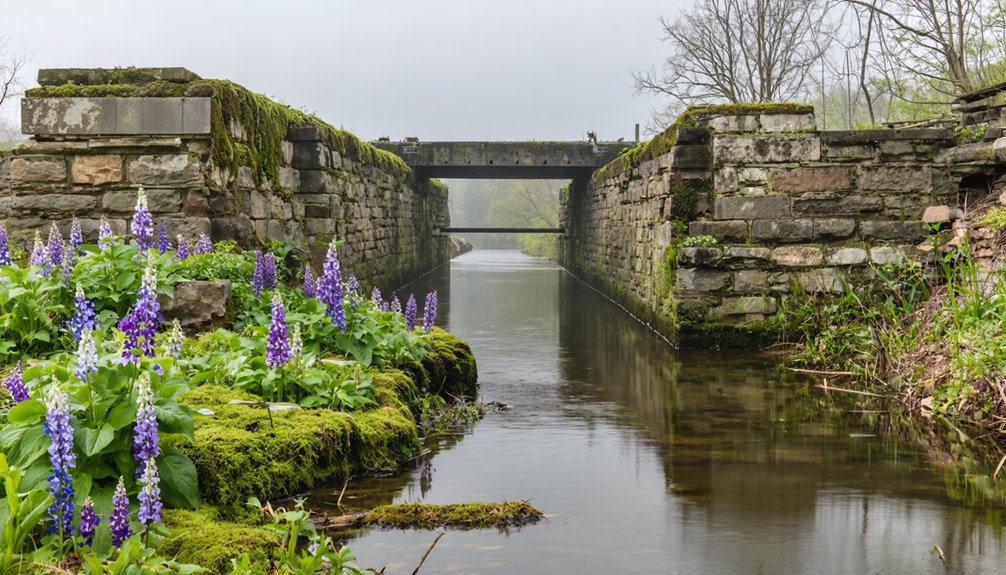
The nuclear power plant across the river forced residents out during the 1960s-1980s, creating this modern ghost town.
While it’s private property under surveillance, the East Coventry Historical Commission offers free tours several times annually—your only legal chance to explore this frozen snapshot of Pennsylvania’s canal era.
Yellow Dog Village: Western Pennsylvania’s Hidden Gem
You’ll find Yellow Dog Village remarkably intact compared to most ghost towns—19 duplexes and homes from the 1910s still stand along Buffalo Creek, their wooden frames weathered but solid.
The new owners welcome visitors through paid tours, giving you legal access to explore these former limestone workers’ dwellings without trespassing concerns.
Spring transforms the site into an ideal hiking destination, where you can wander between buildings on trails that wind through blooming Appalachian hillsides, just an hour north of Pittsburgh.
Best-Preserved Coal Mining Structures
Nestled along Buffalo Creek in Armstrong County, Yellow Dog Village stands frozen in time—a remarkably intact company town where 34 residences still cluster together like artifacts under glass.
You’ll discover industrial architecture that Pittsburgh Limestone Company built during the 1910s-1920s, creating housing for workers who’d otherwise face treacherous commutes. The historic preservation here’s accidental—residents simply walked away during the 2008-2009 water crisis, leaving behind extraordinary snapshots of working-class life.
What You’ll Find Preserved:
- 19 weathered duplexes with original two-story layouts and family quarters
- Chapel, boarding house, and communal facilities still standing
- Personal belongings: furniture, photographs, toys, dishes frozen mid-routine
- Rusting mailboxes and sagging porches marking former homes
- 32-acre property showcasing early 20th-century company town planning
This isn’t sanitized history—it’s raw, untouched Pennsylvania mining heritage.
Legal Access and Exploration
Since former history teacher Joe Meyer purchased Yellow Dog Village in 2014, this 32-acre ghost town has transformed from an urban explorer’s illicit destination into a legitimate living history experience you can visit legally.
You’ll need to book private tours through yellowdogvillage.com, typically offered several times monthly for a small fee that funds ongoing restoration work.
The current owners, who repurchased the property in 2022, welcome visitors while maintaining strict yard preservation standards—trespassing isn’t tolerated here.
What you’ll discover during guided visits are 26 original buildings frozen in time, complete with intact pantries and minimal vandalism.
Spring tours let you explore this early 1900s company town safely, learning about “yellow dog” contracts that once banned unionization.
Several renovated houses will soon offer overnight stays for adventurous history enthusiasts.
Spring Hiking Through History
Hidden among the wooded hills of Armstrong County, Yellow Dog Village reveals itself gradually as you follow the crumbling access road through dense Pennsylvania forest. Spring breathes life into this 1920s mining settlement, where wildflowers push through abandoned porches and birds nest in roofless structures.
You’ll discover a settlement frozen in time:
- The mine manager’s hilltop mansion overlooking workers’ homes below
- 28 deteriorating houses along Buffalo Creek’s banks
- An old chapel where folklore legends still whisper
- Original playground grounds now grazing land for horses
- Shadowy boarding house remnants sparking ghost stories among explorers
The former limestone company town offers unmatched freedom to wander authentic history. Since Joe Meyer’s 2022 repurchase, guided tours illuminate this community’s century-long journey from bustling mining hub to preserved historical site.
Eckley Miners’ Village: Hollywood’s Preserved Coal Town
Deep in the anthracite coal region of Northeastern Pennsylvania, Eckley Miners’ Village stands frozen in time—a company town where red wooden houses with black trim still line the dirt main street just as they did in the 1850s.
You’ll walk where miners once trudged after twelve-hour shifts, their lives controlled by the coal company that built these dwellings cheaply to enforce industrial discipline. Hollywood discovered Eckley in 1969 for the film “The Molly Maguires,” spurring community preservation efforts that saved the town from demolition.
Today’s museum lets you explore authentic slate pickers’ houses, the company store where inflated prices trapped workers in debt, and the band practice house where miners sought freedom through music.
Mine safety regulations that followed decades of struggle feel tangible here, where danger lurked in every shift.
Frequently Asked Questions
What Should I Bring When Exploring Pennsylvania Ghost Towns in Spring?
You’ll need waterproof boots, flashlights, and cameras to capture Pennsylvania’s 300+ abandoned settlements. Historical preservation efforts protect these sites, so respect boundaries while chasing local legends. Pack water, maps, bug spray, and first-aid supplies for safe spring exploration.
Are Pennsylvania Ghost Towns Safe to Visit With Children?
Most Pennsylvania ghost towns aren’t safe for children due to toxic fumes, sinkholes, and structural collapse risks. You’ll find better historical preservation sites with supervised tours. Wildlife encounters happen unexpectedly—stick to designated areas where rangers guarantee your family’s safety.
Exploring abandoned places in Pennsylvania can provide a fascinating glimpse into the past, but caution is essential. Many of these locations are not only hazardous but also home to various wildlife that can pose a risk. It’s always wise to research and join guided tours to ensure a safer adventure through these historical remnants.
Do I Need Special Permits to Photograph These Abandoned Locations?
Managing permit red tape feels like exploring ruins themselves—complicated but manageable. You’ll need owner permission for private abandoned sites, while publicly accessible roads require no permits. Always respect legal restrictions and posted signage for hassle-free shooting.
Which Ghost Towns Have Nearby Camping or Lodging Options?
You’ll find camping near Pithole at Oil Creek State Park, and Rausch Gap offers trail camping along the Appalachian Trail. Yellow Dog Village provides lodging options nearby. Each site’s historic significance and haunted legends make overnight stays unforgettable adventures.
How Long Does It Take to Explore Each Ghost Town?
You’ll need 1-2 hours at most sites, though accessibility considerations and historical preservation restrictions affect your pace. Pithole’s mowed streets offer easiest access, while Cold Spring’s trails and Fricks Lock’s private property boundaries demand extra time maneuvering carefully.
References
- https://en.wikipedia.org/wiki/List_of_ghost_towns_in_Pennsylvania
- https://kids.kiddle.co/List_of_ghost_towns_in_Pennsylvania
- https://www.atlasobscura.com/things-to-do/pennsylvania/ghost-towns
- https://uncoveringpa.com/ghost-towns-in-pa
- https://www.youtube.com/watch?v=yxFuqGq-FJ8
- https://pabucketlist.com/pa-abandoned-places/
- https://www.youtube.com/watch?v=0jxNCcpVW2o
- http://freepages.rootsweb.com/~gtusa/history/usa/pa.htm
- https://www.legendsofamerica.com/centralia-pennsylvania/
- https://pabucketlist.com/the-rise-and-fall-of-centralia-pas-toxic-ghost-town/