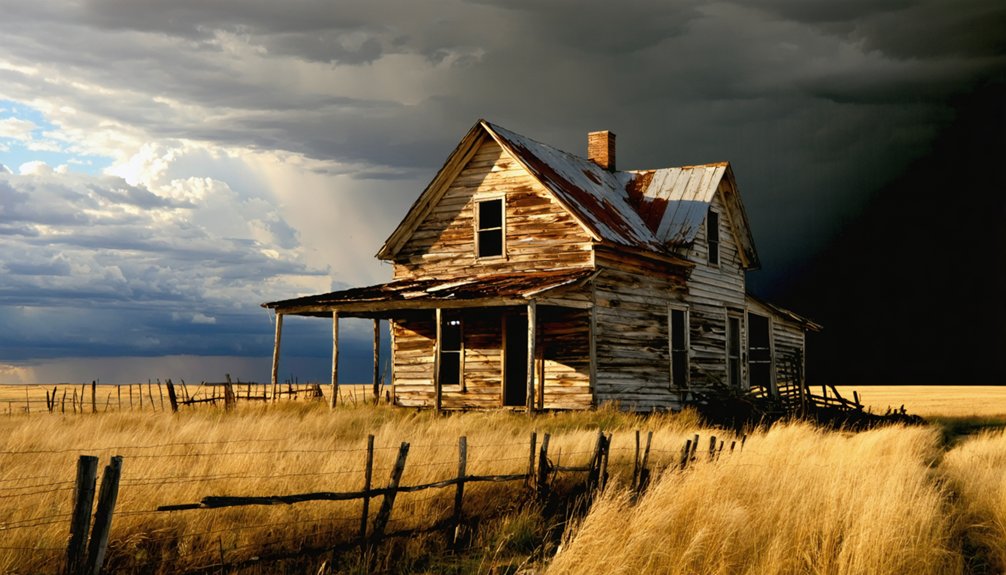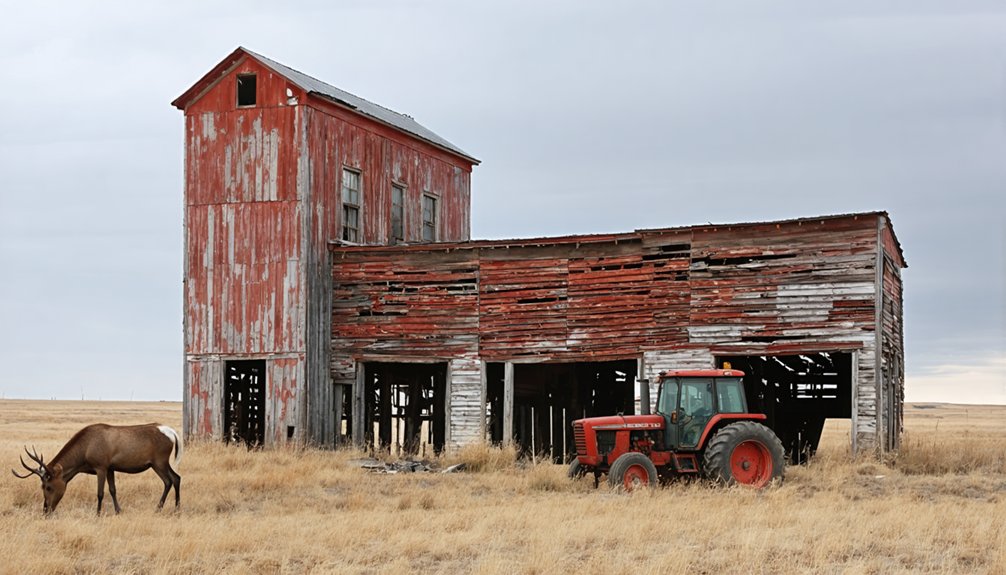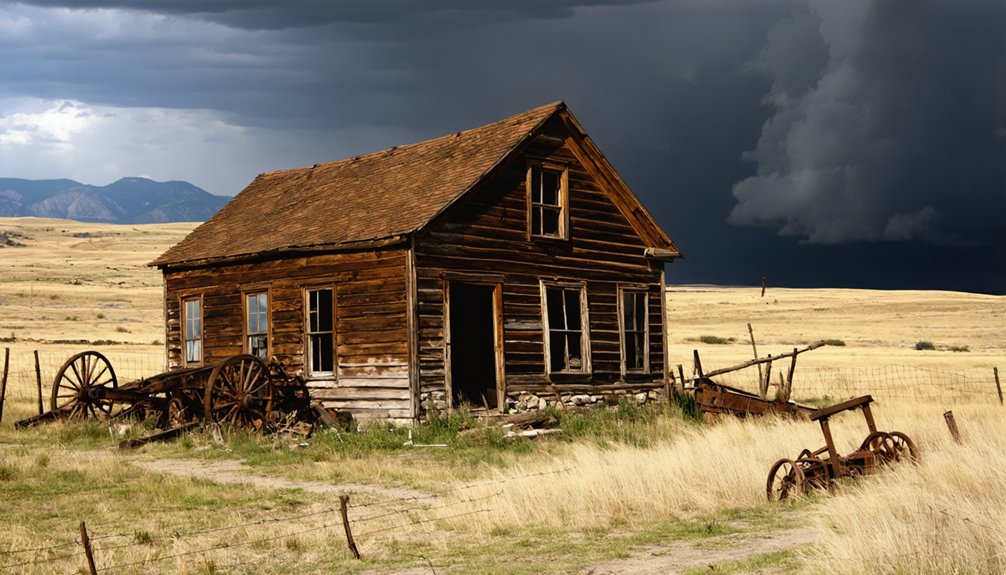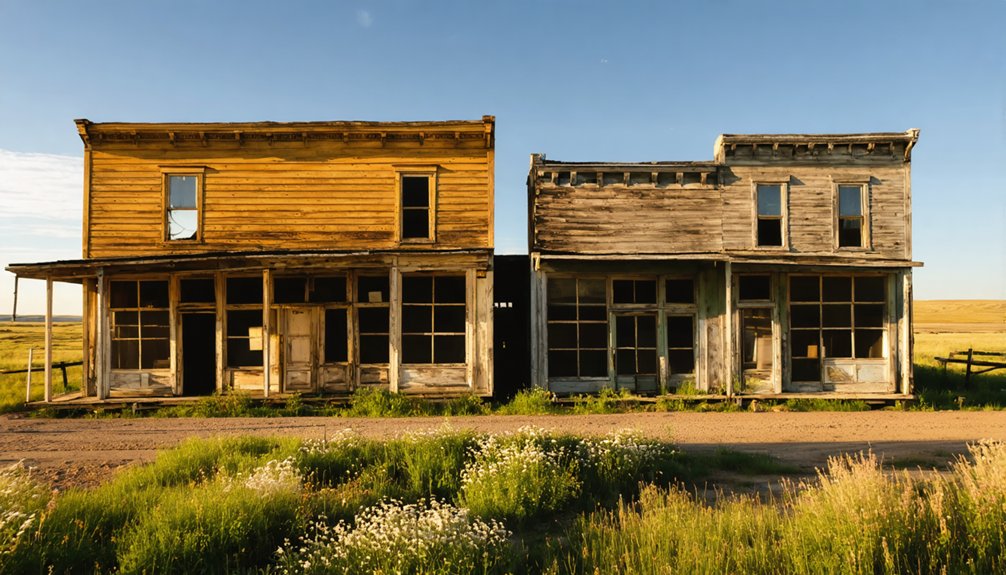
You’ll discover South Dakota’s most atmospheric ghost towns in spring when mild temperatures transform abandoned settlements into photographer’s paradise. Explore Okaton’s weathered grain elevator off I-90, Mystic’s 1909 mining dredge in the Black Hills, or Ardmore’s 15-25 structures near the Nebraska border. Spring’s 55-65°F days offer ideal conditions for traversing gravel roads before summer heat arrives, while melting snow reveals foundations and artifacts connecting you to miners and homesteaders who endured these harsh plains. Your journey through these preserved sites uncovers the stories behind South Dakota’s 600 protected settlements.
Key Takeaways
- Mystic Ghost Town in Castle Creek valley is accessible via a 12-mile gravel road from Hill City during spring.
- Mystic features a 1909 placer-mining dredge with 78 buckets and has been on the National Register since 1986.
- Spokane Ghost Town, 16 miles northeast of Custer, offers moderate hiking terrain through stamp mills and mining pits.
- Okaton Ghost Town near Murdo displays a weathered grain elevator, rusting equipment, and abandoned railroad town structures.
- Approximately 600 Black Hills settlements are protected by law, requiring respectful exploration and prohibiting artifact removal.
Argonne Ghost Town: Prairie Remnants Near Hermosa
When spring winds sweep across the South Dakota prairie, they whisper through the skeletal remains of Argonne, a town that once promised prosperity along the Northwestern Railway line.
You’ll find this ghost town in Miner County, where a derelict grain silo and bank vault stand as monuments to a community that peaked at 100 residents in 1920.
Originally named St. Mary’s in 1886, it was rechristened Argonne after WWI’s bloodiest battle.
Drive 4.3 miles west from Highway 25 North, following an unnamed dirt track to a triangular grove where wildflower hikes and bird watching replace the schoolchildren’s voices that fell silent in the 1970s.
The prairie’s eerie beauty reclaims what civilization abandoned—a perfect spring exploration for those seeking solitude.
The town was founded by Louis Gotthelf, a Prussian-born medical doctor who established the settlement but departed for Parker, South Dakota, just three years later in 1889.
The Argonne Arrows basketball team achieved legendary status during the 1952-53 season when Delbert Gillam scored 72 points in a single game, setting a South Dakota record that remains unbroken.
Okaton Ghost Town: Railroad Town Off Interstate 90
You’ll find Okaton just off Exit 183 near Murdo, a railroad town born in 1906 when the Chicago, Milwaukee & St. Paul Railroad pushed westward toward Rapid City.
What began as temporary housing for track workers and homesteaders eventually faded as the construction crews moved on, harsh winters drove farmers away, and the Great Depression emptied the prairie—but the final blow came when Interstate 90 bypassed the town entirely, cutting it off from passing travelers.
Today, with only 23 residents and the tracks gone silent since 1980, Okaton stands as one of South Dakota’s most accessible ghost towns, where you can walk among collapsing homesteads and rusting farm equipment without venturing far from the highway. The Westlake family once attempted to revive the settlement by advertising it as a ghost town tourist attraction, complete with a rock shop, petting zoo, and a general store serving sandwiches. The town’s most recognizable landmark is its abandoned grain elevator, which still displays the false “Bingo Grain Co.” name painted for an old movie that was never released.
Founded as 1906 Railroad Stop
Along the windswept prairie of central South Dakota, Okaton sprang to life in 1906 as the Chicago, Milwaukee & St. Paul Railroad pushed westward toward Rapid City. You’ll find this settlement emerged specifically to house railroad workers constructing the Milwaukee Road‘s ambitious expansion across the plains. Unlike nearby Murdo with its impressive roundhouse and passenger station, Okaton remained a modest workers’ camp where hardy souls laid tracks through unforgiving terrain.
The town’s brief railway heyday attracted homesteaders who raised cattle and planted grains alongside the tracks. When the railway’s construction concluded, most residents departed, following the work crews to the next expansion site. In its busier days, visitors could enjoy a petting zoo and browse local minerals at the town’s rock shop.
Today, urban legends and ghost stories drift through the abandoned structures as you explore the overgrown railway corridor. The Milwaukee Road ceased operations in the 1980s, leaving behind rusting equipment and weathered buildings that whisper tales of frontier determination.
Interstate Bypass Caused Decline
The Milwaukee Road’s decline set the stage for Okaton’s final blow: Interstate 90’s construction in the 1960s carved a path that bypassed the struggling town entirely.
You’ll notice the irony as you drive past Exit 183—proximity without connection sealed Okaton’s fate rather than saving it. Highway travelers who once stopped for gas and meals now blazed past at 80 mph, glimpsing weathered structures through their windshields.
The bypass transformed a dying community into a ghost town by the 1990s. The iconic grain elevator, marked by its Bingo Grain Co. signage from a film production, remains one of the most recognizable structures visible from the interstate. Today’s urban decay tells a cautionary tale about infrastructure’s double-edged sword. While historical preservation efforts remain minimal, the crumbling general store and abandoned buildings stand as monuments to how easily isolation erases a town from America’s map. The post office closed in 2013, marking the final severance of Okaton’s connection to the broader world.
Accessible Exit 183 Location
Finding Okaton requires nothing more than watching for Exit 183 as you cruise westbound on Interstate 90, roughly 30 miles east of Murdo. You’ll leave the highway’s momentum behind and enter a landscape where urban decay tells South Dakota’s railroad story without museum walls or guided tours.
The access road delivers you directly to structures that embody both abandonment and unintentional historical preservation—weathered buildings frozen in their 1980s ghost town tourist phase, grain elevators repainted for forgotten film projects, and collapsed homes gradually returning to prairie soil.
There’s no admission booth controlling your experience, no operating hours restricting your visit. Spring’s mild conditions make exploration comfortable while highlighting the stark beauty of abandonment. Photography enthusiasts can capture the deteriorating landscape from public roads, documenting structures like the old jail with its marshal and prisoner mural.
This accessible freedom lets you witness history on your terms.
Mystic Ghost Town: Black Hills Mining Community
You’ll find Mystic tucked into the evergreen slopes of Castle Creek valley, where gold fever once gripped hundreds of prospectors who transformed this 1876 mining camp into a bustling community complete with electric dredges and cyanide mills.
The crumbling ruins scattered across the landscape tell stories of railway circles that defied mountain terrain and floods that ultimately sealed the town’s fate.
Spring’s mild weather makes the 12-mile gravel road north from Hill City particularly inviting, offering you clear access to explore the mining remnants along the popular Mickelson Trail.
The town’s historic significance earned its placement on the National Register in 1986, preserving the legacy of its mining operations and distinctive electro-cyanide reduction mill that operated at the turn of the century.
Mining Town Historical Background
When George Armstrong Custer’s thousand-man expedition threaded through the Castle Creek valley in 1874, they couldn’t have imagined the frenzied transformation that would overtake this quiet corner of the Black Hills within a year.
Gold discovery in 1875 sparked a rush that birthed a mining camp called “Sitting Bull” by 1876. You’ll find historical landmarks throughout Mystic that tell this story—from the 1909 electric placer-mining dredge with its 78 buckets to the industrial-scale cyanide reduction mill.
Mining techniques evolved from simple placer operations along Castle Creek to sophisticated hard rock extraction.
Two railroads arrived to haul timber and coal, including the treacherous Crouch Line with its fourteen complete circles and hundred bridges.
The Great Depression and subsequent floods eventually silenced the town’s machinery.
Scenic Black Hills Location
The Black Hills’ evergreen-studded slopes cradle Mystic’s remains in a valley twelve miles north of Hill City, where Castle Creek still runs along the same gravel road that once connected this bustling mining community to civilization. You’ll find the site nestled within Black Hills National Forest, where ponderosa pines frame crumbling mill foundations and wildlife habitats have reclaimed what miners abandoned.
Spring transforms this valley—local flora bursts through rusted equipment, and deer wander past forgotten cyanide pits.
The Mystic Trailhead gives you direct access to the George S. Mickelson Trail, where you’ll hike along the old railroad grade that once carried Black Hills gold.
Historic Route 16 runs nearby, connecting you to Mount Rushmore while offering glimpses into the valley Custer’s 1874 expedition first explored.
Spring Exploration Access Tips
Getting to Mystic requires traversing a gravel road that winds twelve miles north from Hill City through Black Hills National Forest.
Spring conditions transform access from winter’s treacherous routes into muddy passages before settling into firm, dusty tracks by late May. You’ll want a high-clearance vehicle in early spring when snowmelt swells Castle Creek and softens the gravel.
The Mystic Trailhead connects to George S. Mickelson Trail, following abandoned railroad grades through evergreen-studded slopes bursting with spring flora.
Trail safety demands vigilance around open mineshafts and unstable dredge remnants from historic placer operations. Pack water, detailed maps, and bear spray—cell service vanishes here.
No motorized vehicles are allowed on the rail trail, preserving this ghost town’s wild solitude for those seeking unregulated exploration beyond tourist corridors.
Ardmore Ghost Town: Agricultural Settlement Frozen in Time
Nestled just a mile north of the Nebraska border along Highway 71, Ardmore stands as a proof to ambitious dreams crushed by an unforgiving landscape. You’ll discover 15-25 abandoned structures where historical preservation meets nature’s reclamation—homes, a general store, and a fire department frozen since drought strangled this 1889 railroad town.
Where prairie ambitions met their end—15 abandoned buildings stand as monuments to dreams the drought destroyed in 1889.
What Makes Ardmore Uniquely Haunting:
- President Coolidge once picnicked here in 1927, celebrating experimental dry farming that ultimately failed.
- The town survived entirely without welfare during the Great Depression.
- Today’s single resident guards memories of a community that once defied impossible odds.
Walk among rusting vehicles and weathered abandoned architecture where acidic Hat Creek still flows, reminding you that some frontiers remain unconquerable despite human determination.
Spokane Ghost Town: Mining Heritage Near Hermosa
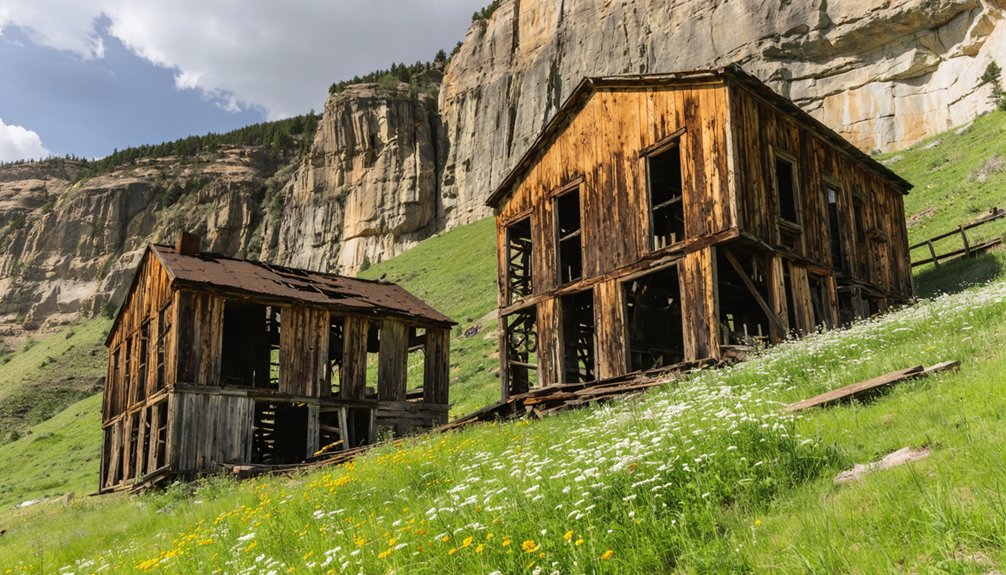
Just sixteen miles northeast of Custer, where Black Hills pines crowd the remnants of ambition, Spokane ghost town clings to steep hillsides that once thundered with stamp mills crushing quartz. You’ll discover a landscape scarred by glory holes and mining pits—stark reminders of environmental impact from silver, lead, and copper extraction that peaked in 1927.
The watchman’s house still stands, though historical preservation here means letting nature reclaim what miners abandoned in 1940. Wander past the collapsing schoolhouse, explore the root cellar’s empty shelves, and contemplate James Shepard’s lonely grave—murdered over claim disputes in 1908.
Access demands effort: park at Spokane Creek Campground and hike moderate terrain. This isn’t sanitized history; it’s raw, unfiltered freedom to explore consequence and decay.
Capa Ghost Town: Southwest Railroad Settlement
While Spokane’s miners carved wealth from mountain rock, settlers on the central plains built their fortunes around a different kind of hope—the railroad’s promise of connection. Capa emerged in 1904 as a Chicago North Western Railway town, its Lakota-derived name meaning “beaver.”
Where mountain miners sought metal veins, prairie settlers chased steel rails—both communities built on the gamble of American expansion.
You’ll find remnants of its 300-resident peak scattered across Jones County’s prairie.
The ghost town architecture tells stories of ambition: a collapsed Catholic church with arched windows, weathered outhouses, and fourteen structures holding forgotten lives.
During the 1920s, visitors flocked to the Capa Hydro Sanitarium for therapeutic mineral baths.
What drew settlers, then drove them away:
- The railroad’s 1906 arrival sparked prosperity
- The Depression emptied pockets and homes
- 1960’s discontinued passenger service sealed Capa’s fate
Navigate nine miles of gravel from Midland—though local ghost stories suggest some residents never truly left.
Planning Your Spring Ghost Town Adventure

Before you load your camera gear and set out across South Dakota’s prairie, understanding spring’s mercurial temperament will separate memorable exploration from muddy misadventure.
April through May brings 55-65°F days but freezing nights, demanding layered clothing for urban photography sessions among weathered storefronts.
Black Hills National Forest roads turn treacherous post-snowmelt—gravel routes to Spokane and Galena become impassable quagmires requiring four-wheel-drive.
Plan 100-150 mile circuits connecting four to six sites daily.
Start early at Deadwood-area towns like Maitland, then push south via Route 385 to Spokane before afternoon rains arrive.
Wildlife observation peaks at dawn when bears emerge from hibernation and rattlesnakes sun themselves in canyon warmth.
Carry satellite communication through cell-dead zones, respect private property boundaries, and secure $20 Custer State Park permits beforehand.
What to Bring for Ghost Town Exploration
Since abandoned doorways and collapsing mineshafts don’t discriminate between prepared visitors and careless wanderers, your pack becomes survival insurance across South Dakota’s loneliest corners. Sturdy hiking boots grip treacherous ground while layered clothing adapts to prairie weather’s mercurial moods. Your camera captures authentic decay—wide-angle lenses frame weathered storefronts against dramatic backdrops, tripods steady low-light shots inside dim saloons.
Essential gear for autonomous exploration:
- Navigation tools: GPS devices and offline maps guide you through remote forest roads where cellular signals vanish.
- Historical preservation items: Gloves protect fragile structures you document; trash bags maintain Leave No Trace ethics.
- Photography tips: Polarizing filters reduce glare on sun-bleached wood; extra batteries ensure you won’t miss Owanka’s golden-hour magic.
Bug spray, sunscreen, and water bottles complete your liberation kit for spring’s unpredictable terrain.
Preserving History: Respectful Ghost Town Visiting
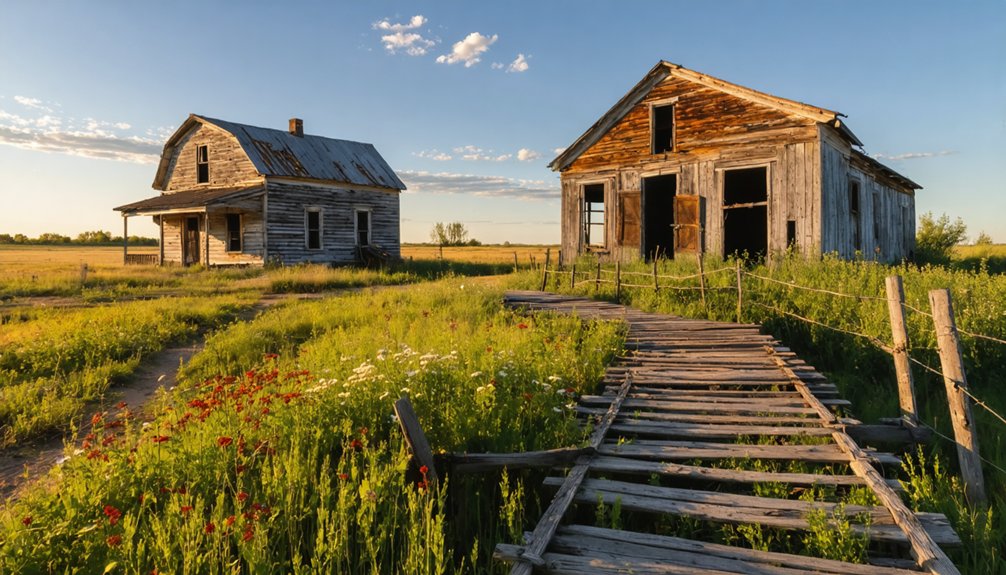
Weathered timber frames and crumbling stone foundations tell stories that exist nowhere else—stories you’ll erase if you pocket a rusty nail as a souvenir or carve initials into century-old wood.
South Dakota’s preservation laws protect these six hundred Black Hills settlements not to restrict your access, but to guarantee future explorers discover what you’re experiencing now.
The cultural significance of these mining camps transcends property boundaries—each artifact connects to miners who worked crushing shifts extracting gold, families who endured brutal winters, and railroad workers who built connections through mountain passes.
Photograph everything. Touch nothing removable. Walk around foundations rather than across them.
You’re documenting vanished worlds where cyanide vats still mark valleys and shaft houses cling to hillsides, maintaining their integrity through your restraint.
Frequently Asked Questions
Are Ghost Town Visits in South Dakota Safe for Families With Children?
Safety varies markedly. You’ll find family-friendly historical preservation sites with excellent photography opportunities, but watch for structural hazards and posted warnings. Research specific locations beforehand—some welcome explorers seeking freedom, while others pose real dangers requiring adult-only adventures.
Do Any South Dakota Ghost Towns Charge Admission Fees?
Yes, you’ll pay admission at preserved sites like 1880 Town ($8-14) and Broken Boot Gold Mine ($10-12). Historic preservation costs money, but you’ll find excellent photography opportunities. Many abandoned towns remain free to explore at your leisure.
Can I Camp Overnight Near These Ghost Town Locations?
You’ll find hidden campsites near ghost towns, especially on National Forest land where dispersed camping thrives. While camping permits aren’t required for most dispersed sites, you’re limited to fourteen consecutive days before moving on.
Exploring historic ghost towns in South Dakota offers a unique glimpse into the past, with remnants of old buildings and a sense of history that permeates the landscape. These towns often serve as intriguing backdrops for photography and storytelling, inviting visitors to uncover the tales of those who once inhabited these vibrant communities. As you venture through these sites, be sure to respect the area and leave no trace to preserve their charm for future generations.
Are Guided Tours Available for South Dakota Ghost Towns?
Yes, you’ll find guided tours through Black Hills ghost towns from Rapid City, exploring gold mining settlements with historic preservation insights. These tours offer exceptional photography opportunities while you discover forgotten places like Spokane and Mystic at your own pace.
What Wildlife Might I Encounter While Exploring Ghost Towns?
Though ghost towns feel abandoned, they’re teeming with life. You’ll encounter local bird species like bald eagles and wild turkeys, plus deer and prairie dogs. Mountain lion sightings remain rare but possible—nature’s reclaiming these forgotten places.
References
- https://www.atlasobscura.com/things-to-do/south-dakota/ghost-towns
- https://www.youtube.com/watch?v=_0WNYsFLSLA
- https://www.powderhouselodge.com/black-hills-attractions/fun-attractions/ghost-towns-of-western-south-dakota/
- https://kxrb.com/the-creepiest-ghost-towns-in-all-of-south-dakota/
- https://www.sdhspress.com/journal/south-dakota-history-2-2/some-black-hills-ghost-towns-and-their-origins/vol-02-no-2-some-black-hills-ghost-towns-and-their-origins.pdf
- https://www.blackhillshikingbikingandmore.com/old-mining-ghost-towns
- https://www.sdpb.org/rural-life-and-history/2023-08-21/some-black-hills-ghost-towns-and-their-origins
- https://www.tripadvisor.com/Attractions-g28962-Activities-c47-t14-South_Dakota.html
- https://www.travelsouthdakota.com/trip-ideas/abandoned-beauty-ghost-towns-structures-south-dakota
- https://www.atlasobscura.com/places/argonne-ghost-town-south-dakota