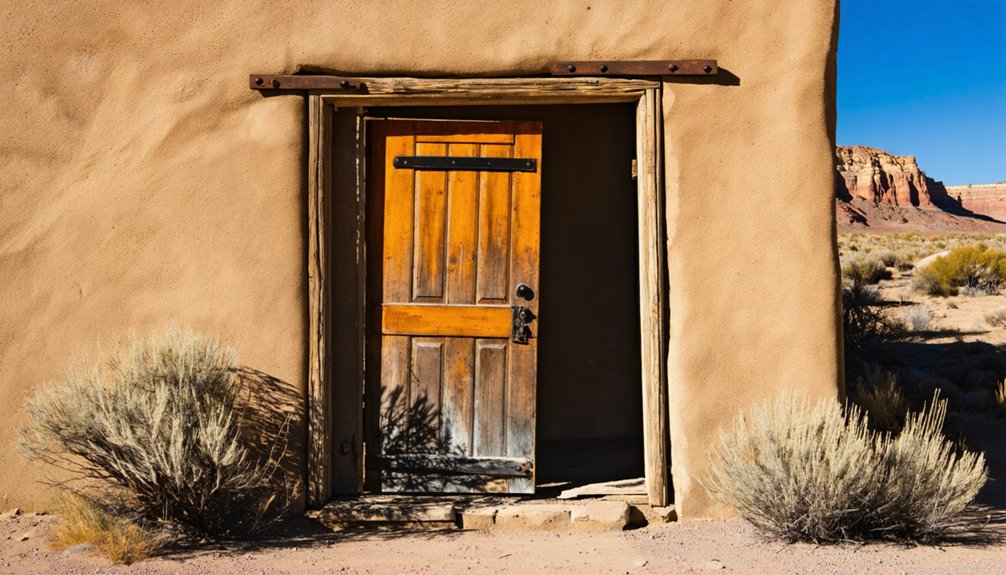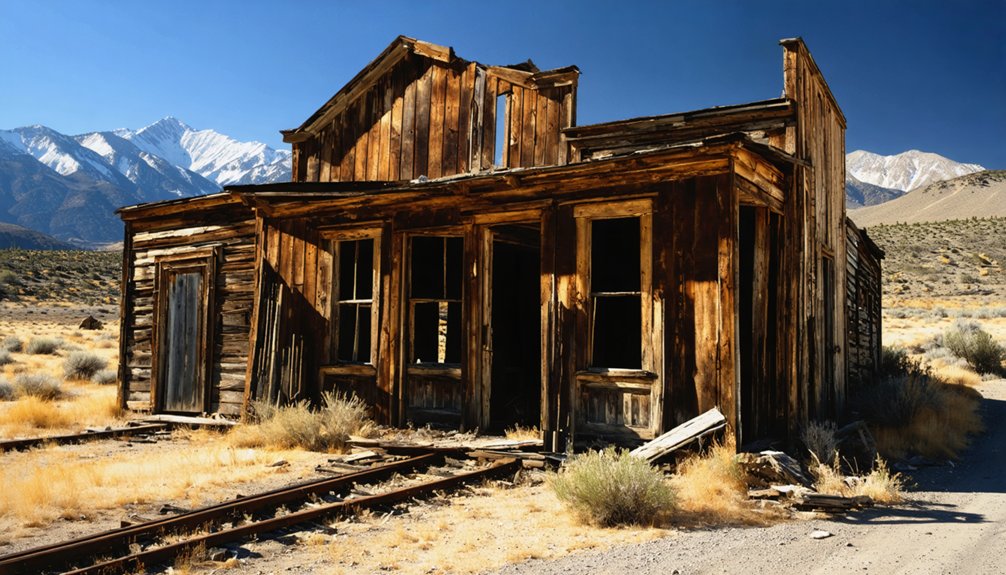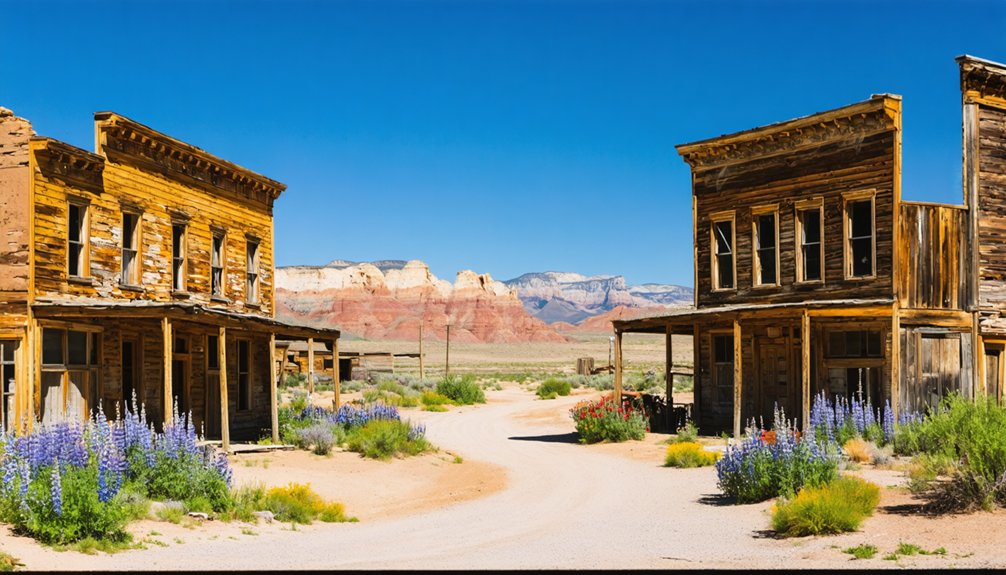
Spring transforms Utah’s ghost towns into perfect exploration destinations, with wildflowers blooming around weathered buildings and comfortable temperatures replacing summer’s scorching heat. You’ll find Grafton’s photogenic pioneer settlement near Zion, Silver Reef’s unique sandstone silver mines, and Frisco’s dramatic beehive kilns against desert mountains. Eureka remains a living ghost town with 600 residents maintaining historic Main Street, while remote Sego offers ancient rock art alongside coal mining ruins. Each site tells distinct stories of boom, bust, and perseverance that await your discovery.
Key Takeaways
- Grafton near Zion offers authentic 1860s Mormon structures, a historic cemetery, and film location fame from *Butch Cassidy and the Sundance Kid*.
- Silver Reef features rare sandstone silver mining history, museum artifacts, restored 1879 St. Johns Catholic Church, and the Cassidy Powder House.
- Frisco showcases five National Register beehive kilns, abandoned mining equipment, and remnants from its violent 1880s silver boom era.
- Sego contains remote coal mining ruins, ancient rock art panels, and diverse miners’ cabins in the scenic Book Cliffs region.
- Spring visitors should carry maps, water, sturdy footwear, and layered clothing while respecting property boundaries and variable Utah weather conditions.
Grafton: Utah’s Most Photogenic Ghost Town
Spring transforms this abandoned settlement into something magical. Desert blooms frame the weathered structures while mild temperatures make exploring comfortable.
Wander through the cemetery where headstones tell stark stories of pioneer heritage—brothers killed in conflicts, children lost to disease, settlers who endured repeated floods before ultimately surrendering to nature’s persistence.
The Grafton Heritage Partnership maintains this National Register site, ensuring future wanderers can experience this authentic slice of 1860s Mormon frontier life. The town once gained Hollywood fame when Butch Cassidy and the Sundance Kid filmed here in 1969, with the movie going on to win four Academy Awards. Descendants gather annually at the site to celebrate their heritage and share family stories.
Silver Reef: A Desert Mining Museum Perfect for Beginners
Unlike most Western mining camps that yielded their riches from hard rock veins, Silver Reef defied geological convention—here, silver emerged from sandstone cliffs, a phenomenon found nowhere else in North America.
You’ll discover this mining history seventeen miles northwest of Zion River Resort, where the Wells Fargo Express Building houses artifacts from the 1876-1890 boom years.
The desert landscapes surrounding this ghost town shine brightest in spring’s mild weather.
Inside the museum, you’ll find Chinese gambling games, hand-blown bottles, and geologic samples that tell stories of 7 million ounces extracted from soft sandstone.
Visit Monday, Thursday, Friday, or Saturday from 10am-3pm.
The Cassidy Powder House displays detailed models of silver-processing facilities. This historic structure once stored dynamite for mining operations before its restoration.
No challenging trails here—just straightforward exhibits perfect for newcomers exploring Utah’s unconventional mining heritage. The museum occupies the restored St. Johns Catholic Church, originally built in 1879 when the mining camp housed roughly 2,000 residents from diverse backgrounds.
Frisco: Tragic History Meets Stunning Scenery
You’ll find Frisco nestled in the juniper-covered San Francisco Mountains, where the beehive-shaped charcoal kilns rise against desert peaks like monuments to Utah’s most violent mining town.
I still remember my first visit—standing before those massive stone structures while imagining the daily gunfights that once earned Frisco its reputation as the “wildest town in the Great Basin.” The kilns and scattered ruins make this an ideal starter ghost town since everything’s concentrated in one dramatic valley.
Spring wildflowers soften the harsh reminders of the 1885 mine collapse that sealed the town’s fate. The cemetery sits on higher ground above the ruins, where mostly children’s graves with iron fences and weathered headstones tell stories of the hardships faced by early settlers. Among the rusting mining equipment scattered throughout the site, you can still sense the scale of operations that once extracted tens of millions of dollars in precious metals.
Frisco’s Dark Mining Past
When prospectors James Ryan and Samuel Hawks struck silver on April 5, 1875, they couldn’t have imagined the boom-and-bust drama that would unfold at Frisco. You’ll discover a tale where fortune-seeking clashed with mining safety realities.
The Horn Silver Mine’s catastrophic story includes:
- Peak Glory (1880-1885): Daily shipments of 150 tons averaging 70-200 ounces of silver per ton, generating $13 million. The mine paid out fifty-four million dollars in dividends, establishing it as one of the world’s richest silver mines.
- The Fatal Collapse (February 12, 1885): Inadequate timbering caused an earthquake-like cave-in felt 10 miles away, destroying the richest ore sections. The mine’s collapse led to a one-year shutdown before limited production resumed at a slower pace.
- Ghost Town Decay: Population plummeted from thousands to just 15 by 1912.
Today, you’re free to explore five beehive charcoal kilns from 1877—remarkable examples of historic preservation listed on the National Register since 1982.
Breathtaking Desert Mountain Views
Standing at 6,489 feet in Beaver County’s juniper-covered hills, Frisco delivers a haunting contrast you won’t forget—the rusted bones of industrial ambition scattered across breathtaking desert mountain vistas.
The 900-foot-deep Horn Silver Mine pit carves into terrain where desert flora clings to rocky slopes, while mountain wildlife occasionally crosses paths with decaying equipment.
From the 1877 charcoal kilns perched in the hills, you’ll witness the San Francisco Mining District‘s raw beauty—sage-dotted valleys stretching toward distant peaks.
Visit during spring when temperatures make exploring safer, though watch for unmarked mine openings.
Located just 15 miles west of Milford, this partially accessible ghost town offers unobstructed views that capture Utah’s rugged character. At its zenith, this rowdy mining camp housed approximately 6,000 residents who sustained 21 saloons and a thriving red-light district. The district produced over $60 million in minerals by 1885, making it one of southern Utah’s most lucrative operations.
The cemetery sits dramatically against this backdrop, where tragedy and natural majesty coexist.
Best for First-Time Explorers
If you’re new to ghost town exploration, Frisco offers the perfect introduction—accessible enough for beginners yet packed with the authentic Wild West drama that makes Utah’s abandoned settlements irresistible.
You’ll discover why this settlement earned its reputation as the “wildest town in the Great Basin.” The haunting remnants tell stories of a place where murder occurred almost nightly until Marshal Pearson arrived and reportedly killed six outlaws in one evening.
What makes Frisco beginner-friendly:
- Visible landmarks – Beehive charcoal kilns on the National Register mark your destination
- Concentrated ruins – Cemetery, abandoned mining equipment, and structures cluster together
- Dramatic backstory – The 1885 mine collapse felt like an earthquake ten miles away
Note: Frisco sits on private land, so check access before visiting these ghost town ghost stories.
Old Iron Town: Exploring Beehive Kilns in Dixie National Forest
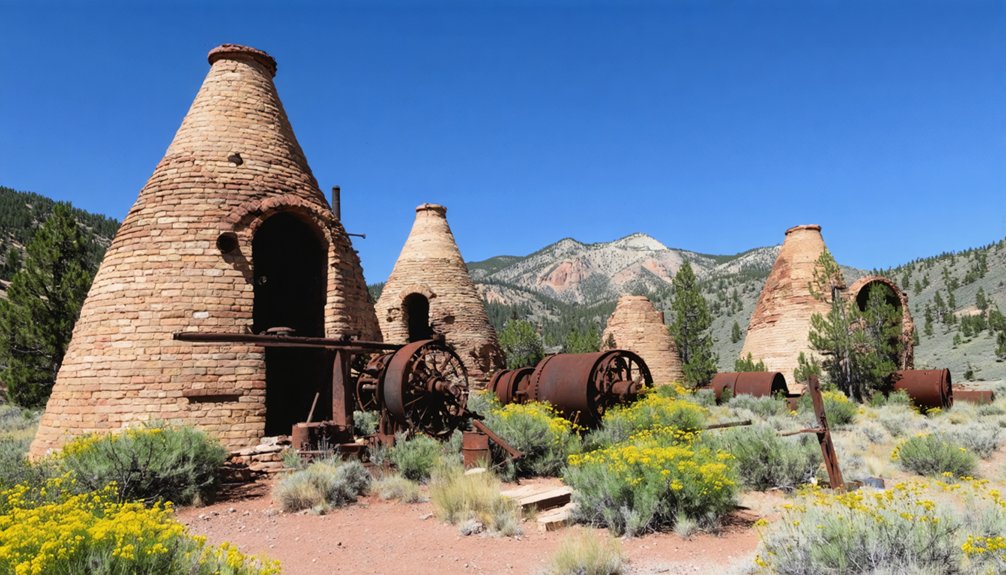
The preserved beehive kiln at Old Iron Town stands as a 150-year-old engineering marvel. Its domed stone structure once converted juniper and pinyon into charcoal over 12-day burn cycles.
You’ll find this ghost town 22 miles west of Cedar City on Highway 56, then a few miles south down Old Irontown Road’s gravel surface into Dixie National Forest.
Two quarter-mile interpretive trails wind through the fenced site, connecting the kiln to foundry ruins, a pioneer cabin, and the massive chimney that still punctuates the horizon.
Beehive Kiln Structure Details
Approaching these dome-shaped structures for the first time, you’ll immediately understand why early settlers called them “beehive” kilns—their parabolic curves mirror the traditional straw hives that once dotted pioneer homesteads. The beehive kiln architecture reveals ingenious frontier engineering, with bases measuring 15-24 feet wide and heights reaching 19-22 feet.
Walk around each kiln and you’ll notice three critical features:
- Thick stone walls plastered with hard white mortar, creating airtight chambers
- Two main openings—upper for loading wood, lower for ash removal
- Base vents spaced every three feet for precise oxygen control
These charcoal production techniques transformed pinyon pine into fuel through carefully monitored burns lasting 3-7 days.
The carbon-blackened interiors and exterior stucco patches tell stories of countless firing cycles that powered Utah’s silver mining operations.
Accessing the Historic Site
Located 25 miles west of Cedar City, Old Iron Town rewards adventurous spring visitors who don’t mind trading pavement for gravel. Take Highway U-56 west for 20 miles, then turn south onto Old Iron Town Road.
The final five miles through Dixie National Forest terrain puts you right at the ruins—no entrance fees, no gates, just pure exploration during daylight hours.
Spring transforms this journey into something special. Seasonal blooms carpet the roadside while local wildlife emerges from winter hiding. Before heading out, grab a self-guided tour brochure at Cedar City’s Frontier Homestead State Park Museum.
Once there, two quarter-mile trails—the Ruins Trail and Nature Trail—let you wander freely among the beehive ovens and crumbling foundry walls, interpreting history at your own pace.
Eureka: a Living Ghost Town With 600 Residents
Nestled in Utah’s Tintic Mountains at 6,424 feet elevation, Eureka earned its optimistic name after silver was discovered in 1869 in what locals first called Ruby Hollow. By 1910, this mining heritage drew 3,900 residents, making it Utah’s 9th largest city and the world’s second-largest silver producer.
Today, you’ll find 600-740 souls maintaining this living ghost town. The preservation efforts shine on Main Street, listed on the National Register of Historic Places since 1979, where historic buildings stand mostly empty yet proud.
What You’ll Experience:
- Empty historic structures beckoning exploration in every direction
- B’s Hangout and another restaurant serving Little Sahara dune visitors
- Nearby true ghost towns Silver City and Knightsville for stark contrast
Recent gold strikes hint at renewed mining, while freedom-seekers appreciate the uncrowded, authentic atmosphere.
Sego: Remote Coal Mining Ruins and Ancient Rock Art
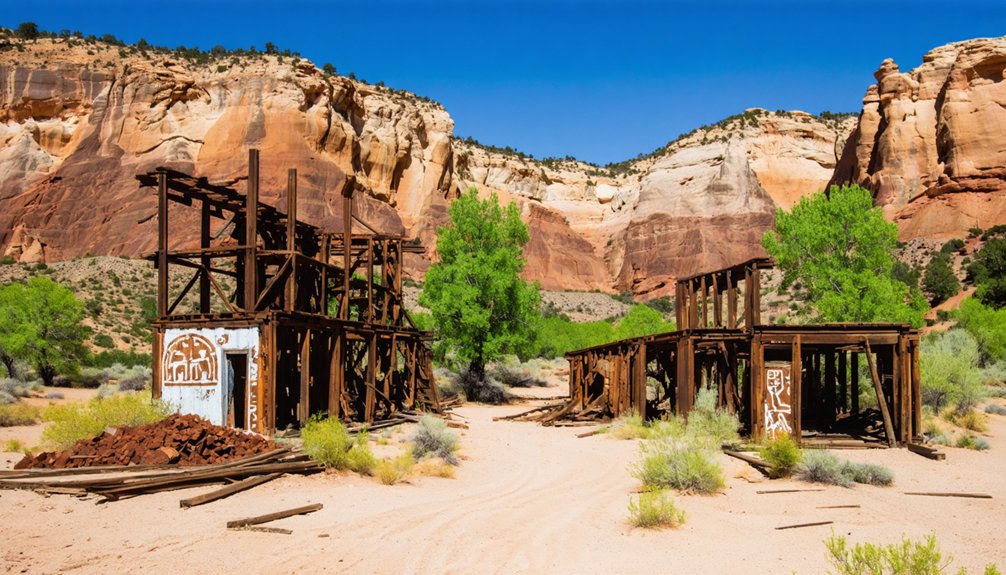
Deep in the rugged Book Cliffs, five miles north of Thompson Springs, Sego Canyon holds two distinct treasures: coal mining ruins from Utah’s industrial past and rock art panels created thousands of years before miners ever arrived.
You’ll navigate a dirt road through the canyon, following the old Ballard & Thompson Railroad grade to reach stone cabin remnants where Italian, Greek, Japanese, and African American miners once lived. Six or seven structures still stand against canyon walls, though treasure hunters torched many buildings in 1973.
The canyon’s true marvel awaits upstream—ancient rock art spanning thousands of years. These pictographs predate Sego’s 1908 coal discovery by millennia, making canyon exploration here a journey through multiple eras of human history, all accessible without permits or fees.
Planning Your Spring Ghost Town Adventure
Whether you’re drawn to Sego’s layered history or any of Utah’s dozens of abandoned settlements, successful ghost town exploration starts with solid research.
Thorough preparation and local research separate memorable ghost town adventures from potentially dangerous expeditions into Utah’s remote backcountry.
Check local weather forecasts before departure—spring conditions vary dramatically between scorching southern sites like Silver Reef and cooler northern locations across the Great Basin.
Your travel essentials checklist should include:
- Orientation tools: Paper maps and compass (cell reception disappears in remote areas, though AT&T works best)
- Sturdy footwear: Closed-toe boots with ankle support for maneuvering unstable terrain
- Safety gear: Extra water, sun protection, and emergency supplies
Respect private property boundaries at sites like Iosepa’s cemetery. Combine multiple ghost towns into road trip sequences—Eureka to Helper makes an excellent route.
Start with accessible Grafton or Silver Reef if you’re new to backcountry exploration.
What to Bring for Your Utah Ghost Town Explorations
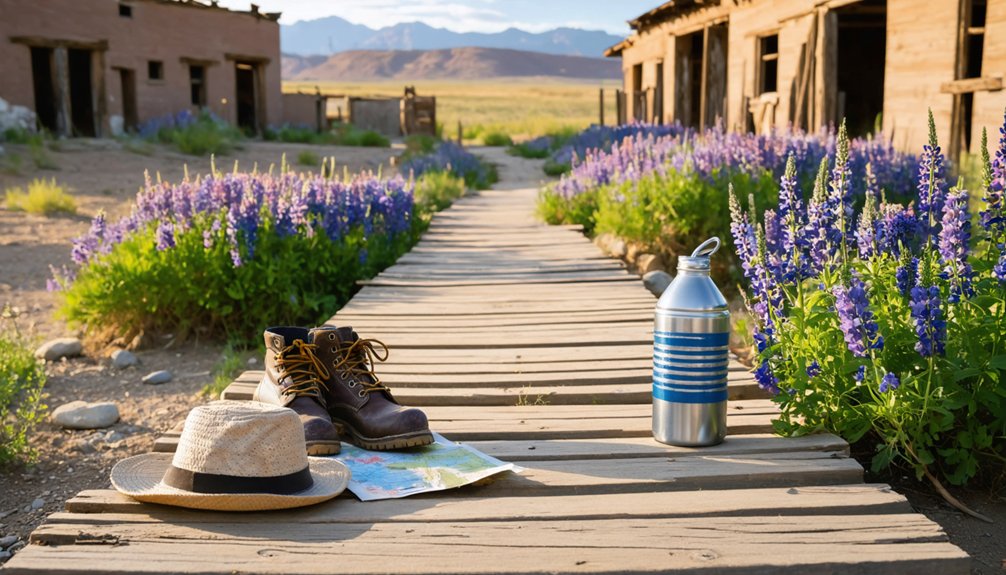
Utah’s ghost towns hide in landscapes where spring weather can shift from shirt-sleeve sunshine to stinging snow squalls within hours. You’ll need layered clothing—warm jackets for freezing mornings, windproof shells against desert gusts.
Exploring abandoned sites in Utah offers a glimpse into the rich history and culture that once thrived in these now desolate areas. Each location tells a unique story, revealing the challenges and triumphs of those who lived there. As you wander through the rugged terrain, you’ll discover hidden treasures and remnants of the past waiting to be uncovered.
The allure of ghost towns in Utah lies in their eerie silence and the tales of adventure that linger in the air. Each settlement, from the well-preserved remnants of miners’ cabins to the crumbling foundations of long-abandoned homes, invites exploration and reflection. As you delve deeper into these forgotten places, you’ll gain a profound appreciation for the resilience of those who once called them home.
Pack sturdy boots for icy roads and rocky canyon floors, plus gloves to push through sage and brush. Your camping gear should include GPS with offline maps (cell service vanishes), a compass for featureless terrain, and ample water since natural sources don’t exist.
Bring binoculars to spot distant ruins, flashlights for dark mine remnants, and basic safety precautions like first aid kits and emergency whistles. Don’t forget recovery gear if spring melt turns roads treacherous.
These ghost towns demand self-reliance—nobody’s coming if you’re unprepared.
Frequently Asked Questions
Are Utah Ghost Towns Safe to Visit With Young Children?
You’ll love dodging crumbling walls and heatstroke—kidding! With proper safety precautions like water, supervision, and sticking to stable areas, Utah’s historic preservation sites offer manageable family adventures. You’re free to explore responsibly, avoiding hazards while creating memorable experiences.
Can I Camp Overnight Near These Ghost Town Locations?
You can camp near most Utah ghost towns on BLM or trust lands without camping permits. Follow safety tips: choose durable surfaces, pack out trash, maintain 200 feet from water, and observe fire restrictions for responsible overnight stays.
Do Any Ghost Towns Charge Admission or Entrance Fees?
Yes, some charge fees. Silver Reef Ghost Town costs $3 per person ($10 family rate) for historic preservation and visitor facilities. However, you’ll find Grafton, Old Irontown, and Cisco completely free—just pure exploration without barriers.
Are Pets Allowed at Utah’s Ghost Town Sites?
Most Utah ghost towns don’t restrict pets, offering pet-friendly policies for your four-legged companions. You’ll want to keep dogs leashed, respect private property boundaries, and pack water since these remote sites lack amenities for adventurous exploration together.
What Is the Best Time of Day to Photograph Ghost Towns?
You’ll capture ghost towns magnificently during golden hour—that magical window when timing’s ideal. Arrive before sunrise or shoot 1-2 hours before sunset. These lighting conditions create dramatic shadows, warm tones, and breathtaking contrast that’ll make your photos absolutely unforgettable.
References
- https://www.utahlifemag.com/blog/post/4-ghost-towns
- https://www.visitutah.com/things-to-do/history-culture/ghost-towns
- https://utahguide.com/utah-ghost-towns-and-mining-towns/
- https://www.ksl.com/article/51308628/restored-utah-ghost-towns-that-should-be-on-your-summer-travel-bucket-list
- https://www.deseret.com/utah/2023/1/21/23549285/utah-ghost-towns-mormon-history/
- https://www.tripadvisor.com/Attractions-g28965-Activities-c47-t14-Utah.html
- https://graftonheritage.org/history-settlement/
- https://www.hannahhendersontravel.com/grafton-ghost-town-utah/
- https://zionriversedgeadventures.com/article/the-history-behind-graftons-ghost-town
- https://inspiredimperfection.com/adventures/grafton-ghost-town/