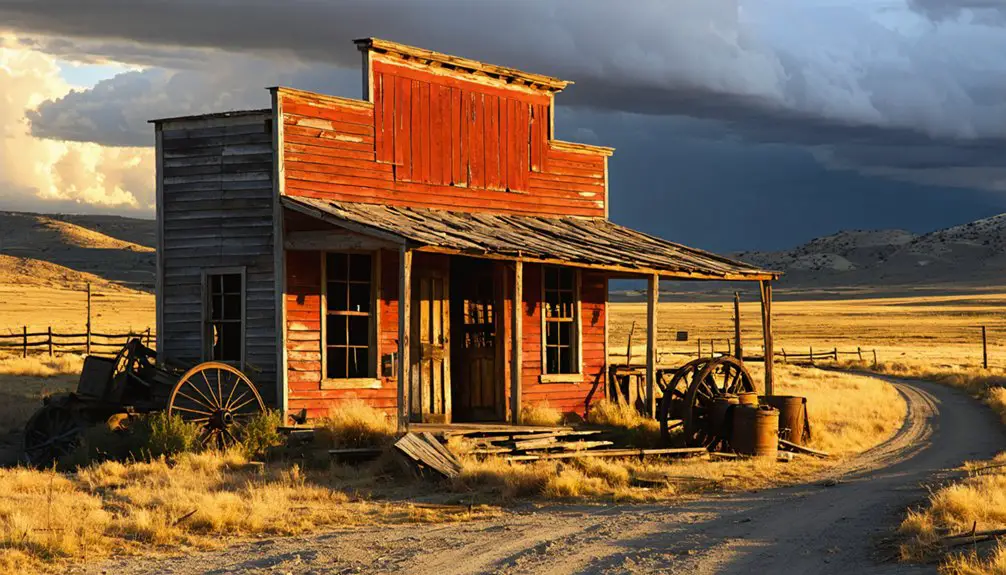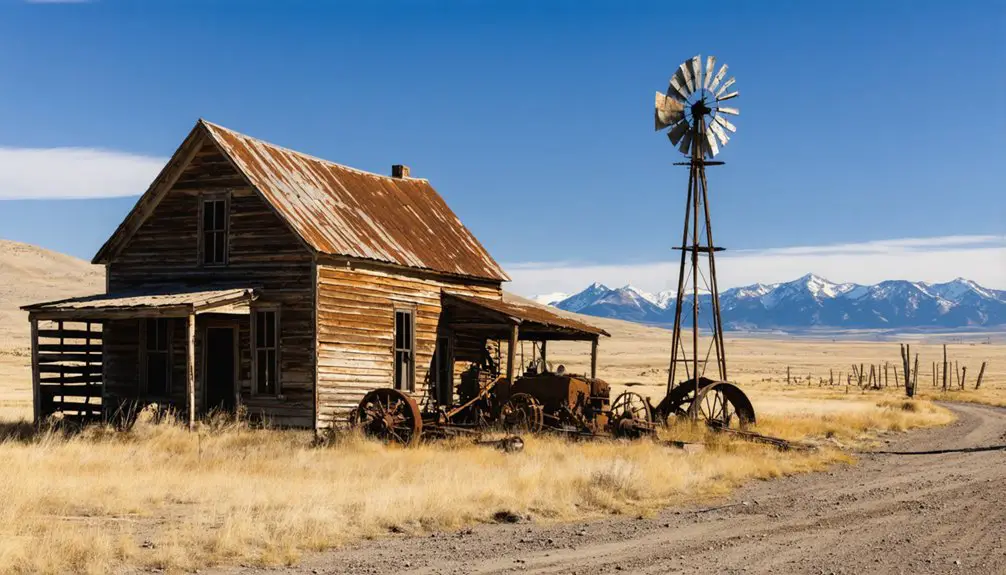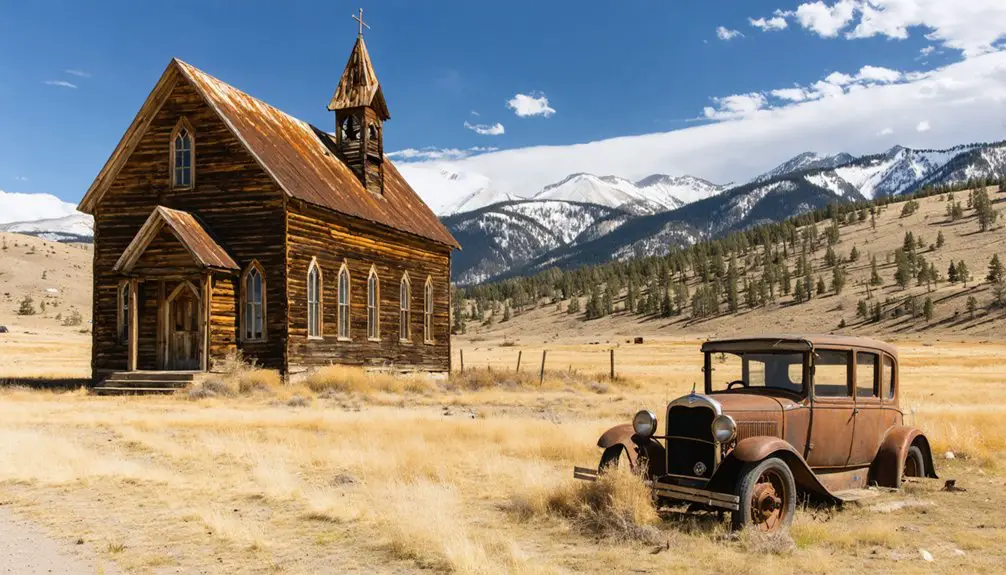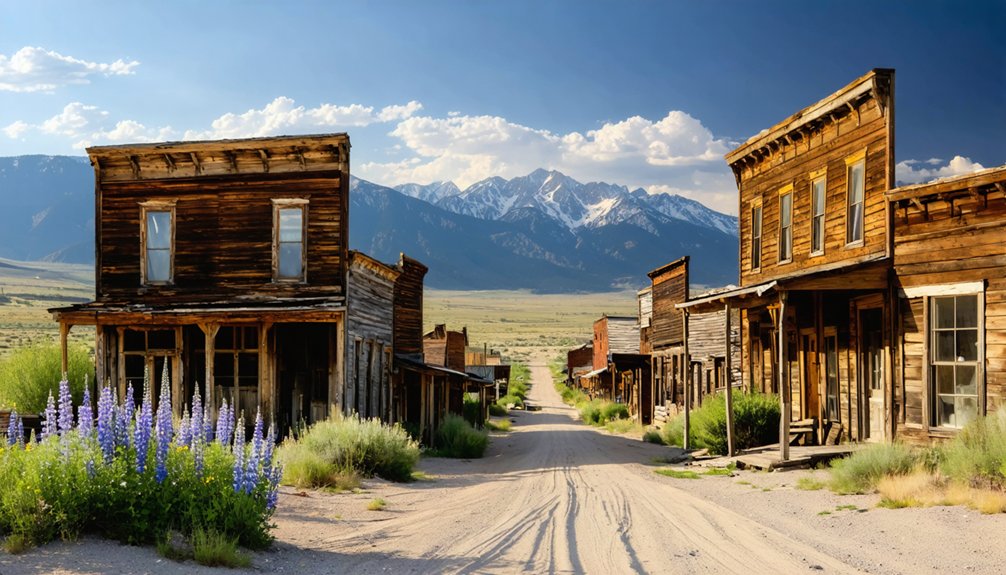
You’ll find Wyoming’s best spring ghost towns scattered across the high country, where snowmelt reveals hidden foundations and mountain passes finally become passable. Superior offers restrooms and picnic areas for comfortable exploration, while Kirwin’s 9,200-foot elevation rewards your 4×4 journey with weathered cabins and rusted mining tools. Bryan’s railroad ruins emerge from spring wildflowers near Green River, and Winton’s crumbling walls stand sentinel where wild horses roam past graffiti-covered concrete. The following sections reveal exactly how to reach these isolated settlements and what you’ll discover there.
Key Takeaways
- Bryan offers authentic backcountry exploration with minimal preservation, featuring depot foundations and scattered machinery, ideal for spring wildflower photography.
- Kirwin at 9,200 feet showcases weathered log cabins and mining infrastructure, with spring snowmelt revealing scenic mountain views and Wolf Mine remnants.
- Miner’s Delight near Atlantic City features seventeen well-maintained log structures and interpretive trails, with spring providing fewer crowds and Continental Divide views.
- Superior provides rare amenities including parks, playgrounds, and public restrooms, serving as a practical base for exploring nearby historic mining sites.
- Winton’s crumbling foundations and nearby wild horses create haunting spring photography opportunities, accessible only via four-wheel-drive vehicles on deteriorated roads.
Bryan: Union Pacific Railroad Ghost Town West of Green River
Nestled along the Black’s Fork River about twelve miles west of Green River, Bryan emerged in 1868 as the Union Pacific Railroad‘s ambitious alternative to working with existing settlements. You’ll discover railroad remnants where roundhouses once serviced locomotives and switching yards managed transcontinental traffic.
The town thrived briefly as a winter terminus until drought struck in 1872, drying up the Black’s Fork and forcing operations back to Green River. When railroad operations resumed, Union Pacific relocated steel infrastructure from Bryan to Green River to stimulate growth in the more viable location. The relocation included vital facilities like the roundhouse, depot, and machine shops that transformed Green River into the permanent switching point. Spring’s your ideal time to explore—wildflowers frame the abandoned depot foundations, and you can walk freely among the scattered machinery without crowds.
History preservation here remains minimal, giving you an authentic, unfiltered glimpse into how quickly railroad towns rose and fell. Bring water and sturdy boots for this genuine backcountry adventure.
Superior: Living Ghost Town With Modern Amenities
You’ll find Superior’s five acres of parks surprisingly welcoming for a ghost town, complete with playgrounds where your kids can burn energy while you rest at shaded picnic tables between exploring the quiet streets.
The two public restrooms—rare luxuries in Wyoming’s ghost town circuit—make this an ideal lunch stop when you’re touring the coal mining sites scattered across Sweetwater County.
I’ve used Superior as my morning base camp, letting the children play in the crisp spring air before driving out to more remote ruins where amenities simply don’t exist.
Located 23 miles east of Rock Springs, Superior once thrived as a coal mining community with over 3,000 residents before transforming into today’s friendly settlement of about 300 people.
For a more extensive ghost town experience, consider Old Trail Town’s 26 historic buildings relocated from across the region to preserve Wyoming’s frontier heritage.
Family-Friendly Parks and Facilities
Unlike many abandoned ghost towns where visitors tread carefully through crumbling ruins, Superior welcomes families with five acres of well-maintained parks that blend seamlessly with its historic character. You’ll find two public restrooms strategically placed throughout the grounds—a rare luxury when exploring Wyoming’s backcountry.
The playground equipment lets your kids burn energy while you stretch your legs after the 23-mile drive east from Rock Springs.
These park amenities transform Superior from a mere roadside curiosity into a legitimate rest stop. Scatter your picnic lunch across the provided tables, where weathered buildings frame your view. While Superior offers modern comforts, Kirwin once featured two-story homes with wallpaper and even electricity before its 1907 abandonment, proving Wyoming’s mining towns valued civilization even in remote mountain locations.
The family friendly facilities don’t diminish the ghost town‘s authenticity; instead, they prove that 300 resilient residents have created something unique—a living community that honors its past while serving today’s adventurous travelers. Jeffrey City offers a similar experience with its Split Rock Bar & Cafe, which has served as a historic gathering place since the 1950s and continues welcoming tourists and bicyclists as a symbol of the town’s resilience.
Base for Regional Exploration
Superior’s strategic position along Highway 789 transforms this living ghost town into the perfect launching pad for your Southwest Wyoming adventure.
You’ll find yourself 23 miles from Rock Springs, perfectly situated to explore Sweetwater County’s cluster of abandoned mining settlements.
The town’s 300 residents share insider knowledge about hidden trails and forgotten sites most tourists never discover.
Between expeditions, you can return to Superior’s parks and facilities for regrouping.
While the local art scene remains modest and the culinary scene limited, you’re trading tourist polish for authentic access to Wyoming’s mining heritage.
Use Superior as your base camp to roam freely through canyon country, photograph crumbling structures at dawn, and piece together stories of the Old West’s boom-and-bust cycles.
Day trips bring you to South Pass City, where well-preserved buildings include a grocery store, post office, old saloon, and the iconic assay office once used for weighing gold.
Winton: Abandoned Mining Settlement Near Wild Horse Country
The skeletal remains of Winton rise from the high desert five miles northeast of Reliance, where concrete foundations and crumbling walls mark what was once a bustling coal mining settlement of 700 souls.
You’ll need four-wheel drive to navigate the deteriorated dirt road leading to this 1920s-era town, abandoned since the coal bust of 1952.
Spring brings ideal conditions for ghost town photography and cultural preservation efforts before summer’s heat arrives:
- Graffiti-covered walls and roofless structures create haunting compositions
- Wild horse herds frequently roam nearby, adding untamed beauty
- White Mountain Petroglyphs and Killpecker Sand Dunes lie within striking distance
The town’s post office, bath house, and boarding house stood strong until Union Pacific dismantled them.
Now only rubble remains—a testament to Wyoming’s boom-and-bust mining heritage.
Explorers who venture through the ruins often discover numerous building foundations scattered across the site, revealing far more structures than initially visible from the road.
Hikers exploring the ruins have reported encountering strange lights, adding an eerie dimension to the abandoned settlement’s mystique.
Stansbury: Coal Mining Camp With Tragic History
You’ll find Stansbury’s scattered foundations nine miles north of Rock Springs.
There, 1,000 miners once extracted coal before a 1955 collapse silenced the operation forever.
Walking through the crumbling walls and concrete remnants, you’re tracing the footsteps of families who watched their neighbors’ homes loaded onto trucks and hauled away to Rock Springs, Pinedale, and towns as far as Idaho.
The camp’s swift decline—from bustling company town to empty prairie in just fifteen years—reveals how quickly disaster can erase an entire community built on coal.
Union Pacific’s shift to diesel-electric locomotives in the late 1940s eliminated the railroad’s need for coal, sealing Stansbury’s fate alongside nearby camps like Reliance and Winton.
1955 Mining Disaster Impact
- Stansbury’s post office, school, store, and clinic closed permanently within months.
- Desperate families sold miners’ houses for pennies to avoid taxes, hauling them to Rock Springs, Pinedale, and distant states.
- Union Pacific shuttered operations as diesel locomotives replaced coal demand.
You’ll find accessibility challenging—four-wheel drive recommended for these remote ruins. Walking among scattered concrete slabs, you’re witnessing where economic collapse met human tragedy, creating another Wyoming ghost town frozen in 1955’s devastating aftermath.
Historic Camp Infrastructure
Seven miles north of Rock Springs, Stansbury emerged as Union Pacific’s model coal camp after 1906, when spur lines began snaking through Sweetwater County’s coal-rich basin.
You’ll find industrial ruins where a complete town once thrived—post office, school, clinic, boarding house, and rows of company homes sheltering immigrant miners and their families.
The 1940s brought Stansbury’s zenith, with Union Pacific crafting their showcase community around the Number One Mine.
Today, only crumbling foundations and scattered pioneer remnants mark where hundreds lived and worked.
You’ll need four-wheel drive to navigate the rugged access roads, but these weathered walls tell stories of company-built existence that vanished when steam locomotives died.
Sweetwater County Coal Legacy
When Captain Howard Stansbury surveyed the Rock Springs Coal Field during his 1849-1851 expedition, he documented coal outcrops jutting from valley ridges that would later fuel Union Pacific’s empire.
By 1944, Stansbury coal camp emerged as Union Pacific’s model town, employing 1,000 miners from 56 nationalities who carved freedom from Wyoming’s unforgiving earth.
The environmental impact still marks this landscape:
- Crumbling foundations and scattered wall remnants trace former streets
- Transported miners’ houses now stand in Rock Springs, Pinedale, and distant states
- Abandoned mine shafts scar ridgelines where men once descended daily
Historical preservation here means confronting tragedy—the 1955 mine collapse killed many, closing operations by 1957.
You’ll find only wind-swept ruins now, nine miles north of Rock Springs, where tormented souls supposedly linger among Sweetwater County’s coal legacy.
Kirwin: High-Altitude Ghost Town in Shoshone National Forest
Perched at 9,200 feet in the Absaroka Mountains, Kirwin stands as Wyoming’s most dramatically situated ghost town—a collection of weathered log cabins clinging to the headwaters of the Wood River, 34 miles southwest of Meeteetse.
Spring transforms this 1885 gold-and-silver camp into an explorer’s paradise, accessible mid-May when snowmelt subsides.
You’ll need a high-clearance 4×4 for Forest Service Road 200’s three unbridged river crossings—cell service won’t follow you here.
The mountain scenery rewards your effort: Wolf Mine’s shaft house overlooks pristine valleys while wild raspberries line the trail.
Historical preservation efforts maintain the manager’s house with its rare frontier dormers, the assay shop, and stables where rusted tools remain frozen in time.
The 1907 avalanche that killed three miners effectively preserved everything—residents fled so abruptly their belongings stayed behind.
Miner’s Delight: Mountaintop Ghost Town Near Atlantic City
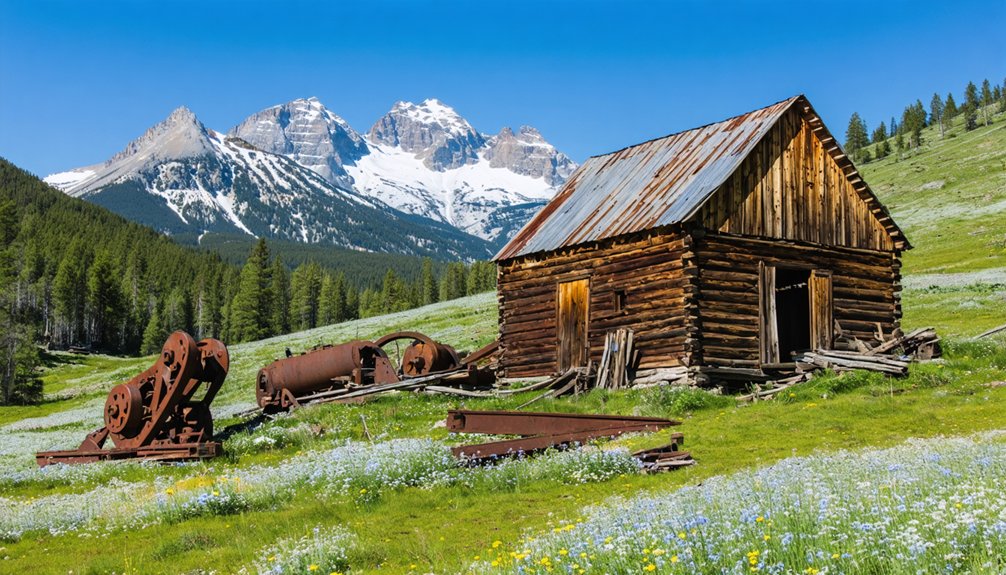
Straddling Peabody Hill just two miles from Atlantic City, Miner’s Delight crowns a forested mountaintop where $5 million in gold ore once flowed from the district’s richest claim.
You’ll discover seventeen preserved log structures through BLM’s art preservation efforts, including cabins where Calamity Jane once lived and the saloon where fortune-seekers celebrated strikes.
The half-mile interpretive trail leads you past:
- Seven original cabins with intact walls telling stories of 1868’s boom
- A 10-stamp mill site where Jonathan Pugh’s discovery transformed raw ore into wealth
- Three weathered privies, corrals, and shaft houses frozen in time
Spring’s conditions make hiking trails accessible before summer crowds arrive.
The Continental Divide backdrop frames your exploration of this mountaintop settlement, where independence-minded prospectors carved civilization from wilderness near South Pass.
Planning Your Spring Ghost Town Adventure in Wyoming
Before you load your truck for Wyoming’s backcountry ghost towns, understand that spring transforms these high-desert sites into muddy challenges and breathtaking opportunities. Pack four-wheel-drive capability for Kirwin’s river crossings and Gebo’s storm-soaked trails. Layer your clothing—mountain elevations like Eadsville’s 7,800 feet mean 20-40°F nights despite daytime warmth.
Plan your routes around seasonal access. Grand Encampment Museum opens May through October, while South Pass City welcomes visitors year-round. Check avalanche conditions near Kirwin in the Absarokas post-winter.
Spring blooms carpet the sage hills surrounding these abandoned camps. You’ll spot wildlife viewing opportunities near Winton’s wild horse herds.
Combine ghost town exploration with nearby attractions—Casper Mountain’s trails, Killpecker Sand Dunes—for multi-day adventures embracing Wyoming’s untamed backcountry freedom.
You can delve into the histories of these places, uncovering stories of the past that still echo through the empty streets, making exploring Wyoming’s abandoned towns a unique experience. As you traverse the remnants of these settlements, the vast landscapes surrounding them provide breathtaking views and a sense of solitude. This blend of adventure and history creates a memorable journey through one of America’s most picturesque states.
Essential Gear and Safety Tips for Exploring Wyoming Ghost Towns
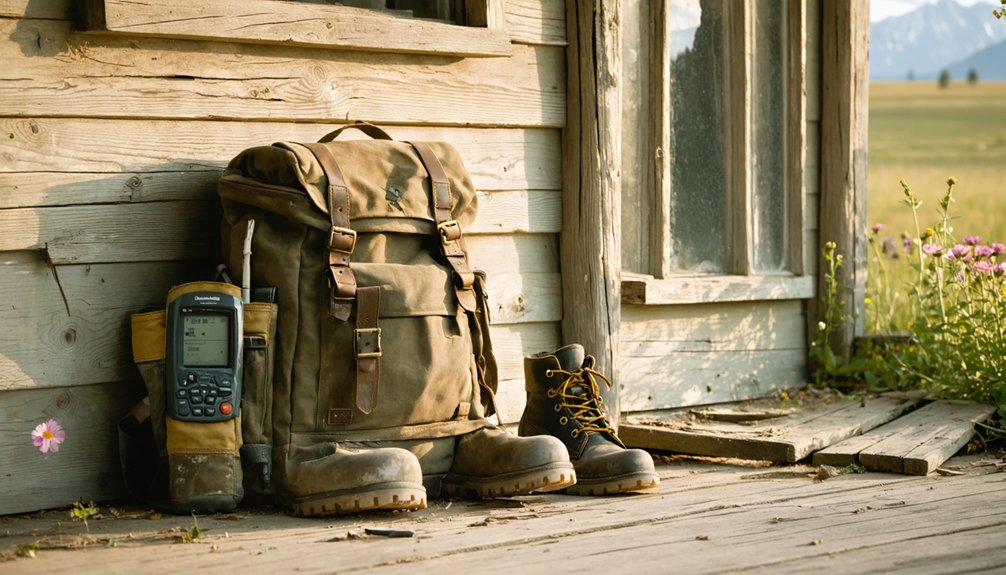
Your Wyoming ghost town expedition demands preparation beyond route planning—the right gear separates memorable exploration from dangerous situations. I’ve watched spring storms roll across sage-covered hills in minutes, transforming accessible trails into muddy challenges requiring four-wheel drive and traction devices.
In Wyoming’s backcountry, spring weather changes everything in minutes—proper gear transforms potential disasters into manageable adventures.
Essential equipment for backcountry independence:
- Vehicle recovery kit: Jumper cables, tow rope, portable air compressor, and tire repair supplies
- Personal safety bundle: First aid kit with prescriptions, multi-tool, headlamp for hands-free repairs
- Weather protection: Rain gear, emergency blankets, sunscreen for high-altitude exposure
Wildlife safety near abandoned structures means carrying bear spray and making noise. Regular gear maintenance prevents failures when you’re exploring remote sites like Kirwin. Pack offline GPS—cell service disappears quickly. Your multi-tool handles unexpected repairs, while ice axes provide stability on mountainous approaches.
Best Routes for Multi-Town Ghost Town Tours in Sweetwater County
Rock Springs makes an ideal staging point for Sweetwater County’s ghost town circuit. I’ve used its hotels and gas stations as my command center for three separate spring expeditions covering forty-plus miles of mining history.
Head north to Stansbury’s collapsed mine foundations first, then loop through Superior’s massive Union Hall seven miles from I-80.
Photography tips: morning light catches the Point of Rocks Stage Station’s 1862 stonework beautifully before tourist crowds arrive.
Continue northeast toward Winton via Reliance, where wild horse herds provide unexpected subjects.
This eco-friendly travel route minimizes backtracking while maximizing your spring daylight.
Pack water and snacks—services disappear between towns.
The entire circuit delivers preserved structures, eerie foundations, and Overland Trail history within fifty miles of comfortable Rock Springs lodging.
Frequently Asked Questions
Are Pets Allowed When Visiting Wyoming Ghost Towns in Spring?
Planning an adventure? Pet policies vary—you’ll find abandoned ghost towns welcome leashed companions for wildlife encounters, but Old Trail Town prohibits pets entirely. State parks offer pet-friendly access, so you’ve got options for exploring Wyoming’s historic ruins.
Do Any Ghost Towns Offer Camping Facilities or Overnight Accommodations Nearby?
You’ll find nomadic camping at Sage Creek Ghost Town, perfect for self-contained adventures among historic preservation sites. Superior offers restrooms and parks, while scenic routes provide excellent photography opportunities. Base camps near Winton guarantee you’re exploration-ready.
What Are Typical Spring Temperatures in Wyoming’s High-Altitude Ghost Towns?
Spring temperatures at Wyoming’s high-altitude ghost towns range from 20-50°F, perfect for exploring historical preservation sites. You’ll find crisp mornings warming to pleasant afternoons, with spring wildflowers emerging as snow retreats from these freedom-filled mountain landscapes.
Are Guided Tours Available for Wyoming Ghost Towns During Spring Months?
Yes, you’ll find guided tours starting in May at Kirwin and Grand Encampment, where historical preservation efforts have created incredible photographic opportunities. You’re free to explore authentic frontier structures while experienced guides share enthralling stories from Wyoming’s untamed past.
Which Ghost Towns Are Most Suitable for Families With Young Children?
You’ll find Superior and Old Trail Town most suitable—they’ve got historical site safety with flat terrain, modern restrooms, and family friendly activities like playgrounds and structured tours that keep little adventurers engaged while you explore Wyoming’s untamed past.
References
- https://www.explorewy.com/blog/ghost-towns-halloween-southwest-wyoming-travel
- https://takingthekids.com/long-abandoned-wyoming-ghost-towns-where-the-old-west-still-lingers/
- https://bighorndrifters.com/elementor-2633/
- https://www.codyyellowstone.org/activities/kirwin-ghost-town-adventures/
- https://www.youtube.com/watch?v=GEoxbcwf8Ks
- https://www.youtube.com/watch?v=Oe33S_KII3k
- https://www.tripadvisor.com/Attractions-g28973-Activities-c47-t14-Wyoming.html
- https://www.wyomingcarboncounty.com/?id=123:5-ghost-towns-to-explore
- https://www.wyohistory.org/encyclopedia/green-river-wyoming
- https://www.grwyo.org/244/Railroad