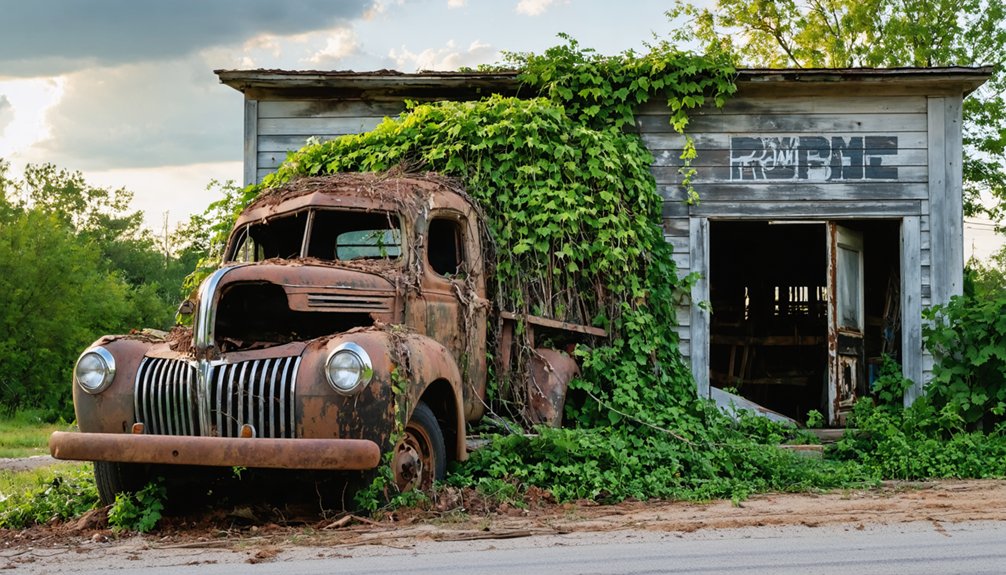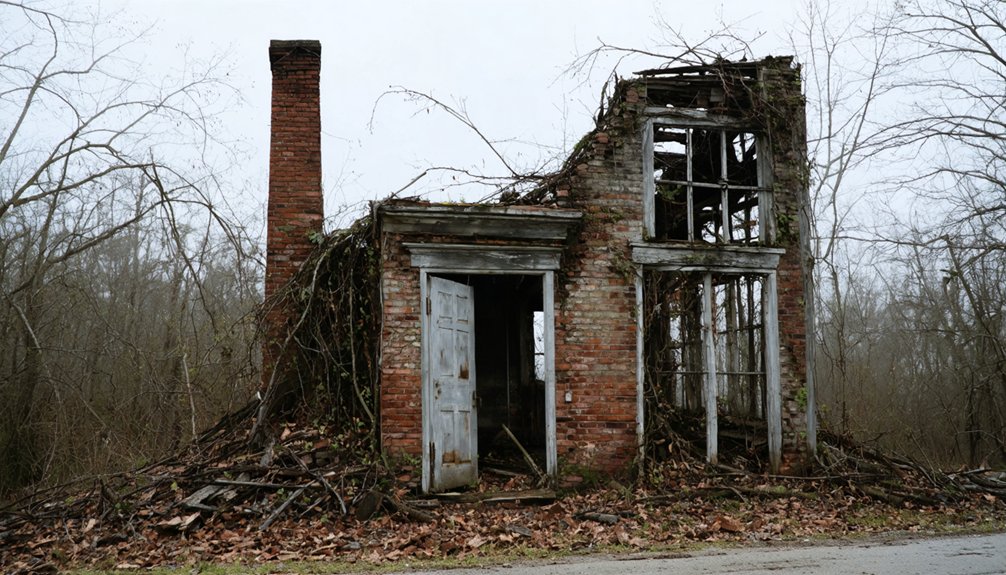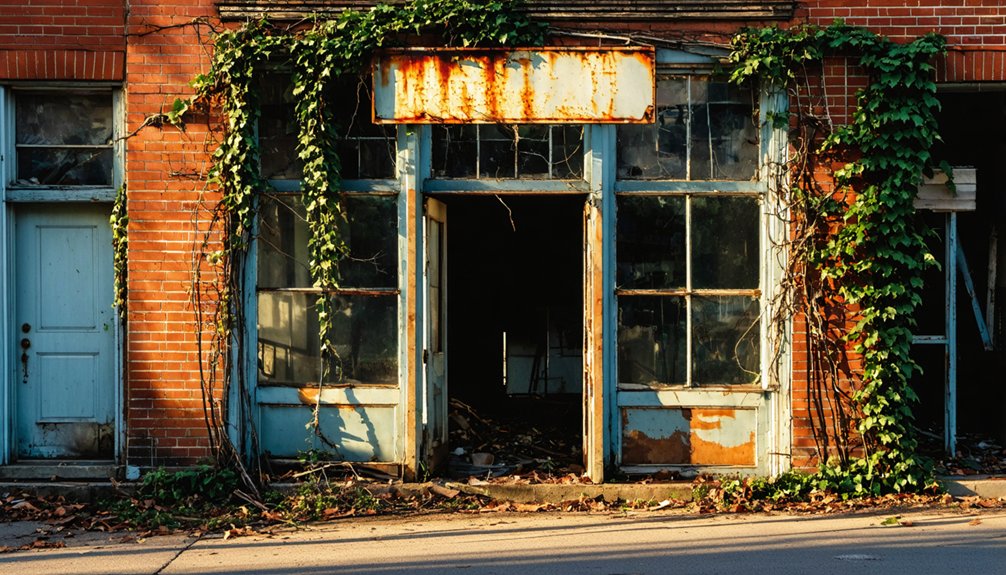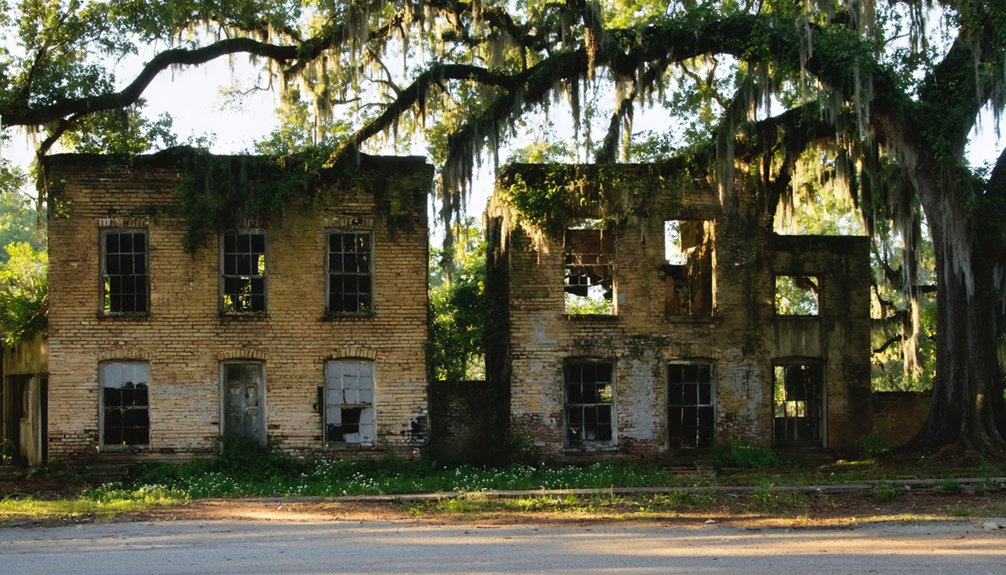
You’ll find Alabama’s most mesmerizing ghost towns accessible throughout summer’s extended daylight hours. Start at Old Cahawba, the state’s first capital with crumbling foundations along the river, then venture to Bellefonte’s haunting chimney ruins where cholera once devastated hundreds. Don’t miss Spectre’s weathered film set on Jackson Lake Island, complete with Spanish moss-draped facades, or Blakeley State Park’s Civil War remnants along Mobile Bay. St. Stephens offers archaeological excavations revealing centuries of multicultural history, while Arcola’s single remaining structure whispers of failed French ambitions—each site revealing deeper stories of Alabama’s forgotten communities.
Key Takeaways
- Cahawba Archaeological Park preserves Alabama’s first capital with foundations, crumbling walls, and interpretive trails showcasing 1800s history.
- Old St. Stephens features archaeological digs, virtual ruins, Native American artifacts, and an 1854 courthouse museum along the Tombigbee River.
- Blakeley State Park offers Civil War battlefield remnants, foundation stones, unmarked graves, and trails exploring historic wetlands near Mobile Bay.
- Spectre on Jackson Lake Island displays Tim Burton’s film set from *Big Fish* with weathered facades and nature-reclaimed structures.
- Old Bellefonte Cemetery marks the remains of the former Jackson County seat, featuring historic grave plots and the Martin Inn chimney.
Arcola: A French Settlement Lost to Time
Deep in Alabama’s Black Warrior River country, where Hale County stretches across former wilderness, the ghost of a French dream lingers in whispered place names and overgrown foundations.
In Alabama’s wilderness, French colonial ghosts whisper through forgotten names and crumbling stones along the Black Warrior River.
You’ll find Arcola’s remnants where Bonapartist exiles planted their hopes in the 1820s, naming their settlement after Napoleon’s 1796 victory. These refugees fled the Bourbon Restoration, seeking agricultural freedom through wine grapes and olive trees—crops doomed in Alabama soil.
The French architecture and settlement history vanished by the 1850s when American planters claimed the land grants. The settlement evolved from a colonial village into a network of adjoining plantations, each using the river landing for transporting cotton and goods.
Today, you can trace their legacy through the Alfred Hatch Place, the sole survivor added to the National Register in 1988. What began as a village of 200 determined colonists dissolved into river landings and cotton fields, their European ambitions swallowed by Southern reality.
Bellefonte: From Thriving Hub to Silent Ruins
You’ll discover Bellefonte’s story begins with remarkable promise—Alabama’s Legislature granted land to James Riley in 1819, and by 1821, this bustling county seat boasted brick buildings circling a central square where lawyers, doctors, and politicians built their lives.
Yet prosperity proved fragile when townspeople refused the railroad passage, and Civil War flames reduced their thriving hub to ashes, setting in motion an exodus that wouldn’t stop until the 1920s left only chimney stones and scattered bricks.
Today, you can walk among 229 grave plots where headstones from 1826 still stand on elevated ground, silent witnesses to both the ambitious dreams and the cholera outbreaks that shaped this vanished community. The Old Bellefonte Cemetery offers historical insight into the early inhabitants who built this once-thriving community of around 100 residents. Nearby, the abandoned Bellefonte Nuclear Plant stands as a modern echo of the town’s failure, its incomplete cooling towers and mothballed reactors mirroring the nineteenth-century ruins below.
Early Prosperity and Growth
By 1844, 400 souls called this place home.
Martin Inn’s chimney still stands on the old courthouse square, a symbol of when lawyers argued cases and doctors tended the sick.
You could’ve posted letters at the 1830 post office or joined the Masonic Lodge’s fellowship.
The town had been the Jackson County seat since 1821, serving as the center of regional government and commerce.
Then came economic decline.
When the county seat shifted in 1859, Bellefonte’s pulse weakened.
By 1880, the town had disappeared from census rolls, erased from official records as if it had never existed.
Cholera’s Devastating Impact
When cholera crept through Bellefonte’s muddy streets in the 1850s, it didn’t discriminate between the lawyer drafting wills at Martin Inn and the merchant’s child playing near Mud Creek.
You’ll find the evidence of this devastation in the cemetery’s 229 grave plots—silent witnesses to an epidemic that consumed nearly 200 residents within decades.
The waterborne disease exploited the town’s unsanitary conditions and flood-prone location, transforming prosperity into urban decay by 1868.
Professional men who’d built Alabama’s first county seat fell alongside their families, leaving orphans and widows scattered through census records.
The railroad’s depot, built three miles away in 1855-1856, had already begun draining commerce from Bellefonte before disease delivered its final blow.
By 1883, fewer than 100 survivors remained.
The county seat transferred to Scottsboro in 1868, sealing Bellefonte’s fate as businesses shuttered and families departed for more promising settlements.
Today, historic legends of cholera victims haunt the abandoned grounds, their cold presence reminding visitors how quickly ambition crumbles beneath nature’s indifferent power.
Exploring Today’s Remnants
The chimney of Martin Inn rises from Bellefonte’s overgrown landscape like a skeletal finger pointing at Alabama’s sky—the sole architectural survivor of a town that once commanded Jackson County’s political and commercial destiny.
You’ll find scattered brick piles marking where courthouse corridors once echoed with legal debates and merchant negotiations.
The Old Bellefonte Cemetery, preserved in the Alabama Historic Cemetery Register since 2006, holds 229 grave plots dating to 1826, though weeds slowly reclaim the inscribed markers.
Urban legends whisper through these grounds about Civil War ghosts and the ambitious Robert Scott whose railroad dreams destroyed what he sought to advance.
Despite minimal preservation efforts, you’re free to wander these ruins two miles southeast of Hollywood, contemplating how a single railroad rejection transformed prominence into oblivion.
Old Cahawba: Alabama’s Forgotten First Capital
Deep in the Alabama wilderness where two mighty rivers converge, a commission gathered at St. Stephens on February 13, 1818, to select your state’s permanent capital.
At the meeting of two rivers, a February commission determined where Alabama’s government would rise from the wilderness.
They chose land once hosting a thriving Mississippian village engaged in Native American trade from 100–1550 CE, possibly the legendary Maubila.
By 1820, over 1,000 residents called Cahawba home—more than Montgomery.
You’d have walked streets named for trees and famous men, watching lots skyrocket from $1.25 to $70 per acre.
But river floodplains ultimately sealed its fate.
Though flooding claims were exaggerated by rival newspapers, the legislature fled to Tuscaloosa in 1826.
The town experienced a resurgence when the railroad arrived in 1859, sparking a building boom that swelled the population to around 2,000 by 1860.
During the Civil War, a cotton warehouse was converted into Castle Morgan, a Union prison that became overcrowded and disease-ridden.
Today, you’ll find Old Cahawba Archaeological Park preserving what remains: statehouse foundations, crumbling walls, and stories of Alabama’s audacious first capital.
Spectre: Hollywood’s Purpose-Built Ghost Town
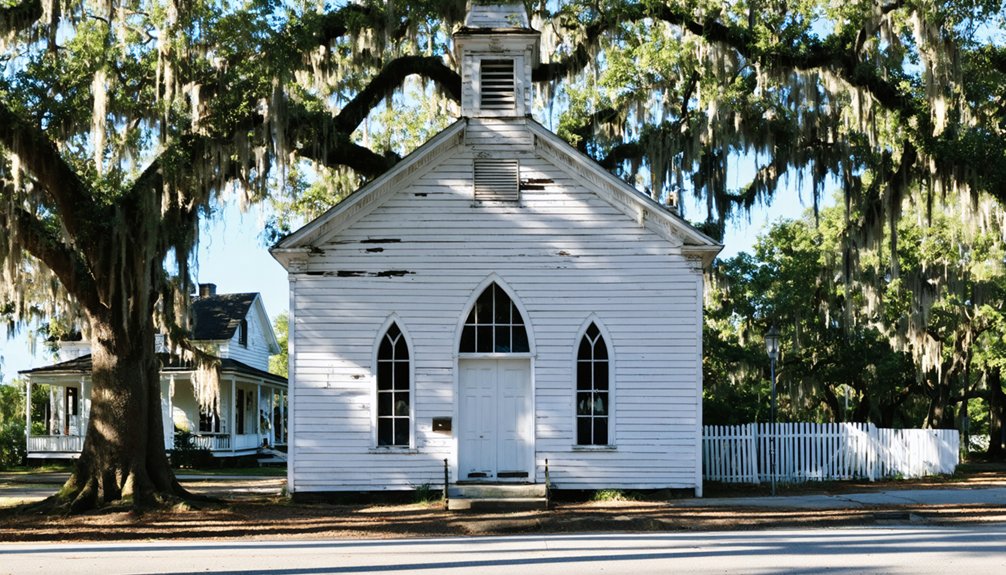
You’ll find Spectre hidden on Jackson Lake Island, a Hollywood creation born from Tim Burton’s imagination rather than Alabama’s frontier past. Unlike Cahawba’s genuine historical ruins, this ghost town sprang to life in 2003 as the fantastical film set for *Big Fish*.
The set includes a white chapel, hanging shoes, and pastel-colored homes that never housed real families. What makes Spectre extraordinary is its deliberate transformation—Burton’s crew aged it on camera.
Nature continued the work through storms and floods, and now you can walk through a place that blurs the line between movie magic and authentic decay.
Big Fish Film Set
Nestled on a small private island in the Alabama River outside Millbrook, the fictional town of Spectre exists as one of cinema’s most enchanting accidents—a movie set that refused to fade away.
Tim Burton’s 2003 masterpiece “Big Fish” brought this dreamscape to life through ingenious filming techniques, with designer Dennis Gassner crafting an entire village from styrofoam.
The historical gameplay between reality and fantasy mirrors the film itself—structures shot pristine first, then artificially aged for Edward Bloom’s return scenes.
Today, Spanish moss drapes crumbling facades where goats wander freely through the church.
Two styrofoam trees from the Enchanted Forest still stand seventeen years later.
You’ll find this peculiar paradise for just five bucks, cash only, where cinematic magic slowly surrenders to nature’s reclamation.
Exploring Abandoned Movie Structures
Tim Burton’s Spectre stands alone among America’s ghost towns—a Hollywood fabrication that outlasted its cinematic purpose to become something stranger than fiction. You’ll walk streets where Styrofoam houses and artificial trees blur reality’s edges, their intentional urban decay now authentically weathered by Alabama’s elements.
The film set wasn’t meant to survive, yet here it persists on Jackson Lake Island, accessible for just $5. Spanish moss drapes the crumbling facades while goats wander freely through Burton’s dreamscape.
Fire claimed the commercial district, floods took Jenny’s riverside house, but six homes and that white chapel remain. Those famous shoes still hang between trees—a peculiar monument to moviemaking magic that refused demolition and embraced genuine abandonment instead.
Blakeley: Where History Meets Nature
Along the eastern shore of Mobile Bay, where the Tensaw River carves through Alabama’s coastal delta, the skeletal remains of Blakeley tell the story of ambition undone by nature itself.
You’ll discover a town that once rivaled Mobile with 4,000 residents, now reduced to foundation stones and unmarked graves where yellow fever claimed entire families. Local legends speak of the “hanging tree” where frontier justice prevailed, while ghost structures in Washington Square reveal architectural styles of 1820s prosperity.
Today’s 3,800-acre state park preserves both the commercial dreamscape and Civil War battlefield where Confederate defenses crumbled in 1865. Walk these trails where mosquito-haunted wetlands defeated what speculation and competition couldn’t—a civilization’s determined foothold against an unforgiving wilderness.
St. Stephens: Preserving Two Centuries of Alabama Heritage
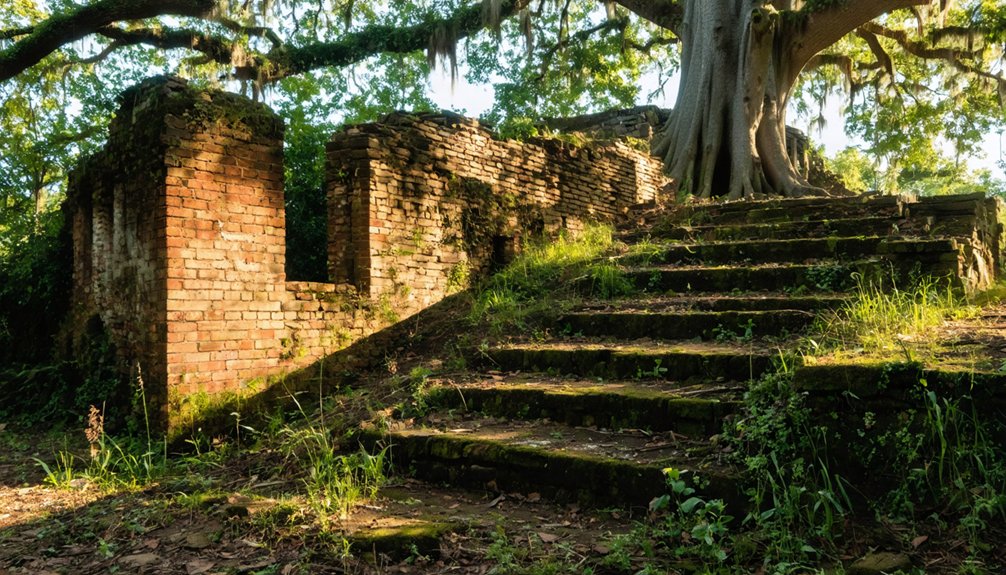
High on the bluffs of the Tombigbee River, where Spanish soldiers first raised their flag in 1789, St. Stephens awaits your discovery. This forgotten territorial capital—”Where Alabama Began”—now serves as one of the state’s most remarkable archaeological excavation sites.
You’ll walk streets marked by faux home-fronts and signs, tracing pathways where Cherokee, Creek, Choctaw, French, Spanish, and American settlers once mingled in Alabama’s first true melting pot.
Historical preservation efforts have transformed these virtual ruins into an active research site where you can witness ongoing digs.
The 1854 courthouse and museum display artifacts from two centuries of occupation, while the mysterious Indian Bathtubs intrigue visitors. After remaining undisturbed for over a century, St. Stephens offers you an authentic glimpse into Alabama’s complex founding era.
Planning Your Alabama Ghost Town Road Trip
Your journey through Alabama’s forgotten settlements requires strategic planning to maximize your experience across 400 miles of haunted history. Begin your loop at Cahaba, dedicating roughly eight hours to traverse hidden trails connecting sites like Claiborne, Prairie Bluff, and New St. Stephens.
You’ll encounter varying accessibility—some locations feature historical markers along “Old Fort Claiborne Road,” while Prairie Bluff’s original route now sits behind gated subdivisions.
Stop at local gas stations and vintage establishments where residents share directions and local legends about yellow fever outbreaks that decimated once-thriving communities.
Archaeological sites like St. Stephens offer undisturbed remains for exploration, while three 19th-century cemeteries at Claiborne provide tangible connections to 5,000 former residents.
Download curated maps beforehand, as cell service proves unreliable in these remote territories.
Best Times to Visit During Summer Months
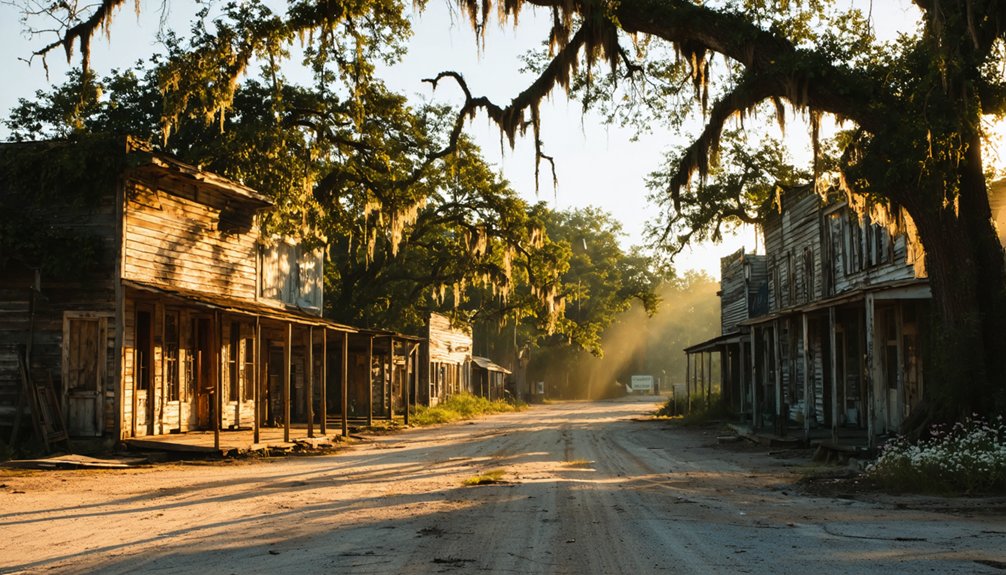
Summer transforms Alabama’s abandoned settlements into accessible outdoor museums, where extended daylight hours stretch exploration windows to nine hours and eliminate the restrictive schedules that govern fall’s organized ghost tours.
You’ll discover Cahawba’s crumbling brick walls between 9 a.m. and 5 p.m. without competing against October’s Haunted History Tour crowds. The haunted legends that draw September’s $13-per-person ghost walks become yours to explore freely at sunrise-to-sunset sites like Maple Hill Cemetery and Blakeley State Park.
While summer festivals concentrate tourists at Gulf Shores’ coastline, you’re wandering Old St. Stephens’ 200-year-old archaeological grounds undisturbed. Early morning visits beat Alabama’s notorious heat, and roadside ruins reveal their weathered stories under generous daylight—no flashlight required, no tickets necessary.
What to Bring for Your Ghost Town Exploration
Before you step into Alabama’s crumbling cotton warehouses and vine-strangled iron forges, proper equipment separates safe exploration from emergency-room visits. Pack sturdy boots with thick soles—rusted nails and broken glass hide beneath decades of decay.
Cut-resistant gloves shield your hands while you steady yourself against weathered timber, and a respirator mask filters mold spores that preservation efforts haven’t yet reached.
Your headlamp illuminates historical accuracy in peeling ledgers and faded photographs, leaving both hands free for documenting these forgotten places.
Carry backup flashlights, spare batteries, and an all-encompassing first-aid kit.
A multi-tool handles unexpected obstacles, while water and energy bars sustain you through extended explorations.
These essentials honor both your safety and these sites’ fragile authenticity.
Frequently Asked Questions
Are Guided Tours Available at Alabama’s Ghost Town Locations?
You’ll find excellent guided tour options at Alabama’s ghost towns, where historical preservation meets adventure. Old Cahawba offers walking and wagon tours, while the Black Belt’s haunted sites provide immersive experiences exploring abandoned streets and forgotten tales.
For those interested in historic sites in Alabama spring, the rich history of the Civil Rights Movement can be explored in cities like Montgomery and Birmingham. Additionally, visits to landmarks such as the Scott and Zelda Fitzgerald Museum in Montgomery highlight the literary significance of the state. These experiences not only offer a glimpse into Alabama’s past but also bring to life the stories that have shaped its identity.
Can Visitors Explore Inside Remaining Structures at These Ghost Towns?
You’ll find limited interior access due to historic preservation efforts. Fort Gaines offers the best exploration opportunities inside original structures, while Seale’s abandoned buildings provide raw photography opportunities. Most sites restrict you to exterior viewing for safety reasons.
Are These Ghost Town Sites Wheelchair Accessible for Mobility-Impaired Visitors?
You’ll find wheelchair-accessible paths at Old Cahawba’s visitor center and Clear Creek Trail, where historical preservation meets mobility needs. However, exploring local legends deeper in wooded ruins requires vehicles, as crumbling structures lack proper accessible routes throughout.
Do Any Ghost Towns Charge Admission Fees or Require Permits?
Yes, admission policies vary by location. You’ll pay $2-$5 at Old Cahawba and Spectre, while Arcola charges $3 daily. There aren’t specific permitting requirements for visiting, though camping and tours cost extra at certain sites.
Are Overnight Camping Facilities Available Near These Ghost Town Locations?
Like discovering hidden treasure maps, you’ll find abundant overnight camping—from RV hookups to primitive tent sites—at these ghost town locations. Historical preservation meets local legends as you sleep where Alabama’s forgotten communities once thrived under starlit skies.
With a sense of adventure, many are drawn to exploring abandoned places in Alabama, revealing the stories etched in dilapidated structures. Each site offers a glimpse into the past, where nature slowly reclaims what was once bustling with life. As you wander through the remnants, you’ll feel a connection to the history and the people who once called these places home.
References
- https://thebamabuzz.com/5-alabama-ghost-towns-to-put-on-your-bucket-list/
- https://www.youtube.com/watch?v=1Qy5Sq51SbA
- https://deepsouthurbex.com/2020/01/02/6-south-alabama-ghost-towns/
- https://freepages.history.rootsweb.com/~gtusa/usa/al.htm
- https://digitalalabama.com/alabama-maps/alabama-map-ghost-towns-of-alabama-map/9449
- https://www.ezhomesearch.com/blog/11-ghost-towns-in-alabama-that-bridge-the-distance-between-yesterday-and-today/
- https://kids.kiddle.co/List_of_ghost_towns_in_Alabama
- https://digitalalabama.com/alabama-ghost-towns/arcola-alabama/2798
- https://www.hmdb.org/m.asp?m=38185
- https://en.wikipedia.org/wiki/Vine_and_Olive_Colony