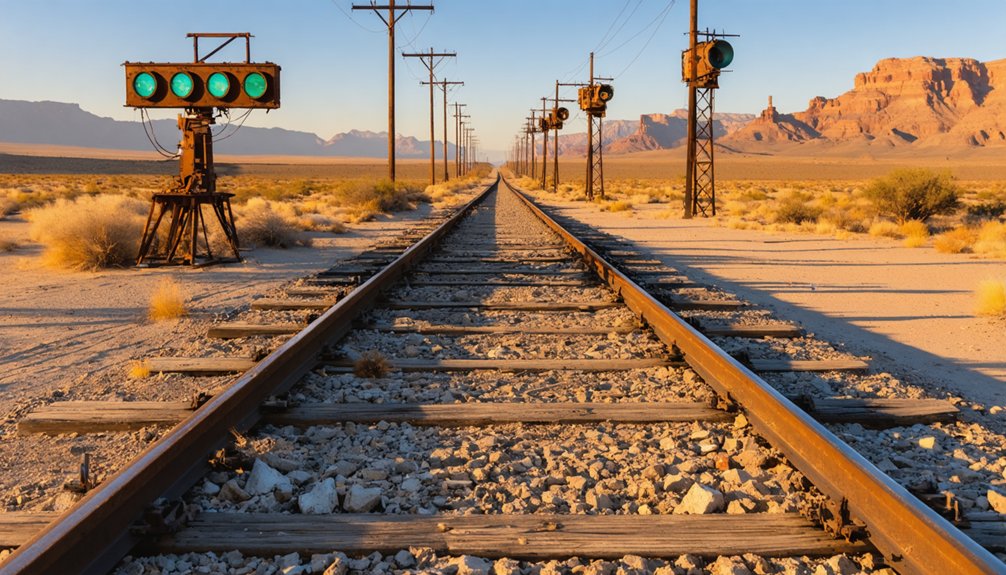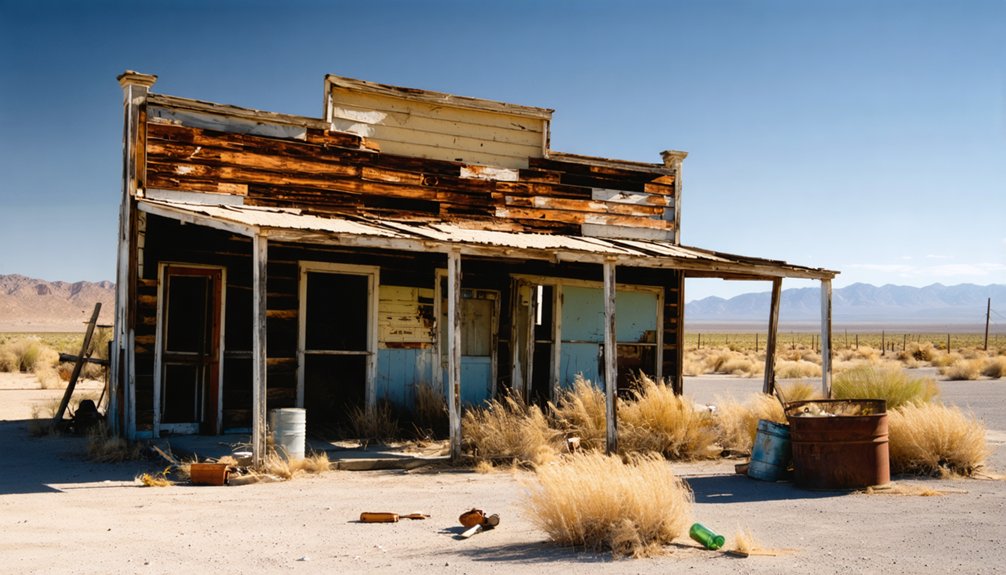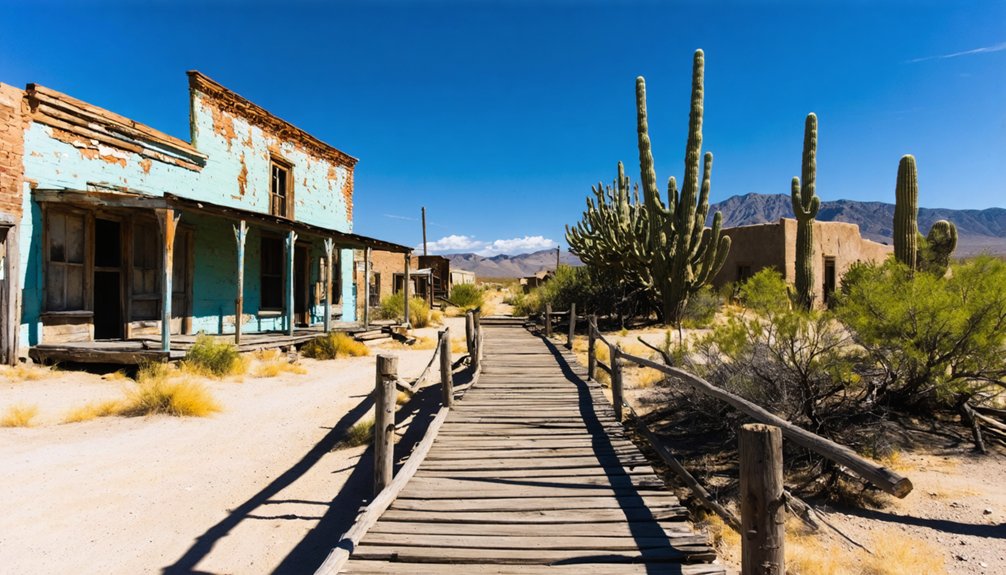
You’ll discover Arizona’s summer-accessible ghost towns by visiting early morning when temperatures remain manageable. Goldfield offers reconstructed buildings and underground mine tours in the Superstition Mountains, while Vulture City preserves authentic structures from its 1863 gold rush heyday (open October–May only). Two Guns sits eerily along Route 66 with graffiti-covered ruins, and Fairbank provides riverside trails plus volunteer-guided tours. Courtland‘s skeletal remains offer complete solitude among crumbling adobe walls and abandoned copper shafts. Each site reveals distinct chapters of Arizona’s mining heritage, with strategic planning enabling richer exploration opportunities throughout the desert.
Key Takeaways
- Goldfield Ghost Town operates year-round with no entry fee, offering mine tours, gunfight shows, and gold panning experiences in the Superstition Mountains.
- Vulture City closes June–September due to extreme heat exceeding 100°F; plan visits for cooler months October through May instead.
- Two Guns on Route 66 features accessible ruins including gas stations, Canyon Diablo Bridge, and the historic Apache Death Cave site.
- Visit early morning or post-sunset during summer to avoid peak heat; carry one quart of water per hour and wear sun protection.
- Fairbank offers self-guided exploration with a weekend visitor center, preserved historic buildings, and a four-mile trail to the riverside cemetery.
Goldfield Ghost Town: A Living History Experience in the Superstition Mountains
Nestled against the jagged volcanic peaks of the Superstition Mountains, Goldfield Ghost Town rises from the Sonoran Desert like a portal to Arizona’s untamed past. You’ll discover a settlement born from $4 million in gold mining fever during the 1890s, where fortune-seekers struck paydirt before the veins faulted and dreams crumbled.
Today, you’re free to explore reconstructed buildings along dusty Main Street, descend 25 minutes underground into the Mammoth Mine, and watch gunfights erupt in blazing afternoon sun. The haunted legends of the Lost Dutchman Mine permeate every weathered plank and canyon shadow.
Summer’s brutal heat? You’ll escape it deep in mine tunnels while discovering authentic equipment and mining procedures. The Goldfield Museum showcases late 19th-century artifacts that bring the mining era to life through personal belongings, tools, and photographs of those who once called this desert outpost home. At the Prospector’s Palace, you can try your hand at gold panning with guidance from a gold historian, keeping whatever flakes or nuggets you uncover. No entry fees restrict your wandering—you’ll only pay for experiences that call to you.
Vulture City: Arizona’s Most Productive Gold Mining Settlement
Where vultures circled above sun-bleached desert in 1863, Henry Wickenburg followed their descent and stumbled upon Arizona’s richest treasure—a quartz outcropping glittering with gold that would birth the territory’s most productive mine.
You’ll walk through authentic remnants of 340,000 ounces worth of dreams at Vulture City, where 5,000 souls once carved prosperity from unforgiving terrain. The mining history surrounds you through weathered structures—the assay office, blacksmith shop, and that notorious Hanging Tree where eighteen thieves met frontier justice.
Underground tours aren’t available, but aboveground exploration reveals enough drama: stone foundations of dismantled buildings, the ingenious 15-mile pipeline that sustained life here, and operational scars from multiple revivals until Roosevelt’s 1942 wartime closure. The settlement’s post office operated from 1880 until April 1897, marking the rise and decline of this once-thriving community. Costumed interpreters now bring the town’s gritty past to life through educational programs and living history demonstrations.
Visit October through May and discover Arizona’s most lucrative gold settlement turned hauntingly preserved timepiece.
Two Guns: A Route 66 Relic on the Edge of Canyon Diablo
Along the eastern rim of Canyon Diablo, thirty miles east of Flagstaff, Two Guns rises from the high desert as a crumbling monument to America’s Mother Road obsession. You’ll find ghost town architecture that tells tales of Earl Cundiff’s 1922 trading empire and the blood-soaked lease dispute that left him dead.
The ruins whisper historic storytelling through:
- Graffiti-covered stone towers from Rimmy Jim’s 1925 gas station
- Gutted animal cages where Louise Cundiff’s zoo once thrived
- The original 1915 Canyon Diablo Bridge spanning the gorge
- Murals fading on crumbling walls near Interstate 40
Route 66’s 1938 realignment doomed this outpost. The name “Two Guns” carries multiple meanings and connects to several Arizona locations and historical references throughout the region. The site’s eerie reputation stems from the Apache Death Cave, where 42 Apaches suffocated in 1878 after Navajo raiders set fire to the entrance. Now you’ll wander freely among the rubble at coordinates 35°07′04″N 111°05′37″W, where mountain lions once mauled a murderer and tourists flocked for roadside Americana.
Fairbank: a Riverside Ghost Town With Volunteer Stewards
You’ll find Fairbank’s adobe walls rising beside the San Pedro River, where volunteer stewards maintain one of Cochise County’s best-preserved ghost towns.
The restored schoolhouse museum opens weekend afternoons, inviting you to trace the story of this 1880s railroad stop through interpretive plaques before wandering trails to the historic cemetery.
The town’s name connects it to the broader Fairbanks family of place name variations found across the American West.
The Mercantile building, constructed in 1882 as Fairbank’s earliest structure, served as the business center for nearly a century until 1973.
From here, the ghostly remains of nearby Courtland lie just minutes away, extending your exploration of Arizona’s vanished mining communities.
Historic Buildings and Museum
Though time and desert winds have claimed many of Fairbank’s original structures, seven historic buildings still stand along the San Pedro River. Each one is a tangible link to the town’s heyday as a bustling railroad depot in the 1880s.
You’ll find the Schoolhouse Museum your best starting point, where knowledgeable docents share ghost stories and urban legends alongside historical photos. This 1920 gypsum-block building operates as the visitor center Friday through Sunday, 9:30 a.m. to 4:30 p.m.
Don’t miss:
- Fairbank Mercantile (1882) – the oldest structure, once combining general store, saloon, and post office
- Montezuma Hotel foundation – remnants beneath Highway 82
- Adobe Commercial Building – recently stabilized by BLM
- Small House (1885) – two-room dwelling
Interpretive plaques guide your self-exploration through this volunteer-preserved slice of frontier Arizona. The town was originally established in 1881 as Junction City along the Benson-to-Sonora rail line before being renamed. After touring the townsite, you can walk along the San Pedro River to reach the historic Fairbank cemetery.
River Trails and Cemetery
Beyond the crumbling adobe walls, a 4-mile loop trail beckons you into Fairbank’s living landscape—the lush San Pedro River corridor that once made this ghost town thrive.
You’ll follow decorative rusted iron markers along paths where horses and hikers share the riverside terrain.
The trail parallels the old Arizona & Southeastern Railroad bed before dropping to the meandering San Pedro, where animal bedding and tracks tell stories of deer and pronghorn seeking water.
A half-mile side trail leads to the pioneer cemetery—accessible but weathered after a century of desert storms.
The cemetery history remains tangible in this disrepair, offering quiet moments among forgotten graves.
Well-maintained by volunteer stewards, these trails thread through 40 miles of riparian conservation area, revealing why settlers chose this river landscape despite the unforgiving Sonoran heat.
Nearby Courtland Ghost Town
Twenty miles northeast of Fairbank, the skeletal remains of Courtland stand as a stark contrast to the riverside tranquility you’ve just explored. This copper mining ghost town offers raw mining archaeology without interpretive signs or maintained trails—pure exploration for those who value historical preservation through minimal interference.
What makes Courtland compelling:
- Crumbling jail walls that once confined rowdy miners during the 1909-1912 boom
- Adobe ruins and stone foundations scattered across open desert terrain
- Abandoned mine shafts dotting hillsides where copper ore fueled brief prosperity
- Complete isolation with zero commercial development or tourist amenities
You’ll navigate independently through mesquite and remnants of 2,000 former residents’ lives.
Bring water, wear boots, and respect the fragile structures—this untamed site rewards adventurers seeking authentic Southwest ghost town experiences.
Courtland: Copper Mining Remnants in the Desert
Tucked into the rugged Dragoon Mountains, Courtland emerged as a copper boom town in 1909 when prospectors struck rich veins that would lure nearly 2,000 fortune-seekers to this remote corner of Cochise County. Within months, miners carved 8,000 feet of underground shafts while the surface buzzed with railroads, newspapers, and saloons.
The mining history ended abruptly in 1920 when ore deposits vanished at 300 feet.
Today, you’ll find desert exploration rewarded with haunting remnants: a concrete jail standing sentinel near the road, crumbling stone walls, and foundations marking where businesses once thrived. Open mine shafts pock the surrounding hills—tread carefully.
The cemetery holds 50-100 graves telling stories of mining accidents, murders, and Spanish Flu victims who gambled everything on Courtland’s copper dreams.
Ruby: Arizona’s Premier Ghost Town With Restricted Access
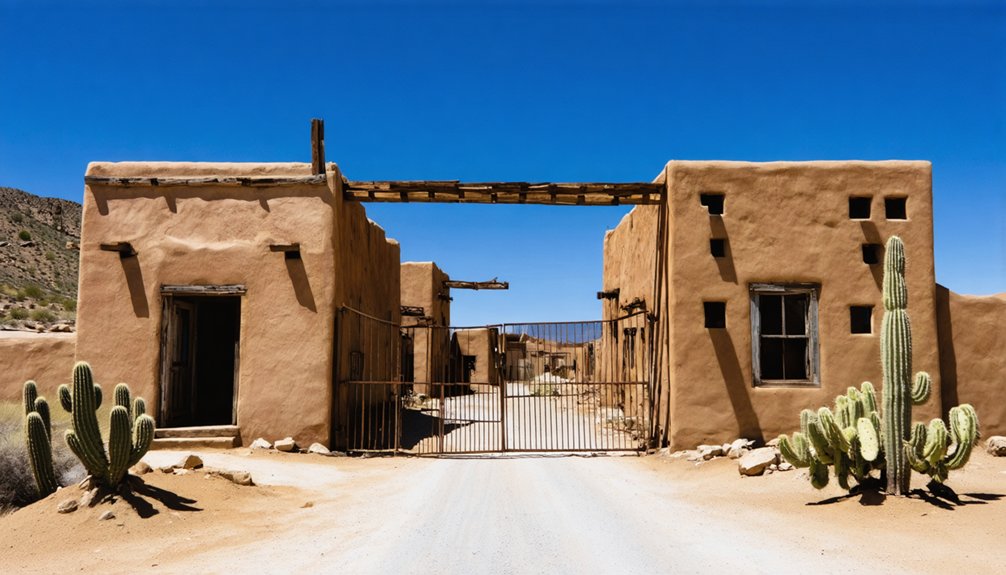
- Original schoolhouse that educated 150 students across eight grades
- Montana Mine machinery frozen in time since 1940
- Company housing where miners lived beneath desert stars
- Functional jail from frontier justice days
You’ll need to appreciate Ruby’s 362 acres from afar—its inaccessibility ironically protecting what vandalism destroys elsewhere.
Best Times to Visit Arizona Ghost Towns During Summer Months
Arizona’s ghost towns don’t follow a one-size-fits-all summer schedule—you’ll find them shuttered, restricted, or cautiously welcoming depending on elevation and desert brutality. Vulture City closes entirely June through September when Wickenburg bakes past 100°F. Castle Dome near Yuma demands advance calls May through September, as temperatures surpass 110°F.
Goldfield operates year-round but varies summer hours unpredictably.
Your freedom lies in timing. Hit sites at sunrise when wildflower blooms frame abandoned structures, or arrive post-sunset for flashlight tours and night photography under star-pierced skies.
Early morning burro feeding in Oatman starts around 9am, while evening walking tours exploit cooler temperatures.
Always call ahead May-September—summer transforms operating hours without warning, and isolation means no backup plans when gates stay locked.
What to Bring for Your Arizona Ghost Town Adventure
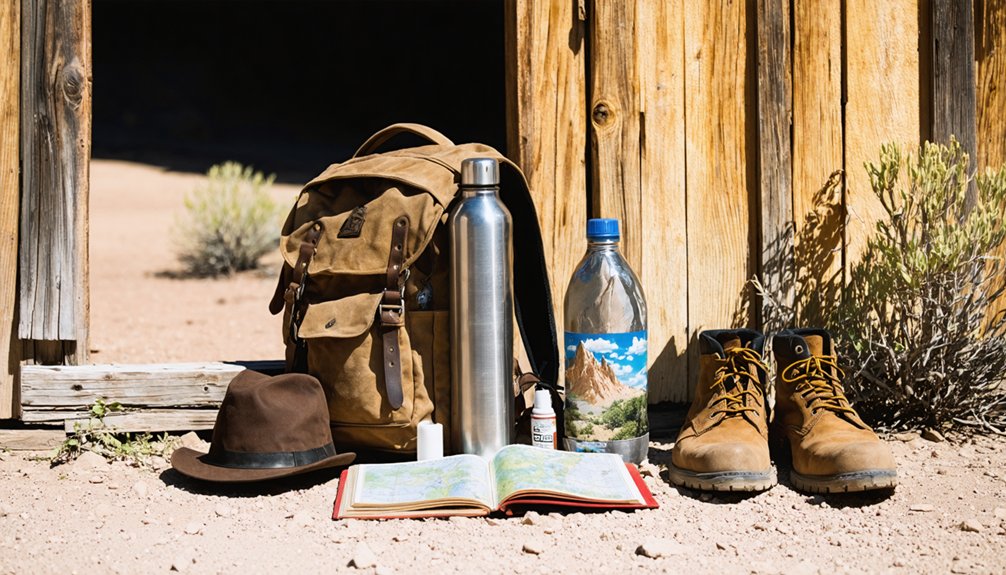
When summer heat hammers Arizona’s ghost towns into shimmering mirages, your survival gear becomes as critical as your camera. Master these packing essentials before wandering those dusty corridors:
- Sun defense arsenal: Wide-brimmed hat, SPF 30+ sunscreen, UV-blocking sunglasses, and a cooling bandana transform scorching rays into manageable warmth.
- Hydration strategies: Carry one quart per hour in reusable bottles, sip constantly before thirst strikes, and pack electrolyte tablets for endurance.
- Temperature-swing layers: Breathable shirts for 110°F afternoons, long sleeves for evening drops of 30°F.
- Trail-ready footwear: Supportive boots deflect cactus spines and rattlesnake encounters on crumbling pathways.
Toss in headlamps for exploring darkened interiors, energy bars for remote treks, and you’ll claim genuine freedom among Arizona’s abandoned outposts.
Combining Multiple Ghost Towns Into One Summer Road Trip
Your pack loaded and boots laced, those singular ghost town snapshots suddenly beg for expansion—why settle for one when Arizona’s desert highways thread together entire constellations of abandoned settlements? Route 66’s 401-mile ribbon connects Oatman’s wild burros to Two Guns’ crumbling zoo through Seligman’s birthplace-of-revival nostalgia.
Southeast of Tombstone, the Mining Triangle lets you chase Pearce’s 1894 Commonwealth Mine claims through Courtland and Gleeson on mostly navigable dirt roads—each stop layering local legends atop historical preservation efforts.
Northern loops pair Prescott’s paved route to Humboldt with Vulture City’s saguaro-framed decay. String together seven sites across 700 miles, camping between clusters, and you’ll trace copper booms to gold busts without backtracking. The desert rewards momentum.
Photography Tips for Capturing Arizona’s Abandoned Mining Towns
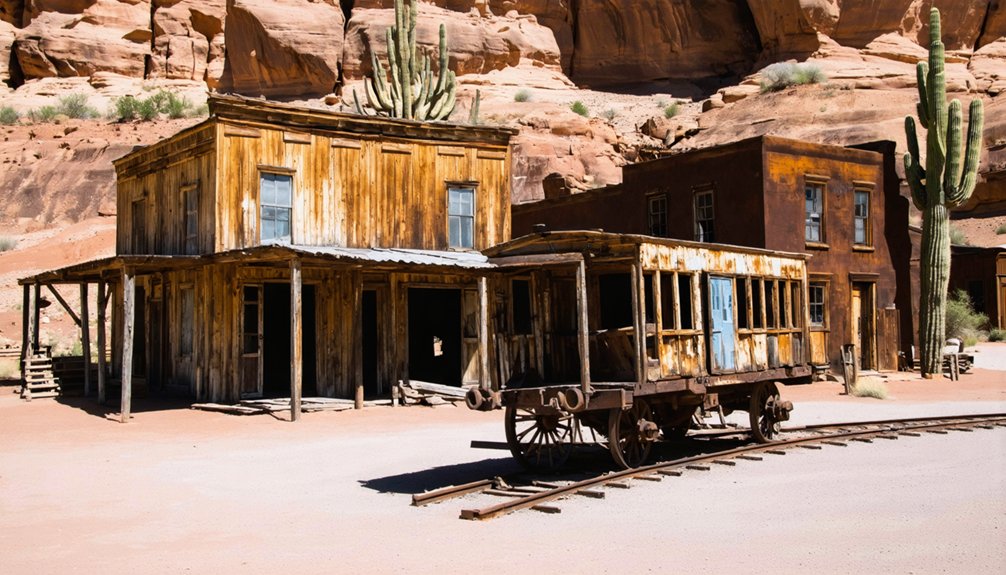
Before the shutter clicks, abandoned mining towns demand a photographer’s respect for their fragility and your commitment to timing. Golden hour transforms rusted relics and crumbling adobe into visual poetry—shoot dawn or dusk to escape brutal midday heat while capturing dramatic shadows across weathered structures.
Essential photography gear and approach:
- Wide-angle lens for sweeping main street compositions and building context
- Sturdy tripod for sharp interiors and low-light exposures in dim saloons
- High dynamic range capability to balance bright desert exteriors with shadowy interiors
- Telephoto lens for wildlife safety when photographing remote sites
Frame abandoned vehicles against slag piles, capture texture in peeling paint, and emphasize decay’s honest beauty.
Travel with a companion through isolated locations, respect fragile buildings by shooting exteriors, and leave these time capsules undisturbed for future wanderers.
Frequently Asked Questions
Are Arizona Ghost Towns Safe for Children and Elderly Visitors?
Most Arizona ghost towns pose significant risks for children and elderly visitors due to structural hazards and unstable terrain. You’ll find safer experiences through local guided tours at managed sites emphasizing historical preservation, like Swansea’s interpretive trails with basic facilities.
Exploring historic ghost towns in Arizona can be a captivating journey into the past, revealing stories of the people who once called these places home. While some locations may be off-limits, others provide opportunities for visitors to delve into the rich history and unique architecture of the Wild West. Engaging with knowledgeable guides not only enhances your understanding but also ensures a safe and enjoyable experience.
Do I Need Special Permits to Explore Abandoned Buildings?
You’ll need permits for most sites—Ruby charges admission, Kentucky Camp requires USFS camping permits, and BLM sites like Swansea need sign-in. Legal access regulations protect ghost town preservation while respecting private property boundaries and tribal lands.
Are Restrooms and Drinking Water Available at These Ghost Towns?
Restroom facilities and drinking water sources aren’t guaranteed at these remote destinations. You’ll find some amenities in thriving Bisbee and Jerome, but Ruby’s wilderness demands you pack essentials. Goldfield’s snack bar might offer relief during your adventure.
Can I Use Drones to Photograph Arizona Ghost Towns?
You’ll need FAA registration and aerial photography permits to capture Arizona’s abandoned ghost towns from above. While drone regulations might feel restrictive, they’re protecting your freedom to explore these weathered landscapes where history whispers through crumbling walls.
Among these historic ghost towns in Arizona, each location tells a unique story of its past, inviting adventurers to walk through time. As you explore, you might stumble upon remnants of old mining operations or deserted storefronts that once bustled with life. The allure of these fading structures is a testament to the resilience of history, echoing the dreams and endeavors of those who once called them home.
Throughout the year, various annual events in Arizona ghost towns provide a glimpse into the vibrant culture that once thrived in these places. Visitors can engage in reenactments, local art exhibits, and guided tours, all aimed at preserving the rich history of the area. These gatherings not only celebrate the past but also foster a community spirit, bringing together enthusiasts who share a passion for the haunting beauty of these forgotten locales.
Are Overnight Camping Options Available Near These Ghost Town Locations?
Yes, you’ll find overnight camping near Arizona’s ghost towns with varying campground amenities—from primitive BLM sites to full hookups. Local tour guides often recommend booking ahead at popular spots like Goldfield, where Superstition Mountain sunrises reward early risers.
Exploring historic ghost towns in Arizona offers a unique glimpse into the state’s rich mining history and cultural heritage. Each town has its own stories and remnants of the past, making them fascinating destinations for history buffs. Make sure to bring a camera, as the hauntingly beautiful landscapes provide the perfect backdrop for unforgettable photographs.
References
- https://grandmisadventures.com/2023/07/12/ghost-town-cacti-desert-sun-arizona/
- https://www.westgateresorts.com/blog/why-the-spookiest-summer-getaway-of-all-time-is-an-abandoned-ghost-town-in-arizona/
- https://www.experiencescottsdale.com/stories/post/ghost-towns-in-arizona/
- https://www.arizonahighways.com/article/arizona-ghost-towns
- https://goldfieldghosttown.com
- https://usghostadventures.com/americas-most-haunted-trending/ghost-towns-to-visit-on-your-summer-road-trip-along-route-66/
- https://mwg.aaa.com/via/places-visit/arizona-ghost-towns
- https://www.youtube.com/watch?v=Q18D1sHH2Cc
- https://www.fyzical.com/superstition-springs-az/blog/goldfield-ghost-town-near-superstition-springs-history-location-and-community-connections
- https://global-goose.com/goldfield-ghost-town/