You’ll find California’s best summer ghost towns scattered from the High Sierra to the Mojave Desert, each offering authentic glimpses into Gold Rush history. Bodie State Historic Park preserves 170 unrestored buildings where you can peer through dusty windows at century-old merchandise, while Calico Ghost Town near Los Angeles features underground mine tours and restored saloons. For northern exploration, visit Shasta State Historic Park‘s brick ruins, or hike to Glen Alpine Springs‘ mountain retreat structures. These sun-bleached remnants reveal their secrets best when you understand what makes each uniquely preserved.
Key Takeaways
- Bodie State Historic Park features 170 unrestored buildings preserving authentic Gold Rush history, accessible via a 13-mile dirt road.
- Calico Ghost Town offers mine tours, mineral panning, camping facilities, and restored structures from its 1880s silver mining era.
- Shasta State Historic Park near Redding displays half-ruined brick buildings and restored Gold Rush structures, open Thursday through Sunday.
- Randsburg remains a living ghost town with operational saloons, antique shops, and ongoing small-scale gold mining activities year-round.
- Plan for summer heat with early arrivals, essential supplies, and extended hours at locations like Calico for sunset photography.
Bodie State Historic Park: California’s Largest Unrestored Ghost Town
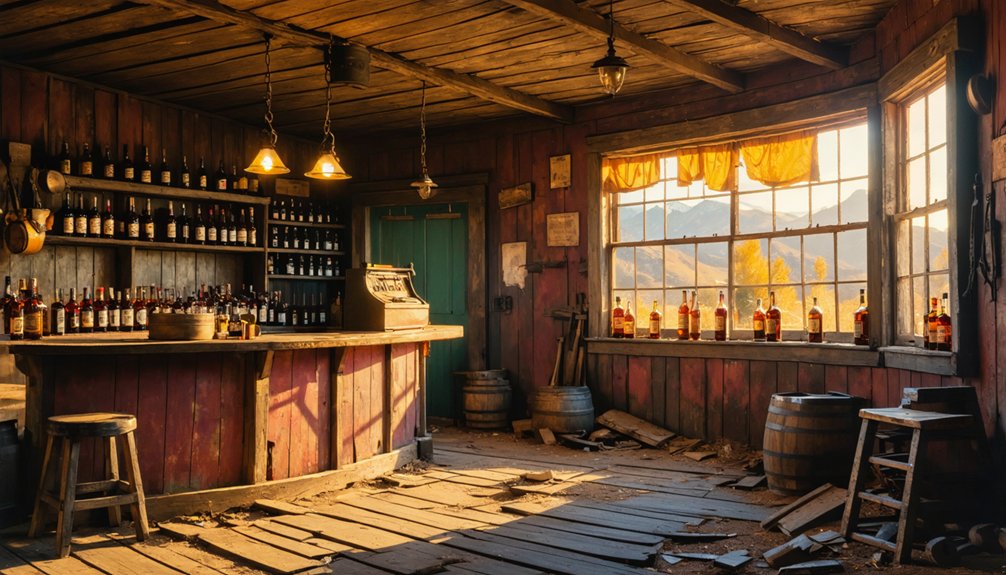
Unlike sanitized tourist attractions, preservation efforts here maintain authenticity. You’ll peer through dusty windows at merchandise still stocked on shelves, furniture positioned as if occupants just stepped out. The 13-mile dirt road keeping 200,000 annual visitors at bay adds to the adventure.
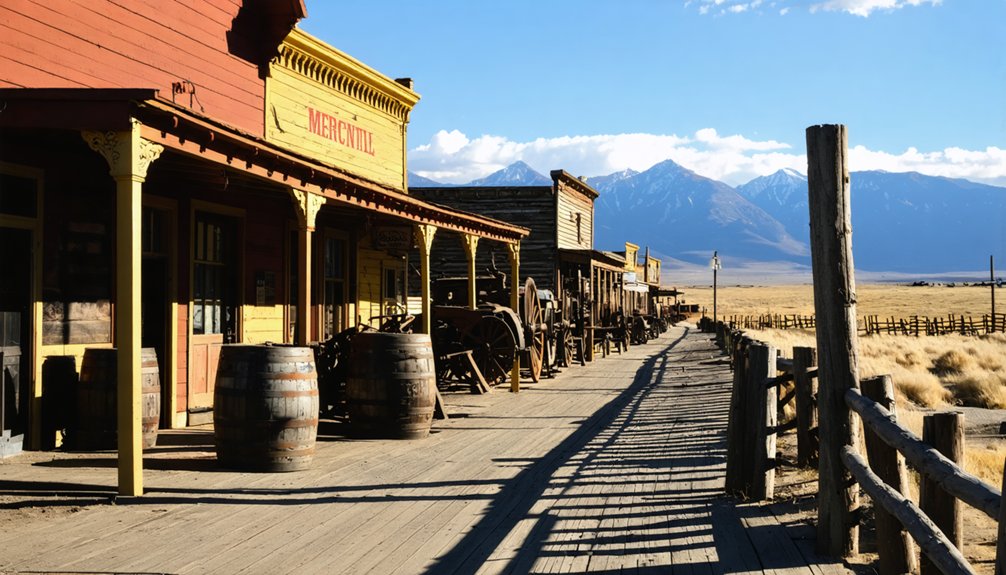
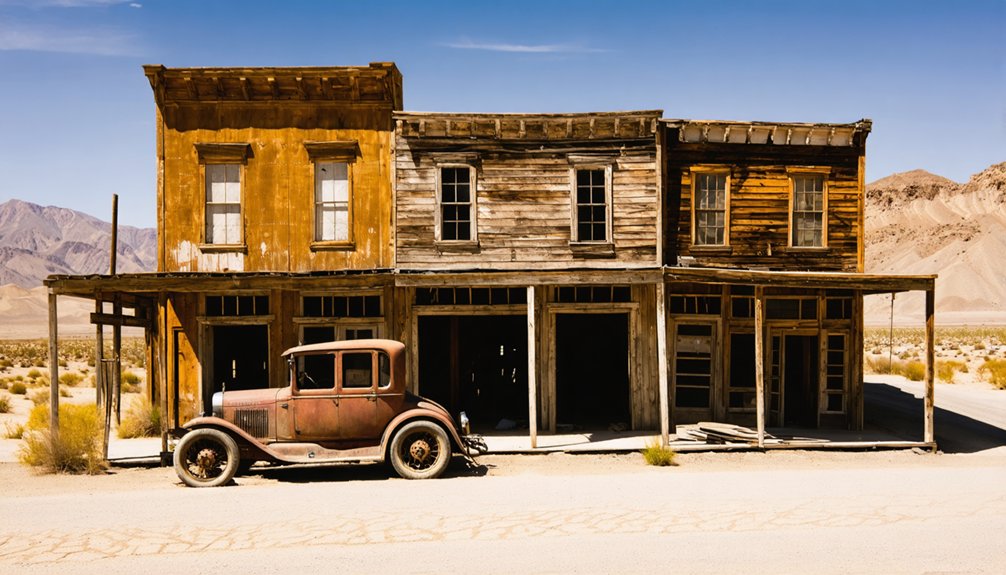
Summer’s cool climate makes exploration comfortable as you traverse Main Street‘s mile-long corridor of genuine Western history. Visitors can walk around 170 remaining buildings preserved in their original state. This ghost town draws visitors seeking authentic remnants of California’s Gold Rush era.
Calico Ghost Town: A Desert Mining Destination Near Los Angeles
You’ll find Calico Ghost Town sprawled across the sun-bleached Calico Mountains just off Interstate 15, where California’s Governor officially proclaimed it a Silver Rush Ghost Town in 2005.
This carefully restored mining camp—now a California Historical Landmark—welcomes you daily from 9 AM to 5 PM with original saloons, museums, and mine tours that bring its 1880s silver boom to life.
Step into the Maggie Mine‘s thousand-foot tunnels or photograph the weathered schoolhouse beneath the giant “CALICO” letters that overlook the Mojave Desert.
The town’s 500 mines once produced over $20 million in silver across twelve years before the rush ended in the mid-1890s.
Walter Knott, creator of Knott’s Berry Farm, purchased and meticulously restored Calico in 1951 using photographs from the 1880s before donating it to San Bernardino County in 1966.
Historic Landmarks and Recognition
When prospectors stumbled upon silver in the surrounding mountains on April 6, 1881, they sparked one of California’s largest silver strikes and set Calico’s destiny in motion.
The Silver King Mine’s $86 million yield over three decades cemented the town’s legendary status.
Today, you’ll discover the fruits of Walter Knott’s 1950s historic preservation efforts, where he meticulously restored structures using 1880s photographs as guides.
Five original buildings still stand, including Lil’s Saloon and the Lane House & Museum, testifying to authentic frontier life.
The town’s cultural significance earned dual recognition: State Historical Landmark 782 in 1962 and California’s Official State Silver Rush Ghost Town in 2005.
Now part of San Bernardino County’s Regional Parks system, Calico remains one of California’s most accessible living ghost towns.
The restoration project cost over $700,000, transforming the abandoned settlement into the prominent tourist destination visitors experience today.
Calico welcomes visitors from across the country and worldwide who seek to experience its educational programs and outdoor recreation opportunities.
Visitor Attractions and Facilities
Beyond the weathered facades and historical monuments, Calico transforms into a hands-on adventure playground where you can descend 1,000 feet into the Maggie Mine’s cool darkness. Inside, blacklight mineral displays illuminate the tunnels while historical artifacts and preserved equipment reveal how miners extracted $65,000 in silver from the glory hole.
You’ll pan for iron pyrite, pocket your glittering treasures, then board the Calico Odessa Railroad for an authentic mining transport experience.
The Mystery Shack challenges your perception with gravity-defying illusions, while nine shops peddle fossils, minerals, and handcrafted goods. Three restaurants fuel your exploration between mining experiences.
For extended adventures, RV sites and mountain bike trails await. The town’s desert environment offers scenic views from surrounding hills, enhancing your exploration with natural panoramas that frame the historic structures below. The Lucy Lane Museum preserves authentic period furnishings and artifacts from the former home of Lucy Bell Lane, offering insights into daily life during Calico’s silver mining heyday. At $179, the zipline tour launches you across nine high-speed lines—pure adrenaline above this desert relic that refuses to stay buried.
Shasta State Historic Park: Northern California’s Queen City Ruins
Six miles west of Redding, a row of half-ruined brick buildings rises from the valley floor, their weathered facades standing as silent witnesses to California’s most dramatic gold rush transformation. You’ll discover Shasta, once the “Queen City of the Northern Mines,” where 3,500 fortune-seekers once swarmed through streets packed with freight wagons and pack mules.
The mining history here runs deep—from 1850 to 1890, this was California’s northern epicenter of wealth and ambition.
Today’s architectural preservation efforts have transformed the site into a living museum where you can explore the restored Litsch General Store, watch bread bake in Blumb Bakery’s 1870s brick oven, and wander through the 1853 Masonic Hall.
The courthouse displays original artifacts while cemetery trails lead you past graves of pioneers who chased freedom in gold country. Beyond the historic buildings, you’ll find a replica double gallows complete with period-appropriate gallows poetry positioned out back from the main park area. The museum welcomes visitors Thursday through Sunday from 10 am to 4 pm, with adult admission set at $3 and youth tickets at $2.
Glen Alpine Springs and Silver Mountain City: High Sierra Historic Retreats
You’ll find Glen Alpine Springs nestled in the Sierra Nevada near Fallen Leaf Lake, where Bernard Maybeck’s 1920s lodge buildings still stand among towering pines and natural soda springs.
Just beyond this former health retreat, trails wind through the Desolation Wilderness toward the scattered remnants of Silver Mountain City, a silver boom camp that once bustled with miners.
These Tahoe Basin sites offer accessible summer hiking through mountain meadows and forest, letting you explore both a preserved Victorian resort and the windswept ruins of a mining ghost town in a single backcountry journey.
Glen Alpine’s Historic Lodge
Tucked into a pristine canyon near Fallen Leaf Lake, Glen Alpine Springs rose from humble beginnings as a health resort in 1878. It has since become one of the High Sierra’s most beloved wilderness retreats.
You’ll discover nine remaining structures today, including five fire-proof buildings designed by Bernard Maybeck after a devastating 1921 blaze. The architectural significance shines through his innovative use of natural rock and rounded metal eaves that mimic thatched roofs—revolutionary construction for the Tahoe Basin.
The assembly hall‘s stone walls and the sturdy 1889 barn stand as proof of wilderness ingenuity. Historical preservation efforts transformed this once-thriving resort into a 501(c)(3) nonprofit, where volunteers maintain these architectural gems.
You can explore the bubblestone building, dining hall, and that original soda spring that started it all.
Silver Mountain City Boom
While Glen Alpine Springs catered to wealthy vacationers seeking mountain air and mineral waters, a far wilder settlement erupted just miles away in the High Sierra. Silver Mountain City exploded into existence when Scandinavian miners struck ruby silver ore in the creeks around 1861.
You’d have witnessed an extraordinary transformation—a remote mountainside at 6,411 feet morphing into a roaring camp of over 3,000 fortune-seekers within four years.
This mining history speaks to pure frontier ambition. The silver discovery triggered a prospector stampede that built a complete town almost overnight: saloons, hotels, assay offices, even a jail carved from granite blocks.
Accessible Tahoe Basin Trails
From the trailhead at Fallen Leaf Lake, a moderate 4.4-mile roundtrip path delivers you straight into Nathan Gilmore’s 1863 vision—a High Sierra sanctuary built around a bubbling soda spring.
You’ll wander through six surviving structures designed by architect Bernard Maybeck, whose native architecture blends granite and timber into the landscape. The experimental Bubblestone Cabin stands as a testament to 1920s innovation, while the 1889 barn still holds its original horse stalls.
This living museum operates through historic preservation efforts, transforming Tahoe’s first resort into accessible wilderness. Trails splinter toward Grass Lake, Gilmore Lake, and eventually Mt. Tallac’s summit.
John Muir walked these paths in 1890, sparking Sierra Club‘s formation. You’re following footsteps that carved Desolation Wilderness into protected land—freedom measured in preserved acres and unobstructed views.
Randsburg: a Living Ghost Town With Year-Round Operations
Gold fever struck the slopes of Rand Mountain in 1895 when three prospectors—Mooers, Burcham, and Singleton—uncovered glittering deposits that would transform empty desert into a thriving camp almost overnight.
By 1899, over 3,500 fortune-seekers packed Randsburg’s dusty streets, extracting an estimated $60 million in gold during the boom years.
Today, you’ll find 60-77 residents maintaining this Wild West relic at 3,523 feet elevation along Highway 395. Living history surrounds you—the operational Wine House Saloon, authentic jail, weathered mining equipment, and towering tailing piles behind town.
Unlike abandoned ruins, Randsburg functions year-round with antique shops and a desert museum. You’re free to explore California Historical Landmark No. 938, where small-scale gold mining continues and the gold rush atmosphere remains virtually unchanged since the 1890s.
Planning Your Summer Ghost Town Adventure in California
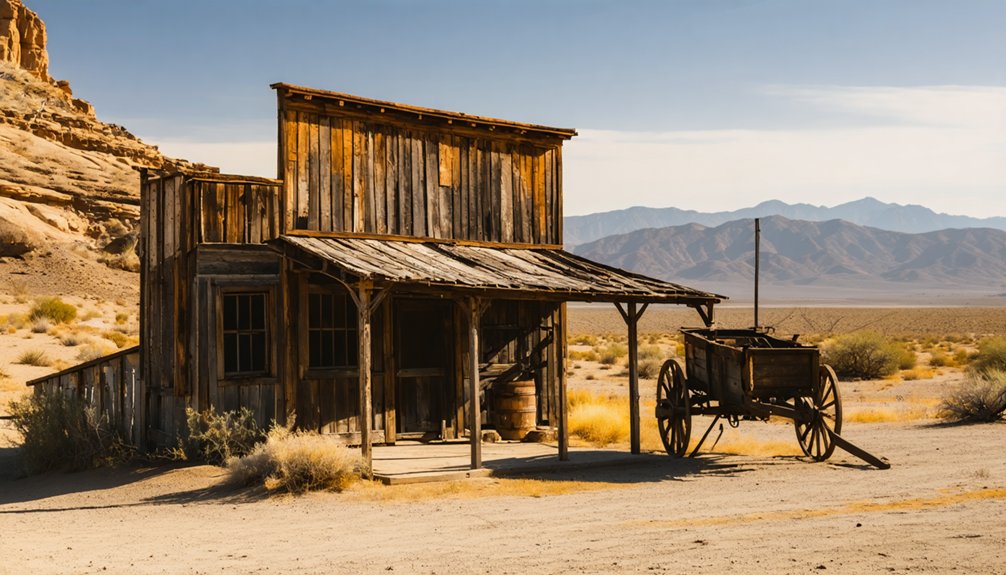
California’s ghost towns beckon summer explorers with sun-bleached buildings and whispers of gold rush fortunes. But successful adventures require more than spontaneous desert wanderlust.
You’ll need strategic planning for these remote destinations—Bodie’s 6 PM summer closing prohibits night photography opportunities, while Calico’s extended hours accommodate sunset shoots.
Pack heat essentials for desert landscapes where temperatures soar, and arrive early to beat afternoon crowds during peak season.
Distance matters: Calico’s 126-mile journey from Los Angeles varies vastly from North Bloomfield’s seven-hour trek through the Sierra Nevada.
Budget for entrance fees ranging from $8 to $10, plus individual attraction costs.
Guided tours open up ghost stories and mining history you’d otherwise miss.
Consider overnight camping at properties offering bunkhouses—there’s freedom in waking where prospectors once dreamed.
Frequently Asked Questions
What Should I Pack for Visiting California Ghost Towns in Summer?
Pack lightweight layers, sturdy boots, and a wide-brim hat for your adventure. Sun protection essentials include SPF 50+ sunscreen and UV sunglasses. Bring plenty of water, offline maps, snacks, and a first-aid kit for true desert freedom.
Are California Ghost Towns Safe for Children to Explore?
Many California ghost towns offer safe family exploration when you’re cautious. Stay on marked paths, supervise kids around unstable structures lacking historical preservation, and watch for wildlife encounters. You’ll discover adventure while keeping everyone protected through smart choices.
Exploring abandoned places in California spring can unveil the state’s rich history and intriguing stories of the past. These sites, often nestled in the scenic landscape, provide a unique backdrop for family photos and exploration as long as you prioritize safety. Always take the time to research the area ahead of your visit to enrich your experience and ensure a memorable outing.
Do I Need a Four-Wheel Drive Vehicle to Reach These Sites?
You won’t need 4WD for most California ghost towns—roughly 70% offer standard vehicle access. However, remote off road trails demand capable rigs. Consider vehicle rentals with proper clearance if you’re chasing those untamed, backcountry destinations where adventure truly awaits.
Can I Bring My Dog to California’s Ghost Towns?
Yes, you can bring your dog to California’s ghost towns! Keep them leashed on dog-friendly trails, follow pet safety tips like avoiding hazardous mines, and embrace the freedom of exploring these historic sites together.
Are There Guided Tours Available at These Ghost Town Locations?
Picture dusty boardwalks and weathered buildings coming alive through storytelling. You’ll find guided tours at Bodie and Calico, where historical preservation meets tourist amenities. Randsburg and Shasta offer self-guided freedom to explore crumbling remnants at your own pace.
References
- https://www.camp-california.com/california-ghost-towns/
- https://whimsysoul.com/must-see-california-ghost-towns-explore-forgotten-histories/
- https://lafamilytravel.com/10-best-california-ghost-towns-to-visit-this-summer/
- https://www.visitcalifornia.com/now/california-ghost-towns-road-trip/
- https://californiahighsierra.com/trips/explore-ghost-towns-of-the-high-sierra/
- https://www.weekendsherpa.com/issues/explore-ca-ghost-towns-gold-towns-and-an-underground-garden/
- https://www.exploratography.com/blog-cal/category/Ghost+Town
- https://en.wikipedia.org/wiki/Bodie
- https://kids.kiddle.co/Bodie
- https://modernhiker.com/bodie-state-historic-park/