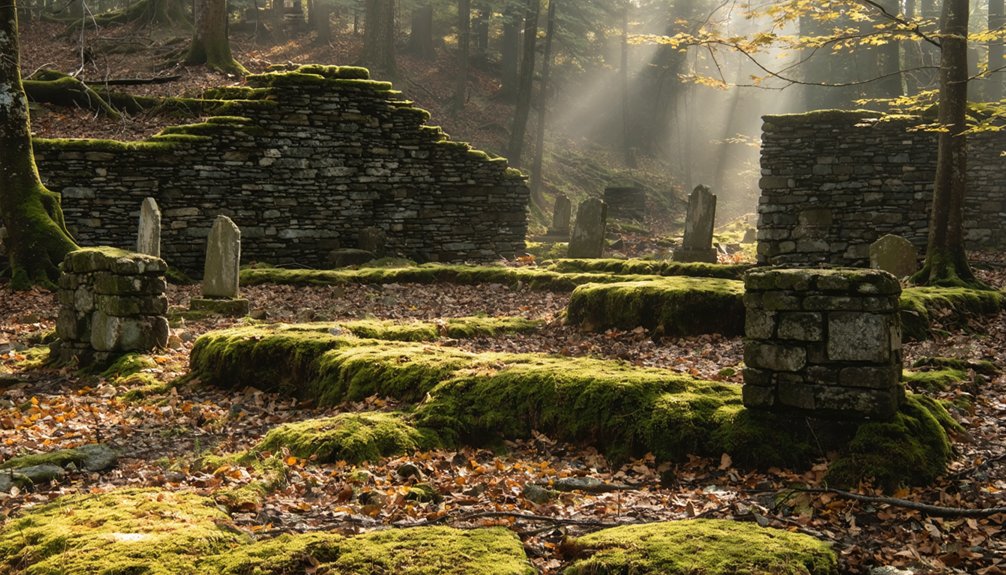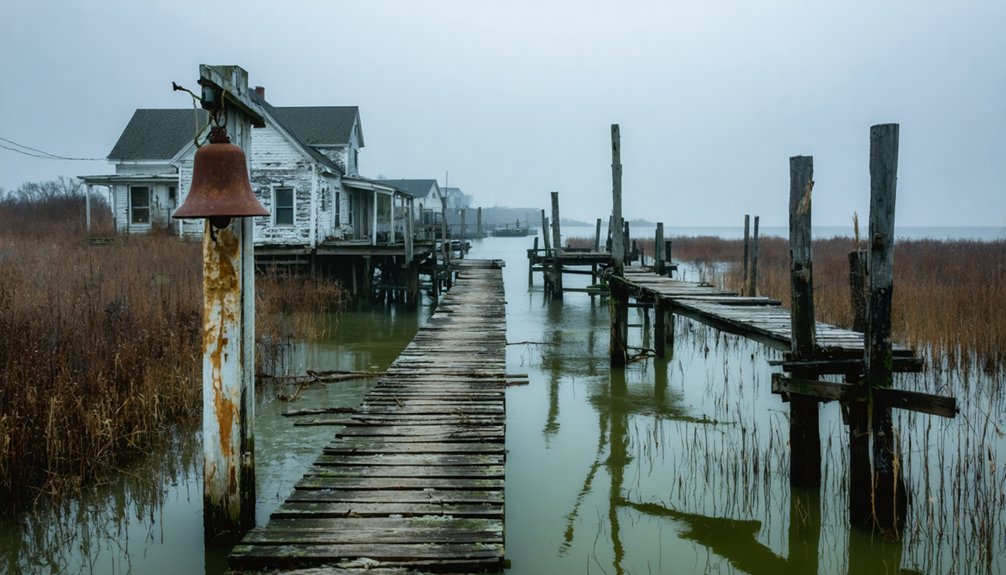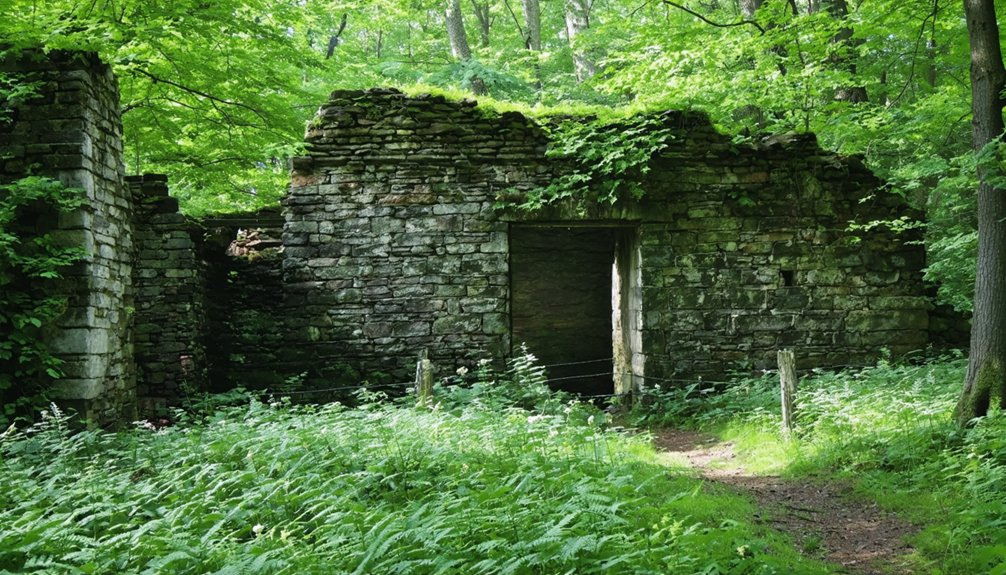
You’ll find Connecticut’s most intriguing ghost towns within state parks like Gay City and the haunting ruins of Bara-Hack in Windham County, where stone foundations and weathered cemeteries dating from the 1770s emerge from dense forest trails. Summer mornings offer ideal conditions for exploring Dudleytown’s cursed legends or Johnsonville’s preserved Victorian mill complex along the Blackledge River. These sites reveal crumbling cellar holes, moss-covered wells, and industrial remnants best accessed via maintained trails—though you’ll need to understand the full safety protocols, prime timing, and fascinating backstories that make each location uniquely captivating.
Key Takeaways
- Bara-Hack features crumbling stone foundations, weathered cemeteries, and frequent paranormal sightings including spectral voices and ghost activity since 1778.
- Gay City State Park offers over 10 miles of maintained trails, stone foundations, swimming areas, and a historic cemetery from the 1796 settlement.
- Dudleytown, Connecticut’s most infamous haunted site, sits within Dark Entry Forest and features legends of curses alongside Revolutionary War-era ruins.
- Early morning hikes avoid summer heat, while pre-sunset visits heighten atmospheric experiences at wilderness ghost town sites like Dudleytown.
- Visitors should watch for poison ivy, bring hydration for summer heat, avoid unstable structures, and travel with companions for safety.
Bara-Hack: Windham County’s Mysterious Abandoned Settlement
Deep in Pomfret’s Ragged Hills, where forest now reclaims what settlers once carved from wilderness, lies Bara-Hack—a ghost town that’s earned its reputation through more than mere abandonment. Founded in 1778 by Rhode Island colonists, this settlement thrived until the Civil War era before vanishing completely by 1890.
Where Connecticut wilderness swallows forgotten settlements, Bara-Hack stands as testament to communities that flourished briefly before disappearing into historical shadow.
Haunted legends surround the crumbling stone foundations and weathered cemetery. Visitors report hearing phantom voices, spectral livestock, and ghostly buggies rattling through empty woods.
Orbs dance over gravestones while mysterious faces materialize in the darkness. Among the eerie sightings, witnesses have reported a ghost baby reclining in a nearby tree. The settlement’s founders, Obadiah Higginbotham and Jonathan Randall, established Higginbotham Linen Wheels, manufacturing flax spinning wheels that were sold throughout the region.
Native curses allegedly doomed this place after displaced Nipmuc people were driven from ancestral lands. Today, Bara-Hack sits on private property—access restricted, yet its reputation as Connecticut’s most paranormally active ghost town remains unshakeable.
Gay City State Park: Connecticut’s Most Accessible Ghost Town
Unlike remote Bara-Hack, Gay City State Park transforms ghost town exploration into a summer day trip, complete with hiking trails, swimming areas, and well-maintained paths winding through nineteenth-century ruins.
You’ll discover stone foundations and cellar holes scattered throughout the forest—remnants of the mill village that thrived here from 1796 until fires and Civil War casualties drove residents away in the 1880s.
The state’s preservation efforts mean you can safely explore crumbling walls and weathered gravestones while enjoying modern amenities, making this Connecticut’s most visitor-friendly abandoned settlement.
The settlement was named after John Gay, its founder, with most residents being members of his extended family. Near the park entrance, you’ll find a small cemetery where stones face each other, reflecting the bitter animosity between the founding families.
Historic Mill Village Remains
Tucked within the forested hills of Hebron, Gay City State Park preserves Connecticut’s most hauntingly accessible ghost town—a settlement that rose with ambitious religious fervor in 1796 and collapsed into oblivion less than a century later. Today, you’ll discover stone canals snaking through undergrowth, a towering chimney stack standing sentinel over crumbling cellars, and weathered foundations where mills once thundered with industry.
The Blackledge River still flows past decaying stone walls, indifferent to the vanished community that harnessed its power. Near the entrance, eroded tombstones mark the cemetery where founding families rest—the highest structures remaining from this ambitious experiment. The settlement took its name from founder John Gay, whose vision shaped this now-vanished commercial community.
The War of 1812 British blockade devastated the village’s woolen mill industry, triggering an economic collapse that would never fully recover. Urban legends whisper of murdered peddlers and headless specters, while folklore anecdotes describe drunken voices echoing through moonlit ruins, keeping the ghost town’s dark reputation alive.
Accessible Trails and Amenities
While many ghost towns require bushwhacking through unmarked wilderness, Gay City State Park welcomes summer visitors with over 10 miles of well-maintained trails that weave directly through its abandoned settlement. You’ll find clearly marked routes starting from the southern picnic area, with the blue trail bisecting the western half via a footbridge.
The 0.4-mile Split Rock Trail offers an easy loop perfect for ghost town photography sessions.
Unlike urban redevelopment sites with restricted access, these forested paths provide dappled shade for comfortable exploration. You can picnic lakeside before hiking to mill remnants, or cool off at the beach between ruin discoveries. Along the way, you’ll encounter stone foundations and tombstones that reveal the settlement’s dark history.
The park even hosts the Hartford Marathon Summer Solstice Trail Run, proving this ghost town’s accessibility attracts both casual visitors and serious adventurers seeking Connecticut’s forgotten history. The Blackledge River Loop provides one of the most scenic routes through the historical village remnants.
Protected Ruins and Preservation
When Emma Foster donated her family’s ancestral land to Connecticut in 1944, she attached one essential condition: preserve the remnants of Gay City as they stand, forbidding intentional demolition of any structure or gravestone. This stipulation transformed urban decay into protected history, creating Connecticut’s most accessible ghost town.
You’ll discover preservation challenges overcome through state park designation, where nineteenth-century ruins remain frozen in time beneath forest canopy.
What You’ll Encounter Among Protected Ruins:
- Massive stone chimney stack rising through overgrown woodland, marking the thrice-burned mill site
- Vine-covered cellar holes and foundation outlines scattered along forest paths
- Weathered canal stonework channeling phantom waterways through silent undergrowth
- Cemetery gravestones adorned with visitor offerings—teddy bears and flowers honoring forgotten children
- Crumbling farm fences defining boundaries of vanished homesteads
Dudleytown: The “Demonically Possessed” Village in Dark Entry Forest
Deep in the shadowed valleys of Dark Entry Forest lies Dudleytown, Connecticut’s most infamous abandoned settlement and the subject of countless paranormal investigations. Founded by Dudley family settlers in the 1740s, this village peaked at 26 families before economic hardship forced abandonment.
Urban legends claim a curse followed the Dudleys from England, where Edmund Dudley was beheaded for treason in 1510. However, folklore myths often obscure reality—local historians attribute the settlement’s decline to poor soil and isolation, not supernatural forces. Before abandonment, early residents farmed flax, wheat, and corn until 1792. The community briefly shifted to iron ore mining during the Revolutionary War, when demand for locally produced steel surged.
Despite the Cornwall Historical Society’s debunking efforts, Ed and Lorraine Warren’s 1970s declaration of demonic possession cemented Dudleytown’s haunted reputation. You can’t visit this private land trust anymore; persistent trespassing and vandalism forced permanent closure, preserving only the mystery.
Johnsonville Village: A Victorian-Era Mill Community Frozen in Time
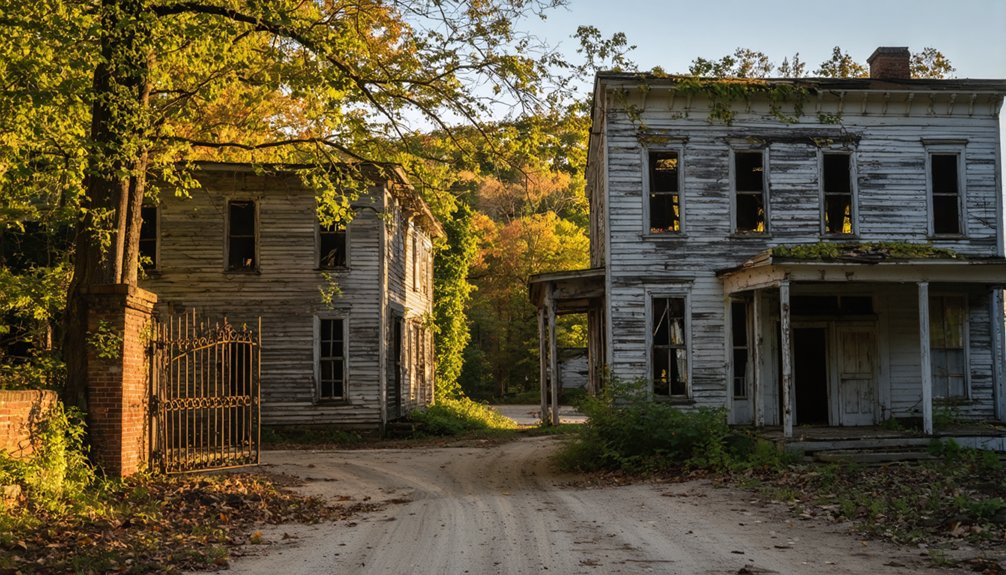
Johnsonville Village rises from the Connecticut wilderness like a preserved Victorian photograph, its eight antique buildings—including a pillared church, one-room schoolhouse, and mill office—scattered across 62 overgrown acres.
You’ll find this abandoned 19th-century mill community just 30 minutes from Hartford, where Raymond Schmitt’s dream of recreating a functioning Victorian town now stands frozen in decay, complete with empty wooden desks and animal skeletons haunting the chapel pews.
Summer’s longer daylight hours offer the best conditions for exploring the architectural remnants of this once-thriving twine mill hub, though “Village closed to the public” signs remind you that you’re witnessing history from behind the fence.
Victorian Architecture Still Standing
- The Emory Johnson Homestead’s three fireplaces and pillared porches reflect 1846 craftsmanship.
- Hyde Schoolhouse’s rows of empty wooden desks await phantom students in the 1863 one-room structure.
- Gilead Chapel’s 75-seat sanctuary hosts animal skeletons scattered across weathered floors.
- Carriage House collections of antique sleighs recall winter journeys through New England countryside.
- General store and clock shop interiors are frozen in commercial decay.
- Hand water pumps and hitching posts creating authentic Victorian streetscapes
- Gas-operated lamp posts casting period-appropriate shadows along pathways
- The mill pond reflecting seasonal foliage in late spring visibility
- Eight antique buildings including the 1862 Canterbury District School
- Grassy knolls surrounding the 1842 Emory Johnson Homestead
- Early morning hikes through Dudleytown’s ancient woods before heat intensifies, when mist still clings to overgrown paths.
- Mid-morning low tides at Charles Island’s causeway, revealing the mile-long passage while summer sun illuminates haunted legends.
- Afternoon ventures to Pilfershire’s remnants during cooler hours, discovering stone foundations beneath dappled forest light.
- Pre-sunset arrivals at wilderness trails, balancing safety with atmospheric conditions that heighten paranormal sensations.
- Nighttime exploration via Mystic’s 8 p.m. ghost strolls, when darkness amplifies downtown’s spectral stories.
- Welsh immigrant stone foundations reclaimed by forty-foot oaks
- Disinterred cemetery grounds where entire communities once mourned
- Industrial mill remnants alongside swift-flowing rivers
- Sacred Mohawk grounds transformed into Dark Entry Forest
- Colonial settlement patterns frozen in scattered cellar holes
- https://en.wikipedia.org/wiki/List_of_ghost_towns_in_Connecticut
- https://kids.kiddle.co/List_of_ghost_towns_in_Connecticut
- https://www.atlasobscura.com/things-to-do/connecticut/ghost-towns
- https://www.cthauntedhouses.com/real-haunts/places.aspx
- https://earlybirdonthetrail.com/haunted-hikes-in-connecticut/
- https://www.geotab.com/ghost-towns/
- https://ctvisit.com/articles/ghost-hunting-in-connecticut
- https://digging-history.com/2013/12/04/ghost-town-wednesday-bara-hack-connecticut/
- https://www.atlasobscura.com/places/the-abandoned-village-of-barahack-pomfret-connecticut
- https://theghostinmymachine.com/2021/07/19/haunted-road-trip-bara-hack-pomfrets-lost-village-of-voices-connecticut/
You’ll discover authentic fragments of America’s past, preserved through one man’s obsessive vision.
Mill Community Industrial Heritage
Beyond the homes and public buildings lies the beating heart of why this community existed at all—the industrial complex that gave Johnsonville its purpose and prosperity. You’ll discover remnants of twelve mills that once harnessed the Moodus River‘s 300-foot drop, transforming raw power into economic might.
The Neptune Twine and Cord Mill, established in 1832, became America’s oldest continuously operating twine mill, supplying fishing nets to both coasts and serving two World Wars.
Industrial archaeology reveals how fifteen mills rose between 1819 and 1865, averaging one every three years.
Though fires claimed most structures, heritage conservation efforts preserve what remains of this self-reliant community where millowners lived alongside workers, fostering uncommon prosperity through inventiveness and mutual dependence.
Summer Exploration Best Practices
While the industrial remnants tell stories of Connecticut’s manufacturing past, today’s reality presents a significant challenge for summer explorers: Johnsonville has remained firmly closed to the public since 1994.
The 62-acre property sits under private ownership by Iglesia ni Cristo, undergoing renovations with no public access permitted.
Despite ghost stories circulating about Raymond Schmitt and mill workers, nighttime exploration remains off-limits and legally prohibited.
If access were available, you’d encounter:
Respect current restrictions while appreciating this preserved slice of industrial history from afar.
Pleasure Beach: From Thriving Amusement Park to Abandoned Landscape

Long before it became a haunting collection of charred pilings and crumbling foundations, Pleasure Beach stood as one of Connecticut’s premier entertainment destinations. You’ll discover hidden histories across this 37-acre Bridgeport island, where wholesale liquor dealers transformed barren sand into a vibrant amusement park in 1892.
During its peak, thousands flocked here via steam ferry and swing bridge to experience roller coasters, steeplechase rides, and New England’s largest ballroom hosting Glenn Miller and Gene Krupa.
Today’s urban decay tells a different story. Multiple fires ravaged the site between 1953 and 1973, while failed revival proposals—from Trump’s theme park to nudist camps—never materialized.
You’ll find only scattered ruins: a bandstand, restaurant remnants, and memories of carousel horses now residing at Beardsley Zoo.
Best Times to Explore Connecticut’s Ghost Towns During Summer
Summer’s extended daylight hours open ideal windows for ghost town exploration, but timing your visits strategically transforms mere sightseeing into memorable adventures.
Optimal exploration windows:
Charles Island requires careful tide monitoring, while land-based sites offer flexibility. Pack water provisions for extended daylight outings—freedom means preparation.
What to Expect When Hiking to Abandoned Settlements
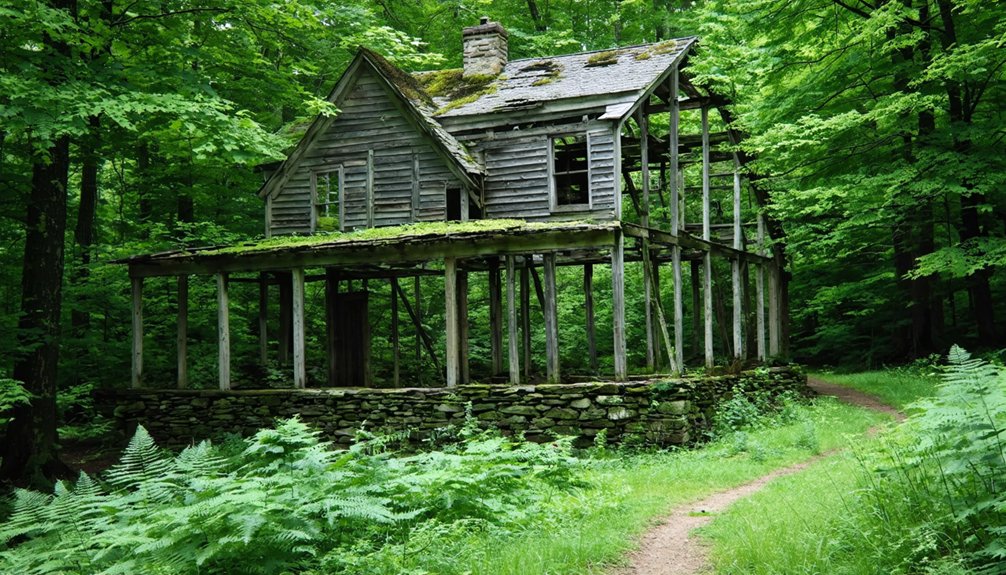
Approaching Connecticut’s abandoned settlements means leaving maintained civilization behind for paths that nature has reclaimed with aggressive indifference. You’ll navigate overgrown trails marked by weathered cairns, dodging fallen trees and crude “No Trespassing” warnings that few heed.
The ruins themselves—lichen-covered foundations, collapsed cellar holes, moss-choked wells—emerge from dense thickets where sunlight struggles to penetrate. What strikes hardest is the silence: no birdsong, no rustling wildlife, just tomb-like quiet that’s spawned countless urban legends and folklore stories about vengeful spirits and supernatural guardians.
Expect moderate climbs around 600 feet over unmaintained terrain where brooks carve unofficial routes. The atmosphere feels frozen, heavy with history’s weight. You’re genuinely on your own here—police patrol infrequently, and you explore entirely at your own risk.
Historical Significance of Connecticut’s Ghost Town Sites
These crumbling foundations and overgrown cellar holes weren’t always silent monuments to abandonment—they’re fragments of Connecticut’s turbulent economic and social evolution.
You’ll discover authentic chapters of industrial ambition, displacement, and resilience at these sites. Johnsonville’s twine mills powered early manufacturing growth, while Valley Forge Village’s destruction reveals the harsh reality of progress displacing communities for reservoirs.
Preservation efforts now protect these landscapes from vandalism, though urban legends about curses and hauntings persist at Dudleytown and Bara-Hack.
What you’ll witness at these historical sites:
Safety Tips and Access Information for Summer Ghost Town Visits
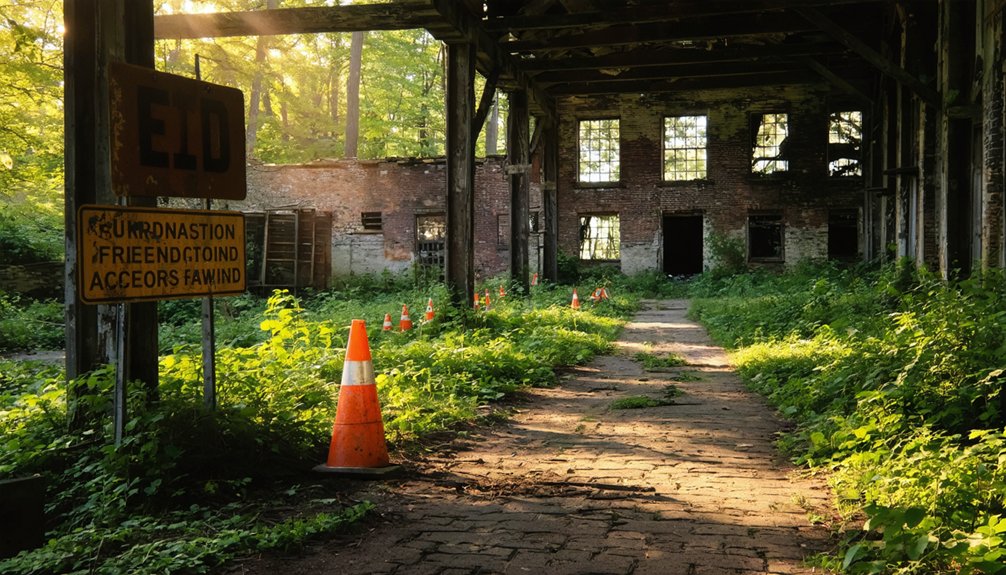
Before you step through the poison ivy-choked doorway of your first Connecticut ghost town, you’ll need to navigate a minefield of legal boundaries and physical dangers that claim more casualties than any local legend ever did.
Secure access permits through local records—identify yourself as a photographer if confronted. Watch for “No Trespassing” warnings spray-painted on crumbling walls, and respect chain-link barriers around main structures. Pack essential safety gear: sturdy boots for rotten floorboards, bug spray against Lyme-carrying ticks, and flashlights for dim interiors.
Legal access and proper gear aren’t optional—they’re what separate prepared explorers from cautionary tales waiting to happen.
Travel with companions and trust your gut when situations feel wrong.
Summer intensifies hazards—hydrate in unshaded fields, avoid weakened roofs during storms, and never climb unstable skylights. Check weather forecasts before venturing out. Your cell phone becomes your lifeline in these isolated locations.
Frequently Asked Questions
Are Pets Allowed When Visiting Connecticut’s Ghost Town Locations?
Pet policies vary widely across Connecticut’s ghost towns. You’ll find leash regulations enforced at Gay City State Park, while private locations like Dudleytown prohibit access entirely. Always prioritize pet safety and verify site-specific rules before exploring these haunting destinations.
Do Any Ghost Towns Charge Admission Fees or Require Permits?
Picture downloading ghost town coordinates: Most authentic Connecticut ghost towns don’t charge fees since they’re abandoned sites. However, organized haunted folklore tours ($15-$50) fund preservation efforts. You’ll find free exploration at genuine ruins, while guided experiences require tickets.
As the leaves change and the air turns crisp, the best seasons for visiting Connecticut ghost towns are fall and late spring. These times not only enhance the eerie atmosphere but also present opportunities to explore the vibrant fall foliage or the vivid spring blooms. Whether you prefer a haunting backdrop or scenic beauty, these ghost towns offer a unique experience for every kind of adventurer.
Can Visitors Camp Overnight Near These Abandoned Settlement Sites?
You can’t legally camp at Connecticut’s ghost towns due to private ownership and parking regulations. Overnight safety concerns and trespassing laws prevent camping, though nearby state forests offer legitimate alternatives where you’ll find freedom to explore responsibly.
Are Guided Tours Available at Connecticut’s Ghost Town Locations?
You won’t find guided tours at Connecticut’s actual abandoned settlements, as historical preservation efforts haven’t established formal programs there. However, you’ll discover local legends through nearby ghost tour companies that explore the state’s haunted historic districts instead.
If you’re interested in uncovering the eerie past of the region, consider seeking out ghost towns in connecticut to explore. Many of these forgotten places are steeped in stories of their former inhabitants and intriguing mysteries waiting to be uncovered. Whether you’re a seasoned ghost hunter or a curious traveler, these locations offer a unique glimpse into the history that once thrived in the area.
Exploring historic ghost towns in Connecticut can reveal remnants of the past that are often overlooked. Many of these locations serve as fascinating backdrops for local folklore and ghost stories that contribute to the state’s rich cultural tapestry. As you venture into these abandoned sites, you’ll not only encounter the haunting beauty of decaying architecture but also the whispers of history that echo through the landscape.
What Photography Equipment Works Best for Documenting Ghost Town Ruins?
You’ll want a DSLR with wide-angle lens for historical preservation shots, plus a sturdy tripod for low-light photography techniques. Don’t forget your torch and external lighting—these essential tools capture Connecticut’s atmospheric ruins authentically and dramatically.