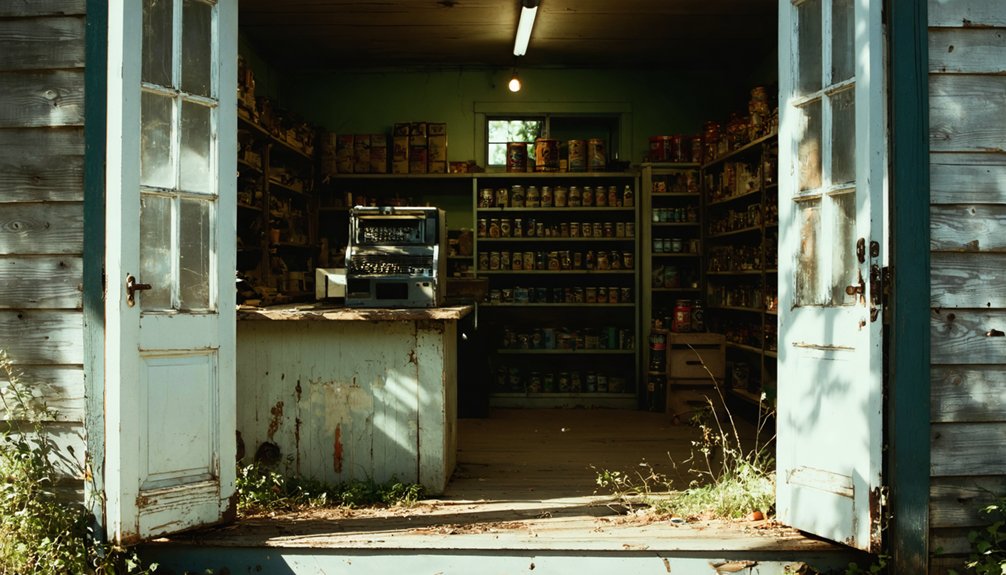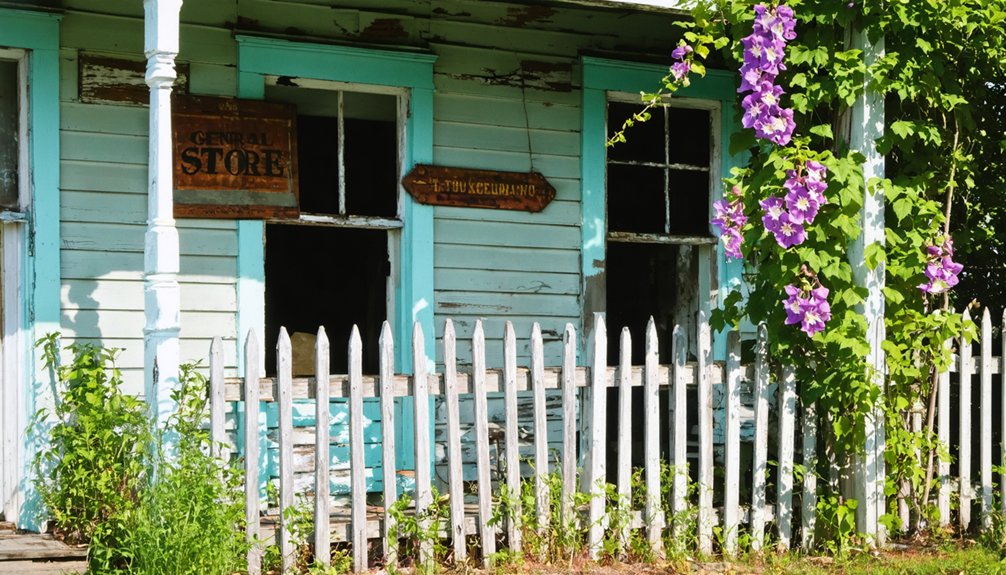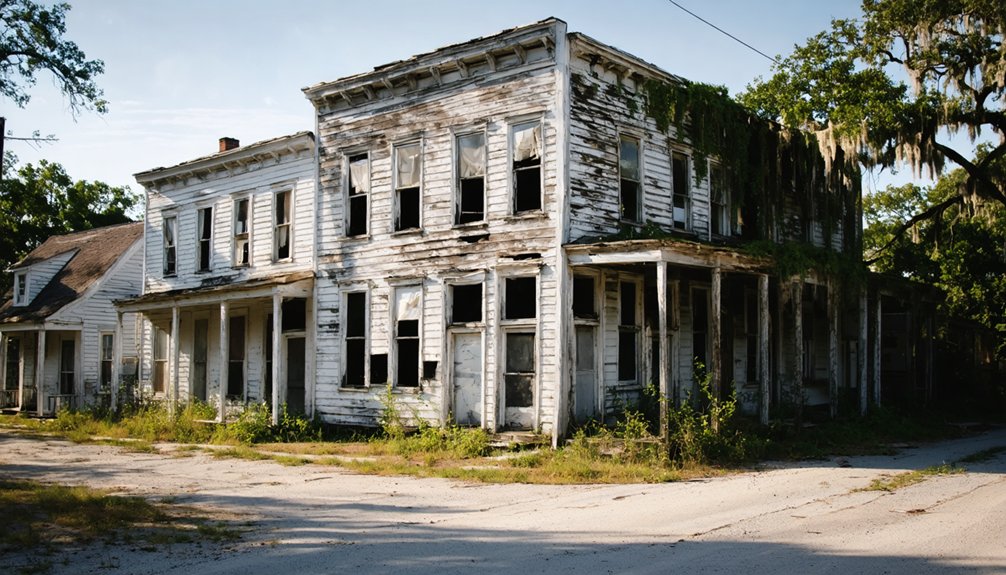
You’ll find Delaware’s best summer ghost town explorations at Glenville along Red Clay Creek, where flood-destroyed foundations peek through wild vegetation, and Owens Station in Sussex County, where weathered houses stand silent among overgrown farmland. Visit early mornings before 9 AM when temperatures hover around 70°F, bringing sturdy boots, plenty of water, and sun protection. Saint Johnstown’s 1822 church and empty foundations offer haunting photo opportunities, while Woodland’s marshland cemetery features reversed gravestones and eerie local legends. The sites below reveal each location’s unique story and essential visiting strategies.
Key Takeaways
- Owens Station in Sussex County offers best summer exploration with weathered houses and rural scenery visible amidst seasonal overgrowth.
- Glenville in New Castle County is ideal for early morning summer visits, providing cooler temperatures and better lighting for photography.
- Saint Johnstown features a historic 1822 church and cemetery, accessible year-round with Delaware’s Historical Markers guiding exploration.
- Woodland in Sussex County marshlands benefits from coastal sea breezes, reducing summer heat by 5–10°F for comfortable visits.
- Visit between June and August during early mornings before 9 AM to avoid peak heat and humidity while enjoying optimal lighting.
Glenville: Delaware’s Most Recent Ghost Town
Tucked along the winding banks of Red Clay Creek in New Castle County, Glenville once hummed with suburban life on a narrow strip of land called Bread and Cheese Island.
You’ll find nothing but emptiness here now—this ghost town emerged from tragedy, not time. Hurricane Floyd and Tropical Storm Henri devastated homes built unwisely in the floodplain, forcing complete abandonment by 2004.
Unlike most ghost towns shaped by gradual decline, Glenville died suddenly—claimed by floodwaters rather than the slow march of history.
The state bought out residents, offering them escape from nature’s relentless cycles.
Today’s urban decay tells a different story than Delaware’s older ghost towns: government intervention prevented generations of suffering. You can witness the environmental impact firsthand where houses once stood.
Painted pleas for buyers still haunted walls before 2005’s demolitions.
This 20th-century housing development was ultimately swallowed by a 2003 flood, leaving several ruined buildings as reminders of the disaster. It’s Delaware’s newest cautionary tale about building where water rules. The town’s vulnerability stemmed from its location near waterways like Red Clay Creek, which made flooding disasters almost inevitable.
Owens Station: Rural Remnants in Sussex County
Unlike Delaware’s flood-ravaged Glenville, Owens Station faded quietly into Sussex County farmland when the Queen Anne’s Railroad stopped running through here over a century ago.
You’ll find this unincorporated community along Delaware Route 16, where Beach Highway meets Owens Road—though you’ll need sharp eyes to spot what remains.
The historic architecture here tells a subtle story. A few weathered houses from the original settlement still stand among modern rural landscapes, memorial to when 62 residents called this railroad stop home in 1925.
There’s no dramatic Western-style decay, just gentle surrender to time and agriculture.
Summer’s your best window for exploration. Drive Route 16 east from Greenwood, and you’ll discover why some ghost towns whisper rather than shout their histories across Delaware’s coastal plain. About a mile east of Ellendale, New Market’s small cemetery survives as another quiet testament to vanished community life, its overgrown grounds marking where Wesley Methodist Episcopal Church once stood until 1953.
Saint Johnstown: A Faded Community Frozen in Time
When Francis Asbury rode through these Sussex County woods in spring 1779, he couldn’t have imagined his Methodist mission would outlive the town itself.
Saint Johnstown’s 1872 church still stands at 13471 St. Johnstown Road, a testament to historic preservation amid vanished railroad dreams.
The Queen Anne’s Railroad once promised prosperity here, but when tracks disappeared, so did the town.
You’ll find:
- Empty foundations where community spirit once thrived
- Weathered gravestones marking families who built something lasting
- Silent woods where early Methodists gathered secretly in 1779
Delaware’s Historical Markers Program recognizes this site, though no formal town remains.
The community formally incorporated the St. Johnstown Methodist Episcopal Church on March 5, 1822, solidifying its religious identity even as the settlement’s future remained uncertain.
That 1786 preaching house expansion? It represented hope.
Today, you’re free to explore what happens when progress moves on—leaving only faith standing.
Much like Michigan’s Delaware, which once housed approximately 1,200 residents during its copper mining peak, Saint Johnstown experienced the familiar pattern of boom and abandonment.
New Market: Small Settlement Lost to History
You’ll find New Market at the quiet crossroads of Holly Tree Road and Reynolds Pond Road, where a small settlement once clustered around its church before fading into the Sussex County landscape. Unlike more preserved ghost towns, this site challenges you to imagine what’s vanished—no buildings stand, only a persistent cemetery marks where the community gathered for generations.
I’ve walked this intersection on humid July afternoons, studying the old gravestones while ranch homes and a nearby trailer park remind you how completely modern development can erase a town’s physical memory. The name “New Market” appears across multiple geographical locations throughout the United States, making this Delaware settlement just one of many communities that shared this common place name. For those interested in Delaware’s haunted heritage beyond ghost towns, consider exploring Old New Castle’s Hauntings in History Tours, which offer inside access to the 18th-century Amstel House and its reported paranormal activity dating back nearly a century.
Economic Decline and Abandonment
Between the modern developments of Ellendale and Milton, New Market once anchored itself at the crossroads of Holly Tree Road and Reynolds Pond Road, a small settlement that organized its entire existence around a single church.
You’ll find nothing remains today except the cemetery—a stark reminder of how quickly communities vanish when economic foundations crumble.
The town’s disappearance followed a familiar pattern of population migration and shifting urban development:
- Residents abandoned their homes seeking better opportunities elsewhere.
- The church closed, severing the community’s social lifeline.
- Buildings gradually deteriorated until no structures survived.
Standing at those coordinates (38°48′26″N 75°23′49″W), you’re witnessing complete erasure.
The trailer park and ranch homes nearby bear no connection to New Market’s original identity—just modern construction occupying land where freedom-seeking settlers once built their lives.
Exploring Remaining Historical Structures
The graveyard at Holly Tree Road and Reynolds Pond Road stands as New Market’s sole survivor—a weathered demonstration to the families who once called this crossroads home. You’ll find tilted headstones dating back to the 18th century, their inscriptions fading beneath Delaware’s humid summers.
While no urban legends haunt these grounds like other ghost towns, the cemetery’s quiet abandonment tells its own haunting story.
Preservation efforts remain minimal—the site desperately needs attention from volunteers willing to clear overgrowth and document remaining markers. Like many abandoned mining settlements, the structures that once surrounded this cemetery have completely vanished, leaving only the burial ground as evidence of the community’s existence. These resource-dependent towns typically dissolved when their economic foundation disappeared, much like communities built around copper mining or timber harvesting.
When you visit, bring water and wear sturdy boots; the quarter-mile trek from New Market Village mobile-home community rewards you with unobstructed access to history.
No signs guide your way, so GPS coordinates (38°48′26″N 75°23′49″W) prove essential for finding this hidden remnant.
Woodland: Forgotten Stories of Sussex County
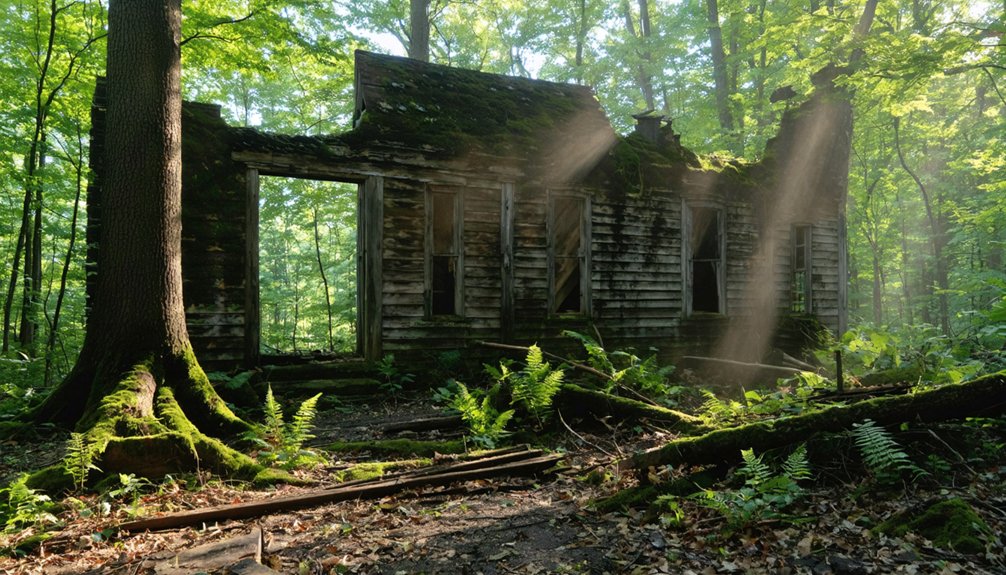
Deep in Sussex County’s marshlands, Woodland village harbors tales that’ll send chills down your spine even on the hottest summer day. This forgotten settlement west of Seaford blends colonial history with darker folklore—from Hermanus Wiltbank’s 1673 homestead to urban legends that’ve earned national recognition.
Three experiences await the bold explorer:
- Maggie’s Bridge stands where haunted bridges meet tragedy—shout “Maggie, I’ve your baby” into the night marsh.
- The witch Allison’s binding site marks where victims showed mysterious purplish stains matching poisoned crops.
- Reversed gravestones face the woods instead of tradition, their silent watch unexplained.
You’ll find Woodland’s past woven through decapitation stories, smallpox outbreaks, and that demolished tomb bearing cat-like claw marks. Visit the cemetery at dusk—those 1800s stones tell stories officials won’t. The burial site honors Col. Armwell Long, a Revolutionary War veteran whose grave stands among the weathered markers.
Zwaanendael: Delaware’s First European Settlement
Long before Woodland’s witch trials and haunted bridges, thirty-two Dutch colonists carved out Delaware’s first European foothold along Lewes Creek in 1631—only to vanish in a massacre that left their whaling dreams smoldering inside a charred palisade.
Thirty-two dreamers arrived seeking whale oil and prosperity—none survived to witness Delaware’s first colonial dawn.
You’ll find the 1931 Zwaanendael Museum celebrating this Dutch heritage through its stepped gable façade modeled after Hoorn’s town hall.
Inside, archaeological findings tell fragmented stories: yellow bricks, charred postholes, glazed pottery scattered across centuries. Though excavators can’t definitively separate Swanendael’s remains from a later 1773 battery, you’re standing where freedom-seeking colonists attempted their patroonship.
The museum’s HMS DeBraak shipwreck exhibits add maritime depth to your visit.
Come summer, you’ll explore Delaware’s ghostliest settlement—where ambition met catastrophe, leaving only commemorative architecture and contested dirt.
Best Times to Explore Delaware’s Abandoned Sites
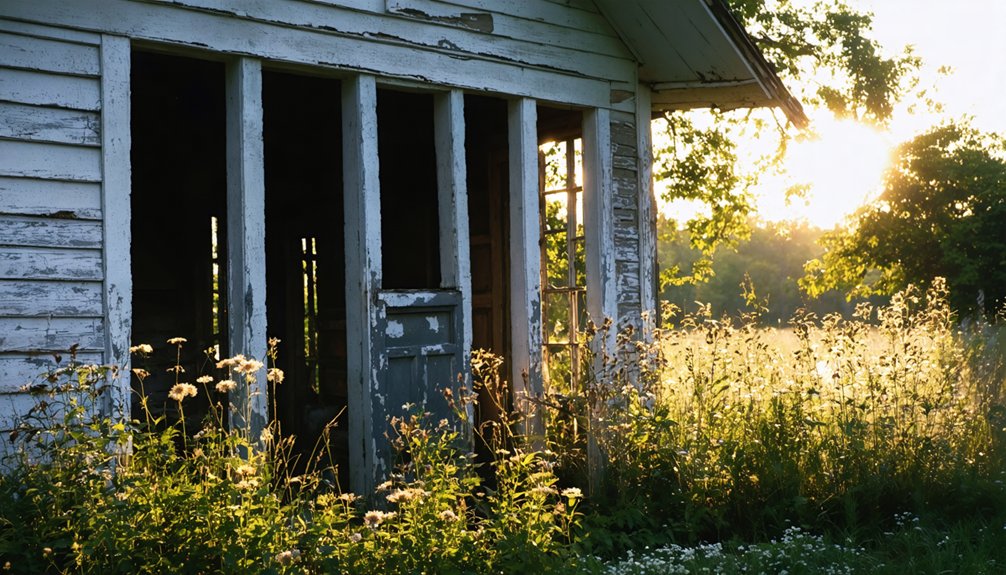
You’ll find Delaware’s ghost towns most comfortable during June through August, when temperatures hover between 80-85°F and humidity stays remarkably low for the mid-Atlantic.
exploring delaware’s abandoned sites reveals the rich history and hidden stories within these forgotten communities. As you wander through overgrown paths and dilapidated structures, you’ll uncover the remnants of lives once lived, each site offering a unique glimpse into the past. Don’t forget to capture the stunning photography opportunities that these eerie landscapes present.
I’ve learned the hard way that mid-morning visits to inland sites like Glenville offer the sweet spot—you’ll catch perfect light for photography before the afternoon heat builds.
Plan your coastal explorations at places like Robinsonville for any time of day, where sea breezes drop temperatures by 5-10°F and keep you cool even during extended wandering through weathered structures.
Optimal Weather Conditions
When planning your ghost town expeditions in Delaware, you’ll find summer’s temperature patterns create a strategic decision point between comfort and atmosphere. Peak July-August brings 82-85°F coastal highs, but humidity levels of 70-90% intensify that heat index considerably.
You’re battling tropical-feeling dew points while documenting urban decay and witnessing preservation efforts firsthand.
Consider these *ideal* exploration windows:
- Early mornings before 9 AM – temperatures hover around 65-70°F with dramatic lighting across abandoned structures.
- Post-Labor Day weekends – enjoy 70-78°F highs with reduced crowds and enhanced desolation.
- Evening hours after 7 PM – cooler air returns while capturing golden-hour photography of weathered buildings.
Afternoon thunderstorms strike 10-15 days monthly, so pack waterproof gear.
September offers your *best* spot: fewer tourists, manageable weather, and that authentic abandoned atmosphere you’re seeking.
Avoiding Peak Heat Hours
Delaware’s abandoned sites transform into sweltering heat traps between 11 AM and 3 PM, when the sun’s relentless angle turns rusted metal hot enough to brand skin. Crumbling concrete radiates waves that blur your camera lens.
You’ll want to arrive at places like Fort Miles by 7 AM, when 70°F air keeps you energized. Morning light gives your photos that golden edge without the midday glare.
Evening explorations shine brightest—literally. Hit Woodland Beach remnants around 6 PM as temperatures plummet 15 degrees and coastal breezes kick in.
Sunset timing near 8:30 PM opens opportunities for night photography at atmospheric ruins like Bancroft Mills.
Wildlife observation peaks during these cooler hours too, when foxes and deer venture from hiding spots you’d never spot during scorching afternoons.
What to Bring When Visiting Ghost Towns in Summer
Before you set foot on the sun-bleached boardwalks of Delaware’s abandoned settlements, you’ll need to pack strategically for the state’s notoriously thick summer air. Your packing essentials should prioritize breathable clothing layers—lightweight shirts paired with convertible pants let you adapt as you wander through overgrown streets and crumbling foundations.
Don’t venture out without these critical items:
- SPF 50+ sunscreen and a wide-brimmed hat to shield yourself from relentless coastal sun
- 2-liter reusable water bottle with electrolyte packets for hydration in 90°F heat
- DEET 30% insect repellent to fend off mosquitoes thriving in abandoned structures
Pack sturdy hiking boots for exploring debris-strewn paths, and toss a headlamp in your daypack for searching shadowy interiors where nature’s reclaimed civilization.
Safety Tips for Exploring Delaware’s Abandoned Communities
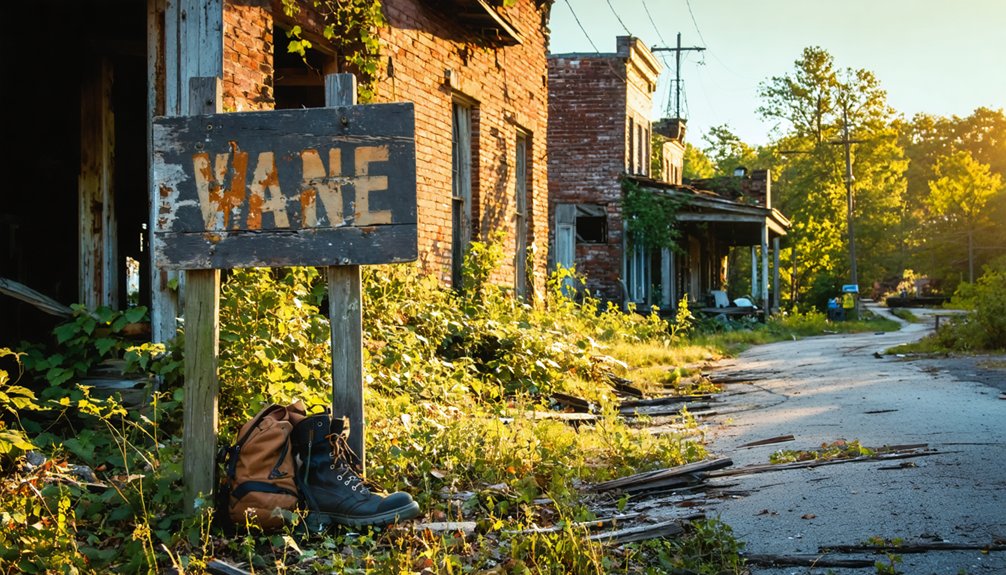
Packing smart won’t protect you if you’re careless once you arrive. Before stepping into any abandoned structure, assess urban hazards like unstable floors, rusted metal, and crumbling walls that’ll give way without warning.
I’ve watched explorers nearly plunge through rotted boards because they rushed ahead without testing each step. Watch for asbestos, lead paint, and contaminated groundwater at industrial sites.
Legal considerations matter too—many “abandoned” properties remain privately owned, and trespassing charges aren’t worth the adventure.
Always explore with a partner who knows your location. Wear sturdy boots, gloves, and long sleeves.
Trust your instincts; if something feels dangerous, it probably is.
Document your surroundings, but never compromise safety for a photograph.
Frequently Asked Questions
Are There Guided Tours Available for Delaware’s Ghost Towns?
Step into Delaware’s shadowy past—you’ll discover guided tours weaving haunted legends through historical preservation sites. From New Castle’s Lady in Blue to Dover’s dark mysteries, these immersive experiences offer you freedom to explore paranormal encounters firsthand.
Do I Need Permission to Access Private Property at These Sites?
Yes, you’ll absolutely need permission. Private property regulations protect these sites, and legal access concerns are real—trespassing carries misdemeanor charges. Respect owners’ rights, seek consent beforehand, or explore public alternatives like museums and roadside historical markers instead.
Can I Camp Overnight Near Any of These Ghost Town Locations?
You’ll find overnight camping at Fort Delaware’s atmospheric marching ground and Cape Henlopen’s bunker-shadowed sites, where ghost town history and local legends come alive. These spots let you explore Delaware’s haunted past while sleeping under starlit freedom.
Are There Restaurants or Facilities Near These Abandoned Communities?
You’ll find restaurants within 5-10 miles of each site, from Lewes clam shacks near Zwaanendael to Wilmington eateries by Glenville. Historic preservation areas offer basic facilities, though urban exploration guidelines suggest packing supplies for remote locations.
What Photography Equipment Works Best for Capturing Ghost Town Details?
You’ll want versatile camera gear like a Sony a7R III or Nikon Z6 for low-light shots. Master lighting techniques using long exposures and natural ambient light rather than flash to authentically capture weathered textures and haunting architectural details.
References
- https://kids.kiddle.co/List_of_ghost_towns_in_Delaware
- http://freepages.rootsweb.com/~gtusa/history/usa/de.htm
- https://www.delawarehauntedhouses.com/real-haunts/
- https://www.youtube.com/watch?v=ex8Hld_imPU
- https://www.geotab.com/ghost-towns/
- https://travelswithabandon.com/2018/08/22/adventure-10-cliff-phoenix-delaware-mandan/
- https://www.youtube.com/watch?v=0UAkxBOSLhs
- https://kids.kiddle.co/Glenville
- https://www.loveexploring.com/gallerylist/188219/the-us-state-with-the-most-ghost-towns-revealed
- https://www.townofglenville.gov/sites/g/files/vyhlif3161/f/uploads/historical_gleanings_from_old_time_maps_mad_deeds.pdf