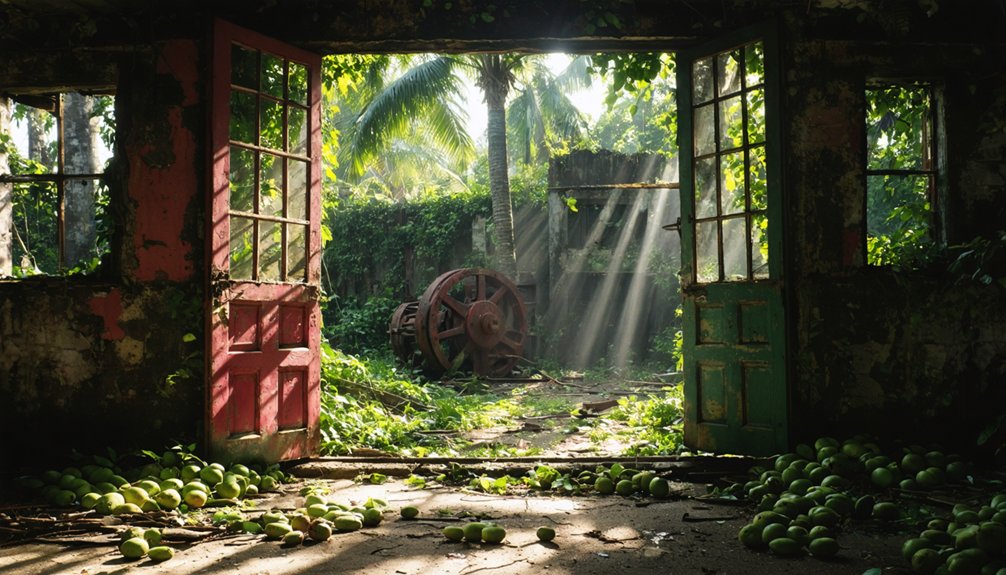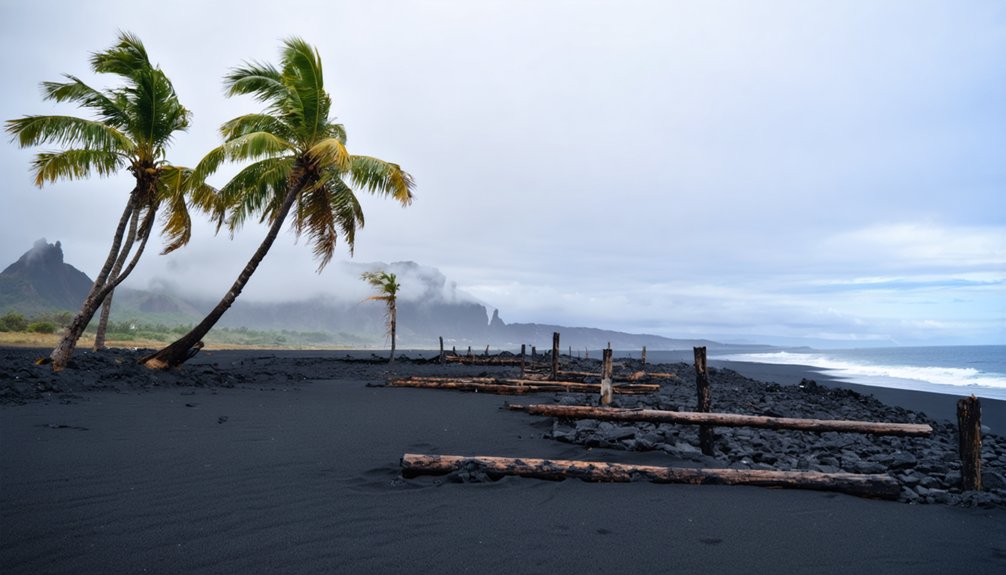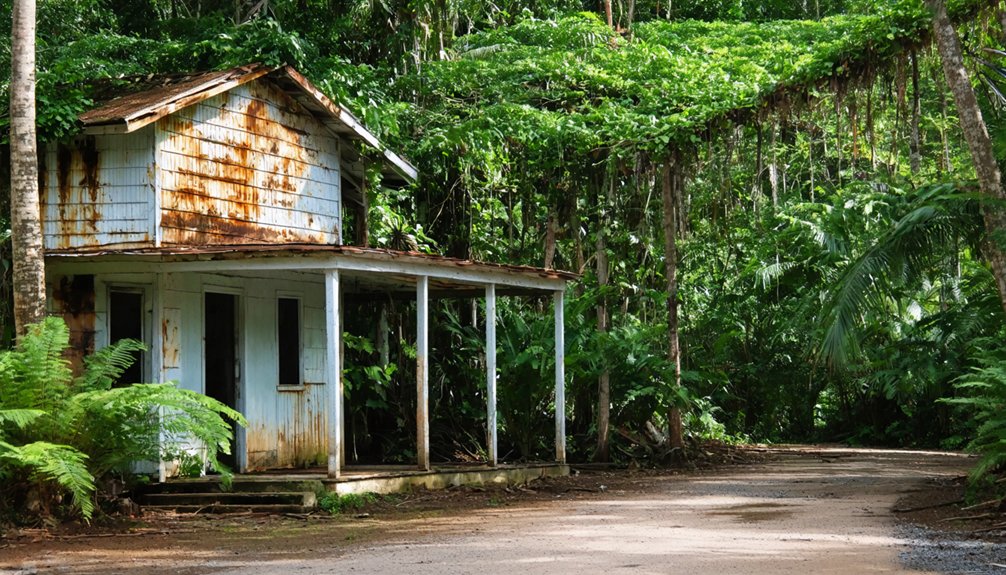
You’ll find Hawaii’s most compelling ghost towns during summer when calm weather opens access to sites like Honoka’a’s sugar plantation relics and Waialua’s abandoned church where workers’ unmarked graves still dot the landscape. The crumbling Coco Palms Resort on Kauai stands frozen since Hurricane Iniki, its Hollywood glamour surrendered to jungle vines. For something truly remote, Tern Island’s WWII runway sits 500 miles offshore, though access remains restricted. Each location reveals layers of Hawaiian history—from ancient refuge systems to plantation-era struggles—waiting beneath the tropical sun.
Key Takeaways
- Waialua on Oʻahu’s North Shore features unmarked plantation worker graves, an abandoned coral church, and ghost stories involving children’s spirits.
- Coco Palms Resort on Kauai remains frozen since Hurricane Iniki in 1992, offering Hollywood nostalgia amid overgrown sacred grounds.
- Visit during summer months (April-June) for optimal weather conditions and better exploration opportunities at historic sites.
- Honokaʻa showcases abandoned plantation structures from the 1870s-1994 sugar era, preserving five generations of worker history on Hamakua Coast.
- Bring sturdy boots, long sleeves, GPS, and flashlight when exploring abandoned sites for safety and proper documentation purposes.
Wai Opae of Kekaha Kai: Ancient Shrimp Farming Pools
Along the sun-scorched western coast of Hawaii’s Big Island, where ancient lava flows meet the sea, you’ll find pools so thick with tiny red shrimp that early Hawaiians could spot their crimson glow from afar.
These lava pools at Kekaha Kai State Park tell stories of a ghost village that thrived here over 600 years ago. Native communities engineered brackish fishponds in volcanic crevices, raising eight species of ancient shrimp—particularly the endemic ‘ōpae’ula.
They’d harvest these half-inch filter-feeders as bait for fishing expeditions, sustaining themselves through ingenious aquaculture. The nearby beach remains largely deserted, flights roaring overhead along a constant flight path that keeps most visitors away.
Today, you can explore these abandoned farming sites where subterranean ocean channels still pulse through black rock, keeping the shrimp colonies alive in waters that remember hands long gone. Though these pools endure, other tide pool ecosystems like nearby Wai`opae have been permanently buried under lava, reminding visitors that Hawaii’s volcanic landscape continues its cycle of destruction and renewal.
Pu’uhonua O Honaunau National Historic Park: Sacred Place of Refuge
When you stand before the Great Wall at Pu’uhonua o Hōnaunau—965 feet of mortarless lava rock, twelve feet high and eighteen feet thick—you’re touching the boundary between life and death in ancient Hawaii.
Beyond this wall, kapu breakers who’d committed offenses punishable by execution could find absolution, their fate transformed from certain death to ceremonial cleansing by priests who drew power from the bones of 23 chiefs housed in Hale o Keawe temple.
This wasn’t a ghost town but a living sanctuary where defeated warriors, terrified families fleeing battle, and those who’d broken sacred laws found refuge until the kapu system collapsed in 1819, leaving behind reconstructed temples and carved ki’i statues that still guard this 420-acre portal into Hawaii’s spiritual past.
The Hale o Keawe temple, originally built around 1650 AD as a burial site for King Keaweʻīkekahialiʻiokamoku, was dismantled in the 1820s before being reconstructed in the 1960s to honor its sacred legacy.
Today, the park hosts cultural events like summer festivals that showcase traditional Hawaiian crafts, keeping these ancient traditions alive for modern visitors.
Ancient Hawaiian Refuge System
Deep within the ancient Hawaiian justice system existed a revolutionary concept that merged law with mercy—the pu’uhonua, or place of refuge.
You’d have found sanctuary here if you’d broken Ancient Kapu—those sacred laws governing everything from fishing seasons to shadow placement near chiefs. While other societies imprisoned offenders, Hawaiians offered redemption through escape to Sacred Grounds like Pu’uhonua O Honaunau, established in 1475.
The system balanced accountability with compassion brilliantly. Break kapu, face death—unless you reached the refuge first.
Once inside those massive lava rock walls, priests performed purification rituals, absolving your transgressions. You’d emerge forgiven, reintegrated into society.
During wartime, these sanctuaries sheltered non-combatants and defeated warriors alike, embodying a sophisticated understanding that justice shouldn’t always mean annihilation. Chiefly declarations designated certain lands or heiau as puuhonua, maintaining their sacred status throughout the islands.
The site’s spiritual energy, or mana, was believed to originate from the gods themselves, creating a powerful atmosphere for transformation and redemption.
It’s freedom through forgiveness, ancient Hawaii’s most radical gift.
Historic Structures and Ceremonies
Standing sentinel over Hōnaunau Bay, the reconstructed Hale o Keawe temple commands your attention with its fierce wooden ki’i guardians—their carved faces twisted in expressions meant to terrify kapu breakers and enemies alike. You’ll feel the weight of history here, where bones of 23 chiefs once infused the grounds with protective mana through ancestral offerings that connected the living to deified royalty.
Beyond the 965-foot Great Wall—a dry-stacked lava masterpiece 18 feet wide—you’ll discover the royal grounds where Hawaiian rituals unfolded. Chiefs once raced down hōlua slides, their toboggans screaming across lava rock.
Towering coconut palms commemorate the departed, while royal fishponds glisten in the sun. The Keōua Stone still waits, smooth and warm, where high chiefs rested between ceremonies that bound earthly power to divine authority. The Canoe Hālau stands nearby, showcasing traditional canoe craftsmanship that once sheltered the vessels of Hawaiian navigators. Nearby, you can witness cultural demonstrations including the pounding of taro into poi, the beating of kapa cloth, and strategic games of kōnane played on traditional Hawaiian game boards.
Honoka’a: Former Sugar Company Town Turned Tourist Haven
You’ll step onto streets where five generations of sugar workers—from Chinese contract laborers to Filipino sakadas—built their dreams between mill whistles and cane smoke.
The Honokaʻa Heritage Center stands in the heart of this transformed plantation town, its free exhibits preserving the tools, photographs, and stories of families who worked the fields from 1876 until that final harvest in 1994.
Walk past the manager’s former residence where William Rickard once oversaw operations, now reimagined as lodging for visitors seeking the coast’s misty beauty.
The town’s main thoroughfare, Māmane Street, developed during the 1870s as Honoka’a emerged to become Hawaii’s third-largest town before the modern Belt Road redirected traffic away from its historic center.
The surrounding Hamakua Coast plantations cleared vast areas of native forest to make way for sugar cane cultivation in the ideal climate.
Sugar Company Heritage History
In 1876, when J.F.H. Siemsen and J. Marsden carved their vision from 500 acres of raw Hawaiian earth, they couldn’t have imagined the agricultural heritage they’d forge.
You’ll discover how Hawaiian hands first worked these fields, their labor history soon joined by waves of Chinese, Japanese, Portuguese, Filipino, Korean, Puerto Rican, Russian, and Spanish workers—each group adding threads to Honoka’a’s cultural tapestry.
The plantation’s heartbeat pulsed through mule-drawn wagons and railroad tracks, through ditches carved in 1907 and 1911 that expanded cultivation across 9,000 acres.
By 1928, mergers created an empire.
You’re standing where over 600 souls once toiled, where sugar ruled until October 1994‘s final harvest silenced the mills forever.
Heritage Center Free Exhibits
When you push open the doors of the 1927 Botelho Building at 45-3490 Māmane Street, you’re stepping into Honoka’a’s living memory. This heritage center welcomes you Tuesday through Saturday without charging admission—museum preservation funded by community collaborations rather than your wallet.
Inside, plantation-era photographs line the walls alongside The Shigematsu Family exhibit, where a 1907 immigrant family’s sumō apron tells stories textbooks skip. You’ll discover Waipi’o Valley’s taro terraces, meet the region’s Portuguese and Japanese pioneers, and trace Camp Tarawa’s wartime footprint.
The building itself survived as Ford dealership, dance hall, and USO before becoming this cultural repository in 2021. Bimonthly heritage nights celebrate the diverse bloodlines that built this coast—no velvet ropes, just neighbors sharing their ancestors’ treasures.
Coco Palms Resort: Nature’s Takeover of Kauai’s Abandoned Paradise
Tangled vines now snake through the skeletal remains of what was once Kauai’s most glamorous resort, where Elvis Presley’s celluloid wedding captivated millions and Hawaiian royalty once raised fish in sacred ponds.
You’ll find Coco Palms hidden behind 15 acres of reclaimed coconut grove on Wailuanuiaho’ano land—sacred ground for over a thousand years. Hurricane Iniki’s 1992 fury reduced 400 rooms to rubble, where Spielberg and his Jurassic Park crew sheltered in the basement as paradise collapsed around them.
Nature’s environmental impact proved stronger than Hollywood glamour. The 2027 restoration promises cultural preservation honoring Queen Kapule’s legacy, though debates rage over reopening this haunted paradise.
For now, it remains frozen—a monument to impermanence where torch ceremonies once drew Sinatra and the Shah of Iran.
Tern Island: Remote Military Outpost Left to the Elements
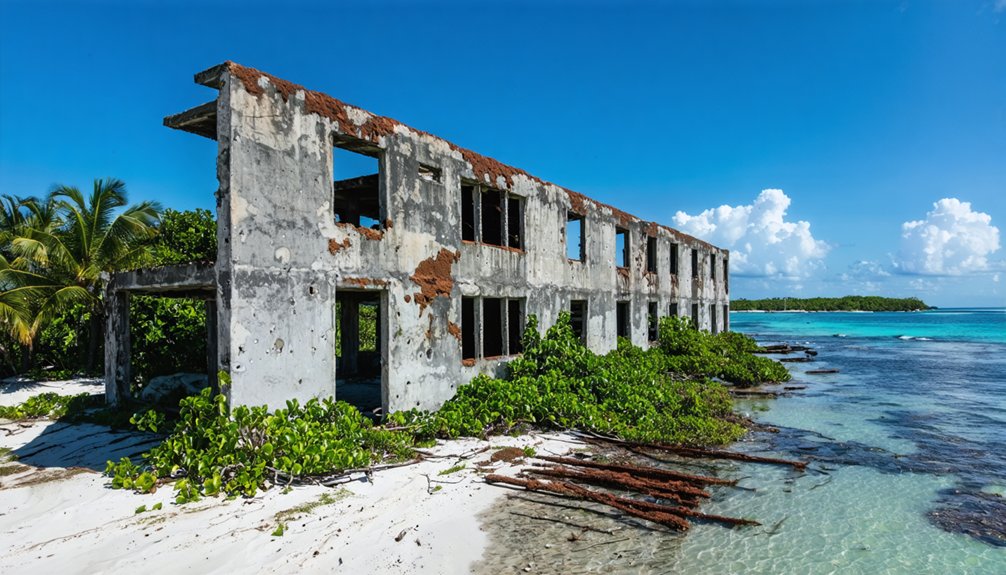
While Kauai’s abandoned resort succumbed to jungle and storm, another Hawaiian ghost rises from coral 500 miles northwest of Honolulu—where the Navy once dredged an entire island from the sea.
You can’t visit Tern Island freely—it’s locked within French Frigate Shoals’ protected marine habitat. But imagine standing on that 3,300-foot runway, surrounded by steel seawalls holding back the Pacific.
In 1942, Seabees transformed a coral outcrop into 26 acres of military precision: barracks, fuel tanks, a 90-foot radar tower.
Waialua: Honolulu’s 19th Century Industrial Ghost Town
Deep in Oʻahu’s North Shore, where sugarcane once transformed foreign laborers into ghosts, Waialua tells a darker story than most Hawaiian ruins. You’ll find Pu’uiki Cemetery wedged between beaches—never officially registered, yet filled with unmarked graves of workers who died under brutal plantation conditions.
Between paradise beaches lies Waialua’s haunted truth: unmarked graves of plantation workers, their suffering buried beneath Oʻahu’s sugarcane legacy.
Off-road racers and dogs have desecrated these burial grounds for decades, creating ecological impacts that recent preservation efforts now address.
The abandoned Roman Catholic church, built from coral-based cement, stands as a testament to divine intervention—local legend claims the landowner received dream-warnings against demolition.
Walking these overgrown sites, you’ll understand why ghost tour operators document children’s spirits here.
Wildlife preservation work can’t erase the psychic weight of forgotten immigrants who sought freedom but found only cane fields and early graves.
Best Times to Explore Hawaii’s Forgotten Places
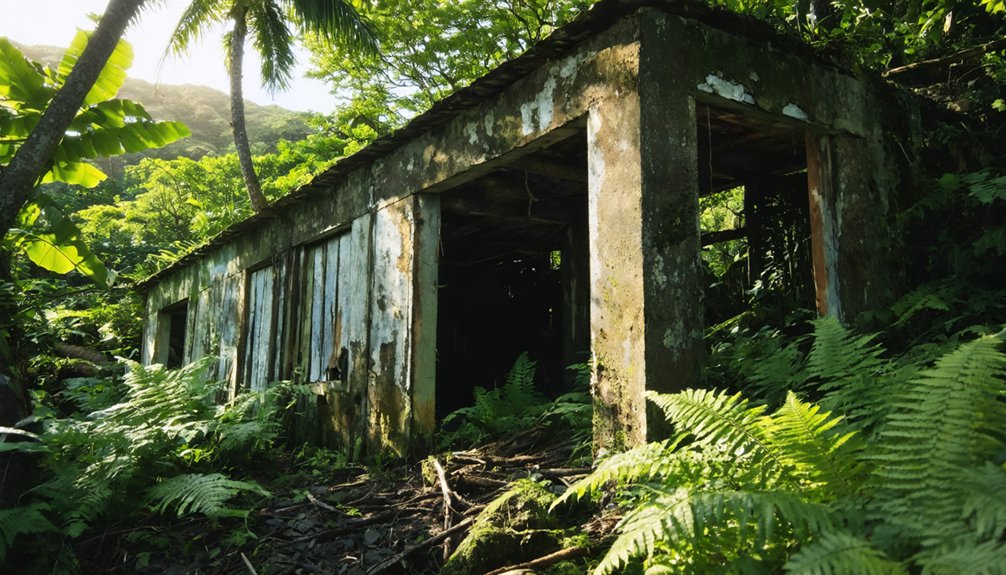
Timing your exploration of Hawaii’s abandoned sites requires balancing weather patterns with the haunting solitude these places demand.
You’ll find April through early June offers clear paths and minimal crowds, letting you absorb the archaeological significance without tourist interference. September’s post-summer lull creates perfect conditions for documenting ruins before the rainy season arrives.
Consider these ideal exploration windows:
- Early morning visits capture ethereal light filtering through collapsed structures
- Weekday excursions ensure you’re alone with local legends and whispered histories
- Shoulder seasons provide comfortable temperatures for hiking to remote sites
- Pre-storm clarity in late August delivers dramatic skies for photography
Avoid December’s peak crowds at Volcanoes National Park, where forgotten lava-buried villages lie.
Summer’s extended daylight maximizes your time among Hawaii’s silent witnesses to plantation-era dreams.
What to Bring When Visiting Abandoned Hawaiian Sites
Your carefully planned timing means nothing if you arrive at Kalaupapa’s windswept cliffs without proper gear. Urban exploration demands sturdy hiking boots—those lava rocks don’t forgive ankles—and long sleeves against Hawaii’s aggressive jungle reclamation. I learned this photographing Waipi’o Valley’s crumbling homesteads, arms scratched bloody.
Pack three liters of water minimum; summer heat crushes unprepared wanderers. Your flashlight illuminates forgotten lava tubes where ancient Hawaiians once sheltered. Bring snake gaiters for overgrown trails and gloves for handling rust-eaten structures without tetanus risk.
Photography tips: that tripod prevents disturbing fragile foundations while capturing perfect shots. GPS devices trump phone signals in remote valleys, though compass backup respects volcanic magnetic interference. Most importantly, pack trash bags—these sacred abandoned places deserve leaving no trace of your freedom-seeking passage.
Preserving History While Exploring Hawaii’s Ghost Towns
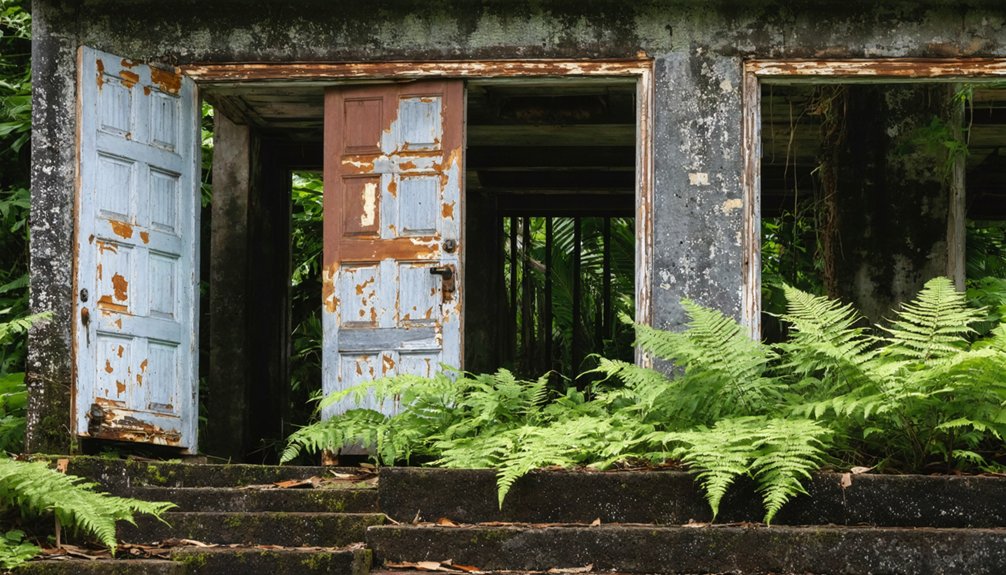
When you step through Kaloko-Honokohau’s 1,160 acres of pre-historic village remnants, you’re walking on more than ancient lava rock platforms—you’re treading six centuries of ingenious aquaculture where coastal Hawaiians transformed inland bays into fishponds that still hold water.
Modern conservation demands your respect for these fragile sites. The cultural significance extends beyond crumbling walls—it’s embedded in every coral-mortared stone.
Every stone carries history—your footsteps on these ancient grounds connect past wisdom to present responsibility.
Preservation actions you can take:
- Document deterioration patterns without disturbing structures
- Support nonprofits like Ka’apa’apa’a ‘O Kohala converting abandoned buildings into museums
- Participate in He’eia Fishpond’s summer community events honoring traditional site management
- Donate to restoration efforts for endangered places like Moku’aikaua Church’s earthquake-damaged walls
You’re not just exploring ruins—you’re stewarding sacred landscapes where resilience outlasts devastation.
Frequently Asked Questions
Are There Any Ghost Towns on Maui or Molokai Worth Visiting?
You’ll find Hamakuapoko’s abandoned ruins near Maui’s north shore, where Old Maui High School crumbles beneath jungle vines. Haunted legends swirl around Olowalu’s massacre sites, while Molokai’s Maunaloa offers eerie plantation remnants—though access remains restricted.
Do I Need Special Permits to Access These Abandoned Hawaiian Sites?
You’ll need private property access permissions for most sites, as landowners strictly control entry. Historical preservation regulations also govern certain locations. Always verify ownership and secure written consent before exploring—respecting boundaries protects both Hawaii’s heritage and your freedom.
Are Guided Tours Available for Hawaii’s Ghost Towns and Historic Sites?
You’ll find guided exploration through Hawaii’s haunted sites, where cultural storytellers reveal ancestral spirits and historical preservation comes alive. These tours blend freedom with respect, letting you experience authentic folklore while honoring sacred traditions independently.
As you delve deeper into the islands’ rich past, you’ll uncover ghost towns to explore in Hawaii that echo tales of resilience and lost communities. Each site holds remnants of the islands’ vibrant histories, waiting to be discovered by those with a curiosity for the unseen. Embrace the adventure as you walk through these forgotten places, where every shadow might tell a story.
As you continue your journey, consider visiting historic sites in Hawaii’s winter, where remnants of past civilizations remind us of their enduring legacies. Each location not only provides a glimpse into the islands’ unique heritage but also invites reflection on the cultural narratives that shaped Hawaii today. The tranquil beauty of these sites is amplified during the cooler months, allowing for a more intimate connection to the land and its stories.
Which Ghost Towns Are Family-Friendly for Children to Explore Safely?
You’ll hit the jackpot at Pu’uhonua o Honaunau, where historical preservation meets accessible walkways. Kids safely explore reconstructed villages without haunted legends overwhelming them. Anna Ranch’s 110 acres offer structured discovery through Hawaii’s ranching heritage—perfect for curious young minds.
Can I Camp Overnight Near Any of These Hawaiian Ghost Town Locations?
You can’t camp at preserved historic sites like Pu’uhonua o Honaunau, but MacKenzie State Park offers camping despite its haunted reputation. You’ll find excellent photography opportunities at dawn, though locals warn against ignoring cultural protocols around sacred spaces.
References
- https://nvtami.com/2023/04/26/big-island-hawaii-ghost-towns/
- https://www.mysteries-of-hawaii.com/blog
- https://www.tripadvisor.com/Attractions-g28932-Activities-c42-t226-Hawaii.html
- https://www.atlasobscura.com/things-to-do/hawaii/abandoned
- https://www.onlyinyourstate.com/experiences/hawaii/abandoned-hi
- https://en.wikipedia.org/wiki/List_of_ghost_towns_in_Hawaii
- http://onedayinamerica.blogspot.com/2018/07/remembering-kapoho-vactionland-and.html
- https://dlnr.hawaii.gov/dar/marine-managed-areas/hawaii-marine-life-conservation-districts/hawaii-waiopae-tidepools/
- https://www.nps.gov/articles/000/anchialine-pools.htm
- https://smea.uw.edu/currents/pools-of-wonder-the-unique-anchialine-ponds-of-hawaii/