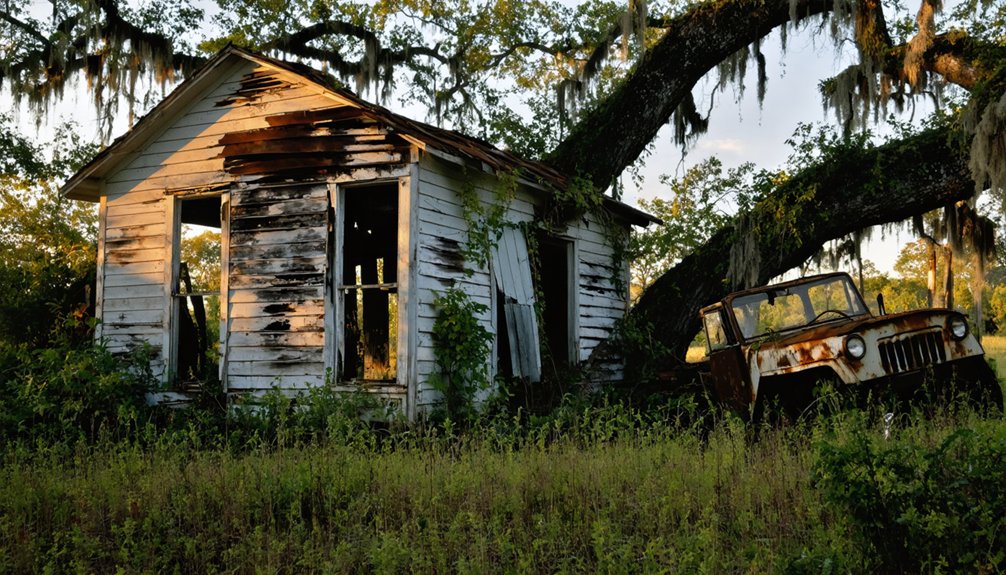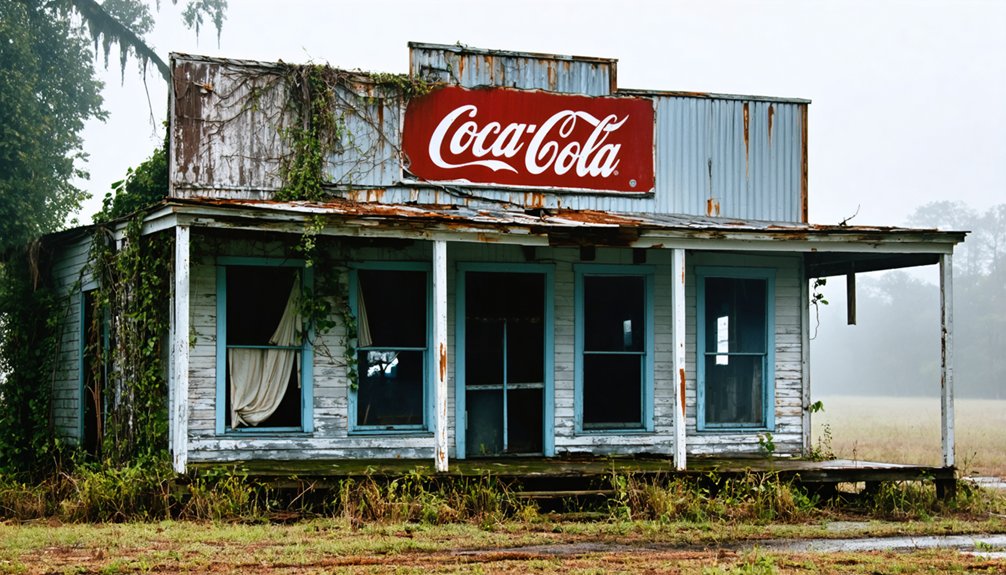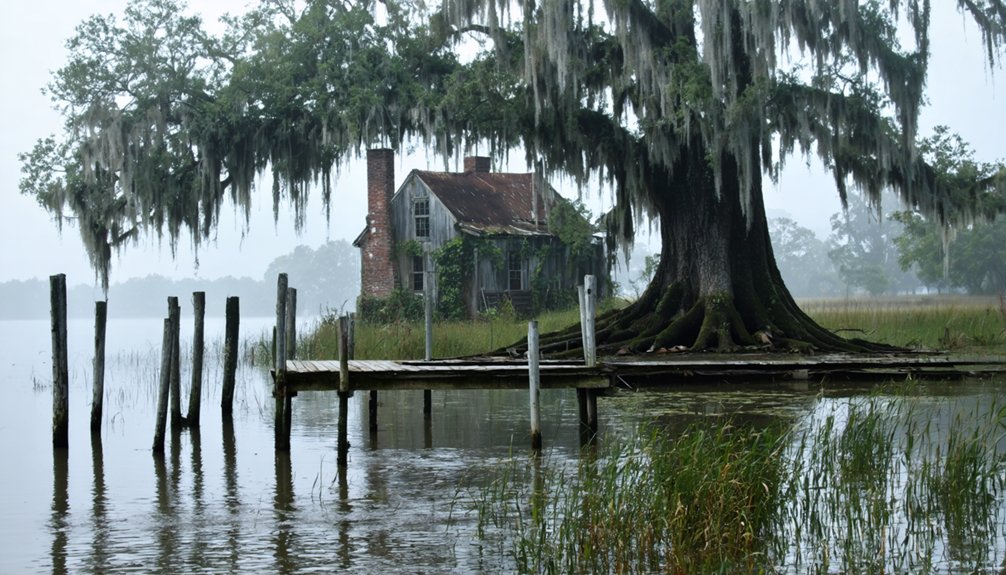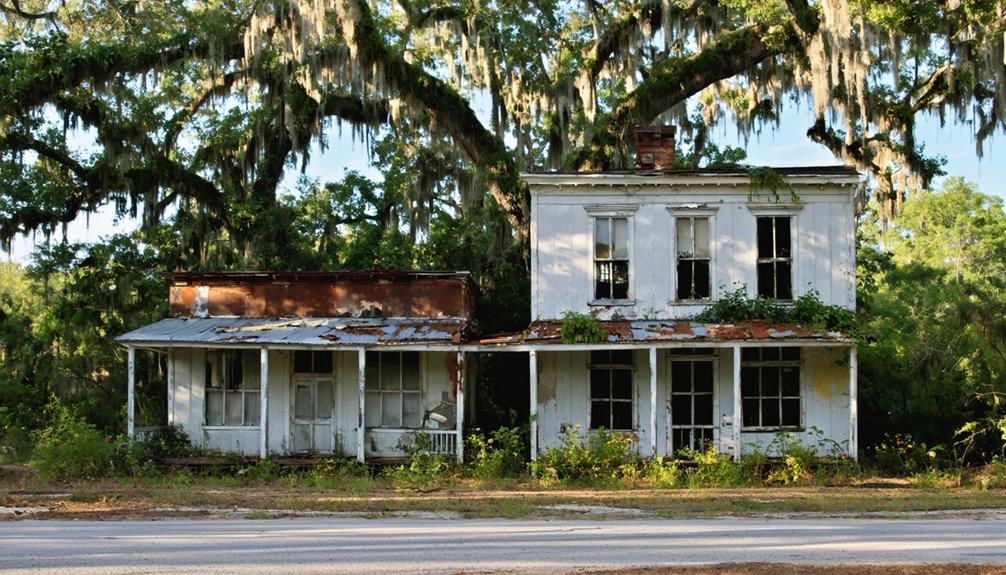
You’ll find Louisiana’s most haunting ghost towns scattered across storm-battered coastlines and flooded marshlands. Explore Frenier’s abandoned streets where Julia Brown’s voodoo legend still lingers, or walk through Ruddock’s regenerated cypress forests reclaiming a once-thriving lumber town. Visit Cheniere Caminada’s crumbling brick tombs near Grand Isle, witness Isle de Jean Charles’ sinking cemeteries, and discover forgotten River Road plantations slowly surrendering to decay. Each site tells stories of hurricanes, displacement, and resilience—and there’s much more beneath their weathered surfaces.
Key Takeaways
- Frenier offers haunted lore surrounding voodoo priestess Julia Brown, destroyed by the 1915 hurricane with nearly 300 deaths and ongoing paranormal reports.
- Cheniere Caminada near Grand Isle features restored structures like the Curole house and a crumbling cemetery from the devastating 1893 hurricane.
- Ruddock, a former cypress lumber town on stilts, was obliterated in 1915; only decayed wood remnants remain amid regenerated forests.
- Bayou Chene in St. Martin Parish displays cement foundations and witch folklore, now mostly submerged under silt from historic flooding.
- Abandoned riverfront plantations like Destrehan preserve slave quarters and historic structures, offering memorials to Louisiana’s complex, traumatic past.
Ruddock: The Cypress Lumber Town Lost to the 1915 Hurricane
Deep in Louisiana’s swamplands, where cypress trees now reclaim their dominion, the thriving town of Ruddock once hummed with the whine of sawmill blades and the chatter of nearly a thousand workers. Founded in 1892, this company town housed families in stilted homes connected by wooden walkways above marshy ground.
You’ll find nothing remains of the commissary, post office, or boarding houses that served this self-contained community. The 1915 New Orleans Hurricane erased Ruddock completely, claiming 58 lives and preventing any town reconstruction. The Category 4 storm brought winds up to 145 mph and raised water levels about ten feet, with relentless waves battering homes throughout the night of September 29.
Today, you can exit Interstate 55 at marker 7 to explore where decayed wood hints at this lost world. Ironically, the cypress preservation that once drove Ruddock’s economy now buries its memory beneath regenerated forests.
Frenier: Where Voodoo Legend Meets Tragic History
You’ll find Frenier’s story tangled between documented tragedy and embellished folklore, where a respected folk healer named Julia Brown became posthumously branded as a voodoo priestess who cursed her own town. The legend claims she sang “One day I’m going to die and take the whole town with me” before dying the exact day a Category 4 hurricane obliterated Frenier on September 29, 1915, killing nearly 300 people across Louisiana.
What actually happened reveals something far more complex: a literate Black landowner and mother was transformed by survivor stories and ghost tour marketing into a supernatural villain. The voodoo priestess narrative didn’t emerge until around 2010, nearly a century after the hurricane, reflecting modern sensationalism rather than historical reality. During her funeral, the coffin was never recovered after the storm surge swept through the procession. This transformation overshadowed the real horror of 25 people crushed in a collapsing railroad depot and an entire community washed away by 13-foot storm surges.
Julia Brown’s Prophetic Curse
Along the murky edges of Manchac Swamp, where cypress trees drip with Spanish moss and the water holds secrets from over a century ago, Julia Brown built her reputation as both healer and harbinger of doom.
You’ll hear tour guides recount her eerie porch song: “One day I’m going to die and take the whole town with me.”
Whether she practiced ceremony rituals connecting to ancestral spirits or simply warned Frenier’s residents of coming danger, you can’t deny the chilling coincidence—she died on September 29, 1915, the same day a catastrophic hurricane obliterated the town.
Her funeral attendees scattered as winds reached 145 mph, killing hundreds.
The small farming community of Frenier vanished completely beneath the storm surge, joining the ranks of Louisiana’s most tragic ghost towns.
Before tragedy struck, she had served the isolated settlement as midwife and healer, often traveling up to 30 miles to treat patients in nearby areas.
Today, you’ll find a staged crucifix marking her supposed grave, though truth blurs with legend in these haunted waters.
The 1915 Hurricane Devastation
When Julia Brown died on September 29, 1915, her prophetic curse materialized with terrifying precision. The next day, a Category 4 hurricane slammed into Frenier with 145 mph winds and 15-foot storm surges, obliterating everything you’d recognize as civilization.
The devastation brought immediate consequences:
- Complete infrastructure collapse – railroad tracks washed away, every building flattened
- Massive casualties – 25 people died when the depot collapsed, 58 perished in nearby Ruddock
- Economic impacts – the Ruddock Cypress Company sawmill destroyed, eliminating all employment
- Agricultural decline – farms vanished beneath floodwaters, making recovery impossible
The isolated swamp community never rebuilt. Without roads, electricity, or economic foundation, survivors abandoned what remained. In the chaos of the storm, Julia Brown’s coffin and body were abandoned, left to the floodwaters that consumed the town she had called home.
Today, visitors report ghostly sightings and eerie singing at the mass grave site near the swamp.
Frenier transformed from settlement to legend overnight.
Ghost Stories and Legends
The hurricane’s destruction birthed something darker than physical devastation—a legend that would outlive the town itself. You’ll hear tour guides recount Julia Brown’s prophecy: “One day I’m going to die and take the whole town with me.”
She supposedly died the day the hurricane struck, her funeral happening as winds destroyed Frenier.
Reality tells a different story. “Aunt Julie” was a respected landowner and traiteuse—a faith healer who treated neighbors when doctors were scarce.
No census records mention Voodoo rituals, yet paranormal investigations still seek her spirit in the swamp.
Her grave sits isolated, 100 yards from mass burial sites. The town once thrived on cypress timber and cabbage farming, earning local fame for its “Frenier Sauerkraut” before the hurricane erased it all.
Airboat operators perpetuate the curse narrative, but you’re witnessing how tragedy transforms ordinary people into myths—preserving forgotten history through sensationalized storytelling. The settlement’s complete isolation made it particularly vulnerable, with no roads connecting Frenier to the outside world and only the railroad providing communication with civilization.
Bayou Chene: A Fading Settlement in St. Martin Parish
- Navigate via airboat to glimpse rare cement foundations beneath murky waters
- Discover Bay Sirius Witch folklore from 1935 local legends
- Explore where Chitimacha Tribe territory once stood
- Experience true wilderness isolation that old-growth cypress loggers knew
- Walk grounds buried under twelve feet of silt from the catastrophic 1927 flood
You’re witnessing Louisiana’s untamed spirit—resilient, mysterious, and forever independent.
Cheniere Caminada: Coastal Ruins Along Louisiana’s Shoreline
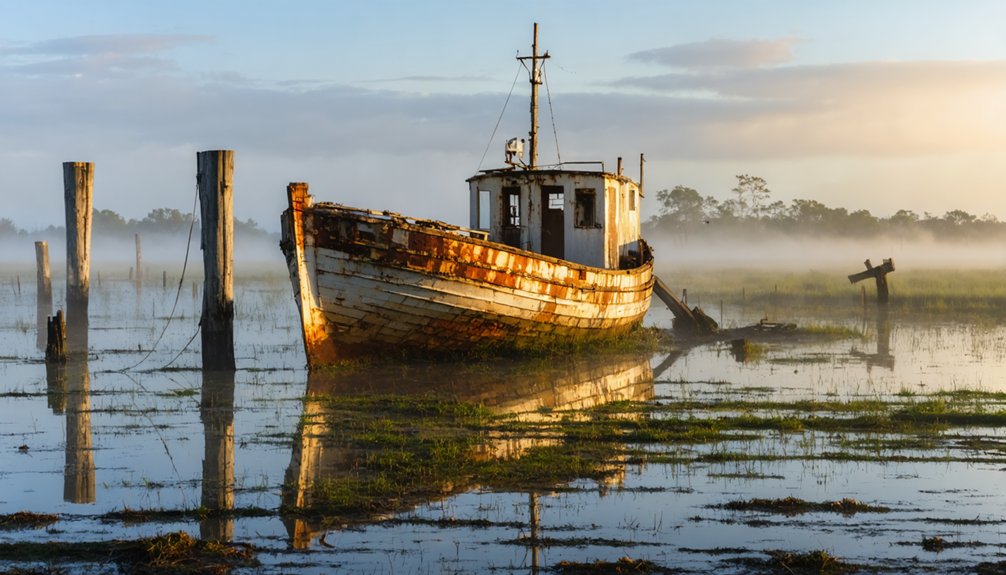
You’ll find one of Louisiana’s most haunting ghost towns along Highway 1 near Grand Isle, where an 18-foot storm surge in October 1893 killed 779 of Cheniere Caminada‘s 1,471 residents and erased a thriving resort community from the map.
In addition to the ghost towns, haunted hotels in Louisiana offer eerie encounters for those seeking a supernatural experience. Many of these hotels are steeped in history and are said to house restless spirits from the past. Visitors often report strange noises and unexplainable phenomena, adding to the allure of exploring these haunted locales.
Today, a small cemetery with crumbling brick graves and a dead oak tree marks where this once-prosperous village stood—complete with 180 buildings, steamship service from New Orleans, and European servants who catered to wealthy Creole families.
The ruins tell the story of Louisiana’s deadliest hurricane, a Category 4 monster that claimed the highest percentage of its victims among children and left survivors no choice but to abandon their coastal home forever.
Hurricane-Devastated Historical Structures
On October 1, 1893, a sixteen-foot storm surge obliterated Cheniere Caminada, transforming this thriving fishing village on Louisiana’s barrier islands into one of America’s most haunting coastal ruins. This Category 4 hurricane killed 779 of 1,471 residents, leaving only four of 450 homes standing.
Today, you’ll find scattered foundations and a weathered cemetery along Highway 1 near Grand Isle—testament to nature’s raw power and the community’s cultural preservation efforts.
What You’ll Discover:
- The relocated Curole house in Cut Off, restored in 2022, showcasing white cypress construction
- Grand Isle’s Chighizola House (1880), which sheltered sixty-two survivors
- Crumbling brick tombs beside a dead oak tree, marking environmental recovery’s slow pace
- Foundations where plantations and the gold-adorned Catholic church once stood
These structures whisper stories of resilience against overwhelming odds.
Storm-Ravaged Community Remains
Where Highway 1 cuts through marshland near Grand Isle, a weathered cemetery stands as the last physical remnant of Cheniere Caminada—a fishing village that vanished in sixteen hours on October 1, 1893.
You’ll find crumbling brick graves sinking into eroding ground, marked by a solitary dead oak tree.
The Category 4 hurricane‘s 18-foot storm surge killed 779 of 1,471 residents, obliterating 446 of 450 homes.
What once thrived as a prosperous resort community—complete with a church bell cast from 700 pounds of gold and pirate treasure—now disappears beneath Gulf waters.
Modern conservation efforts and flood control systems can’t reclaim this barrier island.
It’s a stark reminder that Louisiana’s coast remains vulnerable, with yesterday’s seaside villages becoming today’s underwater graves.
Isle De Jean Charles: a Disappearing Island Community
- Cemetery markers slowly sinking into marshland, marking 170+ years of history.
- Abandoned cypress groves now jutting from open water.
- Single-lane road submerging during high tide, trapping you briefly.
- Chief Albert Naquin’s stories about climate adaptation and America’s first climate refugee resettlement.
The community’s managed retreat to Houma represents both loss and survival—freedom redefined by water’s relentless advance.
Forgotten River Road: Abandoned Plantations Along the Mississippi
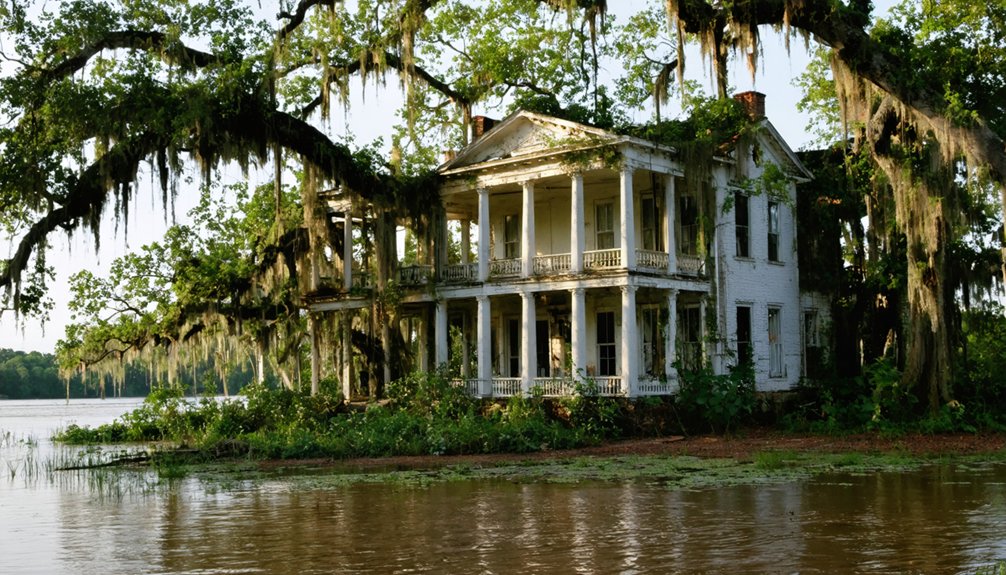
Between New Orleans and Baton Rouge, the River Road unspools along the Mississippi’s levees like a thread through abandoned wealth. You’ll discover crumbling riverfront architecture where sugar barons once ruled—grand houses stripped by fires, floods, and time’s indifference.
The 1920s mosaic disease crushed the industry, leaving estates to decay.
Plantation ghost stories haunt these grounds, particularly at Destrehan, where the 1811 slave uprising ended with heads displayed on pikes. At Saragossa, only the overseer’s house stands; the enslaved quarters vanished entirely.
Whitney Plantation breaks the silence, preserving twenty original slave cabins and memorials honoring 2,200 children who died in bondage.
You can explore several sites—Destrehan offers daily tours, St. Joseph operates as a working plantation. Some remain private, their secrets protected behind rusted gates.
Frequently Asked Questions
What Safety Precautions Should Visitors Take When Exploring Louisiana Ghost Towns?
You’ll need proper safety gear like sturdy boots and flashlights, plus keep emergency contacts handy on your phone. Check structures before entering, explore during daylight, and tell someone your plans—freedom requires smart preparation.
Are Guided Tours Available for Any of These Abandoned Locations?
Surprisingly, 80% of Louisiana’s ghost towns lack formal tours due to preservation efforts protecting their historical significance. You’ll find most adventures require self-guided exploration, though local historical societies occasionally offer special access events during summer months.
Exploring abandoned places in Louisiana can be a captivating experience for those interested in the state’s rich history. Each location tells a unique story, with remnants of the past that spark the imagination. Adventurers should come prepared with a camera and an open mind, as every visit reveals hidden gems waiting to be discovered.
Exploring abandoned sites in Louisiana can lead to unexpected encounters with local wildlife and an opportunity to connect with the natural landscape. Some areas may even provide insights into the architectural styles of the bygone era, showcasing the creativity and resilience of those who once inhabited them. As you wander through these silent witnesses of history, take the time to reflect on the stories they hold, each one adding to the tapestry of Louisiana’s cultural heritage.
What Is the Best Time of Day to Photograph These Sites?
You’ll capture the best shots during golden hour—sunrise and sunset photography reveal stunning textures on crumbling walls. Morning light illumination through fog creates ethereal atmospheres at swamp sites. Avoid midday’s harsh shadows; they’ll flatten your compositions and kill detail.
Do I Need Special Permits to Access These Ghost Towns?
Permits possibly protect preserved properties—you’ll face accessibility challenges reaching remote ruins. Historical preservation rules vary by location and land ownership. Most abandoned sites don’t require permits, but always respect private property boundaries and check local regulations before exploring freely.
Which Ghost Town Is Closest to New Orleans or Baton Rouge?
Fazendeville’s your closest bet to New Orleans at under 30 miles—perfect for urban exploration freedom. You’ll discover historical preservation efforts at St. Bernard Cemetery, where weathered markers tell stories of hurricane survivors who once called this vanished community home.
References
- https://www.ezhomesearch.com/blog/ghost-towns-in-louisiana/
- https://thebayouinsider.substack.com/p/ghost-towns-and-forgotten-roads-louisianas
- https://www.explorelouisiana.com/articles/things-do-haunted-places-louisiana
- https://www.youtube.com/watch?v=aoGIda87AVQ
- https://www.getyourguide.com/louisiana-l583/ghost-vampire-tours-tc23/
- https://www.tripadvisor.com/ShowTopic-g28939-i33-k13978978-How_to_see_old_Louisiana-Louisiana.html
- https://kids.kiddle.co/Ruddock
- https://lobservateur.com/2015/09/30/ruddock-washed-away-100-years-ago/
- https://www.crt.state.la.us/Assets/OCD/hp/nationalregister/historic_contexts/The_Louisiana_Lumber_Boom_c1880-1925.pdf
- https://manchacgreenway.org/ruddock/