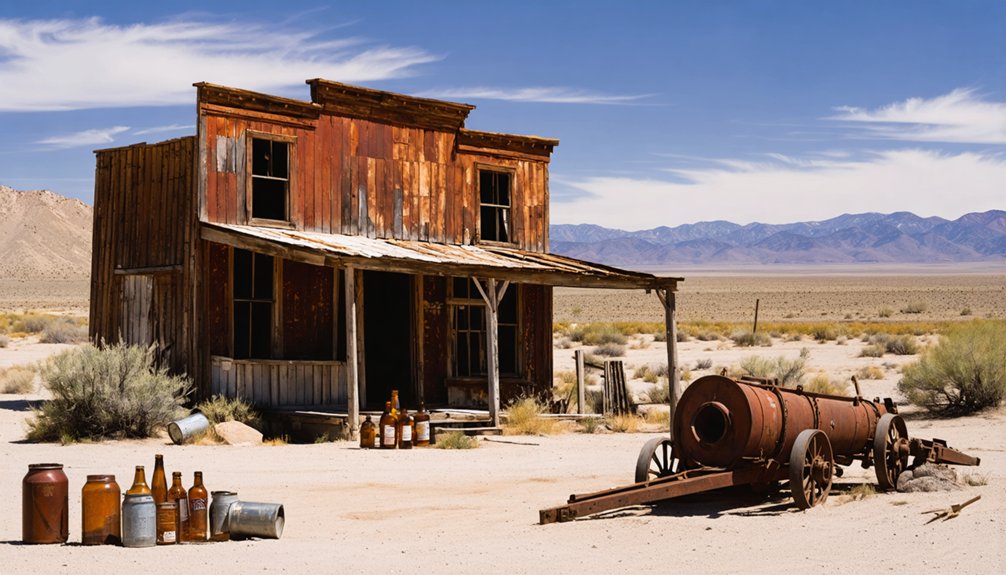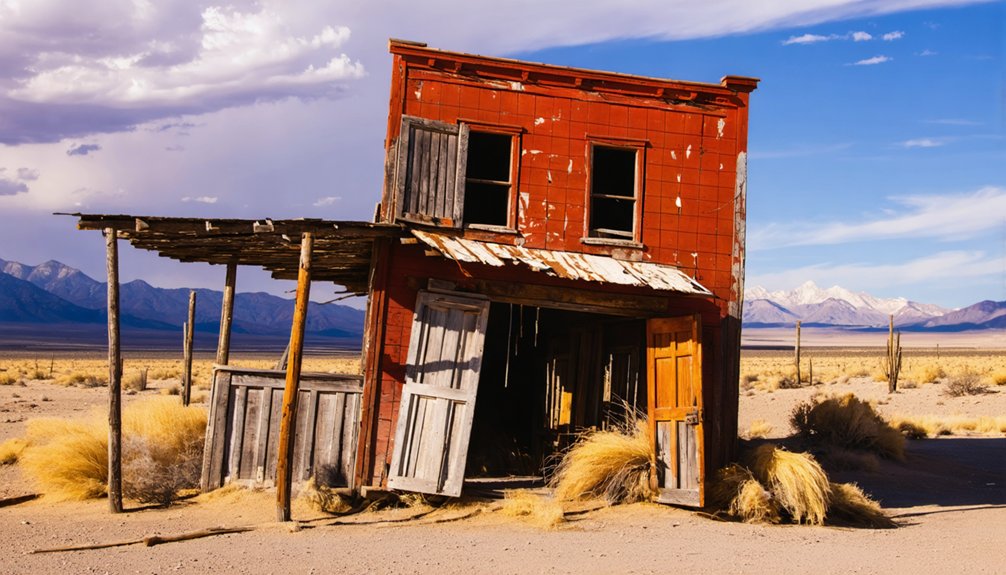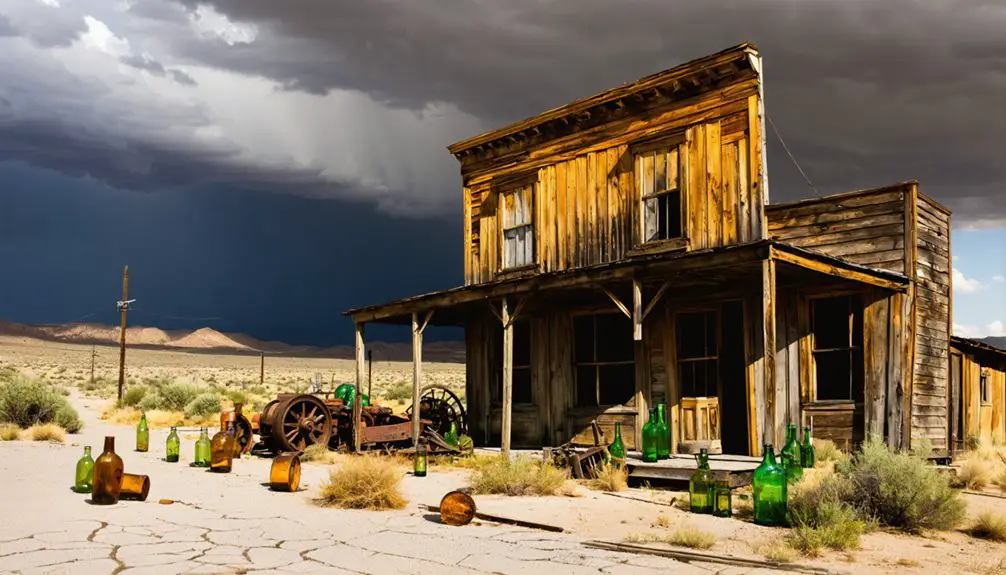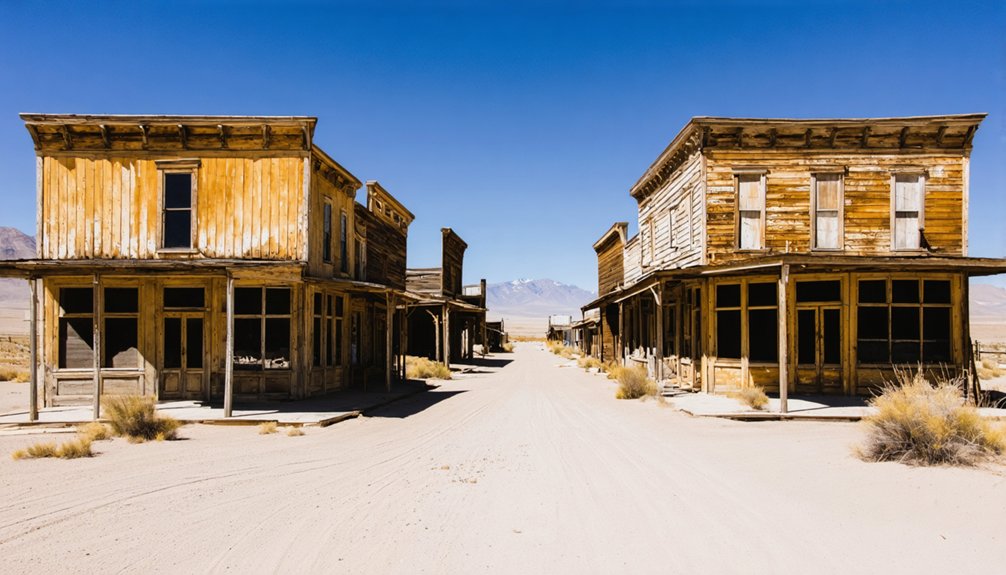
You’ll find Nevada’s best summer ghost town experiences at Rhyolite near Death Valley, where 50+ preserved buildings include Tom Kelly’s famous bottle house, and remote Jarbidge in the northeast, still home to a small community. Pioche offers violent frontier history with its Boot Hill Cemetery and haunted Overland Hotel, while Belmont showcases 150-year-old stone structures. Visit during early morning or evening hours before 9 AM or after 7 PM to avoid scorching midday heat. Pack water, sun protection, and sturdy boots—these abandoned sites reveal compelling stories through weathered walls and mining relics.
Key Takeaways
- Rhyolite near Death Valley is Nevada’s most photographed ghost town, featuring preserved buildings and maintained by the Bureau of Land Management.
- Jarbidge in remote northeast Nevada offers accessible exploration via town taxis, with summer festivals swelling the historic mining town’s population.
- Pioche features violent Old West history, including Boot Hill Cemetery, the Million Dollar Courthouse, and the haunted Overland Hotel Saloon.
- Visit early morning before 9 AM or around 7 PM during summer to avoid extreme midday heat between 11 AM-4 PM.
- Pack water, SPF 50+ sunscreen, sturdy boots, and navigation tools while exploring abandoned structures, mine ruins, and desert landscapes.
Rhyolite: Nevada’s Most Photographed Ghost Town
When Shorty Harris and Ernest L. Cross discovered gold in the Bullfrog Hills on August 4, 1904, they sparked Nevada’s wildest boom.
You’ll find Rhyolite named after the silica-rich volcanic rock surrounding it, where 10,000 residents once crowded 50 saloons and a stock exchange. The three-story Cook Bank Building remains the West’s most photographed ghost town structure, while Tom Kelly’s ingenious 50,000-bottle house showcases frontier resourcefulness.
By 1910, diminished ore and financial panic emptied the streets—only 14 residents remained by 1920. The town’s infrastructure had included electric lights, water mains, telephones, newspapers, a hospital, and a school during its peak years. Three railroads connected Rhyolite to Tonopah, Goldfield, and Las Vegas, enabling the transport of ore and supplies during the boom years.
Today, the Bureau of Land Management maintains this historical preservation site with accessible tourism infrastructure. Located near Death Valley National Park, Rhyolite stands as Nevada’s best-preserved ghost town, offering you unfiltered glimpses into authentic frontier life.
Jarbidge: A Living Relic of the Gold Rush Era
You’ll find Jarbidge tucked deep in Nevada’s remote northeast corner, where this authentic mining town has defied its “ghost town” label since prospectors struck gold in 1909.
Unlike abandoned ruins, Jarbidge pulses with year-round residents who’ve kept their community alive through countless boom-and-bust cycles spanning over a century.
The town transforms each summer when visitors flood in for annual festivals, swelling the population just as prospectors once did during those frenzied gold rush days of 1911.
The town’s name comes from a Shoshone word meaning “devil,” rooted in local indigenous legend that adds mystique to this remote settlement.
Today, visitors can explore the town’s quaint atmosphere on foot or take advantage of the pair of town taxis that offer rides along the main drag, adding to the settlement’s historic charm.
Remote Mining Town History
Hidden deep in Nevada’s northeastern corner, Jarbidge stands as one of the state’s most authentic mining relics—a town born from gold fever and shaped by extreme isolation.
You’ll discover a settlement that defied all odds when Dave Bourne struck gold in 1908, triggering a rush that brought 1,500 miners to this unforgiving canyon. Underground tunnels soon honeycomb the surrounding mountains as the Elkoro Mining Company extracted $10 million in precious metals by the 1930s.
The town’s remoteness—requiring treacherous journeys through wilderness—kept development in check even as newspapers predicted 10,000 residents. Despite a devastating 1919 fire and harsh winters, miners persevered until operations ceased in 1941. Jarbidge earned notoriety in 1916 as the site of America’s last stagecoach robbery, where bandits held up the mail stage and shot the driver before being convicted and later pardoned.
Today, you’ll find authentic wooden buildings standing evidence to those who chose freedom over comfort. Perched at an elevation of 6,218 feet, this tiny community of around 20 residents maintains its historical character while offering visitors a glimpse into Nevada’s rugged mining past.
Annual Summer Festival Events
Despite its population of barely a dozen year-round residents, Jarbidge transforms into Nevada’s most spirited ghost town party hub from spring through fall. When hundreds of visitors descend upon the canyon for its legendary festivals, the town truly comes alive.
These community festivals showcase festive traditions dating back to pioneer days. The celebrations swell the population to over a hundred adventure-seekers. Each event brings together food, vendors, and entertainment that exemplify what makes a true Nevada festival.
Summer highlights include:
- Mid-August Jarbidge Days – Contests and games culminating in parties at Pioneer Park, stumbling distance from the Outdoor Inn’s full bar
- Fourth of July barbecues – Costume parties following morning hikes and afternoon fishing expeditions
- Memorial Day gatherings – Spring kickoff featuring revelrous contests in the wilderness
- Labor Day festivities – Fall celebrations with community barbecues and costume competitions
- Single unpaved street parades – Honoring mining heritage beneath canyon walls
Many festival-goers appreciate that kids 17 & under enter free, making these remote celebrations accessible for families seeking authentic Nevada heritage experiences.
Pioche: Silver Boom Town With a Violent Past
You’ll find Pioche’s violent past preserved in three haunting landmarks that tell the story of Nevada’s deadliest silver boom town. The historic Boot Hill Cemetery overlooks the aerial tramway where outlaws and miners met their end during the 1870s. During that time, 72 murders occurred before anyone died of natural causes.
Downtown, you can tour the infamous Million Dollar Courthouse—a monument to corruption—and belly up to the bar at the Overland Hotel Saloon. Bullet holes and ghost stories at the saloon remind visitors that this town’s streets once ran red. The Lincoln County Museum on Main Street displays relics from Pioche’s colorful past, offering insights into the mining era and the community’s turbulent history.
The Thompson Opera House, once a hub of entertainment with ornate architecture and backstage areas, is currently undergoing restoration to preserve its early 20th-century grandeur.
Historic Boot Hill Cemetery
Along the northern edge of Pioche, where the Great Basin Highway cuts through Nevada’s high desert, Boot Hill Cemetery stands as a grim proof to one of the Old West’s most violent chapters. You’ll discover graveyard legends etched in weathered headstones, where 72 men were buried with their boots on before Pioche recorded its first natural death.
Hidden stories emerge from Murderer’s Row, where over 100 alleged killers rest beneath shallow graves once marked by protruding boot tips.
As you explore this active cemetery, you’ll encounter:
- Morgan Courtney’s grave—shot five times from ambush in 1873
- John Lynch’s marker—killed over a dog dispute
- Abandoned 1920s aerial tramway cables stretching overhead
- Unmarked graves alongside detailed epitaphs describing violent ends
- Intact views of Nevada’s unforgiving high desert landscape
This isn’t sanitized history—it’s raw frontier justice preserved in stone.
Million Dollar Courthouse Tour
When Pioche’s county commissioners commissioned a modest courthouse in 1871, they envisioned spending $26,000 on a functional government building for Nevada’s newest silver boomtown. Instead, corruption and mismanagement transformed it into an $800,000 nightmare that wasn’t paid off until 1937.
Today, you’ll explore this Italianate-style monument to frontier excess, where historic architecture tells tales of kickbacks and compounding debt that reached $670,000 by century’s end. The two-story brick structure features lavish courtroom details that showcase mining history’s boom-era extravagance.
After abandonment in 1933, the building survived four decades of decay before restoration in the 1970s. Now operating as a museum, it’s earned its “Million Dollar Courthouse” nickname—a tribute to boomtown ambition gone spectacularly wrong.
Haunted Overland Hotel Saloon
Just a block from the courthouse that nearly bankrupted Pioche stands the Overland Hotel and Saloon, where the town’s violent past lingers in more ways than one. Built during the 1870s silver boom, this atmospheric relic served miners and gamblers when Pioche recorded 72 murders before its first natural death.
Preservation efforts have maintained the original bar and upstairs rooms with period furnishings, where haunted legends thrive through reported apparitions and unexplained cold spots.
Experience the Overland’s eerie atmosphere:
- Original saloon bar where 1870s gunfights erupted over claim disputes
- Upstairs rooms furnished with authentic mining-era pieces
- Ghostly footsteps echoing through wooden hallways
- Cold spots materializing near windows overlooking Boot Hill Cemetery
- Aerial tramway buckets visible overhead, remnants of boom-era industry
Summer visitors can explore this preserved Wild West structure without crowds, perfect for adventurous road-trippers.
Belmont: Central Nevada’s 150-Year-Old Treasure
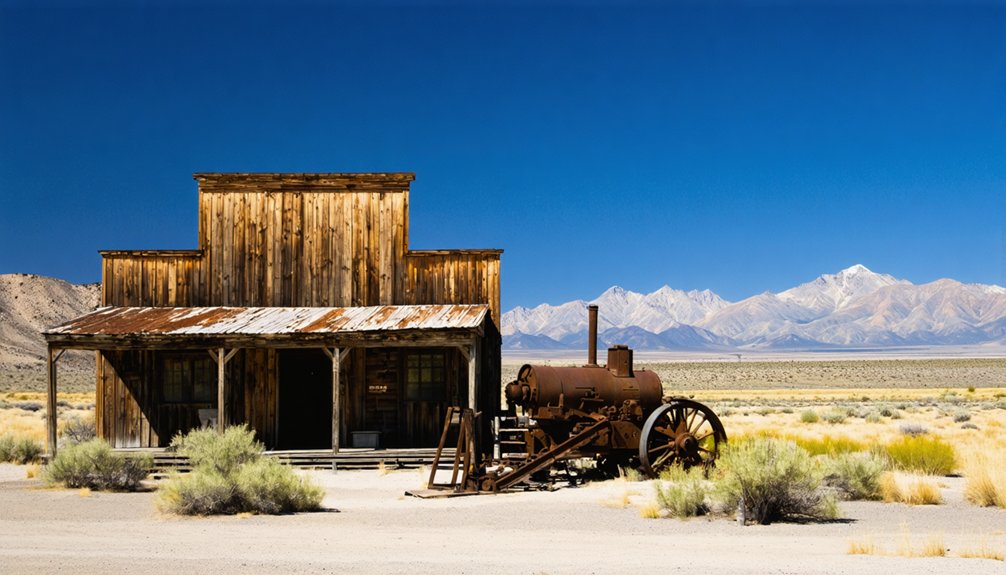
Deep in the mountains of central Nevada, Belmont stands as one of the state’s most authentic ghost towns, where 150-year-old stone buildings tell stories of silver-rush prosperity and frontier chaos.
Belmont’s weathered stone walls and crumbling saloons preserve an untamed chapter of Nevada’s silver-rush legacy.
You’ll discover the magnificent 1876 courthouse—a two-story brick masterpiece that’s remarkably intact—alongside crumbling saloons, mill ruins, and stone cabins scattered through piñon-studded hills.
The Monitor-Belmont Mill site showcases mining equipment including a 20-stamp mill, towering chimney, and rusted machinery that processed $15 million in ore.
These historic landmarks witnessed everything from vigilante hangings to rowdy saloon brawls when thousands called this place home.
Today, you’re free to wander independently along former State Route 82, exploring miner cabins and photographing Nevada’s raw history in absolute solitude.
Galena: A Canyon Ghost Town Near Battle Mountain
Tucked into a rugged canyon just 10 miles south of Battle Mountain, Galena unfolds as a sprawling ghost town where silver dreams once supported 348 residents and two thriving hotels.
You’ll discover remnants of Nevada’s 1870s boom scattered throughout Galena Canyon, where the Dutch Creek Mine extracted $5 million in silver and lead before an 1889 fire destroyed critical mining technology.
- Pioneer cemetery headstones weathering among sagebrush at 6,158 feet elevation
- Crumbling brick high school walls standing memorial to educational aspirations
- Hotel ruins framing canyon views once enjoyed by prospectors
- Wide streets now reclaimed by desert vegetation
- Public park plaza—rare luxury for mining camps
Preservation challenges intensify as elements claim what fire spared.
You’ll need to drive three miles up-canyon from SR 305’s marked turnoff to explore this authentic wilderness ghost town.
Gold Point: Open-Air Museum and Saloon Experience
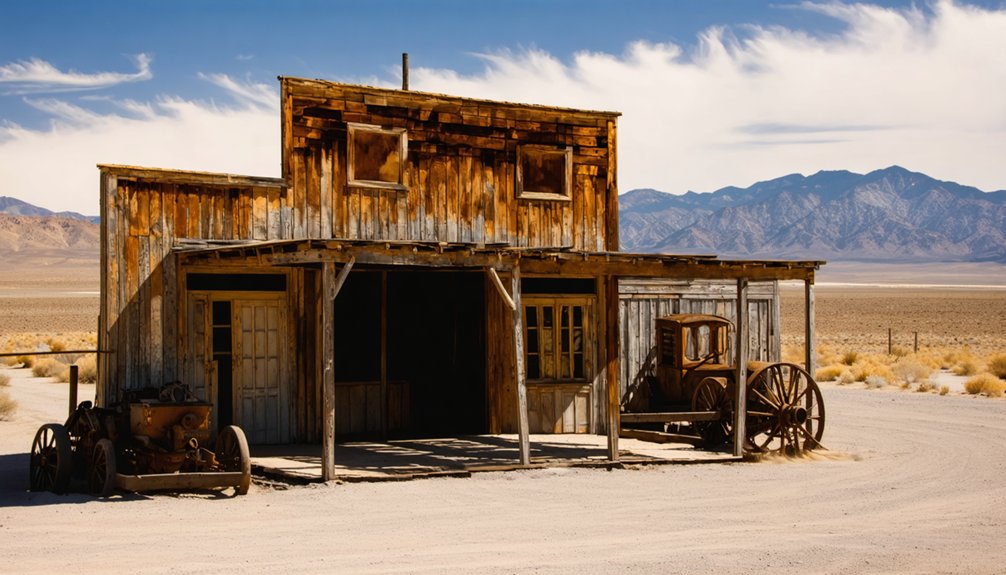
Four hours northwest of Las Vegas, Gold Point sprawls across the desert as Nevada’s most accessible living ghost town, where you can belly up to an authentic saloon bar while exploring 50 preserved buildings from the 1908 boomtown era.
You’ll discover mining equipment scattered throughout the site, including steam-powered stamp mill remnants and towering headframes marking old shafts. The saloon houses a 1909 Brunswick pool table and a massive photo album documenting 8,000 Nevada mining camps.
Thanks to historical preservation efforts since the late 1970s, the main street’s wooden structures remain remarkably intact, offering an unvarnished glimpse into frontier life. Walk through the post office, bakery, and hotel ruins without modern intrusions—just you, the desert, and authentic Old West history.
Best Time to Visit Nevada Ghost Towns in Summer
Summer exploration of Nevada’s ghost towns demands strategic timing to balance authentic desert experiences with personal safety. You’ll want to tackle these haunting destinations during early morning hours before 9 AM or sunset excursions starting around 7 PM, when temperatures drop from brutal triple digits to manageable levels.
The thrill of exploring Nevada’s historic ghost towns allows visitors to step back in time and witness the remnants of the Wild West. Each town tells a unique story, with abandoned structures and fascinating artifacts that evoke the spirit of its former inhabitants. As you wander through these eerie settings, don’t forget to capture the breathtaking desert landscapes that frame these forgotten places.
Beat Nevada’s desert heat by exploring ghost towns at dawn or dusk when temperatures become bearable and shadows create haunting atmospheres.
Summer heat in Mojave Desert locations like Nelson peaks dangerously between 11 AM and 4 PM, making midday adventures risky. Smart tour scheduling means booking guided evening ghost walks or underground mine tours that offer cooler refuges from the elements.
- Dawn light casting long shadows across Rhyolite’s crumbling bank facades
- Goldwell’s ghostly sculptures glowing under star-filled desert skies
- Cool underground passages in Nelson’s historic mines providing respite
- Goodsprings Pioneer Saloon’s vintage interior offering air-conditioned sanctuary
- Purple-orange sunsets painting Goldfield’s weathered buildings in dramatic hues
What to Bring When Exploring Ghost Towns
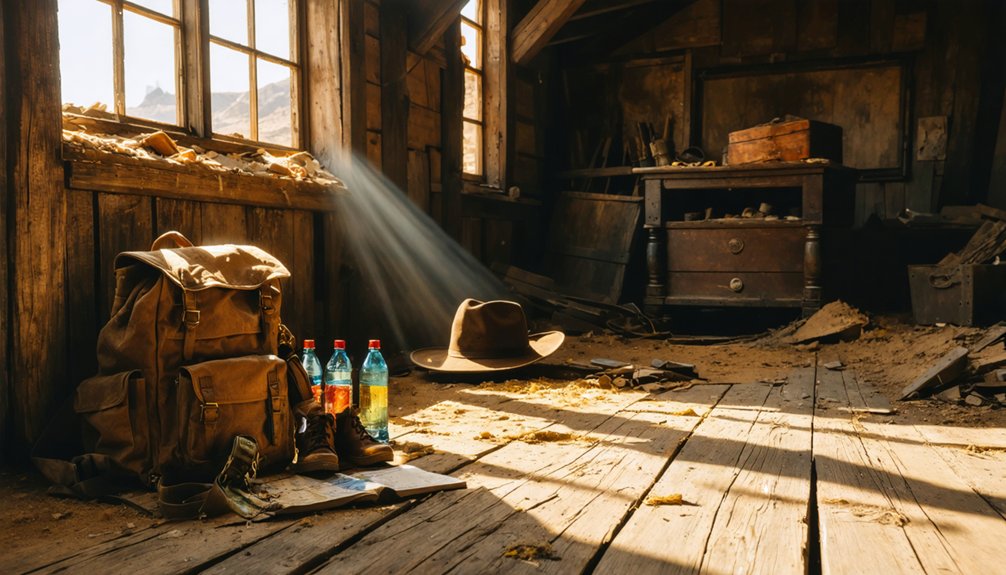
When venturing into Nevada’s abandoned settlements, proper gear transforms potential disaster into memorable adventure. You’ll need sun protection essentials: SPF 50+ sunscreen, wide-brimmed hat, UV-blocking sunglasses, and lightweight long sleeves.
Pack at least one gallon of water daily with electrolyte packets to combat desert heat.
Navigation tools prove critical—bring topographic maps, GPS devices, and compasses for remote areas where local folklore often marks hidden sites.
Your backpack should include flashlights for exploring structures important to historical preservation, plus first-aid supplies and multi-tools.
Don’t overlook safety items: snake bite kits, emergency whistles, and insect repellent. Sturdy boots protect against rocky terrain, while high-energy snacks maintain your stamina.
Remember trash bags—respecting these time capsules ensures they’ll remain for future explorers seeking freedom through discovery.
Photography Tips for Capturing Ghost Town Beauty
You’ll capture Nevada’s ghost towns at their most dramatic by shooting during golden hour, when warm light bathes weathered wood and crumbling stone in rich, dimensional tones.
Frame your compositions to include foreground elements like rusted mining equipment or desert vegetation that lead viewers’ eyes toward distant structures, creating depth and context.
Don’t overlook the intricate details—peeling paint, sun-bleached signs, and wind-carved textures tell powerful stories when you move in close with your lens.
Golden Hour Lighting Techniques
As the sun dips toward Nevada’s desert horizon, ghost towns transform into a photographer’s paradise where golden light breathes temporary life into abandoned structures.
You’ll capture magic during those fleeting minutes when warm rays illuminate weathered facades and cast dramatic shadows across empty streets.
Light reflection off rusted metal and vintage glass creates unexpected compositional elements, while shadow play adds depth and mystery to your frames.
Master these golden hour essentials:
- Position yourself where low-angle sunlight highlights textures on decaying wood and oxidized surfaces
- Bracket exposures at 1-stop intervals to balance bright skies against dark building interiors
- Use your tripod to stabilize long exposures that capture moving clouds above static ruins
- Scout locations beforehand to predict how sunrise illuminates specific structures you’ve targeted
- Spotlight details with flashlights to enhance foreground elements against naturally-lit backgrounds
Composition and Framing Strategies
The skeletal remains of Nevada’s ghost towns offer exceptional compositional opportunities where architectural decay becomes your artistic canvas. You’ll discover powerful silhouettes through weathered doorways and collapsed rooflines during golden hour, transforming ruins into striking shadow plays.
Exploring abandoned towns in Nevada allows you to unearth stories hidden in the remnants of long-lost communities. Each visit reveals new perspectives, with crumbling buildings standing as testimony to a rich history. As you wander through desolate streets, the atmosphere is thick with nostalgia, sparking creativity through contrasts of the past and present.
Embrace negative space around isolated structures—that vast desert emptiness amplifies your subject’s haunting presence and creates visual breathing room that demands attention.
Master abstract framing by shooting through broken windows, crumbling archways, and splintered beams. These natural frames focus viewer attention while adding immersive depth to your compositions.
Seek out leading lines from abandoned railways, dusty roads, and buckled fences that pull eyes through your frame.
Experiment with unconventional angles—shoot low through debris or climb cautiously for elevated perspectives that reveal layered landscapes.
Let decay dictate your composition, and you’ll capture Nevada’s ghost towns with authentic, unrestricted creativity.
Weathered Texture Detail Shots
When light rakes across sun-blistered paint and splintered wood, Nevada’s ghost town surfaces transform into tactile narratives of abandonment and time. You’ll capture the most compelling weathered textures during golden hour when side-lighting reveals every crack and crevice in decaying structures.
Position yourself where light skips across surface decay at sharp angles, then underexpose by -2/3 stops to intensify textural details.
Frame these compelling subjects for maximum impact:
- Peeling paint layers curling away from sun-bleached planks
- Rusted metal fragments with oxidation patterns spreading across corrugated surfaces
- Crumbling brick exposing interior mortar and erosion channels
- Weathered boot soles pressed against deteriorating floorboards
- Fractured window glass creating geometric shadow patterns
Shoot in RAW format and convert to high-contrast black and white during post-processing to emphasize every textural element.
Staying Safe While Visiting Abandoned Mining Sites
Nevada’s approximately 200,000 abandoned mines create a haunting landscape that’s as dangerous as it’s alluring. Mine safety demands you stay out of all abandoned sites and stick to marked trails.
Nevada’s 200,000 abandoned mines blend deadly hazards with irresistible mystery—stay out and stick to marked trails for your survival.
You’ll face multiple threats: water-filled pits with steep, slippery walls hiding old machinery; unstable ladders with broken rungs that’ll fail under your weight; and decayed structures that collapse without warning.
Old explosives like dynamite and blasting caps remain active after decades—touching them means death or maiming.
Wildlife encounters add another layer of risk, as rattlesnakes seek cooling refuge in tunnels and shafts during summer heat, concealing themselves near openings where rodents attract them.
Heed warning signs, avoid hopping fences, and if accidents happen, call the county sheriff. Your freedom to explore requires respecting these deadly hazards.
Frequently Asked Questions
Are Pets Allowed When Visiting Nevada Ghost Towns?
Pet policies vary by ghost town, but you’ll generally find leashed dogs welcome at sites like Nelson. Always prioritize pet safety around old structures and wildlife hazards. Check local regulations beforehand to guarantee you’re exploring responsibly.
Do Any Ghost Towns Charge Admission Fees or Require Permits?
Yes, you’ll encounter varying admission fees supporting historical preservation. Nevada City charges $8-10, Nelson requires $1 for walking plus $10 photography permits for enhanced opportunities, and Techatticup Mine tours cost $20 per adult with advance reservations required.
Is Cell Phone Service Available at These Remote Ghost Town Locations?
Cell coverage varies wildly—you’ll find yourself completely disconnected in most locations. Gold Point offers surprising 3G service, while Goldfield provides limited remote access. However, expect zero cell reception for 25+ miles between most ghost towns, so plan accordingly.
Can Visitors Enter Buildings or Are They Off-Limits?
You’ll find many building interiors open for exploration at sites like Fort Churchill, Rhyolite, and Jarbidge, though safety restrictions fence off unstable structures. Always respect barriers, leave artifacts untouched, and watch for hazardous mine shafts while adventuring.
Are Guided Tours Available at Nevada Ghost Towns?
Yes, you’ll find guided walking tours at several Nevada ghost towns. Carson City offers theatrical historical preservation walks, while Rhyolite and Nelson provide expert-led excursions. Berlin features ranger-guided tours maintaining authentic sites through careful preservation efforts.
In addition to these guided experiences, visitors can explore abandoned mining towns in Nevada at their own pace, immersing themselves in the rich history of the area. Sites like Goldfield and Virginia City offer a glimpse into the past, showcasing the remnants of a once-thriving mining industry. The stories of fortune and hardship that shaped these towns add an intriguing layer to any visit.
References
- https://www.roadtripryan.com/go/t/nevada/northern-nevada/galena-ghost-town
- https://www.visittheusa.com/experience/6-nevada-ghost-towns-explore-if-you-dare
- https://roadtrippers.com/magazine/dark-skies-and-ghost-towns-stops-on-a-spooky-nevada-road-trip/
- https://www.tripadvisor.com/Attractions-g28949-Activities-c47-t14-Nevada.html
- https://matadornetwork.com/trips/travel-guide-nevadas-ghost-towns/
- https://www.youtube.com/watch?v=opD2zxGhNtg
- https://nvtami.com/2024/01/07/best-ghost-towns-2023/
- https://www.rhyoliteghosttownnevada.org/explore/rhyolite-ghost-town
- https://www.nvexpeditions.com/nye/rhyolite.php
- https://travelnevada.com/ghost-town/rhyolite-ghost-town/