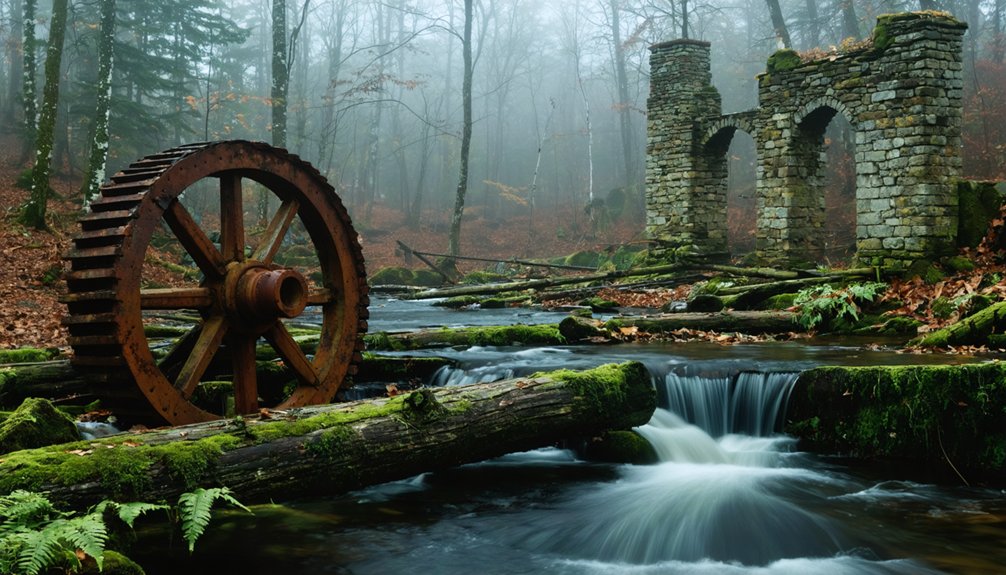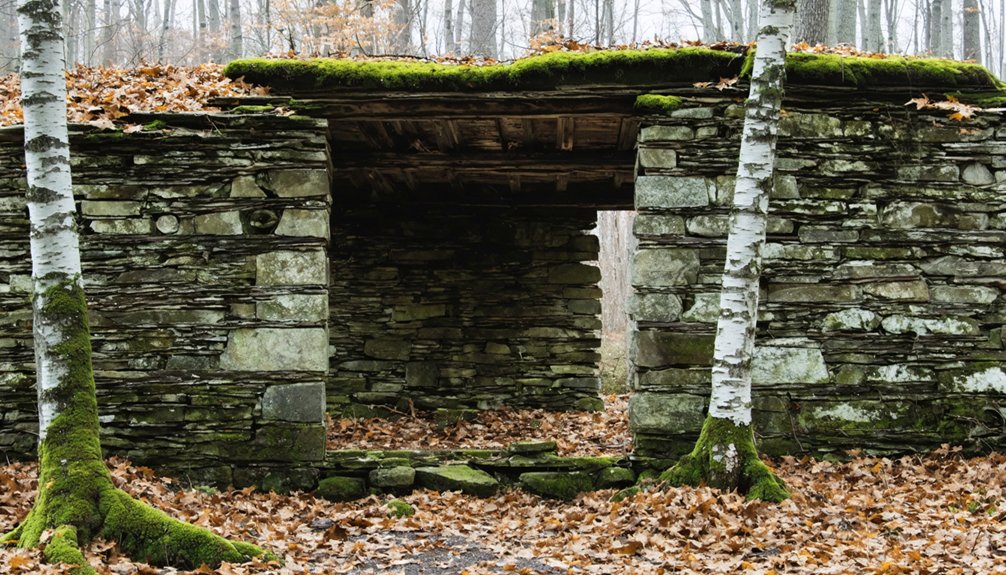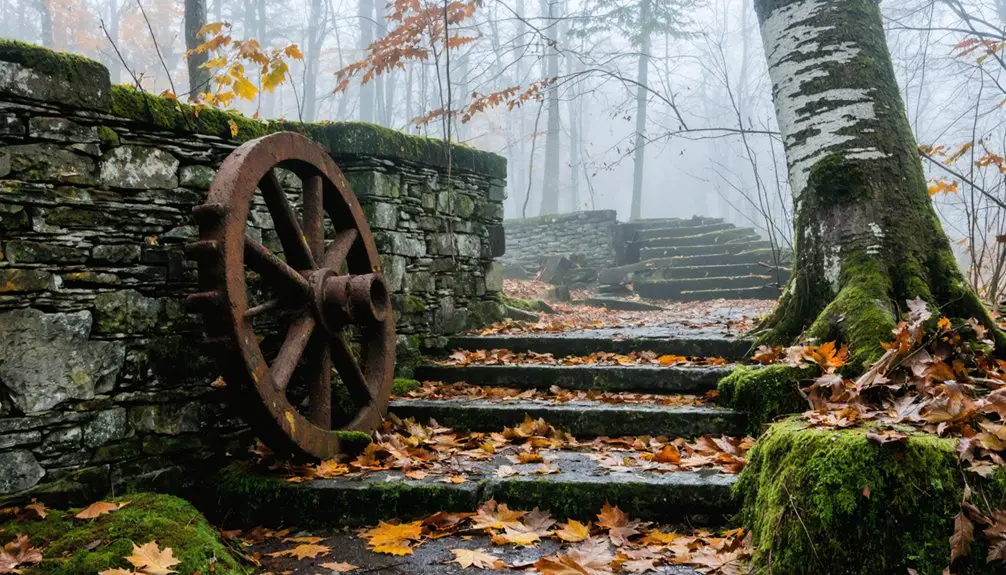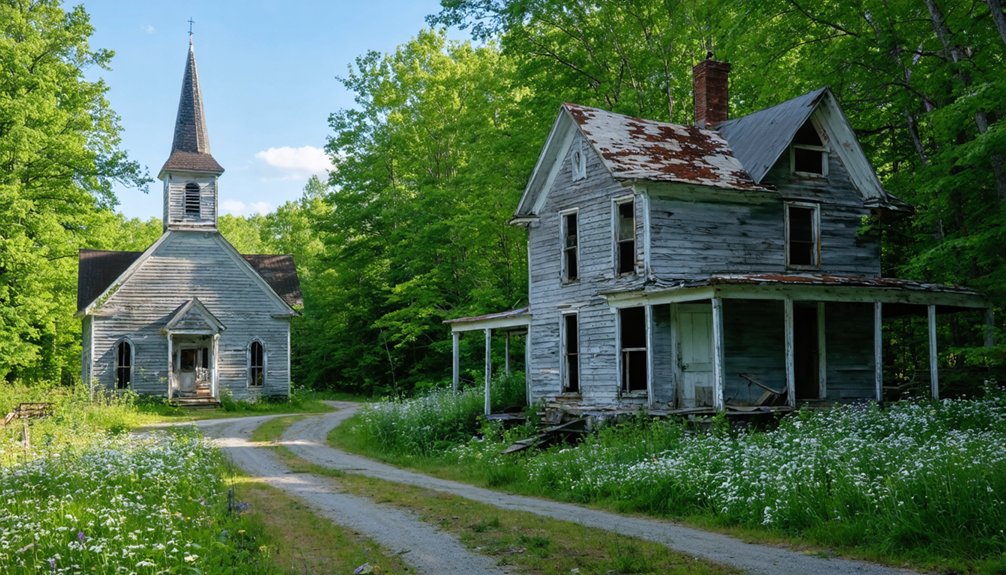
You’ll find New Hampshire’s most enthralling ghost towns scattered through dense forests and mountain passes, where summer’s warmth makes exploration ideal. Monson Center reveals stone-lined cellars from the 1730s along peaceful trails, while Madame Sherri’s dramatic staircase rises through trees near the Vermont border. The Livermore Falls mill ruins blend rusted machinery with vibrant graffiti art, and America’s Stonehenge presents enigmatic megaliths that’ve puzzled archaeologists for decades. Each abandoned settlement holds secrets waiting to reward your curiosity with stories of vanished lives.
Key Takeaways
- Monson Center offers 200 acres of trails connecting 1730s farmland ruins, including cellar holes and the historic Gould House museum from 1756.
- Madame Sherri’s Castle ruins feature a dramatic stone staircase and foundations within a 513-acre forest with trails to Indian Pond.
- Livermore Falls Mill ruins showcase abandoned 1901 pulp mill structures with weathered brick walls and graffiti art near North Conway.
- Sandwich Notch and Thornton Gore ghost towns provide trails through stone walls, cellar holes, and pioneer cemeteries reclaimed by nature.
- Summer visitors should wear orange during hunting season and use road addresses for navigation where GPS signals are weak.
Monson Center: A Vanished 18th-Century Settlement
When you step onto the forested trails of Monson Center, the silence feels almost sacred—broken only by rustling leaves and distant birdsong where voices once called across seventeen thousand acres of cleared farmland. This 1730s settlement, New Hampshire’s first inland colony, became one of New England’s most significant archaeological sites after its complete abandonment by the 1770s.
You’ll discover stone-lined cellar holes where families once gathered, crumbling walls that defy centuries of erosion, and the restored 1756 Gould House museum. Each foundation tells stories through labeled signs—genealogies and local legends preserved against forgetting. One cellar hole marks where the Bailey family’s house burned to the ground, prompting their eventual migration west with Mormon pioneers.
The settlement failed spectacularly: no meetinghouse, no school, just a livestock pound. Yet its preservation offers something rare—unfiltered access to archaeological findings and the freedom to wander where a community vanished without explanation. The park spans approximately 200 acres, providing ample space to explore fields, forests, and hiking trails that connect the scattered ruins.
Madame Sherri’s Castle Ruins: The Stairway to Heaven
You’ll discover the haunting remains of a 1920s party palace where a flamboyant Broadway costume designer once hosted extravagant soirees for her theater friends.
The iconic stone staircase—now called the “Stairway to Heaven”—rises dramatically through the forest canopy, flanked by crumbling chimneys and foundation walls that whisper of champagne-soaked nights beneath the stars. The stairs recently collapsed, scattering rubble around the once-pristine archways and leaving visitors to admire the ruins from ground level.
Today, well-maintained trails wind through the 513-acre Madame Sherri Forest, leading you past sugar maples and rubble-filled basements to this enchanting ruin near the Vermont border. A fire in 1962 destroyed the castle, leaving only the foundation and the dramatic staircase that still draws curious visitors to this day.
Antoinette’s Lavish Summer Retreat
Deep in the forests of Chesterfield, New Hampshire, a grand stone staircase rises from the earth like a theatrical stage set forgotten by time. This was Antoinette “Madame Sherri” Bramare’s summer playground—a three-story castle built without blueprints on 600 acres she purchased in 1929.
The Broadway costume designer transformed wilderness into extravagance, creating a retreat where theater’s fast crowd escaped convention.
The castle’s theatrical design included:
- A massive exterior staircase ascending to a third-floor bedroom suspended among treetops
- Live trees growing through the main floor bar’s ceiling
- A lower bistro arrangement with red-tablecloth tables for Prohibition-era revelries
Madame Sherri’s architectural significance lies in its defiant creativity—proof that historical preservation honors those who refused ordinary lives.
Her chauffeur-driven cream Packard and shoulder-perched monkey announced freedom’s arrival. The castle blended Roman and French architectural influences, creating an eclectic masterpiece adorned with portraits and animal furs throughout its interior spaces. The retreat’s construction followed her husband André’s death in 1924, marking her transformation from Broadway designer to New Hampshire’s most flamboyant hostess.
Exploring the Stone Remains
The grand stone staircase climbs twenty feet skyward before ending abruptly in air—a theatrical gesture frozen mid-performance. You’ll find this iconic “stairway to heaven” just beyond the Gulf Road trailhead, where rock formations pierce through decades of forest reclamation.
The three-story castle burned completely in 1962, leaving only foundations, archwork piles, and that defiant staircase reaching toward vanished bedrooms.
Wander among the rubble where trees once grew through ceilings and a fireplace chimney stood sentinel. Two stone pillars mark where Madame Sherri’s botanical bar once thrived.
Though partially collapsed in 2021 and now roped off, the ruins whisper folklore legends of strange sounds echoing through sugar maples. The Anne Stokes Loop Trail offers a moderate 2-mile hike from the parking lot, passing these historic remains en route to scenic Indian Pond.
The Chesterfield Conservation Commission maintains trails threading through these theatrical remains.
Forest Trails and Access
Since GPS signals weaken beneath the sugar maple canopy, punch 41 Egypt Rd, West Chesterfield, NH into your navigation before leaving civilization.
From the Gulf Road parking lot, you’ll discover trails threading through 513 acres of wild New Hampshire forest, where flora diversity shifts with every season and trail maintenance remains deliberately minimal—this is freedom, not a manicured park.
The Ann Stokes and Daniels Mountain loops stretch 4.4 miles deep into borderland woods:
- White diamond markers guide your clockwise journey past the small pond where civilization’s last whispers fade.
- Moon Edge overlook rewards your 1.9-mile push with Vermont vistas.
- Dense sugar maples cloak the ruins in perpetual twilight, concealing Madame Sherri’s secrets from casual wanderers.
Wear blaze orange during hunting season—these woods belong to everyone. Beyond the architectural remains lies a smaller bungalow where Madame Sherri actually lived her daily life, separate from her legendary party palace. At the trailhead, an informational kiosk displays the castle’s history and provides orientation before you venture toward the ruins.
Livermore Falls Mill Ruins: Graffiti Art Meets Natural Beauty
Nestled sixteen miles west of North Conway, crumbling brick walls emerge from the forest floor like ancient monuments reclaimed by wilderness. You’ll discover the Livermore Falls Mill ruins where urban decay transforms into unexpected artistic expression—vibrant graffiti splashes across weathered concrete foundations and rusted steel machinery.
Cast iron equipment lies scattered like industrial fossils among stone walls overtaken by vegetation.
The 1901 pulp mill operated until 1953, shipping its products to Lincoln before a devastating 1973 flood destroyed the dam and rendered everything irreparable. Now part of White Mountain National Forest, you’re free to explore chipped concrete structures and corroded metal fragments at your own pace.
The eastern gorge banks offer raw authenticity—history meeting creativity where nature’s relentless reclamation creates hauntingly beautiful scenes perfect for summer wanderers seeking off-grid discoveries. Nearby, the 263-foot Pumpkin Seed Bridge spans the Pemigewasset River, abandoned since 1959 and resembling its namesake shape.
Willey House Site: Crawford Notch’s Tragic Tale
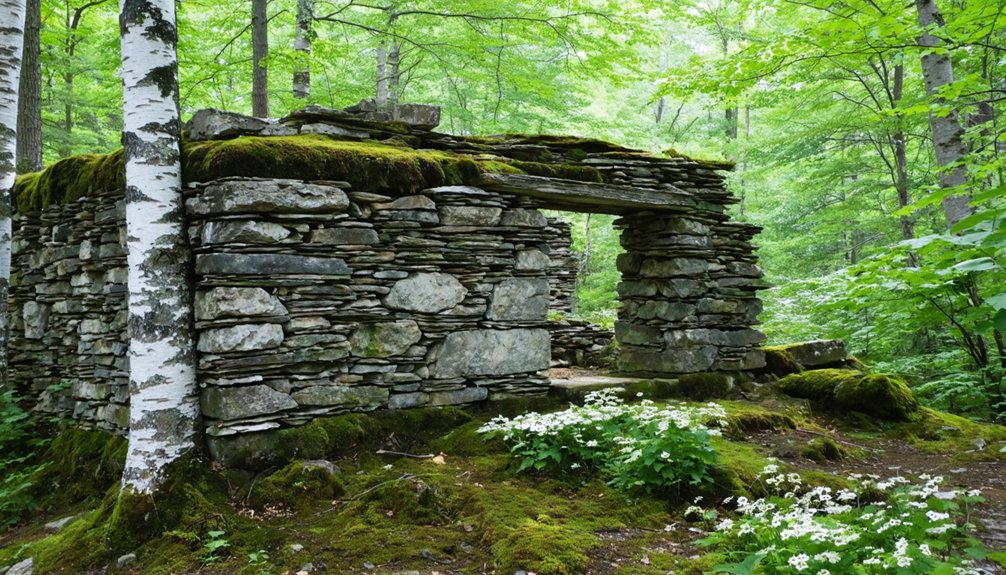
Among Crawford Notch’s towering peaks, one site stands frozen in time where tragedy reshaped an entire family’s fate on a single August night in 1826.
You’ll discover the Willey House site, where Samuel Willey Jr.’s family transformed a modest 1793 structure into a thriving inn before disaster struck. After witnessing June’s violent landslide, they’d built a stone shelter for protection.
Yet when torrential rains triggered Mt. Willey’s catastrophic slide that August, the house survived unscathed while the fleeing family perished.
What You’ll Experience:
- Interpretive center preserving tragic storytelling through historical conservation efforts
- Stunning vantage points where you’ll witness the same mountain that claimed seven lives
- Hiking trails threading through landscapes that launched White Mountains tourism
The doors stood open when travelers arrived, revealing empty beds and scattered belongings—a haunting testament to freedom’s fragility.
America’s Stonehenge: New Hampshire’s Ancient Mystery
You’ll find yourself standing among weathered megaliths and shadowy stone chambers at Mystery Hill, where the truth shifts like morning mist over exposed bedrock. The 30-acre site whispers competing histories—some claim you’re walking through a 4,000-year-old astronomical temple, while skeptics insist these grooved stones and underground passages are merely a colonial farmer’s handiwork transformed by a 1930s dreamer.
As you navigate the Oracle Chamber‘s alcove and trace your fingers along ancient-looking drains and basins, you’re left to wonder whether Jonathan Pattee’s 19th-century homestead or something far older lies beneath your feet.
Ancient Stone Structure Origins
When you stand among the weathered stone slabs at America’s Stonehenge, you’re looking at one of archaeology’s most contentious puzzles. The ancient construction theories range from Viking explorers to Celtic seafarers, each leaving supposed celestial markers carved in stone.
Yet archaeological skepticism dominates professional circles—no European artifacts, pottery shards, or burial grounds support pre-Columbian contact.
Competing theories propose:
- Irish monks building astronomical chambers in the 11th century
- Native Americans creating ceremonial structures 4,000 years ago
- Colonial farmers constructing root cellars and quarrying stone commercially
Radiocarbon dating reveals human presence from 2000 BCE, but the Pattee family’s 19th-century homesteading and William Goodwin’s 1930s “restorations” muddy the evidence.
You’ll need to decide whether you’re witnessing ancient mystery or elaborate Yankee ingenuity.
Exploring the 30-Acre Site
Sprawling across Salem’s wooded hillside, the 30-acre archaeological complex greets you with an immediacy that photographs can’t capture—weathered stone chambers emerging from the earth like ancient teeth, their dark mouths beckoning from beneath centuries of leaf mold and New England frost. You’ll navigate thirteen interconnected chambers through self-guided exploration, discovering stone-lined drains carved into bedrock and mysterious basins that spark debates about medieval rituals versus colonial farmstead utility.
The exposed summit reveals grooves and niches that enthusiasts compare to prehistoric monuments, though scholars remain skeptical. Between December snows and August heat, you’re free to wander snowshoe trails and examine every cryptic marking. The site’s privately-owned status means fewer restrictions—just pay admission and lose yourself in New Hampshire’s most contentious archaeological puzzle.
Forgotten Settlements of the White Mountains
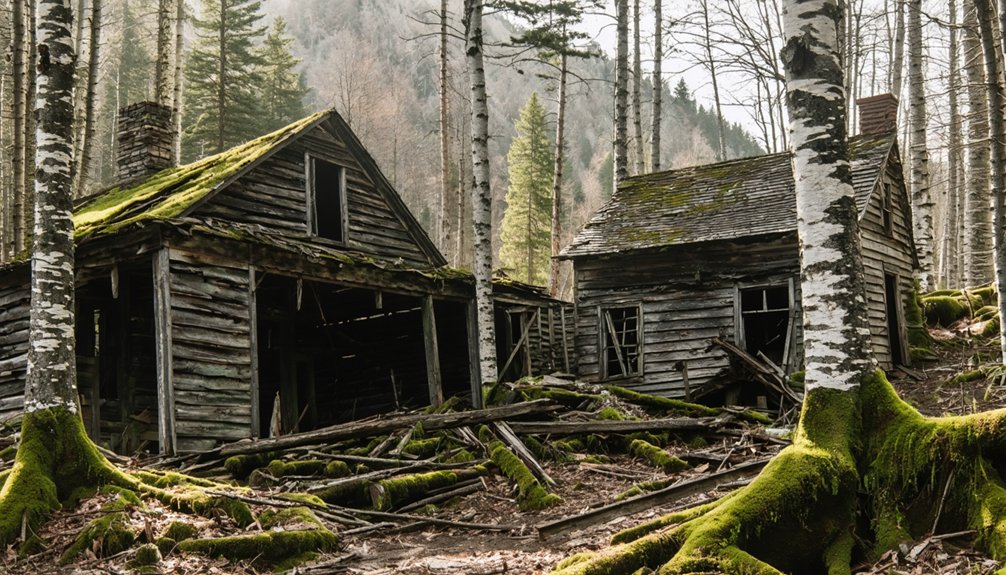
Deep within the White Mountain National Forest, nature has reclaimed what 19th-century settlers once carved from wilderness—dozens of forgotten villages where stonewalls now disappear beneath moss and cellar holes sink into forest floors.
You’ll discover over 600 documented cellar holes marking where communities like Thornton Gore and Sandwich Notch once thrived. These settlements peaked in the 1850s before residents abandoned their rocky homesteads for western lands and factory work.
Today’s forest conservation and historical preservation efforts protect these haunting remnants:
- Wildcat Cemetery stands sentinel among Thornton Gore’s scattered foundations
- Sawyer River’s silence echoes where Livermore’s 200 residents once bustled
- Tripoli Road trails lead you past stonewalls threading through second-growth timber
Limited documentation protects these sites from vandalism, leaving you to navigate unmarked paths where freedom-seeking pioneers once gambled everything on unforgiving soil.
Frequently Asked Questions
Are These Ghost Town Sites Safe to Visit With Young Children?
You’ll find these sites generally safe since 1937’s federal preservation eliminated major structural hazards. Practice hazard awareness around scattered debris and cellar holes, follow preservation guidelines on marked trails, and you’ll create unforgettable adventures exploring New Hampshire’s hauntingly beautiful abandoned villages.
Among the most intriguing options are the ghost towns in New Hampshire, where nature has begun to reclaim the land. As you wander through these remnants of the past, take a moment to appreciate the stories hidden within the dilapidated structures. Captivating tales of the former residents linger in the air, inviting you to imagine life in these once-thriving communities.
Do Any of These Locations Require Entrance Fees or Permits?
Most sites welcome you freely without entrance fees or permits, respecting your wanderlust. However, Willey House in Crawford Notch State Park may require standard park fees. Visitor regulations remain minimal, allowing spontaneous exploration while supporting historical preservation efforts.
What’s the Best Time of Day to Photograph These Ruins?
You’ll capture these forsaken settlements best during golden hour—dawn or dusk—when prime lighting bathes crumbling foundations in amber warmth. Light conditions transform ordinary stones into storytelling relics, letting you document history’s whispers without crowds interfering with your explorations.
Are Dogs Allowed at These Historic Sites and Trails?
Yes, you’ll find dog friendly trails throughout these sites! Just follow pet safety tips: keep leashes handy, pack water, and watch footing on ruins. Your adventurous pup can explore abandoned cellar holes and coastal forests alongside you.
Can I Camp Overnight Near Any of These Ghost Towns?
You’ll find sleeping under the stars near Thornton Gore possible at Tripoli Road Camping Area ($25/night). Historical preservation rules prohibit camping at Monson Center. Wildlife encounters await in White Mountain’s backcountry, where freedom-seekers can disperse camp following distance regulations.
References
- https://www.worldatlas.com/cities/8-delightfully-odd-towns-in-new-hampshire.html
- https://nothingbutnewengland.com/new-hampshires-haunted-hikes/
- https://thefrogandpenguinn.blogspot.com/2021/07/a-nh-ghost-town.html
- https://www.youtube.com/watch?v=blAbKoH-S5Q
- https://www.visitwhitemountains.com/blog/post/spooky-stories-ghost-towns-and-historic-haunted-spots/
- https://www.forestsociety.org/property/monson-center
- https://www.scenicnh.com/abandoned-places-white-mountains/
- https://theparkexplorer.wordpress.com/2013/03/02/lost-town-found-monson-center/
- https://www.atlasobscura.com/places/monson-new-hampshire
- https://www.nhmagazine.com/the-mystery-of-monson/