You’ll find New Mexico’s ghost towns particularly rewarding in summer, when extended daylight hours let you explore abandoned silver-mining camps like Mogollon and Chloride, turquoise settlements along the Turquoise Trail such as Cerrillos, and authentic Old West sites like Shakespeare. The season offers ideal conditions for photographing weathered adobe structures, false-front storefronts, and historic cemeteries against dramatic mountain backdrops. With proper preparation—including plenty of water, sun protection, and reliable transportation—you can experience these atmospheric portals to frontier history while discovering the specific attractions and planning strategies that’ll make your expedition truly memorable.
Key Takeaways
- Notable summer destinations include Cerrillos, Mogollon, Chloride, Lake Valley, and Shakespeare, featuring preserved adobe ruins and false-front storefronts.
- Access sites via scenic routes like the Turquoise Trail (65 miles) and Billy the Kid Trail (121 miles) with reliable vehicles.
- Summer visitors must carry 1 gallon of water per person daily, sun protection, sturdy footwear, and emergency supplies.
- Golden hour offers ideal photography conditions to capture textures, rust, and atmospheric decay of historic structures.
- Self-guided tours include museums, abandoned buildings, historic cemeteries, and landmarks like the Hanging Tree and stage stations.
Cerrillos: Turquoise Mining Heritage Along the Turquoise Trail
Nestled along the scenic Turquoise Trail between Albuquerque and Santa Fe, Cerrillos stands as a living legacy to North America’s oldest and most significant turquoise mining operations.
Cerrillos preserves North America’s ancient turquoise mining heritage along New Mexico’s storied Turquoise Trail between two historic cities.
You’ll discover a remarkable timeline spanning from A.D. 900, when Native Americans first wielded stone tools at Mount Chalchihuitl, through Spanish colonial exploitation that sparked the 1680 Pueblo Revolt, to the 1870s silver boom that transformed this into a thriving railroad town.
The mining techniques evolved from prehistoric surface pits to territorial-era tunnels extracting gold, silver, and copper alongside the prized turquoise.
The district’s turquoise displayed distinctive characteristics, with colors ranging from sky blue to blue-green, often featuring bright specks of pyrite within specimens that made Cerrillos stones particularly prized among collectors.
Today, you can explore the Cerrillos Turquoise Mining Museum at Casa Grande Trading Post, where Native crafts and historical artifacts reveal how this gem once rivaled Persian turquoise in European markets before deposits played out. The museum stands on the former Palace Hotel site, where Thomas Edison once stayed while conducting gold experiments and territorial governor Lew Wallace drafted portions of *Ben Hur* nearby.
Mogollon: Mountain Ghost Town With Scenic Views
You’ll find nearly 100 historic structures clinging to the mountainside in Mogollon, accessible via a thrilling 9-mile drive through narrow, winding roads carved into the Mogollon Mountains.
The preserved buildings—including saloons, a theater, hospital, and two former red-light districts—now house galleries and shops operated by the town’s 15-20 dedicated residents on summer weekends.
Rising from Silver Creek Canyon at high elevation, this remote ghost town rewards your adventurous ascent with sweeping mountain vistas and an authentic glimpse into New Mexico’s mining past. Named after a Spanish governor from the 1700s, the town’s origins trace back to Sergeant James C. Cooney’s discovery in the nearby Hila Mountain during the 1870s. The Mogollon Museum displays mining tools and artifacts alongside a recreated mine shaft, offering visitors tangible connections to the town’s boom era that peaked in 1915.
Historic Buildings and Galleries
Approximately 100 historic buildings stand as weathered sentinels throughout Mogollon‘s canyon setting. Their stone and adobe walls tell stories of boom times when 2,000 residents filled the streets.
Adobe architecture replaced original wooden structures after devastating fires, creating the enduring streetscape you’ll explore today. The town’s infrastructure once supported 5 saloons, 2 restaurants, a bakery, and hotels during its mining heyday.
Must-See Historic Attractions:
- Silver Creek Inn – Operating from an 1885 adobe structure, the original Mogollon House once housed travelers in upstairs rooms while merchants sold goods below.
- Mogollon Museum – Discover Mimbres pottery, antique firearms, and a recreated mine shaft in the old root cellar. The museum occupies a former general store that once served the mining community.
- Painted Coyote Gallery – Browse distinctive stained-glass art set within restored antique window frames.
- General Store & Theatre – Walk through authentic commercial buildings from mining’s heyday.
Furnace preservation efforts continue through dedicated caretakers who’ve maintained these structures since the 1990s.
Mountain Drive and Elevation
Reaching Mogollon requires traversing one of New Mexico’s most dramatic mountain approaches—the winding NM-159 that climbs, plunges, and curves through 2,700 feet of elevation changes. This mountain roadway, originally built in 1897 as Bursum Road, snakes along narrow canyon walls barely a quarter-mile wide, offering breathtaking views over Silver Creek Canyon‘s depths.
You’ll find yourself at 6,800 feet elevation once you arrive, surrounded by high altitude flora typical of the Mogollon Mountains.
The drive features hair-raising sections where rock walls support one-and-a-half lane passages, but modern paving has tamed the worst hazards. The partially single-lane road stretches approximately 6 miles, with designated parking before the narrowest section where travelers must leave their vehicles. Summer conditions make this journey ideal—clear skies showcase the dramatic elevation changes as you descend 2,000 feet toward the San Francisco River valley, with sweeping vistas rewarding your adventurous spirit. The challenging route’s reputation is so well-known that local T-shirts humorously reference the road’s narrow turns and steep drops that deter many visitors.
Chloride: Silver-Mining Town With Pioneer History
Chloride stands as one of New Mexico’s most accessible and well-preserved silver-mining towns, where you’ll find authentic 1880s structures still anchoring the dusty streets.
The Pioneer Store Museum captures the boomtown era in stunning detail. Its shelves are time-sealed in 1923 with period merchandise exactly as the last merchant left them.
Beyond the museum, you can explore the Monte Cristo Saloon‘s transformed gallery space and photograph the legendary Hanging Tree, a 200-year-old sentinel that once served as the lawless town’s makeshift jail. The town’s discovery traces back to 1879 when Harry Pye stumbled upon a silver chloride vein while hiding in a gulch during a freight transport. For those wanting to extend their visit, the town offers two vacation rentals—Pye Cabin and Miner’s Cabin—each providing a unique opportunity to experience overnight stays in this historic setting.
Historic Buildings and Landmarks
Stepping onto Wall Street in Chloride feels like walking through a portal to the 1880s, where twenty-seven original buildings—adobe structures and weathered false-fronts—still line the dusty thoroughfare. You’ll discover authentic Victorian architecture preserved through decades of abandonment, creating an atmosphere ripe with ghost stories and frontier legends.
Must-See Historic Sites:
- Pioneer Store Museum – James Dalglish’s 1880 general store, sealed in 1923 with merchandise intact for seventy years, now showcases original fixtures and pre-1900 goods alongside mining artifacts.
- Monte Cristo Saloon – This multi-purpose adobe served as saloon, schoolhouse, and mining headquarters; today it’s an art gallery featuring local craftspeople.
- The Hanging Tree – A 200-year-old oak on Wall Street that witnessed frontier justice.
- Grafton Cabin – A two-story log structure open for exploration.
Silver-Mining Boom Era
The weathered buildings you see along Wall Street owe their existence to a chance discovery in 1879, when freight hauler Harry Pye stumbled upon silver-rich ore while traversing a Black Range Mountains canyon on a U.S. Army supply route.
His find sparked Chloride’s explosive silver boom, transforming empty wilderness into a 3,000-person mining hub by 1883. You’ll find remnants of this historic mining era scattered throughout town—remnants of 42 working mines that once extracted $500,000 worth of silver from 480 claims.
The boom’s intensity matched its brevity: nine saloons lined the main drag alongside stores, hotels, and even a millinery shop. When the 1896 gold standard collapsed silver prices, this thriving community dwindled to just 125 residents by 1900, leaving behind the ghost town you’re exploring today.
Museums and Attractions
Your exploration of Chloride‘s past begins at the Pioneer Store Museum, where original artifacts sit exactly as they were found after decades behind shuttered doors. The self-guided walking tour reveals mining-era buildings and the two-story Grafton Cabin, showcasing daily life through handmade resident items.
Essential Chloride Experiences:
- Monte Cristo Saloon and Gallery – Browse local artisan works in this converted dance hall, open five days weekly
- Historic Cemetery – Discover frontier graves marked by vintage telephones and Native American heritage connections
- 200-Year-Old Hanging Tree – Visit the crime deterrent on Wall Street, still standing despite storm damage
- Chloride Bank Cafe – Enjoy local culinary experiences after touring false-front buildings and adobe structures
Both museum and gallery operate Thursday through Monday, 10 a.m. to 4 p.m., letting you roam independently.
Shakespeare: Authentic Old West National Historic Site
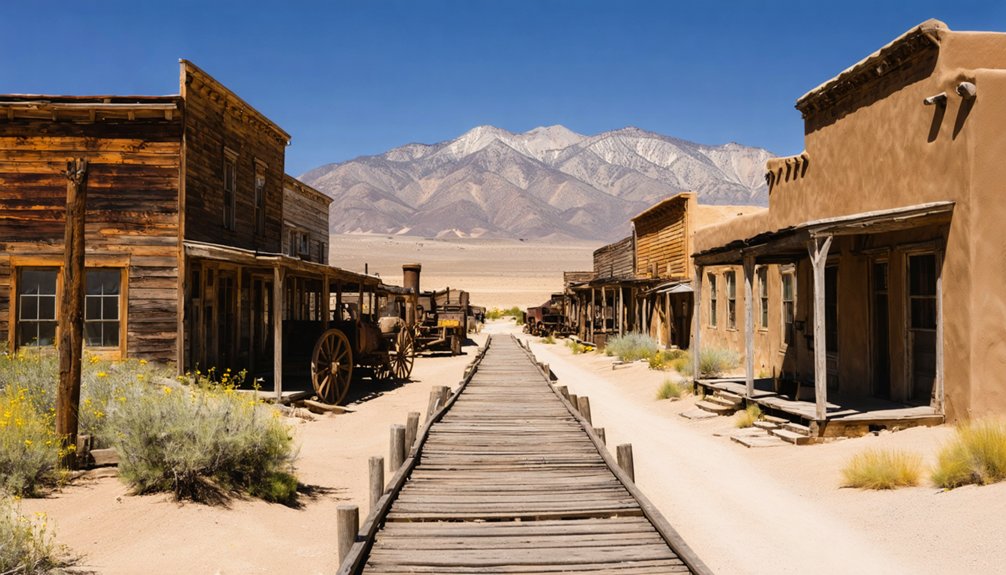
Nestled in the high desert near the Pyramid Mountains, Shakespeare stands as one of New Mexico’s most authentic ghost towns, where genuine Old West history unfolds across weathered adobe walls and sun-bleached wooden structures.
You’ll walk through the original 1858 Grant House stage station and explore buildings where notorious outlaws like Curly Bill Brocius and John Ringo once roamed.
Local legends whisper of vigilante justice—”Russian Bill” and Sandy King swung from nooses here in 1881—and some say Brocius himself lies buried beneath the general store.
Thanks to preservation efforts beginning in 1935 when the Hill family purchased the site, Shakespeare earned National Register status in 1973.
You can visit one weekend monthly, experiencing unvarnished frontier reality without tourist gimmicks.
Lake Valley: Archaeological Treasure With Self-Guided Tours
Rising from the mineral-rich Black Range seventeen miles south of Hillsboro, Lake Valley beckons history seekers with its weathered buildings and self-guided exploration of one of New Mexico’s most significant silver strikes.
This protected archaeological site preserves ancient artifacts where they’ve rested since the 1893 silver panic emptied the streets.
You’ll wander among 10-12 standing structures—homes, commercial buildings, and remnants of the legendary Bridal Chamber mine that yielded 2.5 million ounces of silver.
What Makes Lake Valley Worth Your Visit:
- Self-guided walking tours through authentic 1880s buildings
- Visible railroad grades from the 1884 Atchison, Topeka & Santa Fe spur
- Archaeological significance with federally protected artifacts
- Lake Valley Back Country Byway access into remote Black Range terrain
Open daylight hours (closed Tuesdays-Wednesdays), this genuine ghost town remains unpopulated—pure Western solitude.
Cuervo: Route 66 Relic Along Historic Highway

Straddling the ghostly divide where Interstate 40 sliced through its heart, Cuervo stands as a haunting monument to Route 66‘s rise and fall.
You’ll find abandoned structures scattered across barren streets—remnants of gas stations, a hotel, and medical clinic that once served 300 residents during the 1940s boom.
Crumbling remnants of everyday life—gas pumps, lodging, healthcare—still stand where 300 souls once called this desolate crossroads home.
The town’s demise came swiftly when I-40 bypassed its center in the late 1960s, demanding costly on-ramps the community couldn’t afford.
Named for nearby Cuervo Hill (Spanish for “raven”), this 1901 railroad settlement officially became a ghost town when its post office closed in 2011.
Today, local legends whisper through empty buildings, drawing Route 66 enthusiasts who crave the untold stories of America’s vanishing roadside culture.
Planning Your Ghost Town Road Trip
How will you navigate New Mexico’s vast desert expanses to reach these abandoned outposts of frontier history? You’ll need a reliable vehicle for remote dirt roads and smaller highways leading to ghost towns. Here’s your essential planning guide:
As you venture into the less-traveled areas of the state, consider checking out some abandoned sites to explore in New Mexico, which often tell stories of the past and surprise with their haunting beauty. These forgotten places can offer a glimpse into a time long gone, making your journey an adventure filled with history and mystery. Don’t forget to bring a camera; the remnants of these locations provide stunning photo opportunities against the backdrop of New Mexico’s striking landscape.
- Choose your route: The Billy the Kid Trail spans 121 miles, while the Turquoise Trail covers 65 miles through juniper-piñon hills with local cuisine stops in Cerrillos and Madrid.
- Plan extra time: Factor in wildlife encounters and site exploration beyond pure driving hours.
- Prepare for conditions: Barely noticeable dirt paths require careful navigation, like the off-road access near Gage.
- Extend your adventure: Consider the two-day Las Vegas itinerary with overnight stays in haunted hotels, exploring northeast ghost towns at your own pace.
What to Bring for Summer Ghost Town Exploration
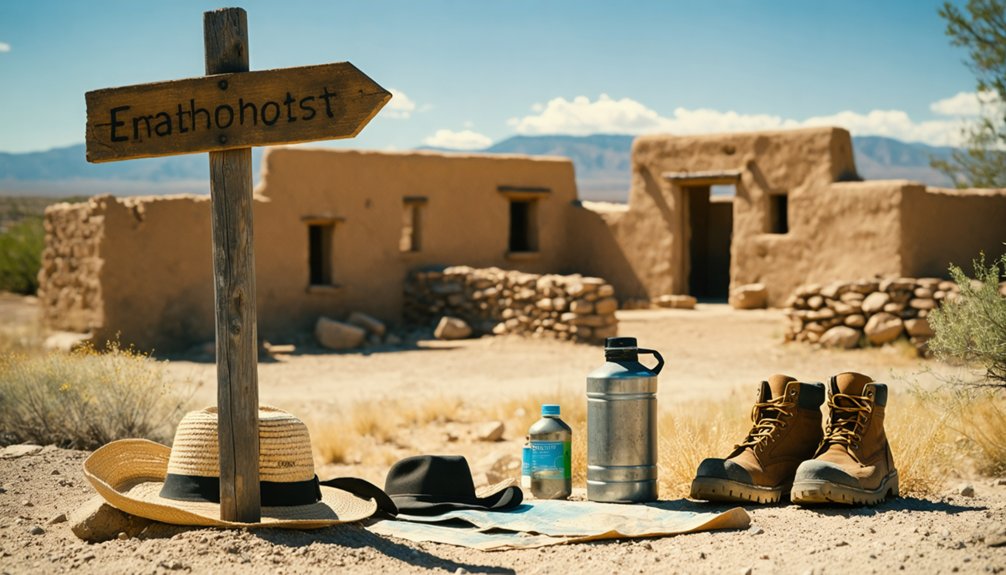
Before you venture into New Mexico’s abandoned settlements, you’ll need to pack strategically for the state’s unforgiving summer conditions. Carry one gallon of water per person daily, plus electrolyte packets for high-altitude treks through local legends like Mogollon at 7,000 feet.
Survival in New Mexico’s high-desert ghost towns demands serious hydration—one gallon per person daily isn’t a suggestion, it’s essential.
Apply SPF 50+ sunscreen every two hours and wear wide-brimmed hats against the relentless desert sun. Sturdy hiking boots with solid traction handle rugged mountain roads, while moisture-wicking layers adapt to temperature swings from scorching days to cool evenings.
Download offline maps—cell service vanishes in these remote locations. Pack a first-aid kit, flashlight, and insect repellent for wildlife encounters in the Gila Wilderness.
Include emergency supplies: whistles, spare tires, and tools for those isolated drives where help isn’t coming quickly.
Photography Tips for Capturing Historic Sites
When golden hour bathes New Mexico’s weathered adobe walls in amber light, your camera becomes a time machine.
You’ll capture the untamed spirit of abandoned settlements by mastering these essential techniques:
- Embrace natural light cycles – Shoot during dawn or dusk when shadows reveal architectural textures and crumbling details tell authentic stories.
- Keep compositions uncluttered – Remove modern distractions, find leading lines through doorways, and frame shots with natural elements like weathered timber beams.
- Experiment with perspectives – Use wide-angle lenses for environmental context, then zoom tight on intricate details like rusted hinges or faded advertisements.
- Push creative boundaries – Try drone photography for sweeping overhead views and night photography to capture star-trails above silhouetted structures.
Respect these historic spaces while documenting their raw, unvarnished beauty.
Frequently Asked Questions
Are There Restaurants or Food Services Available in These Ghost Towns?
You’ll discover surprising culinary treasures waiting in ghost towns. Local cuisine thrives at establishments like Mama Lisa’s Ghost Town Kitchen in Madrid, while food vendors and bakeries in Pie Town serve travelers seeking authentic regional flavors and adventure.
Can Visitors Enter the Historic Buildings or Only View From Outside?
You’ll find some buildings open for guided tours with paid entry, like Anderson-Freeman’s museum and stores, while historic preservation concerns and no-trespassing signs restrict others to exterior viewing only. Always respect posted boundaries and structural safety warnings.
Are These Ghost Towns Safe to Visit Alone or at Night?
You shouldn’t visit alone or at night without safety precautions. Remote locations lack emergency services, unstable structures pose hazards in darkness, and New Mexico’s high crime rates increase risks. Nighttime exploration demands extreme caution and preferably companions.
Exploring unique ghost towns in New Mexico can be a fascinating experience, offering a glimpse into the past with their abandoned buildings and rich histories. However, it’s crucial to prepare adequately for the journey, as navigating these secluded areas can be challenging. Ensure you have a reliable map and some basic supplies, as some locations may be harder to access than they appear.
As you embark on your adventure exploring ghost towns in New Mexico, remember to respect the local environment and history. Many of these sites are steeped in stories of the past, and it’s important to leave them undisturbed for future visitors. Engaging with local guides can also enhance your experience, providing insight that enriches your understanding of these fascinating locations.
Do Any Ghost Towns Charge Admission Fees or Require Advance Reservations?
Yes, entry restrictions vary widely. Shakespeare’s fee policies include $15 adult admission with advance reservations required. Madrid offers self-guided freedom from $6-7. Old Town Albuquerque charges $35 for ghost tours, while Mogollon remains mostly free to explore.
What Is the Best Time of Day to Avoid Summer Heat?
Morning visits offer ideal visiting hours before 9 AM when temperatures stay coolest. You’ll find shade and shelter options in historic buildings at higher elevations like Mogollon. Explore early, then retreat before afternoon heat intensifies your adventure.
References
- https://newmexicotravelguy.com/new-mexico-ghost-towns/
- https://geronimoranch.com/blog/ghost-towns-in-nm/
- https://usghostadventures.com/americas-most-haunted-trending/ghost-towns-to-visit-on-your-summer-road-trip-along-route-66/
- https://www.newmexico.org/places-to-visit/ghost-towns/
- https://www.islands.com/2069865/new-mexico-abandoned-ghost-towns-once-thriving/
- https://www.tripadvisor.com/Attractions-g28952-Activities-c47-t14-New_Mexico.html
- https://www.youtube.com/watch?v=pGPjU65CHeE
- https://www.cerrillosturquoise.com/cerrillos-mining-district
- https://www.casagrandetradingpost.com/mining-museum
- https://www.cerrilloshills.org/history/a-cultural-historical-overview/history-of-the-cerrillos-mining-district/tri-cultural-use-of-the-cerrillos-mines