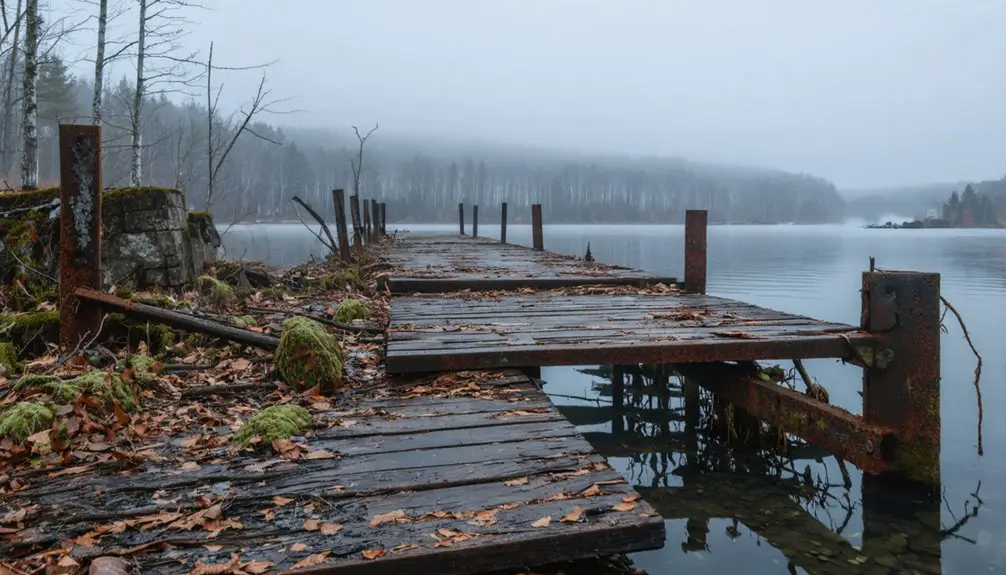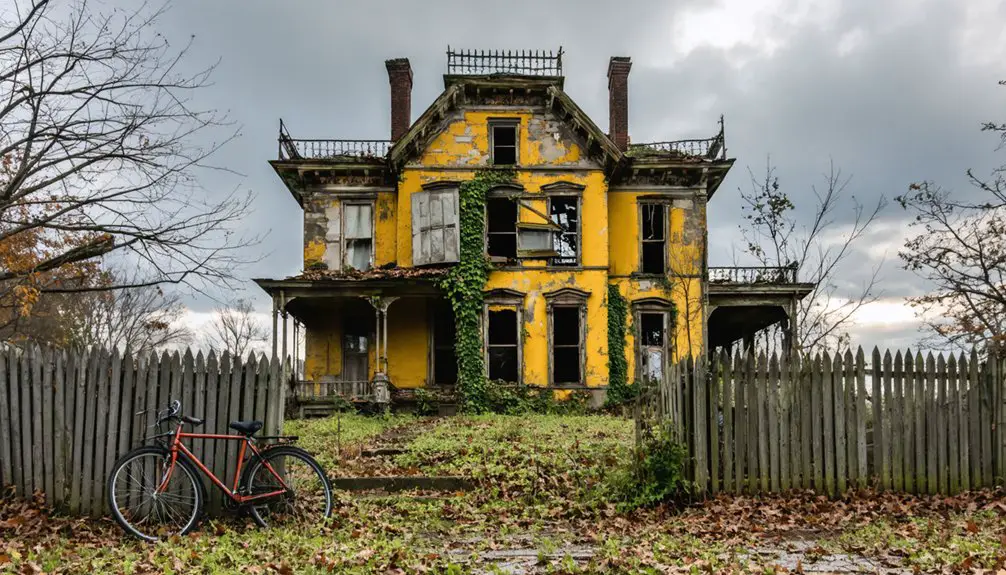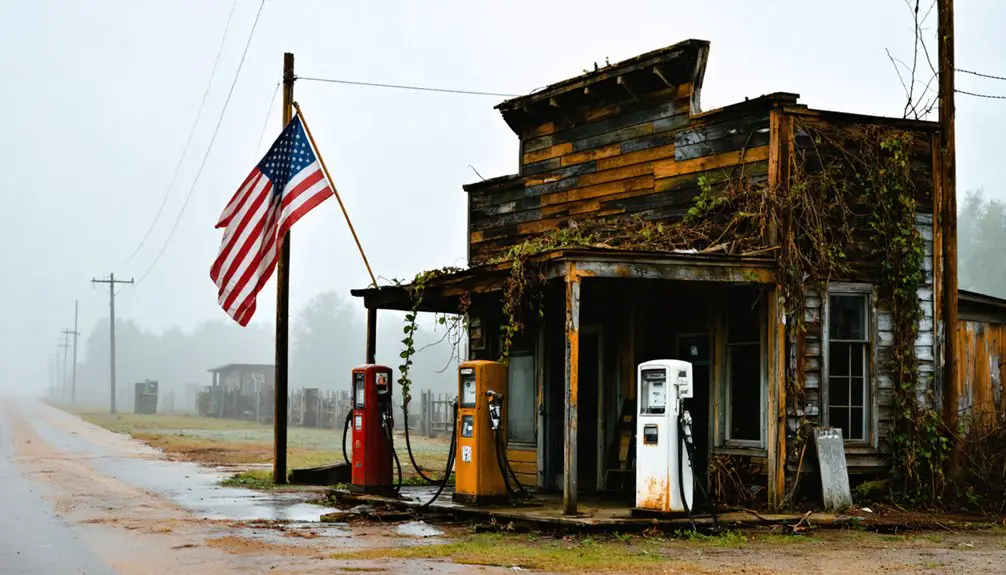
You’ll find New York’s most accessible summer ghost towns at Doodletown in Bear Mountain State Park, where a 3-mile hike reveals 70 abandoned home sites, and Parksville near Liberty, featuring boarded-up storefronts from its Borscht Belt heyday. For industrial ruins, trek to Tahawus in the Adirondacks to explore 1820s blast furnaces, or visit Frontier Town’s Wild West theme park remnants near North Hudson. Each location offers unique photography opportunities and historical insights that transform these forgotten settlements into compelling summer adventures.
Key Takeaways
- Doodletown in Bear Mountain State Park offers a 3-mile hike through 70 demolished home sites with visible foundations and stone structures.
- Parksville near Liberty features abandoned storefronts, former resort hotels, and historic cemeteries along the Little Beaver Kill River.
- Tahawus in the Adirondacks showcases overgrown blast furnaces and abandoned machinery from its 1820s iron works and WWII titanium operations.
- Frontier Town near North Hudson displays ruins of a 1950s Wild West theme park, now campgrounds with trails through theatrical remnants.
- Early summer mornings provide cooler conditions for exploring; spring and fall are recommended as best seasons for ghost town visits.
Doodletown: Bear Mountain’s Hidden Valley Settlement
Tucked into a hidden valley within Bear Mountain State Park, Doodletown’s abandoned foundations and crumbling stone walls tell the story of a community that thrived for two centuries before vanishing.
You’ll hike three miles along Doodletown Trail to discover cellar holes, stone stairs leading nowhere, and remnants of seventy demolished homes.
The state forcibly bought out residents in 1964, evicting the last families by 1965.
Unlike typical urban decay, nature’s reclaiming this settlement—barberry bushes fill old clearings where 300 people once lived.
Trail markers identify former buildings, while June Cemetery remains preserved with recent burials.
Before European settlers arrived, the valley was inhabited by Munsee Indians thousands of years ago, adding deep historical layers to this hidden landscape.
The town’s roots trace back to April 1762, when a member of the June family purchased the land that would become this close-knit hamlet.
Preservation efforts focus on maintaining access and historical markers rather than rebuilding.
Park officials gate Lemmon Road against vehicles, keeping this ghost town accessible only to those willing to walk.
Parksville: Sullivan County’s Forgotten Community
You’ll find Parksville tucked in a forested valley four miles from Liberty, where papered-over storefronts and silent streets create an unsettling contrast to the gentle flow of Little Beaver Kill River.
Access the town via Exit 98 off I-86, now a diamond interchange leading directly to the abandoned business district along what was once bustling Main Street.
Park near the 1898 Methodist Church or by Cabernet Franks—one of the few surviving establishments—then walk the eerie commercial strip where 65 hotels once welcomed Borscht Belt vacationers. The community’s collapse began when passenger train service ended in 1957 following the NYO&W railway bankruptcy, severing the vital connection that once brought thousands of summer visitors from New York City. This former resort community shares its name with several other locations, making it important to specify Sullivan County when researching the area’s history.
Hidden Hamlet in Ruins
Deep in Sullivan County’s verdant hills, Parksville stands as a haunting testament to the Catskills’ vanished glory days. You’ll discover vacant storefronts with papered-over windows lining the old main street—remnants of 65 hotels that once buzzed with summer visitors.
The crumbling Paramount Hotel, originally a hunter’s boarding house, now fuels urban legends among locals. Abandoned for over 22 years, the structure shows extensive water and fire damage from a blaze around 2000. Walk through the Baptist Church Cemetery, where preservation efforts began in 2020, or visit the Methodist Church graveyard where founder William Parks rests. Parks was an early settler who contributed mills and helped shape the community’s development.
With fewer than 1,000 residents, you’re free to explore this eerie landscape that time forgot. Stop at Cabernet Franks for sustenance, then wander past ghostly buildings that once served Borscht Belt vacationers before Interstate 86 sealed Parksville’s legacy.
Sullivan County Access Routes
Getting to Parksville requires maneuvering the winding evolution of Sullivan County’s primary artery—Interstate 86, still known to locals by its former designation as Route 17. You’ll exit at the diamond interchange marking Exit 98, once famous as the only stoplight-controlled grade intersection east of Hancock.
The 2011-2012 bypass that sealed Parksville’s fate now ironically provides your most direct route into its urban decay.
Your vehicle descends from the elevated interstate onto what’s now a two-lane road leading to Main Street’s shuttered storefronts. The contrast strikes immediately—smooth modern highway giving way to streets frozen in time. The highway follows the old railroad bed of the Ontario & Western Railway, which once made this the most popular stop on the line before trains ceased in the late 1950s. The O&W Railroad’s late 19th-century arrival transformed Parksville from a modest farming community into a boarding house destination that would eventually host the region’s famous resort era.
While historical preservation efforts remain minimal, the United Methodist Church cemetery, dating to 1898, offers tangible connection to William Parks and the community’s founders who couldn’t foresee this eventual isolation.
Exploring the Abandoned Remains
When you step onto Main Street today, the silence feels almost oppressive—no car engines, no conversations drifting from doorways, just wind whistling through boarded-up storefronts that once housed thriving restaurants and ice cream shops.
The urban decay strikes immediately: vacant commercial buildings with papered-over windows create an eerie ghost town impression you’ll want to photograph.
You’ll find the abandoned architecture of the former Parksville Paramount Resort particularly haunting. Once accommodating hundreds of guests, it transformed from resort to boarding house to hunters’ hotel to Best Western before a 2000 kitchen fire sealed its fate.
Now it stands empty, joining over 100 hotels that simply vanished.
A gas station and Cabernet Franks restaurant survive—lonely outposts where you can fuel up before exploring further into Sullivan County‘s forgotten corners. Despite the desolation, this community in the town of Liberty still maintains a modest population of approximately 1,000 residents who call this peculiar place home.
Oswego Hamlet: Dutchess County’s Lost Settlement
Tucked between the rolling hills of LaGrange in Dutchess County, Oswego Hamlet once thrived as a small rural cluster where families like the Livingstons, Potters, and Reeds carved out their lives from the Hudson Valley wilderness. You’ll find remnants of colonial-era structures built with untooled stone, silent witnesses to the 1731 Oblong land trade that settled New York-Connecticut border disputes.
The hamlet faded when Hopewell Junction’s 1869 railroad arrival centralized commerce, leaving Oswego to ghost town folklore. This pattern echoed across New York, where railroad development around 1874 transformed settlement patterns and shifted economic centers away from established communities. Today, you can explore the Oswego Meeting House, protected through historic preservation and National Register status.
Wander the abandoned footpaths where early settlers once traveled, discovering why over 100 hamlets vanished from Dutchess County records. Summer’s your best window—these forgotten places reveal their stories when nature reclaims what progress abandoned.
Tahawus: The Adirondack Mining Village Frozen in Time
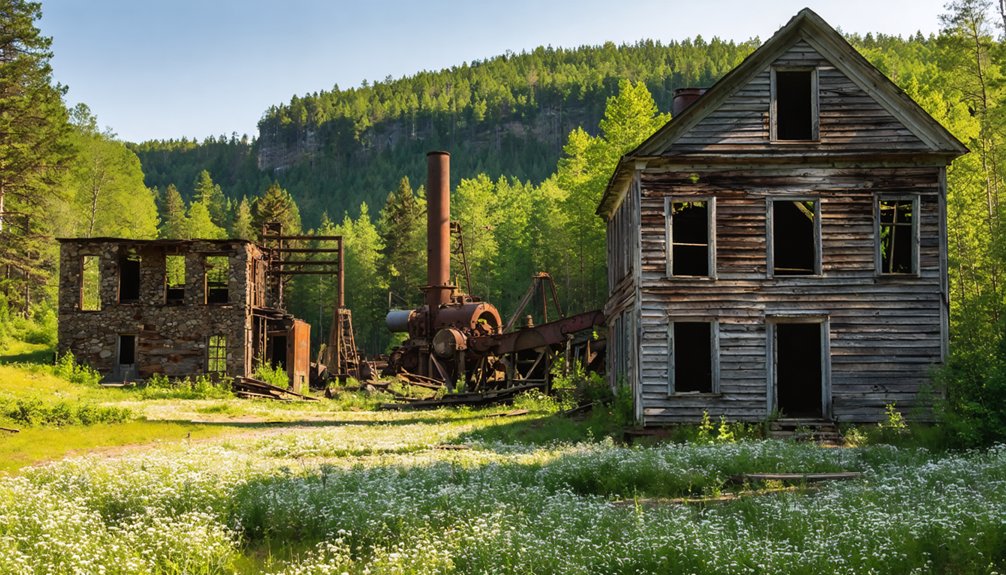
Rising from the Adirondack wilderness like a monument to industrial ambition, Tahawus stands where the McIntyre Iron Works once promised to revolutionize American steel production in the 1820s.
Tahawus rises from wilderness as a monument to industrial ambition, where 1820s iron dreams met Adirondack reality.
You’ll discover the 1854 blast furnace still commanding the landscape, alongside abandoned machinery slowly surrendering to nature’s reclaim.
This industrial heritage site witnessed two lifetimes—first producing America’s finest iron ore at premium prices until transportation challenges forced closure in 1858. Then, it was resurrected during WWII for titanium extraction until 1989.
Trek to MacNaughton Cottage and explore interpretive signs revealing stories of 180 families who once called this remote village home.
The overgrown plant site whispers of blast furnaces, mills, and a self-contained community that defied Adirondack isolation twice before finally yielding to economics and geography.
Frontier Town: A Wild West Theme Park Left Behind
While Tahawus tells the story of genuine industrial pioneers, another Adirondack ghost town celebrates a purely theatrical version of frontier life. You’ll find Frontier Town’s remains near North Hudson, where Arthur Bensen’s 1952 Wild West dream once drew 300,000 annual visitors.
Staged gunfights, can-can dancers, and bucking broncos entertained families until the 1980s brought decline and eventual abandonment in 1998.
Today, drought effects have exposed artifacts hidden for decades while accelerating the decay of weathered facades. Ghost town photography opportunities abound among overgrown rodeo arenas and collapsing saloons, though ruins officially remain off-limits.
New York State transformed the site into campgrounds with trails threading past theatrical remnants. You’re free to explore this peculiar intersection where manufactured mythology crumbles back into wilderness, offering something more authentic than Bensen ever intended.
Kensico: The Town Beneath the Reservoir
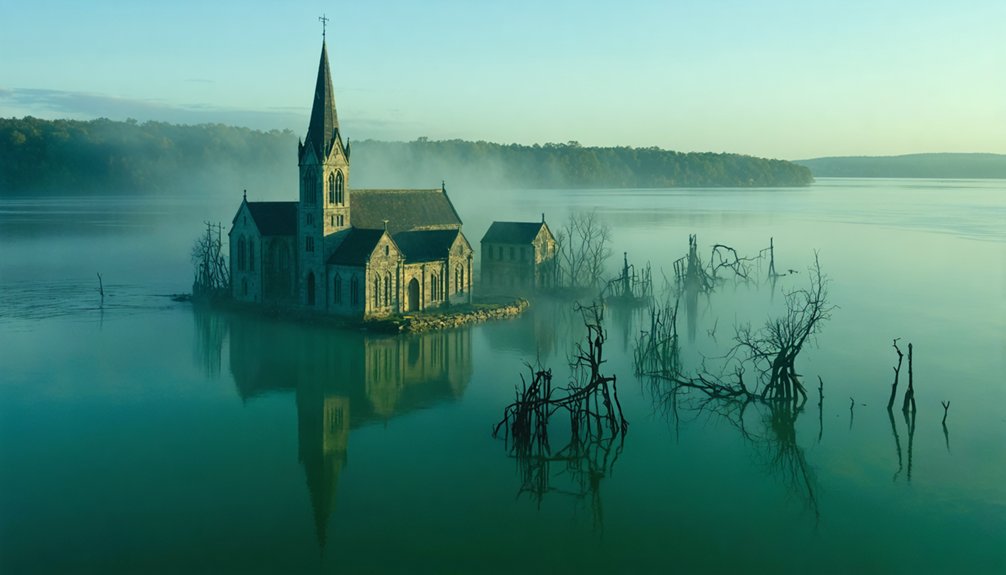
You can’t walk through Kensico’s streets or peer into its abandoned buildings—this ghost town lies beneath 30 billion gallons of drinking water.
When New York City needed a larger reservoir in 1910, an entire village disappeared: homes, churches, hotels, and the historic Wright’s Mills where General Washington once headquartered.
Today, you’ll find the massive Kensico Dam rising 307 feet above what was once a fertile valley, with only a millstone plaque marking where the old village stood before the waters covered it forever.
History of Kensico’s Submersion
Deep beneath the calm waters of Kensico Reservoir lies a complete village that once bustled with daily life—houses where families gathered for supper, stores where neighbors exchanged gossip, churches where wedding bells rang out across the valley.
Long before ancient folklore spoke of submerged foundations, this was Native American territory sold to English settlers in 1705.
The village’s fate was sealed by geography—those surrounding hills that formed a natural V-shape made it the perfect dam site.
Here’s what happened:
- 1885: First earthen dam flooded the valley’s lowest sections
- 1905-1910: New York City condemned and purchased every property as drought threatened the growing metropolis
- 1917: Massive concrete dam completed, drowning Kensico forever beneath 30 billion gallons
You’re swimming above an entire town’s memories.
Visiting the Reservoir Today
Standing at the edge of Kensico Reservoir today, you’ll gaze across 30 billion gallons of drinking water that serves over eight million New York City residents—a serene expanse that stretches between Armonk and North White Plains, just three miles north of White Plains proper.
The reservoir ecology thrives beneath the surface, where trout swim over submerged foundations and forgotten streets.
You can fish these stocked waters during summer, though water quality regulations prohibit swimming or diving.
Visit Kensico Dam’s park for playground areas and nature trails, or drive along NY-22 for sweeping views.
When water levels drop, you might spot that rumored church steeple breaking the surface—a ghostly reminder of the communities that once flourished here before 1915.
Planning Your Summer Ghost Town Adventure in New York
Before setting out to explore New York’s abandoned settlements, you’ll need to think about timing, accessibility, and proper permissions. While spring and fall typically offer ideal conditions, summer exploration remains possible with early morning starts to beat the heat.
Plan your adventure around season and access—spring and fall work best, but summer mornings can beat the heat.
Essential preparation includes:
- Securing access rights – Contact park authorities for Camp Santanoni or verify Frontier Town’s current visitor policies, as trespassing violations can end your adventure quickly.
- Researching locations – Study trail maps for Tahawus’s 7-mile wilderness approach and Doodletown’s Bear Mountain routes to avoid getting lost while hunting hidden artifacts.
- Packing appropriately – Bring water, sun protection, and a camera to document your discoveries and capture those ghost stories you’ll share later.
Respect posted signs and private property boundaries – true freedom comes from responsible exploration.
Frequently Asked Questions
Are There Any Ghost Towns in New York That Allow Overnight Camping?
You’ll find overnight camping at Crown Point’s historic battlegrounds and the abandoned Old Catskill Game Farm. Both blend historical preservation with adventure—expect wildlife encounters while exploring crumbling animal shelters and centuries-old forts under starlit skies.
What Safety Precautions Should Visitors Take When Exploring Abandoned Buildings?
Though it seems restrictive, you’ll actually explore more freely by wearing safety gear essentials—sturdy boots, respirator masks, and gloves. Test floors before stepping, watch for abandoned building hazards like unstable structures, and always bring a buddy for true adventure security.
Can I Legally Remove Artifacts or Souvenirs From These Ghost Town Sites?
You can’t legally remove artifacts from ghost towns without written landowner permission. Preservation laws protect these sites’ cultural significance—they’re held in trust for future generations. Always respect property rights and archaeological protocols when exploring abandoned places.
Which Ghost Towns Are Wheelchair Accessible or Suitable for Young Children?
Deserted Village of Feltville offers excellent wheelchair access with fully accessible buildings and restrooms. For family-friendly routes, you’ll find Tahawus has improved pathways, though Doodletown’s holes and crumbling roads aren’t ideal for young children.
Do Any of These Locations Offer Guided Tours or Interpretive Programs?
You won’t find guided tour options at these ghost towns—they’re all self-exploration adventures. However, Tahawus and Camp Santanoni feature excellent interpretive programs through detailed signage that’ll help you understand their fascinating histories while exploring independently.
For those interested in the lesser-known aspects of the region, historic ghost towns in New York offer a unique glimpse into the past. Each site tells a story of resilience and transformation, with remnants of old architecture and artifacts that ignite the imagination. As you wander through these abandoned places, you’ll feel a connection to the lives that once thrived there.
As you venture further into these ghost towns to explore in New York, you might come across fascinating structures that hint at the bustling communities they once were. These hauntingly beautiful sites are often surrounded by stunning landscapes, making them perfect for photography and reflection. Don’t forget to check out the local flora and fauna that have reclaimed these areas, adding another layer of history to the experience.
References
- https://943litefm.com/abandoned-ghost-towns-new-york/
- https://en.wikipedia.org/wiki/List_of_ghost_towns_in_New_York
- https://www.atlasobscura.com/things-to-do/new-york-state/abandoned
- https://visitadirondacks.com/fall/abandoned-places-ghost-towns
- https://hudsonvalleycountry.com/6-mysterious-hudson-valley-ghost-towns/
- https://www.youtube.com/watch?v=Nw2j2-YSknU
- https://midatlanticdaytrips.com/2022/06/doodletown/
- https://www.atlasobscura.com/articles/new-york-ghost-town-growing-graveyards
- https://rooseveltislanddaily.news/2019/04/24/doodletown-suburban-ghost-town/
- https://hvparent.com/doodletown