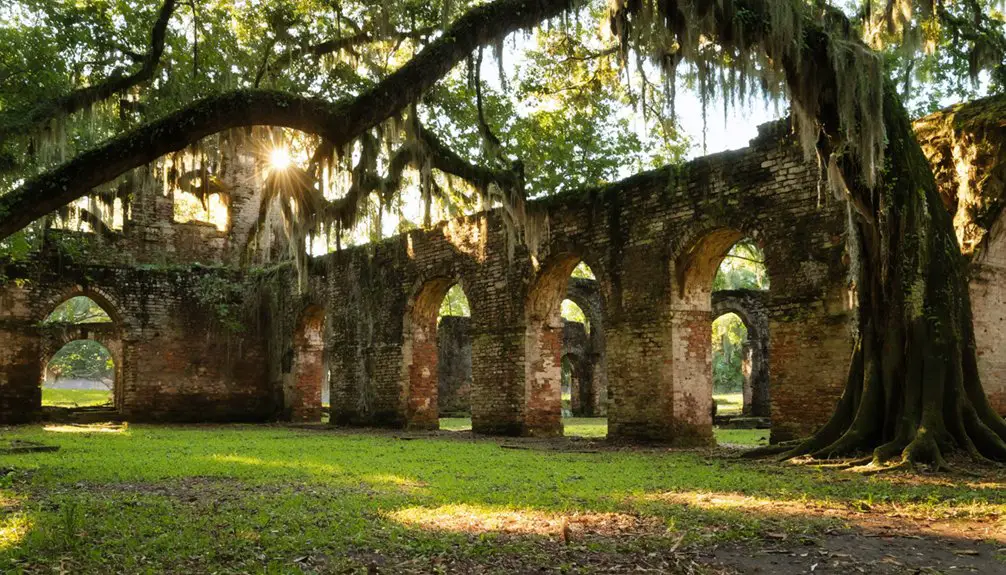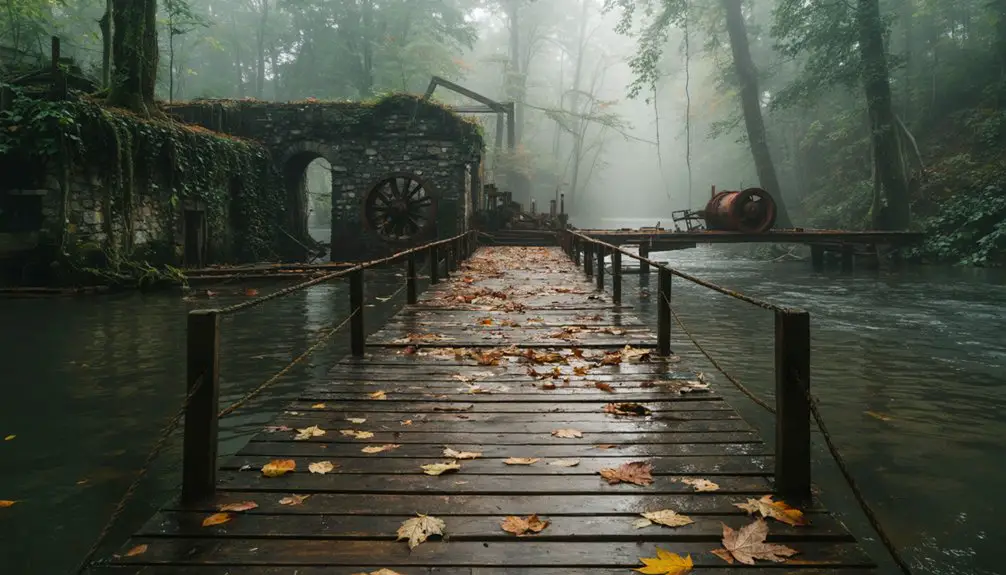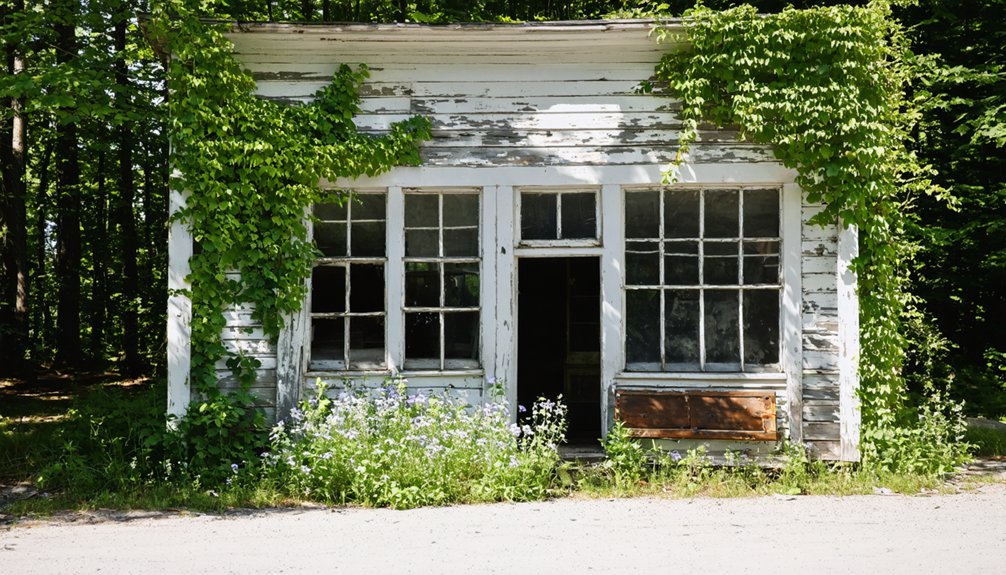
You’ll find North Carolina’s most accessible ghost towns at Mortimer, where Wilson Creek has reclaimed an entire 1904 lumber settlement you can explore by foot, and Portsmouth Village on the Outer Banks, reachable by ferry with 20 preserved buildings frozen since 1971. For something unusual, kayak to Proctor’s ruins beneath Fontana Lake, where 480 feet of water trapped an entire town in 1944. Buck Mountain’s abandoned Ghost Town theme park offers Wild West structures slowly disappearing under kudzu—though you’ll need proper gear and permits for several locations we’ve mapped out below.
Key Takeaways
- Mortimer offers accessible hiking, camping, and kayaking along Wilson Creek with visible ruins from the 1904 lumber town disaster.
- Proctor lies beneath Fontana Lake; kayak from Fontana Village Marina to see remnants above water and 27 cemeteries.
- Ocracoke Village within Cape Lookout National Seashore preserves 20 historic buildings including a church and schoolhouse from the 1800s.
- Ghost Town in the Sky remains closed atop Buck Mountain due to security barriers following a 2010 mudslide.
- Brunswick Town features colonial foundations, St. Philip’s Church ruins, and Civil War earthworks accessible through archaeological sites.
Mortimer: A Forest-Reclaimed Settlement Along Wilson Creek
Tucked deep within Pisgah National Forest, Mortimer emerges from the wilderness like a half-forgotten memory along the banks of Wilson Creek. You’ll find scattered foundations and rusted mill machinery where 800 souls once thrived in this 1904 lumber town.
Forest renewal has reclaimed what fire, flood, and a devastating 1916 disaster left behind—nature’s patient work over eight decades.
The abandoned architecture tells stories: cotton mill ruins, a railroad bridge skeleton, one white building that somehow survived the 1940 hurricane flood when Wilson Creek swelled to 94 feet deep. The town’s name likely derives from Mortemer village in Normandy, France, reflecting the Norman origins common to many American settlements. A memorial plaque mounted on a flagpole marks the historic site where the incorporated town once stood.
You can explore freely, camping at the backcountry site before hiking, fishing for trout, or kayaking the Wild and Scenic River. Forest Service Road grants access to this rugged sanctuary where Cherokee once hunted.
Proctor: Lake-Locked Ruins in the Great Smoky Mountains
While Wilson Creek’s ruins stand exposed to the elements, Proctor’s ghost tells a different story—one drowned beneath 480 feet of lake water. When Fontana Dam flooded this 1886 logging town in 1944, it trapped hidden artifacts and abandoned structures beneath the surface.
Beneath 480 feet of water lies Proctor—a 1886 logging town frozen in time since Fontana Dam’s 1944 flooding.
Though you’ll find remnants above the waterline, you can’t drive here—Highway 288 washed away decades ago. Instead, kayak from Fontana Village Marina or hike 10-12 miles through backcountry wilderness.
Your reward? The Calhoun House still stands. Mill ruins peek through undergrowth. Twenty-seven cemeteries hold over 1,000 graves on higher ground.
Cast your line in Hazel Creek’s legendary trout waters, then pitch your tent at Campsite #86. You’re free to explore this forest-reclaimed settlement where 1,000 souls once thrived. The dam was built to power aluminum production for the war effort following Pearl Harbor. Residents were promised Lakeview Drive, a 30-mile road to access their ancestral cemeteries, but only 6 miles were completed before abandonment.
Henry River Mill Village: The Hunger Games Filming Location
You’ll recognize Henry River Mill Village the moment you arrive—those weathered cottages clinging to steep slopes served as District 12 in *The Hunger Games*, where Katniss Everdeen’s story began. This 1904 cotton mill complex offers more than movie nostalgia; its 72 acres hold genuine Appalachian industrial history, from the 30-foot concrete dam to twenty surviving worker homes that once housed textile laborers.
Whether you’re chasing film locations, exploring abandoned architecture, or even booking a night in the fully restored House #12, you’ll find guided tours and self-exploration options at 4255 Henry River Road near Hickory. The mill produced yarns used in lace, gloves, and insulation before ceasing operations in 1970, and the original structure was destroyed by fire in 1977. The site’s Company Store, which doubled as Mellark’s Bakery in the film, now anchors plans for a future museum showcasing artifacts from both the movie production and the village’s textile manufacturing past.
Cotton Mill History
In 1904, entrepreneur Michael Erastus Rudisill surveyed a 1,500-acre tract along the Henry River and saw something others missed—raw hydropower waiting to be harnessed. He partnered with the Aderholdt family to build a complete industrial village from scratch.
By 1905, workers had constructed a 30-foot concrete dam and a three-story brick mill that produced fine cotton yarns for lace and embroidery—prime examples of early textile manufacturing and mill architecture.
The operation started with 4,000 spindles running entirely on water power. You’ll appreciate the founders’ self-sufficient vision: they built 35 worker houses, a boarding house, company store, and even a steel truss bridge that survived the devastating 1916 flood.
The mill village gained modern fame as the filming location for the 2012 film *The Hunger Games*, where it served as the backdrop for District 12 scenes. The company store, built from sun-baked mud bricks on a river rock foundation, has survived over a century and was transformed into a bakery to match the film set.
Movie Set Features
The abandoned village sat relatively unknown for decades after the mill closure until Hollywood scouts discovered its weathered authenticity in 2011. They transformed the 72-acre site into District 12’s coal mining town for The Hunger Games.
You’ll recognize the company store that became the Mellark family bakery and the gutted mill house serving as Katniss’s home. The set design required minimal alteration—these dilapidated structures provided ready-made filming locations.
During production, crews even blew up one derelict house for the mine explosion flashback, capitalizing on authentic decay rather than constructing artificial sets.
Today, you can explore these same structures on guided tours, walking through Peeta’s bakery and the Seam neighborhood while hearing behind-the-scenes stories from the production. For those wanting to extend their visit, the village now offers overnight stays in restored cabins. Henry River Mill Village has gained such fame from its role in the film that it now operates as a dedicated tour destination for fans of the franchise.
Planning Your Visit
Getting to Henry River Mill Village requires just a quick detour off I-40 at exit 119, where you’ll find the site roughly halfway between Charlotte and Asheville near Hildebran.
Local guides lead tours on Saturdays, revealing both the mill’s fascinating history and its Hunger Games legacy. You’ll want to bring your dog—the site’s pet-friendly—but pack water and snacks since there’s no running water on-site.
Here are essential visitor tips: stick to the main road, as the abandoned cottages have dangerously collapsing floors inside. Call (828) 471-4768 before heading out to confirm access, since the area’s typically closed except for special events and Saturday visits.
The company store serves as your tour hub, where you can safely explore this deteriorating piece of Carolina textile history.
Portsmouth Village: An Island Community Frozen in Time
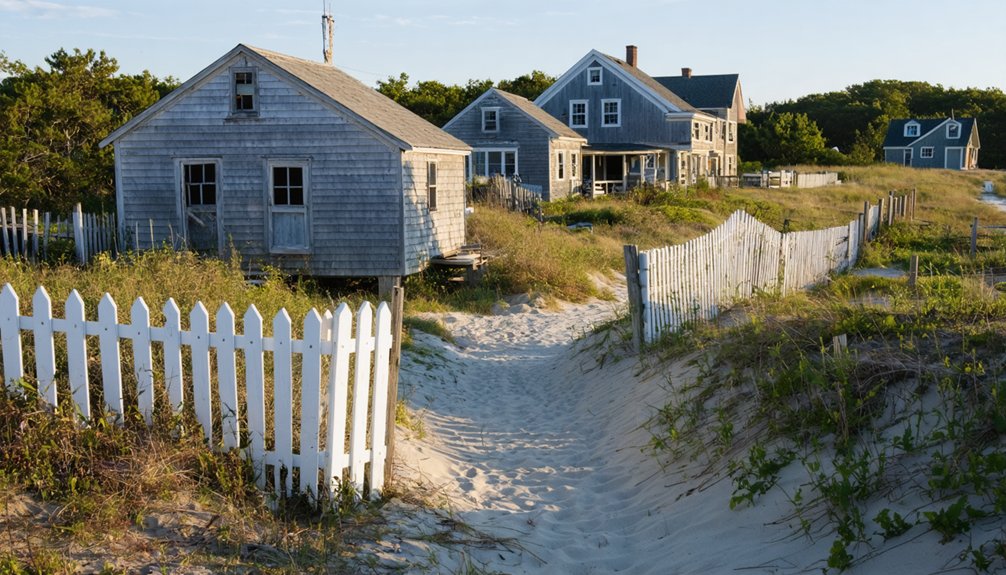
Stepping onto Portsmouth Village feels like walking through a door into the 1800s, where weathered structures stand as silent witnesses to a once-thriving maritime hub. You’ll wander among twenty buildings scattered across 250 acres, including the symbolic Methodist church from 1914 and a schoolhouse built in 1920.
This settlement peaked at 505 residents in 1860 before industrial decline—railroads and new inlets—shifted its fate.
The Civil War accelerated the exodus, with the last residents leaving in 1971.
Today’s architectural preservation efforts by the National Park Service let you explore light-yellow painted homes, the general store, and post office.
You’re free to roam this ghost town within Cape Lookout National Seashore, discovering how working-class Outer Banks families lived before time stopped here.
Ghost Town Village: Buck Mountain’s Abandoned Theme Park
You’ll find Ghost Town Village perched on Buck Mountain’s peak, where R.B. Coburn carved 45 feet off the mountaintop in 1960 to build this Wild West theme park that once drew half a million visitors each summer.
The park’s abandoned chairlift—the same one that stranded guests for hours in 2002—still dangles above the forest, offering a haunting reminder of when families rode it to reach breathtaking Smoky Mountain views.
Though it’s been closed since 2009, you can glimpse the weathered facades of 40 life-size Wild West buildings now swallowed by kudzu and saplings during summer, when security is typically lighter and the mountain air makes the steep approach more bearable.
Wild West Park History
Perched atop Buck Mountain in Maggie Valley, Ghost Town in the Sky emerged from R.B. Coburn’s vision after he’d explored authentic Western ghost towns. Opening May 1, 1961, this million-dollar venture transformed a mountaintop—blasting away 45 feet of rock—into North Carolina’s wildest attraction.
You’d find authentic experiences across four themed areas:
- Old West Street featuring gunfights every 40 minutes
- Operating church with Sunday services
- Mining Town and Indian Village sections
- Can-can saloons with live entertainment
The park drew 400,000+ annual visitors at its peak, rivaling today’s Dollywood.
TV Western stars from Laramie and Wagon Trail made appearances, while urban legends and haunted tales now surround its abandoned buildings.
Though it’s changed hands multiple times and closed in 2002, Ghost Town’s remnants still captivate adventure-seekers exploring North Carolina’s mountains.
For those who wish to explore ghost towns in North Carolina, the state offers a rich tapestry of history waiting to be uncovered. Each site tells its own story, often peppered with tales of mystery and nostalgia. As you wander through these abandoned streets, you can almost hear the echoes of the past and imagine the lives once lived there.
In addition to ghost towns, there are numerous annual events in North Carolina towns that celebrate the state’s rich heritage and vibrant culture. From lively music festivals to quaint farmers’ markets, each event brings the community together, fostering a sense of belonging and shared history. These gatherings not only showcase local talents but also provide an opportunity to connect with the stories that shape each town’s unique identity.
Summer Access and Views
At 4,650 feet above sea level, Ghost Town in the Sky commanded Buck Mountain’s summit with views that stretched across Western North Carolina’s ridgelines—though getting there was half the adventure and sometimes the problem. You’d ride a double incline railway or North Carolina’s longest chairlift, climbing over 3,300 vertical feet.
Those mountain panoramas came with a price: the chairlift stranded passengers for hours in 2002, and both systems demanded constant repairs costing thousands annually.
The park’s closed now—a 2010 mudslide buried the access road, and despite investor restoration efforts, it hasn’t reopened to visitors. Security guards patrol the property, blocking the high-elevation lake vistas and abandoned Old West structures that frame those dramatic valley overlooks you’re seeking.
Brunswick Town: Colonial Port Preserved in Ruins
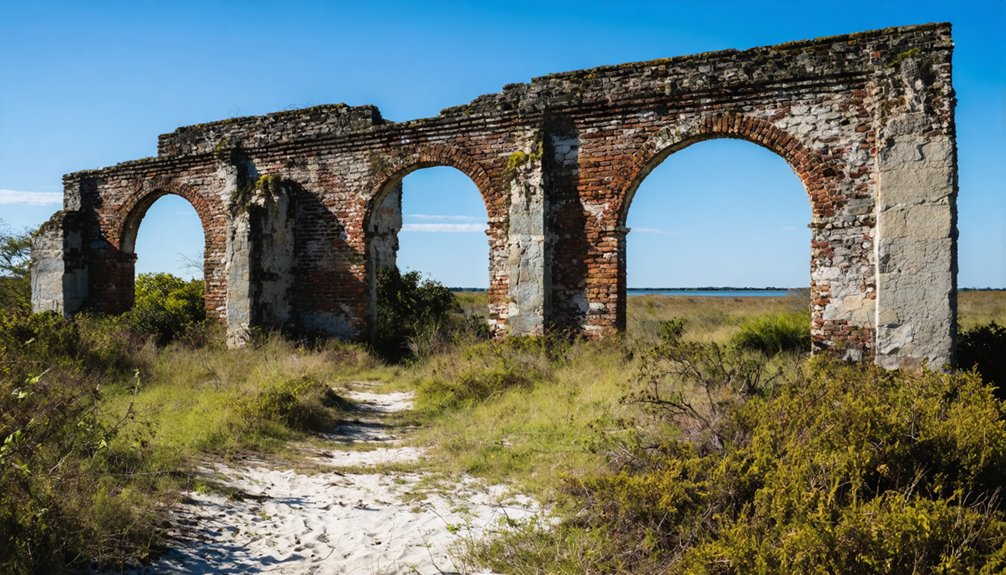
What makes Brunswick exceptional:
- First Stamp Act revolt site (1765) – eight years before Boston’s Tea Party
- Archaeological significance – revealed through preserved colonial foundations beneath Civil War earthworks
- St. Philip’s Church ruins – standing since British forces torched it in 1776
- Fort Anderson’s massive earthworks – built atop the town in 1862
Spanish privateers attacked in 1748, hurricanes battered it, and British raiders burned it twice during the Revolution.
By 1830, the entire town sold for $4.25.
Now you’ll discover authentic freedom-fighter history without the tourist crowds.
Planning Your Summer Ghost Town Adventure
Brunswick Town’s crumbling foundations and Revolutionary War earthworks set the stage for what you’ll encounter across North Carolina’s abandoned settlements—but reaching these sites demands more planning than plugging coordinates into your GPS.
Cape Lookout requires ferry transportation, so check seasonal schedules before committing to the journey.
Ghost Town in the Sky sits at 4,600 feet elevation; pack layers even during summer heat.
Coastal locations expose you to unpredictable tidal patterns and salt marsh terrain.
Book guided tours at Fort Raleigh or Roanoke Island Festival Park for structured exploration, or grab paranormal investigation equipment if urban legends and ghost stories drive your curiosity.
Ferry-accessible islands offer overnight camping—you’ll need permits.
Mountain sites present variable weather.
Bring quality camera gear; original furnishings and architectural details create compelling documentation opportunities you won’t find elsewhere.
What to Bring for Exploring Abandoned Sites

When you’re wandering through North Carolina’s abandoned structures under the summer sun, the right gear separates a memorable adventure from a dangerous situation. I learned this the hard way during my first ghost town visit when I arrived with just my phone’s flashlight and sneakers—thirty minutes in, I’d twisted my ankle on rotting floorboards and couldn’t see into the shadowy rooms where the best relics hid.
Pack your bag with safety equipment that’ll protect you from hazards, weather protection suited for Carolina’s humid heat, and photography tools to capture the haunting beauty you’ll discover.
Before you step into any abandoned structure in North Carolina’s ghost towns, you’ll need the right gear to keep yourself safe and oriented. Safety protocols demand proper protection, while navigation techniques require reliable tools that won’t fail when you’re deep inside a crumbling mill or forgotten factory.
Essential gear includes:
- Head protection: A helmet with chin strap guards against falling debris and low beams in collapsed structures
- Lighting system: Primary flashlight plus backup headlamp ensures you’re never caught in darkness
- Navigation tools: GPS with offline maps, compass, and physical area maps prevent disorientation
- Emergency supplies: First aid kit, respirator mask, multi-tool, and whistle handle injuries and air quality issues
Pack cut-resistant gloves for gripping rusted metal, and always carry extra batteries—your independence depends on staying prepared.
Protection From Weather Elements
As summer thunderheads build over North Carolina’s abandoned settlements, you’ll discover that weather shifts faster than you can retreat from a decaying structure. Weather preparedness separates memorable explorations from miserable ones—especially when Hurricane Florence’s ghost still haunts coastal forests where 47,000 acres transformed to marshland.
Your gear essentials start with rain protection for sudden tropical downpours that flooded mountain mill towns like Mortimer. Pack lightweight waterproof layers and insect repellent for wetland mosquitoes breeding around Core Sound’s coastal ruins.
Sun protection becomes critical across treeless ghost forests where 11% tree cover vanished since 1985, leaving you exposed during boat access to Shackleford Banks. Mountain elevations rarely exceed the high 70s, but coastal sites amplify heat through UV reflection off king tide waters.
Photography and Documentation Equipment
Beyond weatherproofing yourself, you’ll need gear that captures North Carolina’s vanishing architecture before humidity and kudzu erase it completely.
Your DSLR or mirrorless body handles the dim interiors where sunlight barely penetrates—sensor technology compensates when 30-second exposures become necessary.
Pack these essentials:
- Wide-angle lens (16-35mm) for tight mill corridors and collapsed churches
- Sturdy tripod supporting those long exposures without shake
- Extra batteries and cards that drain quickly in summer heat
- Powerful flashlight *exploring* rooms without electricity
A 55mm lens captures decay’s intimate details—rusted hinges, peeling wallpaper, abandoned Bibles. Check drone regulations before launching; North Carolina restricts flights near certain historic sites.
Your weather-resistant bag protects everything while you’re scrambling through brambles documenting these ghost town remnants before they’re completely reclaimed.
Photography Tips for Capturing Historic Ruins
When you step into an abandoned building with sunlight streaming through broken windows, your camera becomes a time machine. Set your tripod low and shoot upward—that 24mm wide-angle lens transforms cramped spaces into cavernous voids. Bracket your exposures for HDR processing; those harsh contrasts between bright windows and shadowy corners won’t tame themselves.
Focus on the details that tell stories: a rusted phone dangling from peeling walls, dust particles dancing in shafts of light. Don’t rearrange anything—authenticity lives in the crooked chair and scattered debris.
For night photography, try long exposures at f/8 for thirty seconds, or experiment with light painting to create ghostly atmospheres. Your flashlight becomes a paintbrush, selectively illuminating forgotten corners while preserving the eerie darkness that makes exploration addictive.
Respecting Protected Sites and Historical Preservation
That crumbling textile mill you’re photographing isn’t just a backdrop for your Instagram feed—it’s a protected cultural resource, and North Carolina law treats it accordingly. Before exploring, understand what’s off-limits:
- Metal detectors and subsurface probes are banned at historic sites unless you’ve secured a Special Activity Permit for locating lost property.
- Illegal excavations carry Class 3 misdemeanor charges when you violate posted regulations.
- Entering abandoned structures that are posted means you’re breaking local ordinances.
- Site restoration efforts depend on your compliance—removing artifacts damages preservation work.
The Historical Commission doesn’t mess around with enforcement. Their regulations carry legal weight, and climbing restrictions at places like Ghost Town aren’t suggestions.
Respecting boundaries ensures these places survive for future adventurers who’ll crave the same authentic exploration you’re seeking.
Frequently Asked Questions
Are Any Ghost Towns Wheelchair Accessible for Visitors With Mobility Limitations?
Unfortunately, you won’t find wheelchair-accessible ghost towns in North Carolina. Historical preservation efforts haven’t included accessibility improvements at these remote sites. Sandy beaches, steep mountain trails, and crumbling structures create barriers that prevent visitors with mobility limitations from exploring freely.
For those interested in history, exploring historic ghost towns in North Carolina can be a fascinating experience. Each town tells its own story through abandoned buildings and relics of the past, captivating the imaginations of visitors and historians alike. However, the lack of accessibility means that many eager adventurers miss out on the opportunity to connect with these nostalgic sites.
Can I Bring My Dog to Explore North Carolina’s Abandoned Sites?
You can bring your dog to most ghost towns on dog friendly trails, but keep them leashed and follow pet safety tips—watch for snakes, ticks, and unstable structures while exploring these wild, overgrown ruins together.
What Is the Best Time of Day to Avoid Crowds?
Early mornings offer your best escape from peak visitation at North Carolina’s ghost towns. You’ll capture stunning photography in golden light while exploring freely before tour groups arrive. Summer weekday dawns guarantee solitude at these haunting, abandoned locations.
Are There Nearby Accommodations for Multi-Day Ghost Town Exploration Trips?
You’ll find camping facilities nestled near most ghost towns, from Portsmouth’s starlit shores to Cataloochee’s mountain hideaways. Brunswick offers coastal lodging options, while Henry River’s restored house #12 provides authentic overnight stays within the village itself.
Do Any Sites Offer Guided Tours With Historians or Park Rangers?
You’ll find guided tour options led by knowledgeable historians throughout North Carolina’s ghost sites. These experts excel at historical storytelling, bringing centuries-old tales alive through authentic research and local folklore, perfect for your independent exploration of haunted locations statewide.
References
- https://www.atlasobscura.com/things-to-do/north-carolina/ghost-towns
- https://en.wikipedia.org/wiki/Ghost_Town_Village
- https://www.romanticasheville.com/ghost_town.htm
- https://www.youtube.com/watch?v=iWhjTfCyUpY
- https://takingthekids.com/abandoned-north-carolina-destinations-every-explorer-should-visit/
- https://www.visitnc.com/list/ncs-mysterious-disappearances-and-abandoned-places
- https://appalachian.org/lost-cove-ghost-town-in-the-national-forest/
- https://en.wikipedia.org/wiki/Mortimer
- https://www.youtube.com/watch?v=nxOGwCFhRRQ
- https://www.islands.com/1988321/mortimer-north-carolina-abandoned-ghost-town-historic-pisgah-national-forest/