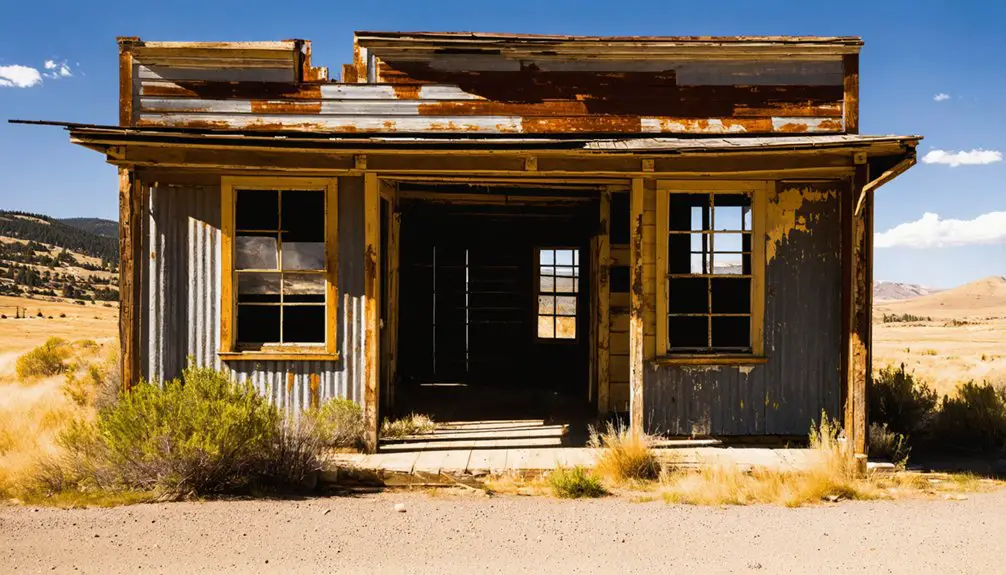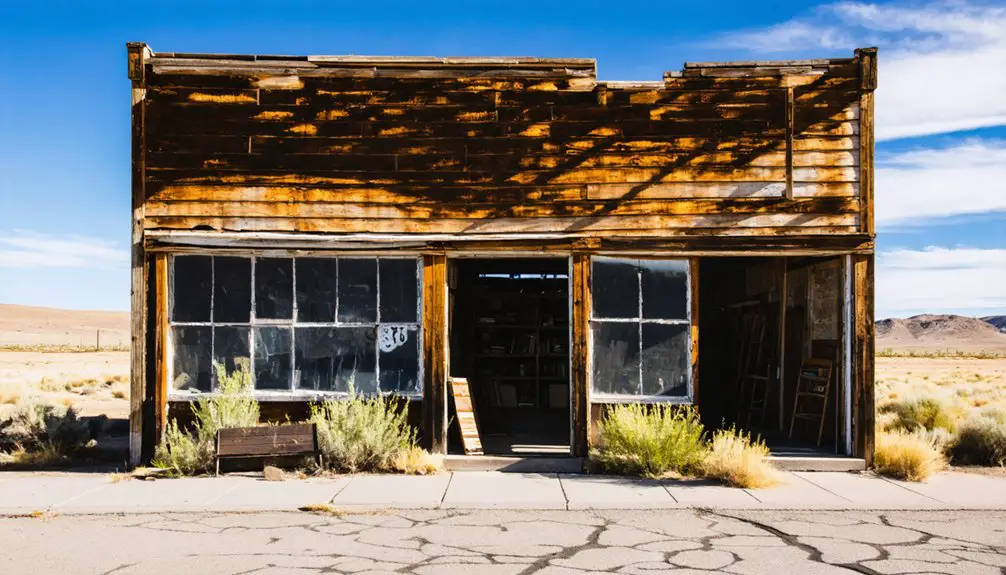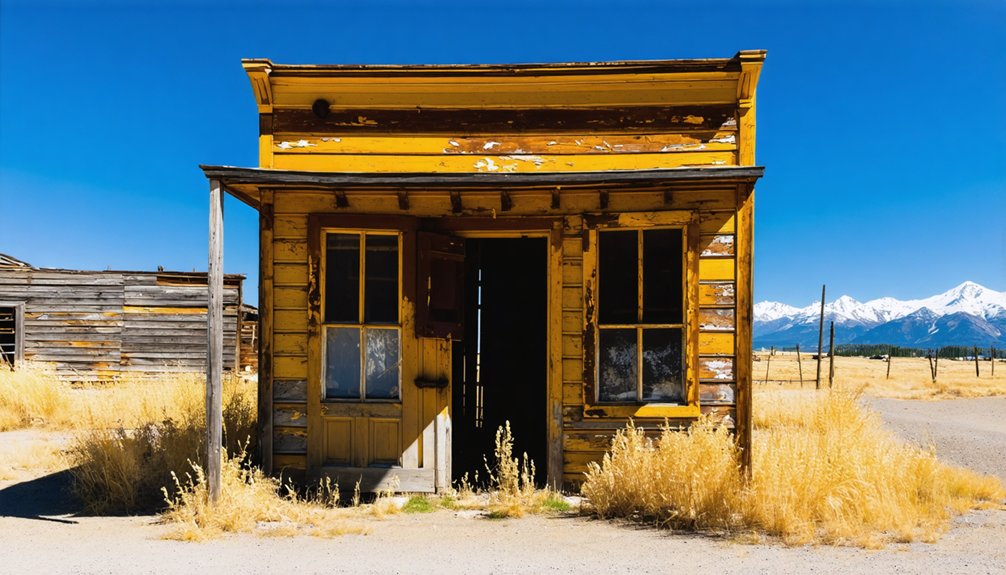
Summer opens the high roads to Oregon’s most dramatic ghost towns, where you’ll explore Shaniko’s seasonal storefronts and gunfight reenactments, walk through Sumpter’s massive three-story gold dredge, and photograph Buncom’s weathered mining structures along wetland trails. You can venture to Cornucopia’s 7,000-foot mountain ruins or discover Granite’s 4,000 artifacts from its 1860s gold rush peak. The warmer months transform snow-blocked mountain passes into accessible scenic routes, revealing authentic frontier settlements across the Blue Mountains and beyond, each with its own compelling story waiting to unfold.
Key Takeaways
- Shaniko Ghost Town operates seasonally April to September with gunfight reenactments, festivals, and a 1901 schoolhouse toy museum.
- Sumpter offers walkthrough tours of the 1935 Valley Dredge No. 3 and access to scenic Blue Mountain trails.
- Summer access improves to remote sites like Cornucopia and Granite via routes like the Elkhorn Scenic Byway.
- Buncom features three preserved structures, historic mining equipment, and the Coyote Creek Wetlands photography trail.
- Over 200 Oregon ghost towns become accessible after June when snow melts from mountain passes and backroads.
Golden State Heritage Site Near Coyote Creek
When placer miners surged into Coyote Creek during the 1850s, they sparked a boom that would transform southwestern Oregon Territory’s wilderness into one of the region’s most intriguing settlements.
You’ll discover four original structures still standing at Golden State Heritage Site, including the 1892 church that distinguished this community from typical mining camps—no saloons existed here.
The Oregon Parks and Recreation Department now manages this rare mining town, earning National Register status in 2002 and heritage site designation in 2011.
Preservation efforts extend beyond buildings to protect the Golden Coyote Wetlands, where local wildlife thrives among historic remnants. The town site is perched above the valley where miners historically worked their claims. The cemetery served as a Hollywood set for a 1972 “Gunsmoke” episode, though it contains no actual residents’ graves.
You’re free to explore authentic frontier architecture while imagining the 150 residents who once called this remote outpost home.
Shaniko: A Thriving Summer Destination
Along the high desert plains of north-central Oregon, where sagebrush stretches toward distant horizons, Shaniko stands as a tribute to the fleeting glory of America’s wool boom.
You’ll find this 1900s railway town springing to life each April through September, when volunteers open weathered storefronts and the handmade-brick Shaniko Hotel welcomes wanderers once more.
Summer events transform these dusty streets into vibrant gathering places—Shaniko Days in August brings gunfight reenactments and ragtime festivals, while bluegrass jamborees echo through the turret-topped schoolhouse.
You’re free to explore the original jail, photograph vintage cars against weathered boardwalks, and browse vendors’ wares beneath that iconic 38,000-gallon water tower.
The 1901 school building, with its distinctive front turret, now houses a charming toy museum worth exploring during your visit.
Local dining options emerge seasonally, fueling your exploration of this remarkably preserved ghost town.
Located just 30 minutes north of Madras and approximately 2.5 hours southeast of Portland, Shaniko offers an accessible day trip from Oregon’s urban centers.
Sumpter and the Valley Dredge Experience
Sumpter rises from the Elkhorn Mountains as Oregon’s “Queen City” reborn.
Where gravel tailings snake through valleys like frozen rivers—scars left by the colossal Valley Dredge that once roared loud enough to echo forty miles away.
You’ll walk aboard this ship-like behemoth at Sumpter Valley State Heritage Area, its 72 buckets still poised to devour nine cubic feet of earth per minute in an endless hunt for gold.
Beyond the dredge, mountain trails lead deeper into mining country where brick storefronts and weathered cabins stand as proof to the 3,500 souls who once called this boom town home.
The area’s 35 mines collectively pulled over $9 million in gold from these mountains, fueling a frenzy that transformed a simple 1862 prospectors’ camp into a thriving hub complete with hotels, newspapers, and entertainment halls.
Today’s narrow gauge steam engine experiences trace the historic railway route that once delivered up to six carloads of mining equipment daily to fuel the town’s industrial hunger.
Historic Dredge and Tailings
Rising from the sagebrush flats like a beached metal leviathan, the Sumpter Valley Dredge No. 3 dominates the landscape where gold fever once consumed thousands. You’ll witness mining techniques that moved mountains—seventy-two one-ton buckets that devoured seven yards of earth per minute, processing river bottom at a relentless pace.
This 1935 giant extracted $4.5 million in gold before costs shut it down in 1954.
Walk among the tailings piles stretching for miles, ten-foot monuments to industrial ambition that transformed pristine meadows into a stone labyrinth visible from space. The dredge’s shallow hull design allowed it to carve new channels and move perpendicular to the original riverbed, unrestricted by natural waterways. The dredge restoration lets you explore the three-story hull where twenty men once worked year-round.
Stand where they stood, understanding the price of prosperity—and the freedom gold promised to those bold enough to chase it. Added to the National Register in 1971, the site now serves as the Sumpter Valley Dredge State Heritage Area, drawing heritage tourists to one of the West’s best-preserved dredges.
Mountain Views and Access
Deep in Oregon’s Blue Mountains, where the Elkhorn Range pierces summer skies, Sumpter sprawls across a valley that demands you look up. Mountain panoramas unfold through bands of ponderosa pines—gold-shimmering aspens frame grassy plains that stretch toward haunting Eastern Oregon horizons.
You’ll reach this remote access paradise via Highway 7 to Highway 410, or take the Elkhorn Scenic Byway winding from Baker City.
The Powder River route climbs past ranchland and canyon walls, while Cracker Creek Road ventures north as a rewarding out-and-back.
Summer opens gravel paths to Olive Lake and Granite’s ghost town ruins.
This isn’t curated wilderness—it’s raw mountain country where 4-wheeling trails thread between streams, hiking paths disappear into aspens, and overlook views remind you why you left pavement behind. What began as Fort Sumter in the 1860s—a farming settlement founded by three Carolinian homesteaders—transformed when gold deposits sparked a rush that brought Northern sympathizer miners and a new name. The Sumpter Valley Dredge, built in 1935 and towering along the Powder River, stands as the last remaining of three massive gold dredges that once extracted over four million dollars in gold from these valley waters.
Buncom’s Mining History and Nature Trails
Though Chinese miners first discovered gold along Sterling Creek in 1851, Buncom’s transformation from a humble mining camp to an essential supply hub would span nearly seven decades.
You’ll find three weathered structures—the 1910 post office, bunkhouse, and cookhouse—standing as silent witnesses to this rough-hewn past. The hydraulic mining that once scarred these hillsides has given way to the Coyote Creek Wetlands trail, where you can explore nature’s reclamation of scarred earth.
It’s prime territory for ghost town photography, with intact glass windows and mining equipment preservation telling stories of gold, silver, and chromite extraction.
The devastation by fire and gold depletion forced abandonment by 1918, leaving you free to wander these grounds where fortune-seekers once staked their claims.
Cornucopia in Oregon’s Remote Frontier
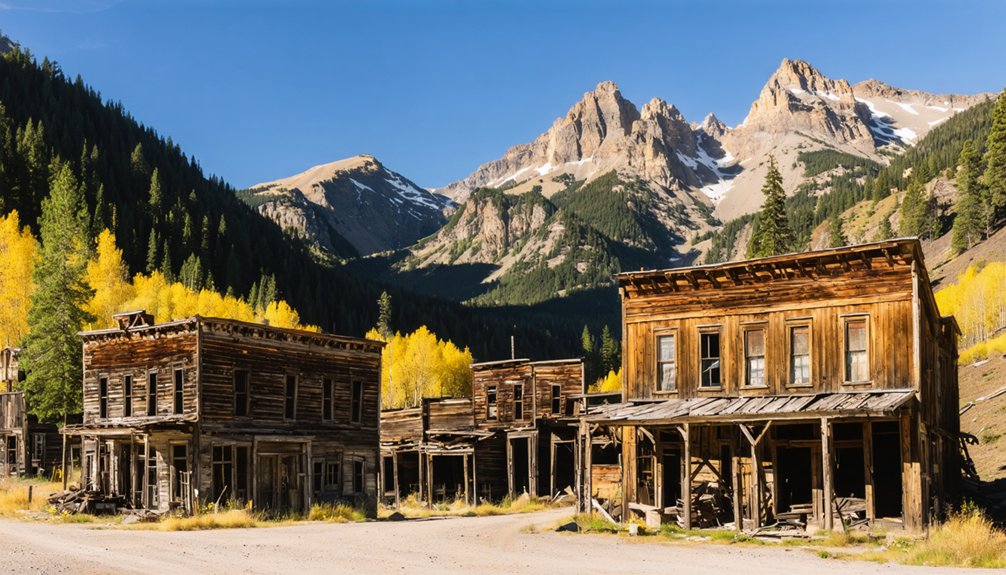
You’ll find Cornucopia’s weathered ruins scattered across steep granite slopes at elevations reaching 7,000 feet, where aerial tramway towers still cling to mountainsides that once echoed with stamp mills crushing ore.
This remote corner of Oregon’s frontier, nestled in Pine Valley near the Idaho border, challenges modern visitors with the same rugged terrain that once demanded ingenuity from miners hauling millions in gold from tunnels burrowed 36 miles deep into the mountains.
Summer transforms these high-altitude remnants into an accessible adventure, the snow-buried ghost town emerging from winter’s grip to reveal collapsed bunkhouses, abandoned mine shafts, and the skeletal remains of Oregon’s richest gold-silver district.
Historic Mining Camp Ruins
Perched at 7,000 feet in Oregon’s Wallowa Mountains, Cornucopia’s crumbling ruins tell the story of one of the state’s most productive gold camps.
You’ll discover towering tailings piles cascading down the mountainside, remnants of the elaborate aerial tram system that once conquered impossibly steep terrain, and abandoned structures with pitched roofs designed to shed heavy winter snows.
Old mining equipment rusts among scattered gold-bearing rocks—fragments too uneconomical to mill but tangible evidence of the $7 million extracted here.
Three weathered buildings still stand near decaying mine shafts, including the mansion that housed the mine overseer.
These vernacular structures, common throughout Baker County’s gold regions, offer raw glimpses into frontier life where 700 men once worked the sixth-largest operation in America before abandonment claimed everything.
Remote Frontier Location Access
Reaching Cornucopia requires commitment—this isn’t a roadside attraction you’ll stumble upon during a casual Sunday drive. You’ll navigate 56 miles from Baker City, winding through Oregon Route 86 past tiny Richland and Halfway before tackling the Cornucopia Highway into the Wallowa Mountains.
The journey rewards those who embrace lifestyle challenges inherent to frontier exploration.
What makes this remote destination worth the trek:
- Authentic isolation at 4,741 feet elevation, where preservation efforts maintain historical integrity without commercialization
- Genuine wilderness access where Eagle Cap’s trails begin steps from your cabin door
- Summer accessibility through Cornucopia Lodge, offering horseback rides and mine hikes in terrain that buried prospectors under 28 feet of winter snow
You’re venturing into Oregon’s backcountry on your terms—exactly where freedom-seekers belong.
Granite: Grant County’s Historic Mining Camp
Deep in the Blue Mountains of Grant County, Granite stands as a weathered proof to Oregon’s gold rush era. You’ll discover a settlement born on Independence Day 1862, when prospectors struck gold along Granite Creek. At its zenith, 5,000 fortune-seekers called this remote camp home.
Born from gold fever on July 4, 1862, Granite swelled to 5,000 souls before fading into Blue Mountain silence.
Mining techniques evolved from simple placer operations to hard rock extraction at the Monumental Mine. The Ah Hee Diggings reveal where Chinese miners employed hydraulic methods along eight miles of creek, leaving sixty acres of hand-stacked stone walls.
Archaeological findings include over 4,000 artifacts—bowls, mining implements, remnants of daily life—now catalogued at Baker City’s Ranger District Office.
The 1942 wartime shutdown emptied Granite overnight. Today, you’ll find authentic frontier remnants accessible via Forest Road 73, where history speaks through silence.
Planning Your Oregon Ghost Town Summer Adventure
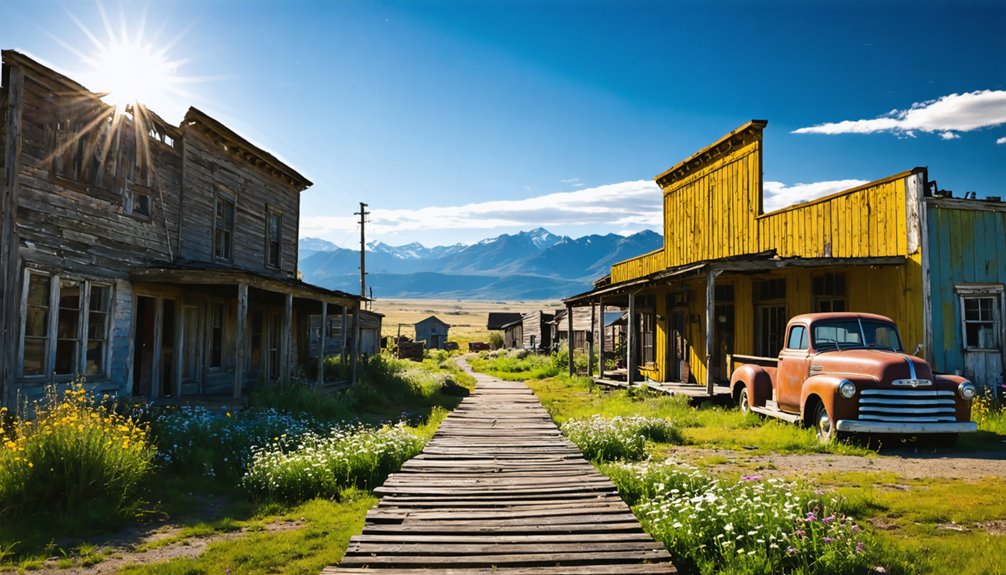
When charting your course through Oregon’s ghost towns, you’ll need more than enthusiasm—the state’s 200-plus abandoned settlements span vast distances from eastern desert plateaus to mountain passes that hold snow until June.
Exploring ghost towns in Oregon reveals a fascinating glimpse into the past, with remnants of once-thriving communities quietly echoing their histories. Each abandoned structure tells a story, inviting adventurers to imagine the lives that were lived there. As you wander through these forgotten places, you’ll encounter unique landscapes that contrast sharply with the urban sprawl of today.
Winter adventures in Oregon ghost towns offer a unique experience as the quiet beauty of the snowy landscapes transforms these historic sites into a winter wonderland. As the chill in the air sharpens the silence, visitors can explore the fascinating architecture and remnants of past lives, often unveiling the stories hidden under layers of frost. Bundle up and embark on this journey to see how nature reclaims these towns while providing a stunning backdrop for your explorations.
Essential preparations for your expedition:
- Stock up properly – Fuel tanks, paper maps, and extra provisions become lifelines when cell towers vanish into sagebrush horizons.
- Time it strategically – Summer reveals Elkhorn Scenic Byway’s 106-mile mountain loop and clears roads to 6,300-foot Greenhorn.
- Blend exploration with local experiences – Between ghost towns, discover hot springs near Crane, sample local cuisine in Baker City, and catch seasonal festivals in Shaniko.
The Journey Through Time Scenic Byway connects multiple sites efficiently, while southeastern backroads from Jordan Valley through Rome demand self-sufficiency and adventurous spirit.
Frequently Asked Questions
Are Pets Allowed at Oregon Ghost Town Sites?
Your four-legged outlaw’s welcome remains mysteriously undocumented—Oregon’s ghost towns lack specific pet restrictions in available records. You’ll need to contact individual sites directly to discover their pet friendly policies before setting out on your historically rebellious adventure together.
What Cell Phone Coverage Can Visitors Expect in Remote Ghost Towns?
You’ll face spotty cell service in most remote Oregon ghost towns, especially in eastern regions. Verizon offers the best reception quality, but expect dead zones regardless of carrier. Pack satellite backup for true off-grid freedom.
Are There Camping Facilities Near These Ghost Town Locations?
You’ll find endless camping adventures near these ghost towns! Wolf Creek Campground serves Golden visitors, while Sumter offers dispersed forest camping. Historical preservation sites like Golden lack overnight facilities, though volunteer opportunities exist. Embrace the wild, independent exploration you’re craving.
Do Any Ghost Towns Require Entrance Fees or Permits?
Most Oregon ghost towns don’t require entrance fees—you’ll find open access across abandoned landscapes. However, some sites with historical preservation efforts or on private land may have access restrictions. Always respect posted signage and property boundaries during your exploration.
What Photography Restrictions Exist at Oregon Ghost Town Heritage Sites?
You’ll find over 80 registered ghost towns where photography permits aren’t typically needed, though state parks require commercial permits. Historical preservation efforts restrict off-trail shooting and building entry, but tripods roam freely across most atmospheric ruins.
References
- https://oregonoutdoorfamily.com/golden-oregon-a-ghost-town/
- https://www.pinesnvines.com/adventures/oregons-coolest-ghost-town
- https://www.tripadvisor.com/Attractions-g28958-Activities-c47-t14-Oregon.html
- https://en.wikipedia.org/wiki/List_of_ghost_towns_in_Oregon
- https://stateparks.oregon.gov/index.cfm?do=park.profile&parkId=189
- https://www.youtube.com/watch?v=GaS3xjrQ-_I
- https://traveloregon.com/things-to-do/culture-history/ghost-towns/
- https://www.historynet.com/golden-oregon-ghost-town/
- https://heritagedata.prd.state.or.us/historic/index.cfm?do=v.dsp_printRecord&resultDisplay=42084
- https://www.southernoregon.org/cities/glendale/forests-parks-wildlife-areas/state-parks/golden-state-heritage-site/