You’ll find Tennessee’s most enchanting ghost towns perfect for summer exploration, from Elkmont’s 70+ moss-covered logging resort structures in the Great Smoky Mountains to Cades Cove’s eleven-mile loop showcasing pioneer cabins and churches from the 1800s. Loyston rests beneath Norris Lake as an underwater archaeological site, while Fork Mountain displays coal mining relics and abandoned train cars along scenic heritage routes. Summer’s extended daylight lets you explore historic buildings before dusk, when paranormal legends suggest spirits become most active and the true character of these abandoned settlements emerges.
Key Takeaways
- Cades Cove features eleven-mile loop with preserved cabins, churches, and gristmill, best visited before 10 a.m. or after 5 p.m.
- Elkmont offers year-round exploration of seventy structures including Wonderland Hotel, ideal for families with moss-covered buildings and foundations.
- Summer provides extended daylight for thorough exploration before dusk, when paranormal activity and ghostly legends reportedly intensify.
- Dawn visits to Cades Cove offer optimal wildlife viewing opportunities alongside historic pioneer-era structures and functioning gristmill.
- Port Royal State Park preserves 1797 settlement with Trail of Tears site, iron bridge, and exhibits on Cherokee removal.
Elkmont: A Preserved Logging and Resort Town
Deep in the Great Smoky Mountains, Elkmont stands as a haunting reminder of Tennessee’s logging boom and the exclusive mountain retreats that followed.
You’ll discover over 70 structures slowly reclaimed by wildlife habitat, from the grand Wonderland Hotel to weathered vacation cottages built for Knoxville’s elite.
The town thrived when Little River Lumber Company carved through 86,000 acres, becoming the county’s second-largest settlement.
After the company sold out in 1925, wealthy club members clung to lifetime leases until 1992.
The community once supported essential town amenities including a post office, school, hotel, Baptist church, and stores that served both logging workers and resort visitors.
Now preservation efforts protect these National Register buildings from demolition, though nature steadily advances.
Among the 19 historic buildings preserved by the National Park Service, the Levi Trentham cabin stands as one of the oldest structures, relocated from Jakes Creek.
You’re free to explore Elkmont Historic District year-round behind the campground, where crumbling foundations and moss-covered walls whisper stories of boom, leisure, and inevitable decline.
Cades Cove: The Smoky Mountains’ Largest Ghost Town
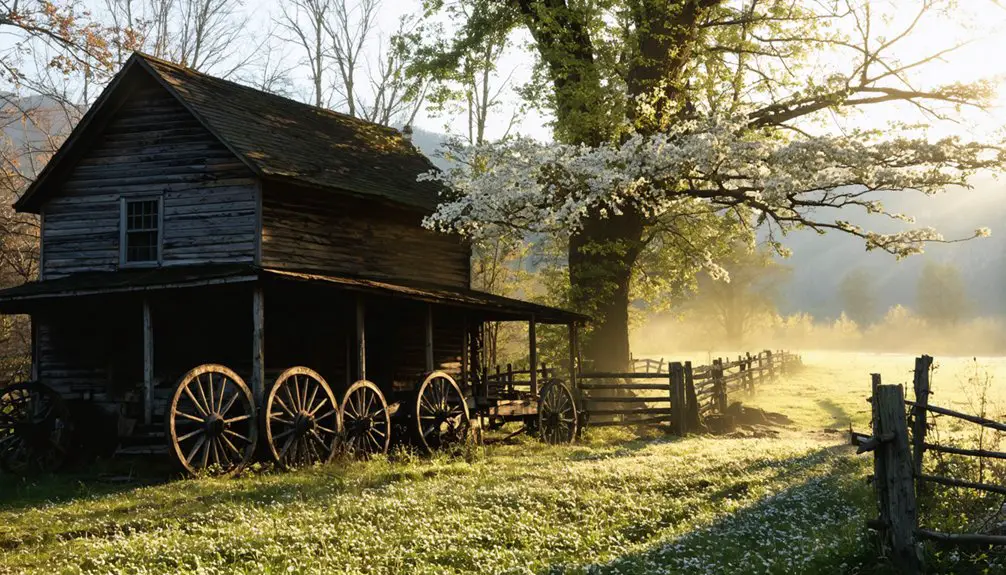
You’ll discover Cades Cove’s eleven-mile loop road winding through what was once the Smoky Mountains’ most populous settlement, where 685 residents farmed this fertile valley by 1850.
The scenic drive stops at remarkably preserved cabins, churches, barns, and a working gristmill that stand as silent witnesses to pioneer life. The valley was named after Chief Kade, a Cherokee leader who once led his people in this region before the Treaty of Calhoun ended their claims in 1819.
For best wildlife viewing and fewer crowds, arrive at dawn during summer months when black bears and deer graze across fields where families once raised crops and livestock. The first permanent Euro-American settlers, John and Lurena Oliver, arrived in 1818 and survived their first winter with help from the Cherokee community who offered dried pumpkin.
Scenic Valley Loop Drive
Winding through the heart of Cades Cove, the 11-mile one-way loop road offers an immersive journey into Tennessee’s most accessible ghost town. You’ll discover open fields where black bears and deer roam freely across former farmlands, making wildlife observation exceptional throughout your drive.
Multiple stopping points reveal authentic cabins, weathered barns, a working gristmill, and historic churches—all maintained through careful historical preservation efforts. Among these landmarks stands the Primitive Baptist Church, built in 1887 and recognized as a key landscape symbol of the valley’s settlement era.
You’re free to explore at your own pace, though you’ll want to arrive early morning by bicycle to escape vehicle congestion. The John Cable Grist Mill, constructed in 1868, demonstrates historic water-powered grain processing with its original overshot wheel drawing from Mill Creek.
The valley’s numerous pull-offs let you pause wherever curiosity strikes, whether photographing century-old structures or watching wildlife graze where settlers once cultivated crops. Each stop connects you directly to the displaced community’s legacy.
Preserved Historic Structures
Standing as silent witnesses to a vanished way of life, over a dozen preserved structures dot the Cades Cove landscape, each telling stories of the resilient families who carved out lives in this isolated valley. You’ll discover John Oliver’s 1822 cabin, the gristmill, and the Methodist Church—each maintained through meticulous preservation techniques that keep history alive.
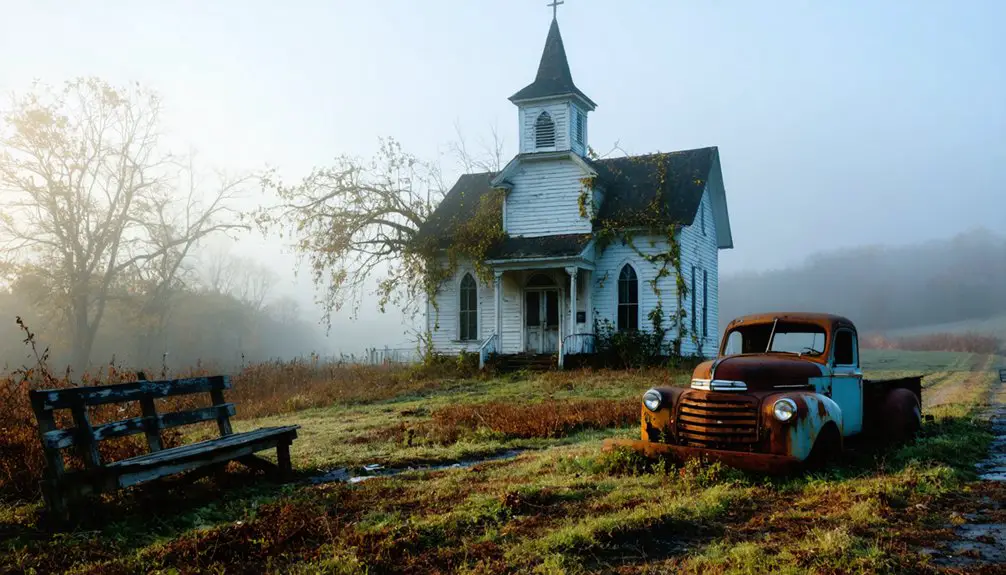
The church harbors haunted legends of a ghostly woman emerging from its walls, while visitors report eerie sensations throughout the valley. As dusk settles over the cove, many experience particularly eerie feelings that locals attribute to restless spirits from the area’s past. As you explore these cabins, barns, and churches along the 11-mile loop, you’re wandering through a frozen snapshot of frontier existence.
Many experience unexplained feelings of being watched or photograph mysterious orbs, adding supernatural intrigue to this once-thriving community.
Best Summer Viewing Times
While Cades Cove draws massive crowds year-round as the park’s most visited destination, timing your summer exploration makes all the difference between a bumper-to-bumper crawl and an atmospheric journey through history. You’ll want to arrive either before 10 a.m. or after 5 p.m. to avoid peak congestion along the 11-mile loop.
Evening hours offer something special beyond lighter traffic—this is when urban legends come alive. As twilight descends across the valley, you’ll understand why paranormal activity peaks during these hours. The fading light transforms historic cabins and church cemeteries into settings straight from haunted folklore. Legends claim spirits hover over the graves of those buried in the cove’s cemeteries.
Visitors consistently report glowing orbs, disembodied voices, and unsettling sensations of being watched as darkness approaches. Summer’s extended daylight gives you ample time to explore before the spirits allegedly claim their territory.
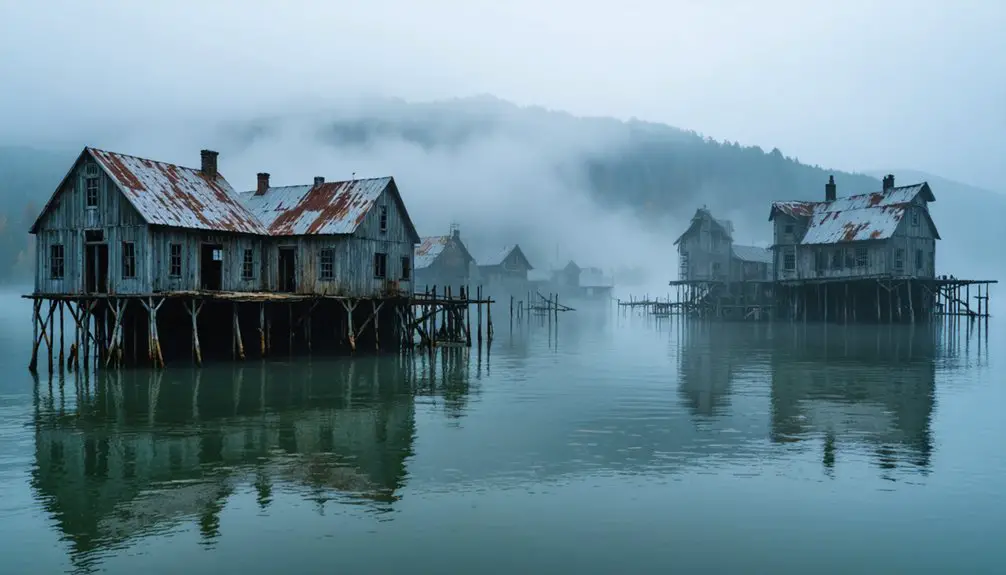
Loyston: The Submerged Community Beneath Norris Lake
Before flooding, Loyston thrived as a trading center with:
Before flooding, Loyston thrived as a trading center with homes, churches, schools, and farmland serving generations along the Clinch River.
- 70 residents living in homes ranging from log cabins to eight-room houses.
- A bustling general store recording $50,000 in annual sales.
- Two churches, schools, and a post office serving generations.
- Rich farmland along Mill Creek near the Clinch River.
Federal authorities wielded eminent domain, scattering families across East Tennessee.
The Tennessee Valley Authority constructed Norris Dam for flood control, completing it in 1936 and submerging the entire townsite under what became Norris Lake. Photographer Lewis Wickes Hine documented the community in 1933, capturing its schools, churches, and mill before inundation.
Today, this underwater archaeology site represents one of Tennessee’s best-documented submerged towns, its stories preserved through photographs and resident interviews despite eight decades beneath the surface.
Devonia: Anderson County’s Abandoned Coal Mining Settlement
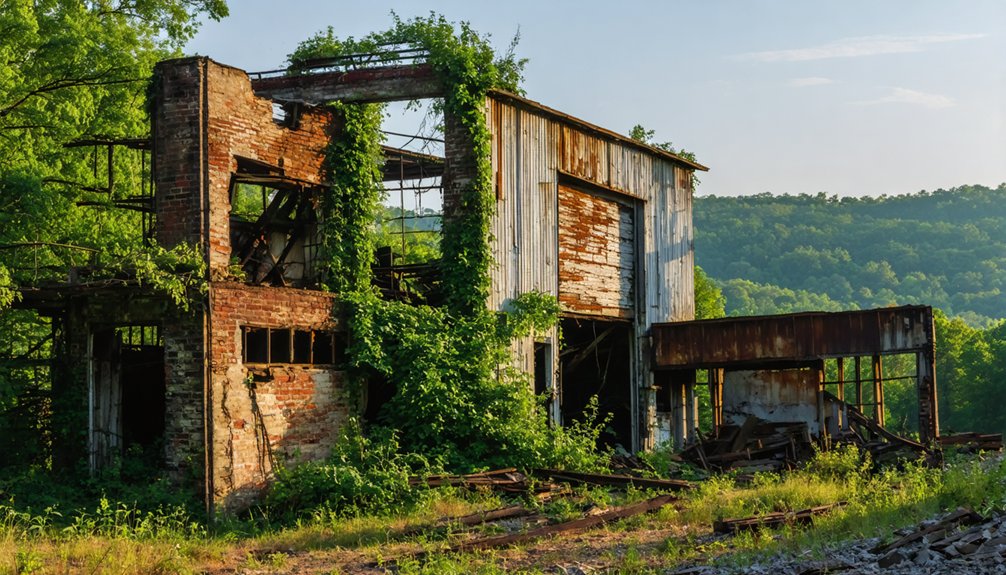
Deep in Anderson County’s coal country, Devonia emerges from Tennessee’s industrial past as a settlement that once pulsed with mining activity along the New River’s headwaters.
You’ll discover railway remnants from the 42-mile line that connected this former mining camp to Oneida, while the operational Baldwin Coal Preparation Plant stands alongside abandoned structures from its 1920s heyday.
This coal heritage site served multiple communities—Rosedale, Fork Mountain, Braytown—until its post office shuttered in 1975.
You can explore via State Route 116, where mining families’ residential camps once thrived.
Look for the abandoned steam train at the coal plant and nearby Rosedale Elementary School, restored after closure.
Devonia’s accessible ghost town status lets you freely wander through authentic Appalachian mining history without restrictions.
Fork Mountain: Remnants of a Coal Mining Past
Nestled in the rugged Cumberland Mountains of northeast Tennessee, Fork Mountain stands as a haunting reminder of Appalachia’s coal mining zenith. Once thriving in the 1950s, this ghost town became completely abandoned by the 1980s when coal operations ceased.
Fork Mountain: where Appalachian coal glory faded to silence, leaving only ghost town remnants among Tennessee’s Cumberland peaks.
You’ll discover authentic mining relics along mountain trails accessible via State Route 116, where nature reclaims industrial history.
Your exploration reveals:
- Abandoned drift mine portal with defunct excursion train engine and passenger cars slowly disappearing into overgrowth
- Restored six-classroom school now serving ATV riders exploring the surrounding wilderness
- 41-mile rail corridor from Oneida, abandoned in 2020 after final operations in 2008
- Scenic roadways connecting historic camps like Moore’s Camp and Beech Grove
Summer offers ideal conditions for this half-day adventure through Tennessee’s forgotten mining heritage.
Port Royal: Historic River Town Without the Rails
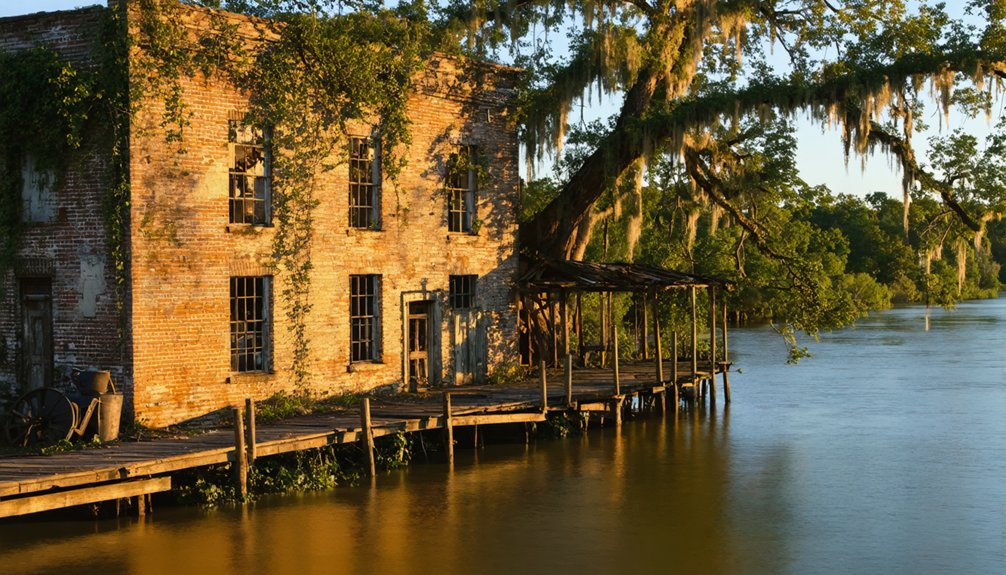
You’ll find Port Royal’s constitutional significance embedded in its very foundation—this 1797 settlement served as a meeting point for Tennessee’s early government formation.
Today, the 30-acre Port Royal State Park preserves this riverbank community where tobacco commerce once thrived and thousands of Cherokee passed through on the Trail of Tears.
The park’s historic structures and certified Trail of Tears site let you walk through centuries of Tennessee history compressed into the state’s second-smallest preserved area.
Constitutional Convention Legacy Lives
Before Tennessee became a state, Port Royal’s four delegates had already secured the town’s place in history at the 1796 Constitutional Convention. You’ll find this Red River settlement’s roots stretch back to 1784, when North Carolina still claimed this territory. The Second Tennessee General Assembly formally established the town in 1797, recognizing its commercial importance.
As you explore this historic site, you’ll discover:
- 1799 tobacco inspection point that sparked early prosperity
- 1802 post office serving the Nashville-to-west corridor
- Trail of Tears passage where eleven Cherokee detachments marched through
- Urban legends surrounding Dr. George Hopson’s Bell Witch connection
Today’s ghost tour tips include visiting the 1890 iron bridge and exploring certified National Historic Trail sections—tangible reminders of Port Royal’s constitutional legacy.
State Park Features Today
Spanning just 26 acres along the Red River‘s banks, Port Royal State Historic Park stands as Tennessee’s second-smallest state park—yet its compact footprint preserves an outsized legacy.
You’ll discover interpretive exhibits detailing the town’s 1797-1940 existence, from its Trail of Tears connection to the Black Patch Tobacco Wars.
The park’s trailhead guides you through remnants of what thrived before railroad bypasses triggered inevitable urban decay.
Ghost stories permeate the site—particularly around the Masonic Lodge, where an 1903 bridge collapse claimed lives.
Phantom footsteps and Civil War soldier sightings add supernatural intrigue to historical exhibits on statehood and enslaved labor’s impact.
The Red River remains central, its waters once powering mills that supplied Cherokee detachments during removal routes cutting straight through this preserved riverside settlement.
Best Times to Visit Tennessee Ghost Towns in Summer
Summer visitors to Tennessee’s ghost towns will find the most rewarding experiences during early morning and evening hours when temperatures cool and crowds thin. You’ll discover ideal access windows that balance comfort with atmosphere.
As you explore abandoned towns in Tennessee, be sure to bring your camera to capture the haunting beauty of decaying structures and overgrown landscapes. Each site tells a story, offering a glimpse into the past that can ignite your imagination. Engaging with the local history enhances the experience, revealing the unique tales that these forgotten places hold.
As the seasons shift, winter getaways in Tennessee offer a different kind of charm, with snow-dusted landscapes and festive holiday decorations. Cozy cabins and mountain retreats become the perfect backdrop for winter adventures, whether it’s hiking through serene trails or enjoying a warm drink by the fire. Embrace the tranquility of nature during this quieter time, allowing the picturesque scenery to provide a refreshing escape from the hustle and bustle of everyday life.
Strategic timing for summer ghost town visits:
- Bell Witch Cave operates 10am-5pm Wednesday-Sunday in June-July, with tours running until 5pm daily.
- Elkmont Ghost Town welcomes daytime exploration year-round, perfect for families with young children seeking ranger-led interpretations.
- Cumberland Gap offers Wednesday, Friday, and Saturday evening tours during September-October, with flexible spring-summer scheduling available.
- Jonesborough provides year-round advance reservations for lantern-led tours during beautiful East Tennessee spring evenings.
Haunted legends come alive during nighttime explorations, while morning visits let you escape heat and experience sites independently before crowds arrive.
What to Bring When Exploring Abandoned Communities

When you venture into Tennessee’s abandoned communities, proper preparation transforms curiosity into safe exploration. Your safety gear starts with sturdy boots, long sleeves, and quality gloves protecting against sharp debris and rusty surfaces.
A helmet shields you from falling objects, while knee pads help navigate tight spaces.
Pack reliable lighting—a primary flashlight, backup headlamp, and emergency glow sticks ensure you’re never caught in darkness. Your navigation arsenal should include a GPS device, compass, and physical maps for signal-dead zones.
Essential exploration tips include carrying a well-stocked first aid kit and respiratory protection against mold and asbestos.
Don’t forget a multi-tool, extra batteries, water purification supplies, and energy bars. Route markers prevent disorientation as you uncover Tennessee’s forgotten spaces.
Frequently Asked Questions
Are Guided Tours Available at Any Tennessee Ghost Towns?
A picture’s worth a thousand words at Elkmont, where Pink Jeep Tours guides you through historical landmarks and photography opportunities. You’ll explore renovated Daisy Town cabins, stone chimneys, and the mysterious Troll Bridge independently.
Can You Camp Overnight Near These Ghost Town Locations?
You’ll find campgrounds at Elkmont Ghost Town and Big Ridge State Park near Loyston’s ruins. Reserve through recreation.gov, respecting historical preservation guidelines and minimizing wildlife disturbances. You’re free to explore these atmospheric sites while camping nearby.
Are the Abandoned Structures Safe to Enter and Explore?
Most abandoned structures aren’t safe to enter due to severe deterioration. You’ll need safety precautions like avoiding floor holes and crumbling walls. Instead, explore historical preservation sites in Elkmont, where 16 restored buildings offer legal, secure access.
Do You Need Permits to Visit Ghost Towns in Tennessee?
You won’t need stacks of bureaucratic paperwork! For Tennessee’s ghost towns, you’ll only need parking tags at Great Smoky Mountains sites. Always respect historic preservation efforts and verify private property boundaries before exploring these hauntingly beautiful ruins.
Exploring historic ghost towns in Tennessee offers a glimpse into the rich past of the region, where stories of early settlers and forgotten communities come to life. Each town holds unique remnants that showcase architectural styles and cultural influences from eras gone by. Don’t forget to bring your camera, as these sites provide stunning backdrops for photography and a perfect opportunity for reflection on Tennessee’s intriguing history.
Are Any Ghost Towns Accessible for People With Mobility Limitations?
Yes, Elkmont Ghost Town offers wheelchair-friendly sites with paved roads through Daisy Town and Millionaires Row. You’ll find accessible pathways letting you drive through and view historic cabins from your vehicle, requiring minimal walking to explore.
References
- https://en.wikipedia.org/wiki/List_of_ghost_towns_in_Tennessee
- https://kids.kiddle.co/List_of_ghost_towns_in_Tennessee
- https://www.wanderingsmokymountains.com/smoky-mountain-ghost-towns-in-tennessee/
- https://www.tnmagazine.org/19-ghost-towns-in-tennessee-that-are-not-underwater/
- https://www.youtube.com/watch?v=7mYZYhQaj4U
- https://freepages.rootsweb.com/~gtusa/history/usa/tn.htm
- https://www.loveproperty.com/gallerylist/91679/tour-the-abandoned-tennessee-ghost-town-where-millionaires-vacationed
- https://gatlinburghaunts.com/elkmont-tennessees-ghost-town/
- https://www.visitmysmokies.com/blog/smoky-mountains/about-elkmont-ghost-town/
- https://hikinginthesmokymountains.com/blog/elkmont-ghost-town-restoration/