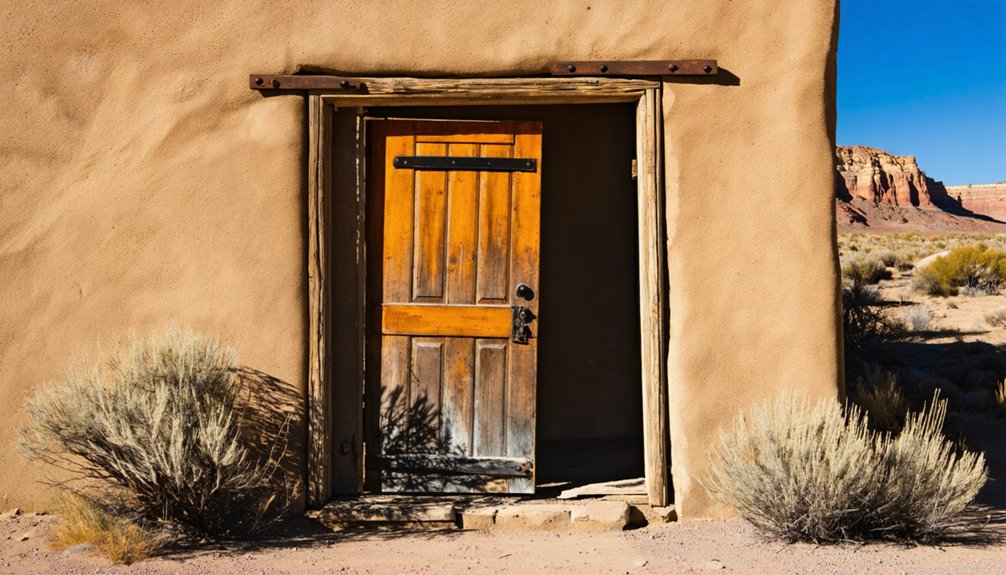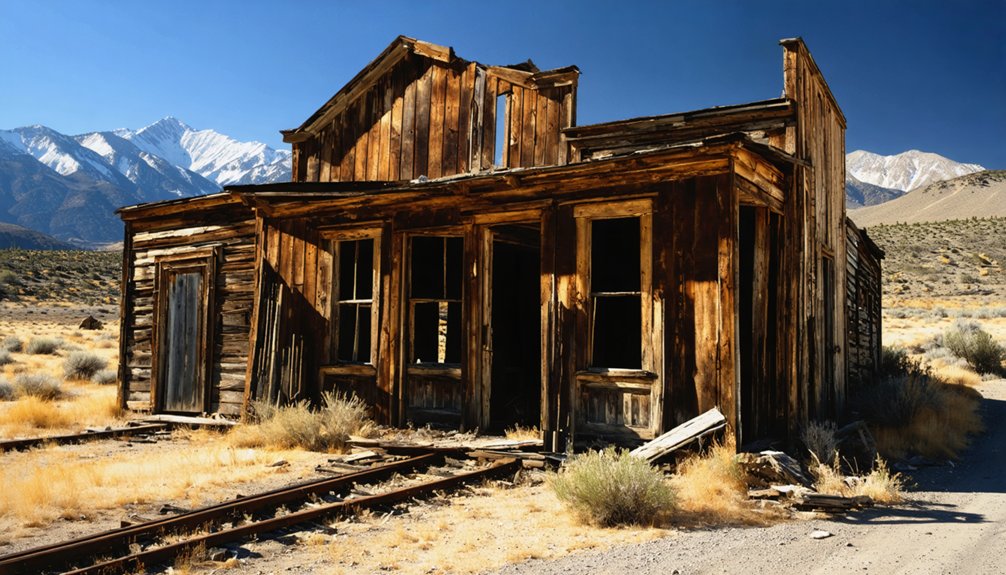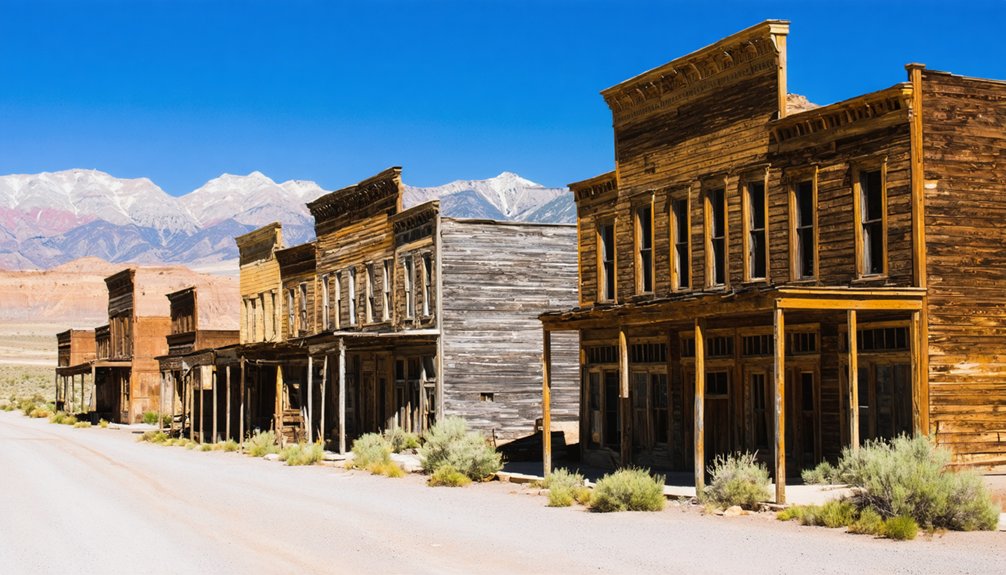
You’ll find Utah’s most accessible summer ghost towns along scenic backroads where Mormon pioneers and silver miners left weathered structures standing against desert skies. Grafton sits 9 miles from Zion, offering five restored buildings and that iconic *Butch Cassidy* film backdrop, while Silver Reef showcases sandstone-trapped silver mines that generated $25 million in the 1870s. Ophir operates as a volunteer-run museum on summer Saturdays at 6,496 feet elevation, and Old Irontown‘s beehive kilns tell stories of Utah’s iron boom. The sections ahead cover essential gear, timing, and photography techniques.
Key Takeaways
- Grafton, near Zion National Park, features five restored structures and is accessible year-round with ideal summer visits in early morning.
- Silver Reef showcases unique sandstone silver deposits with remnants of a 1870s boomtown that produced $25 million in silver.
- Ophir operates as a living mining museum with free exploration of reconstructed buildings, open summer Saturdays at 6,496 feet elevation.
- Old Irontown displays beehive charcoal kilns and iron foundry ruins 23 miles east of Cedar City, accessible for self-guided tours.
- Gold Hill in Utah’s West Desert contains weathered mining structures, remnants of equipment, and Utah’s purported first bowling alley.
Grafton: The Most Photographed Ghost Town in the West
Nestled along the Virgin River just nine miles from Zion National Park’s entrance, Grafton rises from Utah’s red dust like a sepia-toned photograph come to life. You’ll recognize the weathered schoolhouse from *Butch Cassidy and the Sundance Kid*—it’s earned Grafton’s reputation as the West’s most photographed ghost town.
Wander past the cemetery where Berry brothers rest, casualties of the 1866 Black Hawk War, and peer through the windows of John Wood’s 1877 homestead. The ghost town legends here aren’t manufactured tourism; they’re etched in every sun-bleached plank.
Thanks to Grafton Heritage Partnership’s historical preservation efforts since 1997, you’re free to explore five restored structures and imagine the Mormon pioneers who battled floods, wars, and harsh winters before abandoning their cotton mission dream by 1944. The town’s cinematic legacy began in 1929 with Old Arizona, the first outdoor talking movie ever filmed, which earned five Academy Award nominations and launched Grafton into Hollywood history. Access requires crossing a historic iron bridge built in 1924 over the Virgin River from Rockville.
Silver Reef: Where Silver Was Found in Sandstone
You’ll step into Utah’s geological anomaly at Silver Reef, where prospectors defied scientific wisdom and struck silver in sandstone—a discovery experts claimed was impossible.
During the 1870s boom, nearly 2,000 fortune-seekers packed this mile-long Main Street, building a brass band town complete with racetracks and five processing mills that churned out $25 million in silver.
The Wells Fargo office still stands as your touchstone to this fevered past, its 1877 stone walls now housing artifacts from the days when miners proved the experts spectacularly wrong. Despite being surrounded by Mormon settlements, Silver Reef notably lacked a Mormon church, with only a Catholic Church serving the community alongside Presbyterians who shared the worship space. The town’s prosperity ended abruptly in 1881 when wage reductions from $4 to $3.50 sparked a miner strike that led to the closure of mines and mills.
Utah’s Hottest Mining Location
In 1866, when John Kemple spotted peculiar white sandstone streaked with dark gray in a dry wash near Harrisburg, he’d stumbled onto what scientists declared geologically impossible—silver embedded in sandstone.
You’re standing at Earth’s only location where silver was commercially extracted from sandstone, making Silver Reef a geological anomaly that defied expert predictions.
The mining techniques employed here adapted to unprecedented geological formations.
By peak production, six miles of claims yielded over $1 million annually, with ore initially assaying at staggering concentrations.
What makes Silver Reef extraordinary:
- First authenticated discovery ignored for eight years until 1874 confirmation
- Produced approximately $25 million in silver from “impossible” sandstone deposits
- Later became world’s only dual silver-uranium extraction site from identical strata
Walk these weathered paths where fortune-seekers proved conventional wisdom wrong.
The Wells Fargo Express office established operations to handle the booming town’s silver shipments and financial transactions.
News of the discoveries spread rapidly by 1876, triggering the Pioche Stampede as approximately 1,000 unemployed miners flooded the area within three months, transforming the Rockpile tent city into Silver Reef’s thriving mining community.
1870s Silver Boom Era
When prospectors clutched their silver samples from White Reef in 1874, they’d already endured eight years of ridicule. The Smithsonian had dismissed Kemple’s 1866 discovery as an “interesting fake”—because silver geology dictated that precious metals couldn’t exist in sandstone.
You’ll appreciate the irony: these Nevada-hardened prospectors understood prospecting techniques better than ivory-tower geologists. Thomas and Ferris proved everyone wrong when their samples finally authenticated what Kemple knew all along.
The 1870s boom exploded across White Reef, creating over 450 mine openings that eventually extracted 7.5 million ounces—the world’s only commercial silver-from-sandstone operation.
Those dark gray streaks in the dry wash weren’t just mineral deposits; they represented freedom from conventional thinking, rewarding those brave enough to trust their own eyes. By 1879, approximately 2,000 residents had flooded into what became Silver Reef, transforming the once-dismissed site into a thriving mining community complete with hotels, saloons, and even a brass band. Today, you can explore the old Wells Fargo office, which was built in 1877 and now houses a museum preserving the town’s extraordinary history.
Preserved Structures and History
Today’s Silver Reef preserves fragments of that extraordinary boom in ways that’ll transport you straight into 1870s mining camp chaos. Walk the grounds where prospectors defied geological impossibility, extracting silver from sandstone deposits that scientists swore couldn’t exist.
The mining district earned National Register status, protecting remnants of an operation that produced over 7 million ounces before 1910.
Notable preserved features include:
- Wells Fargo Building – Original structure standing since the boom years when $10 million worth of ore flowed through town
- Sealed mine openings – 465 entrances closed during federal reclamation, marking where the Buckeye Reef yielded 70% of total production
- White Reef formations – Arkosic sandstone where horn silver still streaks the rock face
You’re witnessing geology’s greatest anomaly—the only commercial silver mining from sandstone worldwide.
Ophir: A Volunteer-Run Outdoor Mining Museum
Nestled on the west slope of the Oquirrh Mountains, Ophir transforms into an accessible time capsule every summer Saturday when volunteers open the doors to its 19th-century buildings. You’ll walk freely through a reconstructed schoolhouse, original post office, and vintage train car without fees or guided tours dictating your pace.
Mining history comes alive through authentic artifacts displayed throughout the settlement, where a dozen year-round residents maintain this living museum. Volunteer efforts have preserved structures dating back to when 6,000 residents once filled these streets during the silver-lead boom. The town sits at an elevation of 6,496 feet, offering crisp mountain air as you explore its historic grounds. The historic cemetery features both a newer section from 1982 and an older section with iron markers and family plots, accessible via pathways that once served as wagon routes from town.
You’ll discover the charming architecture of original homes and businesses, explore spooky mine remnants scattered across hillsides, and appreciate decorations celebrating the town’s prosperous past when ore shipments averaged $6,000 per ton.
Old Irontown: Desert Ruins With Beehive Kilns
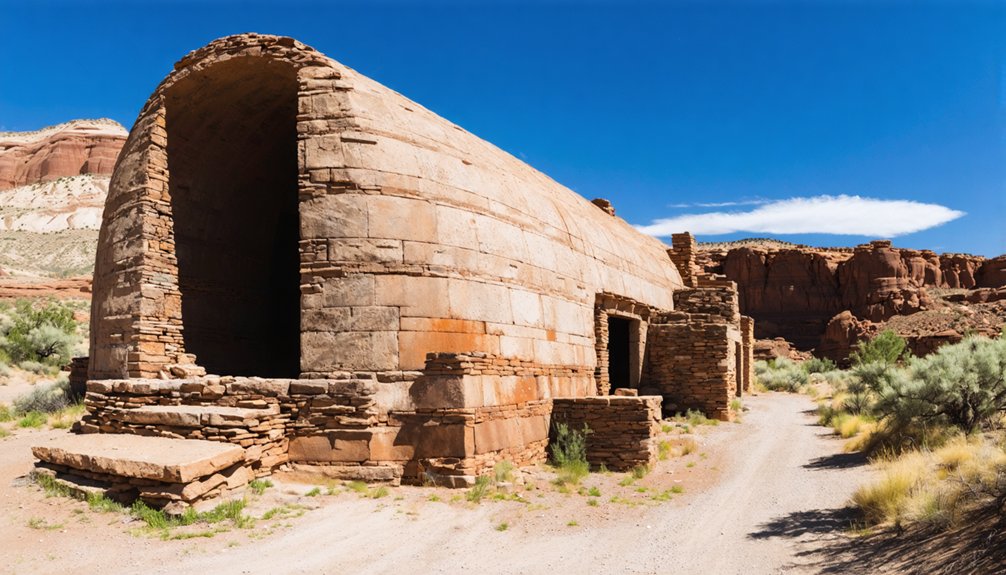
Rising from the desert floor 23 miles east of Cedar City, Old Irontown’s distinctive beehive kilns stand as monuments to Utah’s ambitious but short-lived iron industry.
You’ll discover Utah’s first ghost town, where 1870s ironworkers once produced everything from stoves to 12 cast iron oxen for St. George Temple’s baptismal font.
The desert landscape reveals fascinating archaeological features you can explore via a short trail:
- Beehive charcoal kilns where workers smoldered juniper and pinyon pine without oxygen
- Foundry chimney and furnace ruins that once produced 5-7 tons of pig iron daily
- Arastra grinding apparatus for preparing sand molds
Listed on the National Register since 1971, the site’s managed by Frontier Homestead State Park Museum.
Take State Route 56, then turn left on Iron Town Road for your self-guided adventure.
Clifton: Remnants of a Pony Express Era Mining Camp
You’ll find Clifton’s story written in scattered ruins and a windswept cemetery, where Major Howard Egan’s employees struck gold in 1857 while working the Pony Express route.
The camp exploded into a proper mining district by 1869, complete with mills, saloons, and hotels perched on these desolate hills before collapsing into abandonment by the mid-1870s.
Navigate with GPS through sagebrush to locate the hidden graveyard and crumbling foundations—your high-clearance vehicle will thank you for the slow approach over rock-studded trails.
Gold Discovery and Origins
Long before the Pony Express became legend, its superintendent’s employees stumbled onto something that would reshape this desolate stretch of Utah’s west desert. In 1857, Major Howard Egan’s workers discovered gold near what’d become Clifton, eight years before silver mineral deposits emerged. You’re standing where fortune-seekers once tested primitive mining techniques against stubborn ore.
The discovery sparked immediate interest:
- Gold Hill materialized from wilderness as prospectors abandoned their posts to stake claims
- Pony Express riders witnessed the transformation from their saddles, watching tent cities bloom along their route
- 1869 marked formalization when the Clifton Mining District organized, legitimizing claims and attracting serious capital
This wasn’t accidental wealth—it was frontier determination meeting geological fortune. Those early strikes laid foundations for everything that followed: the boom, the infrastructure, and ultimately, the ghost town you’ll explore today.
Mining District Development
When silver emerged around 1865, prospectors formalized what gold had started—the Clifton Mining District organized in 1869, transforming scattered claims into a legitimate operation. You’ll find evidence of this mining legacy scattered across the hills, where tunnel openings and tailings mark ambitious excavations.
By 1872, builders erected a small mill and smelter, freeing miners from hauling ore 125 miles to Stockton—a game-changer for profitability.
Hotels, saloons, and stores sprouted during the boom, serving rough-edged fortune seekers who’d abandoned convention for possibility. Yet the heyday flickered fast. By the mid-1870s, veins played out and prospectors drifted toward Gold Hill.
Today, town preservation efforts remain minimal—nature reclaims structures, leaving you to explore authentic decay where Brigham Young’s nephews once outlasted everyone else in stubborn solitude.
Exploring the Historic Remains
The log cabin Brigham and Oliver Young built still stands among weathered mine shafts and crumbling stone foundations, a tribute to those final holdouts who refused to abandon Clifton when everyone else left.
You’ll discover authentic industrial archaeology scattered across these hillsides—mill ruins, smelter remnants, and tunnels carved into rock by desperate fortune-seekers.
What awaits your exploration:
- Hidden cemetery nestled in brush where William R. Sheldon’s bleached headstone marks his 1889 Christmas Day death
- Multiple mine sites threading through surrounding hills, accessible via dusty trails
- Stone buildings clinging to elevated terrain, their preservation techniques barely holding against Utah’s harsh elements
Bring GPS coordinates and plenty of water. These weathered structures won’t last forever, and there’s something liberating about walking ground where determined prospectors once chased silver dreams before reality forced them elsewhere.
Gold Hill: Remote Western Utah Boom Town
Deep in Utah’s West Desert, Gold Hill rises from the alkaline flats like a fever dream of American ambition—a collection of weathered structures baking under relentless sun where sagebrush now outnumbers people by the thousands.
You’ll find corroded mining equipment scattered between the 1916 Goodwin Mercantile Store and what locals claim was Utah’s first bowling alley. Ghost town legends whisper of million-dollar copper shipments and arsenic fortunes that vanished like desert mirages.
Respect the private property markers—original families still maintain seasonal cabins here. The gravity-fed spring water’s contaminated with arsenic, so pack everything you’ll need.
This isn’t vacation country; it’s rattlesnake territory where summer heat tests your resolve.
But if you’re chasing genuine Western isolation, Gold Hill delivers unvarnished truth about boom-and-bust dreams.
What to Bring When Visiting Utah Ghost Towns in Summer
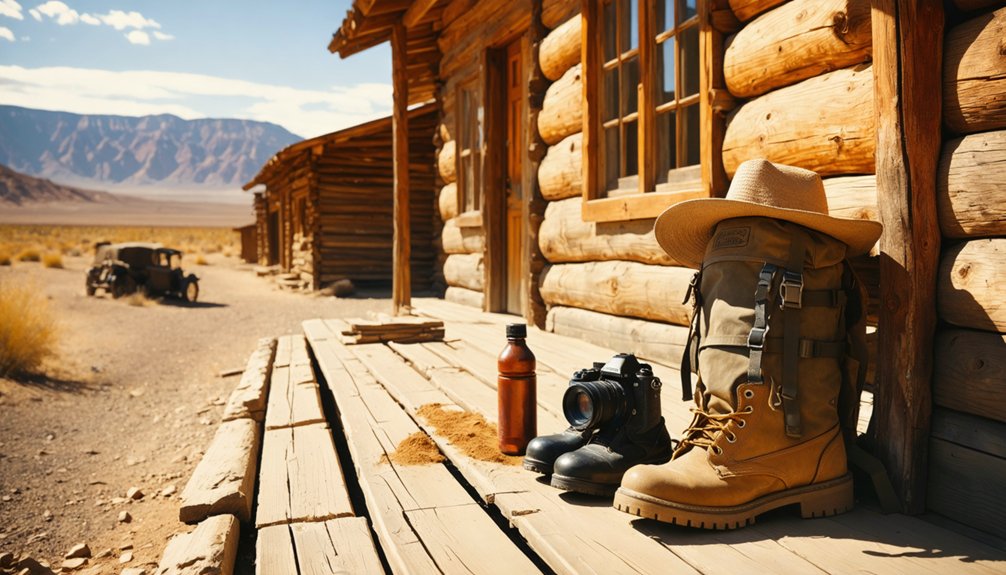
Your backpack’s contents will determine whether your ghost town expedition becomes a memorable adventure or a cautionary tale whispered among search-and-rescue teams. Desert environments demand respect, and these travel essentials aren’t suggestions—they’re survival necessities.
In desert ghost towns, your backpack separates adventure stories from rescue operations—pack accordingly or become the cautionary tale.
Critical Safety Precautions:
- Water and navigation tools: Pack multiple gallons in insulated containers, GPS coordinates written down, physical maps, and a compass since cell reception vanishes in remote locations.
- Sun protection arsenal: Wide-brimmed hat, sunglasses, sunscreen, and light-colored breathable clothing for Utah’s scorching summers.
- Emergency preparedness kit: First aid supplies, flashlight with extra batteries, medications, energy snacks, and a portable phone charger.
Research access restrictions beforehand—sites like Ophir only open May through September on Saturdays. Always inform someone of your planned location and expected return time before vanishing into history.
Best Times to Visit Utah’s Historic Mining Communities
When you’re planning your journey through Utah’s abandoned mining communities, timing transforms from a minor detail into the critical factor between sun-scorched misery and perfect exploration conditions. You’ll find May through September offers peak access, though smart adventurers arrive at dawn before temperatures breach 100°F at spots like Silver Reef.
Fall delivers sweet 60-80°F days—perfect for examining rusted mining equipment without heat exhaustion looming over your shoulder. Ophir’s volunteer-led tours run summer weekends only, while sites like Grafton welcome you year-round.
Evening light magnificently illuminates Old Irontown’s beehive ovens, creating unforgettable photo opportunities. Just remember: July-August monsoons flood desert washes rapidly, and winter snow seals off high-elevation ruins.
Preservation challenges intensify with each passing season, making your summer visit both timely and urgent.
Photography Tips for Capturing Ghost Town Architecture
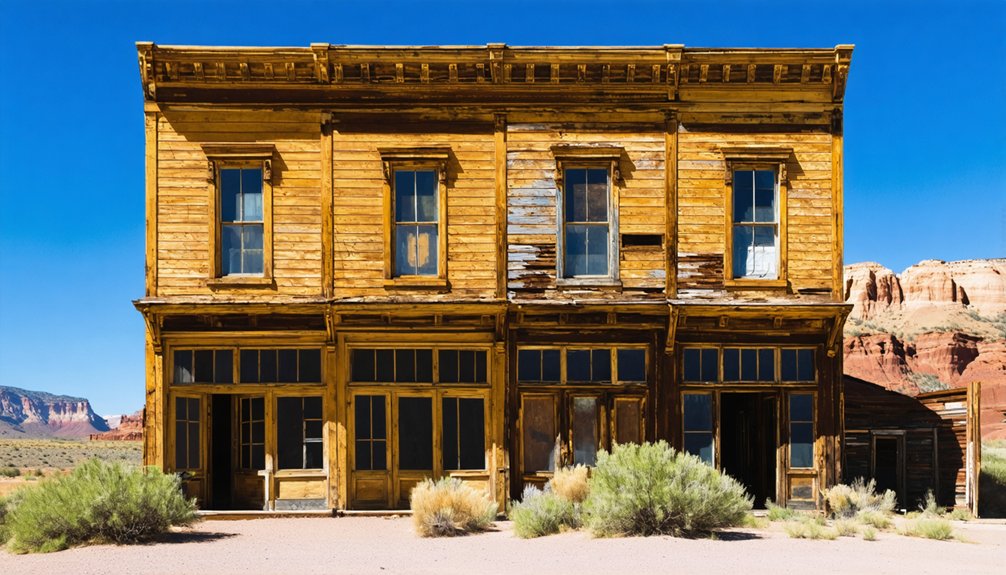
Abandoned structures whisper their stories through crumbling facades and sun-bleached timber. But capturing that haunting narrative requires more than simply pointing your camera at weathered buildings. You’ll need the right approach to immortalize Utah’s deteriorating treasures.
Essential gear for ghost town exploration:
- Wide-angle lens (24mm) to emphasize emptiness and architectural symmetry in confined spaces
- Sturdy tripod for long exposures (13-30 seconds) that reveal details without harsh flash
- Headlamp for traversing shadows and selective light-painting techniques
Shoot during golden hour when natural light and shadow become your compositional allies. Set your aperture to f/8 for crisp foreground-to-background sharpness. Document everything—weathered doors, rust-orange textures, discarded artifacts. These intimate details ground your images in specific eras, transforming simple photographs into powerful historical narratives that celebrate architectural decay.
Frequently Asked Questions
Are Utah Ghost Towns Safe for Children to Explore?
Utah ghost towns aren’t safe for children to explore freely. Despite their historical significance, abandoned mines pose deadly hazards—falls, toxic air, unexploded explosives. You’ll need strict safety precautions: stay outside structures, avoid mines, supervise constantly, and respect posted warnings.
If you’re looking for ghost towns to explore in Utah, it’s essential to go with knowledgeable guides who understand the risks involved. These locations offer a glimpse into the past, but it’s crucial to prioritize safety above all. Always conduct thorough research before your adventure to ensure a safe and enriching experience.
If you’re planning to visit abandoned towns in Utah to explore, consider going during the day when visibility is optimal. Additionally, equipping yourself with essential supplies like water, a first aid kit, and a reliable map will enhance your safety. Engaging with local historians can deepen your understanding of the region’s rich heritage and the stories behind these ghostly remnants.
Do I Need a 4×4 Vehicle to Reach These Ghost Towns?
Want to chase etching history into Utah’s backcountry? You’ll need a high-clearance 4×4 for most ghost towns requiring remote access. However, some roadside sites like Frisco remain accessible without extreme off-road capability—freedom varies by destination.
Exploring winter adventures in Utah’s ghost towns unveils a captivating blend of history and rugged landscapes. Each town has its own unique story, from old mining operations to abandoned streets lined with remnants of the past. As you navigate these hidden gems, be prepared for breathtaking views and unexpected encounters with wildlife, making your journey even more memorable.
Can I Camp Overnight Near Any of These Ghost Towns?
Yes, you can dispersed camp near most ghost towns on BLM or state lands. Bring proper camping gear and practice wilderness safety—choose durable surfaces, pack out trash, and respect 14-day limits for your freedom adventure.
Are There Entrance Fees to Visit Utah’s Ghost Towns?
Most ghost towns you’ll explore are free, offering unmatched photography opportunities and historical preservation access. Grafton and Old Irontown cost nothing, while Silver Reef charges just $3—perfect for budget-conscious adventurers seeking authentic Western heritage without constraints.
What Cell Phone Coverage Can I Expect at These Locations?
You’ll find cell service spotty at best—AT&T offers the most reliable coverage areas, but don’t count on it. Download offline maps beforehand, pack a compass, and embrace the digital detox these remote locations naturally provide.
References
- https://www.ksl.com/article/51308628/restored-utah-ghost-towns-that-should-be-on-your-summer-travel-bucket-list
- https://www.roadtripryan.com/go/t/utah/westdesert/gold-hill-and-clifton-ghost-towns
- https://www.tripadvisor.com/Attractions-g28965-Activities-c47-t14-Utah.html
- https://www.utahvalley.com/plan/day-trips-itineraries/history-buff/ghost-towns-and-haunted-places/
- https://www.youtube.com/watch?v=0RLITc0eKoc
- https://www.visitutah.com/things-to-do/history-culture/ghost-towns
- https://www.deseret.com/utah/2023/1/21/23549285/utah-ghost-towns-mormon-history/
- https://graftonheritage.org/history-settlement/
- https://www.americansouthwest.net/utah/zion/grafton_ghost_town.html
- https://www.hannahhendersontravel.com/grafton-ghost-town-utah/