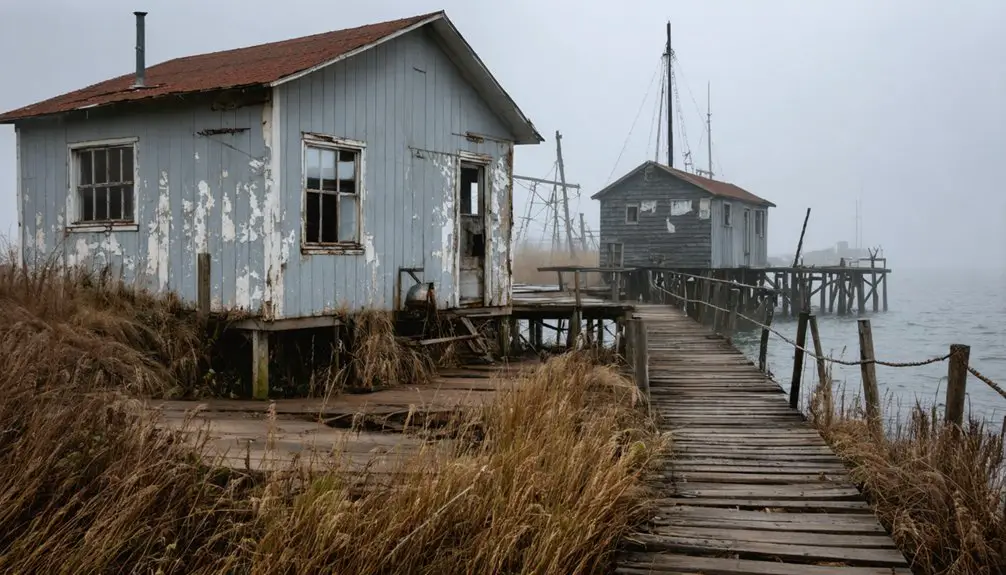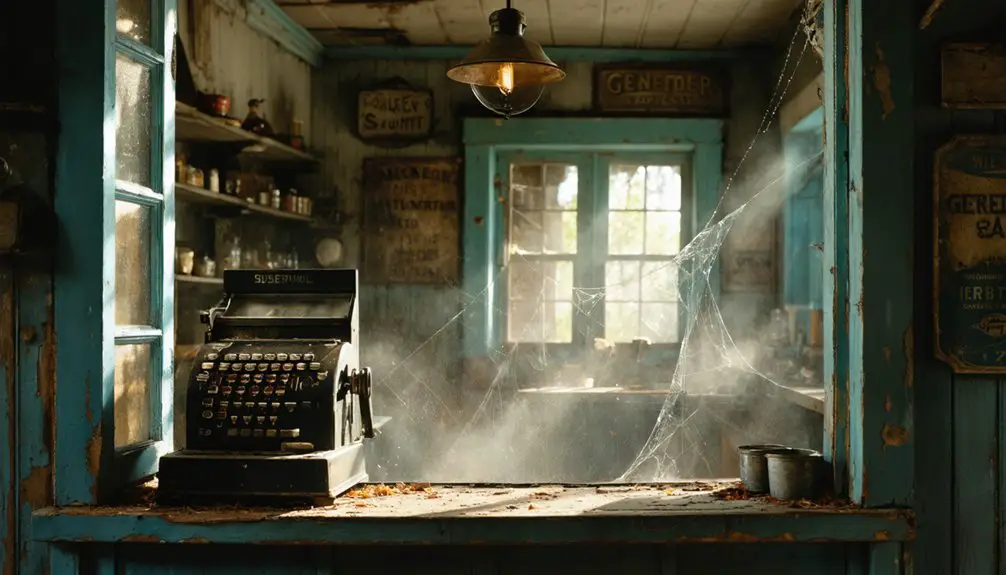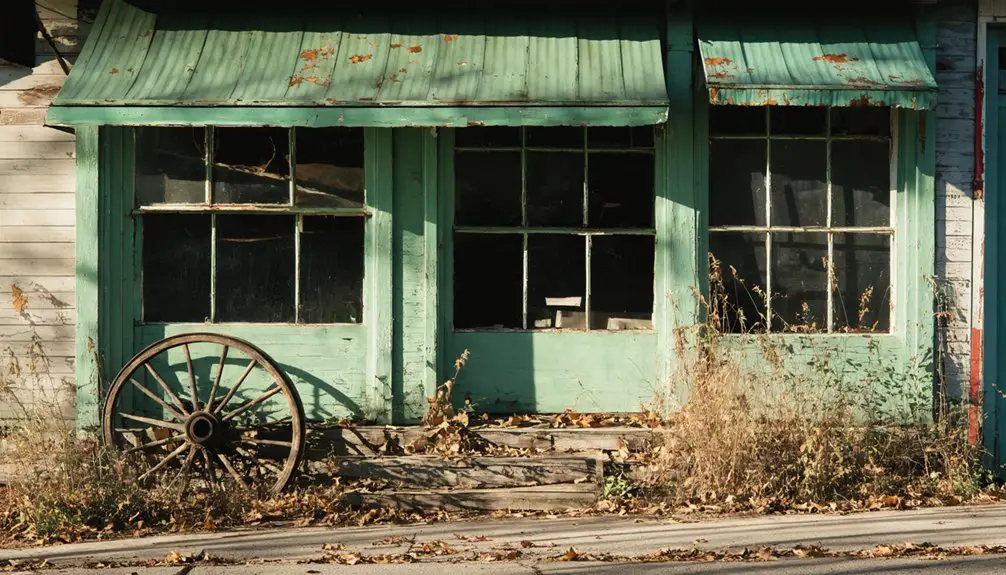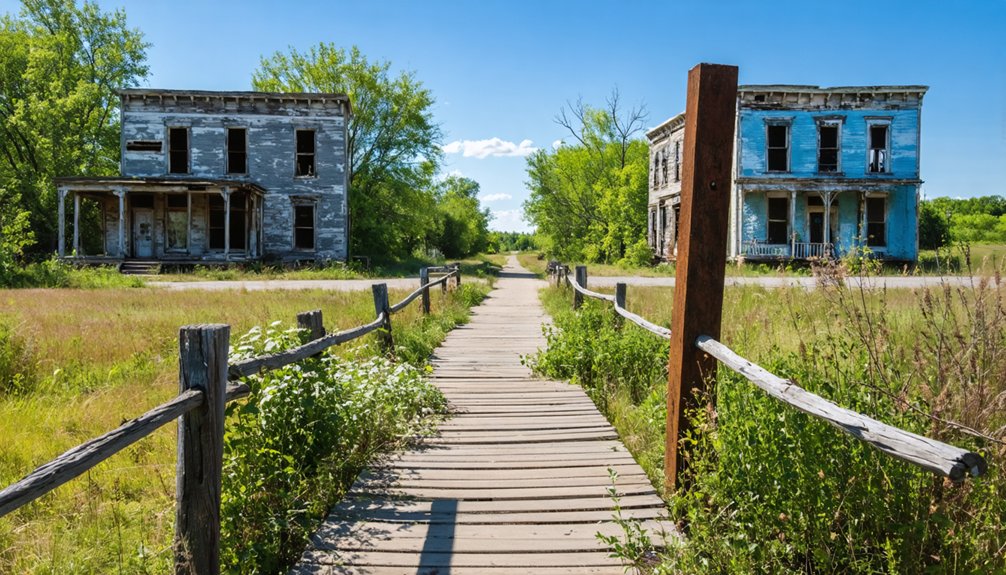
You’ll find Wisconsin’s best ghost towns waiting for summer exploration, from Fort Howard’s weathered military buildings on Green Bay’s shore to Cooksville’s perfectly preserved 1850s streetscape—frozen in time after the railroad passed it by. Walk through Ceresco’s reconstructed Long House where 180 utopian dreamers once shared communal meals, or trace Dover’s temperance colony foundations near Mazomanie. Pack sturdy boots and your camera for dawn visits to these haunting reminders of frontier ambitions, where crumbling brick and overgrown foundations tell stories you won’t discover anywhere else.
Key Takeaways
- Summer offers ideal weather and extended daylight for exploring Wisconsin’s ghost towns like Cooksville, Dover, and Ceresco.
- Cooksville preserves authentic 1850s architecture with 35 historic structures, including an 1847 general store frozen after railroad bypass.
- Ceresco features a reconstructed Long House replica showcasing 1840s communal living based on Fourier’s socialist principles.
- Dover traces remain near Mazomanie’s old schoolhouse, documenting a failed 1843 British temperance colony abandoned after railroad development.
- Start early at sites like Buena Vista Trail and take scenic detours along Rustic Road 66 for enhanced exploration.
Fort Howard: A War of 1812 Military Outpost on Green Bay
Where the Fox River meets Green Bay’s western shore, you’ll find traces of a military outpost that once stood as America’s first line of defense in what would become Wisconsin. Fort Howard rose in 1816, named for War of 1812 hero Brigadier General James Howard. You can explore authentic historic architecture at Heritage Hill, where three original buildings—the hospital, school, and company kitchen—still stand after relocation.
The fort’s story intertwines deeply with Native American history. Menominee Chief Tomah negotiated peace for its construction, while soldiers later mediated between tribes and settlers. Beyond military operations, the fort provided social and educational services to the frontier community. Though decommissioned in 1852, its legacy shaped Green Bay’s development. The fort served as a Civil War enlistment center when it briefly reopened in 1863.
Visit Heritage Hill to walk through these weathered structures and imagine the frontier soldiers who once controlled this strategic waterway connecting the Great Lakes to the Mississippi.
Fort Crawford: From Frontier Defense to Municipal Pool
At the confluence of the Wisconsin and Mississippi Rivers, Fort Crawford‘s twin incarnations defended America’s northwest frontier for four decades.
You’ll find Prairie du Chien‘s original 1816 oak-timbered fort succumbed to devastating floods, forcing soldiers to relocate uphill in 1829.
This strategic outpost hosted thousands during the 1825 Treaty of Prairie du Chien, where Dakota, Ho-Chunk, and six other nations negotiated boundaries—a masterclass in frontier military strategy.
Walk where Zachary Taylor and Jefferson Davis once stood during the Black Hawk War. Dr. William Beaumont conducted groundbreaking digestion experiments here, treating cholera victims between battles.
Today’s Fort Crawford Museum preserves these stories, though the second fort’s foundations lie beneath modern streets. The museum operates from 10:00 AM to 4:00 PM during the summer season, welcoming visitors to explore the fort’s frontier legacy. Archaeological digs revealed what Native American treaties and frontier expansion built—and ultimately abandoned by 1856. The site’s origins trace back to Nicolas Perrot’s trading post established in 1685, connecting it to the broader French fur trade network that first drew Europeans to this strategic location.
Belmont: Wisconsin’s Forgotten First Capital
For just 46 days in 1836, this ambitious frontier village served as Wisconsin Territory’s capital before Madison’s selection triggered one of the region’s most dramatic municipal collapses.
You’ll discover two restored buildings where legislators shaped Wisconsin’s foundation—the Council House and Supreme Court House stand as monuments to architectural preservation. Urban legends whisper about Belmont’s founder John Atchison, who gambled everything on attracting lawmakers with four hastily-constructed public buildings.
John Atchison’s desperate gamble: four hastily-built public buildings that briefly housed Wisconsin’s territorial government before complete municipal abandonment.
What You’ll Experience:
- Two-story Council House where 42 territorial laws were drafted
- Original “beautiful mountain” landscape of three prominent hills
- Free admission to Wisconsin Historical Society-managed grounds
- Abandoned settlement’s transformation from capital to cattle barn
The exodus happened overnight. When James Doty’s Madison lobbying succeeded, residents fled so quickly that Belmont essentially vanished, later resurfacing miles south along railroad tracks. The original lodginghouse eventually became Chief Justice Charles Dunn’s residence before its later conversion to agricultural use. The site remained dormant until 1910, when the Wisconsin Federation of Women’s Clubs initiated restoration efforts that would eventually save these historic structures from complete destruction.
Cooksville: The Town the Railroad Left Behind
You’ll find Cooksville frozen in the 1850s, its Greek Revival buildings standing exactly where the Cook brothers left them before the Panic of 1857 bankrupted the railroad that was supposed to transform their village into a commercial hub.
Walk past the original 1847 general store—its red vermilion brick still solid—and you’re witnessing what happens when a town loses its economic lifeline yet somehow preserves its soul.
The railroad chose a northern route to Fond du Lac instead, and while Cooksville’s population plummeted from 175 to just 65 residents, this abandonment accidentally created Wisconsin’s most authentic time capsule.
Hidden in the ravines near Caledonia Springs, you can still find the stone culvert bridge that was built for tracks that never came—a Roman-style arch standing as a monument to the town’s abandoned future.
When electricity finally arrived in 1917, the village had already adapted to its quiet fate, relying on Bad Fish Creek to power its gristmill while neighboring towns raced into modernity.
Railroad Bypass History
When the Chicago, St. Paul and Fond du Lac Railroad surveyed their diagonal route through Porter Township in the 1850s, Cooksville’s future seemed promising. You can still find remnants of this railway heritage in the overgrown woods near Caledonia Springs, where a 160-year-old stone culvert bridge stands as a haunting monument to abandoned dreams.
The 1857 bypass changed everything:
- Tracks rerouted to Edgerton and Stoughton instead
- Financial Panic of 1857 bankrupted the under-funded railroad
- Village population never exceeded 200 residents
- Cooksville earned its nickname: “town that time forgot”
This ghost town preservation story offers you something rare: authentic mid-19th century architecture frozen in time. Those vermilion brick houses that anchored the settlement now preserve its “wee bit of New England” character you’ll discover today. Despite the railroad bypass, the community maintained essential services including five blacksmith shops that operated in 1894 to support local agriculture. The town’s National Register listing as Wisconsin’s second historic district came after Mineral Point, recognizing its exceptional preservation.
General Store Remnant
Standing at the corner of Cooksville’s quiet public square, you can’t miss the vermilion brick building that anchored this village’s survival—the old general store built around 1846 by Waucoma Masonic Lodge No. 90. Wisconsin’s oldest general store still stands with its faded Masonic globe light glowing outside, while lodge members continue meeting upstairs just as they did before statehood.
The ground floor’s retail space invites you to imagine shelves stocked with provisions for settlers who never saw their population exceed 200. Though haunted legends don’t swirl around this pre-1848 structure, its silent endurance feels equally supernatural.
Preservation efforts since 1911 earned Cooksville National Register status, protecting all 35 historic buildings. You’re witnessing what happens when communities choose heritage over development—authentic freedom frozen in vermilion brick.
Dover: A Failed Temperance Colony in Dane County
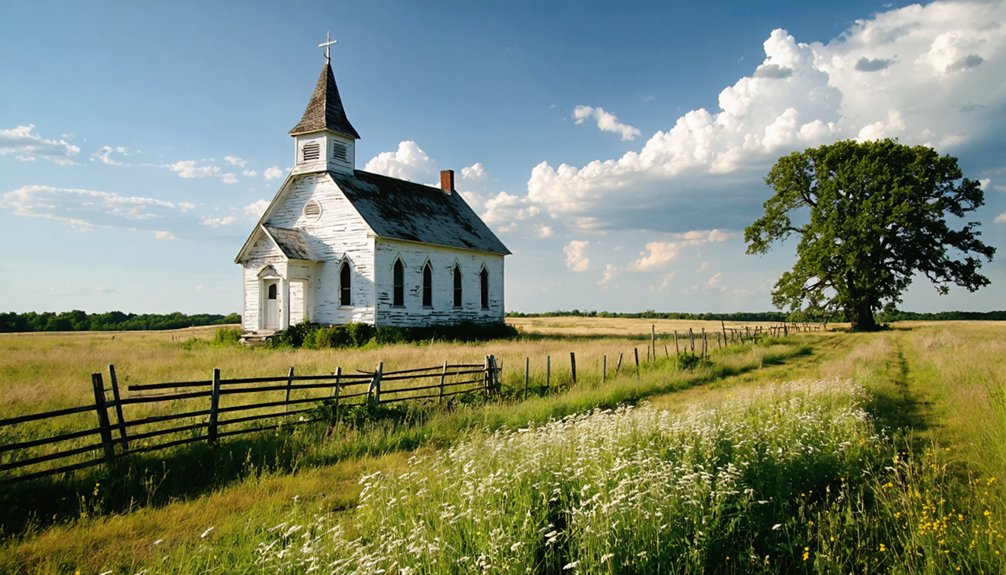
On Christmas Day 1843, three determined Englishmen—Charles Wilson, Joshua Rhodes, and Alfred Senier—stepped off their ship onto frozen Wisconsin soil with a radical vision: building America’s first sober frontier settlement.
Three Englishmen abandoned civilization on Christmas 1843, determined to build America’s first temperance colony on Wisconsin’s frozen frontier.
They sheltered in an abandoned Ho-Chunk wigwam and began constructing Dover, a temperance colony that briefly thrived as a trading hub.
What you’ll discover exploring Dover’s site:
- Original pioneer lifestyle traces near the old schoolhouse southwest of Mazomanie
- Historical preservation efforts documenting 900+ British emigrants’ journey
- Evidence of why railroads killed frontier dreams—the Milwaukee Road chose Mazomanie instead
- Remnants of a social experiment where clerks and watchmakers became struggling farmers
Ceresco: Exploring Wisconsin’s Utopian Commune Experiment
You’ll discover Ceresco’s roots in Charles Fourier’s radical vision when you visit the historical marker at Ceresco Park, where followers once gathered in their Long House—a communal dwelling that sheltered up to 30 families under one roof.
The settlement took its name from Ceres, the Roman goddess of harvest, reflecting the utopian farmers’ hope that collective wheat cultivation would yield both prosperity and social harmony.
Stand across Warren Street at the replica Long House, and you can almost hear the clatter of shared meals at that single communal table where rigid hierarchy dictated every aspect of daily life.
Fourier’s Communal Living Principles
When you wander through the remnants of Ceresco today, it’s hard to imagine that this quiet Wisconsin landscape once hosted one of America’s boldest social experiments—a commune built on Charles Fourier’s radical vision of communitarian socialism.
Despite urban decay and preservation challenges, Fourier’s principles remain fascinating:
- Collective property ownership replaced individual wealth, with members receiving shares instead of cash payments
- The Long House united 20-30 families under one roof, featuring communal dining halls that shattered traditional family isolation
- Job flexibility let residents change occupations and partners freely, fostering cooperation over competition
- Democratic governance empowered all members through elected superintendents and industry councils
The commune thrived on nearly 2,000 acres at peak, housing 180 residents who challenged conventional society’s constraints.
Original Long Home Structures
The Long House rose from rough-hewn lumber in 1845, a sprawling tribute to Ceresco’s rejection of private domestic life. You’d have found yourself dining elbow-to-elbow with 20 to 30 families at one massive table, your meals prepared in a single communal kitchen. Privacy? That concept didn’t exist here.
Today, historical preservation efforts let you explore this radical experiment through a replica positioned across from Ceresco Park. Walk the grounds where 180 souls once chose collective existence over individual autonomy—a choice most couldn’t sustain.
By 1848, only 29 families remained.
The irony’s thick: these freedom-seekers built their own cage. Community life demanded surrendering the very independence they’d sought, proving that utopia’s always someone else’s vision imposed.
Roman Harvest Goddess Namesake
Ceres watched over Roman wheat fields with divine authority, and her disciples in 1844 Wisconsin borrowed more than just her name—they staked their entire survival on her promise. You’ll discover how ancient mythology shaped this commune’s identity when Warren Chase selected “Ceresco” for his utopian experiment.
The cultural symbolism ran deep—goddess of agriculture protecting 2,000 acres of wheat.
Consider what the name revealed about their priorities:
- Agricultural abundance as spiritual foundation
- Roman ideals merged with American frontier independence
- Wheat farming as path to collective prosperity
- Divine blessing sought through naming ritual
The settlers understood symbols carry power. They needed Ceres’ protection while planting 100 acres of winter wheat that first season. Every harvest became proof their goddess-inspired vision could flourish in Wisconsin soil.
Best Times and Routes for Your Ghost Town Road Trip
Summer’s golden light transforms Wisconsin’s ghost towns into perfect road trip destinations, and planning your route strategically makes all the difference. Start early morning hikes at spots like Buena Vista Trail—you’ll beat the heat while capturing ghost town architecture in soft dawn light.
The Southwest Wisconsin Mining Route from Potosi to Platteville offers concentrated exploration, connecting Badger Mine’s hand-dug tunnels with Mulcahy Mine’s haunting tailings pile. Take the 7.5-mile Rustic Road 66 detour through Coon Branch coulee for pastoral scenery between sites.
For extended adventures, link La Crosse to Platteville via Cashton and Viroqua, then continue to Madison through Blue Mounds. These seasonal visitation tips maximize your freedom: cooler mornings mean comfortable exploration, while summer wildflowers frame your photographs of Wisconsin’s forgotten settlements.
What to Bring When Exploring Wisconsin’s Abandoned Sites
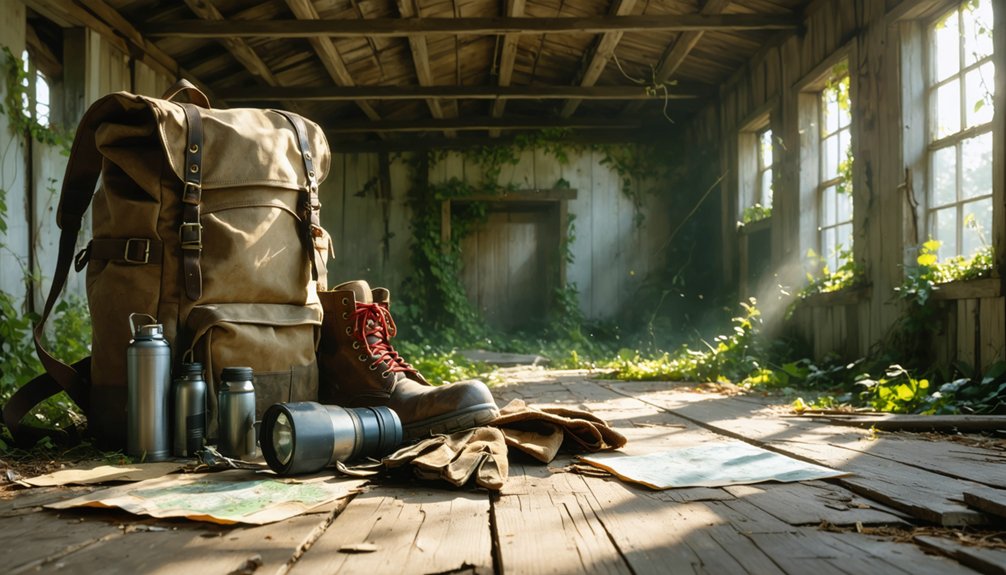
Planning your route matters little if you’re unprepared for what awaits inside those crumbling structures. Emergency preparedness starts with sturdy boots and a flashlight—those rotting floorboards at Mineral Center won’t forgive cheap footwear. I’ve watched countless explorers turn back because they didn’t pack the basics.
For effective historical documentation and safe exploration, you’ll need:
- Navigation gear: Topographic maps, GPS device, and compass for remote North Shore sites
- Safety essentials: First aid kit, whistle, high-visibility vest, and thick gloves for handling rusted remnants
- Documentation tools: Camera, notebook, and binoculars for capturing structures and cemetery inscriptions
- Protection: Long sleeves, permethrin-treated clothing, bug spray, and waterproof jacket
Bring portable chargers—dead batteries mean lost discoveries at places like Sawbill Landing.
Frequently Asked Questions
Are Wisconsin Ghost Towns Safe for Children to Explore?
Wisconsin’s ghost towns are adventure playgrounds where you’ll discover historical preservation meets tourist safety! You should supervise kids closely around old structures, watch for uneven terrain, and pack first-aid supplies for your family’s unforgettable exploration.
In addition to the thrill of exploration, some ghost towns with unique festivities offer a chance to experience local culture and traditions. Seasonal events like harvest festivals and reenactments bring these historic sites to life, making each visit a memorable one. Whether it’s tasting homemade treats or enjoying live music, there’s always something delightful waiting around the corner.
if you’re looking for hidden gems, abandoned places in Wisconsin’s spring beckon with their eerie charm and untouched beauty. Exploring these sites during the season of rebirth reveals timeworn structures often adorned with vibrant wildflowers and new growth, enhancing their hauntingly beautiful appeal. It’s the perfect backdrop for photography enthusiasts seeking to capture the juxtaposition of decay and renewal in the heart of the Midwest.
Do Any Ghost Towns Require Entrance Fees or Permits?
Most Wisconsin ghost towns don’t require access fees or permit requirements since they’re abandoned settlements on public land. However, you’ll need state park passes ($13-$16 daily) if exploring ghost towns within park boundaries for unrestricted adventure.
Can You Camp Overnight Near These Abandoned Historical Sites?
Want to sleep under stars near history? You’ll find primitive campsites throughout Chequamegon-Nicolet National Forest near abandoned sites. Historic preservation meets wildlife conservation in these remote locations, offering you genuine freedom with fire rings, trails, and riverfront access.
Are Guided Tours Available at Wisconsin Ghost Town Locations?
You’ll find guided exploration at Wisconsin’s ghost towns through historical preservation groups and local tour operators. They’ll lead you through abandoned settlements, sharing authentic stories while you’re free to photograph crumbling buildings and imagine frontier life firsthand.
winter explorations in Wisconsin’s ghost towns can lead to unexpected discoveries, from artifact remnants to remnants of long-lost communities. As you walk the weathered paths, the whispers of history come alive, inviting you to reflect on the lives once lived there. Each visit offers a unique glimpse into a forgotten past, perfect for those with a sense of adventure and a love for history.
If you’re looking for even more eerie experiences, consider visiting the haunted places in Wisconsin that are steeped in legends and ghostly tales. From old prisons to historic inns, these sites are often said to be inhabited by spirits who refuse to leave. Engaging in nighttime tours can heighten the thrill as you uncover chilling stories and perhaps even encounter a ghostly presence yourself.
Which Ghost Towns Have Restroom Facilities for Visitors?
When nature calls, you’ll find restroom facilities at Paradise Springs Eagle with accessibility features like handicap parking. The other ghost towns don’t offer modern conveniences, so plan accordingly before exploring these hauntingly beautiful, off-the-grid Wisconsin destinations.
References
- https://en.wikipedia.org/wiki/List_of_ghost_towns_in_Wisconsin
- https://www.ghosttowns.com/states/wi/wi.html
- https://www.onlyinyourstate.com/experiences/wisconsin/ghost-towns-wi
- https://pbswisconsin.org/news-item/southern-wisconsins-ghost-towns-leave-behind-vital-stories/
- https://en.wiktionary.org/wiki/Category:en:Ghost_towns_in_Wisconsin
- http://shunpikingtoheaven.blogspot.com/2016/05/a-wisconsin-ghost-town.html
- https://www.wisconsinhistory.org/Records/Image/IM116137
- https://kids.kiddle.co/List_of_ghost_towns_in_Wisconsin
- https://grantcountyhistory.org/wp-content/uploads/2016/01/GhostTownsGrantCountyTLundeen.pdf
- https://www.wisconsinhistory.org/Records/Article/CS392