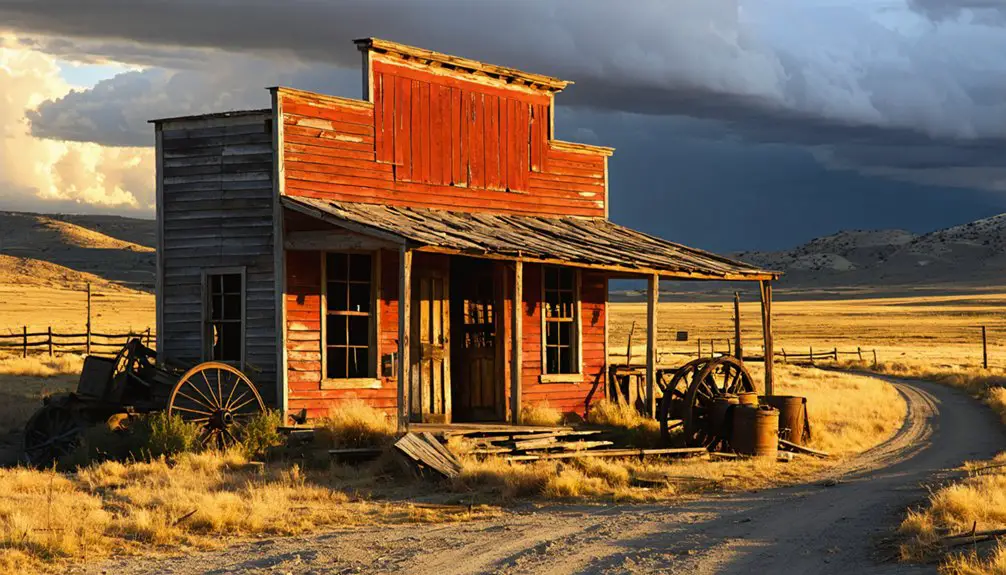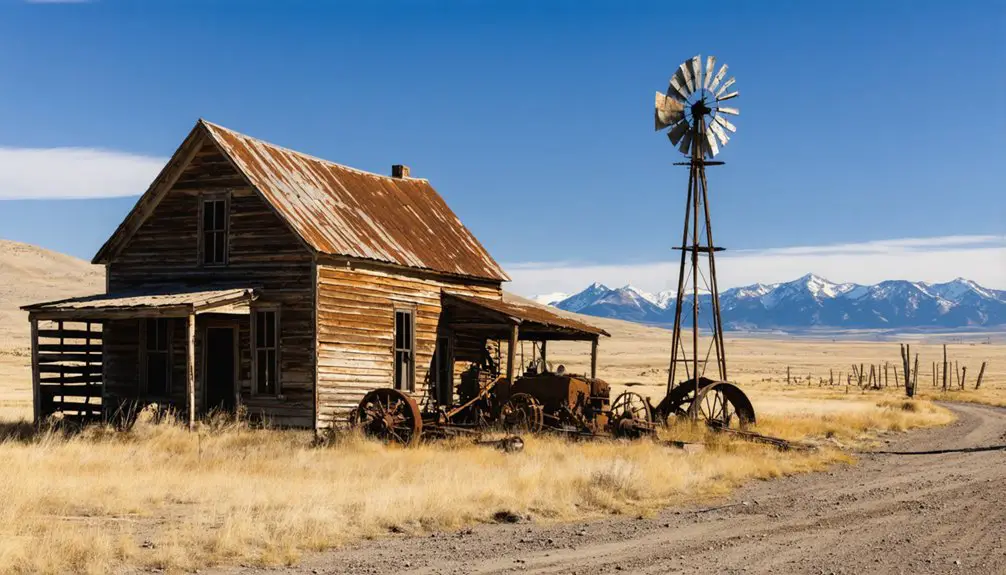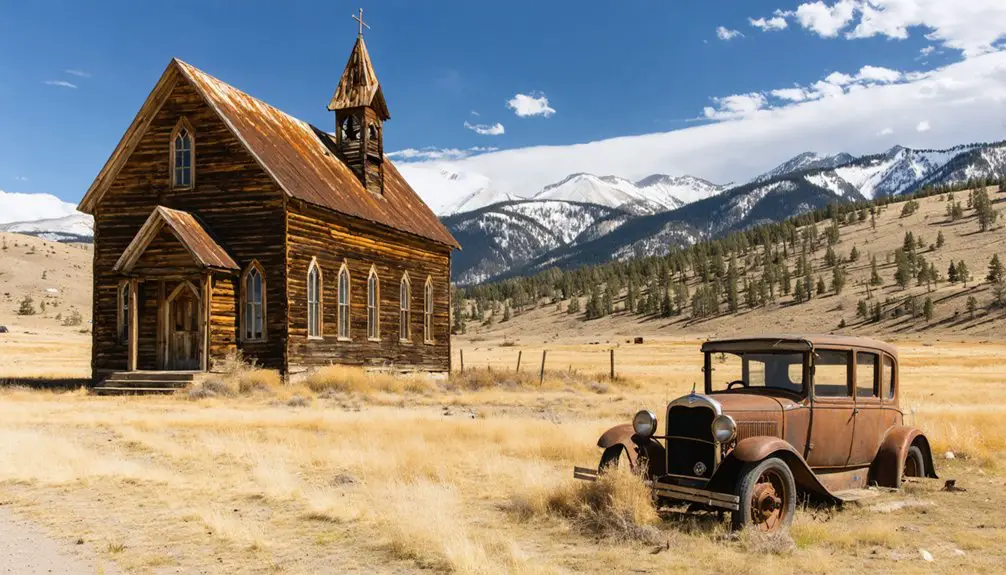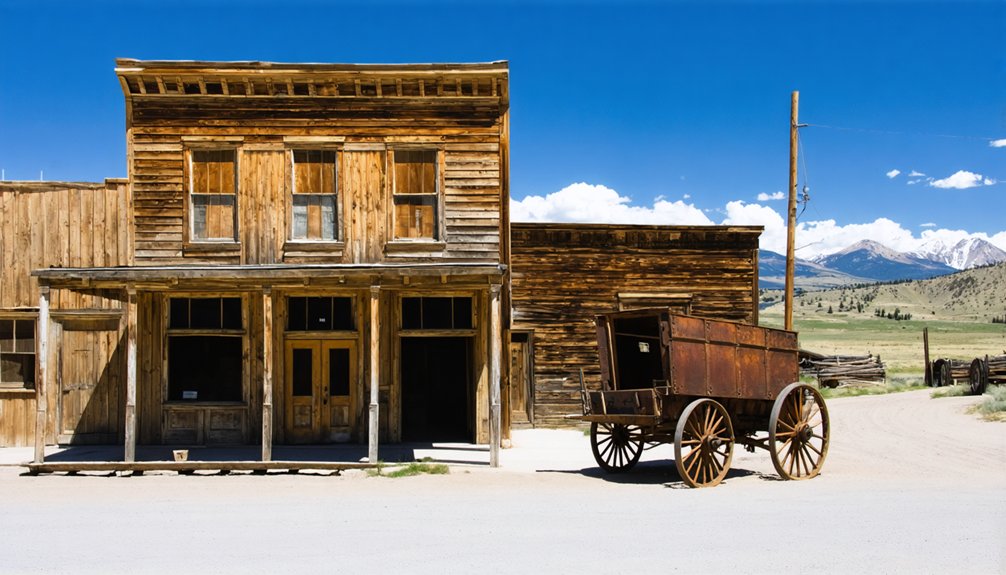
You’ll find Wyoming’s best summer ghost town adventures at South Pass City, where 23 preserved structures from the 1860s gold rush line a bustling half-mile street, and remote Kirwin, perched at 9,200 feet in the Absaroka Mountains with 38 weathered buildings. Don’t miss Reliance Tipple‘s dramatic coal processing ruins near Rock Springs, or Jeffrey City’s eerie 1960s-era apartments along Highway 789. Atlantic City still clings to life with 57 residents, while Piedmont’s beehive kilns stand silent in prairie grasslands—each site reveals fascinating stories of boom, bust, and survival.
Key Takeaways
- South Pass City hosts Gold Rush Days festival in July with gold panning, wagon tours, and costumed interpreters among 23 preserved original structures.
- Kirwin Ghost Town offers off-grid summer exploration at 9,200 feet elevation with 38 weathered structures surrounded by 12,000-foot peaks.
- Atlantic City provides Continental Divide Trail access and wildlife viewing opportunities while maintaining historic structures and a small resident population.
- Reliance Tipple features accessible interpretive signs and a short footpath to view the 1936 coal processing site’s industrial remnants.
- Jeffrey City along Highway 789 showcases 1960s-era abandoned buildings including apartments, high school, and storefronts from recent mining collapse.
Kirwin Ghost Town: Remote Mountain Adventure in the Absaroka Range
Nestled at a breathtaking 9,200 feet in Wyoming’s rugged Absaroka Mountains, Kirwin Ghost Town rewards adventurous souls willing to tackle the challenging 34-mile journey southwest of Meeteetse. You’ll navigate ATV trails through wilderness that’ll test your mountain exploration skills, but the payoff’s worth it—38 weathered structures standing exactly where miners left them over a century ago.
The ghost town history here’s tangible: peer into the Wolf Mine shaft house, explore log cabins with original tools scattered inside, and wander through the sawmill where rusted equipment lies frozen in time. Miners once worked these tunnels with heavy hammers and drills, battling dense volcanic rock in cold, damp conditions that claimed many lives through accidents and disease.
Discover why 200 residents abandoned this once-thriving camp in 1907 when an avalanche swept through, claiming three lives. The Wolf Mine operated sporadically into the 1940s, long after most residents had departed, marking the final chapter of Kirwin’s mining legacy. Surrounded by 12,000-foot peaks along the Wood River, you’re genuinely off-grid here—no crowds, no restrictions, just raw frontier authenticity.
South Pass City: Wyoming’s Premier Preserved Gold Rush Settlement
You’ll find South Pass City bursting with life each July during Gold Rush Days, when costumed interpreters fire up the blacksmith forge and demonstrate 1860s mining techniques against a backdrop of authentic saloons and storefronts.
Walking through structures that housed real prospectors—from the Wild West Saloon where miners spent their gold dust to the Sherlock Hotel still standing after 150 years—connects you directly to Wyoming’s rowdy past.
Time your visit for the festival’s post-July 4th weekend to watch gold panning competitions, but arrive any summer day to explore the preserved stamp mill and peer into the dark shaft of the legendary Carissa Mine. The mine’s 1867 assay results showed ore worth approximately $75 per ton, with one gold bar valued at over $740—riches that sparked the region’s explosive growth. The stamp mill, moved to its current location in 1976 and carefully restored, represents the technological shift that replaced backbreaking manual quartz crushing in Wyoming’s mining camps.
Gold Rush Days Festival
Every July, South Pass City’s Gold Rush Days Festival transforms Wyoming’s best-preserved gold rush settlement into a living celebration of 1860s mining culture. Mark July 11-12, 2026 on your calendar for this two-day adventure where historical preservation meets authentic frontier entertainment.
You’ll pay just $5 admission (kids under 2 free) to experience genuine mining techniques through gold panning, explore the working Carissa Mine, and witness the festival’s legendary anvil blasting demonstrations.
Community engagement shines through six local bands and Shoshone basket makers from Nevada showcasing indigenous traditions. The festival draws visitors primarily from Lander and Riverton, with approximately 80% of attendees traveling from nearby Wyoming communities including Rock Springs, Green River, Pinedale, and Casper.
Festival Highlights:
- Pan for gold using 1800s techniques at hands-on mining stations
- Watch vintage base ball tournaments played by historical rules
- Tour authentic Conestoga wagons and witness pony express exhibitions
Hours run 10 a.m. to 5 p.m. daily, with sarsaparilla flowing and food vendors serving throughout. The South Pass City State Historic Site manages the festival as part of the Department of State Parks & Cultural Resources, with funding support from the non-profit Friends of South Pass City dedicated to preservation and interpretation of this historic settlement.
Original Buildings and History
Beyond the festival’s lively celebrations, South Pass City stands as Wyoming’s most authentic window into 1860s mining life, with 23 original structures still rooted in their exact locations from the boom years.
You’ll walk through the Carissa Saloon, built in 1890 and named after the district’s richest strike, where miners once celebrated their fortunes.
The E.A. Slack Cabin housed Esther Hobart Morris‘s family and served as South Pass News’s publication site in 1871.
Mining history comes alive at the restored Carissa Mine, where you can tour original bunkhouses and the working stamp mill.
The Carissa mine’s early success produced over $15,000 in gold by 1868 using only hand processing methods.
Thanks to preservation efforts since Wyoming’s 1966 state purchase, 30,000 artifacts remain exactly where miners left them.
The Exchange Bank, Grecian Bend Saloon, and one-room schoolhouse foundation tell stories of freedom-seekers who carved their destinies from solid rock.
At its peak, the town’s half-mile-long main street bustled with hotels, restaurants, and general stores serving the growing population.
Reliance Tipple: Coal Mining Heritage in Sweetwater County
Seven miles north of Rock Springs, the abandoned Reliance Tipple rises from the high desert like a industrial cathedral. Its steel and concrete frame still commands the landscape decades after the last coal car rolled through in 1955.
An industrial cathedral of steel and concrete, frozen in time since 1955, rising defiantly from Wyoming’s high desert.
This 1936 steel-and-concrete giant once processed 500 tons of coal hourly, its main conveyor belt screaming at 310 feet per second.
You’ll find coal history etched into every rusted beam—from the overhead trolley cables that carried four-ton cars to the massive shaker screens that sorted coal into powder, nut, egg, and lump.
What You’ll Discover:
- The original 1910 sandstone foundation beside the current structure
- Heritage preservation efforts protecting this monument to 1.4 million tons of peak wartime production
- Corrugated siding and variegated roofline showcasing industrial engineering
- Interior catwalks and stairways that once connected two stories of machinery
You’re free to explore Wyoming’s mining legacy on your own terms. A short two-minute walk from the parking area along the footpath leads you to an interpretive sign at the tipple.
Jeffrey City: Eerie Remnants of a Modern Mining Boom and Bust
You’ll find Jeffrey City‘s haunting landscape unlike any other ghost town—1960s-era apartment complexes and a modernist Catholic church stand frozen in time along Highway 789.
Just 50 miles south of where the Oregon Trail once passed through this high desert country.
The abandoned structures tell a compressed story: boom in 1957, bust by 1982, leaving behind a peculiar time capsule of Atomic Age architecture slowly surrendering to Wyoming’s elements.
Start your exploration at the Jeffrey City Mercantile, where you can grab supplies and directions to the most photogenic ruins.
These include the vandalized high school and the eerie town hall with its vintage computers still gathering dust.
Abandoned Buildings and Structures
Where else can you witness the haunting speed of American economic collapse quite like Jeffrey City’s abandoned streetscapes? You’ll discover a preservation challenge frozen in time—empty apartment complexes and boarded-up storefronts decaying from decades of wind and weather exposure.
The south side reveals an especially eerie scene of urban decay:
- Unfinished subdivisions with fire hydrants, street lights, and sidewalks leading to empty foundations where homes never materialized
- Hazardous buildings with weather-damaged structures you shouldn’t enter, though they’re tempting to photograph from outside
- Former mining sites at Split Rock, now capped and fenced following 2006 cleanup operations
You’ll find some life remains— a fire department, church, pottery shop, and bar operated by the sixty residents who’ve stayed behind, creating Wyoming’s most accessible modern ghost town experience.
As you explore abandoned towns in Wyoming winter, you’ll encounter the stark beauty of snow-covered rooftops and frozen landscapes. Each deserted street tells a story of resilience and nostalgia, drawing in those who seek adventure in the quiet of the season. The remains of once-bustling communities invite reflection on the past and the fleeting nature of time in this rugged terrain.
Oregon Trail Historical Sites
Long before Jeffrey City’s uranium miners arrived with their Geiger counters, the Sweetwater River valley witnessed over 300,000 Oregon Trail emigrants trudging westward through the 1840s and 1850s.
You’ll find Split Rock‘s distinctive formation still guiding travelers like it did trappers and pioneers centuries ago. Check out the 1956 Trail Markers along US 287 that commemorate this natural landmark’s role in westward expansion.
Head north to Three Crossings, where emigrants carved their names into granite canyon walls—rivaling Independence Rock’s famous inscriptions.
The area bustled during gold rush years, offering two routes across the Sweetwater River.
While you’re exploring, keep your eyes open for Fossil Finds and wildlife.
This stretch remains wild, uncompromising territory that demands respect from modern adventurers.
Railroad Heritage and Access
When the Chicago and North Western Railway extended its tracks through this windswept stretch of central Wyoming in 1960, it sealed Jeffrey City’s fate as a genuine company town rather than a remote outpost.
You’ll find traces of those historic train routes that once hauled uranium ore to processing facilities and brought hopeful workers seeking Cold War riches.
The railroad infrastructure tells Jeffrey City’s story:
- Abandoned rail spurs branch toward the former Western Nuclear Corporation mine site, where trains loaded yellowcake concentrate bound for national defense programs.
- Deteriorating loading facilities stand as monuments to railroad preservation challenges in remote Wyoming locations.
- Original trackbeds remain visible across the high desert, offering adventurous visitors tangible connections to 1960s-era transportation networks.
You’ll appreciate how these rusting rails symbolize boom-and-bust freedom—prosperity chasing opportunity, then moving on.
Piedmont: Hidden Prairie Ghost Town With Historic Charcoal Kilns
Tucked away in the windswept prairie six miles southwest of Fort Bridger, Piedmont stands as one of Wyoming’s most intriguing ghost towns—a place where five towering beehive-shaped charcoal kilns rise from the grasslands like ancient monuments.
Founded in 1867, this settlement thrived on supplying the Union Pacific Railroad until fate dealt a crushing blow when trains rerouted through Aspen Mountain’s tunnel.
Moses Byrne’s kilns once burned local timber into charcoal for Salt Lake City smelters, creating an industrial heritage that defined the frontier economy.
You’ll find three preserved kilns on public land as a state historic site, though preservation challenges persist with abandoned buildings scattered across private ranch property.
The cemetery remains accessible uphill from the ruins, offering haunting glimpses into pioneer lives that answered only to the horizon.
Atlantic City: A Ghost Town That Refuses to Die
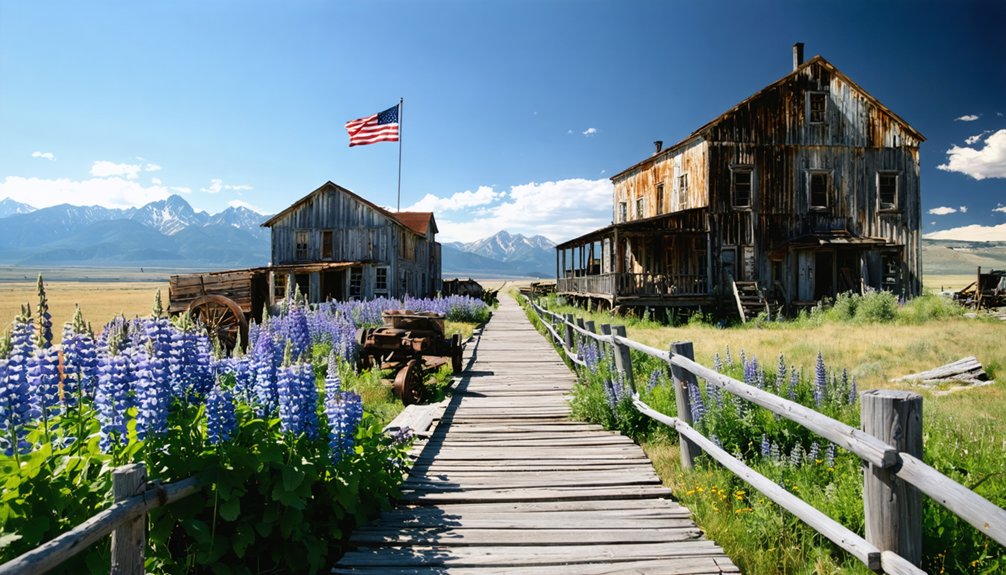
While Piedmont surrendered completely to abandonment, Atlantic City tells a different story—one of stubborn persistence against every odd the frontier could throw at it. Since 1868, this mining camp has weathered five boom-bust cycles, yet around 57 resilient souls still call it home.
You’ll find preservation efforts keeping history alive through sites like the 1869 stone bank building and Gratrix Cabin, where justice was dispensed and children learned their lessons.
Urban legends swirl around Calamity Jane’s rumored residence in nearby Hamilton City, adding mystique to your exploration.
What makes Atlantic City unique:
- Continental Divide Trail brings modern adventurers through this historic crossroads
- Year-round community survives between Wind River Mountains and Red Desert
- Wildlife encounters—wolves, mountain lions, bears—remind you this remains untamed country
Miner’s Delight: Dilapidated Remnants Near Atlantic City
Just two miles north of Atlantic City, you’ll discover what remains of Miner’s Delight—seventeen weathered log structures slowly surrendering to the forest at the head of Spring Gulch.
This ghost town‘s mining history runs deep: the Miner’s Delight Mine pulled $5 million in gold from Peabody Hill before economics forced its 1882 closure.
You’ll walk a half-mile interpretive trail through cabins, a saloon, and privies where 75-100 residents once struck it rich alongside legends like Calamity Jane and Henry Comstock.
The BLM’s preservation efforts keep this site accessible while protecting its authentic decay—crumbling walls and sagging rooflines tell stories no museum can match.
Visit during summer when Continental Divide wildflowers frame these ruins, offering unobstructed exploration of Wyoming’s rawest frontier remnants.
Planning Your Summer Ghost Town Road Trip in Wyoming
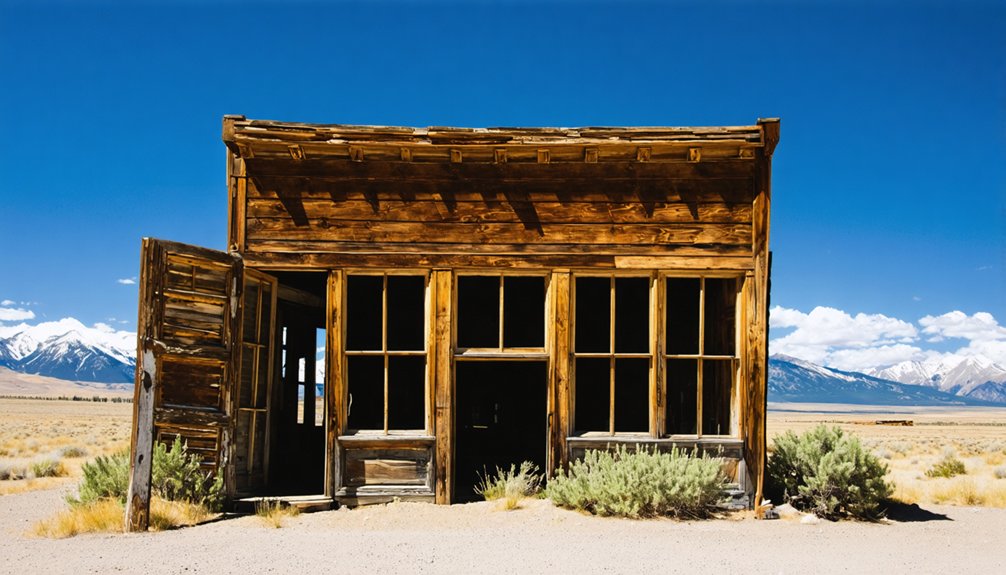
Since Wyoming’s ghost towns scatter across 280 miles of frontier terrain—from Kirwin’s alpine valleys to South Pass City’s sagebrush flats—you’ll need strategic route planning to maximize your summer adventure.
There are several ghost towns to explore in Wyoming that offer unique glimpses into the state’s history. From the abandoned mining structures of Miner’s Delight to the preserved charm of Lanark, each site has its own story to tell. Make sure to bring a camera, as the rugged landscapes surrounding these towns provide spectacular backdrops for unforgettable photos.
In addition to exploring these ghost towns, consider planning your visit to coincide with annual events in Wyoming ghost towns, which celebrate the rich heritage and local culture. These festivities often feature reenactments, artisan markets, and live music, enhancing your experience of the region’s history. Engaging with the community during these events can provide deeper insights into the lives of those who once inhabited these now-desolate places.
Essential considerations for your urban exploration:
- Vehicle capabilities matter: Battle requires 4WD high clearance, while Kirwin demands river crossings. South Pass City’s well-maintained roads suit standard vehicles.
- Timing restrictions: Highway 14A opens June through October. South Pass City operates May 15th-October 15th with $1 entry supporting ghost town preservation.
- Guided experiences: Meeteetse Museums hosts free August Kirwin tours (donations encouraged), and ATV operators run May-October excursions.
You’ll discover authentic mining history through Battle Pass Byway’s interpretive signage and South Pass City’s 44-star flag display.
Pack water, fuel up beforehand, and respect these fragile remnants—your freedom depends on their preservation.
What to Bring and Safety Tips for Exploring Abandoned Sites
Your route’s mapped and your vehicle’s ready—now let’s talk about the gear that’ll keep you safe in Wyoming’s backcountry. Pack layered clothing despite summer heat—mountain temperatures plummet after sunset. Sturdy boots handle crumbling structures, while sun protection combats that relentless high-altitude glare.
Gear essentials include downloaded offline maps (cell service vanishes fast), a satellite communicator for emergencies, and plenty of water since ghost towns don’t have convenience stores. Share your itinerary with someone back home.
Wildlife safety demands bear spray and knowing how to use it. Make noise while hiking, store food in bear canisters, and maintain 100 yards from predators.
Watch your footing around deteriorating foundations, and remember: take only photos, leave only footprints.
Those artifacts belong to history, not your mantle.
Frequently Asked Questions
Are Pets Allowed When Visiting Wyoming’s Ghost Towns?
Pet policies vary by site—you’ll find your furry friend welcome at South Pass City and Wyoming Territorial Prison grounds, but they’re banned from Old Trail Town. Always prioritize pet safety with leashes and water in Wyoming’s heat.
Can You Camp Overnight Near These Ghost Town Sites?
“Home is where you park it”—yes, you’ll find excellent camping near ghost towns! Designated campgrounds like Wood River offer historical preservation alongside photography opportunities. You’re free to explore abandoned sites by day, then retreat to campfires under starlit skies.
Do Any Ghost Towns Charge Entrance or Tour Fees?
Yes, you’ll pay entrance fees at some ghost towns. South Pass City charges $3-$5 for adults, while Old Trail Town requires payment. Most offer incredible photography opportunities and ghost town history access that’s worth every penny of freedom-seeking adventure.
Are the Ghost Towns Wheelchair Accessible for Visitors With Mobility Issues?
Unfortunately, you’ll find these ghost towns aren’t wheelchair accessible—no accessible pathways or wheelchair rentals exist. The rough terrain, river crossings, and stairs make mobility challenging. Consider guided 4WD passenger tours at Kirwin if you’re seeking easier exploration options.
What Cell Phone Coverage Exists in These Remote Ghost Town Areas?
Your lifeline to civilization fades quickly—cell phone reception dims to one bar or vanishes completely at remote sites like Kirwin. Pack satellite devices for emergency communication; South Pass City offers spotty coverage, while southwest towns surprise with occasional LTE signals.
References
- https://www.meeteetsewy.com/places-to-visit/kirwin-ghost-town-wyoming
- https://travelwyoming.com/blog/stories/post/5-wyoming-ghost-towns-you-need-to-explore/
- https://www.explorewy.com/play/activities/articles/top-10-things-to-do-this-summer-in-sweetwater-county
- https://www.youtube.com/watch?v=5XZl5-drOQk
- https://windriver.org/experience/gold-panning-ghost-towns/
- https://www.wyomingcarboncounty.com/?id=123:5-ghost-towns-to-explore
- https://www.tripadvisor.com/ShowTopic-g28973-i480-k13844497-Best_ghost_town-Wyoming.html
- https://beautifuldaytraveler.wordpress.com/2025/10/17/kirwin-wyoming-discovering-one-of-americas-most-haunted-and-well-preserved-ghost-towns/comment-page-1/
- https://www.youtube.com/watch?v=cRyjmHe8z-4
- https://www.pioneersofoutlawcountry.com/2031252/episodes/18142844-the-ghost-town-of-kirwin-haunted-wyoming-history