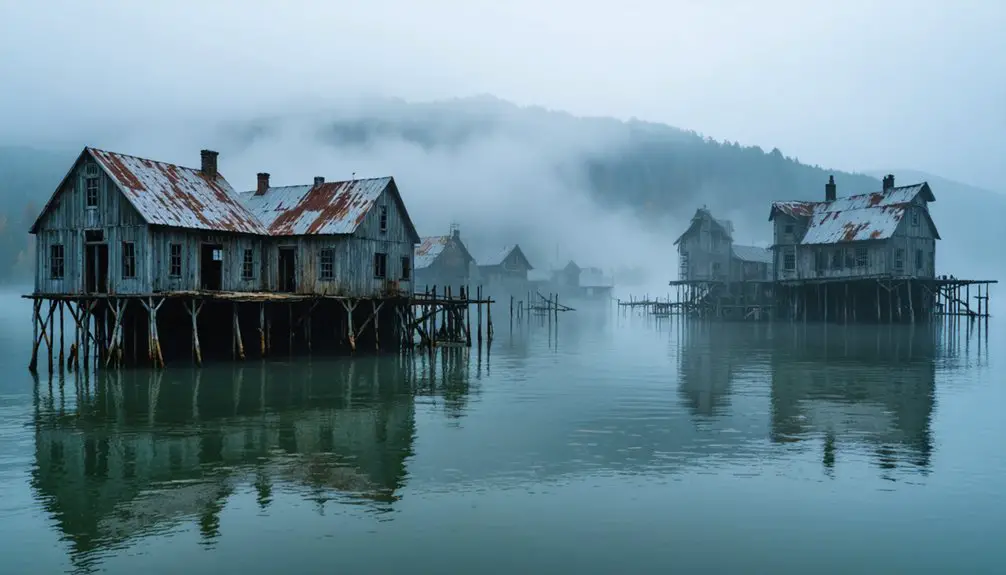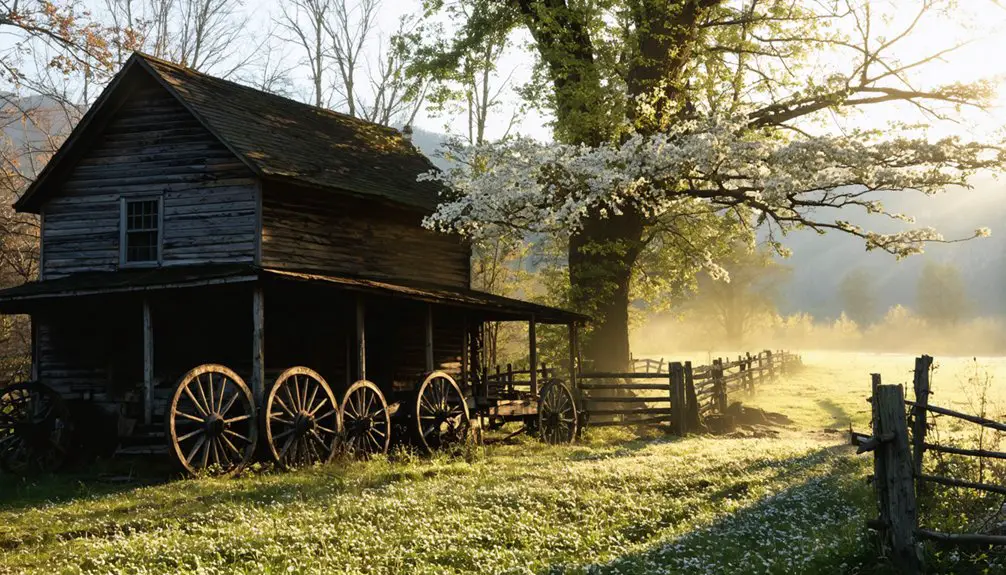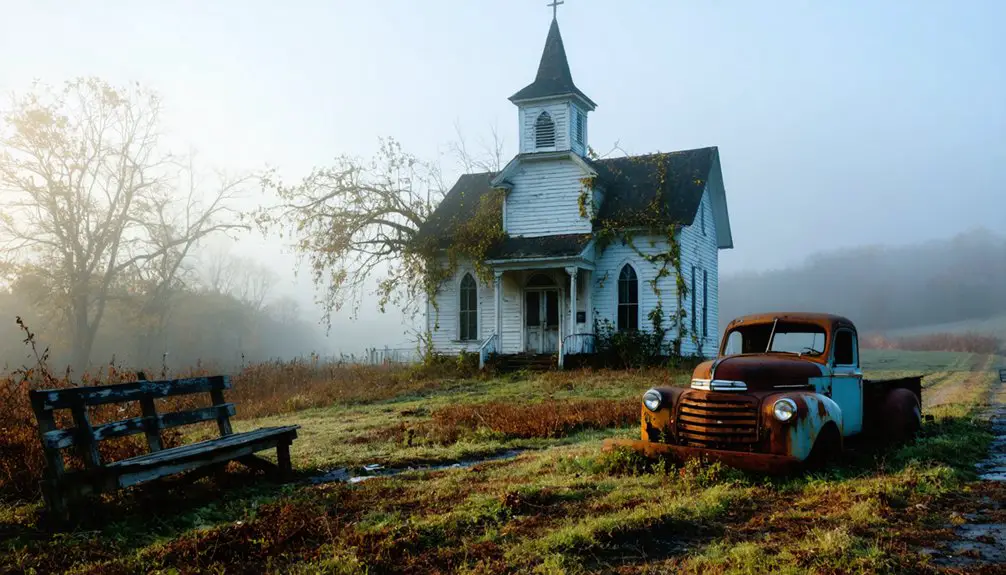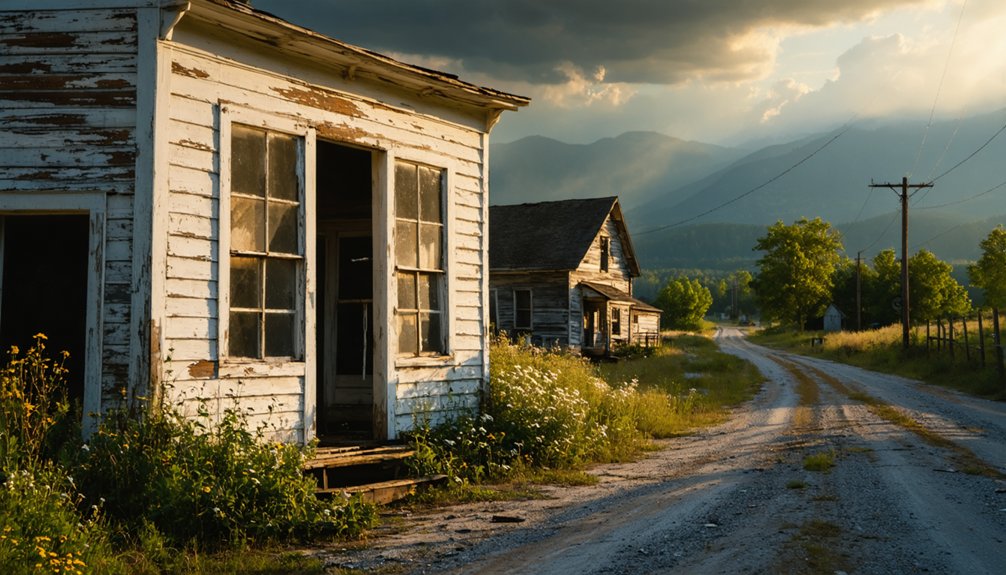
You’ll discover Tennessee’s most haunting ghost towns at Elkmont and Cades Cove in the Smokies, where 200-year-old hand-hewn cabins stand frozen in time. Explore Old Butler and Loyston beneath TVA lakes—their foundations emerge during rare drawdowns, revealing communities displaced in the 1930s-40s. Venture to Devonia’s abandoned coal railroad, where a 1951 locomotive rusts on forgotten tracks, or walk Port Royal’s Trail of Tears wagon ruts beside the Red River. Each site preserves Tennessee’s pioneer heritage, industrial ambitions, and the stories of families who built lives in these now-silent valleys.
Key Takeaways
- Cades Cove features an 11-mile loop road with cabins, churches, and barns from an 1800s community of 685 residents.
- Elkmont showcases the 1830s Levi Trentham Cabin, abandoned resort cottages, and accessible cemeteries within Great Smoky Mountains National Park.
- Port Royal offers Tennessee’s oldest settlement with Trail of Tears roadbed, 1859 Masonic Lodge, and 1890 Pratt truss bridge.
- Old Butler’s foundations emerge when Watauga Lake drains, revealing the only intentionally flooded incorporated town from 1948.
- Loyston’s submerged structures beneath Norris Lake become visible during rare drawdowns, showing foundations photographed in 1933.
Elkmont: A Preserved Resort and Logging Community
But Elkmont’s transformation from sawmill settlement to playground changed everything.
Resort development brought the Appalachian Club in 1910 and Wonderland Hotel in 1912, where Knoxville businessmen swapped axes for fishing rods.
Tourists began arriving as early as 1909, paying $1.95 one way for scenic logging train rides along Little River.
When the 1934 national park absorbed these lands, lifetime leases eventually expired, leaving you free to wander among cottages where laughter once echoed and explore a quartz-adorned cemetery where Appalachian settlers rest eternally.
The Levi Trentham Cabin, built by Robert Trentham in the 1830s, stands as the oldest structure you can walk through today.
Cades Cove: The Smokies’ Most Accessible Ghost Town
You’ll find Cades Cove remarkably easy to explore via its 11-mile loop road, where log cabins, weathered barns, and white-frame churches emerge from the mist like ghosts of the 685 souls who once farmed this fertile valley.
The John Oliver cabin from 1822 still stands with its hand-hewn logs intact, while three churches—including the 1887 Primitive Baptist Church where visitors report a woman’s face materializing through the walls—anchor what’s now an open-air museum.
I’ve watched photographers lose entire afternoons here, circling back repeatedly as the shifting light transforms each structure into something haunting and new.
Before white settlers arrived, the valley was named after Chief Kade, a Cherokee leader who once hunted these same fields.
The land transferred to Tennessee in 1819 after an Indian treaty, opening the valley to settlers who migrated from Virginia and North Carolina.
Scenic Valley Loop Drive
Winding through the heart of what was once a thriving mountain community, the 11-mile Cades Cove Loop Road lets you step back into a haunting chapter of Appalachian history without ever leaving your car.
Multiple pull-offs reveal 19th-century cabins, barns, churches, and a working gristmill—all standing exactly as residents left them in 1937. Valley folklore whispers through these structures, especially during evening hours when shadows lengthen across abandoned fields.
What you’ll encounter on the loop:
- Original settler cabins where families raised 10-12 children
- The Primitive Baptist Church, center of haunted stories featuring a mysterious woman’s apparition
- Wildlife roaming former farmland—black bears and deer now claim what settlers once cultivated
- Accessible stopping points offering intimate views of Appalachian settlement life
The road demands your pace, not park regulations. By 1850, the valley’s population had swelled to 685 residents, transforming this isolated cove into one of the most prosperous communities in the Smokies. The community thrived through self-contained economic units where men built shelters, women managed households, and even children contributed to daily survival.
Preserved Historic Settlement Buildings
Beyond the scenic drive itself, the real magic happens when you step out of your car and walk among the structures themselves. The John Oliver Cabin, over 200 years old, stands without a single nail—just gravity and precise woodworking holding it together.
At the Primitive Baptist Church, you’ll spot carpenters’ handprints on the wooden ceiling, while haunted legends persist about a woman’s apparition emerging from the walls at night. The Methodist Church site holds the oldest graves in Cades Cove.
The cantilever barn at Tipton Place demonstrates ingenious pioneer engineering, protecting crops while providing wagon access underneath. Despite restoration challenges, these structures remain frozen in their 19th-century state.
Cable’s Grist Mill and Henry Whitehead’s double cabin showcase Appalachian craftsmanship, while fourteen cemeteries scattered throughout remind you this valley once supported 685 souls. Visitors exploring at dusk often report orbs floating around the gravestones, with numerous photographs capturing these unexplained phenomena.
Old Butler: A Town Lost Beneath the Waters
Nestled where Roan Creek meets the Watauga River, Butler thrived for nearly two centuries before vanishing beneath the waters of progress. After devastating river flooding claimed six lives in 1940, the TVA chose this valley for Watauga Dam. When gates closed in 1948, 761 families watched their hometown disappear.
You’ll find relocation stories preserved at Butler Museum in New Butler, where residents rebuilt on higher ground. The original town was home to 650 families, along with churches, schools, restaurants, and essential stores that formed the heart of this close-knit community. Here’s what makes this ghost town unique:
- Only incorporated town deliberately flooded by TVA
- 175 buildings physically moved to new farmland
- 1983 lake draining revealed buried foundations and stone walls
- Annual Butler Day festival honors the submerged community
The museum displays photographs and artifacts from “the town that wouldn’t drown,” documenting how these determined souls refused to let progress erase their heritage. Among the preserved relics, visitors can see a horse-drawn hearse that once served the community, alongside postal equipment and tools from the town’s lumber mill.
Loyston: Submerged by Progress in the 1930s
You’ll find Loyston’s story etched in the depths of Norris Lake, where an entire Union County community disappeared beneath 100 feet of water when the TVA completed its dam in 1936.
Unlike many ghost towns you can walk through, this one requires you to wait for rare lake draw-downs to glimpse the submerged foundations of its post office, stores, and school.
The town’s 70 residents scattered across East Tennessee that year, leaving behind a settlement that had grown around John Loy’s foundry for over a century.
Norris Dam TVA Project
Deep beneath the waters of Norris Lake lies Loyston, a Tennessee community that vanished almost overnight when the federal government decided progress couldn’t wait.
When FDR created the TVA on May 18, 1933, construction began just four months later—before residents fully grasped what they’d lose. One displaced resident captured the sentiment: “We said if they drowned Loyston they drowned us along with her. A man’s house’s his home.”
The Norris Dam project’s scope was staggering:
- 152,000 acres flooded for the reservoir basin
- 1,262 land tracts seized through eminent domain in Union County alone
- 5,226 graves disinterred and relocated to new cemeteries
- $36 million construction cost (1936)
This example of industrial archaeology demonstrates both technological ambition and community resilience against government overreach that permanently erased a 130-year-old settlement.
Union County Town Vanishes
Along the banks of the Clinch River, Loyston thrived for more than a century as the kind of place where everybody knew your name—and your grandfather’s, too. Seventy residents called this Union County settlement home by the 1930s, operating two general stores, a filling station, and a barbershop.
Then progress arrived in the form of Norris Dam. When the reservoir filled in 1936, Loyston vanished beneath what’s now called Loyston Sea. You’ll find it analogous modern ghost towns sacrificed for infrastructure—except this one sleeps underwater near Big Ridge State Park.
During dramatic lake drawdowns, the town resurfaces, drawing thousands to witness submerged industrial sites emerging from the depths. Photographer Lewis Hine documented Loyston’s final days in 1933, preserving memories before the Clinch River reclaimed this trading center forever.
Underwater Community Remains
When TVA officials knocked on doors throughout Union County in 1933, they carried maps that sentenced an entire community to drowning.
Loyston’s residents had three years to abandon everything their families built since the 1800s.
By 1936, the Clinch River swallowed their town completely.
Today, this submerged history rests ninety feet beneath Norris Lake’s surface—an underwater archaeology site you can’t visit but should remember:
- Post office and grammar school lie preserved in cold darkness
- Two churches where generations worshipped now shelter fish
- Sharps Station Methodist Church stands silent underwater
- Mill and general stores remain frozen in time
Lewis Wickes Hine photographed this doomed settlement in 1933, capturing what progress demanded citizens surrender.
The “Loyston Sea” stretches a mile wide—a liquid grave for seventy displaced souls’ American dreams.
Devonia: Remnants of Tennessee’s Coal Mining Past
What makes Devonia particularly striking is its railroad history—a 42-mile line that once connected this remote outpost to Oneida.
Today, you can still spot a vintage 1951 Alco RS3 locomotive sitting forgotten on the tracks since 2010.
Route 116 brings you here, where significant coal reserves still lie beneath the earth, untapped and waiting, symbolizing both past prosperity and unrealized potential.
Port Royal: Historic River Town Turned State Park
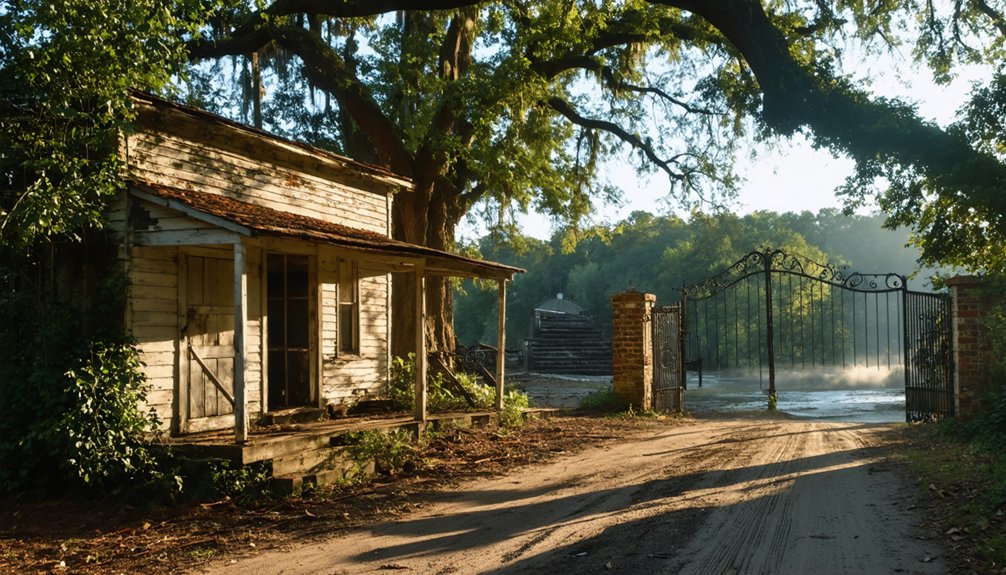
The ghost of Tennessee’s oldest middle Tennessee settlements rises from the banks of the Red River, where Port Royal once thrived as a bustling tobacco hub before fading into a 30-acre state park. You’ll discover authentic Cherokee history here—this was the last place over 10,000 Cherokees slept in Tennessee during their forced 1838 removal. River trading once dominated life, with flatboats carrying tobacco down to New Orleans while stagecoaches rumbled through town.
What You’ll Find:
- 300-yard certified Trail of Tears roadbed with original wagon ruts
- 1859 Masonic Lodge featuring an enslaved worker’s thumbprint preserved in brick
- 1890 Pratt truss bridge spanning the Red River as a pedestrian walkway
- Visible foundations from 18th-century taverns and tobacco warehouses
The town operated from 1797 until 1940, leaving behind tangible freedom to explore Tennessee’s complex past.
Fork Mountain: Another Abandoned Mining Settlement
Deep in Anderson County’s rugged highlands, Fork Mountain tells a different chapter of Tennessee’s industrial past—one written in coal dust rather than river trade. You’ll discover abandoned mines where thousands once worked, now silent monuments to the boom-and-bust cycles that shaped these mountains.
The 41-mile rail line that once carried coal to Harriman sat dormant after 2008, finally abandoned in 2020—its railroad relics rusting alongside forgotten engine cars.
Take State Route 116 through this ghost settlement on a half-day scenic drive.
You’ll pass Fork Mountain Baptist Church, one of the few structures still standing since the 1980s abandonment.
The restored schoolhouse now serves ATV riders exploring these hollows.
Seven residents remain in the surrounding area, guardians of memories from when mining camps bustled with life.
Frequently Asked Questions
Are Tennessee Ghost Towns Safe to Explore With Children?
You’ll find most Tennessee ghost towns safe for kids during daylight, though you should watch for structural hazards. Local tales and haunted legends add excitement, but you’re responsible for supervising children around crumbling buildings and uneven terrain always.
As you explore haunted ghost towns in Tennessee, be prepared for a mix of history and thrill that can captivate both young and old. It’s a fantastic way to engage kids with stories of the past, nurturing their imagination while teaching them about local history. Just make sure to keep a close eye on them, as the allure of a spooky ghost story might lead them too close to areas that aren’t safe for wandering.
As you learn about the ghost towns of Tennessee history, encourage your children to ask questions about the lives once lived there. Each abandoned structure holds secrets waiting to be uncovered, and the stories behind them can ignite a passion for history that lasts a lifetime. Remember, safety comes first, so make sure to choose paths that are both educational and safe for young explorers.
What Is the Best Time of Year to Visit Ghost Towns?
You’ll hit the jackpot visiting during fall’s mid-October peak, when vibrant foliage frames history preservation sites beautifully. Seasonal weather stays mild, crowds thin out, and you’re free to explore Elkmont’s restored cabins without summer’s hustle.
Do I Need Special Permits to Access Ghost Towns in Tennessee?
You won’t need access permits for Tennessee’s public ghost towns like Elkmont’s cabins or Brushy Mountain Penitentary. However, you’ll need permission before exploring sites on private property—respecting boundaries keeps these historical treasures accessible for everyone.
In addition, there are several upcoming festivals and guided tours to explore ghost towns in Tennessee with events that celebrate their rich histories. These activities provide a unique opportunity to learn more about the intriguing stories and artifacts that define these once-thriving communities. Be sure to check local listings for the latest happenings to make the most of your visit.
While venturing through abandoned sites in Tennessee, you may stumble upon remnants of the past, like crumbling structures and forgotten landscapes that tell their own stories. Taking a guided tour can enhance your experience, as knowledgeable guides share fascinating insights about the history and significance of these locations. Don’t forget to bring your camera; the haunting beauty of these sites is sure to leave a lasting impression.
Can You Camp Overnight Near Any Tennessee Ghost Towns?
Yes, you’ll find excellent camping at Elkmont Campground, steps from Tennessee’s most accessible ghost town. Follow standard camping tips and safety precautions—the preserved cabins await your sunrise exploration, offering unmatched freedom to roam historic structures at dawn.
Are Guided Tours Available for Tennessee’s Ghost Town Locations?
You’ll find guided tours at Elkmont’s preserved cabins and Cumberland Gap’s historic buildings, where local legends come alive through historical preservation efforts. These intimate explorations let you discover authentic ghost town atmospheres while supporting ongoing restoration work.
In addition to Elkmont and Cumberland Gap, there are many other ghost towns to explore in Tennessee that offer unique insights into the region’s past. Each location is steeped in stories that echo through dilapidated structures and forgotten streets, inviting adventurers to immerse themselves in history. As you wander through these abandoned sites, you can almost hear the whispers of those who once called these towns home.
References
- https://en.wikipedia.org/wiki/List_of_ghost_towns_in_Tennessee
- https://kids.kiddle.co/List_of_ghost_towns_in_Tennessee
- https://www.wanderingsmokymountains.com/smoky-mountain-ghost-towns-in-tennessee/
- https://www.tnmagazine.org/19-ghost-towns-in-tennessee-that-are-not-underwater/
- https://www.youtube.com/watch?v=7mYZYhQaj4U
- https://freepages.rootsweb.com/~gtusa/history/usa/tn.htm
- https://www.loveproperty.com/gallerylist/91679/tour-the-abandoned-tennessee-ghost-town-where-millionaires-vacationed
- https://gatlinburghaunts.com/elkmont-tennessees-ghost-town/
- https://smokymountainnationalpark.com/blog/fun-facts-about-elkmont-ghost-town/
- https://www.visitmysmokies.com/blog/smoky-mountains/about-elkmont-ghost-town/