You’ll find Washington’s most engrossing ghost towns scattered across mountain passes and high desert plains, each offering unique glimpses into the state’s frontier past. Monte Cristo showcases weathered mining buildings accessible via an 8-mile hike, while Molson preserves frontier-era structures including a bank and schoolhouse museum. Govan stands as a haunted railway depot with notorious murder legends, and Franklin’s coal mining remnants include accessible mine entrances and a historic cemetery. The guide below explores each location’s fascinating history, preserved structures, and directions for your exploration.
Key Takeaways
- Monte Cristo offers an 8-mile roundtrip hike from Barlow Pass to explore weathered buildings, mining equipment, and interpretive signs from the 1889 silver rush.
- Molson features preserved frontier buildings including a state bank, schoolhouse museum, assay office, and exhibits of indigenous heritage and pioneer artifacts.
- Ruby Townsite, once called “Babylon of the West,” is now a protected state park with remaining foundations from its 1886-1894 mining boom.
- Govan displays an abandoned schoolhouse and working grain elevator, notorious as Washington’s most haunted railway town with unsolved murder legends.
- Nighthawk in Okanogan County preserves a partially rebuilt hotel, original post office, and houses from its 3,000-resident peak in 1903.
Monte Cristo: A Mining Ghost Town Near Granite Falls
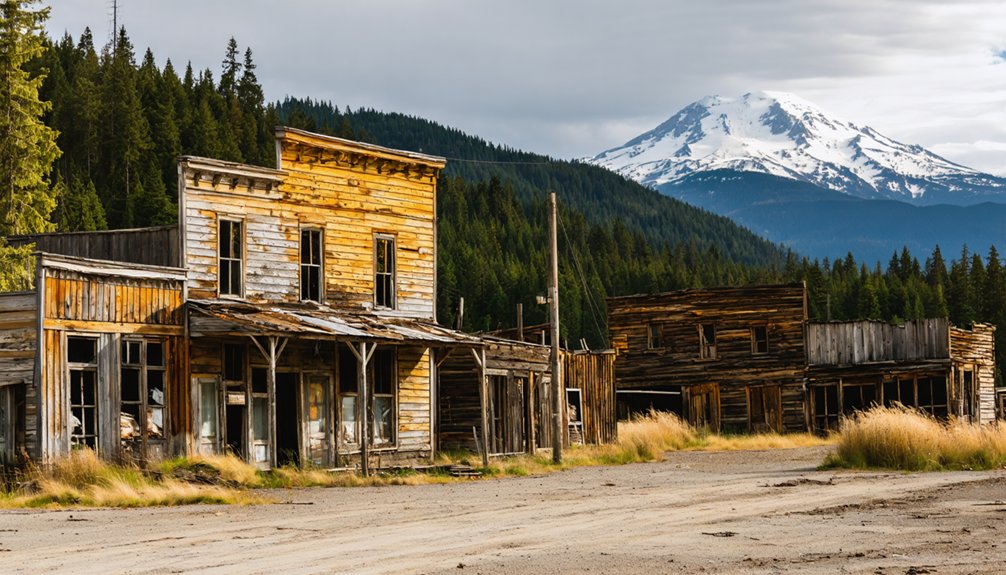
Nestled in the rugged Cascade Mountains near Granite Falls, Monte Cristo stands as one of Washington’s most mesmerizing ghost towns—a proof to the boom-and-bust cycle that defined the American West.
Monte Cristo embodies the dramatic rise and fall that shaped mining settlements throughout the American frontier.
When Joseph Pearl and Frank Peabody struck silver and gold in 1889, they sparked the region’s first major mining camp. By 1894, over 1,000 residents called this wilderness settlement home, backed by Eastern investors including John D. Rockefeller’s syndicate.
However, devastating floods, avalanches, and erratic ore deposits sealed its fate by 1907.
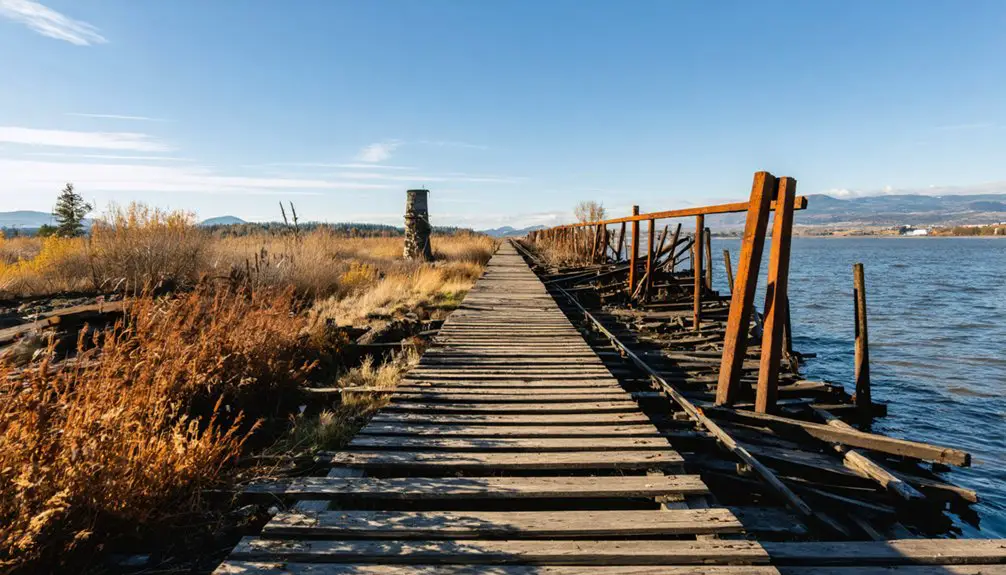
Today, you’ll hike 8 miles roundtrip from Barlow Pass to explore weathered buildings and rusted mining technology scattered across the valley. The trail follows the historic Monte Cristo Railroad grade, where exposed rails and remnants reveal the original railway pathway. You’ll need a Washington Forest Pass to park at the trailhead before beginning your journey.
While town restoration hasn’t occurred, interpretive signs illuminate Monte Cristo’s fascinating history.
Molson: Preserved Buildings and Museum Displays
While Monte Cristo demands a challenging mountain trek to reach its scattered ruins, Molson offers an entirely different ghost town experience near the Canadian border—one where you’ll walk among remarkably intact buildings that tell a more complete story of frontier life.
You’ll explore these preserved structures at your own pace:
- Old Molson State Bank with its original safe and wood-planked construction standing as proof of the town’s prosperous mining era
- Red brick schoolhouse museum displaying historical artifacts, botanical surveys from the region, and materials documenting indigenous heritage alongside pioneer settlement
- Antique-filled homestead cabins staged with period furnishings and black-and-white photographs
The assay office building remains one of the most photographed structures.
The machine shed houses mining equipment and farming tools spanning decades of frontier enterprise. Harry Sherling established this outdoor collection in 1960 as a remembrance of the area’s pioneer families and their heartfelt stories. Visitors can sign the guest book and purchase souvenirs to support ongoing preservation efforts.
Nighthawk: Mining Town Relics in Okanogan County
Along the Similkameen River in Okanogan County, Nighthawk preserves the weathered bones of a mining town that once bustled with 3,000 fortune-seekers. You’ll discover authentic relics from 1903, when settlers platted this remote outpost around the productive Nighthawk Mine.
The town architecture tells stories of boom-era prosperity: a partially rebuilt hotel from 1903, the original post office established in 1899, and even a house of ill repute still standing defiantly. Mining equipment and ore dumps cascade down surrounding mountainsides, marking where the Ruby, Kaaba, and War Eagle mines once operated. As one of the oldest mining districts in Okanogan County, Nighthawk’s roots trace back to the 1860s.
You can explore these remnants along historic Prospect Avenue, where only five residents remain. The Nighthawk–Chopaka Border Crossing operates nearby, offering you unrestricted access to this authentic frontier relic that declined after mining ceased in 1950. The town’s name likely derives from the nighthawk bird species, which was first documented in the Americas in 1778 and has inhabited this region since the Pleistocene era.
Ruby Townsite: The “Babylon of the West”
Deep in the foothills of Ruby Mountain, where Salmon Creek cuts through Okanogan County, you’ll find the scattered stone foundations of what locals once called the “Babylon of the West.” When the federal government opened North Central Washington to mining on May 1, 1886, prospectors swarmed Ruby Mountain’s silver-rich slopes, transforming Thomas D. Fuller’s 1885 cabin site into a 700-person boomtown within two years.
Ruby City’s wild reputation earned its infamous nickname through:
- 70 buildings crammed along the main street, including six general stores, saloons, and hotels
- Brief reign as Okanogan County seat in 1888
- Millions in silver extracted before the 1893 panic crashed prices
The Panic of 1893 brought the town’s prosperity to an abrupt end, causing Ruby City to shut down overnight. By fall 1894, only a few dozen residents remained in what had been a thriving mining community. Today’s Washington State Park Heritage Site offers historical tourism through art preservation efforts, protecting the remaining foundations that hint at this vanished frontier legacy.
Govan: a Railway Town With a Dark Past
You’ll find Govan tucked away in Lincoln County, a railroad depot town born in 1889 that grew into a prosperous grain-shipping hub.
Before tragedy and isolation transformed it into an eerie reminder of Washington’s frontier past, this town experienced significant events.
This former railway stop witnessed two brutal unsolved murders—a saloon shooting in 1903 and a farm killing in 1941—that earned it a reputation as a rough-and-tumble settlement even during its peak years.
The community’s decline accelerated after U.S. Route 2 bypassed the town in 1933, leaving only one store operating by 1940.
By 1898, the thriving settlement boasted several stores, two churches, a hotel, bank, and over 80 residents who relied on the railroad for their prosperity.
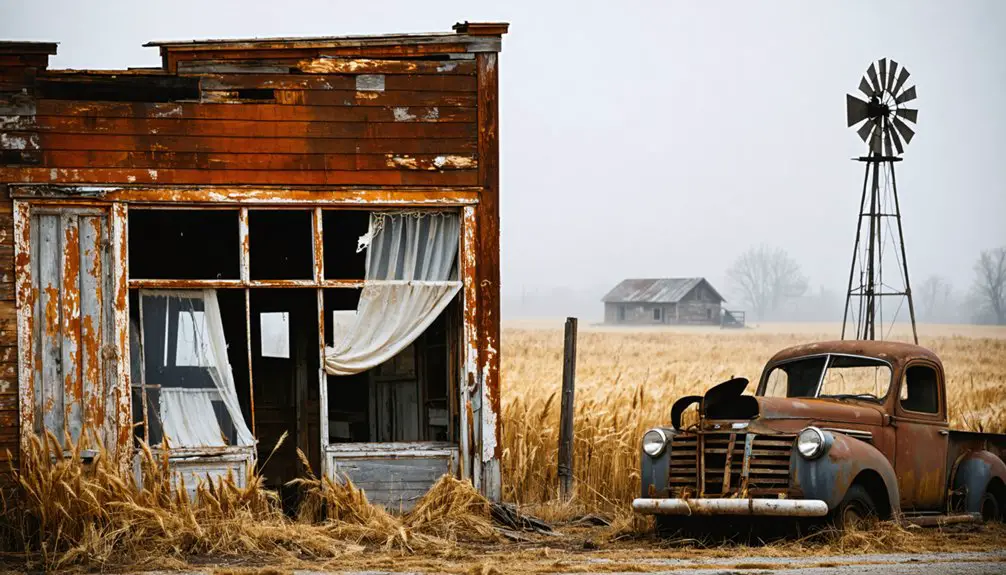
Today, the ghost town sits accessible off Highway 2 between Wilbur and Almira, where its abandoned schoolhouse and working grain elevator tell the story of a community that thrived, suffered, and ultimately faded into history.
Railway Origins in 1889
When the Central Washington Railway carved through the sparse landscape of eastern Washington in autumn 1889, it designated a remote spot that would become Govan—a town born from iron rails and ambitious plans. Named after engineer Robert B. “Bob” Govan, a former Yakima resident, this isolated station emerged where virtually no one lived.
The railroad construction brought immediate transformation:
- Wood, Larsen & Company established headquarters at the site, coordinating railway expansion across the territory
- A post office opened inside the depot, connecting this wilderness outpost to civilization
- The 1890 census recorded 33 residents, drawn by opportunities in railroad construction and the boom-town atmosphere
You’ll find Govan’s origins reflected a pattern repeated across the West—towns materializing wherever rails touched earth, their fortunes tied entirely to town development and railway commerce.
Unsolved Murders of 1900s
Behind Govan’s quiet railway beginnings lurked a violence that would haunt the town for decades. In December 1902, Judge J.A. Lewis and his wife suffered brutal axe murders at their home—motivated by robbery, never solved.
The following spring, a masked gunman shot C.S. Thennes in Govan Saloon. Though caught, the killer walked free without conviction.
The violence continued into 1941 when Lillie Lesneww was murdered on her farm. Her son Wes Murray vanished simultaneously, his skeleton discovered years later in a nearby field. None of these crime mysteries ever found resolution.
These unsolved cases transformed Govan into something darker than an ordinary abandoned settlement. Ghost stories now cling to its weathered structures, drawing travelers seeking the sinister history behind Washington’s most haunted railway town.
Location and Access Today
Despite its shadowy history, Govan remains accessible to modern visitors seeking remnants of Washington’s railway past. You’ll find this ghost town about 7 miles west of Wilbur in Lincoln County, positioned along the original Central Washington Railway line from 1889.
Today, you can explore:
- The iconic abandoned schoolhouse – Drawing photographers with its unique architecture and weathered charm
- Crumbling historic landmarks – Remnants from Govan’s peak era, including structures that survived the devastating 1927 fire
- A working grain elevator – Operating seasonally during harvest, creating an eerie contrast with surrounding ruins
Modern roads provide easy vehicle access to these abandoned buildings, though US Route 2’s 1933 construction bypassed the town entirely.
The depot’s gone, passenger trains vanished in 1954, but Govan’s haunting remains reward adventurous explorers.
Sherman: Homesteading Era Remains
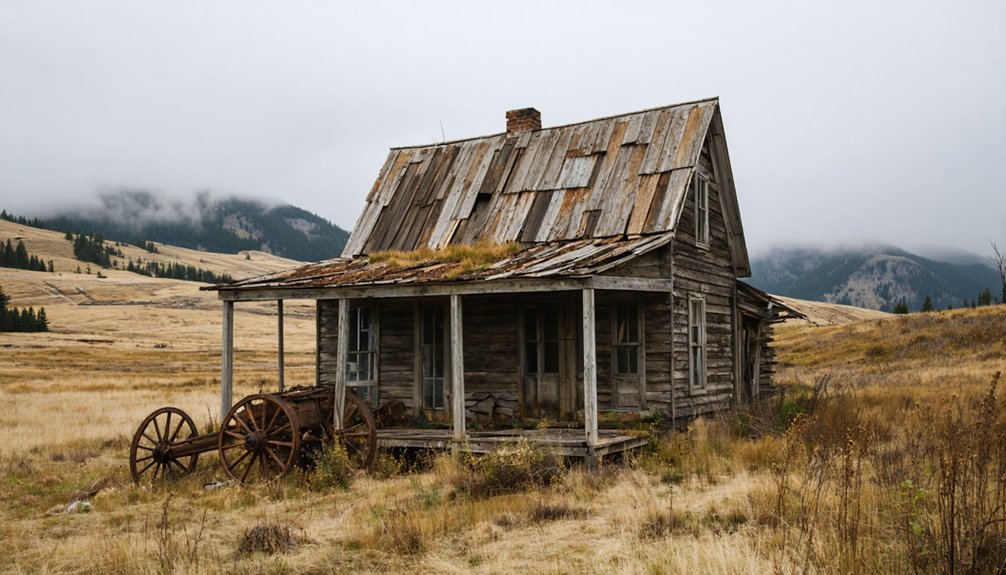
North of Wilbur in Lincoln County, Sherman stands as a quiet proof to eastern Washington’s homesteading era. You’ll discover farmstead remnants that tell settler stories from the late 1880s, when families from Kansas and Oregon claimed their land under the Homestead Acts.
Sherman’s weathered structures whisper tales of homesteaders who carved their lives from harsh eastern Washington soil in the 1880s.
The 1889 blizzard buried them under six feet of snow, forcing survival on potatoes and salt alone.
Today, you can explore a hilltop church with its original steeple and stained glass windows, plus a cemetery dating to 1892. The ruined schoolhouse, which closed in the 1940s, still shows glimpses of its past.
Reach this ghost town via a dirt road off Highway 2, where local farm families gather each Memorial Day to honor their ancestors’ endurance.
Franklin Ghost Town: Cemetery and Coal Mining History
Deep in the Green River Gorge, Franklin’s coal seams drew hundreds of miners in the early 1880s, transforming wilderness into Washington’s most productive mining operation.
By the early 1900s, over 1,000 residents called this boomtown home, shipping coal as far as San Francisco.
The 1894 disaster created haunting miner legends when 37 workers died trapped 700 feet underground.
Labor conflicts erupted in 1891 when African-American strikebreakers clashed with striking white miners, leaving two dead and requiring National Guard intervention.
Today’s Franklin Coal Mine Trail reveals industrial decay through:
- Historic cemetery markers (preserved by State Parks after vandalism)
- Accessible mine entrances and archaeological remnants
- Warm springs created by a 1970s coal fire explosion
You’ll discover authentic frontier history where nature reclaims human ambition.
Northern State Ghost Town: A Self-Sufficient Hospital Community
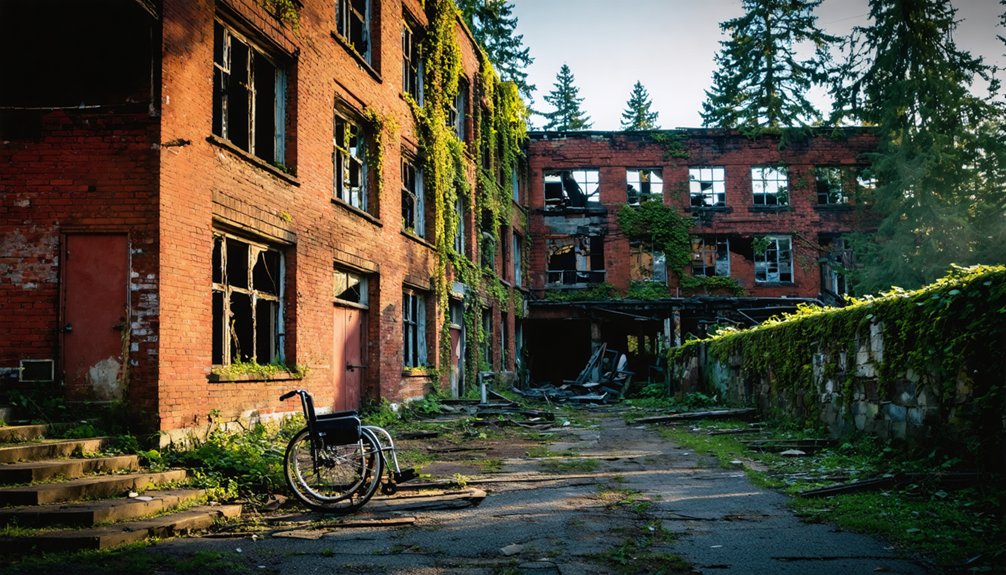
Perched at the foot of the Cascades in Skagit Valley, Northern State Hospital sprawled across 800 meticulously landscaped acres as Washington’s third mental institution when it opened in 1912.
You’ll discover Spanish Colonial Revival buildings designed by Saunders and Lawton, with grounds planned by the Olmsted Brothers.
The facility operated as a self-sufficient community—700 acres of farmland, dairy operations, and a lumber mill sustained its population.
Remarkably, no fences contained patients, who roamed freely and sometimes escaped into nearby Sedro-Woolley.
Behind the architectural preservation efforts lies haunting folklore of experimental treatments, underground tunnels, and an on-campus cemetery holding 1,500 souls.
After legislative funding cuts closed the facility in 1973, hundreds of cremated remains in numbered tin cans were discovered and later reinterred.
The Oxford Saloon: Paranormal Activity in Historic Snohomish
Built by Snohomish’s founding Blackman family in 1890, the Oxford Saloon stands at 913 First Street as one of Washington’s most haunted establishments. Originally a general store serving miners and loggers, it transformed into a saloon with a notorious past—operating a bordello upstairs and speakeasy below during Prohibition.
The building’s violent history feeds its haunted legends. Over ten people died here during its wild early days, including policeman Henry. He was murdered breaking up a brawl and was hidden in the cellar walls.
Today’s paranormal sightings include:
- Madam Kathleen’s spirit walking the upstairs halls
- Ghostly hands reaching from walls where workers once lived
- Officer Henry haunting the basement stairs where he died
You’ll find this active restaurant and bar welcoming visitors seeking both historic atmosphere and supernatural encounters.
Frequently Asked Questions
What Permits or Fees Are Required to Visit Washington Ghost Towns?
You won’t need permits or fees for most Washington ghost towns—they’re free to explore. Just follow visitor guidelines respecting private property and closed areas, ensuring historical preservation while you roam these abandoned sites at your own pace.
Exploring abandoned places in Washington offers a unique glimpse into the state’s rich history and forgotten stories. Each location carries its own mysteries and adventures waiting to be uncovered by intrepid explorers. From crumbling buildings to derelict amusement parks, these sites serve as haunting reminders of the past, inviting you to immerse yourself in their eerie beauty.
As you navigate through ghost towns in Washington state, be prepared to encounter remnants of old railroads and forgotten businesses that once thrived. Each corner you turn reveals a snapshot of daily life long gone, making these excursions not only an adventure but also a poignant journey through time. Keep your camera handy, as the haunting scenery provides the perfect backdrop for stunning photographs that capture the essence of these lost communities.
Are Washington Ghost Towns Safe to Explore With Children?
Many Washington ghost towns are child-safe with family-friendly trails and photography opportunities. You’ll find accessible paths at Coal Creek and Red Town. However, avoid unsafe structures, respect preservation rules, and skip haunted stories for younger explorers.
What Is the Best Time of Year to Visit Ghost Towns?
You’ll find fall ideal for ghost town exploration, when October’s golden larches peak at 80% vibrancy. Seasonal weather enhances Liberty’s historical significance through crisp mountain air, while fewer crowds let you experience these abandoned sites’ authentic, eerie atmosphere freely.
Can Visitors Enter Buildings at Washington Ghost Towns?
You’ll find varying access across Washington’s ghost towns. Old Molson welcomes you inside pioneer cabins for rustic photography and historical preservation viewing, while Northern State restricts buildings entirely. Always verify current access rules before exploring these atmospheric sites.
Are Camping Facilities Available Near Washington Ghost Towns?
You’ll find camping amenities at Ghost Town Hipcamp’s 30-acre property near Pe Ell, though facility accessibility is limited—no toilets or water provided. Most other Washington ghost towns require dispersed camping in surrounding national forests for your off-grid adventures.
References
- https://www.ghosttowns.com/states/wa/waalpha.html
- https://stateofwatourism.com/ghost-towns-of-washington-state/
- https://okanogancountry.com/ghost-towns
- https://www.wta.org/go-outside/seasonal-hikes/fall-destinations/hidden-history-ghost-town-hikes
- https://www.cascadeloop.com/ghost-towns-and-haunted-places-in-the-washington-cascades
- https://www.ghosttownsofwashington.com
- https://kids.kiddle.co/List_of_ghost_towns_in_Washington
- https://1027kord.com/trump-ghost-town-washington-state/
- https://www.youtube.com/watch?v=FVveO9uJBvc
- https://www.onlyinyourstate.com/nature/washington/chilling-history-location-wa