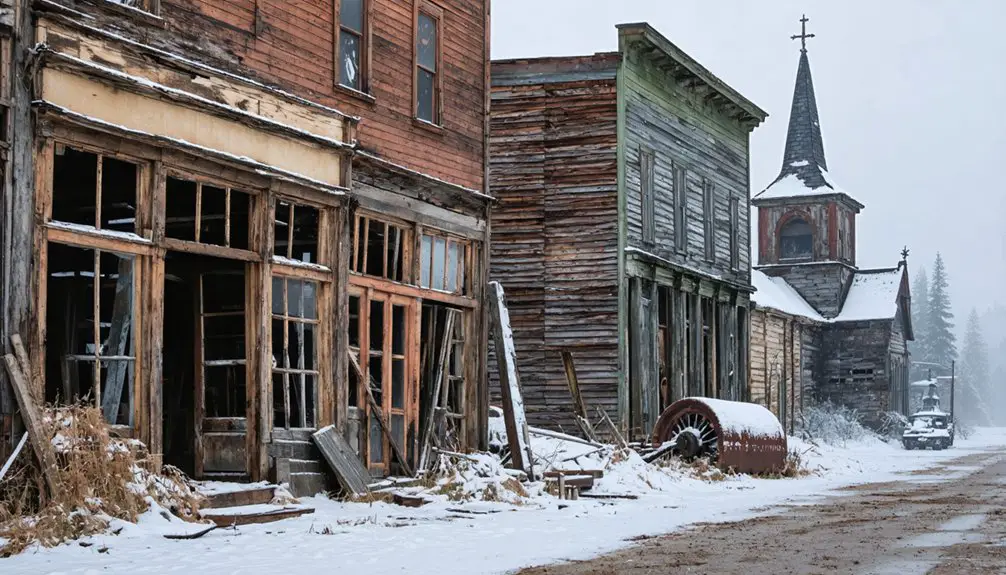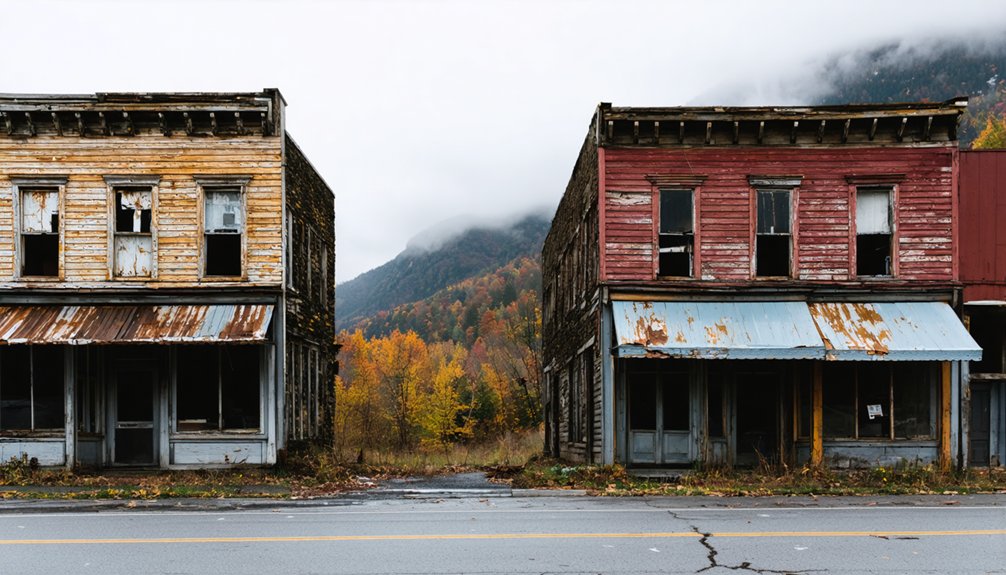
West Virginia’s ghost towns transport you directly into coal mining history, where crumbling foundations tell stories of boom and bust. You’ll find Thurmond’s 1915 steel bridge standing sentinel over an abandoned depot that once processed 95,000 passengers annually, while Kaymoor’s 821 steps lead down to 101 beehive coke ovens nestled in mountain ruins. At Nuttallburg, Henry Ford’s 1,385-foot conveyor system still stretches across the hillside, and Sewell’s 80 blackened ovens hide within Babcock State Park’s forests. Each site reveals different chapters of Appalachian industrial heritage waiting for your exploration.
Key Takeaways
- Kaymoor features 821 steps, 101 coke ovens, and remains of 130 houses in New River Gorge’s industrial ruins.
- Thurmond, a preserved railroad hub with five residents, offers an 1915 steel bridge and historic depot accessible by train.
- Nuttallburg showcases Henry Ford’s 1920s coal mining innovations including a 1,385-foot conveyor system and 80 coke ovens.
- Stotesbury contains St. John’s Baptist Church from 1918 and a cemetery spanning 1912-1969 among crumbling foundations.
- Sewell’s 80 beehive coke ovens in Babcock State Park operated from 1874 to 1956, featuring scenic industrial remnants.
Thurmond: Railroad Hub Frozen in Time
When Captain William D. Thurmond claimed 73 acres for surveying work in 1873, he couldn’t imagine his settlement would outpace Cincinnati in freight revenue.
A surveyor’s 73-acre claim in 1873 became an unlikely freight powerhouse that would eclipse a major American city.
You’ll find railroad architecture frozen at its 1910 peak, when 95,000 passengers yearly flooded through this canyon town accessible only by train for 35 years.
The 1915 bridge spanning 840 feet still stands, its cantilevered road clinging to steel trusses above the New River.
Walk past the shuttered Thurmond National Bank and abandoned depot where 15 passenger trains once stopped daily.
Historical preservation protects these coal-boom relics within New River Gorge National Park.
The bridge’s dual-purpose design served both rail traffic and vehicles, a necessity for a town built without traditional streets.
Thurmond’s strict Baptist founder prohibited saloons and brothels within town limits, pushing vice industries across the river to Ballyhack.
Five residents remain in this town that generated 20% of C&O Railway’s total revenue— a testament to boom-and-bust freedom.
Nuttallburg: Coal Mining Heritage Along Scenic Trails
Henry Ford’s 1920 acquisition revolutionized operations with cutting-edge mining technology:
- 1,385-foot conveyor system – one of America’s longest “rope and button” designs that doubled production
- Steel structures supervised by Edsel Ford during the 1923-1927 modernization
- Three conveyor systems hauling coal from seams hundreds of feet above the river
- 80 coke ovens processing smokeless coal shipped to distant industrial cities
The National Park Service preserved this site in 1998, letting you explore foundations hidden beneath vines where mining ceased in 1958. Ford’s upgrades included replacing traditional pick mining with four continuous mining machines that exemplified his emphasis on mechanization and efficiency. Despite these improvements, Ford sold his interest in 1928 when his vertical integration strategy collapsed after failing to control the railroad operations necessary for coal transportation.
Sewell: Hidden Coke Ovens of Babcock State Park
You’ll find Sewell’s massive stone coke ovens hidden within Babcock State Park, twenty miles southeast of the New River Gorge Bridge. Eighty beehive-shaped chambers once baked coal for days to create high-carbon fuel for iron furnaces.
These industrial relics operated from 1886 until around 1920, when trains hauled coal down from mountaintop mines to be transformed into coke that burned hotter and cleaner than raw coal. The low smoke emissions made this fuel especially valuable for the U.S. Navy’s ships. Processing coal into coke removed impurities and reduced the weight, cutting transportation costs significantly.
Park off County Route 9/2 and prepare for steep terrain with hundreds of steps leading down to the crumbling masonry structures. Their arched openings are still blackened from decades of controlled burns.
Industrial Coke Production History
Deep in what’s now Babcock State Park, the crumbling remains of nearly 80 beehive coke ovens stretch along the old railroad corridor—silent witnesses to Sewell’s reign as possibly America’s largest coking operation.
You’ll discover how industrial innovations transformed this remote gorge:
- First ovens (1874): Longdale Iron Company built 50 beehive ovens, pioneering the Gorge’s coking industry.
- Peak production: Nearly 200 ovens roared simultaneously, converting coal into coke for blast furnaces.
- Regional integration: Chain conveyors and smaller gauge tracks brought oven-sized loads directly from trains.
- Extended operations: Labor shifts kept these ovens burning until 1956—outlasting every other southern West Virginia coke operation.
Even after local mines exhausted, coal arrived from Clifftop via Mann’s Creek Railroad, sustaining production for 82 years before economic realities ended this industrial empire. The town itself evolved from Bowyers Ferry, established by Peter Bowyer around 1798 at the vital crossing where the Charleston-Lewisburg road met the New River. Today, the active CSX line still runs along the New River, paralleling the abandoned ovens and connecting modern rail traffic to Sewell’s industrial past.
Accessing the Remote Ruins
Though Sewell’s massive coke ovens once thundered with industrial might, reaching them today requires genuine commitment—you’ll navigate a minimum five-to-six-mile journey through Babcock State Park‘s dense woodland.
Start from Babcock Mill parking lot, where the first 1.5 miles allow biking on gravel trails before shifting to walking-only terrain along Mann’s Creek Railway service road.
Trail safety demands proper footwear and awareness of unstable foundations hidden beneath forest canopy. You’ll find no cell service or facilities here—pack everything you need.
One remarkable discovery awaits: a functioning spring still produces cold, pure water from the original town site, protected by a small brick structure.
The extensive vegetation—ivy, trees, and weeds—grows over and around the ruins, signifying decades of abandonment and natural reclamation of this once-bustling industrial site. Among the remains, you’ll spot railroad tracks running through the area, mostly covered with undergrowth but still visible as a testament to the town’s industrial past.
Four-wheel drive helps but isn’t essential. Park rangers provide vital directions since this remote location rewards the self-reliant adventurer willing to embrace genuine backcountry exploration.
Dun Glen: Mountaintop Ruins Above the New River
Perched high above the New River Gorge just outside Thurmond, Dun Glen’s scattered ruins tell the story of a once-thriving coal camp that’s now been reclaimed by the wilderness. This forgotten settlement once housed 20 families who extracted world-famous smokeless coal from the Sewell and Fire Creek seams.
You’ll discover these coal mining remnants among the mountaintop ruins:
- Powder house – Thick-walled structure with concrete roof standing as the most substantial remaining edifice
- Stone foundations – Cut stone piles marking where the company store and homes once stood
- Metal wash bins – Scattered throughout the site, testament to miners’ daily routines
- Chimneys – Few erected structures still pointing skyward
Accessible mainly to hunters and backcountry hikers, Dun Glen offers solitude and raw glimpses into West Virginia’s mining heritage.
Stotesbury: Remnants of a Longwall Mining Community
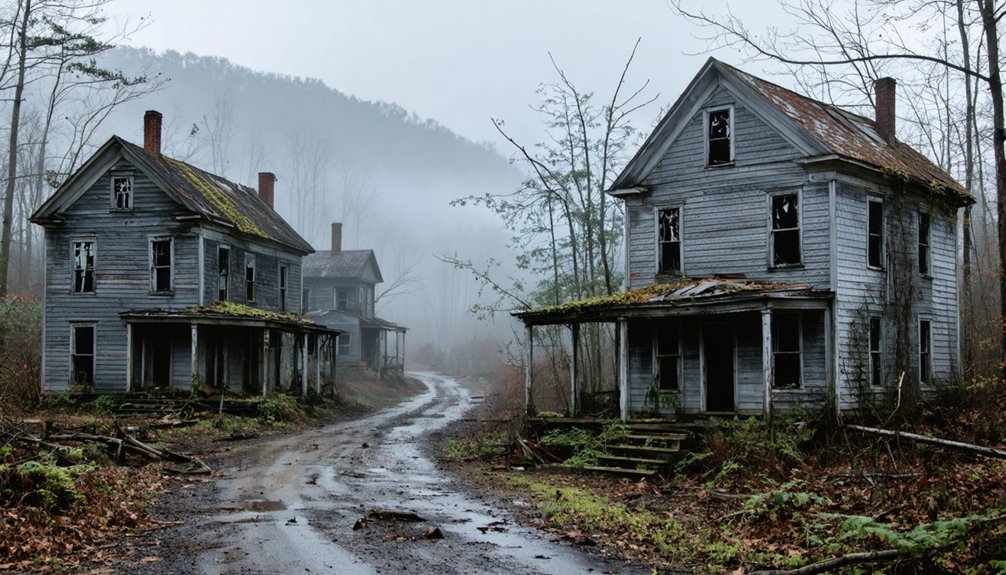
You’ll find Stotesbury tucked between mountains along serpentine roads, where a century-old coal camp once thrived on longwall mining techniques that set it apart from typical room-and-pillar operations.
The town’s segregated past reveals itself in two stark remnants: St. John’s Baptist Church, built in 1918 for African-American miners with its steeple now collapsed and bell stolen, and a separate cemetery behind it where gravestones span 1912 to 1969.
When you explore the abandoned lower camp, you’re walking through a community that housed 500 residents at its peak before the mines closed in 1958, ending what Senator Robert C. Byrd—who graduated from nearby Mark Twain High School—once knew as home.
Mining History and Operations
When you stand among the crumbling foundations of Stotesbury today, you’re walking through the birthplace of American coal mining’s mechanical revolution.
This unassuming hollow witnessed history in 1952 when Eastern Associated Coal Corporation broke free from centuries of backbreaking manual labor, installing the nation’s first modern longwall operation.
The technological advancements transformed everything:
- German coal planes replaced pickaxes, extracting massive panels rather than narrow seams.
- 530 tons per shift flowed from mechanized faces between 1952-1958.
- Three successful panels proved the concept before mining safety challenges ended operations.
- 90 years of extraction concluded in 2002 when dangerous roof conditions finally forced closure.
The E.E. White Coal Company’s gamble launched an industry transformation that would eventually dominate West Virginia’s coalfields.
Segregated Churches and Housing
Beyond the machinery and production records, Stotesbury’s most haunting legacy stands at the far end of the main road: St. John’s Baptist Church. Built in 1918 by E.E. White Coal Company exclusively for black residents, this nearly three-story structure embodies historic segregation that extended from housing to burial grounds.
You’ll find glassless windows, rotting steps, and a partially collapsed roof where weddings and funerals once filled the sanctuary. The cemetery behind the church holds headstones from 1912 to 1969, their inscriptions obscured by overgrowth.
Walking these abandoned communities, you’ll notice how company control enforced “separate but equal” doctrine throughout. Empty houses line both sides of the road, their wide-open doors revealing stripped interiors—physical evidence of West Virginia’s segregated past.
Kaymoor: the 821-Step Journey Into Mining History
Deep in the New River Gorge, 821 steps carved into the mountainside plunge you straight into one of West Virginia’s most dramatic ghost towns.
821 steps descend through mountain stone into Kaymoor—where West Virginia’s industrial ambitions collapsed into haunting ruins.
Kaymoor’s dual-camp layout tells a story of ambition and obsolescence—built in 1899 when Low Moor Iron Company believed they’d struck industrial gold.
What remains at Kaymoor:
- 101 coke ovens standing like sentinels near the processing plant
- Concrete foundations where 130 houses once sheltered 1,500 miners
- Twin incline tracks that hauled workers up and coal down the 1,000-foot slope
- Mining techniques frozen in time—hand-loading methods that sealed the operation’s fate
Worker living conditions varied sharply: company stores and segregated schools existed, but no churches or saloons.
The outdated air-pull furnace systems couldn’t compete with modernized competitors, ultimately abandoning 16 million tons worth of memories.
Frequently Asked Questions
Are These Ghost Towns Safe to Explore Without a Guide?
You’ll find most ghost towns accessible without guides, but hidden hazards like crumbling structures and unstable floors demand serious safety precautions. Trust your instincts, watch your step, and respect deteriorating buildings—especially in Fayette and McDowell counties’ abandoned sites.
Exploring haunted sites in West Virginia can lead to unexpected encounters and eerie experiences. Many visitors report feeling an unusual presence or hearing strange noises, adding to the thrill of exploration. Always remember to go prepared with a flashlight and a camera to capture any spooky moments.
Annual events in West Virginia ghost towns attract history buffs and thrill-seekers alike, eager to uncover the stories behind these forgotten places. From haunted tours to local festivities, each event offers a unique glimpse into the past while celebrating the rich heritage of the region. Participation in these gatherings not only enhances the experience but also allows you to connect with others who share a passion for exploration and the supernatural.
What Is the Best Time of Year to Visit West Virginia Ghost Towns?
Strike while the iron’s hot—visit during spring or fall when you’ll find ideal weather, accessible tourist infrastructure, and safe conditions for exploring historical preservation sites. Summer works too, though winter’s treacherous roads make ghost town adventures downright dangerous.
Do I Need Special Permits to Access These Abandoned Mining Sites?
You don’t need permits for publicly accessible ghost towns like Kaymoor in New River Gorge National Park. However, respect private property boundaries and trespassing laws—many abandoned sites remain privately owned, and unauthorized entry carries legal consequences and safety risks.
Are There Any Entrance Fees for Visiting These Ghost Town Locations?
Want to explore without breaking the bank? You’ll find Thurmond Ghost Town offers free access for historic preservation exploration, while guided tours featuring local folklore run $14-$25. Most abandoned sites welcome you at no charge during daylight hours.
Can I Camp Overnight Near Any of These West Virginia Ghost Towns?
You can’t camp directly at these ghost towns, but New River Gorge National Park offers nearby campgrounds. Pack your camping gear and take safety precautions—dispersed sites let you wake up to Appalachian wilderness before exploring abandoned coal towns.
As you venture into the region, you’ll discover ghost towns to explore in West Virginia that showcase the rich history of coal mining. Each site tells a unique story, offering a glimpse into a bygone era. Take your time to wander through the remnants of these once-thriving communities and appreciate the haunting beauty of their desolation.
The remnants of abandoned towns in West Virginia reveal fascinating tales of resilience and change. As you walk through decaying structures and overgrown pathways, you’ll feel the weight of history around you. Each corner turned may lead to a new discovery, such as an old mine entrance or a rusted piece of equipment, reminding us of the once-bustling life that filled these spaces.
References
- https://kids.kiddle.co/List_of_ghost_towns_in_West_Virginia
- https://wvexplorer.com/2025/10/19/ghost-towns-in-southern-west-virginia/
- https://carte-urbex.com/en/blogs/infos/top-10-abandoned-places-in-west-virginia
- https://wvtourism.com/5-wv-ghost-towns/
- https://www.youtube.com/watch?v=-EeLwLa2t90
- https://minskysabandoned.com/2015/07/30/west-virginia-ghost-towns-part-1-nuttallburg/
- https://www.geotab.com/ghost-towns/
- https://tjpowell.net/2024/06/05/the-history-of-the-thurmond-west-virginia-railroad-bridge/
- https://www.wvencyclopedia.org/articles/721
- https://aceraft.com/new-river-gorge/new-river-gorge-national-park/history/history-of-thurmond-west-virginia/