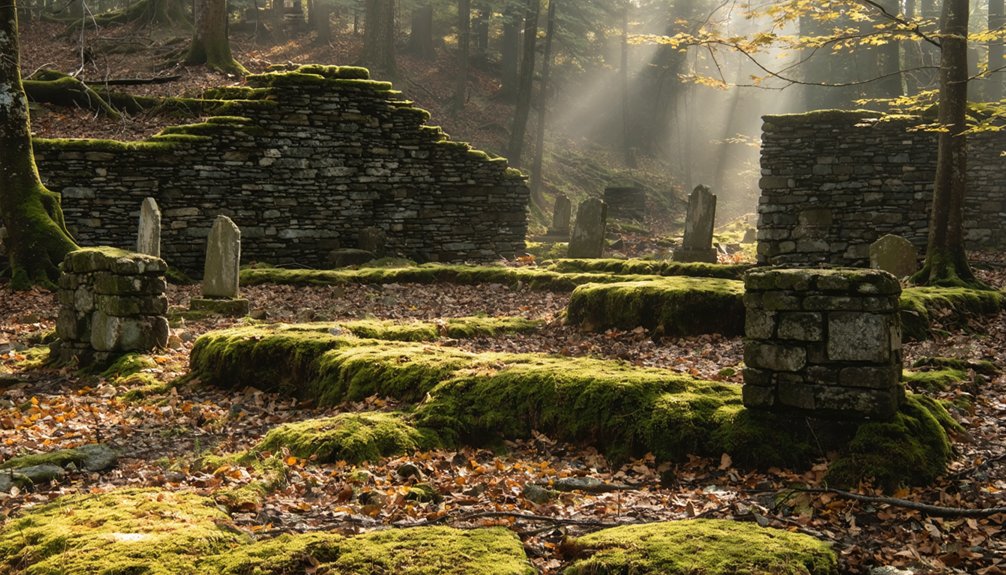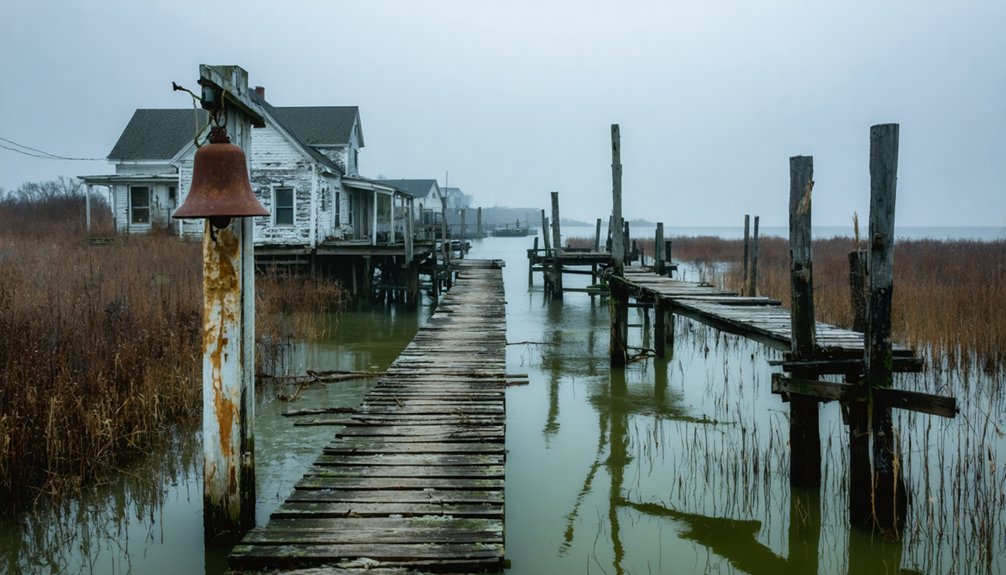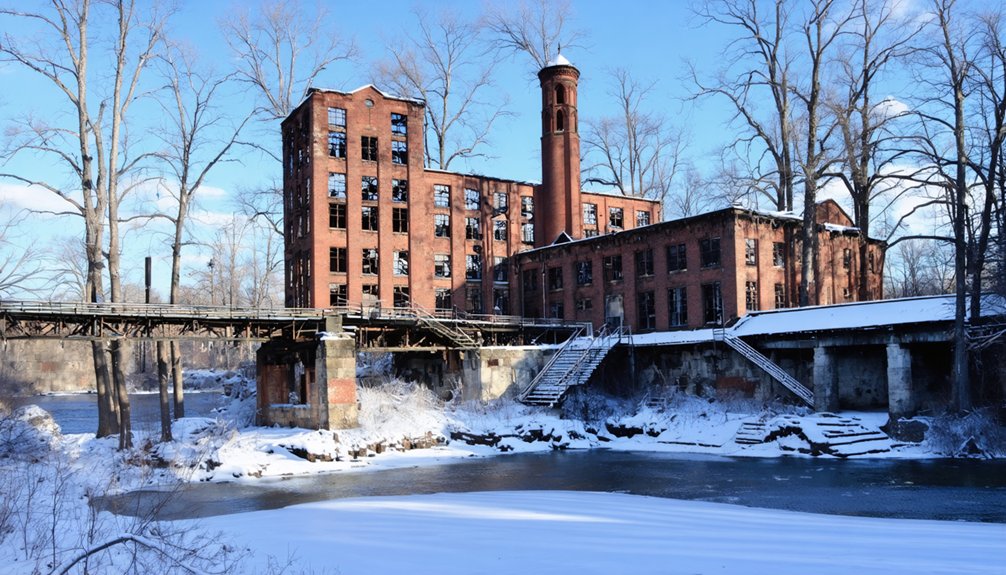
Connecticut’s winter landscape reveals haunting ghost towns like Dudleytown, the state’s most notorious cursed settlement, and Johnsonville Village, a Victorian mill town frozen in time along the Moodus River. You’ll discover Gay City State Park‘s hidden stone foundations and Bara-Hack‘s weathered cemetery stones, all more visible through bare trees and snow. While some sites like Dudleytown remain off-limits due to private ownership, others offer accessible trails where you can explore colonial-era ruins—though proper preparation for icy terrain and navigation challenges will guarantee your journey through these abandoned settlements uncovers their full mysterious history.
Key Takeaways
- Gay City State Park in Hebron offers accessible hiking trails to stone foundations, chimneys, and mill ruins from a 1796 settlement.
- Johnsonville Village features Victorian mills, houses, and a chapel along the Moodus River, but remains on private property with limited access.
- Winter’s leafless trees reveal hidden ruins best, making stone foundations and old structures more visible through bare forest landscapes.
- Bara-Hack near Pomfret contains two house foundations and a cemetery from the 1780s, though it’s closed on private property.
- Dudleytown is completely off-limits year-round, protected by the Dark Entry Forest Association with strict trespassing enforcement and potential fines.
Dudleytown: Connecticut’s Most Notorious Cursed Settlement
Deep within Cornwall’s Dark Entry Forest, where hills cast shadows so thick that noon feels like dusk, lies the skeletal remains of Connecticut’s most infamous settlement. Founded in 1747 by Gideon Dudley, this farming community reached 26 families before mysterious decline gripped it.
Where Cornwall’s perpetual shadows swallow the light, Connecticut’s most cursed village molders in silence, its doomed families forever lost to history.
Urban legends claim a curse followed the Dudleys from England—where Edmund Dudley lost his head to Henry VIII—manifesting in murders, madness, and suicide. William Tanner raved about demons after witnessing violence in 1792. The supernatural narrative gained momentum when paranormal investigators Ed and Lorraine Warren declared the site demonically possessed during televised investigations in the 1970s.
Yet folklore analysis reveals mundane truths: harsh winters, exhausted soil, and distant water sources doomed the town. The community briefly thrived through iron ore mining and charcoal production during the Revolutionary War, when demand for locally manufactured steel sustained the settlement through the early 19th century.
Dark Entry Forest, Inc. closed the site permanently in the 1990s after vandalism plagued the crumbling cellar holes. You can’t visit legally, though the curse story persists.
Johnsonville Village: A Victorian Mill Town Frozen in Time
You’ll find Johnsonville Village locked behind gates along the Moodus River, where three-story wooden mills with church-like bell towers and Victorian houses with pillared porches stand weathered but intact since the 1800s.
Winter transforms this abandoned twine-manufacturing settlement into an eerie tableau—bare trees expose the full scope of colonial and Victorian structures that housed five generations of mill-worker families before fires and economic decline emptied the town in the 1970s.
Though private property restrictions prevent close exploration, the roadside views reveal Neptune Mill‘s foundations, the restored general store, one-room schoolhouse, and chapel that Raymond Schmitt relocated here in the 1960s, all frozen in various states of preservation and decay. The village’s original Triton Mill dominated the landscape as a center of twine production before its destruction by fire in 1924. Iglesia ni Cristo purchased the 64-acre property in 2017 with plans to transform the decaying structures into a worship center.
Victorian Architecture and Ruins
Nestled along the Salmon River Cove, Johnsonville Village stands as Connecticut’s most intact Victorian mill town.
A three-story Neptune Mill, rising 100 feet square, sits beside a rushing waterfall.
You’ll discover Victorian facades throughout this 1832 settlement—from the Emory Johnson Homestead’s pillared porches to relocated treasures like the 1876 Gilead Chapel and an 1858 Massachusetts general store.
The crown jewel, a covered bridge completed in 1976, spans the 15-acre millpond with dual openings for carriages and pedestrians.
But structural decay tells the real story here.
Overgrown vines consume abandoned buildings, while animal skeletons rest inside the chapel’s rotting pews.
Winter strips away any remaining pretense, revealing bare wooden frames and crumbling foundations.
The village earned recognition when Billy Joel filmed his “River of Dreams” music video here in 1993, capturing the haunting Victorian atmosphere before further decline set in.
The original Neptune Twining History Quarter Company, established in 1832, supplied twine for the fishing industry that once drove this community’s prosperity.
You’re free to explore this deteriorating snapshot of industrial America—no guided tours, no gift shops, just authentic ruins.
Winter Access and Exploration
Winter transforms Johnsonville into a stark study in contrasts—the waterfall roars against ice-crusted banks while snow blankets the millpond’s frozen surface, creating a photographer’s paradise of Victorian silhouettes against white.
You’ll find the road plowed after storms, with on-site parking available during visiting hours. Pack layers and wear sturdy boots for traversing icy paths through woods and garden scenery once cultivated by mill workers.
The site remains accessible year-round, though ongoing restoration limits certain areas. You’ll spot lights in buildings and caretakers maintaining the grounds—evidence this ghost town isn’t entirely abandoned. The well-preserved 19th-century architecture throughout the village offers an authentic historical experience even during the coldest months. Among the structures, the Gilbert Livery Stable stands as a distinctive three-level building with oak stalls and notable woodwork dating to 1920.
Check conditions beforehand, bring your own provisions since facilities are minimal, and scout potential picnic spots for warmer days. The Filipino church ownership means respecting posted protocols while exploring freely.
Gay City State Park: Ruins Hidden in the Forest
In the dense woods of Hebron, stone foundations and crumbling chimneys mark where 25 families once built their lives along the Blackledge River starting in 1796.
Winter strips away the forest’s concealing foliage, making the unmarked ruins easier to spot among the bare trees—though snow can obscure the subtle outlines of cellars and mill canals hidden yards off the main paths.
The settlement’s prosperity came from harnessing the river to power lumber and textile mills, remnants of which still stand after fires repeatedly destroyed them in the late 1800s.
You’ll need to venture beyond the 10-21.5 miles of marked trails to find most of these 18th-century remnants, using old stone fence lines as your guide through the frozen landscape.
Some visitors leave flowers or teddy bears at burial sites scattered throughout the park, a practice that adds an eerie intimacy to these forgotten graves.
18th-Century Settlement Remains
Deep within Gay City State Park’s 1,569 acres, the skeletal remains of a 19th-century utopian community emerge from beneath snow-dusted forest floors like fragments of a forgotten dream. You’ll discover stone foundations, standing chimneys, and deteriorating mill structures along accessible hiking trails—testimonies to the Methodist settlement that thrived here from 1796 until devastating fires in 1879 and 1885 drove residents away.
Historical preservation efforts began when descendant Emma Foster sold the land to Connecticut in 1943. Today’s environmental impact remains minimal as nature reclaims man-made boundaries. Stone farm fences still slice through woodlands, while cellar holes punctuate the terrain.
Near the entrance, you’ll find the burial ground where founding families rest—their weathered gravestones bearing witness to frontier ambitions that ultimately surrendered to wilderness’s patient persistence.
When snow blankets Gay City’s nine-mile trail network, the flat, wide paths—former colonial roads that once connected the settlement—transform into deceptive corridors where powder obscures the underlying terrain. You’ll rely heavily on winter trail markers—color-blazed posts marking Red, White, Yellow, Orange, and Blue routes—since the usual 90% of visitors abandon these trails once gates close after Columbus Day.
The real challenge? Icy trail hazards lurk beneath innocent-looking snow cover, camouflaging rocks and roots on multi-use surfaces churned by horses and mountain bikes. Navigation demands constant attention: the Blue Shenipsit Connector‘s rerouted hillside climb, Red Trail’s 4.55-mile alternation between rough paths and old roads, abrupt turns near beaver ponds.
Distance markers between junctions become your lifeline when forest obscures mill ruins and glacial erratics disappear under winter’s blanket.
Bara-Hack: Stone Foundations and Mysterious Legends
Among Connecticut’s Quiet Corner forests near Pomfret, stone foundations and crumbling walls mark what locals call the “Village of Voices”—the abandoned settlement of Bara-Hack. You’ll discover two house foundations flanking a brook, alongside a cemetery where Randall and Higginbotham families rest beneath weathered stones.
Welsh descendants established this remote hamlet around 1780, complete with mills and farms, before abandoning it by 1890.
Haunted legends saturate every mossy stone wall. Visitors report voices echoing through bare trees, phantom wagon wheels rumbling past, and children’s laughter where no children play.
Ghostly sightings include luminous orbs hovering over graves and a bearded apparition witnessed during 1971 investigations.
Unfortunately, you can’t legally explore—it’s private property closed to trespassers. Winter’s skeletal forest would’ve offered exceptional views of these mysterious ruins.
Holy Land USA: A Religious Folk Art Park in Restoration
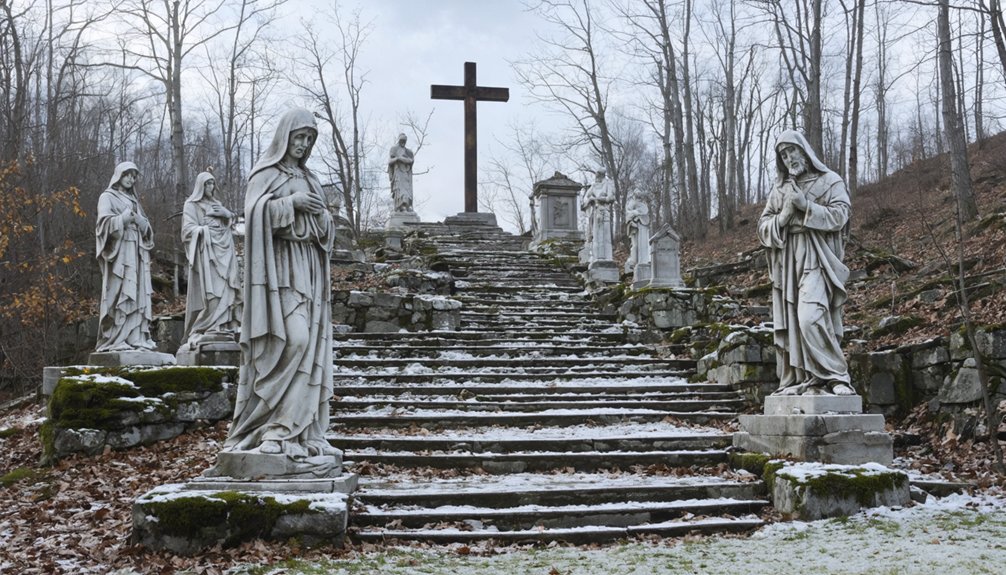
Perched atop Pine Hill in Waterbury, Holy Land USA‘s weathered Biblical replicas emerge from decades of abandonment like artifacts from another era.
This 18-acre religious theme park—once drawing thousands with its plywood Jerusalem and 200-foot catacombs—fell into ruins after founder John Greco’s death in 1986.
But volunteers have been slowly resurrecting it since 2013. You’ll find the gates open from dawn to dusk year-round, where crumbling concrete saints and exposed chicken wire structures create an eerie winter landscape beneath the glow of a 57-foot illuminated cross visible from Interstate 84.
Abandoned Religious Theme Park
Sprawling across 18 acres of Pine Hill in Waterbury, Holy Land USA stands as one of Connecticut’s most peculiar abandoned attractions—a decaying Biblical theme park where headless statues and crumbling plaster temples create an eerie winter landscape.
Founded by attorney John Baptist Greco in 1957, this free religious attraction once drew 50,000 annual visitors to explore miniature replicas of Bethlehem and Jerusalem.
After closing in 1984, thirty years of neglect transformed the site into haunting folk art—vandalized mannequins, weather-beaten biblical scenes, and 200-foot underground catacombs now define the visitor experience.
While the nuns who inherited the property maintain limited access for historical preservation, you’ll still glimpse the iconic 32-foot illuminated cross from Interstate 84, beckoning travelers toward this strange roadside relic of American religious devotion.
Current Restoration Efforts Underway
After decades of weathered decay, Holy Land USA now pulses with renewed purpose under the stewardship of a dedicated non-profit organization determined to resurrect John Baptist Greco’s biblical vision.
You’ll witness transformation through community fundraising and volunteer efforts breathing life into this 18-acre mountaintop sanctuary.
The restoration encompasses three essential initiatives:
- Infrastructure Enhancement – Newly paved walkways guide you safely through the site, while illuminated crosses crown Waterbury’s skyline
- Memorial Brick Program – Your engraved contribution funds ongoing rehabilitation while honoring loved ones
- Building Preservation – Critical repairs address monument deterioration and pathway hazards
This 501(c)(3) organization orchestrates regular masses, concerts, and mountaintop gatherings, reclaiming the park’s role as Connecticut’s unique spiritual destination.
You’re invited to explore freely while preservation work continues protecting this biblical narrative for generations ahead.
Winter Access and Safety
Winter transforms Holy Land USA into a challenging pilgrimage site where Connecticut’s notorious snowfall meets mountaintop exposure. You’ll find the 60 Slocum Street address navigable during daylight hours only, though recent storms dumped up to 20 inches across the region. The elevated terrain that once showcased religious folk art now presents urban decay softened by white drifts, making historic preservation efforts more visible against the snow.
You’re permitted to walk the grounds, but trespassing charges apply after sunset. Connecticut DOT plows maintain access roads, yet whiteout conditions create genuine hazards—2023 saw 320 fatal snow-related crashes statewide. Before visiting, call 855-377-7770 for current conditions.
The illuminated cross guides you upward, but uneven terrain lurks beneath snowpack. Space your adventure between storms for safer exploration.
What Makes Connecticut a Hotspot for Paranormal Activity
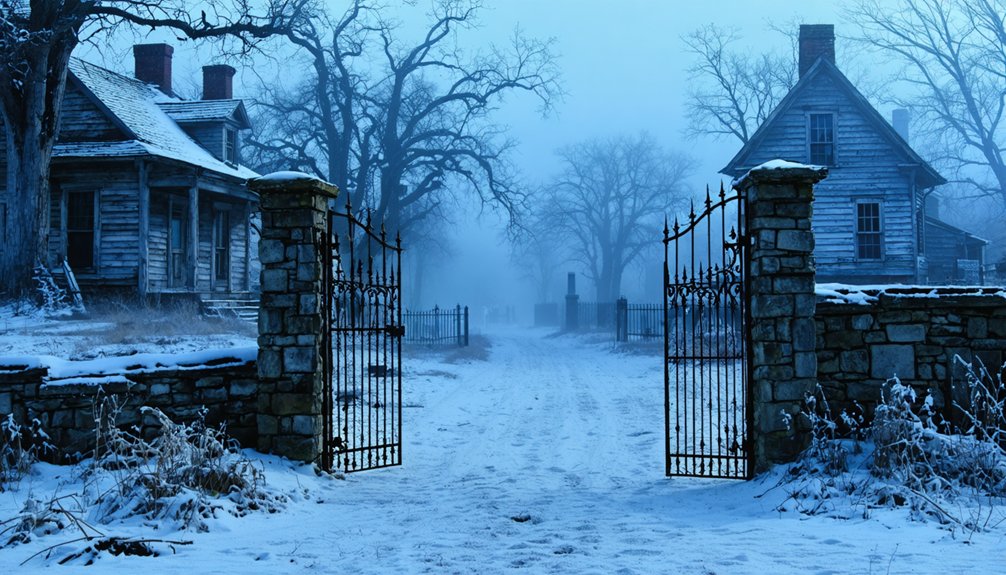
Beneath Connecticut’s quaint New England charm lies a darker tapestry woven from centuries of tragedy, superstition, and unexplained phenomena. You’ll find the state ranks among America’s most paranormally active, hosting the nation’s first witch trials—three decades before Salem’s infamous hysteria.
Three forces converge to create Connecticut’s supernatural intensity:
- Sacred Native grounds – Mohawk Nation territories carry spiritual significance that early Puritans feared, believing devils lurked in wilderness areas.
- Abandoned settlements – Ghost towns like Bara-Hack and cursed Dudleytown draw paranormal investigations with documented apparitions, orbs, and unexplained incidents.
- Devil-branded landscape – Thirty-four locations bear Satan’s name, from Devil’s Backbone to Satan’s Kingdom, where haunted legends persist with demon sightings at Chapman Falls.
You’re free to explore these mysteries yourself, though Dudleytown’s closure proves ghost-hunters take these phenomena seriously.
When you venture into Connecticut’s ghost towns during winter months, you’ll encounter trail conditions that transform from merely rustic to genuinely treacherous. At Moosup Valley State Park Trail, constant water pools force detours around hillsides, while eroded segments hide beneath snowpack.
Pilfershire’s 3.4-mile route gains 600 feet in elevation, where rocky ledges become skating rinks and crumbling foundations turn into snow-masked craters. Don’t expect trail maintenance on these abandoned paths—you’re truly on your own.
Pack proper navigation equipment: GPS devices prove essential when stone walls and dense woods obscure landmarks. Saugatuck Reservoir’s 20-mile network demands traction gear for icy slopes and headlamps for dark, tree-shrouded sections.
Those deep stone wells won’t announce themselves. During freeze-thaw cycles, yesterday’s solid ground becomes today’s ankle-twisting hazard—freedom requires preparation.
Understanding Access Restrictions and Seasonal Closures
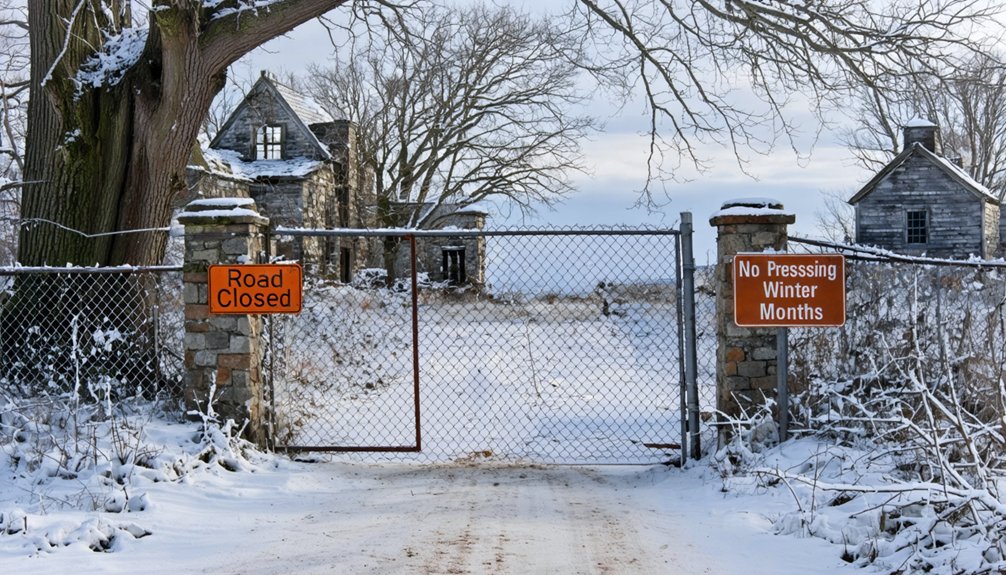
Before you lace up your boots for a winter exploration of Connecticut’s ghost towns, you need to understand that many sites—particularly Dudleytown—exist entirely off-limits to visitors.
The Dark Entry Forest Association has owned this land since the mid-1920s, maintaining it as a private trust for historical preservation.
Legal restrictions emerged after vandalism surged following 1980s ghost rumors and the 1999 Blair Witch Project release.
Why access remains permanently restricted:
- Fires and destruction by trespassers forced owners to implement year-round bans with zero exceptions
- Connecticut State Police actively patrol the area, prosecuting anyone caught entering the property
- Only cellar holes and stone foundations remain—owners prioritize reforestation over tourism
Stealth attempts risk immediate arrest and fines.
Your winter ghost town adventures must respect private property boundaries, regardless of how compelling the destination appears.
Combining Ghost Town Visits With Organized Paranormal Tours
While Connecticut’s abandoned settlements reward solitary exploration, pairing them with professionally guided paranormal tours transforms your winter ghost town experience into a multi-layered historical adventure.
Solo exploration meets guided expertise—winter ghost town adventures gain historical depth through Connecticut’s professional paranormal tours.
Seaside Shadows operates Downtown Mystic Ghost Strolls and Moonlit Graveyard tours year-round, running Tuesday through Sunday with 7 p.m. departures from September through December. You’ll encounter haunted folklore spanning Pequot Wars casualties, lost seafarers, and cryptids during these two-hour walks ($30 March-September).
Hartford’s ghost tours reveal spectral legends at the Old State House, where witchcraft victim Alice Young’s spirit reportedly lingers.
Captain Grant’s 1754 inn offers winter ghost tours combining meals, spiked cider, and séances—perfect for warming up after exploring Connecticut’s frozen, forgotten settlements.
Book private investigations or midnight full-moon tours for deeper paranormal encounters.
Essential Preparation Tips for Winter Ghost Town Exploration
Success in winter ghost town exploration hinges on meticulous vehicle preparation that transforms potentially dangerous backcountry journeys into confident adventures. You’ll need clean headlights piercing Connecticut’s gray winter curtain, tire chains gripping powder-dusted logging roads, and a full gas tank powering your escape from forgotten hamlets.
Share your route with someone trustworthy—local legends speak of explorers vanishing into blizzards.
Critical preparation checklist:
- Vehicle essentials: Working wipers, responsive brakes, winter tires, recovery gear including winch tools and earth anchors
- Navigation backup: GPS coordinates, offline maps, compass—cell service dies where ghost towns thrive
- Safety equipment: Flashlight, respirator mask for moldy structures, first aid kit, emergency supplies for overnight delays
Consider alternative transportation like snowshoes for accessing sites where roads disappear beneath drifts, ensuring nothing stops your pursuit of abandoned Connecticut mysteries.
Frequently Asked Questions
Are Camping or Overnight Stays Permitted Near Connecticut Ghost Town Locations?
You can’t camp at Connecticut’s ghost town sites due to historical preservation requirements and strict visitor regulations. State lands prohibit dispersed camping, and these abandoned locations lack designated campgrounds, restricting you to daytime exploration only.
Do Any Ghost Towns Offer Guided Historical Tours During Winter Months?
You’ll find historic tours at Connecticut’s winter ghost towns through Mystic Ghost Tours, which run year-round. Their Ghosts of Christmas Past weekend tours blend eerie folklore with true history, offering atmospheric December explorations at 4 PM and 7 PM.
Can Photography Equipment Function Properly in Connecticut’s Cold Winter Ghost Town Conditions?
Your camera can handle Connecticut’s winter if you’re smart about it. Keep spare batteries warm in your pockets, use insulated lens pouches for frost protection, and let your winter equipment acclimate gradually to prevent condensation damage.
Are There Nearby Facilities for Warming up Between Ghost Town Explorations?
You’ll find warming stations, cafes, and community centers near each ghost town location. Local weather preparedness includes fireplaces at historic inns, heated diners, and ranger stations—essential winter safety tips for your independent explorations between atmospheric ruins.
Which Ghost Towns Remain Most Photogenic After Connecticut Snowfall?
Like frozen time capsules emerging from white silence, Dudleytown’s snow-covered ruins deliver Connecticut’s most dramatic winter landscape photography. You’ll capture stark stone foundations against bare trees, where fresh powder transforms overgrown cellar holes into hauntingly beautiful compositions worth braving the cold.
References
- https://mommypoppins.com/connecticut-kids/best-ghost-tours
- https://earlybirdonthetrail.com/haunted-hikes-in-connecticut/
- https://usghostadventures.com/hartford-ghost-tour/
- https://www.atlasobscura.com/things-to-do/connecticut/ghost-towns
- https://www.youtube.com/watch?v=J9TIc7cqXNo
- https://ctvisit.com/articles/ghost-hunting-in-connecticut
- https://abandonedwonders.com/tag/connecticut/
- https://newenglandhistoricalsociety.com/the-dudleytown-curse-connecticuts-village-of-the-damned/
- https://www.youtube.com/watch?v=PKr-5HrudiI
- https://en.wikipedia.org/wiki/Dudleytown