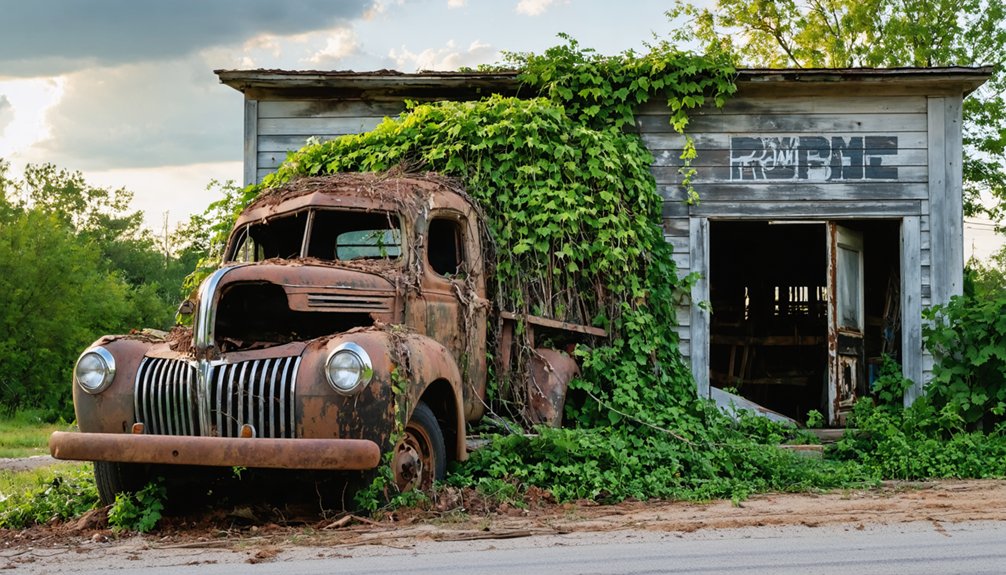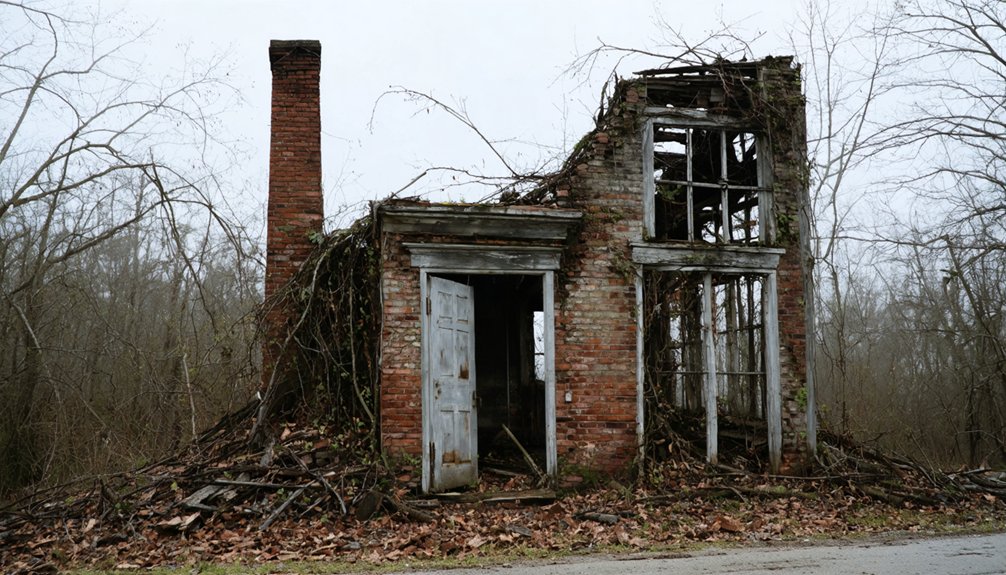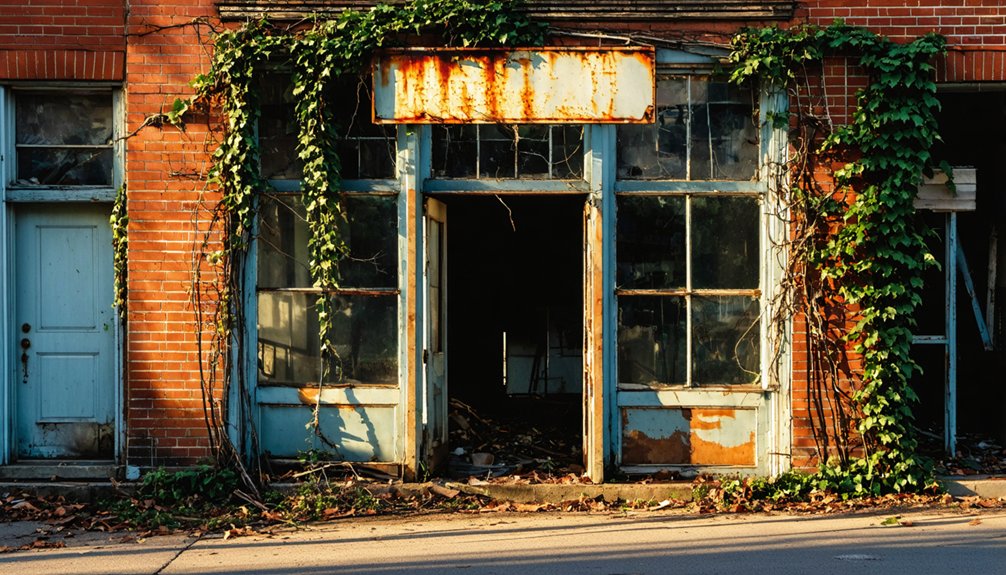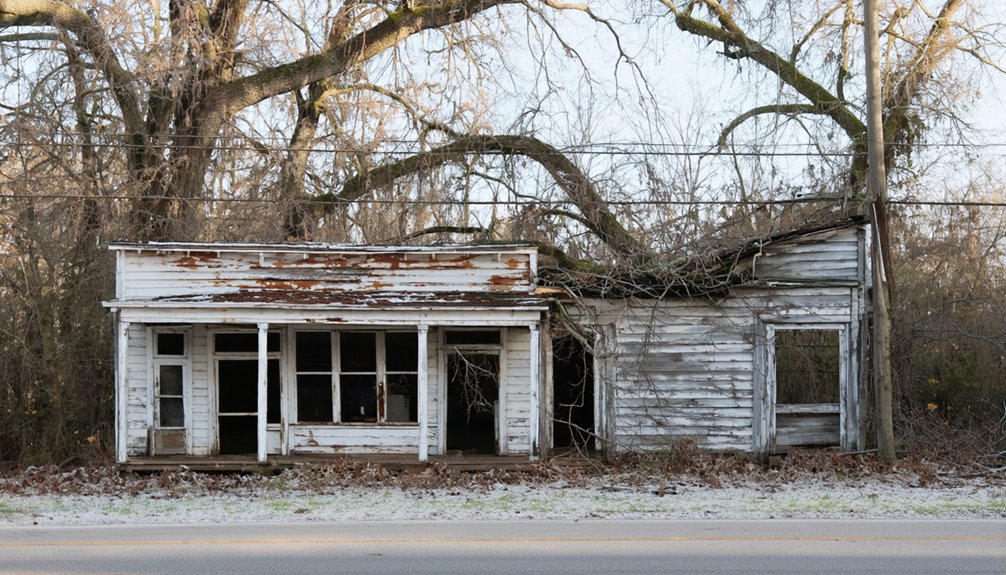
You’ll find Alabama’s ghost towns most accessible in winter, when mild temperatures and bare trees reveal what summer foliage conceals. Old Cahawba, the state’s first capital, offers maintained trails through archaeological ruins and antebellum remnants. Piper’s coal-mining structures still stand behind chain-link fences near West Blocton, while Bellefonte exists only as a cemetery where keelboats once docked. Pack layers, sturdy boots, and a camera—winter’s reduced humidity sharpens your lens on weathered textures, and what follows covers everything from steering frozen back roads to respecting these fragile historical sites.
Key Takeaways
- Old Cahawba offers archaeological ruins, antebellum structures, and maintained trails managed by the Alabama Historical Commission for winter exploration.
- Bellefonte features a historic cemetery and abandoned nuclear station, with remnants from its former cotton port era available to visit.
- Piper displays coal-mining remnants including houses, a concrete bunker, and commissary accessible via County Road 24 near West Blocton.
- Winter provides milder temperatures, better photography lighting, reduced humidity, and fewer crowds for comfortable ghost town exploration in Alabama.
- Arcola’s Greek Revival house and failed vineyard site mark French exile settlement attempts along the Tombigbee River from the 1820s.
Old Cahawba: Alabama’s Abandoned First Capital
Deep in the winter woods of Dallas County, where the Alabama and Cahaba Rivers merge in a silent embrace, you’ll find Old Cahawba—a ghost town that once buzzed with the footsteps of lawmakers and the crack of auctioneers’ gavels.
Alabama’s first capital from 1820 to 1826, this abandoned settlement offers remarkable urban exploration opportunities. You’ll wander through streets where 182 lots once sold for over $123,000, funding the original statehouse.
The archaeological significance runs deeper—beneath your boots lie Native American mounds from 4,000 years ago and possibly the site of Maubila, destroyed by de Soto in 1540.
Winter’s bare trees reveal crumbling foundations, wells, and the prison site where 3,000 Union soldiers suffered. Among the ruins stand the Crocheron Columns, remnants of a grand Greek Revival mansion that burned in 1923, once the site of a Civil War prisoner exchange. The Alabama Historical Commission maintains trails through this haunting landscape, where prosperity and ruin coexist. Jeremiah Haralson, born into slavery here, rose to become Alabama’s first African American to serve in both state chambers and the U.S. Congress during Reconstruction.
Manasco: A Walker County Settlement Lost to Time
Where Walker County’s ridges flatten into creek-fed hollows, you’ll discover almost nothing of Manasco—and that absence tells its own story.
David C. Manasco’s 160-acre settlement thrived from 1879 to 1900, complete with a post office run by Elizabeth A. Palmer. Then it vanished.
What remains for your exploration:
- Overgrown foundations where wooden structures once housed families loyal to Andrew Jackson’s Union ideals
- Creek beds that powered daily life before the 1889 post office closure
- Silence replacing voices of settlers who fled to Winston County’s anti-Confederate haven
For local history buffs and family genealogy researchers, Manasco offers more questions than answers. The settlement’s detailed history has been preserved through the Family History Foundation, providing crucial documentation for those tracing their roots to this vanished community.
You won’t find tourist markers or preserved buildings—just Alabama clay reclaiming what briefly interrupted it. Winter’s bare trees reveal subtle land disturbances where determination met isolation. Unlike Manasco’s complete disappearance, Cahawba preserves two antebellum structures that survived Alabama’s first capital city becoming a ghost town.
Bellefonte: The River Port Claimed by Cholera
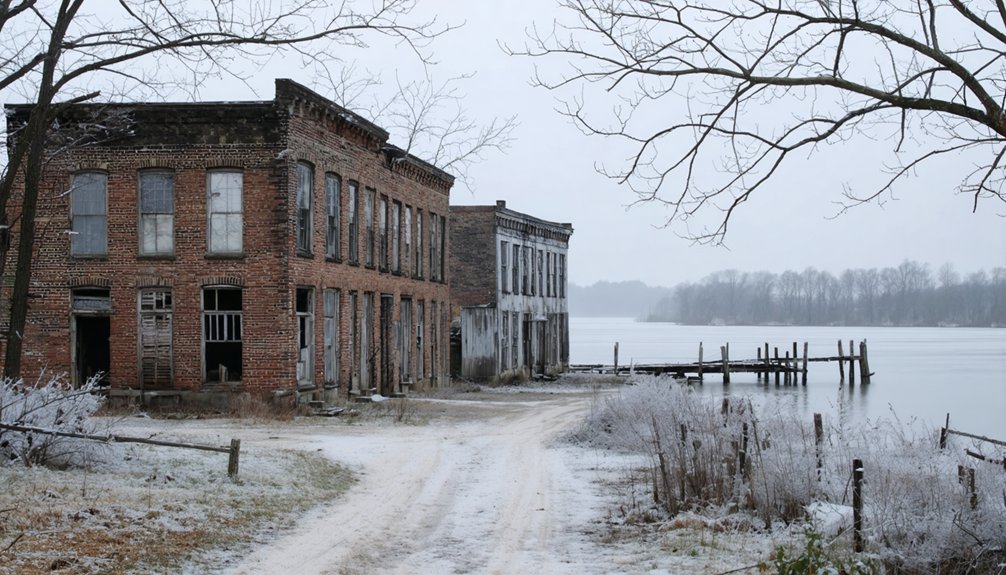
While Manasco faded quietly into Walker County’s clay, Bellefonte’s death came loud—with fever dreams and hurried burials along the Tennessee River.
You’ll find only a cemetery where Jackson County’s seat of justice once thrived from 1828 to 1868. This cotton port handled keelboats loaded with sugar and coffee until the Memphis and Charleston Railroad bypassed it in 1855.
Historic architecture vanished when Scottsboro claimed the county records that November. The town’s population had grown from 320 in 1833 to 400 by 1844 before the railroad sealed its fate. Local legends whisper about cholera sweeping through, though official documents cite the railroad’s shift.
The TVA documented what remained in 1936—foundations, stories, graves.
Now the abandoned Bellefonte Nuclear Station looms nearby, another $4 billion ghost joining Alabama’s collection of places progress left behind. Construction began in 1933 when the Tennessee Valley Authority was established to modernize the region with hydroelectric power and navigable waterways.
Arcola: French Heritage Buried in the Black Belt
Along the Black Warrior River’s muddy banks, Napoleonic exiles planted grapes that withered in Alabama clay they’d never learned to read.
You’ll find Arcola’s French heritage barely visible now—two hundred Bonapartists who fled here in the 1820s, naming their doomed colony after Napoleon’s Italian victories.
By the 1850s, they’d vanished entirely, replaced by plantation lords who understood this Black Belt soil.
What remains speaks through absences:
- Ravesies’ original cabin site, swallowed by the Hatch Plantation’s 3,000 acres
- Failed vineyards where 200 enslaved people later worked cotton fields
- The 1856 Greek Revival house still standing, testament to American takeover
You won’t find Arcola on modern maps. The river landing that witnessed French dreams surrender to Southern reality exists only in county records and one historical marker. The settlement shares its name with multiple other places, a common occurrence that now relegates this forgotten colony to disambiguation pages rather than its own historical recognition.
The exiles arrived aboard schooner McDonough, driven ashore by a gale near Fort Bowyer before Mobile’s residents helped them navigate the Tombigbee River northward.
Piper: Where Mining Dreams Collapsed Underground
Deep in Bibb County’s Cahaba Coal Field, three thousand souls once banked their futures on what lay beneath their feet—seams of black gold that promised permanence but delivered only hollowness. Piper thrived as a company town through the 1880s, peaking at 432 miners in 1914. Then 1950 arrived with mine collapse and mass exodus.
You’ll find the remnants off County Road 24 between West Blocton and Brierfield. Winter’s bare trees expose what summer conceals: two weathered houses, a concrete bunker with electrical guts spilling out, and what appears to be an old commissary behind chain-link. The ghost town sits near Cahaba River and a popular recreational refuge that draws hikers year-round.
The mining history speaks through abandoned structures the woods are slowly digesting. That vault-like feature surrounded by crumbled concrete? Someone’s life savings, now just another monument to extraction’s false promises. A 1925 mine explosion claimed seven lives, foreshadowing the town’s ultimate fate.
Frisco City: A Railroad Town Left Behind
Not all Alabama ghost towns died suddenly—some hemorrhaged slowly over decades, their names changing like desperate rebranding attempts while the lifeblood drained away.
Some towns don’t vanish overnight—they fade slowly, changing names like dying patients grasping at miracle cures.
Frisco City wore four different names between 1909 and 1928, each reflecting broken railroad promises until the St. Louis and San Francisco Railway finally arrived.
You’ll witness urban decay everywhere—from 50 thriving 1960s businesses down to 37 today, with 350 residents clinging to what remains.
Preservation efforts saved three structures:
- The weathered J.W. Jones home, testament to founding families
- Jones Mill’s cramped one-room jail with iron-barred windows
- A rusty railroad caboose honoring the namesake that eventually abandoned them
The 2001 downtown fire sealed Frisco City’s fate—those charred ruins never rebuilt, just dusty wooden storefronts and faded Main Street signs marking freedom’s price.
Best Times to Explore Alabama’s Ghost Towns in Winter
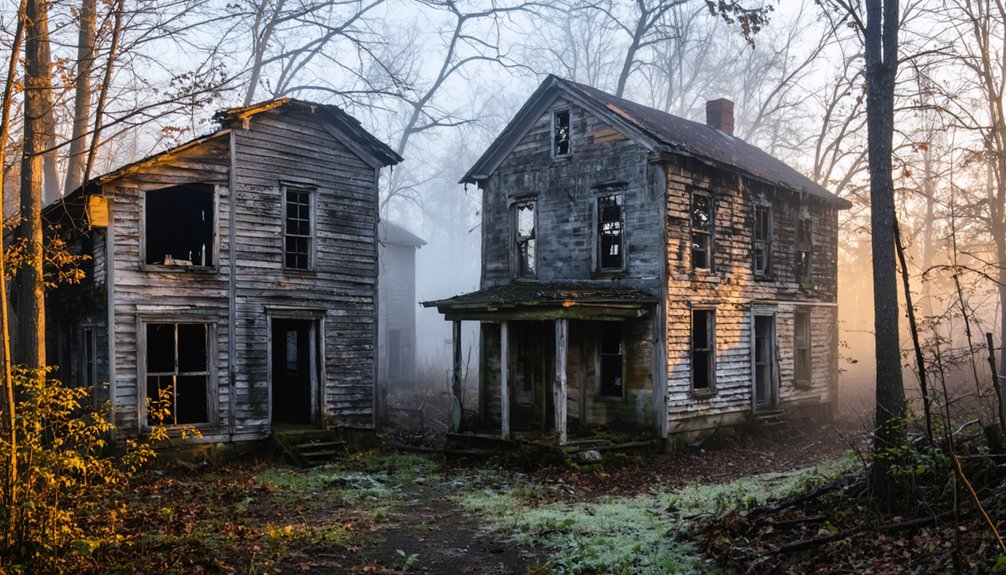
While summer’s oppressive heat drives most Alabama explorers indoors by noon, winter transforms these abandoned settlements into photographer’s paradises. You’ll find ideal conditions during early morning and late afternoon hours when low sun angles cast dramatic shadows across crumbling structures.
Winter’s reduced humidity sharpens your camera’s focus, perfect for winter landscape photography that captures weathered wood and rusted metal in stunning detail.
Plan your arrival for sunrise to catch seasonal birdwatching opportunities—migratory species frequent these quiet spaces undisturbed.
With mild temperatures extending your exploration time and sunsets around 5 PM, you’ve got flexible daylight hours without summer’s brutal constraints.
Pack provisions for remote locations like Manasco, positioned 20+ miles from civilization.
Winter grants you unrestricted access to Alabama’s forgotten places on your terms.
What to Bring for Your Winter Ghost Town Adventures
Alabama’s abandoned settlements demand respect and preparation, especially when winter’s unpredictable weather can shift from mild sunshine to bone-chilling rain within hours. You’ll need the right gear to explore freely without cutting your adventure short.
Your essential pack should include:
- Layered winter clothing – thermal base layers, waterproof jacket, and sturdy boots that grip crumbling foundations and mud-slicked trails
- Safety gear – headlamp with fresh batteries (these structures go dark fast), first-aid kit, and a fully charged phone with offline maps
- Documentation tools – camera, notebook, and water-resistant bag to protect everything from sudden downpours
Don’t forget water and high-energy snacks. These isolated sites offer zero amenities, and you’re completely self-reliant once you venture beyond civilization’s edge.
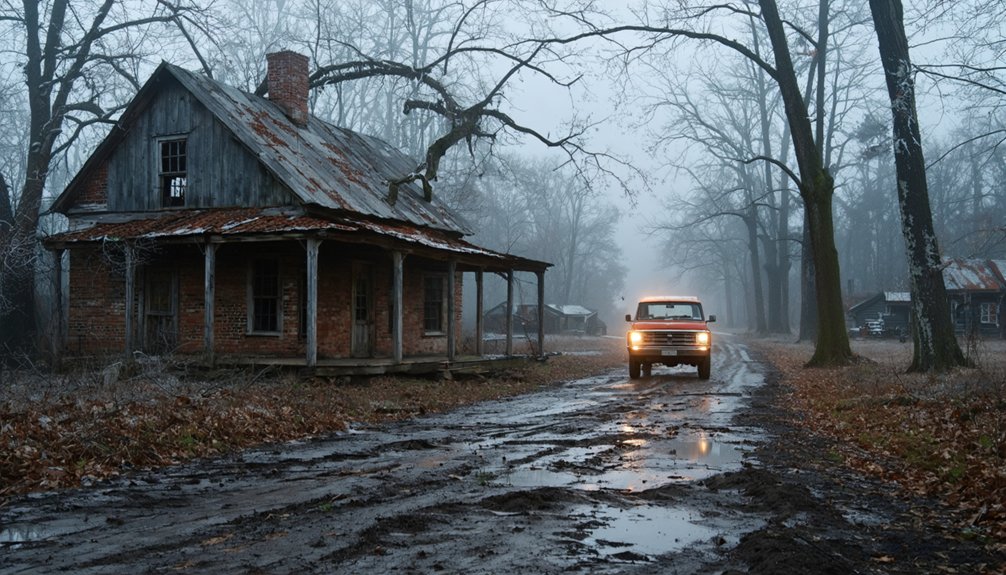
When winter descends on Alabama’s backcountry, the dirt roads and forgotten paths leading to ghost towns transform into treacherous corridors where black ice lurks invisibly on the asphalt.
You’ll find bridges and overpasses freeze first—exactly what you’ll encounter approaching forgotten settlements in northwest Alabama’s remote corners. Understanding winter road hazards means recognizing that wet-looking pavement can betray you instantly, especially during overnight hours when temperatures plummet.
For remote travel safety, ditch cruise control and slow down before curves. Bridges connecting you to abandoned towns become slick sheets when sleet refreezes. Keep headlights on low beam to spot patchy ice without blinding yourself.
Road crews can’t pretreat every forgotten route, so you’re steering solo. Check conditions before departing, pack recovery gear, and remember—these desolate roads won’t forgive mistakes.
Preserving History: Guidelines for Visiting Abandoned Sites
Beyond traversing icy roads to reach these forgotten places, your responsibilities extend to protecting what remains. You’re walking through living museums where safety precautions matter as much as preservation.
Respectful trespassing means leaving no trace—these abandoned structures won’t survive careless visitors.
Follow these essential guidelines:
- Document, don’t disturb: Photograph peeling paint and collapsed rooflines, but leave artifacts untouched for future explorers to discover.
- Watch your step: Test floorboards before committing weight, avoid climbing unstable staircases, and never venture alone into deteriorating buildings.
- Respect boundaries: If gates are locked or “No Trespassing” signs are posted, honor them—your freedom to explore shouldn’t compromise someone’s property rights.
You’re preserving Alabama’s heritage simply by acknowledging these sites exist without accelerating their decay.
Frequently Asked Questions
Are Guided Tours Available at Any Alabama Ghost Towns?
Yes, you’ll find guided tours at Old Cahawba Archaeological Park, Alabama’s abandoned capital. These tours blend haunted legends with preservation efforts, letting you explore deserted streets independently while learning about spectral encounters and the town’s fascinating history.
Can You Camp Overnight Near These Abandoned Town Sites?
You can’t pitch tents at these ghost towns—overnight regulations ban camping directly on sites. However, camping safety improves at nearby state parks 2-10 miles away, where primitive spots let you explore freely while protecting historic ruins from damage.
Which Ghost Towns Have the Most Remaining Structures to Explore?
Winter Place offers you the most exploration potential with its restored South House providing excellent photography opportunities. You’ll find historical preservation efforts showcase authentic Italianate architecture, while Bellefonte’s cemetery and chimney remain accessible for adventurous wanderers seeking Alabama’s past.
Are Any Alabama Ghost Towns Accessible by Public Transportation?
Unfortunately, you’ll need wheels for your adventure—no Alabama ghost towns offer public transit access. These remote sites preserving historic preservation and local legends require driving through rural backcountry, giving you the freedom to explore at your own pace.
Do You Need Permits to Visit These Abandoned Locations?
You won’t need special permits for most ghost towns—just entry fees at places like Spectre ($5). Legal considerations differ by location; preservation efforts mean some sites require guided tours. Always check ownership and respect historical structures before exploring.
References
- https://alabamasfrontporches.org/ghost-tours/
- https://www.youtube.com/watch?v=1Qy5Sq51SbA
- https://familyhistoryfoundation.com/blog/manasco-alabama-one-of-americas-oldest-ghost-towns/
- https://www.getyourguide.com/en-au/alabama-l2364/ghost-vampire-tours-tc23/
- https://www.visittheusa.com/experience/5-us-ghost-towns-you-must-see
- https://www.nps.gov/subjects/abandonedplaces/things-to-do.htm
- https://usghostadventures.com/mobile-ghost-tour/
- https://www.abandonedalabama.com/old-cahawba/
- https://theforgottensouth.com/cahawba-alabama-ghost-town/
- https://amywelborn.wordpress.com/2018/03/02/old-cahawba-alabama/