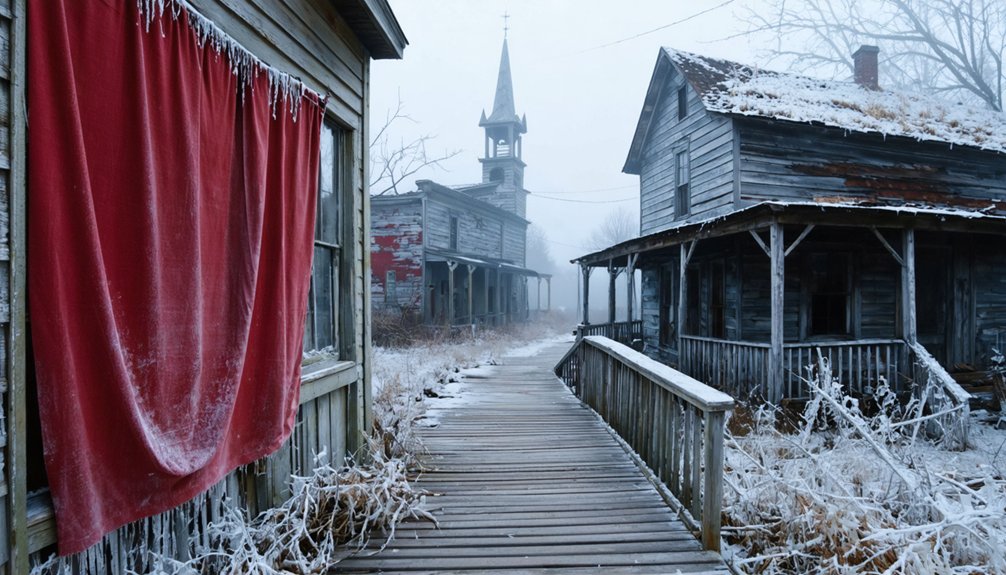
You’ll find Arkansas’s best winter ghost town experiences at Rush, where bare trees reveal zinc mine ruins and a massive 1886 smelter along the Buffalo National River. Calico Rock offers 20 abandoned 1900s buildings still standing amid vine-covered decay, while Monte Ne‘s concrete ruins emerge from beneath Beaver Lake’s winter waters. Don’t miss Booger Hollow‘s quirky two-story outhouse and Eros’s utopian settlement remnants hidden in Marion County forests. Winter’s stripped landscapes expose foundations, mining equipment, and architectural details that summer’s thick foliage conceals, making your exploration far more rewarding.
Key Takeaways
- Rush Ghost Town offers interpretive trails through visible mining ruins, foundations, and a historic smelter along Buffalo National River.
- Calico Rock features twenty abandoned 1900s buildings with walking tours highlighting frontier history and architectural decay along Walnut Street.
- Monte Ne’s submerged ruins beneath Beaver Lake become visible in winter, including Oklahoma Row’s concrete skeleton and amphitheater foundations.
- Booger Hollow Outpost atop Pope County mountain preserves roadside Americana with its abandoned trading post and iconic two-story outhouse.
- Winter conditions enhance visibility of ghost town structures as leafless trees expose foundations, mining equipment, and historic architectural remains.
Rush Ghost Town
Tucked into a remote Ozark valley along the Buffalo National River, Rush Ghost Town stands as the only authentic ghost town between the Mississippi River and the Rocky Mountains. You’ll explore remnants of Arkansas’s zinc mining boom that peaked during World War I when 2,000-5,000 people called this place home.
Rush Ghost Town: the only genuine ghost town between the Mississippi and Rockies, where 5,000 zinc miners once thrived.
The Morning Star Mining Company once produced a 13,000-pound zinc specimen displayed at the 1893 Chicago World’s Fair. The town’s prosperity was such that Rush was recognized as the most prosperous city per capita in Arkansas during its early mining years.
Winter transforms this wildlife habitat into your personal time capsule. Snow reveals mining structures and foundations hidden by summer foliage, while preservation efforts by the National Park Service maintain authentic log cabins, the blacksmith shop, and sealed mine entrances. The original 1886 smelter still stands as a historical relic, reminding visitors of the town’s earliest mining attempts.
Three hiking trails wind through the historic district, letting you discover this federal ghost town without crowds—just deer, turkeys, and echoes of 1880s prosperity.
Calico Rock
Along the White River’s eastern bank, Calico Rock presents a unique anomaly in American ghost towns—abandoned 1900s buildings stand within the boundaries of a living, modern community.
You’ll discover roughly 20 structures from its boomtown days, including the notorious “Peppersauce Alley” where bootleggers once sold moonshine behind Main Street taverns.
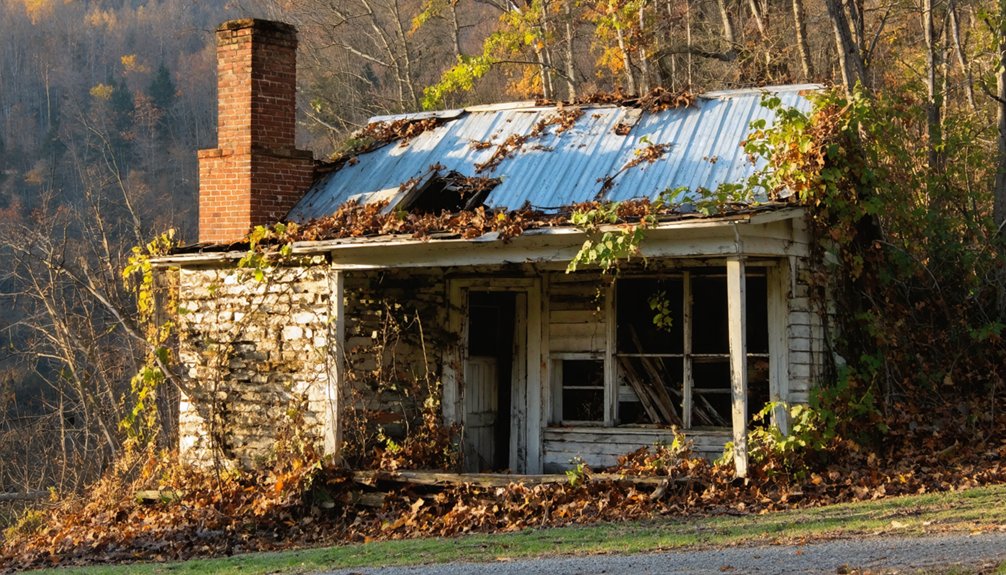
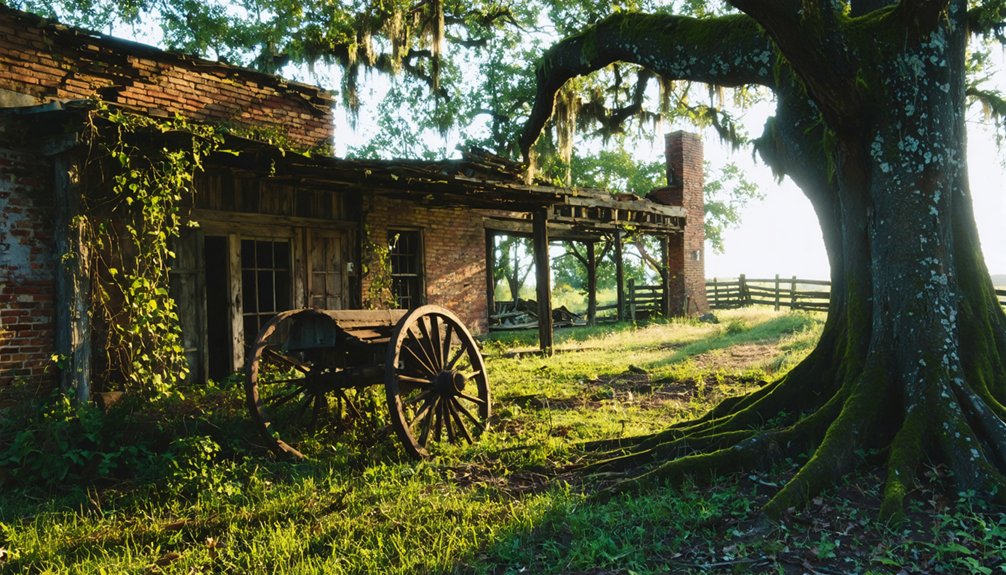
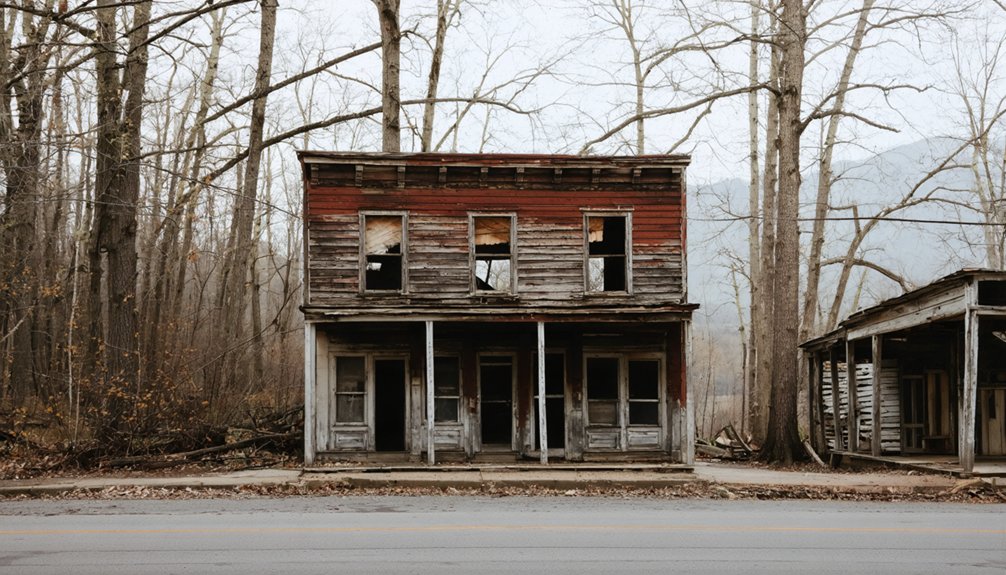
Winter’s bare branches reveal architectural decay: vine-covered walls, collapsed roofs, and empty storefronts along Walnut Street.
The town’s preservation efforts since 2007 have created marked walking tours through this authentic frontier settlement.
You can explore the old cement jail’s interior, where lawmen once locked up rowdy residents.
The railroad’s arrival in 1903 transformed the settlement into a prosperous hub for zinc, timber, and cotton trade before its eventual decline.
Cross Calico Creek via the trestle bridge built in 1941 by local workers to access the heart of the ghost town.
While haunted legends swirl around these deteriorating buildings, the real ghost stories come from violent knife fights and gun battles that earned Calico Rock its wild reputation.
Monte Ne
Beneath Beaver Lake’s surface lies Monte Ne, William Hope “Coin” Harvey’s audacious vision of a health resort and planned community that once sprawled across Arkansas’s Ozark hills. Founded in 1900, this ambitious destination featured grand log hotels, miles of private railway, and Oklahoma Row’s elegant ballrooms before bankruptcy claimed it in the 1930s. The community hosted Arkansas’s only presidential convention, cementing its place in the state’s political history.
Winter’s low water levels reveal what summer conceals:
- Oklahoma Row’s concrete skeleton – one of Arkansas’s earliest multi-story concrete structures, standing defiantly above normal lake levels
- The amphitheater foundation – Harvey’s unfinished pyramid monument to civilization
- Hotel ruins and Missouri Row remnants – ghostly testimony to ecological recovery reclaiming human ambition
Added to the National Register in 1978, Monte Ne represents historical preservation meeting nature’s inevitability. The resort operated until the mid-1930s before the Great Depression sealed its fate as a failed planned community.
Booger Hollow Outpost
Unlike Monte Ne’s submersion beneath water, Booger Hollow Outpost sits high atop a Pope County mountain along Scenic Highway 7, where it’s been collecting dust and decay since 2004. This quirky trading post capitalized on local legends about haunted Bull Frog Valley ten miles south, where two cemeteries spawned tales of “boogers”—Ozark speak for ghosts and hobgoblins.
For over 40 years, travelers stopped for hillbilly knick-knacks, boogerburgers, and photo ops at the iconic two-story outhouse.
That upper level stayed perpetually closed with a hand-painted sign: “upstairs closed til we figure out plummin’.”
Now nature’s reclaiming these empty buildings, transforming this once-thriving stop into authentic roadside Americana. Inside, abandoned Christmas garlands and Chicago Bears glasses remain scattered among the wreckage. The name “Booger” traces back to the old Welsh word “Bwg,” meaning to scare.
The population sign still stands: “Population 7…countin’ one coon dog.”
Zinc
You’ll discover Rush’s dramatic mining legacy as you hike through winter-bare ruins where zinc ore once fueled four separate boom periods between 1885 and 1931.
The cold season offers the clearest views of crumbling processing mills, mine entrances, and stone foundations before nature’s spring growth reclaims them. Winter’s stark landscape reveals how quickly the Ozark wilderness consumed this once-thriving community of 5,000 residents after the Morning Star Mine closed in 1930. The mine’s impressive productivity once generated $500-$1,000 daily in net profits by 1898, when it produced four tons of zinc ore each day.
Today, the National Park Service manages the entire 1,300-acre historic district as part of Buffalo National River, preserving the mines, buildings, and structures for exploration via walking trails and driving tours with interpretive signs.
Mining Boom and Bust
During the 1880s, prospectors John Wolfer, Bob Setzer, and J.H. McDabe mistook zinc for silver along Rush Creek, launching an accidental mining empire. Their 1887 smelter test revealed the truth through brilliant green fumes and rainbows—no silver, just pure zinc.
This mining history transformed into fortune when the Morning Star Mine became Arkansas’s zinc powerhouse.
Rush’s Rise and Fall:
- Wartime Peak: Population exploded to 5,000 residents with 13 operating mines during World War I.
- Prize Specimens: A massive 13,000-pound smithsonite nugget claimed blue ribbons at world’s fairs.
- Swift Collapse: Zinc prices crashed after 1918, sending miners fleeing and leaving these historic landmarks abandoned by 1972.
You’ll find freedom exploring where families once toiled for 19 cents hourly, now reclaimed by wilderness.
Winter Hiking Through Ruins
When winter strips away the forest canopy, Rush’s abandoned mining district reveals itself with startling clarity along 3.6 miles of the Morning Star Loop trail. You’ll encounter thirteen caged mine entrances, blacksmith shops from the 1920s, and log cabins crumbling into their stone foundations—remnants of a zinc boom that peaked during World War I.
The National Park Service’s historic preservation efforts maintain interpretive signs throughout the 1,300-acre site while leaving structures in their natural state of urban decay. Rocky terrain and elevation changes demand sturdy boots, but moderately challenging trails reward you with ore mills, derelict mining equipment, and a century-old cemetery.
Rush Mountain’s 3.4-mile loop offers steeper, unmaintained sections for those seeking solitude among the ruins.
Natural Reclamation of Site
Nature has steadily erased Rush’s industrial past since the last residents departed in the 1960s. You’ll witness the remarkable transformation as forests reclaim zinc mining operations that once dominated these hillsides.
The flora diversity now thriving among rusted equipment and collapsed structures creates haunting beauty—native hardwoods, cedars, and wild grapevines weave through abandoned buildings.
Winter reveals this reclamation most dramatically:
- Exposed foundations become visible through leafless vegetation, showing nature’s architectural takeover.
- Wildlife sightings increase as deer, wild turkey, and foxes explore former mining corridors without summer crowds.
- Moss-covered machinery illustrates decades of biological succession transforming industrial metal into organic sculpture.
You’re exploring a living lesson in nature’s persistence, where wilderness steadily reclaims human ambition.
Eros
Hidden within Marion County’s forests, Eros stands as a fascinating remnant of an idealistic dream that briefly flourished before fading into obscurity. You’ll discover a town that once boasted three hotels, multiple churches, and the parish’s first high school serving over 600 students.
Christian utopians founded this settlement on shared-property principles, creating a thriving community with newspapers, doctors, and even a hippodrome-style movie theater.
A devastating 1920 tornado leveled most buildings, though remarkably caused no fatalities. The final blow came in 1926 when fire permanently closed the Tremont Lumber mill.
Today, you’re free to explore old buildings, a cemetery, and remnants where historical preservation efforts haven’t reached. Some explorers report underground tunnels, adding intrigue to your winter adventure just northeast of Harrison.
Planning Your Winter Ghost Town Adventure
Before you set off to explore Arkansas’s abandoned settlements, proper winter preparation separates an enriching historical adventure from a dangerous ordeal. You’ll need strategic planning to navigate these remote locations safely while respecting historical preservation.
Essential Winter Ghost Town Preparations:
- Check road conditions through ARDOT before departure, as Highway 7 and unpaved Buffalo National River routes close after heavy snow or ice storms.
- Pack layered clothing and emergency supplies including thermal base layers, waterproof boots, offline maps, and blankets—cell service vanishes in rural Ozarks.
- Respect safety boundaries around unstable mines and decaying structures. Distance viewing protects both you and fragile ruins.
Seasonal wildlife such as active snakes and foraging bears also necessitate caution to prevent dangerous encounters.
Verify public access beforehand, especially around privately-owned sites like Daleville.
Frequently Asked Questions
Are These Ghost Towns Safe to Visit Alone in Winter?
You’ll find excellent winter safety conditions for solo exploration at these Arkansas ghost towns. They’re accessible via maintained roads, feature stable structures, and aren’t isolated—giving you freedom to wander independently without significant risks during colder months.
Do I Need Special Permits to Explore Ghost Town Sites?
You’re in the clear—no special permits needed for casual exploration. However, history preservation means access restrictions apply: you can’t enter buildings at Rush, but you’re free to roam designated trails and photograph from outside.
Are There Guided Tours Available for Arkansas Ghost Towns?
Yes, you’ll find guided tours in Eureka Springs that explore historic preservation sites and local legends. These walking and vehicle tours let you experience Arkansas’s haunted locations with knowledgeable guides who share paranormal history and ghost-hunting opportunities.
What Wildlife Might I Encounter During Winter Ghost Town Visits?
Like nature’s time capsule opening, you’ll encounter winter birding opportunities with migratory waterfowl, active opossums foraging nocturnally, and occasional snakes during warm spells. Wildlife observation includes ticks in leaf litter, so remain vigilant while exploring freely.
Can I Camp Overnight Near These Ghost Town Locations?
You’ll find overnight camping only at Rush Ghost Town’s campground with twelve sites. Other locations lack facilities, so you’ll need nearby state parks. Explore local legends and historical preservation during day visits, then camp elsewhere.
References
- https://myfamilytravels.com/arkansas-ozark-towns-that-feel-like-winter-retreats/
- https://www.youtube.com/watch?v=UfdQHTkBTpc
- https://arkansasfrontier.com/ghost-towns-in-arkansas/303766/
- https://www.visiteurekasprings.com/year-round-eureka/
- https://onlyinark.com/places-and-travel/rush-arkansas-ghost-town/
- https://onlyinark.com/places-and-travel/thriller-thursday-calico-rock-ghost-town/
- https://aymag.com/arkansas-backstories-ghost-towns/
- https://www.tripadvisor.com/Attractions-g28925-Activities-c47-t14-Arkansas.html
- https://encyclopediaofarkansas.net/entries/rush-ghost-town-marion-county-1270/
- https://www.barefoottraveler.com/rush.html