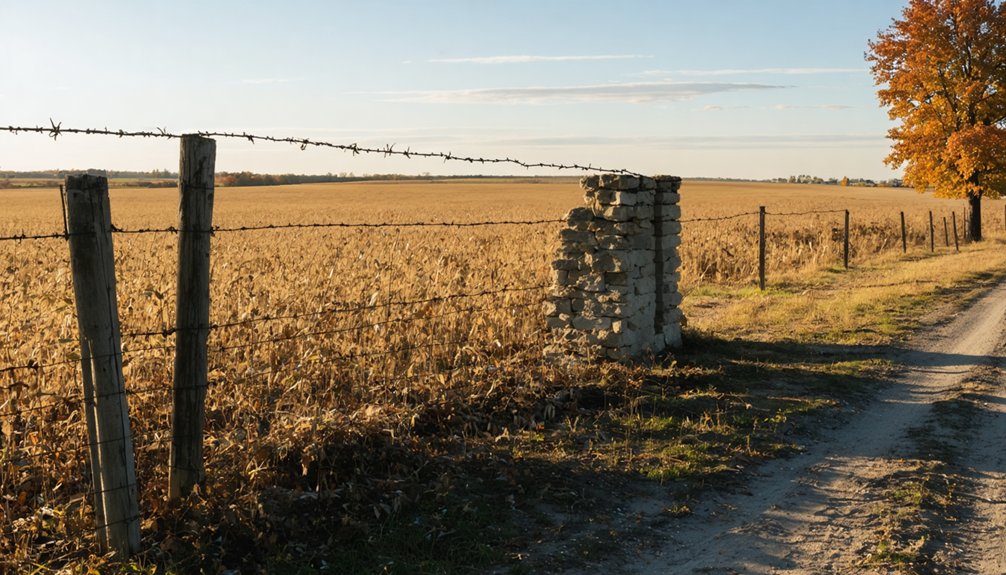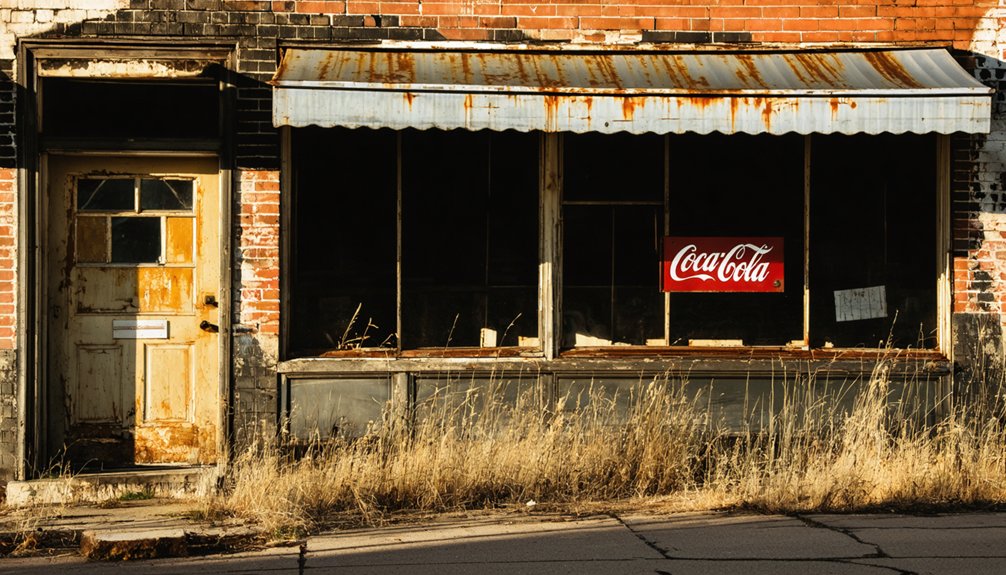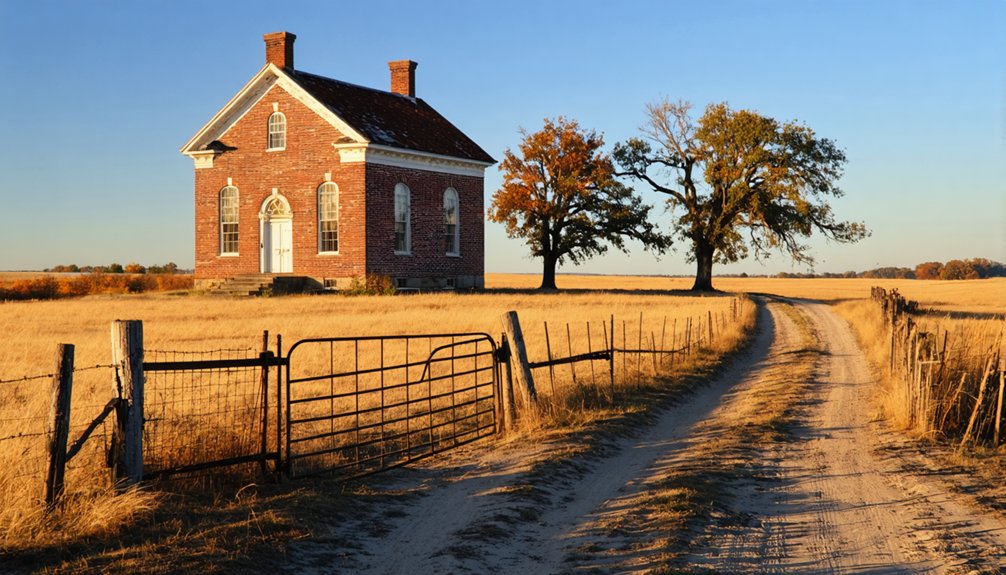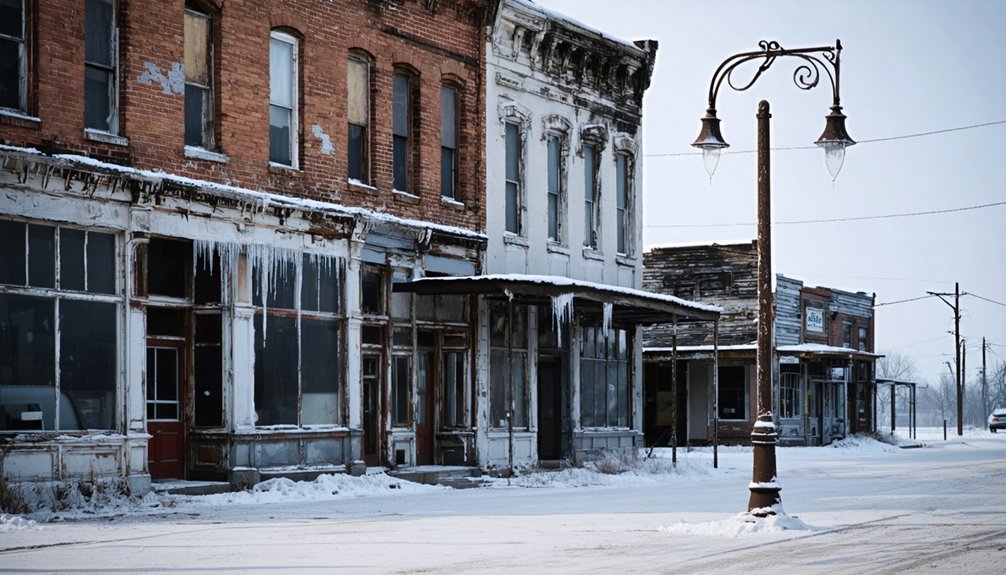
You’ll find Illinois’ most haunting ghost towns become eerily photogenic in winter, when snow outlines Cairo’s abandoned Victorian storefronts near the Mississippi confluence, frost crystallizes on Old Shawneetown’s 1839 Greek Revival bank, and bare trees expose Benld’s subsidence craters from collapsed coal mines. The frozen landscape reveals Buda’s railroad foundations and Delevan’s protected Italianate facades with stark clarity, while winter’s emptiness amplifies the atmosphere at Spoon River Village’s 1838 settlement site—each location offering distinct architectural remnants and historical narratives worth exploring further.
Key Takeaways
- Cairo features crumbling Victorian buildings, underground tunnels, and the fire-gutted Gem Theater along the confluence of two rivers.
- Old Shawneetown showcases the 1816 Bank of Illinois, Federal Land Office District, and ancient Albany Indian Mounds with burial sites.
- Buda offers depot foundations, old roundhouse remnants, and historic downtown buildings dating to 1854 along a winter driving route.
- Delevan maintains active storefronts with protected Italianate facades, Native American burial mounds, and a grain elevator despite ghost town status.
- Winter tours begin at Buda on Route 34, passing through frozen farmland, bare cottonwoods, and ghosted storefronts of railway towns.
Cairo: A Living Ghost Town in Southern Illinois
When you arrive in Cairo, Illinois, the eerie silence speaks volumes about a town that once commanded the confluence of two mighty rivers. You’ll discover crumbling storefronts and empty streets where 15,000 residents once thrived in the 1920s.
The urban decay tells stories of a steamboat hub that fell victim to flooding, racial tensions, and economic collapse. Walk past weathered Victorian buildings and imagine Grant’s Fort Defiance controlling these strategic waters. The architectural remnants include Magnolia Manor, a museum operated by the Cairo Historical Association since 1952, showcasing the city’s prosperous past among its magnolia trees.
Today’s population of 2,000 inhabits what remains of John G. Comegys’s 1817 vision. Despite neglect, historic preservation efforts spotlight remnants of the Illinois Central Railroad era and underground tunnels that once sheltered fugitive slaves, offering you glimpses into America’s complex past. The once-magnificent Gem Theater, built in 1910 and capable of seating nearly 700 patrons, now stands gutted by fire—a symbol of the town’s faded grandeur.
Old Shawneetown: Remnants of Illinois’ First Banking Hub
Winter reveals Old Shawneetown’s haunting beauty through:
- The 1816 Bank of Illinois Building – limestone portico and iron vault preserved within deteriorating brick walls
- Abandoned Federal Land Office District – where pioneers claimed territory along the Goshen Road
- Flood-Scarred Structures – silent witnesses to the 1937 deluge that sealed the town’s fate
The building’s closed to regular tours, but you’re free to explore the exterior and imagine fortunes won and lost. The Greek Revival structure, built between 1839 and 1840 at a cost of $80,000, stands as a monument to the town’s brief prosperity as Illinois Territory’s commercial gateway. Just north on Route 84, the Albany Indian Mounds contain evidence of over 10,000 years of human occupation, with at least 39 burial mounds from the Middle Woodland period still preserved across the restored prairie landscape.
Benld: Coal Mining Heritage in Macoupin County
You’ll find Benld’s coal mining legacy etched into every subsiding foundation and boarded storefront, where European immigrants once poured from seventeen nations to work the underground veins beneath Macoupin County. The town that boomed around Superior Coal Company’s Mine No. 3 now wrestles with the ghosts of its extraction economy—entire buildings have crumbled into the honeycomb of abandoned shafts below, including a multi-million-dollar school that simply sank into the earth. Miners descended over 200 feet deep in open-sided cage elevators to reach the coal seams that fueled this community’s rise and eventual decline. Less than a mile northeast, a structure disguised as a coal tipple once operated as Al Capone’s bootleg distillery, producing an estimated 2,000 gallons of illegal alcohol daily during Prohibition.
Beyond the mining ruins, you can explore an unexpected claim to fame: the site where one of America’s most significant meteorites struck, adding cosmic drama to this fading industrial landscape.
Historic Mining Town Decline
Established in 1904 to exploit Macoupin County’s rich coal seams, Benld rose from the prairie as European immigrants—Italians, Croats, Russians, and Scots—descended into the earth to fuel America’s industrial engine.
The Great Depression shuttered the mines, leaving behind a haunting legacy you’ll witness today.
Signs of Decline You’ll Encounter:
- Subsidence craters where poorly reinforced tunnels collapsed beneath homes—so severe that properties now require subsidence insurance.
- The elementary school ruins from 2009, a multi-million-dollar building that sank into abandoned shafts and was ultimately demolished.
- Abandoned mine ponds near the Little Dog Mine, now eerie fishing holes where catfish glide above flooded galleries.
The population plummeted to 1,464 by 2020.
Mining accidents and unstable ground transformed this once-thriving community into Illinois’s most dramatic coal country ghost town.
Yet remnants of the immigrant past endure in Italian street names like Saracco Drive and the ornate Holy Dormition of the Theotokos Orthodox Church, silent witnesses to the community that once thrived here. Benld’s cultural identity was shaped by wine and pasta traditions brought by Italian immigrants who established the town’s distinctive character among Macoupin County’s mining villages.
Famous Meteorite Strike Display
While Benld’s underground instability may have doomed its earthly infrastructure, the town achieved an improbable claim to fame when the cosmos quite literally crashed into it.
On September 29, 1938, a meteorite tore through Edward McCain’s garage roof, punched through his Pontiac, and ricocheted off the muffler—all while he was safely elsewhere.
Scientists drove 200 miles from Chicago for meteorite research, determining this H6 chondrite’s trajectory pointed toward Merak in the Big Dipper. The 4-pound meteorite revealed chondrules—molten silicate mineral drops from early solar system formation—when a piece broke off its black, fused exterior.
No witnesses reported seeing a fireball during the fall, though some observers mistook the sound of the meteorite’s entry for an aircraft engine.
You’ll find the meteorite, punctured seat, and damaged muffler at Chicago’s Field Museum today, where they’ve captivated visitors for decades.
It’s a tangible fragment of cosmic history—4.5 billion years old—connecting this fading mining town to the ancient asteroid belt.
Buda: Railroad Town With Hungarian Roots
You’ll find Buda’s authentic railroad depot standing as a weathered sentinel to its Hungarian-named past, its wooden platform still echoing with phantom whistles from the Chicago, Burlington & Quincy line that birthed this town in 1854.
The winter drive through Bureau County rewards you with stark, honest views of boarded storefronts and the old roundhouse foundations—remnants of when 1,500 souls called this place home.
Pack a thermos and cruise the quiet streets where knowledgeable locals still preserve stories of George Chalender’s engine works and the wheat-laden glory days that faded into this “living ghost town” of fewer than 550 residents.
Historic Railroad Depot Remains
Tucked into Bureau County’s windswept prairie, eighty-five miles southwest of Rockford, Buda emerged in 1854 as a railroad junction destined to outlive its own prosperity.
You’ll discover remnants of railway history where the CB&Q mainline once crossed the C&NW at Buda Tower—an intersection that defined this settlement’s golden era.
The depot preservation story reveals architectural evolution through satellite imagery and 1941 aerials:
- Original wood frame depot served passengers along the Burlington mainline between Princeton and Kewanee around 1910.
- Stucco replacement structure modernized operations before recent demolition.
- Rare roundhouse facility distinguished Buda from typical small-town stops, supporting extensive rail yards visible in historical photographs.
Today’s winter landscape exposes foundation traces and track beds—ghostly signatures of infrastructure that once employed hundreds.
Winter Driving Tour Route
The gravel crunches beneath your tires as you leave the depot foundations behind and trace Illinois Route 34 westward through frozen farmland toward Buda’s historic downtown—a fifteen-minute journey that compresses 170 years of Hungarian-American heritage into three square blocks.
Winter scenery transforms the landscape into stark beauty: bare cottonwoods frame whitewashed fields where 990 souls once thrived in 1890. You’ll pass shuttered storefronts where Judge Emmerson and W.H. Bloom opened competing mercantiles in 1854, their wooden facades ghosting the railroad prosperity that’s long departed.
The rural charm persists in Concord Township‘s quiet streets, where Kossuth’s exile-inspired namesake now shelters just enough residents to keep the post office open. Park anywhere—freedom’s the only traffic you’ll encounter here.
Delevan: The Town That Vanished Completely
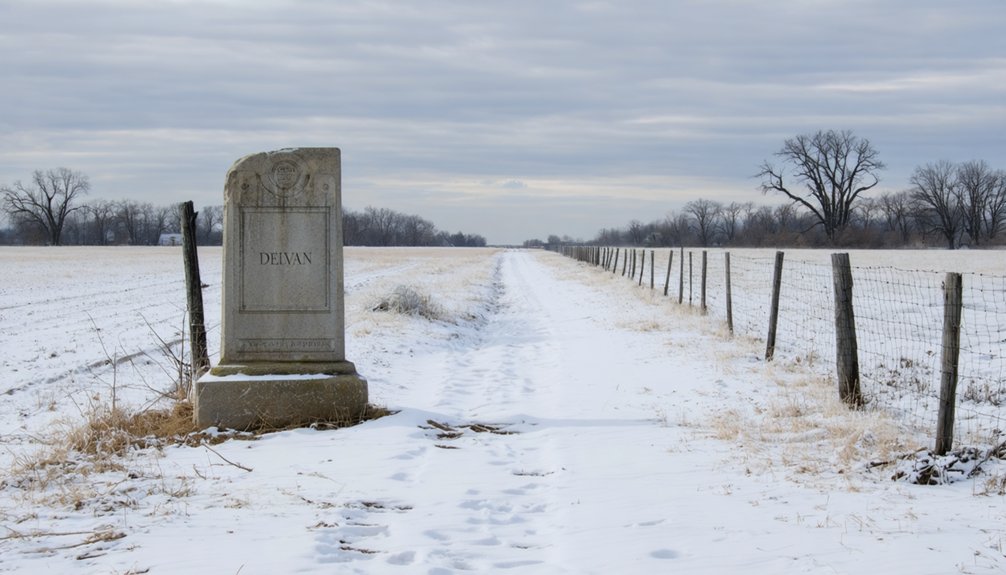
Unlike most ghost towns that fade gradually, Delevan presents a puzzling contradiction—historical records describe a vanished settlement, yet drive down its tree-named streets today and you’ll find preserved Italianate storefronts humming with activity.
Delevan defies categorization—simultaneously a documented ghost town and a thriving community with active storefronts lining its tree-named streets.
Here’s what makes this place intriguing for prospecting tips:
- Telegraph Mystery: Four months after installation, someone ripped out every wire and removed the poles—effectively cutting the town off from progress.
- Abandoned Transportation: The stage line vanished, forcing residents to trek to Pekin or Atlanta for shipping after 1852.
- Historical Preservation: Despite its “ghost town” status, the National Register protects those Italianate facades on Locust Street.
You’ll find three remaining Native American burial mounds and that distinctive grain elevator dominating the south side—tangible evidence of competing timelines.
Spoon River Village: Isabel Township’s Earliest Settlement
Before Illinois became a state in 1818, settlers had already begun carving homesteads along the Spoon River’s fertile banks—and by 1821, these scattered pioneers coalesced into what would become Isabel Township’s first organized settlement.
You’ll find traces of this early settlement near where Hiram Wentworth once platted streets and lots in 1838, establishing Fulton County’s oldest village. The post office operated briefly until 1847, serving pioneers who’d staked their claims to freedom along the river.
Today, nothing remains but the ghost town history embedded in winter-bare landscapes. Walking these grounds, you’re tracing paths where Isabel Township’s original 175 souls sought independence from eastern constraints, building icehouse foundations that crumbled as neighboring Tuscumbia drew settlers away.
Planning Your Winter Ghost Town Adventure
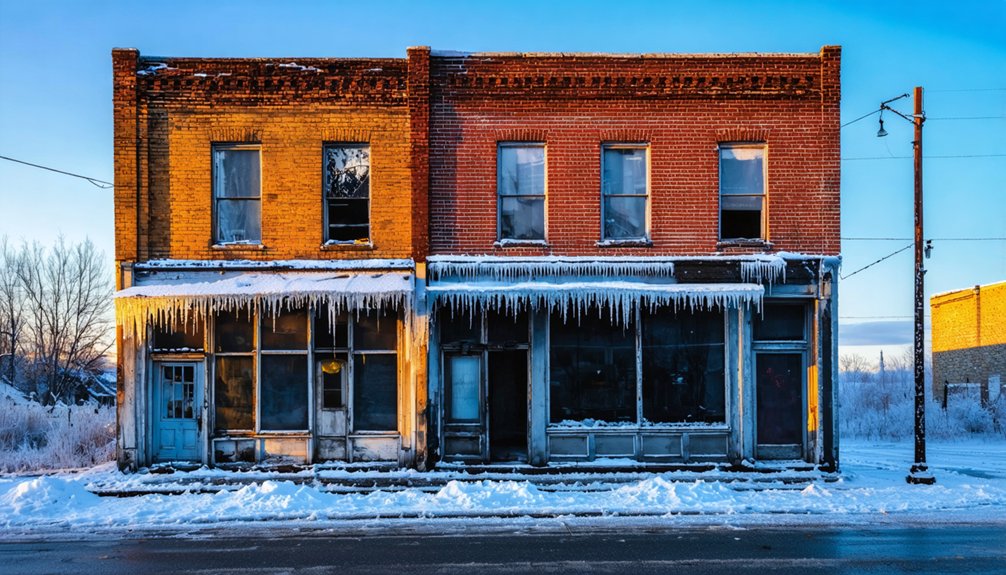
When frost glazes abandoned storefronts and winter silence settles over forgotten streets, Illinois’s ghost towns reveal their most atmospheric selves—but successful exploration demands careful planning around shortened daylight and unpredictable Midwest weather.
Essential winter preparation:
- Book guided paranormal investigations like Alton’s Dinner and Spirits Tours or Aurora’s Ghost Walk with EMF meters, available on select winter dates when urban legends come alive after dark.
- Secure riverside lodging at Pere Marquette Lodge’s stone-fireplace Great Room or Mineral Springs Hotel, your base for ghost hunt departures and protection from bluff winds.
- Monitor river road conditions along Mississippi routes where icy surfaces meet boarded-up buildings in towns like Benld, and Cairo’s decline demands heightened local awareness.
Private tours operate year-round for those seeking solitary encounters.
What to Bring for Cold Weather Exploration
Your boots crunch through snow-crusted gravel as you step toward Cairo’s abandoned customs house, where January winds whip off the frozen confluence and penetrate every gap in inadequate clothing. Layer synthetic base layers beneath fleece mid-layers and a waterproof shell jacket—cotton becomes your enemy when temperatures plummet.
Pack insulated 400g boots, wool socks, and microspikes for icy boardwalks in forgotten settlements.
You’ll need waterproof gloves, a warm hat covering your ears, and a neck gaiter when winds bite harder.
Bring trekking poles for stability on uneven terrain, perfect for winter camping excursions or wildlife photography sessions.
Your pack should include emergency fire starters, extra high-calorie snacks, and an insulated water bottle.
Navigation tools—map, compass, headlamp with lithium batteries—ensure you’ll always find your way back.
Frequently Asked Questions
Are These Ghost Towns Safe to Visit Alone During Winter Months?
Like a lone wolf venturing into uncertain territory, you’ll face real dangers exploring these sites solo in winter. Safety precautions are essential—trespassing laws, crumbling structures, and icy trails limit seasonal accessibility. You’re risking legal trouble and injury without companions.
Do Any Illinois Ghost Towns Offer Guided Tours in Winter?
You’ll find Galena’s ghost tours running year-round through Victorian streets. Their historical preservation guarantees winter weather readiness, letting you explore haunted buildings freely. Tours operate Fridays and Saturdays, with indoor options when temperatures drop too low.
Can I Legally Enter Abandoned Buildings in These Ghost Towns?
No, you can’t legally enter without permission. Property ownership remains intact despite abandonment, and trespassing regulations apply strictly. You’ll face fines up to $2,500 or jail time. Always secure explicit consent before exploring these crumbling, frost-kissed ruins.
Are There Hotels or Lodging Options Near These Ghost Town Locations?
You’ll find cozy lodging near each ghost town—Grafton’s riverside inns offer stunning winter photography opportunities at historic landmarks, while Cairo and Old Shawneetown require advance planning, with motels scattered along remote highways serving your adventurous spirit.
Which Ghost Town Requires the Shortest Driving Distance From Chicago?
Buda’s your closest destination at 45-50 miles southwest, offering accessible urban exploration of its standing railroad depot. You’ll find historic preservation efforts maintaining this living ghost town’s authentic character without lengthy travel from Chicago’s bustling streets.
References
- https://www.riversandroutes.com/blog/winter-fun-in-southwest-illinois/
- https://www.enjoyillinois.com/plan-your-trip/road-trip-itineraries/haunting-season-in-illinois/
- http://cantontornado36.blogspot.com/2017/04/ghost-towns-of-fulton-county-illinois.html
- https://www.youtube.com/watch?v=gM3ZIgtFzBk
- https://www.onlyinyourstate.com/experiences/illinois/creepy-ghost-towns-il
- https://www.atlasobscura.com/things-to-do/illinois/abandoned
- https://www.sublunarphoto.com/ghost-town-cairo-illinois
- https://www.legendsofamerica.com/il-cairo/
- https://allthatsinteresting.com/cairo-illinois
- https://www.numismaticnews.net/paper-money/the-history-rich-ghost-town-of-cairo-ill