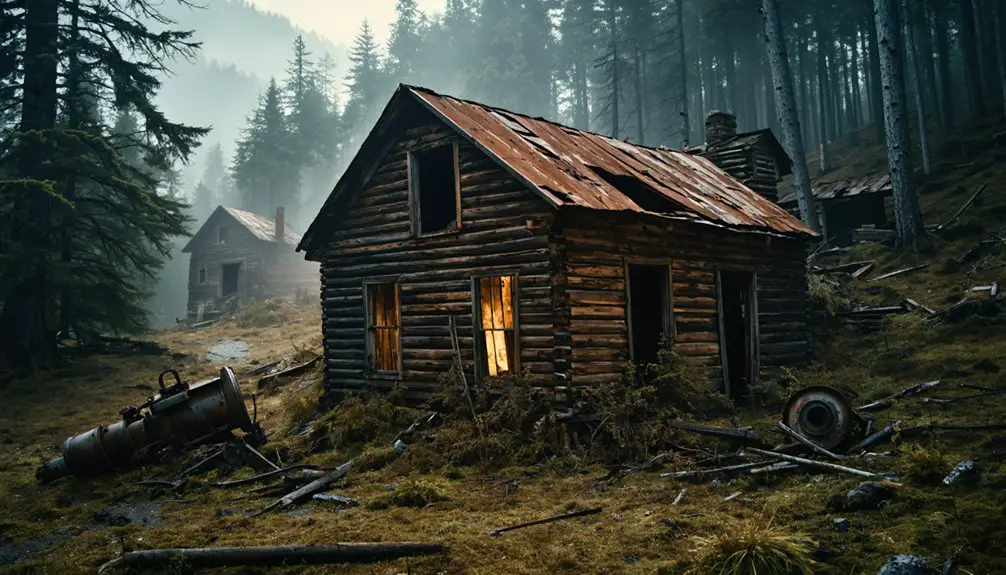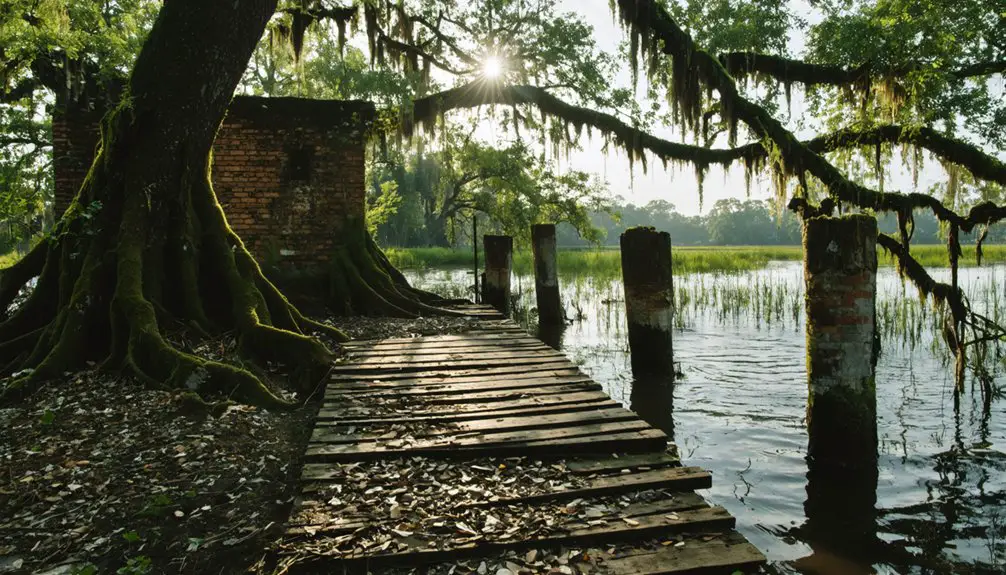
You’ll find Maryland’s most hauntingly beautiful ghost towns come alive in winter when bare branches expose Daniels’ crumbling stone foundations along the Patapsco River and Snow Hill’s 1835 inn where doors lock themselves. Frostburg transforms into a winter wonderland at 2,300 feet elevation, while Rose Hill Cemetery’s 43,000 graves reveal shadowy figures on foggy mornings. The C&O Canal Towpath harbors Civil War spirits, and Furnace Town’s 19th-century ruins take on an otherworldly quality beneath December’s stark light, with each location offering its own chilling secrets waiting to be discovered.
Key Takeaways
- Daniels Ghost Town offers a 2.5-mile winter hike along the Patapsco River to explore mill ruins, stone foundations, and historic church remains.
- Snow Hill features haunted 18th-century architecture, including the 1835 Snow Hill Inn with documented paranormal activity and Eastern Shore heritage.
- Frostburg transforms into a winter wonderland with scenic railroad tours, the Baldwin 1309 steam locomotive, and festivals at 2,300 feet elevation.
- Four Locks Ghost Town along the C&O Canal displays atmospheric ruins from an abandoned settlement, enhanced by winter light and towpath access.
- Furnace Town preserves a 19th-century iron-smelting village with winter-shadowed ruins, bare trees, and documented folklore spanning multiple centuries.
Daniels Ghost Town: A Flooded Mill Town Frozen in Time
Nestled along the Patapsco River’s winding banks, Daniels Ghost Town sits frozen in a moment that time forgot—a mill village where stone foundations peek through winter-bare trees and church ruins stand sentinel over graves that predate the Civil War.
You’ll discover Saint Stanislaus Kostka’s skeletal remains dominating the landscape, while 1950s-era vehicles rust quietly in nearby ravines where Tropical Storm Agnes deposited them in 1972.
Winter transforms this urban exploration destination into something ethereal.
The 2.5-mile hike along Old Alberton Road offers unobstructed views through leafless canopy, revealing architectural details hidden during warmer months.
Park at 8106 Alberton Rd in Windsor Mill—arrive early on weekends—and you’ll experience historic preservation through nature’s lens, where approximately 90 families once thrived before the mill’s 1960s closure sealed Daniels’ fate. Originally known as Elysville in the 1820s, this settlement earned recognition as a Travelers’ Choice destination, ranking #8 among Ellicott City attractions with its compelling blend of scenic river vistas and architectural remnants. Your journey concludes at Daniels Dam, where the historic train bridge frames the river’s final passage through this forgotten settlement.
Snow Hill’s Haunted Heritage and Spectral Stories
Where Maryland’s Eastern Shore stretches into Worcester County, Snow Hill preserves secrets darker than its winter shadows. You’ll discover haunted architecture at the Snow Hill Inn, where pharmacology student William Aydelotte’s spirit reportedly lingers after his mysterious 1904 death in Baltimore.
The spectral legends surrounding “J.J.” include:
- Doors locking and releasing without explanation
- Fire alarms triggering spontaneously throughout empty rooms
- Candles extinguishing while fireplaces ignite independently
- Apparitions materializing in mirrors and shaking occupied beds
National Geographic documented this 1835 building’s paranormal activity, making it the Eastern Shore’s only televised haunted site.
You’re free to explore the town’s historic district, established in 2002, where eighteenth-century structures stand alongside this vacant inn. The building originally served as Levin Townsend’s residence and functioned as both a post office and doctor’s residence before its conversion to commercial use. Dr. John S. Aydelotte occupied the property in the 1870s, establishing his medical practice within these walls.
Winter’s silence amplifies the unsettling atmosphere—locals and investigators witnessed phenomena across decades.
Frostburg: a Winter Wonderland With Historic Charm
Rising from Maryland’s Allegany Plateau at 2,300 feet elevation, Frostburg transforms into an enchanted railway destination each December. You’ll pedal through darkness on Christmas Light railbikes, passing over 100 illuminated features departing from the historic depot.
The Western Maryland Scenic Railroad‘s Christmas City Express offers scenic railrides with Baldwin 1309—the country’s largest operating steam locomotive—climbing nearly 1,000 feet through the 916-foot Brush Tunnel. The Mountain Ridge Rider tour spans 15+ miles of mostly downhill terrain through the scenic Allegheny Mountains, suitable for all ages year-round.
Winter festivals peak during Storybook Holiday on December 2nd, featuring elf breakfasts and parades downtown. Between adventures, you’ll explore the Thrasher Carriage Museum’s Vanderbilt sleighs and Teddy Roosevelt’s inauguration coach. The Annie Moses Band delivers Christmas classics and carols on December 27th at Lane University Center, adding festive musical tradition to your winter visit.
Strap on snowshoes from Wheelzup Adventures to tackle the groomed Great Allegheny Passage, or venture into Savage River State Forest‘s backcountry trails where freedom meets frontier history.
Rose Hill Cemetery: Where 19th-Century Spirits Roam
You’ll find Maryland’s oldest public cemetery sprawling across 102 acres of Wroe’s Hill, where over 43,000 souls rest beneath winter’s bare branches—including 2,467 Confederate soldiers from Antietam, most unnamed.
When fog rolls through the rural garden pathways on January mornings, visitors report shadowy figures drifting between the weathered monuments, particularly near the 1912 memorial to the Unknown Confederate Dead. The land itself carries royal history, originally granted by King George III to the Wroe family in the 1700s before becoming hallowed ground.
The cemetery’s 19th-century landscape design creates isolated pockets where you might encounter Governor William T. Hamilton or General George Bell—though whether you’ll meet their legacy or their lingering presence depends on how thick the mist runs that day. Landscape architect John Wilkinson from Baltimore crafted the master plan in 1867, drawing inspiration from the rural cemetery movement that transformed America’s burial grounds into園 romantic, garden-style sanctuaries.
Notable Figures Laid to Rest
Standing among the weathered headstones of Rose Hill Cemetery, you’ll find yourself walking through Maryland’s political history carved in marble and granite.
This 102-acre burial ground holds over 43,000 graves, including historical figures who shaped the state’s destiny.
Notable burials you’ll discover:
- William T. Hamilton – The cemetery’s founder who became Maryland’s Governor in 1879
- Governors and Senators – Multiple state leaders who wielded power in their era
- Inventors and innovators – Visionaries who pushed boundaries beyond convention
- 2,467 Confederate soldiers – Warriors from Antietam and South Mountain, with only 346 identified
The Washington Confederate Cemetery, purchased by Maryland in 1871, occupies three acres within Rose Hill’s grounds.
The land beneath your feet was once granted by King George III to the Wroe family in the 1700s, long before it became a final resting place.
The cemetery’s searchable database allows you to trace the names and stories of those buried here, connecting visitors to the past through digital records.
You’re free to explore these monuments to America’s complex past, where liberation and conflict intertwine beneath winter’s quiet blanket.
Misty Apparitions and Eerie Encounters
The cemetery’s reputation shifts dramatically after dark, when visitors report phenomena that defy rational explanation.
You’ll find Rose Hill’s cemetery folklore centers on multiple entities, including the “White Witch”—a woman in white who’s been spotted floating among graves since her burial.
Spectral investigations have captured compelling evidence: one EVP recording near James Godfrey’s 1875 grave produced a clear “Here” response, absent from all background noise.
If you’re brave enough for nighttime exploration, you might encounter the “Grey Lady” at sunset or feel the hostile presence locals call “Mr. Grumpy” near the rear lot.
Previous visitors have witnessed candle-holding processions that vanished upon approach, heard disembodied footsteps, and experienced that unmistakable sensation of being watched among the hilly gravesites.
C&O Canal Towpath: Ghostly Encounters Along Historic Waterways
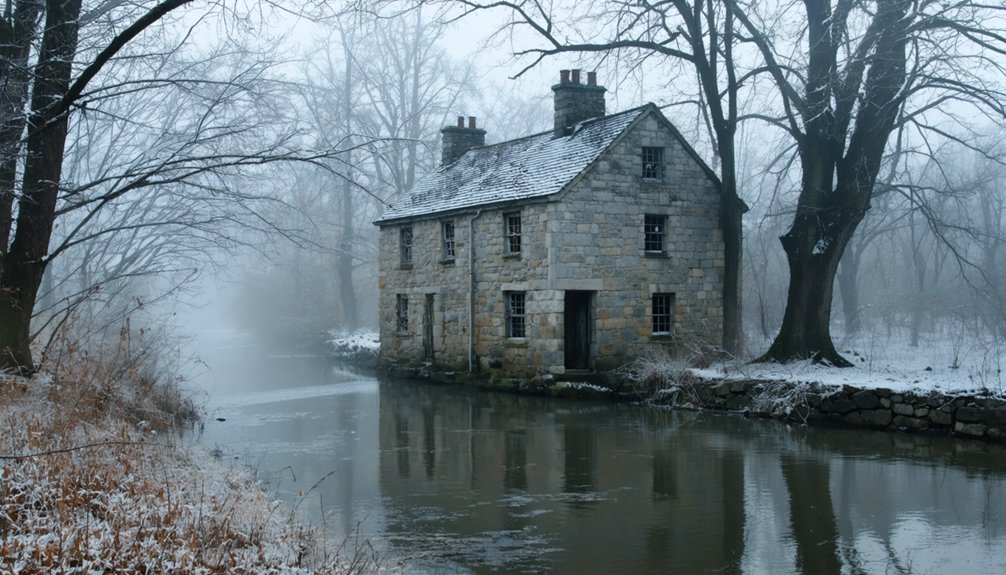
Winter transforms the C&O Canal Towpath into a corridor where history’s shadows feel almost tangible, especially when frost silences the Potomac and bare branches reveal what summer foliage conceals. You’ll find haunted legends concentrated at specific locations where tragic events left permanent impressions.
- Haunted House Bend: Civil War soldier ghosts and canal worker spirits sightings are reported along the towpath. Boats that capsized during battle are said to create restless presences.
- Paw Paw Tunnel: A lantern ghost wanders through 3,118 feet of complete darkness. Unexplained whispers echo off stone walls.
- Four Locks Ghost Town: Free towns built by emancipated slaves now stand abandoned. Their metal roofs catch the winter light.
- Oldtown’s Lockhouse 70: Unchanged since 1924, this remote stretch lacks cell reception, amplifying isolation.
You’re stepping into authentic historical spaces where spirits linger.
Furnace Town Historic Site: A Living Village Lost in Time
You’ll find Furnace Town’s 19th-century iron-smelting village eerily preserved in the Pocomoke Forest, where 300 residents once worked before the 1850 bankruptcy left their homes to decay into atmospheric ruins.
Winter strips away the summer crowds, letting you wander alone among the restored hot blast furnace—the oldest complete one in America—and relocated historic buildings that now serve as a living museum.
The bare trees expose the skeleton of this company town more starkly than any other season, with forest shadows creeping across the slag heaps and weathered structures that speak to Maryland’s lost industrial past.
19th-Century Village Preserved
Deep in the Pocomoke Forest, where winter mist clings to cypress knees and silence wraps around weathered structures, Furnace Town emerges like a portal to 1830s industrial America. You’ll discover a meticulously preserved company town where 300 souls once forged their livelihoods from bog ore and charcoal.
Ancient artifacts scattered throughout tell stories of ironworkers, wheelwrights, and broom makers who called this wilderness home.
Walk freely among relocated historic buildings housing demonstrations that bring forgotten trades alive:
- Watch blacksmiths hammer glowing metal at authentic forges
- Explore the company store where workers once traded iron for provisions
- Trace nature trails revealing slag heaps and hidden tunnels from smelting operations
- Visit the towering furnace stack—America’s oldest complete hot-blast structure
Winter strips away summer’s crowds, letting you experience this industrial ghost town’s raw authenticity.
Winter Woods Ghost Lore
As darkness falls early across the Pocomoke Forest each winter afternoon, you’re not alone among the weathered buildings and silent trails. Sampson Harmon’s spirit—a free Black man who worked the iron furnaces until 1897—still walks these grounds, seeking the burial at Furnace Town he never received. His cat appears alongside him on cold nights when fog drifts between the pines.
The haunting folklore intensifies during winter months when bare branches expose the forest’s liminal nature. You’ll find orbs in photographs and experience the Old Nazareth Church‘s heavy Bible phenomenon firsthand.
Professional investigators document unexplained sounds along Pusey Branch Trail, where over a dozen spirits roam beyond Harmon. This 200-year legacy of documented hauntings makes every winter visit an authentic encounter with Maryland’s most haunted woodland.
Planning Your Winter Ghost Town Adventure in Maryland
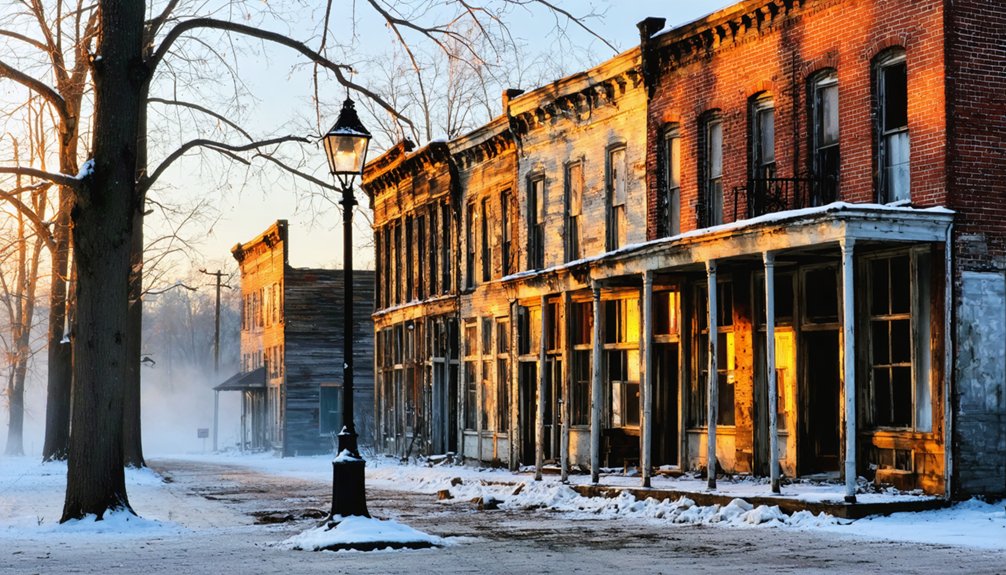
When winter’s first snow blankets Maryland’s abandoned settlements, the state’s forgotten towns transform into hauntingly beautiful destinations that require careful preparation. Your winter safety depends on respecting Maryland’s unpredictable weather—temperatures plummet to 20°F in Garrett County’s remote sites like Vindex, where blizzards can isolate you without cell service.
Essential trail preparation includes:
- Check DNR.maryland.gov before departing for Patapsco Valley closures and river flooding near Daniels mill ruins.
- Travel in groups when exploring Bloomington or Shallmar’s snow-covered roads with limited services.
- Start at dawn in Patapsco for maximum light, departing before dusk enforcement.
- Pack emergency supplies for sub-freezing temperatures and icy Great Allegheny Passage sections.
I’ve learned eastern coastal ghost towns like Snow Hill offer milder conditions, though Pocomoke Forest’s dense woods amplify isolation risks.
What to Bring for Cold-Weather Exploration of Abandoned Sites
Before stepping into Maryland’s frozen ruins, I learned the hard way that cotton kills—after my soaked jeans turned rigid during a January trek through Vindex’s collapsed mining structures, my legs went numb within twenty minutes.
Now I pack proper cold weather gear: moisture-wicking base layers beneath insulating mid-layers, windproof shells, and thermal socks that’ve saved my toes from frostbite. Steel-toed waterproof boots with ankle support navigate debris-strewn floors, while gaiters block snow infiltration.
Essential safety precautions include a 1000+ lumen headlamp, which frees your hands in pitch-black interiors. Sturdy gloves protect against rusted metal, and a helmet guards from crumbling ceilings. Carry spare lithium batteries, a first aid kit with hypothermia treatments, and an emergency beacon.
Maryland’s abandoned sites offer isolation you’ll crave until you actually need help.
Best Times to Visit Maryland’s Ghost Towns in Winter
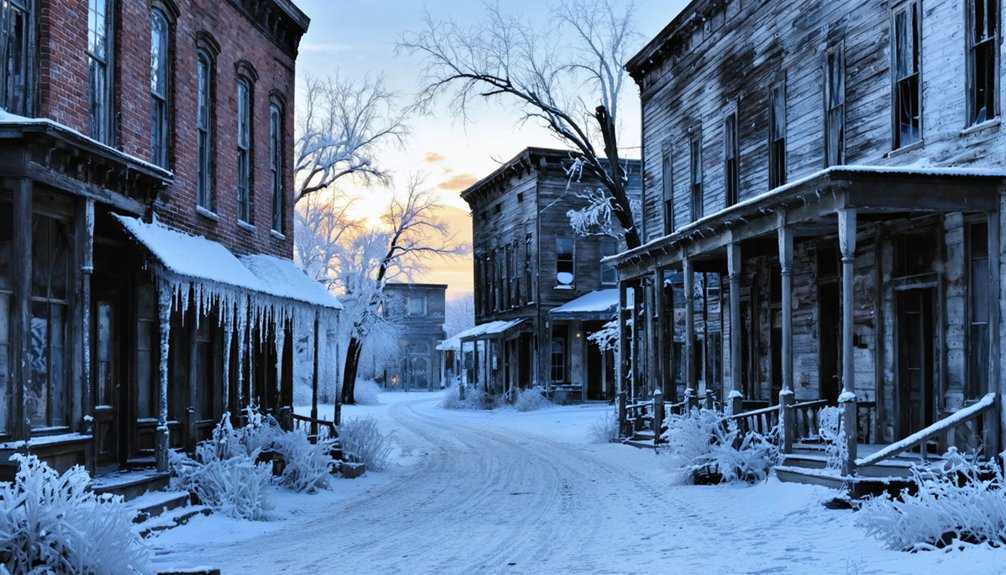
Maryland’s ghost towns reveal their most haunting character between December and February, when bare branches expose crumbling foundations and ice crystals cling to rusted machinery like frozen memories.
You’ll find the sweet spot for exploration during weekday mornings, when you’re free to wander without crowds diluting the atmosphere.
Optimal visiting windows:
- Dawn arrivals at Daniels Ghost Town capture ethereal fog rolling through valley ruins
- Mid-morning lighthouse tours (10 a.m. openings at Piney Point and Drum Point) beat weekend traffic
- Overcast January afternoons intensify seasonal haunting at Point Lookout’s Confederate prison grounds
- Pre-dusk cemetery walks let you experience urban legends as shadows lengthen across weathered tombstones
Winter’s shorter daylight hours demand strategic timing—you’ll want those 45-90 minute hikes completed before darkness transforms exploration into genuine risk.
Frequently Asked Questions
Are Pets Allowed on Trails to Maryland’s Ghost Towns in Winter?
Yes, you’ll find pets are welcome on leashed trails to Maryland’s ghost towns like Daniels year-round. Pet restrictions remain minimal, though trail safety demands you control your dog on snow-covered paths and monitor footing near crumbling ruins.
Do Any Ghost Towns Offer Guided Tours During Winter Months?
You’ll absolutely love this: Chesapeake Ghost Tours offers winter guided tours through Snow Hill, Pocomoke City, and Cambridge. Their historical preservation efforts shine as heated buses transport you into haunted mansions and cemeteries you can’t access on regular walks.
Is Cell Phone Service Available at Remote Ghost Town Locations?
Cell service is unreliable at Maryland’s remote ghost towns, so you’ll want satellite coverage as backup. I’ve learned emergency access remains your priority—download offline maps beforehand and tell someone your hiking plans for safety.
Are There Entrance Fees for Visiting These Historic Sites?
Like finding forgotten treasure maps, you’ll discover these tourist attractions welcome you freely. Maryland’s preservation efforts keep historic sites accessible without entrance fees, letting you roam ghost towns and lighthouses at dawn without barriers or costs.
Can I Camp Overnight Near Any of These Ghost Town Locations?
You can camp overnight near C&O Canal ghost towns at hiker-biker sites and Garrett County locations in state forests. Pack winter hiking gear, respect ghost town preservation rules, and secure backcountry permits for your freedom-filled adventure.
References
- https://www.worldatlas.com/cities/these-towns-in-maryland-come-alive-in-winter.html
- https://usghostadventures.com/snow-hill-ghost-tour/
- https://midatlanticdaytrips.com/2019/02/snowy-hike-to-a-maryland-ghosttown/
- https://www.tripadvisor.com/Attraction_Review-g41131-d10035193-Reviews-Daniels_Ghost_Town-Ellicott_City_Maryland.html
- https://www.mdmountainside.com/blog/post/haunted-history-places-to-visit-for-a-ghostly-good-time/
- https://chesapeake-inspired.com/discovering-the-forgotten-charm-of-daniels-a-ghost-town-walk/
- http://www.furnacetown.org
- https://www.mdshooters.com/threads/ghost-towns-abandoned-buildings-scenic-areas-recommend.224547/
- https://kids.kiddle.co/Daniels
- https://www.youtube.com/watch?v=sbFq0i5w0-c