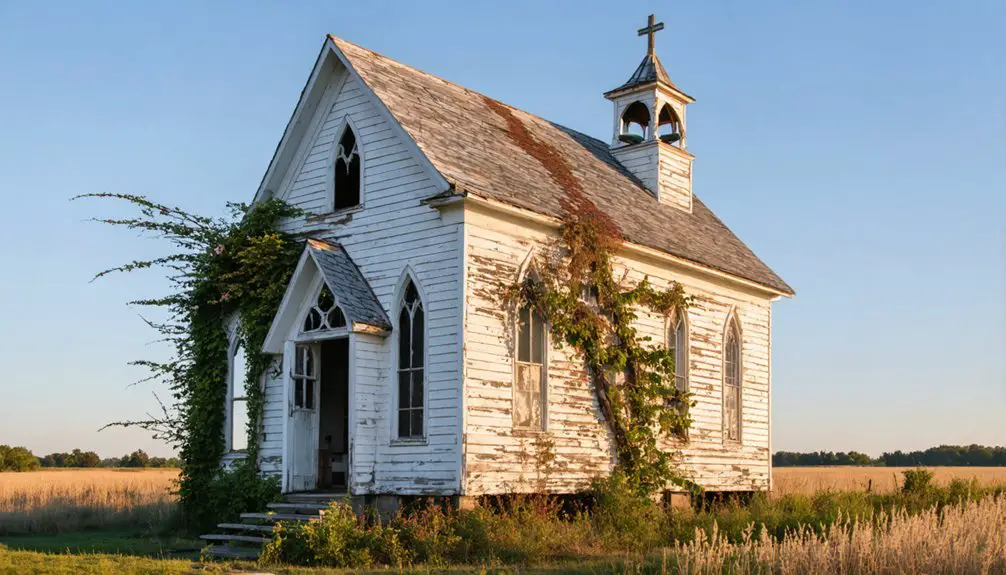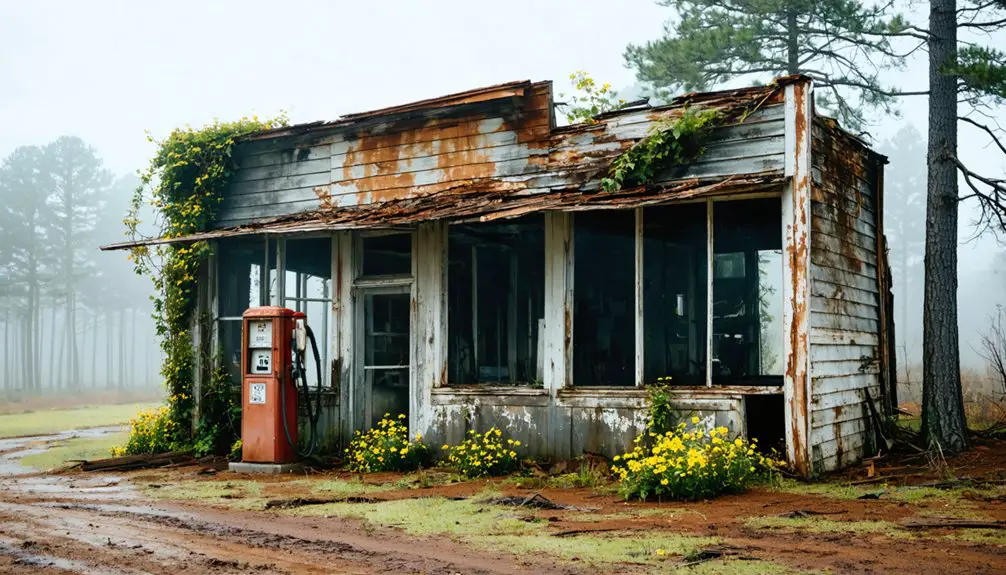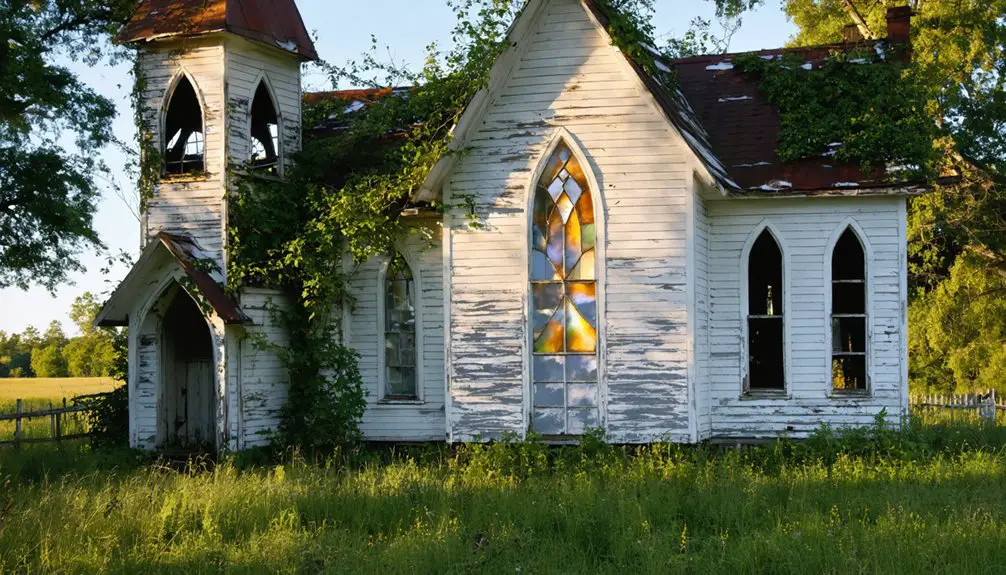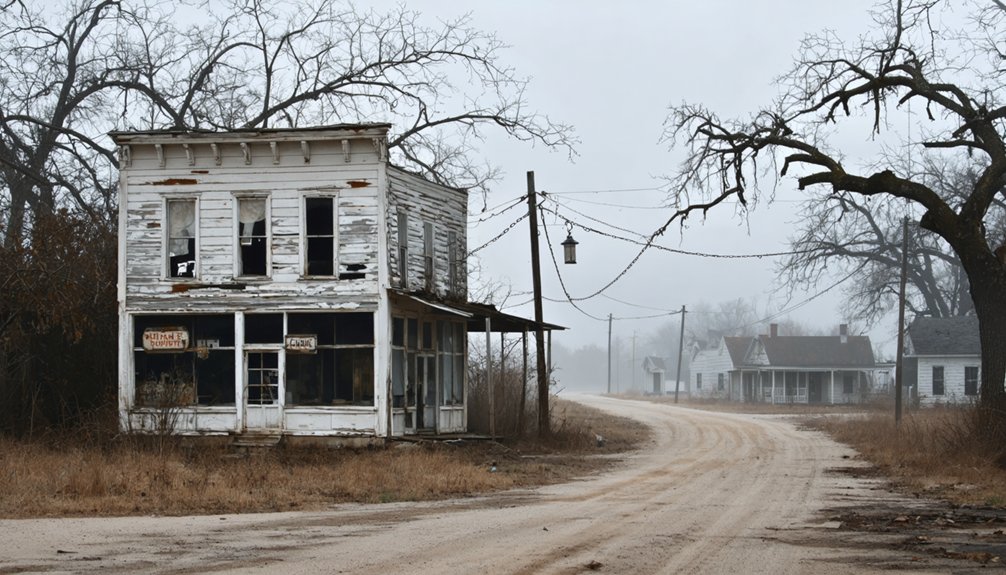
You’ll find Mississippi’s most atmospheric ghost towns come alive in winter’s stark beauty. Visit Rodney, where a Civil War cannonball still marks the church doors and bare trees reveal distant river views from cemetery hill. Explore Bankston’s scattered brick ruins near McCurtain’s Creek, or witness Electric Mills’ remnants of what was once the “brightest town south of St. Louis.” January’s cold strips away vegetation, exposing crumbling foundations and weathered tombstones in haunting clarity—while the stories behind these abandoned streets run deeper than any photograph can capture.
Key Takeaways
- Rodney offers Civil War history with a cannonball-marked church, cemetery views, and scattered ruins accessible via dirt roads in winter.
- Bankston in Choctaw County features Confederate supply hub remnants, foundation ruins near McCurtain’s Creek, and a historic cemetery from 1848–1864.
- Electric Mills was Mississippi’s first fully electric lumber town in 1913, now reduced to a highway intersection and museum sawmill blade.
- January provides optimal visiting conditions with bare trees revealing hidden graves, enhanced vistas, and minimal insects despite cold temperatures.
- Winter photography captures gothic arches, crumbling facades, and cemetery headstones in amber afternoon light and atmospheric morning fog.
Rodney: Mississippi’s Most Famous Ghost Town on the River
Where else can you stand in a weathered churchyard and spot a replica cannonball embedded above the doors, frozen in time since an 1864 Union gunboat attack? Rodney offers this rare glimpse into Mississippi’s turbulent past.
You’ll find historical artifacts scattered throughout this river town that once rivaled New Orleans as a bustling port with 4,000 souls.
The Mississippi River’s westward shift—now 3-4 miles away—transformed prosperity into silence, making river conservation efforts critical for understanding how nature reclaims civilization.
Winter visits reveal the distant river through bare trees from cemetery hill.
Two churches stand sentinel among ruins repeatedly battered by floods.
You’ll navigate mostly dirt roads, still wet from constant flooding, discovering why this ghost town captivates freedom-seekers exploring off-grid destinations.
Bankston: Civil War Supply Hub Reduced to Ruins
You’ll find Bankston hidden in remote Choctaw County, where crumbling foundations mark what was once Mississippi’s most productive Confederate supply hub—churning out 1,000 yards of cloth and 150 pairs of shoes daily until Union General Benjamin Grierson’s raiders torched it all on a December night in 1864.
Today, you can walk among scattered brick remnants and weathered tombstones, the only witnesses to a thriving mill village that declared 29 percent dividends before flames reduced it to ash. The destruction of factories marked the end of Bankston’s industrial activity, leaving the community facing economic ruin with uncertain futures.
The cemetery stands as the town’s sole survivor, its grave markers telling stories of workers, soldiers, and families who built Mississippi’s first cotton mill village before war erased it from the map. The raid claimed 10,000 pounds of flour along with thousands of yards of cloth and bales of cotton, while Federal forces seized farm animals that locals depended on for survival.
Confederate Manufacturing Center History
Deep in the pine forests of Choctaw County, where McCurtain’s Creek once powered an eighty-horsepower engine, the Mississippi Manufacturing Company rose as the state’s first successful mechanized textile operation in December 1848.
You’d have witnessed industrial innovation transform wilderness into prosperity—twelve workers became 178 souls crafting cotton cloth, shoes, and leather.
This self-sufficient compound flourished through wartime logistics, supplying Confederate soldiers with daily essentials when other mills fell silent.
The isolated location proved both blessing and curse. While Grant’s troops destroyed competitors, Bankston thrived until December 30, 1864, when Grierson’s raiders torched everything. Colonel Wesson had anticipated the raid and distributed cloth to aid the community, before relocating forty miles south to establish the new town of Wesson with 75 worker houses completed within three years.
Cemetery Remains Today
The cemetery stands alone now, weathered headstones marking what soldiers’ torches couldn’t erase. You’ll find foundation stones scattered where factories once roared, but these burial grounds survived Grierson’s December raid intact.
Winter’s your ideal season—Mississippi’s mild climate keeps paths accessible while bare trees reveal grave markers hidden during summer’s growth.
What You’ll Discover:
- Original headstones from Bankston’s 1848-1864 peak as Mississippi’s model mill town
- Cemetery restoration efforts preserving the community’s last tangible connection to pre-war prosperity
- Foundation ruins visible through winter vegetation near McCurtain’s Creek
- Historical preservation markers documenting the raid that ended Confederate production
This graveyard represents freedom from erasure—what armies destroy, memory preserves. You’re walking where historical preservation fights forgetting, where names outlasted the strategic elimination of Mississippi’s last operational woolen mill.
Electric Mills: From Booming Sawmill Town to Eerie Silence
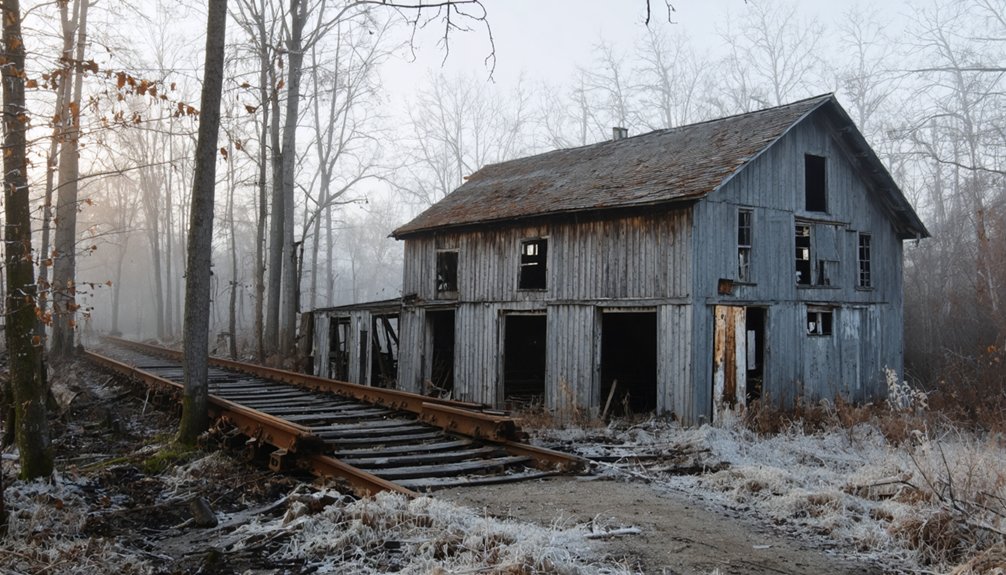
You’ll find yourself standing where 2,500 people once lived under electric lights so brilliant they called it the “brightest town south of St. Louis”—a marvel in 1913 when most sawmills still relied on steam power.
The hum of Mississippi’s first fully electric lumber mill drew families to this company town, where free electricity lit every home, hospital beds served injured loggers, and movie theaters entertained workers who’d never imagined such modern luxuries in the piney woods.
Named after Chicago lumber magnate George Cooley Hixon, the town flourished until timber depletion triggered its closure in 1941, leaving 75 workers jobless and transforming a vibrant community into nothing more than a highway intersection.
Today, only a historical marker stands along Highway 45 in Kemper County, marking where this once-thriving community bustled with life.
Mississippi’s First Electric Sawmill
Standing where silence now reigns absolute, it’s hard to imagine that Electric Mills once hummed with the revolutionary whir of Mississippi’s first all-electric sawmill.
Construction began in May 1911, transforming old Bodga into a technological marvel that powered everything from massive saw blades to residential lighting—all without steam or diesel.
You’ll discover how innovation shaped this frontier:
- 300,000 board feet cut daily from 165,000 acres of shortleaf pine
- Free electricity illuminated every building and home
- Clyde log skidders and Shay locomotives harvested timber until environmental impact forced changes
- 2,500 souls vanished when the mill closed
The facility served as a model for Finkbine-Guild Lumber Company’s later venture at DLo, where they constructed an electric sawmill in 1916 capable of producing 200,000 board feet every 10 hours. Today’s historical preservation efforts maintain only a solitary marker along Highway 45, documenting where progress once blazed trails before abandoning its ambitious experiment. A working example of this era’s sawmill technology, complete with its 52-inch diameter blade, still operates at Mississippi’s Forestry and Agriculture Museum, offering glimpses into the industrial processes that once drove communities like Electric Mills.
Thousand Residents, Thriving Businesses
By 1920, Electric Mills had exploded into a self-contained metropolis of over 2,500 souls—all mill workers and their families who’d transformed raw Mississippi wilderness into what locals proudly called “the brightest town south of St. Louis.”
You’d have found everything needed for independent living: a church where families worshipped, a hospital tending the injured, two hotels hosting timber buyers, and a movie theater offering weekend escape.
The barbershop buzzed with gossip while the meat market supplied fresh cuts. Free electric lights blazed from every building—an audacious luxury for 1920s rural America.
This industrial heritage represents America’s boldest timber operations, with the mill cranking out 300,000 board feet daily.
The company maintained such a high wage scale that workers rarely left, some staying employed for decades until the final closure.
Today’s town preservation efforts can’t recapture that raw energy, but the silence speaks volumes about what’s vanished.
1950s Closure and Abandonment
Throughout 1940, whispers of the mill’s impending closure rippled through Electric Mills like wind through pine branches—workers dismissed them at first, clinging to hope even as Mr. Temple’s maps revealed the stark truth.
By fall 1941, after 165,000 acres of shortleaf pine had fallen to saws, the mill shut down permanently.
Economic decline hit swiftly—population plummeted from 2,500 to just 100 residents within months.
What vanished with the mill’s closure:
- Guy Cammack and Gavin Davis cut the final logs as locomotives like Shay No. 7 retired in October 1940.
- Mississippi’s governor abolished incorporation immediately due to mass exodus.
- Workers hauled buildings away, leaving only thick concrete sidewalks and foundations.
- The “brightest town south of St. Louis” transformed into eerie silence—no historic preservation attempted.
Plymouth: Haunting Remnants Along the Mississippi Waterways
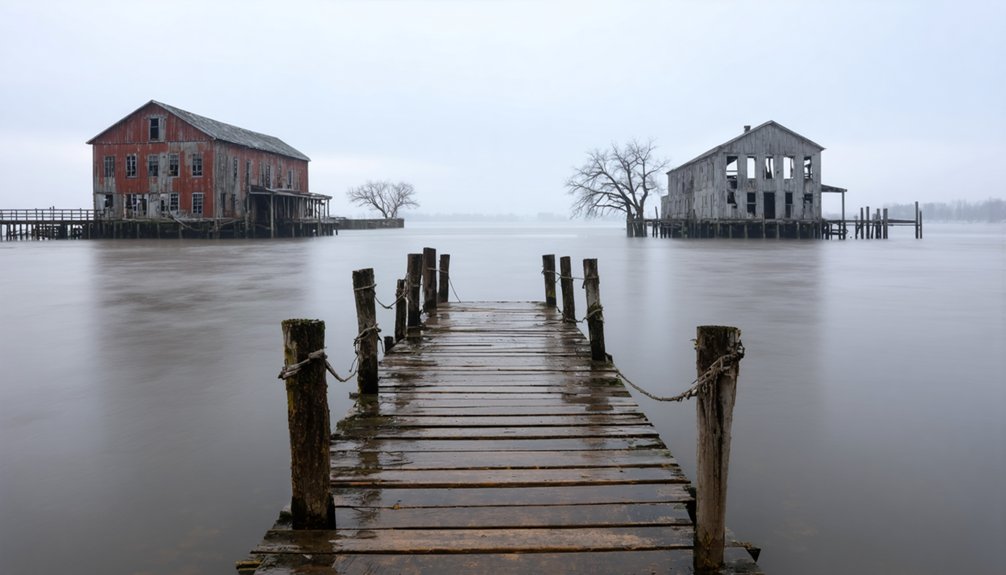
Tucked seven miles above Columbus on the west bank of the Tombigbee River, Plymouth’s crumbling remnants whisper tales of ambition cut short by nature’s relentless floods.
You’ll wander through a 210-acre National Register site where John Pitchlynn’s 1819 settlement once thrived with 200 souls before water drove them out within two decades.
Plymouth legends claim Hernando de Soto camped here, while folklore tales insist Bienville built a fort during Chickasaw wars. Whether true or embellished, you’ll feel history’s weight exploring the weathered cemetery and abandoned structures near the John C. Stennis Lock and Dam.
Winter’s bare branches frame ghostly views across the Tennessee-Tombigbee Waterway, revealing why settlers chose—and ultimately fled—this haunting, flood-cursed landing.
Americus: Exploring the Desolate Streets of a Forgotten Town
Where Cedar Creek’s waters once nourished Jackson County’s seat of power, you’ll now find only whispers of Americus—a town that flickered briefly as Mississippi’s governmental heart before vanishing into rural obscurity. From 1826 to 1870, this settlement thrived around its courthouse, jail, and general store.
Then the railroad chose Brewer’s Bluff, and Americus died overnight.
Winter’s your ideal time to explore these forgotten landmarks:
- Vanished courthouse square where poor farmers once sought justice
- Ghost streets near Methodist Salem Campground marking the original site
- Silent fields replacing urban decay—nature reclaiming civilization
- Archaeological mysteries waiting beneath Cedar Creek’s southern banks
You’ll find freedom in this desolation, wandering where government once ruled but leaving nothing behind except questions and winter wind.
Holmesville: Where Steamboats Once Ruled Before the Rails
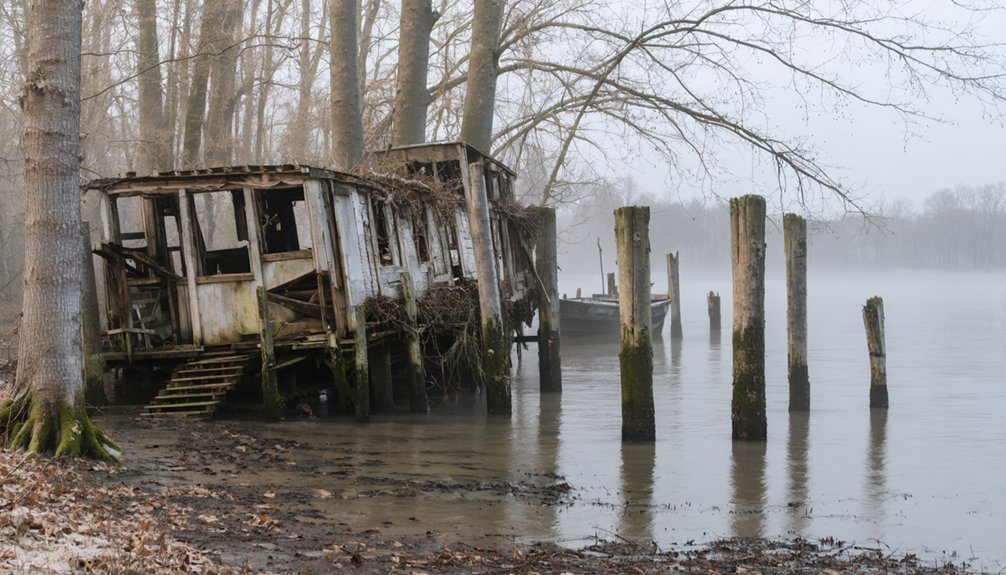
Before the iron horse carved Mississippi into submission, Holmesville commanded the Pearl River’s commerce with steamboat whistles that echoed through Pike County like clockwork hymns.
You’ll find skeletal structures whispering tales of 1816’s promise, when Major Andrew Hunter Holmes’s namesake town positioned itself perfectly within emerging river trade networks.
Walk these winter-emptied streets where sidewheelers once docked with three-foot drafts, their high-pressure engines revolutionizing river trade from fifty-mile crawls to hundred-mile sprints.
Steamboat technology transformed this settlement into a bustling junction—cotton bales stacked high, passengers choosing between cabin luxury and deck-level grit.
Then rails arrived, bleeding commerce from waterways to tracks. Holmesville withered.
Today’s desolation offers you something railroads never could: absolute silence where freedom-seekers once bargained, dreamed, and departed.
Best Times and Safety Tips for Winter Ghost Town Visits
Mississippi’s abandoned settlements demand timing as strategic as the riverboat captains who once navigated their waters. January transforms these sites through local weather patterns—bare trees expose hidden farmhouses along Natchez Trace, while early morning mist amplifies haunting cemetery vistas.
You’ll catch amber light washing over Rodney’s crumbling facades during late afternoons, with blue hour delivering cinematic conditions on gothic architecture.
Visitor safety requires winter planning:
- Avoid snake-season visits: Summer brings high populations; winter eliminates this threat at Rodney
- Navigate the 12-mile access road slowly: Expect alternating blacktop and dirt surfaces with variable conditions
- Account for flooding history: River-proximate sites shift unpredictably
- Time cemetery explorations carefully: Steep, overgrown paths behind Presbyterian churches need daylight navigation
Winter strips Mississippi’s ghost towns to their essentials—architecture prominent, dangers minimized, atmosphere maximized.
What to Bring on Your Mississippi Ghost Town Adventure

When January wind knifes through Rodney’s skeletal storefronts, your gear becomes the difference between compelling exploration and miserable retreat. Pack thermal base layers and insulated waterproof boots—Mississippi’s ghost towns demand respect when temperatures plummet to 19°F.
Your winter gear safety checklist should include microspikes for ice-glazed pathways, hand warmers for extended wandering, and a high-lumen headlamp since these ruins hold no electricity.
I’ve learned wool socks matter more than expensive cameras when you’re photographing frost-coated doorframes. Bring GPS with offline maps—cell service dies in these forgotten places.
Touchscreen gloves let you document without exposing skin. A thermos of coffee and energy bars fuel dawn expeditions. Don’t forget the emergency blanket; hypothermia doesn’t care about your adventure spirit.
Photography Opportunities in Abandoned Mississippi Settlements
The Baptist Church’s silver dome catches winter light like a beacon across Rodney’s skeletal landscape, offering your lens exactly what abandoned Mississippi demands—architecture that refuses to surrender. You’ll find urban decay transformed into art through Gothic arches and crumbling facades, while the Presbyterian bell tower punctures foggy mornings with Federalist defiance.
Winter strips away summer’s concealing foliage, exposing the cemetery’s 200 tilted markers and Commerce Street’s phantom curbs. Your shots improve dramatically when:
- Low winter sun creates shadows that define abandoned architecture’s texture
- Bare trees frame compositions without summer’s visual clutter
- Morning fog adds atmospheric mystery to forgotten graves
- Clear skies sharpen Mississippi River backgrounds from elevated cemetery viewpoints
Multiple visits capture Rodney’s personality shifts—flooded streets, frost-edged tombstones, golden hour silhouettes.
Nearby Attractions and Historical Sites Worth Visiting
After you’ve captured Rodney’s haunting facades through your viewfinder, your winter exploration extends beyond these crumbling walls into a constellation of forgotten places scattered across Mississippi’s back roads.
Drive south to Lorman’s Old Country Store, then circle back to Cane Ridge Cemetery where urban legends whisper through 200 graves dating to 1828. The Presbyterian church’s paranormal reports blend seamlessly with folklore stories you’ll collect in Electric Mills.
In Electric Mills, a 1910 sawmill once powered a thousand dreams before silence reclaimed the Kemper County timber.
In Bankston, eleven Union soldiers’ executions still echo through December nights—their December 30, 1864 burning matches the winter chill you’ll feel exploring that old cemetery.
Port Gibson’s “too beautiful to burn” architecture offers warmth between these darker pilgrimages across Mississippi’s ghosted landscape.
Frequently Asked Questions
Are These Ghost Towns Legally Accessible or on Private Property?
You’ll find absolutely zero “No Trespassing” signs blocking your exploration! These abandoned Mississippi settlements offer legal access without private property concerns. Rodney’s crumbling church welcomes wanderers, while Bankston’s cemetery invites ghost-hunters freely. You’re genuinely free to roam these forgotten places.
Can You Camp Overnight Near Mississippi Ghost Towns During Winter?
You can camp overnight near Mississippi’s ghost towns during winter at Rocky Springs Campground off Natchez Trace Parkway. Winter camping here offers outdoor safety advantages—fewer snakes, crisp air, and starlit solitude among weathered ruins and forgotten trails.
Do Any Ghost Towns Have Guided Tours or Historical Markers?
You won’t find guided tours at Mississippi’s ghost towns, but you’ll discover historical markers showing preservation efforts at Port Gibson’s sites. Rodney’s cemetery and Presbyterian church display the area’s historical significance through weathered headstones and crumbling architecture.
Are Ghost Town Roads Passable After Heavy Winter Rain or Flooding?
Ghost town roads become treacherous gambles after storms. You’ll find winter road conditions worsen dramatically—flooding impact leaves muddy ruts, washed-out bridges, and debris-strewn paths. I’ve witnessed impassable routes transforming adventure into risky isolation, demanding your careful judgment before venturing forth.
What Cell Phone Coverage Exists in Remote Mississippi Ghost Town Areas?
Cell phone coverage in remote Mississippi ghost towns remains frustratingly spotty—you’ll find Verizon offers your best shot at remote connectivity, though even they can’t guarantee signals down those winding dirt roads leading to abandoned dreams and forgotten homesteads.
References
- https://mississippifolklife.org/articles/haunted-by-a-ghost-town-the-lure-of-rodney-mississippi
- https://www.onlyinyourstate.com/experiences/mississippi/ms-ghost-towns
- https://www.tripadvisor.com/Attraction_Review-g28945-d10045204-Reviews-Rodney_Ghost_Town-Mississippi.html
- https://buddhadrinksfanta.com/finding-the-ghost-town-of-rodney-mississippi/
- https://www.thebridgeshotel.com/blog/whispers-from-the-bluffs-atmospheric-winter-ghost-stories-and-mysterious-southern-legends
- https://www.southernthing.com/this-ghost-town-is-now-a-national-park-with-stunning-scenery-hiking-and-abandoned-buildings-2639855049.html
- https://msfarmcountry.com/living/history/visit-rodney-this-fall/
- https://backroadplanet.com/haunting-rodney-mississippi/
- https://www.legendsofamerica.com/ms-rodney/
- https://theforgottensouth.com/rodney-mississippi-ghost-town-history-tour/