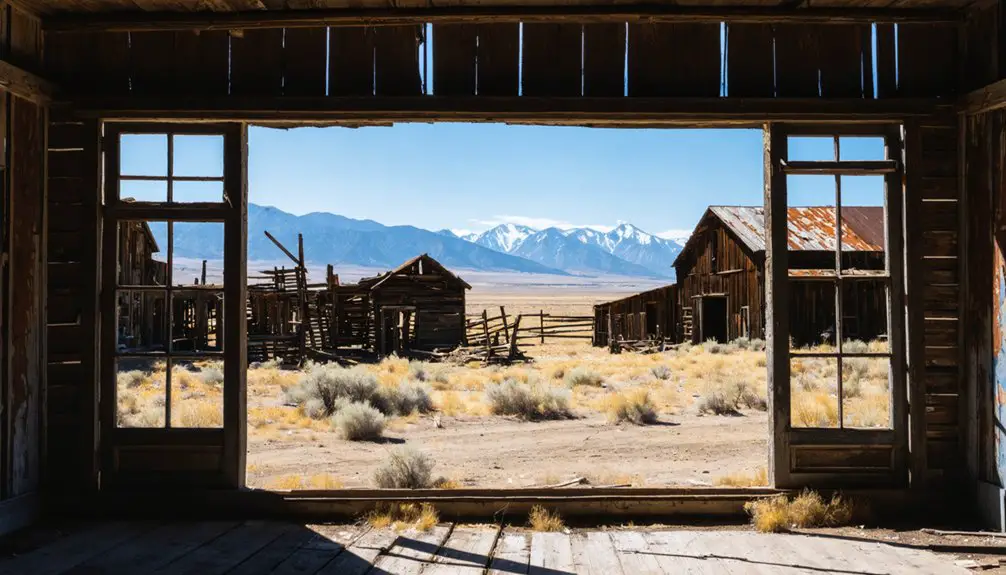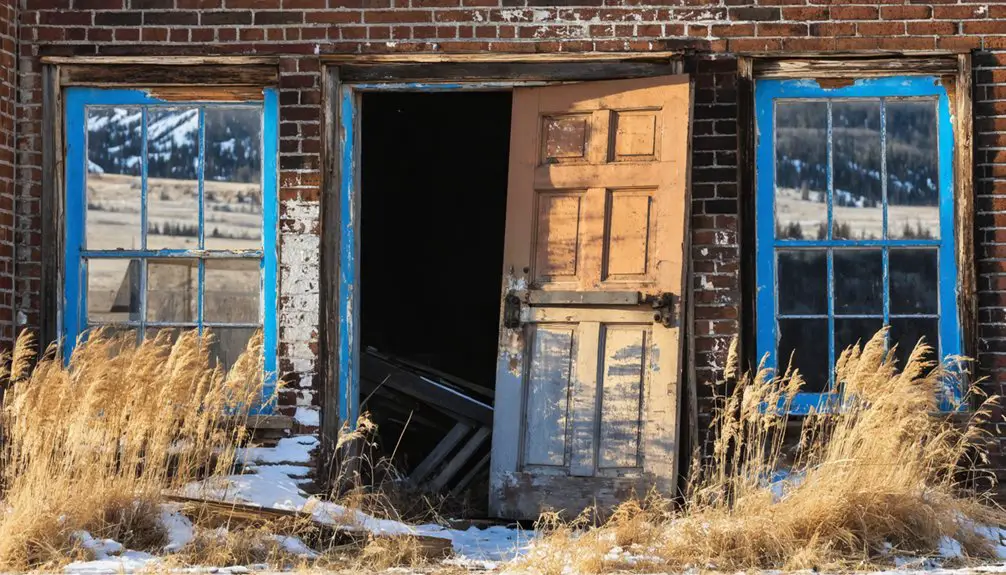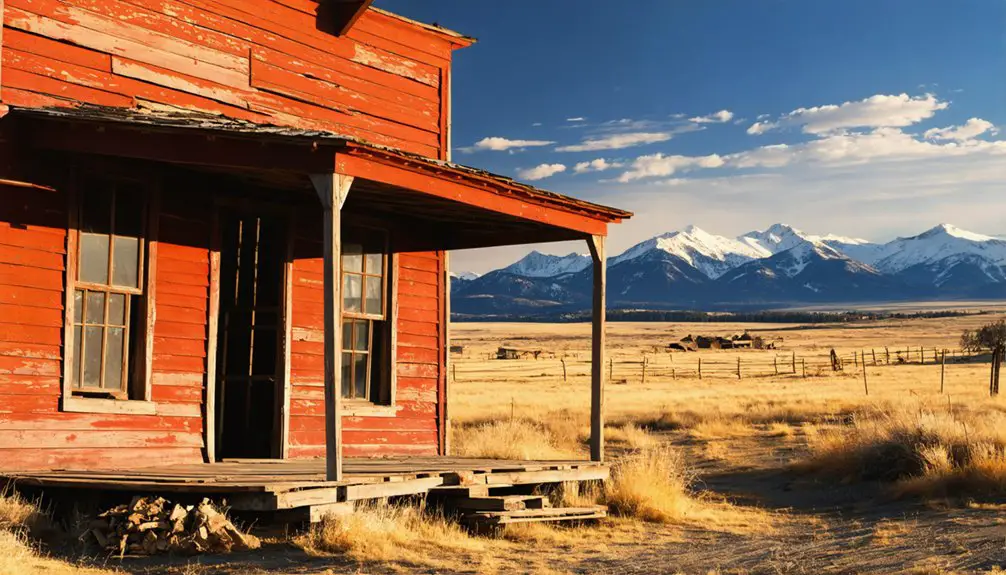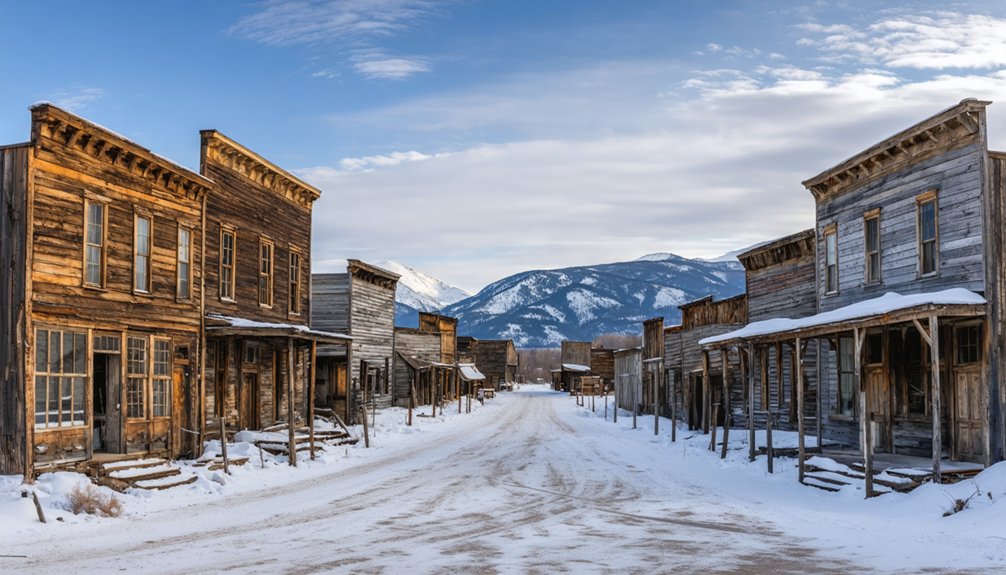
You’ll find Montana’s ghost towns utterly transformed in winter, with Garnet Ghost Town—accessible only by snowmobile or cross-country skis—offering the most dramatic experience. Bannack State Park‘s fifty original buildings stand hauntingly preserved against snow-covered peaks, while Virginia City maintains year-round access to its historic Opera House and frost-covered storefronts. For true solitude, snowshoe into Elkhorn State Park‘s weathered structures, where snowdrifts reach windowsills and you’ll have the entire frontier landscape to yourself, though proper planning for Montana’s harsh conditions is essential.
Key Takeaways
- Garnet Ghost Town requires snowmobile or ski access via 11-mile route from Highway 200, with $3 entry and lottery-based primitive cabin stays.
- Bannack State Park features over fifty original buildings accessible year-round between 8 am-5 pm at 5,800 feet elevation.
- Virginia City offers year-round access to preserved 19th-century architecture, opera house, museums, and Boot Hill Cemetery despite winter road limitations.
- Elkhorn State Park provides remote backcountry exploration with 11 miles of unpaved roads requiring high-clearance vehicles or snowshoes for access.
- Winter visitors should check conditions with BLM before travel, prepare for rapid weather changes, and pack extra fuel and layers.
Garnet Ghost Town: A Premier Winter Destination
Tucked into an isolated valley in the Garnet Mountain Range, about 30 miles east of Missoula, Garnet Ghost Town stands as Montana’s most intact remnant of the gold rush era. You’ll find yourself transported to 1898, when 1,000 souls populated these streets lined with thirteen saloons, four hotels, and bustling shops.
Winter weather here demands respect—you’ll need snowmobiles or cross-country skis to navigate the 11-mile journey from Highway 200. The reward? Unmatched solitude among weathered buildings that’ve survived since Mitchell’s heyday.
Watch for local wildlife tracks in fresh powder as you explore. The ghost town sits at elevations ranging from 4,200 to 7,000 feet, where mountain air sharpens every view. Two primitive cabins offer overnight stays through a lottery system, complete with wood stoves and outhouses. A major fire in 1912 devastated the business district, driving most residents away and sealing Garnet’s fate as a ghost town.
At $3 admission, it’s freedom on a budget.
Winter Access Methods and Transportation Options
When December snows bury the mountain roads, you’ll trade your truck for skis or a snowmobile—it’s the only way in. Winter vehicle restrictions kick in December 15th, closing wheeled access until May. You’ve got three solid options: snowmobiles provide the fastest route, covering those 5.7 or 10 miles with confidence.
When winter seals the mountain, your truck stays home—skis and sleds become your only ticket to the backcountry.
Cross-country skiing offers quieter freedom—especially on the groomed Garnet Range Road from Highway 200. Snowshoeing works too, though you’ll move slower through unbreoken snow.
Snowmobile safety becomes critical at 6500 feet where weather shifts fast. Call BLM Missoula at (406) 329-3914 before heading out—conditions change overnight. Pack extra fuel, dress in layers, and never ride solo.
The steep grades demand respect whether you’re gliding on skis or throttling a sled through pristine backcountry silence. The Highway 90 route from Beartown follows Cave Gulch Road, offering better valley views over its 5.7-mile approach with 2,000 feet of elevation gain. Once you arrive, expect to pay a $3 entry fee at the parking area, which includes access to picnic spots and facilities.
Bannack State Park: Montana’s Largest Ghost Town
While those high-elevation ghost towns test your winter endurance, Bannack sits at a manageable 5,800 feet in southwestern Montana—accessible year-round and sprawling across the sagebrush flats where Grasshopper Creek still glints with traces of gold. You’ll wander through fifty-plus original buildings—no reconstructions, no tourist traps—where preservation techniques favor authentic decay over theme-park polish.
The 1864 Governor’s Mansion stands alongside saloons where Sheriff Henry Plummer once drank before his vigilante hanging. Snow transforms the ghost town architecture into something haunting: wooden boardwalks creak underfoot, jail cells frame views of the gallows, and frontier-era storefronts lean at precarious angles.
Montana preserved this place specifically to avoid commercialization—you won’t find gift shops or guided restrictions, just unvarnished history waiting in the high-desert silence. The town earned its National Historic Landmark designation in 1961, cementing its status as one of the best-preserved gold rush settlements in the American West. Winter visitors can explore during 8 am–5 pm hours, with the park’s 1,154 acres offering solitude that summer crowds never experience.
Virginia City: Living History in the Snow
You’ll find Virginia City’s boardwalks and hand-hewn cabins dusted with snow, creating a stark contrast to the summer crowds that typically pack this National Historic Landmark District.
The town stays remarkably accessible in winter—Pioneer Bar and Rank’s Mercantile keep their doors open year-round, letting you warm up between exploring the preserved buildings that line the quiet streets.
While you won’t catch the Virginia City Players or Brewery Follies performing, the dirt road to Boot Hill Cemetery remains passable, and you can peer through windows of historic structures like the Opera House, home to Montana’s longest-running live theater. Call ahead to confirm specific hours of operation, as schedules can vary during the off-season months.
Established during the 1860s gold rush, Virginia City maintains many original structures that reflect the frontier mining boom era.
Historic Buildings and Museums
Standing at the heart of Virginia City’s snow-dusted streets feels like stepping onto a movie set where the cameras never stopped rolling. The ghost town architecture spans entire blocks—19th-century storefronts, the Opera House, and Gilbert Brewery stand defiant against winter winds.
You’ll find the Nevada City Museum’s “building zoo” particularly striking when frost coats its relocated structures from across Montana.
Local folklore comes alive through ghost tours departing from the Bale of Hay Saloon, Montana’s oldest watering hole. Stories of road agents and vigilantes echo through empty streets. The Boot Hill Cemetery sits on a hilltop overlooking the town, where graves mark outlaws brought to justice by those same vigilantes.
Winter access limits crowds, giving you authentic solitude among heritage artifacts. The Thompson-Hickman Museum, built in the 1920s, houses rare guns and photos from the 1860s alongside geological samples and unique oddities.
The Alder Gulch Shortline Railroad connects both historic districts, though you’ll want to confirm seasonal schedules.
Bundle up—these preserved buildings offer atmosphere over modern heating.
Winter Access Considerations
Planning your Virginia City winter expedition means confronting Montana’s unforgiving seasonal reality head-on. You’ll navigate dirt roads to Boot Hill and the Cemetery that transform into muddy gauntlets during snowfall and thaw cycles—these maintenance challenges aren’t trivial inconveniences.
From November through April, check road conditions twice daily by calling 511 before departure.
The seasonal weather hits hard: January averages 26°F highs and bone-chilling 7°F lows, with overcast skies dominating 61% of winter days. Most attractions shutter mid-October, leaving you with skeleton-crew options—Pioneer Bar and Rank’s Mercantile remain your reliable refuges.
You’re trading summer’s tourist crush for authentic solitude, but that freedom demands preparation. Pack emergency supplies, fill your tank, and embrace the isolation that turns Virginia City into genuine frontier territory again.
Elkhorn State Park: Remote Winter Exploration
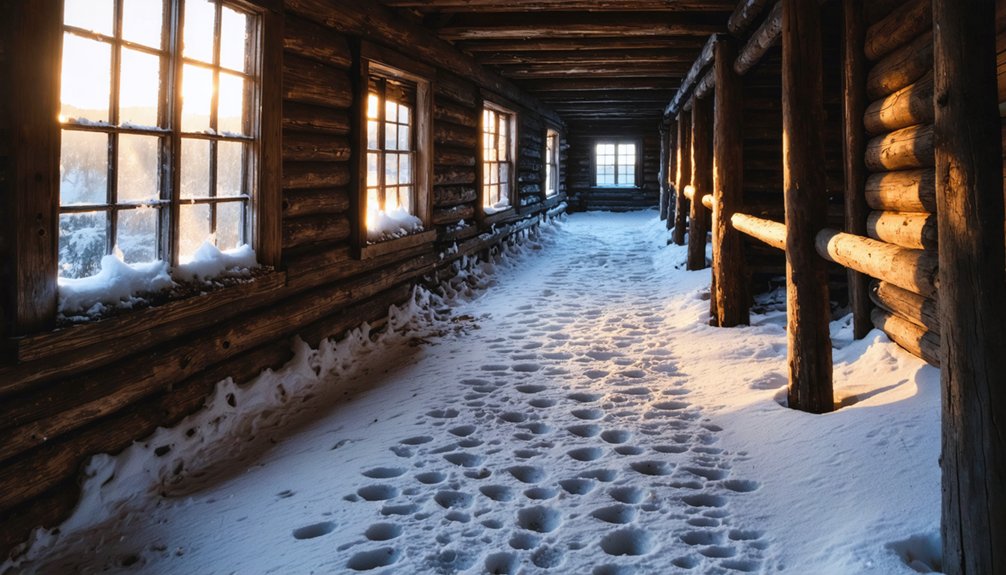
You’ll navigate roughly 11 miles of unpaved forest road to reach Elkhorn, where winter snowpack transforms the journey into a genuine backcountry adventure requiring a high-clearance vehicle or snowshoes for the final stretch.
Once you arrive, you’ll find over a dozen weathered structures still standing—Fraternity Hall’s two-story false front looms above the silent main street, while Gillian Hall’s skeletal frame reveals the craftsmanship of 1890s frontier builders.
The compact town layout lets you explore the entire site in a single afternoon, weaving between buildings as your snowshoe tracks mark fresh paths through drifts that sometimes reach windowsills.
Unpaved Road Winter Access
Although Elkhorn State Park lies just 18 miles northeast of Boulder, reaching this ghost town in winter demands careful planning and respect for Montana’s backcountry conditions.
You’ll navigate 8 miles on Elkhorn Road—half paved, half maintained gravel—crossing private land before entering Beaverhead-Deerlodge National Forest. Passenger vehicles handle the route year-round, but check weather conditions first.
For snowshoeing tips beyond the trailhead, pack gear essentials including navigation tools—cell service doesn’t exist here.
The Elkhorn South Winter Trailhead offers plowed parking, though 4WD or AWD vehicles work best. Beyond this point, only over-snow vehicles continue on 550 Road.
Steep climbs on Diego Town Road might require ski skins as you trace old mining routes.
You’ll find minimal amenities: one pit toilet, picnic tables, nothing else.
Respect private property throughout.
Building Preservation and Layout
Once you arrive at Elkhorn State Park, two remarkably preserved structures anchor the ghost town’s winter landscape. Fraternity Hall and Gillian Hall stand as Montana’s smallest state park‘s crown jewels, their architectural details sharp against snow-covered ridges.
Jefferson County’s preservation efforts keep these frontier buildings accessible year-round, even when snowshoes become your only transport option.
You’ll find these halls clustered along a private strip where a handful of full-time residents actually live among the preserved facades.
Winter transforms this re-inhabited mining town into something magical—fresh snow highlights the buildings’ weathered wood and authentic construction techniques.
The 0.75-mile trail to the cemetery starts at the picnic area, winding past Peter Wys’s tombstone marking where he discovered the silver vein that birthed this remote settlement.
Rimini: A Semi-Inhabited Mining Settlement
Tucked into the narrow confines of Ten Mile Creek Valley between Red Mountain and Lee Mountain, Rimini clings to existence as one of Montana’s most accessible semi-ghost towns. You’ll find remnants of over 100 mines that once shipped 400 tons of ore weekly during the 1890s boom, when 300 souls called this place home.
Over 100 mines once drove this valley settlement, processing 400 tons of ore each week during Rimini’s 1890s heyday.
The mining history here runs deep—$7 million in wealth extracted before silver prices crashed and residents fled.
Today’s ghost town preservation efforts center on the 1904 schoolhouse, now a community hall and National Register landmark. The false-front commercial buildings tell stories of saloons, hotels, and frontier grit.
Winter transforms the narrow valley into an otherworldlyscape where you can explore freely, wandering among structures that survived decades of Montana’s harshest elements.
Planning Your Winter Ghost Town Adventure
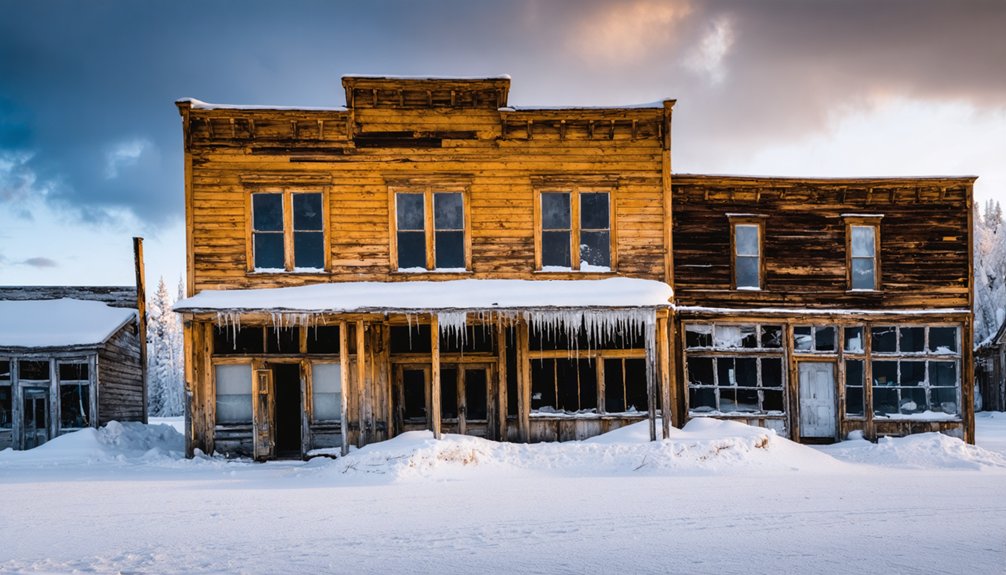
Winter ghost town exploration demands more planning than summer visits, but the rewards—pristine snow blankets, empty streets, and crystalline silence—justify every extra preparation step.
Essential preparations include:
- Transportation planning – Determine whether you’ll snowshoe, ski, or snowmobile based on your destination. Garnet requires winter gear, while Bannack’s 1.5-mile loop accommodates cross-country skis.
- Self-sufficiency protocols – Pack emergency supplies, extra layers, and navigation tools. Remote sites like Lost Creek heighten isolation risks.
- Winter photography gear – Bring lens cloths, spare batteries (cold drains power), and protective cases for capturing frost-covered buildings.
- Local dining research – Identify nearby towns with winter-accessible restaurants since ghost towns lack services.
Check facility statuses beforehand—some amenities, like Bannack’s warming hut, may close unexpectedly.
What to Expect During Montana’s Ghost Town Winter Season
Your carefully laid plans meet reality the moment you arrive at a snow-locked ghost town.
You’ll haul every supply on your back or sled—no running to the car for forgotten items. Cell service vanishes completely, leaving you genuinely off-grid. Winter photography becomes magical as golden hour light catches weathered wood against pristine snow, but expect your batteries to drain fast in subzero temps. Keep spares warm inside your jacket.
Wildlife encounters intensify when you’re occupying a remote cabin. Deer tracks crisscross the main street at dawn, and you might spot moose browsing willows near old mine shafts.
At night, kerosene lamps flicker while floors creak beneath your boots—the same sounds miners heard 130 years ago.
It’s isolation that earns its authenticity through effort.
Frequently Asked Questions
Are Pets Allowed at Montana Ghost Towns During Winter Visits?
Yes, you’ll find pet policies allow leashed dogs at Montana ghost towns during winter visitation. At Garnet, your furry companion can explore snowy grounds and trails freely, though they’re banned from historic buildings and rental cabins.
How Far in Advance Should Winter Cabin Rentals Be Booked?
While summer adventurers scramble last-minute, you’ll need winter cabin booking tips for planning 2-4 months ahead. Holiday weekends disappear faster, so secure your freedom early. Winter safety demands preparation—book now, explore Montana’s ghost towns worry-free later.
What Is the Elevation of Garnet Ghost Town?
Garnet Ghost Town sits at approximately 6,000 feet elevation in Montana’s mountains. You’ll experience authentic mining history and exceptional historical preservation while exploring this high-altitude settlement, where winter snows blanket the weathered buildings in pristine silence.
Which Organizations Manage Garnet Ghost Town Operations?
The Bureau of Land Management and Garnet Preservation Association jointly manage operations, focusing on historical preservation since 1972. You’ll find authentic buildings maintained in “arrested decay,” with tourist amenities like guided tours and educational materials available year-round.
Do Ghost Town Visitor Centers Operate During Winter Months?
Visitor centers close during winter, but you’ll find limited weekend hours at Garnet. Historical preservation efforts prioritize building protection over services. Follow winter safety tips: bring snowshoes, dress warmly, and plan self-guided adventures during reduced operations.
References
- https://southwestmt.com/listings/garnet-ghost-town/
- https://billingsmix.com/brave-enough-to-spend-a-cold-winter-night-in-this-montana-ghost-town/
- https://www.roamingnearandfar.com/montana-ghost-towns-near-helena/
- https://www.mountain-home.com/blog/vacation-planning/guide-montana’s-ghost-towns
- https://www.garnetghosttown.org
- https://visitmt.com/things-to-do/ghost-towns
- https://crownofthecontinent.net/entries/coloma-ghost-town-montana/aec72829-c301-42a2-9a0a-f27d8b109eb6
- https://fwp.mt.gov/stateparks/bannack-state-park
- https://www.blm.gov/visit/garnet-ghost-town
- https://visitmt.com/listing/garnet-national-winter-recreation-trails-898