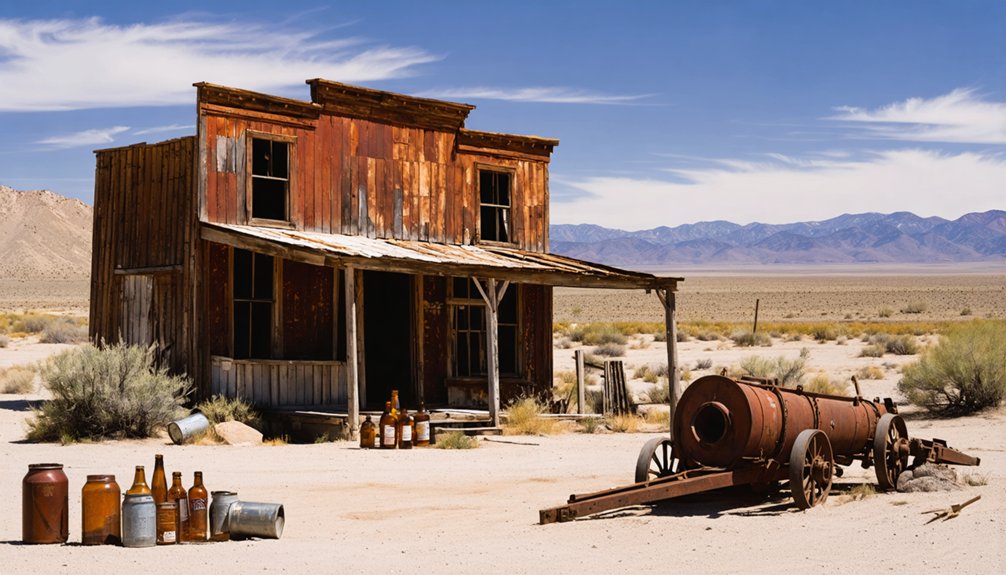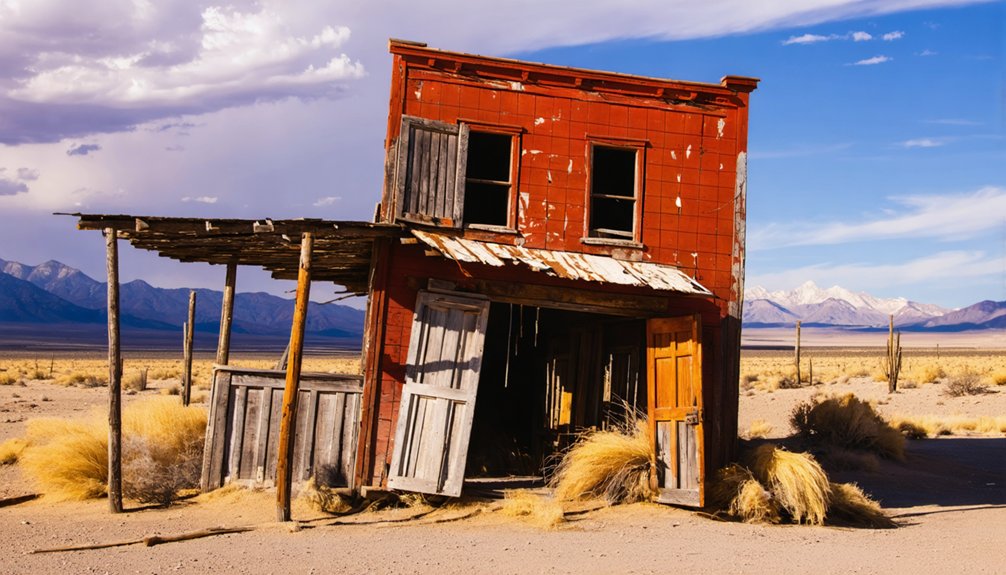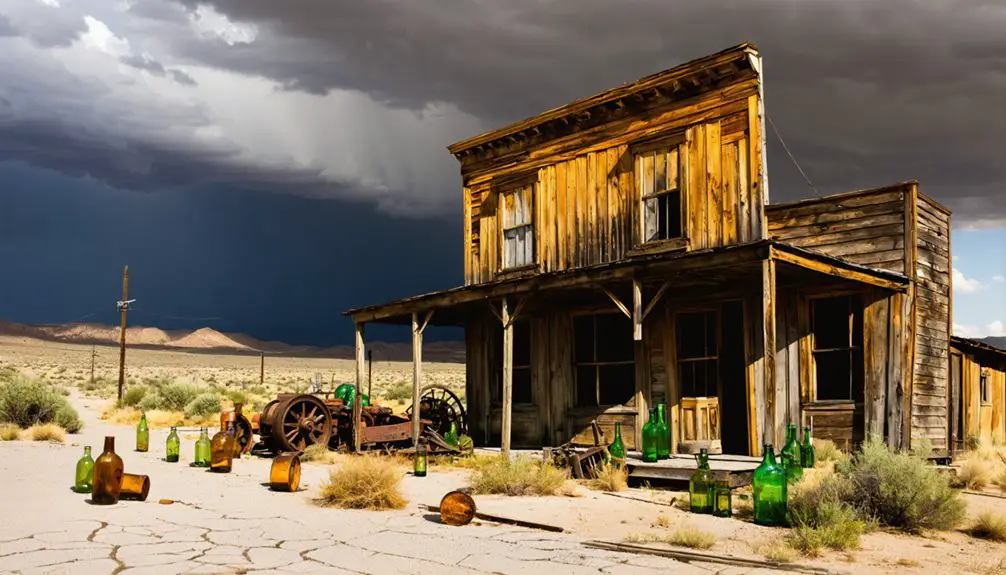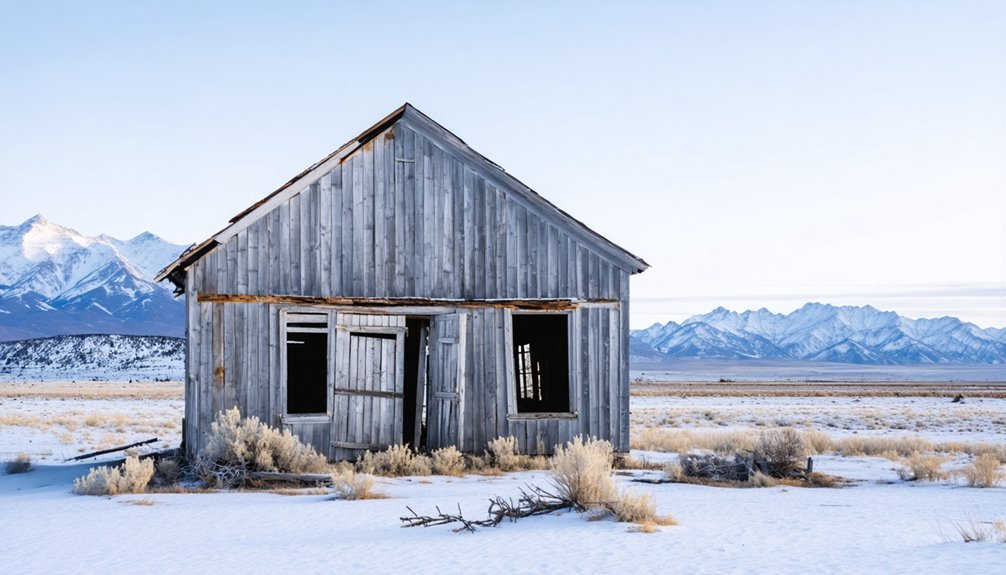
You’ll find Nevada’s most accessible winter ghost towns near Las Vegas—Goodsprings’ 1913 Pioneer Saloon sits just 30 minutes away, while Nelson’s 51-acre preserved ruins offer guided mine tours an hour south. For dramatic elevation, Belmont’s 150-year-old courthouse stands at 7,000 feet, and remote Jarbidge showcases gold rush history surrounded by snow-covered wilderness. Rhyolite near Death Valley remains the state’s most photographed ghost town, with its iconic bottle house and crumbling stone buildings creating extraordinary photographic opportunities beneath winter’s crystal-clear desert skies and occasional snowfall that transforms these abandoned settlements into hauntingly beautiful landscapes worth exploring further.
Key Takeaways
- Rhyolite, Nevada’s most photographed ghost town, features the iconic Tom Kelly’s Bottle House and historic Cook Bank Building ruins.
- Nelson offers guided Techatticup Mine tours and 51 acres of preserved ruins just 60 miles from Las Vegas.
- Goodsprings’ Pioneer Saloon, dating to 1913, displays bullet holes and tin walls near where Clark Gable mourned Carole Lombard.
- Winter provides clear air for photography, cooler temperatures for exploration, and dramatic lighting for night shots and star trails.
- Carry three days’ supplies, check road conditions, and use four-wheel-drive vehicles as seasonal routes close during winter.
Rhyolite: Death Valley’s Most Photographed Ghost Town
When prospectors Shorty Harris and E. L.. Cross discovered gold in 1904, they sparked a rush that transformed desert isolation into Nevada’s most ambitious boomtown.
You’ll find Rhyolite’s remnants in the Bullfrog Hills, where 10,000 souls once chased fortune.
Within months, this two-tent camp exploded into a metropolis with stock exchanges, opera houses, and schools serving 250 children.
From desert whispers to roaring commerce—Rhyolite’s transformation from humble camp to bustling city happened at lightning speed.
Today’s mineral preservation efforts protect what the 1907 panic couldn’t destroy.
You’ll explore historic architecture like the iconic Cook Bank Building and Tom Kelly’s ingenious Bottle House, crafted from 50,000 beer bottles.
The town was named after the volcanic-ash rock formations that dominated the landscape from ancient eruptions in the region.
The Bureau of Land Management maintains this freedom to wander through authentic ruins adjacent to Death Valley National Park, where cement sidewalks still trace vanished dreams across Mojave Desert vistas.
At its peak, the Montgomery Shoshone mine extracted $10,000 worth of ore daily, drawing the attention of steel magnate Charles Schwab who purchased it in 1906.
Nelson: a Living Museum One Hour From Las Vegas
Just sixty miles from Las Vegas’s neon glow, Nelson clings to Eldorado Canyon’s rust-colored walls as Nevada’s most violent ghost town turned photographer’s paradise.
This living museum showcases authentic historical preservation through the Werly family’s 1994 restoration of 51 acres. You’ll discover weathered buildings where gunfights erupted routinely—the nearest lawman was 200 miles away.
The Techatticup Mine alone yielded millions in precious metals from 1861 to the 1940s.
Winter’s mild temperatures make exploring ideal:
- Guided Techatticup Mine tours through original shafts
- Photography permits ($10/hour) among rust-streaked relics
- Preserved stamp mill and miner’s bunkhouse
- Desert vistas without summer’s punishing heat
- Relocated cemetery overlooking Lake Mojave
The town earned its name after Charles Nelson’s murder in 1897, when he and four others were killed in his home by Indian renegade Avote. The property features scattered vintage vehicles resembling Mad Max scenes, offering constantly changing photo opportunities across the grounds. You’ll pay an entry fee to wander this working ghost town where residents still live among the echoes of Nevada’s bloodiest mining camp.
Goodsprings and the Historic Pioneer Saloon
Thirty minutes from the Strip’s glitter, the Pioneer Saloon’s weathered Brunswick mahogany bar has poured drinks since 1913, making it southern Nevada’s oldest watering hole and a survivor of every crisis from the Spanish Flu to COVID-19.
Since 1913, this mahogany bar has weathered Spanish Flu, Prohibition, the Depression, and COVID-19—still pouring drinks in Nevada’s oldest saloon.
You’ll discover authentic historical architecture here—original stamped tin walls, bullet holes from forgotten gunfights, and flooring that’s supported miners since Goodsprings’ 1916 peak of 800 residents.
The town’s mines yielded $25 million in lead ore, spawning miner legends that still echo through the saloon where Clark Gable mourned Carole Lombard‘s 1942 plane crash. During the mining boom from 1915 to 1925, Goodsprings was one of Nevada’s largest cities with a bustling Main Street that included car dealerships and ice cream parlors. The saloon was recognized on Nevada’s State Register of Historic Places in 2007, cementing its significance to the region’s heritage.
Order the Food Network-featured Ghost Burger, explore the adjacent General Store, and experience the real Old West.
Winter’s chill makes this ghost town exploration even more atmospheric.
Belmont: Where 150-Year-Old Structures Still Stand
Rising from central Nevada’s high desert at 7,000 feet elevation, Belmont’s silver rush legacy endures in stone structures that have withstood 150 years of punishing winters and scorching summers. You’ll find mining history preserved through remarkable architecture that outlasted hundreds of Nevada boomtowns.
The 1876 courthouse anchors this ghost town, its two-story stone walls defying abandonment. Preservation techniques here were unintentional—builders chose durability over convenience, creating monuments that wooden structures couldn’t match. The transition from wooden to stone civic buildings symbolized the town’s prosperity and permanence.
Explore these surviving landmarks:
- Combination Building (1867) housing mining offices
- Cosmopolitan Music Hall’s 63-year operational history
- Monitor-Belmont mill’s towering chimney and machinery
- Four-story Belmont Mill with suspended ore carts
- Cemetery established 1869 among juniper and sagebrush
Stone construction saved Belmont when timber-roofed buildings elsewhere vanished. You’re witnessing accidental preservation—endurance through material choice rather than conscious conservation. The town’s six operational mills during peak mining years processed ore that generated $15 million in total production value.
Jarbidge: Remote Gold Rush Remnants in Northwestern Nevada
While Belmont’s stone monuments command attention in the central desert, Nevada’s northwestern corner conceals a gold rush relic so remote that winter transforms it into something few ghost town visitors ever experience.
Jarbidge sits where wilderness exploration meets mining history—a settlement born from David Bourne’s 1909 discovery that sparked a stampede of 1,500 fortune-seekers.
You’ll find remnants of the boom that once topped Nevada’s gold production from 1919 to 1921, generating $10 million before operations ceased in 1941. Over 500 tents initially lined the canyon along the Jarbidge River during the settlement’s earliest days.
The site of America’s last stagecoach robbery adds intrigue to your winter wandering through preserved structures along the Jarbidge River canyon. The 1916 crime left a bloody trail that investigators used as evidence to convict the robber who killed the stage driver and stole $3,000 in mail.
After wandering snow-covered trails through the Jarbidge Wilderness, you can soak trail-weary muscles at nearby Murphy Hot Springs, embracing the isolation that keeps this ghost town authentically frozen in time.
Pioche: Silver Boom Town With a Violent Past
The silver veins beneath Pioche’s mountains attracted fortune-seekers in 1869, but the town’s reputation was forged in gunpowder and blood. Mining history transformed this settlement into Nevada’s wildest frontier outpost, where the first 72 recorded deaths were murders before anyone died naturally.
Ghost town legends still echo through Pioche’s remarkably preserved structures:
- Million-Dollar Courthouse—built through corruption scandals
- Opera House from 1873—hosting concerts on Main Street
- Original jail with 16-inch walls
- Nevada’s only standing aerial tramway
- Boot Hill Cemetery beneath dangling ore buckets
You’ll find around 1,000 residents keeping this Lincoln County seat alive today. The town peaked at $5.5 million in silver production during 1872, then declined before World War II revived it as America’s second-largest lead-zinc producer.
What to Expect When Visiting Nevada Ghost Towns in Winter
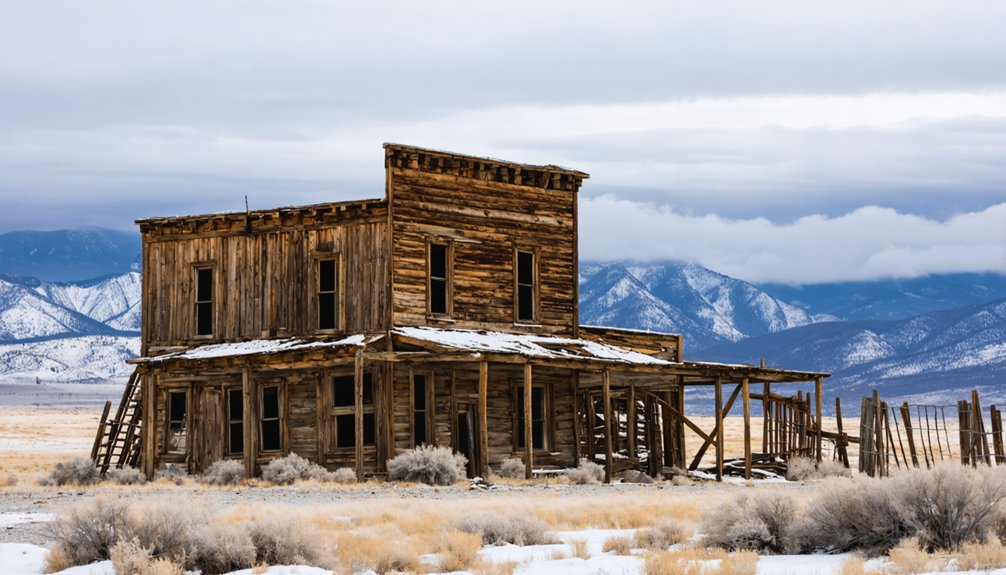
Winter transforms Nevada’s ghost towns into stark, frozen relics where temperatures plummet from summer’s 98°F heat to bitter cold. Sometimes, these areas are blanketed in rare desert snow, creating a surreal landscape.
You’ll encounter limited services and challenging access—remote roads can become impassable overnight. This demands all-terrain vehicles and survival gear, including three days’ worth of water, food, and emergency supplies.
The season rewards prepared visitors with exceptional photography opportunities. The low winter light casts dramatic shadows across weathered ruins, and the crisp air provides crystal-clear visibility of crumbling structures.
Cold Desert Weather Conditions
Before you venture into Nevada’s abandoned settlements, understanding the state’s cold desert climate becomes essential for safe exploration.
You’ll encounter dramatic temperature fluctuations spanning 30-35 degrees daily, with southern regions averaging 38-57°F while northern ghost towns experience frigid 15-20°F conditions.
Winter storms occasionally push temperatures to 0°F or below during extreme events.
The desert’s unique weather patterns create distinct challenges:
- Exceptionally dry air despite occasional precipitation
- Bright sunshine dominating most winter days
- Clean atmosphere providing expansive visibility
- Minimal rainfall averaging just 1.2 inches in February
- Strong westerly winds creating rapid temperature shifts
Currently, La Niña conditions are producing warmer-than-normal temperatures, though you shouldn’t underestimate the cold.
Northern locations remain markedly colder than Las Vegas-area sites, demanding proper preparation for backcountry exploration.
Limited Services and Accessibility
When venturing into Nevada’s ghost towns during winter months, you’ll face significant accessibility challenges that demand serious preparation. Hamilton’s 10-mile seasonal road closes completely. High-elevation sites become snowed-in and impassable.
You’ll need high-clearance four-wheel-drive for most destinations, and vehicle maintenance becomes critical—a single storm can render roads unusable overnight.
There’s no water at these remote sites, and services are non-existent. Pack three days’ worth of water, food, shelter, and medication in your vehicle. Roads see so little traffic that years might pass between travelers.
Weather shifts violently from 98°F to snow, demanding versatile gear. Check with land management agencies before departing, and remember: if Hamilton’s road gets wet, you’re stuck.
Self-reliance isn’t optional—it’s survival.
Photography and Lighting Advantages
Winter’s visual advantages include:
- Crystal-clear air revealing snow-capped ranges in sharp focus
- Reduced haze for capturing distant peaks like Pilot Mountains
- Bare desert vegetation exposing previously hidden structures
- Cooler temperatures supporting extended shooting sessions
- Waxing crescent moonlight enabling dramatic night photography with light painting
You’ll find ideal conditions for both daytime architectural shots and after-dark star trails, with private access at sites like Nelson extending your creative freedom.
Essential Tips for Desert Ghost Town Exploration
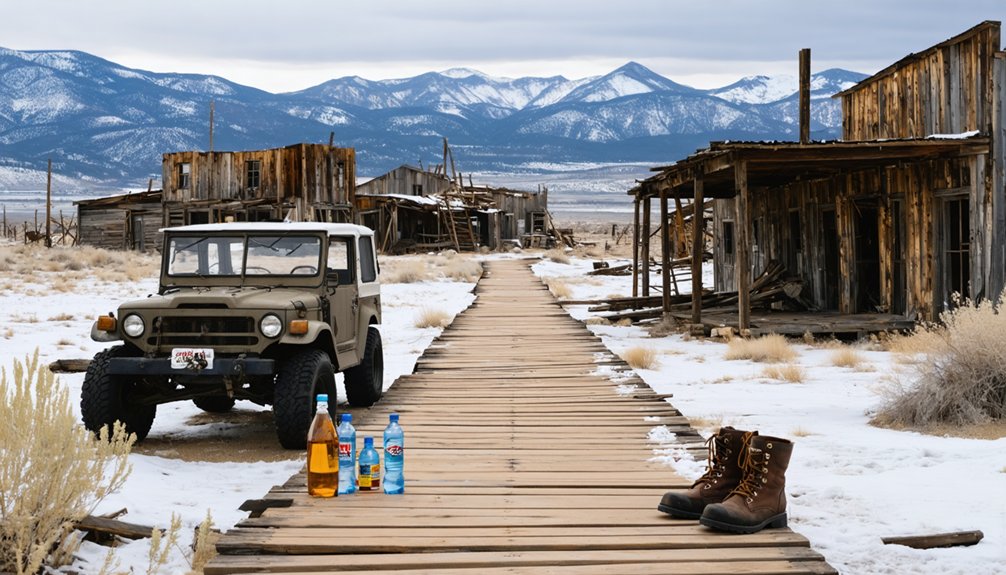
Nevada’s ghost towns stand silent in landscapes where help doesn’t arrive quickly and mistakes carry serious consequences.
You’ll need thorough preparation: pack two spare tires, recovery gear including earth anchors, and a five-gallon gas can.
Equipment maintenance proves critical—test your GPS alongside traditional maps and compass before departure.
Bring surplus water, protective clothing including boots and gloves, and field guides like the Air Force Survival Manual.
Wildlife encounters demand constant awareness of snakes and larger animals sharing these abandoned spaces.
Never enter mine shafts or test deteriorating structures alone—always explore with a buddy.
Print coordinates since cell service vanishes in remote areas.
Respect artifacts over 50 years old, and plan your route to avoid burdening search-and-rescue teams with preventable emergencies.
Planning Your Mojave Desert Ghost Town Tour
With preparation complete, mapping your route through the Mojave Desert’s ghost towns transforms from abstract planning into concrete waypoints and mileage calculations.
Base yourself in Beatty to access Rhyolite’s crumbling bank and train depot remnants.
Beatty serves as the perfect gateway to explore Rhyolite’s haunting architectural skeletons frozen in desert time.
From there, craft a loop incorporating:
- Eastern Death Valley sites like Chloride City with climbing paths
- Nipton’s 1910 adobe hotel near the California-Nevada state line
- Route 66’s Amboy for authentic roadside atmosphere
- Gold Point’s preserved cabins in high desert isolation
- Zzyzx Road’s paved access watching for bighorn sheep
Winter delivers ideal conditions—cooler temperatures for hiking between ruins, wildflower blooms painting desert washes, and nighttime stargazing without summer’s scorching interference.
Check Nevada BLM Caliente Field Office at (775) 726-8100 for current road conditions before departing into territories where isolation defines the experience.
Frequently Asked Questions
Are Pets Allowed at Nevada Ghost Town Sites During Winter Visits?
You’ll find most Nevada ghost towns welcome leashed pets during winter explorations, though animal restrictions apply inside historic buildings. Always prioritize pet safety by checking site-specific policies, watching for rattlesnakes, and preparing for remote desert conditions before adventuring.
What Cell Phone Coverage Can Visitors Expect in Remote Ghost Towns?
You’ll find minimal to no cell phone signals in most remote ghost towns—over 600 sites lack coverage. Expect significant coverage limitations across Nevada’s backcountry, so download offline maps beforehand and embrace the disconnected wilderness adventure ahead.
Are There Entrance Fees Required to Visit These Ghost Town Locations?
You won’t pay entrance fees at these ghost towns—they’re free to explore. Historical preservation efforts maintain accessible sites without charging admission, though visitor amenities remain minimal. You’ll find unrestricted access that honors Nevada’s independent spirit and open-range heritage.
Can Visitors Camp Overnight Near These Nevada Ghost Town Sites?
Yes, you’ll find freedom camping near most ghost towns on dispersed BLM land following 14-day limits. Historical preservation rules prohibit using structures as anchors. Local guided tours often recommend ideal camping spots respecting Leave No Trace principles and artifact protection laws.
What Photography Equipment Works Best in Winter Desert Lighting Conditions?
You’ll need camera gear that handles winter lighting’s harsh contrasts—polarizing filters cut desert glare, UV filters protect against bright snow reflection, and spare batteries combat cold drain. Pack lens cloths for dust and moisture management.
References
- https://offroad.vegas/mojave-ghost-town-tour/
- https://roadtrippers.com/magazine/dark-skies-and-ghost-towns-stops-on-a-spooky-nevada-road-trip/
- https://www.visittheusa.com/experience/6-nevada-ghost-towns-explore-if-you-dare
- https://exploreelko.com/things-to-do/uncommon-activities/ghost-towns/
- https://matadornetwork.com/trips/travel-guide-nevadas-ghost-towns/
- https://travelnevada.com/ghost-town/
- https://www.tripadvisor.com/Attractions-g28949-Activities-c47-t14-Nevada.html
- https://nvtami.com
- https://www.rhyoliteghosttownnevada.org/explore/rhyolite-ghost-town
- https://www.nps.gov/deva/learn/historyculture/rhyolite-ghost-town.htm