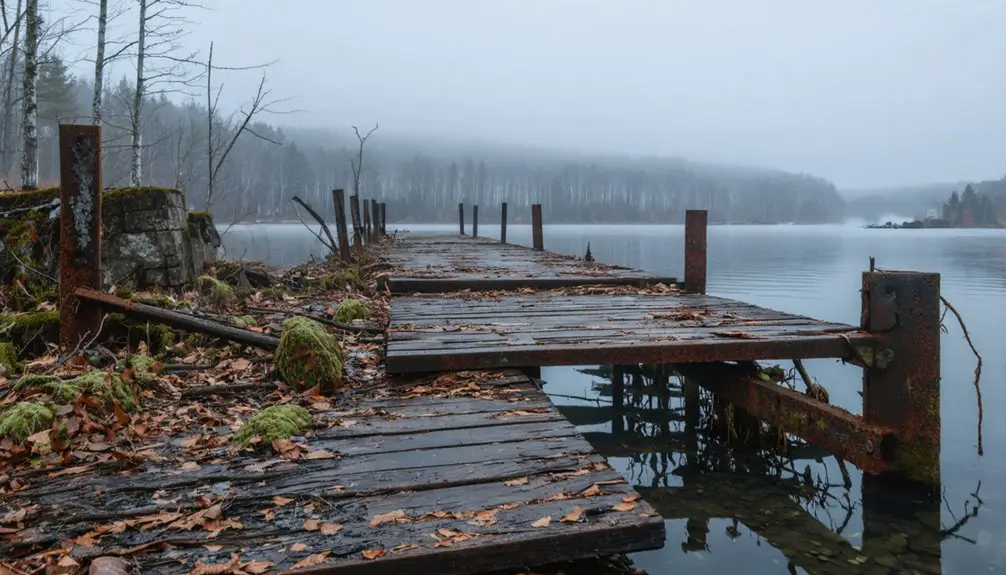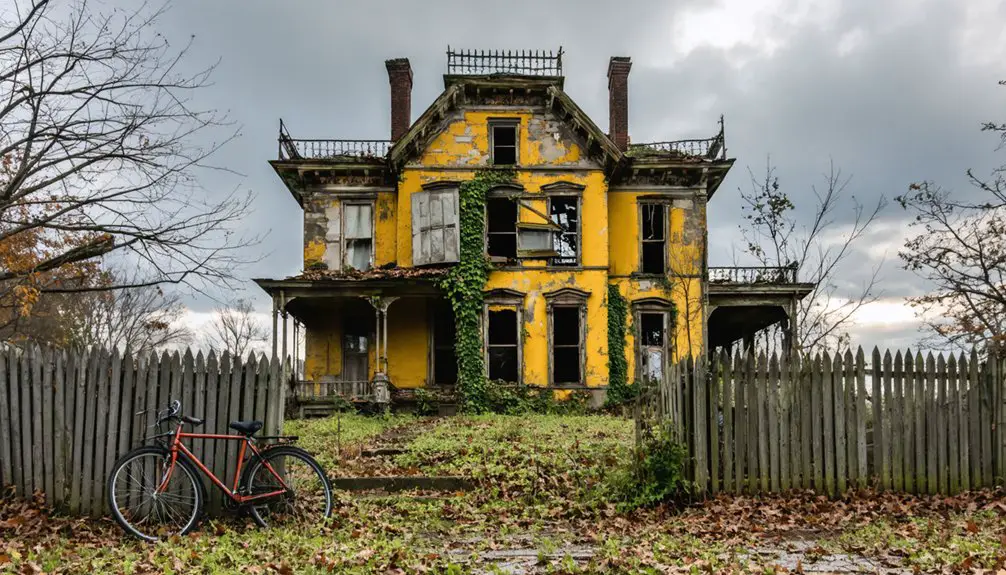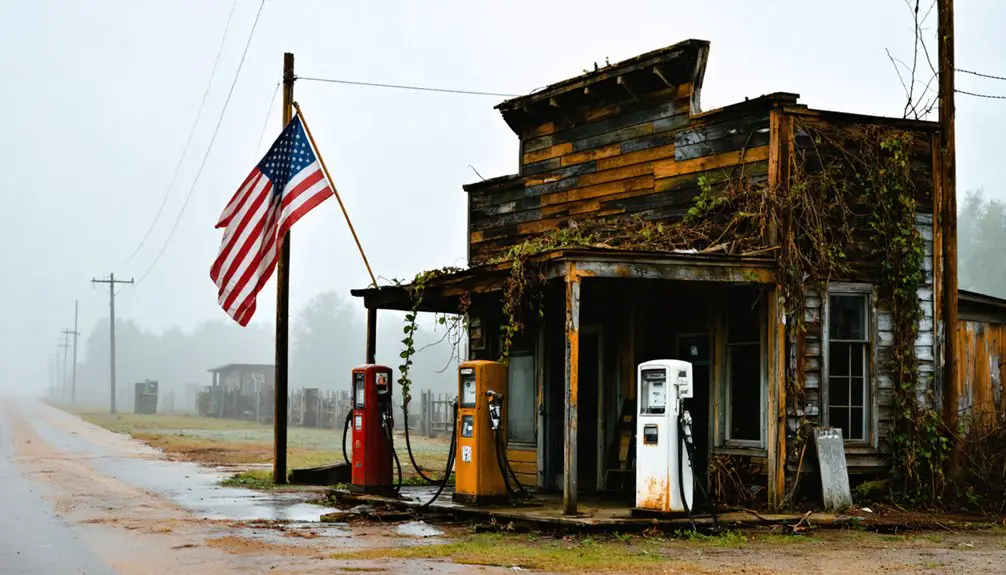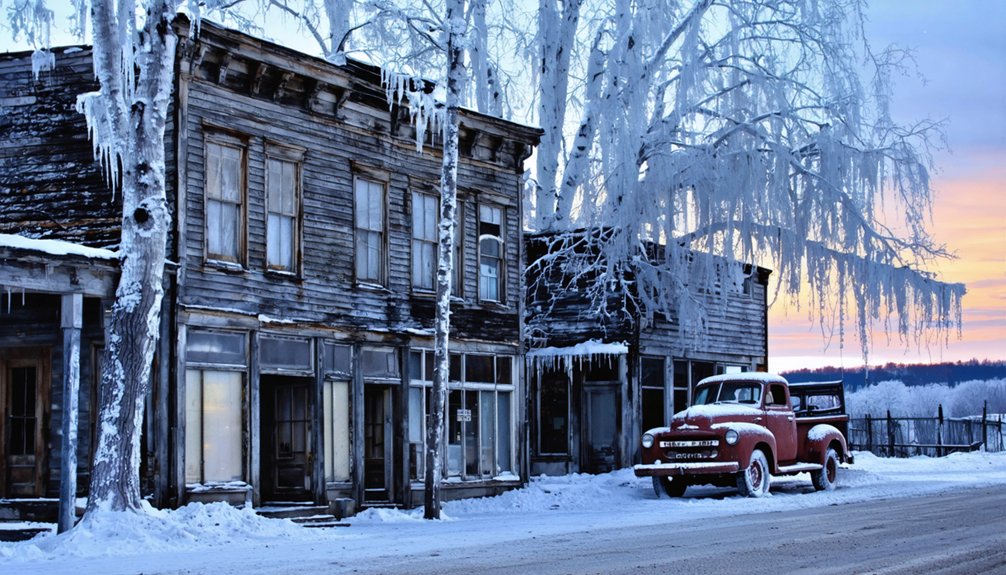
You’ll find New York’s most atmospheric ghost towns in the Adirondacks and Catskills, where winter snow transforms abandoned sites into frozen time capsules. Explore Tahawus’s remnants of blast furnaces and relocated buildings, wander through Camp Santanoni’s Gilded Age estate on cross-country skis, or photograph the eerie structures at Frontier Town near Schroon Lake. The Nevele Resort in the Catskills offers crumbling ski lodges and that infamous dodecahedral tower. Pack waterproof boots, layers, and offline maps—these remote locations demand preparation, and there’s far more to discover about safely exploring each hauntingly beautiful destination.
Key Takeaways
- Tahawus offers interpretative trails to the 1856 blast furnace and MacNaughton Cottage, with winter snow enhancing the ghost town atmosphere.
- Camp Santanoni hosts winter open house events with skiing, hot refreshments, and guided tours of its Gilded Age structures.
- Frontier Town near Schroon Lake features weathered Wild West structures now accessible through state campground trails year-round.
- Lake Placid Club preserves Olympic history from 1932 with iconic bobsled runs, ski jumps, and ice arenas still visible.
- Winter exploration requires waterproof boots, layered clothing, snowshoes, offline maps, and awareness of avalanche risks in remote areas.
Tahawus: A Twice-Abandoned Mining Village in the Adirondacks
Deep in the Adirondack wilderness, where snow muffles the forest and winter winds whistle through skeletal frames, stands Tahawus—a village that died twice.
You’ll discover a rare mining history here: first abandoned in 1858 when iron ore proved impossible to process, then reborn in 1941 when that same “worthless” titanium dioxide became wartime gold.
The government poured millions into extraction, and National Lead Industries rebuilt everything—homes, roads, power lines.
At its peak, Tahawus reached 1,000 residents by 1946, forming a bustling community where every family had ties to the mine and a familiar whistle signaled shift changes.
But in 1963, geologists found titanium directly beneath the town itself. The company didn’t hesitate.
They orchestrated a massive community relocation, moving sixty buildings to nearby Newcomb.
Between its mining eras, the village transformed into a hunting and fishing retreat when the Preston Ponds Club leased the abandoned site in 1876.
Today, you can hike two interpretative trails past the 1856 blast furnace and MacNaughton Cottage, exploring what remains of this double ghost town.
Camp Santanoni Historic Preserve: A Great Camp Frozen in Time
While Tahawus tells the story of industry’s boom and bust, Camp Santanoni reveals how the wealthy carved their own wilderness kingdoms. You’ll discover the Pruyn family’s 1893 masterpiece—a phoenix-shaped lodge with 5,000 square feet of porches overlooking Newcomb Lake.
The five-mile carriage road connects 45 buildings across three complexes, including a 300-acre self-sufficient farm.
After decades of abandonment following the 1972 state acquisition, architectural restoration efforts saved these structures from Article XIV’s “Forever Wild” mandate. You can explore the frozen estate where forest conservation met Gilded Age ambition.
Snowshoe past the stone Artist’s Studio and massive dairy barn, experiencing how preservation groups convinced New York to maintain this National Historic Landmark rather than let wilderness reclaim it. The Main Camp showcases Japanese architectural influence in its design, reflecting Robert C. Pruyn’s time spent in Japan where his father served as Lincoln’s minister. Winter visitors can attend open house events featuring skiing, hot refreshments, and guided tours of the historic buildings.
Lake Placid Club Historic Site: Birthplace of Olympic Winter Sports
His son Godfrey secured the 1932 Winter Games, making Lake Placid the first Olympic host outside Europe. The venues—bobsled runs, ski jumps, ice arenas—were built during the Depression and designed for year-round adventure, including an arena with a refrigerated floor for ice shows.
While it’s no modern museum, Crown Royal now operates the resort where winter sports became an American obsession worth chasing. The original club sprawled across 9,600 acres, featuring everything from golf courses to tennis courts before becoming a winter sports destination.
Frontier Town Amusement Park: A Wild West Relic Near the Northway
You’ll find the remnants of Frontier Town‘s Wild West fantasy frozen in time along the Northway near Schroon Lake, where rodeo arenas and stagecoach stations now stand silent under Adirondack snow. The park that once drew 40,000 visitors annually with its trick riders and shootout shows closed permanently in 1998, leaving behind weathered structures like the White Tower and pioneer village buildings slowly collapsing beneath winter’s weight.
Though the site became a state campground in 2018, you can still glimpse the original attractions along trails that wind through what remains of Prairie Junction’s main street and the abandoned fort where cavalry once performed. The property sat dormant for nearly 20 years after local government seized it for unpaid taxes, with nature gradually reclaiming the decaying structures. Founded by Arthur Bensen, a Staten Island phone technician, the park first opened on July 4th, 1952, with dreams of bringing Old West education and entertainment to families in the Adirondacks.
Wild West Theme Legacy
Deep in the Adirondack Mountains, where snow-dusted pines replace sagebrush and rocky peaks tower over what should be flat desert plains, Art Benson built something audaciously out of place. His Wild West town became a cultural time capsule, preserving frontier mythology alongside Native American history displays and authentic Civil War relics that educated visitors about America’s expansion era.
Today’s Sun Outdoors Frontier Town Western Experience channels that original spirit, proving Benson’s vision transcends decades. You’ll find reenactments, gold panning, and theatrical shootouts that echo the 1950s heyday. During its peak in the 1960s-70s, the park drew over 300,000 visitors annually, capitalizing on America’s fascination with cowboys and frontier life.
The revived A-frame building stands as a testament to nostalgia’s power, while abandoned structures scattered across the property remind you that even manufactured authenticity can become genuine history worth preserving and exploring through winter’s transformative silence. Visitors once experienced daily stagecoach robberies and frontier demonstrations that brought the Wild West to life in this unlikely Adirondack setting.
Vacant Structures and Attractions
When Arthur Bensen, a Staten Island telephone technician with no construction experience, opened Frontier Town on July 4, 1952, he couldn’t have predicted his makeshift Wild West village would outlive its own demise.
Today, you’ll find weathered remnants of Prairie Junction’s main street, the old rodeo arena, and the train station scattered across what’s now state parkland. The historical architecture stands frozen since the 1998 closure—wooden storefronts peeling paint, the grain mill listing sideways, fort walls sagging into themselves.
Though the structures remain off-limits, their ghost town legends draw curious explorers year-round. Winter transforms the site into something eerily authentic: snow drifts through abandoned can-can halls and ice glazes the silent log flume, creating the frontier ghost town Bensen never intended to build.
Winter Access and Exploration
How do you reach a ghost town that’s been swallowed by state parkland? Exit I-87 at North Hudson and follow the signs to what’s now officially marketed as “Gateway to the Adirondacks.” The urban renewal transformed 267 acres of Wild West ruins into managed trails, though you’ll spot crumbling facades through the pines if you know where to look.
Winter access remains solid—the Northway’s plowed year-round, and designated biking and equestrian trails stay open despite snow. The environmental impact of abandonment created an eerie forest cathedral where nature reclaimed wooden storefronts and hitching posts.
Since 2018, camping reservations and controlled access replaced two decades of free exploration. You’re technically restricted to official paths now, but those trails deliberately wind through the ghostly remains.
Nevele Resort: The Catskills’ Forgotten Winter Playground
Tucked against the base of the Shawangunk Mountains, the Nevele Resort once sprawled across hundreds of acres like a self-contained winter kingdom where New York City families escaped to ski, skate, and swim beneath a massive dodecahedral tower that dominated the Catskills skyline.
Today, you’ll find the abandoned property locked behind fences with armed security patrolling on ATVs—this isn’t your typical accessible ghost town. Hidden tunnels still connect the Golden Gate and Empire wings underground, sparking spooky legends among urban explorers who’ve never gotten close.
The ski lodge and ice-skating rink remain eerly intact since the unceremonious 2009 closure. While demolition was scheduled for 2019, the structures persist, waiting as multiple revival attempts collapse without funding.
You can’t legally enter, but the silhouette still haunts Highway 209.
Essential Winter Exploration Tips for New York Ghost Towns
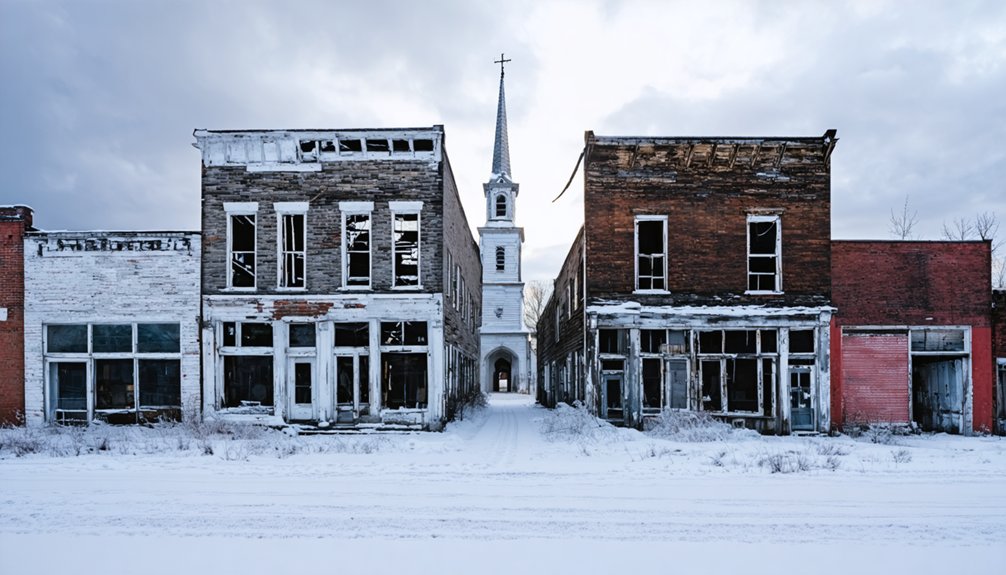
Before you venture into New York’s frozen ghost towns, you’ll need to master winter backcountry preparation—because these abandoned settlements don’t offer the safety nets of maintained tourist sites.
Pack insulated waterproof boots for traversing Tahawus Mines’ deep snow, and layer clothing systems with fleece mid-layers beneath waterproof shells.
Snowshoes become mandatory equipment when exploring Camp Santanoni’s ghostly ambiance, while trekking poles provide crucial stability on icy paths threading through urban decay.
Download offline maps before cell service vanishes near Frontier Town’s snow-drifted structures.
Carry satellite communicators and headlamps with extra batteries—winter darkness descends early across these remote valleys.
Monitor avalanche risks in High Peaks regions, and always respect property boundaries.
These frozen ruins demand self-reliance; there’s nobody coming if you’re unprepared.
Preservation Efforts and Historical Significance of Abandoned Sites
When you wander through the forests surrounding Ashokan Reservoir today, you’re walking over the graves of entire communities—twelve villages that New York City officials deliberately drowned between 1908 and 1915.
Archaeological teams have documented 466 demolished buildings, with 306 structures lying submerged beneath what officials call the “champagne of American urban water.”
The preservation challenges here differ from typical urban decay—these aren’t crumbling structures you can photograph, but communities erased entirely.
The city paid residents non-negotiable sums and offered $15 per grave to relocate the dead.
Now the Department of Environmental Protection maintains these forests for hunters, fishers, and hikers.
You’ll find few physical remnants, just archaeological evidence recovered through community-driven excavation efforts that assure 500 displaced households aren’t forgotten.
Frequently Asked Questions
Are Pets Allowed When Visiting Ghost Town Sites in Winter?
Yes, you’ll find pets welcome at most ghost town sites with leash regulations strictly enforced. Prioritize pet safety on winter trails—pack water, watch for ice, and keep your furry companion close while exploring abandoned buildings and rugged terrain.
What Are the Parking Fees at These Abandoned Locations?
Most New York ghost towns don’t have formal parking regulations or fees—you’ll find free roadside spots near trailheads. Fee exemptions aren’t necessary since these abandoned sites lack official lots. Just park respectfully and you’re good to explore freely.
Can I Take Photographs Inside the Historic Buildings?
You’d think historical preservation means “no cameras,” but you *can* photograph inside—with permits. Photography regulations require written authorization for interiors, especially with tripods. Hand-held shots outdoors? Usually fine. Always contact site coordinators first to avoid trespassing charges.
Are There Restroom Facilities Available at These Remote Winter Sites?
Most remote ghost town sites lack visitor amenities entirely—you won’t find restrooms at abandoned locations like Tahawus or Doodletown. Winter weather compounds challenges, so plan accordingly and use facilities before venturing into these wilderness areas seeking historical freedom.
Do I Need Special Permits for Drone Photography at Ghost Towns?
You’ll definitely need permits for drone photography at ghost towns. Since they’re designated historic sites, drone regulations require written approval from State Parks before launch. Photography permits aren’t negotiable—violators face penalties regardless of hobby versus commercial use.
References
- https://www.iloveny.com/blog/post/new-york-towns-that-come-alive-in-winter/
- https://visitadirondacks.com/fall/abandoned-places-ghost-towns
- https://www.youtube.com/watch?v=TCyPWnfU7-g
- https://www.adirondack.net/history/tahawus/
- https://www.adirondackhub.com/story/2014/10/hunting-ghost-town
- https://www.tripadvisor.com/ShowTopic-g28953-i4-k13054073-Ghost_Towns-New_York.html
- https://www.youtube.com/watch?v=E7r0gxbKZUA
- https://urbanpostmortem.wordpress.com/2012/08/08/the-ruins-of-tahawus/
- https://theclio.com/entry/151479
- https://aarch.org/wp-content/uploads/2014/08/060324VLPTahawusClubPt.1.pdf