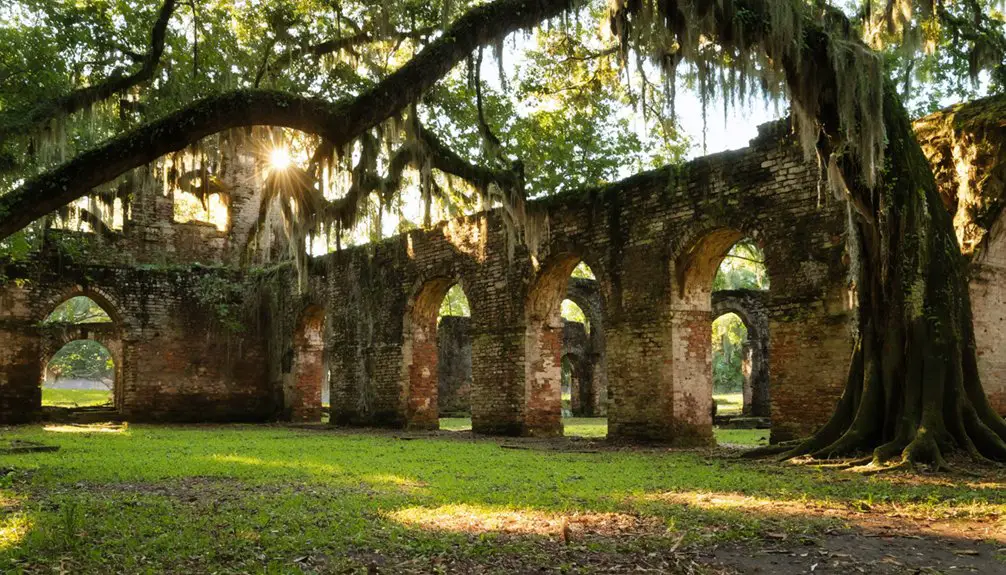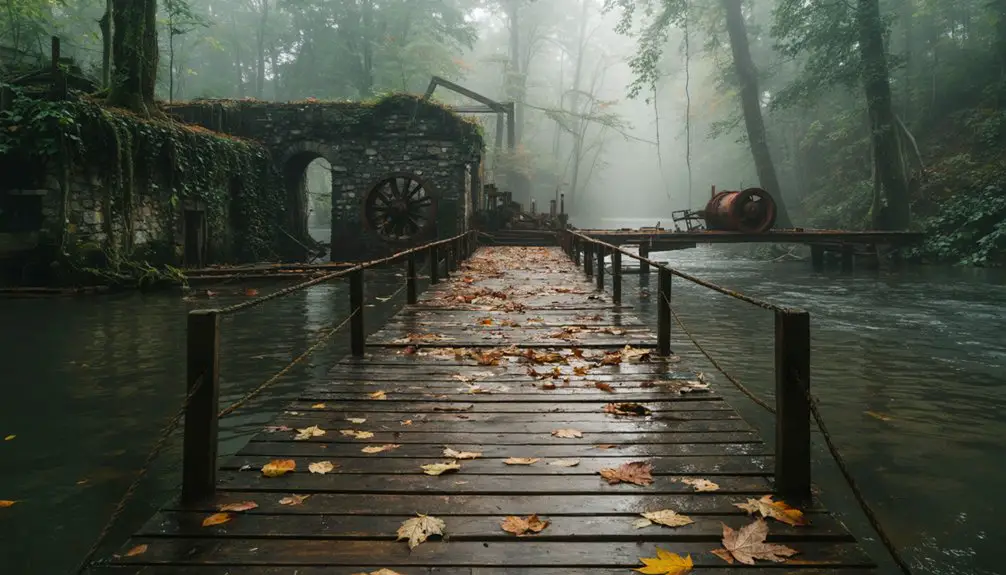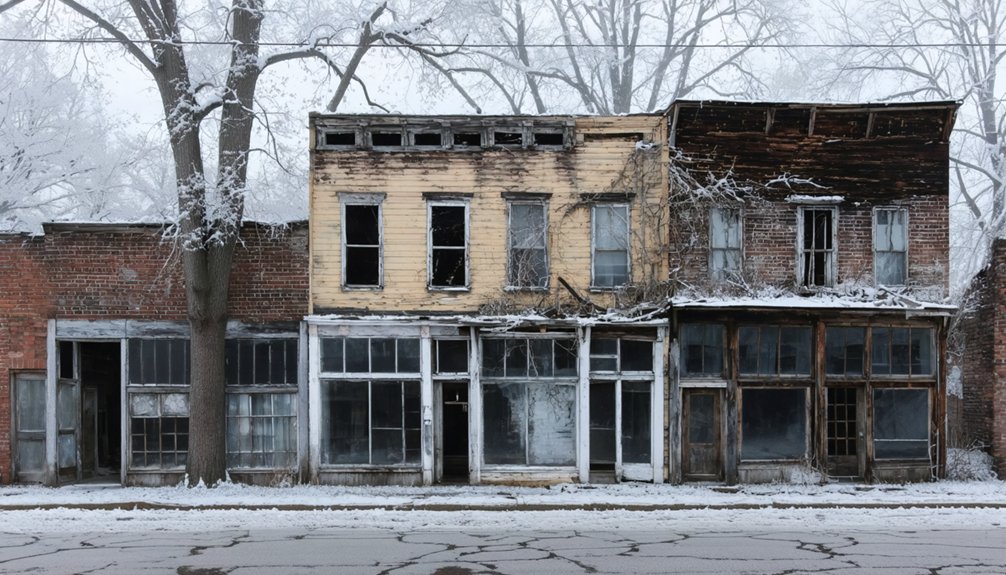
You’ll find North Carolina’s most haunting ghost towns transformed by winter’s stark beauty—from Ghost Town Village‘s 40 abandoned Wild West buildings at 4,600 feet on Buck Mountain to Henry River Mill Village‘s 35 decaying houses that became District 12 in *The Hunger Games*. Winter strips away summer foliage, revealing weathered structures against bare mountains and frozen coastlines where you can explore genuine remnants without crowds. The cold months offer unmatched solitude at these forsaken settlements, and proper preparation *reveals* experiences most visitors never discover.
Key Takeaways
- Ghost Town Village atop Buck Mountain features 40 replica Wild West buildings and North Carolina’s longest chairlift at 4,600 feet elevation.
- Henry River Mill Village, known as District 12 from The Hunger Games, offers Saturday tours of 35 deteriorating worker houses established in 1904.
- Cape Lookout Village requires ferry access, with winter operations limited; ferries typically cease December 31 and resume mid-March with flexible scheduling needed.
- Lost Cove in Pisgah National Forest demands winter hikes through rugged terrain to explore Civil War-era stone chimneys and family home remnants.
- Winter visitors should carry moisture-wicking layers, waterproof boots, microspikes, and emergency provisions due to ice-glazed trails and rapid weather changes.
Ghost Town Village: Wild West Atop Buck Mountain
Perched atop Buck Mountain at 4,600 feet, Ghost Town Village stands frozen in time—a Wild West fantasy that once drew half a million visitors each year to the foot of the Great Smoky Mountains.
You’ll find forty replica buildings scattered across this mountain peak, complete with saloons, jails, and dusty streets where gunfights once echoed daily.
The 1962 chairlift—North Carolina’s longest—still dangles overhead, a rusted reminder of when crowds rode 3,370 feet upward to experience can-can dancers and TV Western stars.
Since closing in 2009, nature’s reclaimed what R.B. Coburn built for $1 million in 1961. The park’s construction employed over 200 locals who worked from September 1960 through May 1961 to complete the elaborate Western Town.
The property has faced bankruptcy filings and multiple failed revival attempts throughout its history, with the most recent sale discussions occurring in 2019.
Now creepy animatronics haunt the preserved structures, and winter wind whistles through this authentic ghost town where Wild West dreams met Appalachian reality.
Henry River Mill Village: Step Into The Hunger Games
While Ghost Town Village brought Hollywood’s Wild West to the mountains, Henry River Mill Village delivered something more haunting—the real decay of an American dream.
You’ll recognize this 1904 textile community as District 12 from *The Hunger Games*, where Hollywood found authentic abandonment among 35 deteriorating worker houses. Once a self-contained empire where 12,000 spindles hummed and workers spent “doogaloo” coins at the company store, it’s now a crumbling monument to overseas competition that killed Southern mills.
Located off I-40 exit 119, it’s one of North Carolina’s most compelling tourist attractions, open Saturdays for exploration. The village still maintains its original character along the Henry River gorge, where buildings cling to steep slopes much as they did over a century ago.
Historical preservation efforts aim to save what lightning strikes and floods haven’t claimed. The company store, constructed from sun-baked mud bricks on a river rock foundation, has remarkably survived over a century and now serves as a testament to early industrial architecture. You’ll walk the same roads where Jennifer Lawrence filmed, experiencing freedom’s darker side—communities left behind by progress.
Lost Cove: Hidden Settlement of Pisgah National Forest
Deep in Pisgah National Forest’s Poplar Gorge, Lost Cove tells the story of Morgan Bailey’s Civil War-era settlement.
The settlement was once home to families who carved out an existence through timber, railroads, and illicit moonshine until 1957.
You’ll need to prepare for a serious winter hike—this isn’t a roadside attraction but a remote ghost town accessible only via Lost Cove Trail.
Rugged terrain and isolation remain as challenging today as when they drove the last residents away.
The site’s stone chimneys and scattered remnants stand as monuments to the self-sufficient mountain families who thrived in this hidden cove before the forest reclaimed their home.
Along the trail, you’ll encounter overgrown staircases and old roads that once connected the community’s scattered homesteads.
The name “Lost Cove” refers to multiple locations, so verify you’re heading to the correct Pisgah National Forest site before your journey.
Remote Civil War Origins
Tucked within Poplar Gorge above the Nolichucky River, Lost Cove emerged from the turbulent years preceding America’s bloodiest conflict. Morgan Bailey, a soldier with the 3rd North Carolina Mounted Infantry, claimed this remote sanctuary around 1860, establishing an Appalachian settlement where rugged terrain provided natural isolation from encroaching war.
The Civil War history here reflects Appalachia’s unique position—neither fully Confederate nor Union, but fiercely independent.
You’ll find this wasn’t accidental refuge. Bailey and fellow pioneers chose these mountain coves deliberately, where dense forests and treacherous slopes kept outside interference at bay. These hollows between ridges created naturally undisturbed sanctuaries that survived longer than most Appalachian settlements. The community they built endured nearly a century, thriving through self-reliance and distance from government oversight. The last family vacated this mountain ghost town in the 1950s, marking the end of generations who had cultivated apple orchards and corn fields in isolation.
Winter’s bare trees now reveal stone foundations where freedom-seeking settlers carved their autonomous existence from wilderness.
Moonshine and Self-Sufficiency Legacy
Beyond wartime refuge, Lost Cove’s settlers forged an economy built on whiskey stills and wilderness resources.
The settlement’s moonshine history thrived in the Nolichucky Gorge’s protective isolation, where federal agents rarely ventured through the rough terrain.
You’ll discover how families turned geographic remoteness into opportunity, distilling spirits while authorities remained safely distant.
Self sufficiency practices sustained approximately 100 residents through multiple revenue streams:
- Illicit distillation operations hidden among Pisgah National Forest’s dense cover
- Logging enterprises harvesting surrounding timber via railroad connections
- Subsistence farming on cleared mountain plots
- Sawmill operations processing local wood resources
These independent communities rejected outside control, even refusing road access that might’ve brought unwanted government oversight.
Their legacy endures in stone chimneys and rusted equipment—monuments to Americans who chose hardship over regulation.
Winter Hiking Preparation Essentials
When winter transforms Lost Cove’s backcountry trails into ice-glazed corridors through abandoned homesteads, your gear becomes the difference between adventure and emergency.
Layer moisture-wicking wool beneath windproof shells—cotton’s a liability in this winter landschaft where sweat turns deadly.
Your feet need waterproof boots, microspikes for ice, and gaiters blocking snow infiltration.
Pack liner gloves under insulated over-mitts; frostbitten fingers can’t navigate out.
Cold survival demands a sleeping system rated to 20°F minimum, backed by an R-4 pad insulating you from frozen ground.
Carry two liters of water wrapped in socks to prevent freezing, plus a thermos of hot liquid for emergency warming.
Winter hiking burns 2,000 to 3,000 extra calories, so pack high-energy foods like nuts, dried fruit, and preserved meats to fuel your exploration of these remote ruins.
Before you leave, share trip plans with someone reliable—these trails demand backup communication.
These crumbling chimneys and collapsed cabins stand remote—inform someone of your route before vanishing into Lost Cove’s white silence.
Cape Lookout Village: Forsaken Outpost on the Graveyard of the Atlantic
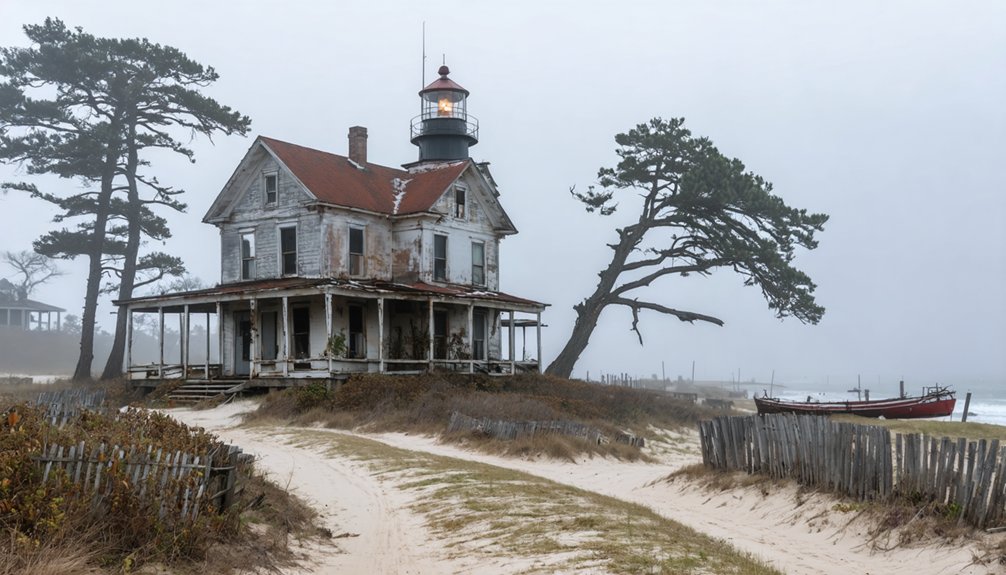
You’ll need to time your winter visit around the passenger or vehicle ferry schedule to reach this remote barrier island outpost, where preserved lighthouse keeper’s quarters stand sentinel over the abandoned settlement.
The weathered homes tell stories of generations who braved the treacherous waters known as the Graveyard of the Atlantic. Their empty windows now face the same storms that eventually drove them to the mainland.
Walking through this authentic maritime ghost town, you’ll experience the stark isolation that defined life on these windswept banks. The keeper’s duties and fishing settlements once sustained a small but resilient community.
Ferry Access and Timing
Since Cape Lookout’s barrier islands remain roadless sanctuaries separated from the mainland by miles of shifting sound waters, ferries become your only practical lifeline to this windswept ghost settlement. Understanding ferry schedules proves critical—operators cease runs to Cape Lookout Village around December 31, resuming mid-March when seasonal access returns.
Your departure options include:
- Harkers Island (1800 Island Road) for lighthouse and east Shackleford Banks—operates 9 a.m.-5 p.m. Monday-Saturday
- Beaufort (701 Front St.) for west Shackleford Banks—maintains winter service despite visitor center closure
- Davis, NC for vehicular ferry to South Core Banks
- Private boats as alternatives when commercial schedules don’t align
Winter’s reduced operations mean you’ll need flexibility. Those seeking complete solitude should embrace these limitations—fewer visitors brave the crossing when nor’easters howl.
Preserved Lighthouse Keeper Homes
Among the weathered structures scattered across this forsaken outpost, three lighthouse keeper dwellings stand as the most tangible connection to Cape Lookout’s human past.
You’ll discover the 1873 brick dwelling that once housed all three keepers, where families raised livestock and tended gardens in defiant sandy terrain.
The 1907 Principal Keeper’s Quarters—now called Barden House—reveals the evolution of keeper life before automation ended 138 years of continuous habitation in 1950.
These preserved homes tell stories of 24-hour shifts, lighthouse restoration after Confederate raids, and Charlotte Ann Mason‘s tenure as the station’s only female keeper.
The National Park Service maintains these structures as Historic Structure Reports, letting you walk through rooms where keepers meticulously recorded oil consumption and planned endless painting schedules beneath that towering 169-foot sentinel.
Maritime History and Atmosphere
The beacon that guided keepers’ daily routines served a far grimmer purpose—warning mariners away from the shoals that earned this stretch of coast its notorious moniker: the Graveyard of the Atlantic. You’ll discover layers of maritime history here, where shipwreck preservation and marine archaeology reveal centuries of nautical tragedy.
The station’s evolution tells the story:
- 1888 Life-Saving Station crew patrolled treacherous waters day and night
- WWII submarine nets and artillery batteries defended convoy anchorages
- Hundreds of wrecks still rest beneath surrounding waters
- Coast Guard operations continued until 1982
Winter isolation intensifies the ghost town atmosphere. You’ll need ferry passage, bug spray, and sturdy boots to reach this seldom-visited outpost.
Twenty historic structures stand sentinel across 810 acres—weathered witnesses to daring rescues and desperate struggles against an unforgiving sea.
Brunswick Town: Colonial Streets Reclaimed by Nature
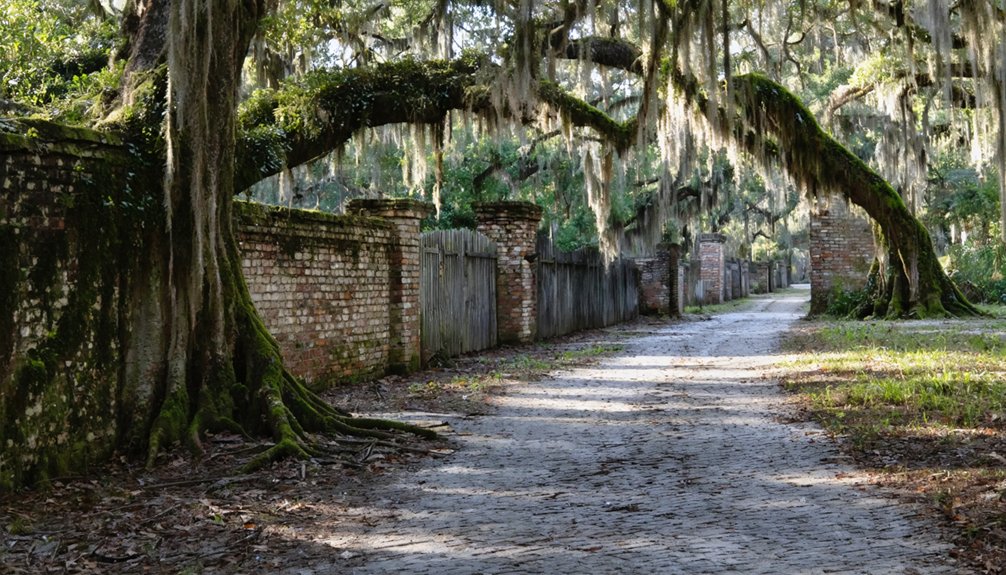
While most ghost towns fade into legend, Brunswick Town reveals itself through crumbling brick walls and moss-draped oaks along the Cape Fear River’s western bank.
You’ll wander colonial streets where merchants once traded naval stores before British forces razed this thriving 18th-century port in 1776. The ruins never rebuilt—nature claimed what empire destroyed.
Winter strips away summer’s concealing foliage, exposing St. Philip’s Church’s skeletal walls and Russellborough’s foundations.
Confederate earthworks, built atop the abandoned settlement in 1862, ironically preserved what they buried. This historic preservation allows you to trace property lines and building footprints beneath your boots.
The colonial architecture emerges starkly against bare branches, revealing a port that challenged British authority during the Stamp Act crisis, then paid the ultimate price for rebellion.
Gimghoul Castle: UNC’s Mysterious Stone Fortress
You’ll find this medieval fortress rising from the woods near UNC Chapel Hill, built by a secret society in the 1920s to honor a legendary duel that never happened. The Gothic castle‘s stone towers and battlements loom over Dromgoole Rock, where students still whisper about blood that won’t wash away and a ghost who wanders the grounds.
While the Order of Gimghoul keeps its doors locked to outsiders, you can glimpse the mysterious stronghold from Gimghoul Road, where winter’s bare trees reveal its full haunting silhouette.
Secret Society Origins
Deep in Chapel Hill’s Battle Park, beneath ancient oaks and winter-bare branches, stands a medieval fortress that shouldn’t exist in North Carolina. You’ll discover Gimghoul Castle was born from tragedy and modern mysticism—the 1889 creation of five UNC students who transformed a campus legend into reality.
The Order of Gimghoul emerged from Peter Dromgoole’s mysterious disappearance, though the actual student simply failed entrance exams. Society secrecy became their foundation:
- Edward Wray Martin crafted elaborate Arthurian mythology around “Point Prospect”
- Robert Worth Bingham and four founders established chivalric traditions
- Exclusive membership limited to notable junior and senior men
- No public roster or photographs have ever surfaced
Their 1915 castle acquisition employed Waldensian stonemasons, creating an eleven-year monument to forbidden knowledge and selective brotherhood.
Gothic Architecture and Legends
The brotherhood’s ambitions materialized through 1,300 tons of rough stone hauled to Point Prospect’s windswept promontory. Between 1915 and 1926, stonemasons from Valdese—descendants of southern French and Italian castle-builders—transformed architect Nathaniel Cortlandt Curtis’s neogothic vision into reality.
Their fortress rises like a medieval sentinel, embodying architectural symbolism that deliberately evokes mystery and romance.
You’ll find the castle shrouded in medieval legends, particularly the tale of Peter Dromgoole. This 1830s UNC student allegedly died in a duel over a woman named Fanny, his blood staining rocks that still mark the ground. Though Dromgoole actually failed his entrance exams and simply vanished, the story persists.
Locals claim his ghost still haunts these stone walls, making this $50,000 monument to secrecy and medieval grandeur genuinely atmospheric during winter’s darkest months.
Viewing From Public Roads
While the castle’s interior remains off-limits to outsiders, Gimghoul Road’s public access grants you surprisingly intimate views of this neogothic fortress. You’ll discover the structure perched dramatically on Point Prospect, where historical legends intertwine with Battle Park’s natural landscape.
Winter strips away concealing foliage, revealing architectural details crafted from 1,300 tons of cut stone by Valdesian masons.
Optimal viewing strategy:
- Park at road’s end where pavement meets the property boundary
- Observe the medieval silhouette during early morning or late afternoon light
- Respect posted no-trespassing signs while photographing from public ground
- Explore surrounding wooded trails for additional vantage points
The fortress overlooks areas steeped in campus mythology, making your visit both visually stunning and eerily atmospheric without crossing into restricted territory.
Essential Winter Gear for Exploring Abandoned Sites
Abandoned buildings demand respect, and winter exploration amplifies every hazard lurking within their crumbling walls. Your gear checklist starts with steel-toe boots—they’ll shield you from rusty nails and broken glass hiding beneath snow.
A high-lumen torch cuts through pitch-black interiors where daylight never reaches. Pack bicycle gloves to protect your hands and a respirator to block black mold spores thriving in damp corners.
For camping safety during extended expeditions, bring a sleeping bag rated to minus 20°F and high-energy snacks when daylight fades faster than expected. Your phone with offline maps marks entry points, while a first aid kit handles unexpected cuts.
A multi-tool conquers obstacles blocking your path. This equipment transforms risky ventures into calculated adventures through North Carolina’s forgotten spaces.
Best Times to Visit North Carolina Ghost Towns in Cold Weather
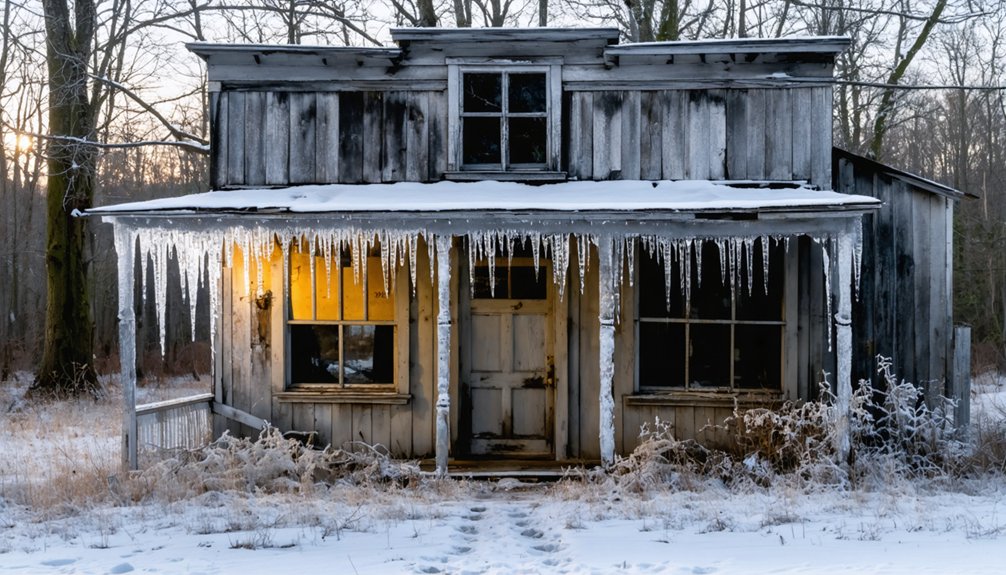
Winter transforms North Carolina’s ghost towns into spectral sanctuaries where your footsteps echo through emptiness without competition. November through February delivers the ultimate liberation from crowds, offering you uninterrupted communion with abandoned ruins.
Prime visiting windows:
- December-February bluebird days – Crystal-clear skies provide 80-mile vistas and exceptional snow photography opportunities against frozen waterfalls.
- November-March weekday mornings – Experience absolute solitude at sites like Henry River Mill Village (open Saturdays-Sundays, 10AM-5PM).
- Post-winter festivals periods – Towns empty after holiday events, leaving trails and attractions gloriously deserted.
- Mild weather windows – Sunny interludes between storms offer perfect hiking conditions without summer’s oppressive crowds.
Start early—trails close at 4PM during shortened winter days. Check forecasts for mountain sites where weather shifts rapidly, ensuring your escape remains both safe and liberating.
Safety Tips for Winter Ghost Town Adventures
Before you venture into North Carolina’s forsaken settlements, understand that winter’s beauty conceals lethal hazards—crumbling structures become ice traps, hypothermia strikes within thirty minutes of wet exposure, and mountain weather pivots from serene to savage without warning.
Master winter safety through layering: several thin garments outperform single thick coats, trapping heat while allowing movement through debris-strewn ruins.
Pack hats, mittens, and scarves—your extremities freeze first.
Stock your vehicle with blankets, non-perishable provisions, and bright markers should storms trap you between civilization and ghost towns.
These clothing essentials aren’t suggestions—they’re survival tools.
Change immediately if moisture penetrates your layers.
Keep fire extinguishers accessible, recognize frostbite’s warning signs, and trust your instincts.
Freedom means respecting nature’s indifference to your adventure.
Photography Guide for Capturing Haunting Winter Landscapes
Through your camera’s viewfinder, North Carolina’s abandoned settlements transform into ethereal tableaus where decay meets crystalline beauty—peeling paint fragments caught in frost, collapsed timbers draped in ice lace, shattered windows framing snow-laden mountains beyond.
Frozen ruins whisper forgotten stories through shattered glass and frost-laced timber, where abandonment and winter’s crystalline touch converge in haunting symmetry.
Capture these haunting scenes with intentional techniques:
- Get low to magnify snowflake patterns and frost sculptures forming across weathered foundations.
- Overexpose snow-covered ruins to prevent dingy-looking whites while maintaining dramatic shadows.
- Frame subjects against vast negative space—abandoned structures silhouetted against empty winter skies.
- Shoot during golden hours when low sun creates stark contrast between crumbling walls and pristine drifts.
Stop down to f/16 for maximum depth of field, letting viewers explore every detail from foreground frost to distant peaks.
Add color contrast with your bright jacket against monochrome decay, or embrace black-and-white processing for timeless atmosphere.
Frequently Asked Questions
Are Pets Allowed at North Carolina Ghost Town Sites During Winter?
Yes, you’ll find most North Carolina ghost towns welcome leashed pets year-round without seasonal visitor restrictions. Their pet policy encourages exploration, letting you and your companion roam historic ruins freely during quiet winter months together.
Do Any Ghost Towns Offer Overnight Camping in Cold Weather Months?
You’ll find overnight winter camping at Proctor Ghost Town’s designated backcountry site and Cape Lookout’s Portsmouth Island. Both locations blend historic preservation with winter hiking adventures, offering you unrestricted cold-weather access to explore these haunting settlements beneath starlit skies.
Which Abandoned Sites Have Cell Phone Reception for Emergencies?
Since 80% of Western NC’s cell phone coverage has returned post-Helene, you’ll find reliable emergency services access at most ghost towns near major highways, though remote mountain sites still experience signal gaps requiring backup communication plans.
Are Guided Ghost Tours Available at These Locations in Winter?
You’ll find guided tours only at Henry River Mill Village year-round, where historical preservation meets tourist accessibility. The other locations—Lost Cove, Mortimer, and Ghost Town in the Sky—remain unguided, offering raw exploration freedom instead.
Can Drones Be Flown Legally at North Carolina Ghost Towns?
Drone regulations require you’ll need property owner consent at most ghost towns, as they’re typically on private land. Aerial permissions depend on location—state parks need special permits, while respecting privacy laws guarantees you’re flying legally and freely.
References
- https://en.wikipedia.org/wiki/Ghost_Town_Village
- https://www.romanticasheville.com/ghost_town.htm
- https://takingthekids.com/abandoned-north-carolina-destinations-every-explorer-should-visit/
- https://www.visitnc.com/list/ncs-mysterious-disappearances-and-abandoned-places
- https://appalachian.org/lost-cove-ghost-town-in-the-national-forest/
- https://www.youtube.com/watch?v=dCdwxW8S3aw
- https://henryrivermillvillage.com
- https://smokymountainnews.com/archives/item/9797-history-of-ghost-town-in-the-sky
- https://leftbehind.zenfolio.com/blog/2022/5/ghost-town-in-the-sky
- https://abandonedsoutheast.com/2019/07/19/ghost-town-in-the-sky/